An Unexpected Visitor

When I was working in our Greenbelt restoration site a few days ago, I was startled to see this bird staring at me. I walked closer to it so I could take its picture.
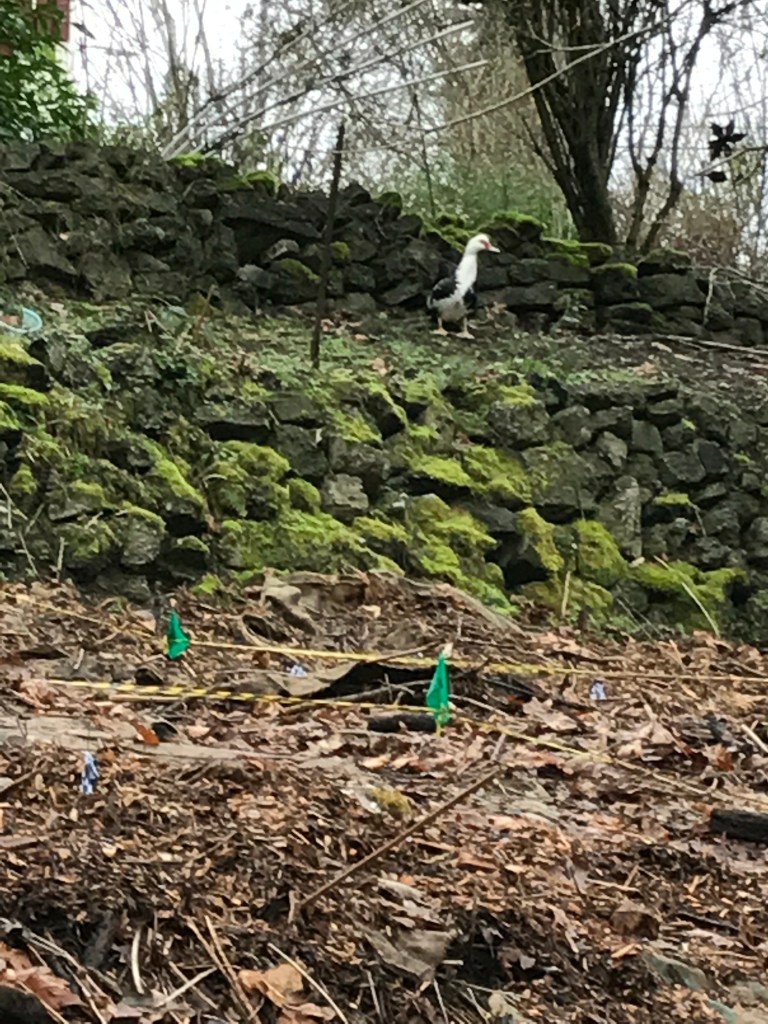
We looked at each other for a while. Then the bird walked over to a broken bowl and started drinking rain water.

At first, I thought the bird was a duck. Then, I decided it was too big to be a duck, that it must be a goose. I was concerned that it might start eating our newly planted shrubs.

As I pondered the situation, I wondered how a goose managed to get to Beacon Hill; we aren’t that close to Lake Washington.
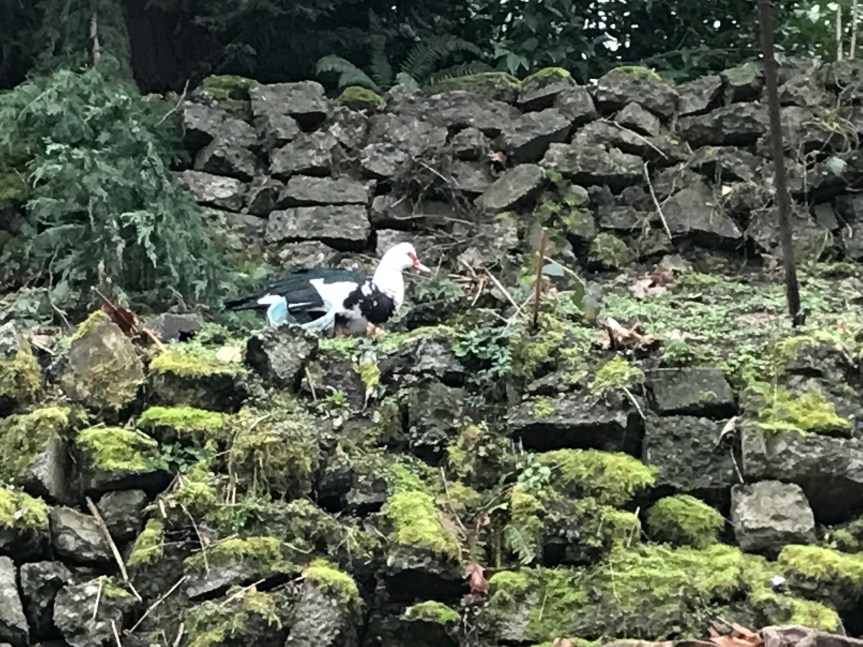
Eventually, I started working again and just ignored it. At one point, when I looked towards the ledge, the bird was gone.

A few days later, people started posting notices on NextDoor, commenting on a duck that had been spotted in a variety of places in my neighborhood. One person said that it had even stopped traffic.Another person included a photograph. It sure looked like the bird that had visited me. Future posts revealed that it was a pet.

I felt embarrassed that I didn’t know the difference between a duck and goose, until I googled it. There are so many similarities between the two birds. One of the main differences is that a goose is usually bigger.

Someone wrote on NextDoor that the bird was a Muscovy duck. Wikipedia says this about Muscovy ducks:

The Muscovy duck (Cairina moschata) is a large duck native to MexicoCentral, and South America. Small wild and feral breeding populations have established themselves in the United States, particularly in Florida and the lower Rio Grande Valley of Texas as well as in many other parts of North America, including southern Canada. Feral Muscovy ducks are found in New Zealand, Australia, and in parts of Europe. They are large ducks, with the males about 76 cm (30 in) long, and weighing up to 7 kg (15 lb). Females are considerably smaller, and only grow to 3 kg (6.6 lb), roughly half the males’ size.

This photo from Wikimedia was included in the Wikipedia article:
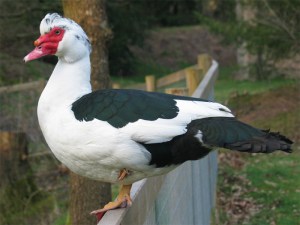
CC BY-SA 3.0, https://commons.wikimedia.org/w/index.php?curid=117668

I didn’t get very close to the duck but this description and photo sure looks right to me. I have no trouble believing that the bird I saw was 30 inches long and weighed 15 pounds. It sure is a long way from Mexico, Central and South America, Florida and Texas though!

I appreciate that it visited me that day, but still hope it stays away from the trees, shrubs and ground covers that we have planted.
Practice in Letting Go

This past summer, during Amma’s Chicago programs, ideas for how to design one of the planting areas in our Seattle forest restoration site started coming into my mind. The next day, I walked to the children’s program room, borrowed colored pencils and graph paper, and drew that design.

When I returned to Seattle, I transferred the design onto the ground as best as I could. It took hours and hours to accomplish that task as I was trying to lay it out perfectly. When I finally finished, I started laughing at myself. It had taken me that long to create placement for 12 plants. We had ordered more than 300 shrubs and ground covers. Clearly, that was not how I was going to maketo make planting plans for the whole site.

I enjoyed having “my area” though and dreamed of what it would look like in the future. This fall, I started noticing  how often branches from nearby trees fell into “my area”.  I also noticed that I was only seeing them in “my area”.

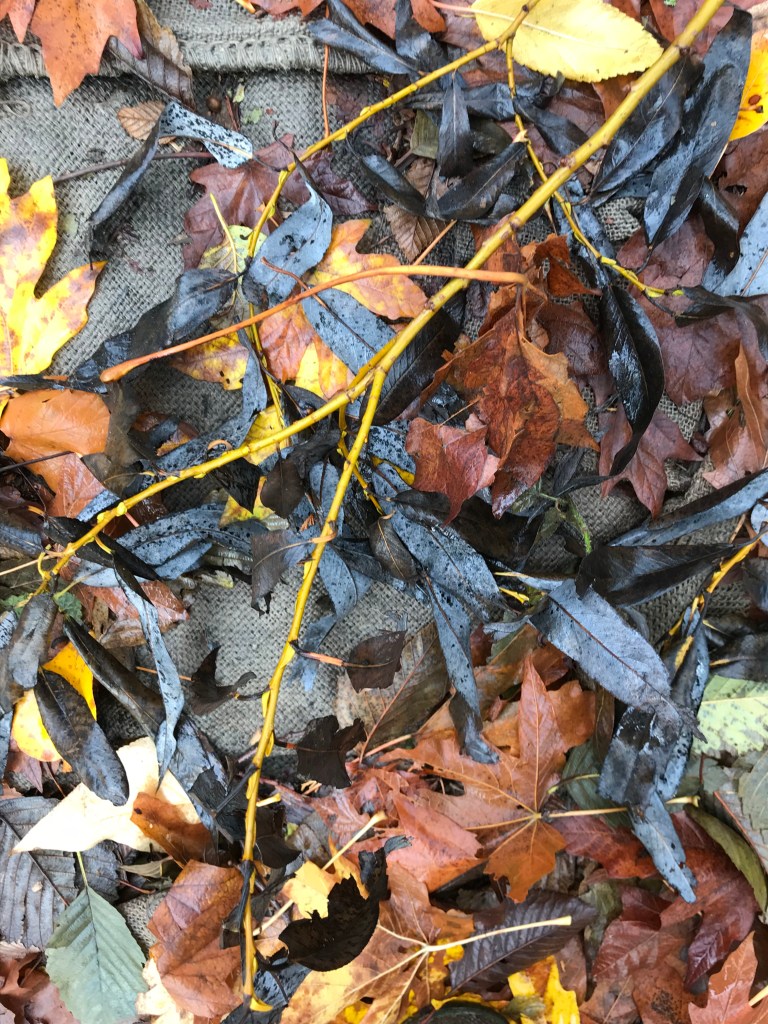
A few weeks ago we had a wind storm. In the photo below you can see some of the branches I took out of “my area” after the storm.

On November 15, we had the big planting work party. It was wonderful to finally have the native plants in “my area”. I day-dreamed about what the area would look like in the Spring.

Then I had a horrifying thought: “Those falling branches could kill ‘my plants’!” I’ve been resisting the apparent fact that in forestry 50% of what we plant may not survive. In fact, I haven’t dealt with it at all because I believe “our” plants will be different. And I hadn’t even considered the possibility that any of the plants in “my area” would die.”

At that point, I took a good look at the terrain surrounding “my area”.

The trees are really tall, they are old, and “my area” is closest to them.

As I reflected on this situation, I had many thoughts.

  • These plants, and all of the plants in the restoration site, are not “mine,” they belong to Mother Nature. I can be an instrument and do my best to take care of them, but what lives and what dies is not in my hands.
  • I knew that we would likely lose some plants in the summer since we now have long stretches with no rain, but it hadn’t occurred to me before that some plants are likely to die during the winter.
  • I remembered the Tibetan monks who spend many hours making a sand mandala and then ritualistically take it apart as a way of acknowledging that life is transient, in a constant state of flux.
  • While I will not purposely dismantle the area I have been thinking of it as “my area”, I am clearly getting an opportunity to let go and surrender. My job is to put in the effort and let go of the results.
  • It is time for me to stop thinking about that area as “my area”. I am an instrument, I am not an owner. That area is no more important than any other area.

As I was writing this post, I thought about the title that the Green Seattle Partnership gave those of us whom they trained to lead forest restoration work parties. We are called Forest Stewards. I decided to look up steward to see exactly what the word means. Merriam-Webster Dictionary defines steward as “a person hired to perform household or personal services.” It gives these words as synonyms: “domestic, flunky, lackey, menial, retainer, slavey, servant”.  That’s it. I am not an owner, I am a servant of the forest.

I am a Forest Steward.

Wetland Best Practices Class

On November 18, I took a three hour Wetlands Best Practices class that was being offered to Green Seattle Partnership Forest Stewards. The class was held at Discovery Park. Seattle.gov says this about Discovery Park:

Discovery Park is a 534 acre natural area park operated by the Seattle Parks and Recreation. It is the largest city park in Seattle, and occupies most of the former Fort Lawton site. The site is one of breathtaking majesty. Situated on Magnolia Bluff overlooking Puget Sound, Discovery Park offers spectacular view of both the Cascade and the Olympic Mountain ranges. The secluded site includes two miles of protected tidal beaches as well as open meadow lands, dramatic sea cliffs, forest groves, active sand dunes, thickets and streams. The role of Discovery Park is to provide an open space of quiet and tranquility away from the stress and activity of the city, a sanctuary for wildlife, as well as an outdoor classroom for people to learn about the natural world. Maintained in its semi-natural condition the park will continue to offer a biologically rich and diverse natural area for urban dwellers and an unmatched opportunity for environmental education.

The park is immense. I can’t even imagine being a Forest Steward for this much property. My mind is totally occupied by the little patch of Greenbelt that I am a Forest Steward for and it is just under an acre in size.

The class began with a lecture by Doug Gresham, a Wetlands Specialist at Washington State Department of Ecology. The lecture portion  was held in the park’s Environmental Learning Center.

I was very interested to learn that wetlands have many functions.  Among them are:

  • flood control
  • erosion control
  • water quality improvement
  • maintain stream base flow
  • nutrient and chemical recycling
  • nutrient production
  • fish and wildlife habitat
  • recreation and aesthetics
  • education and research

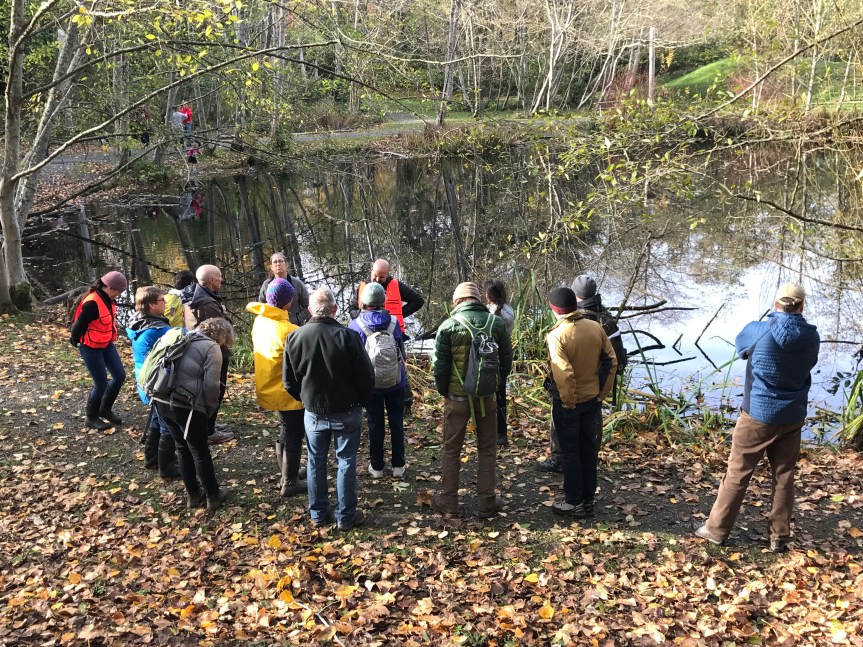
We were told many ways to identify wetlands, the time of the year that it is appropriate to work there, the types of plants that will do well in wet soil, and much more. After the one hour introduction, we took a break and then walked into the park. Michael Yadrick, one of the Seattle Parks Department Plant Ecologists, led the experiential part of the class. Doug Gresham, whom I mentioned before, Lisa Ciecko, the Seattle Parks Department Plant Ecologist who supervises my work, and Elizabeth Housley the person who organizes trainings for Stewards who work with the Washington Native Plant Society and/or the Green Seattle Partnership, also participated in the outdoor segment.

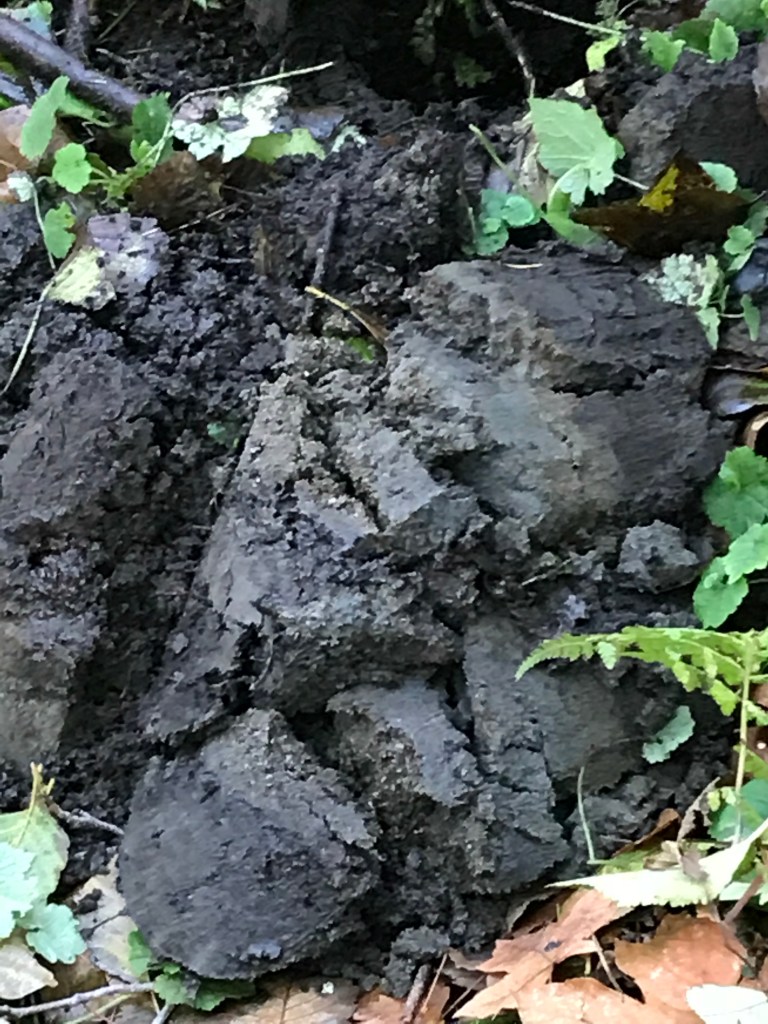
Doug had taught us how to identify wetland soil. On the walk, he dug up some dirt and showed us the difference up close. This first photo is of dry, sandy soil that came from a slope on higher ground.

The wetland soil looked dramatically different. I think the photo below makes that point even though it is not as focused as I would like it to be.

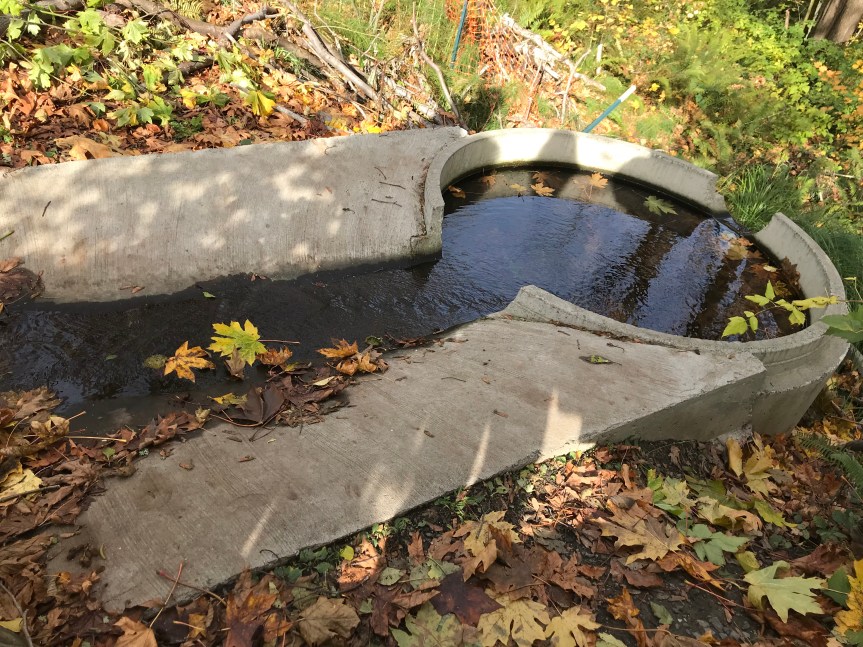
There are many different types of drainage systems for dealing with underground springs. The first one we saw was quite artistic. It consisted of a series of these structures. The series started close to the top of a hill and then similar structures were placed along the slope, each one draining into the next.

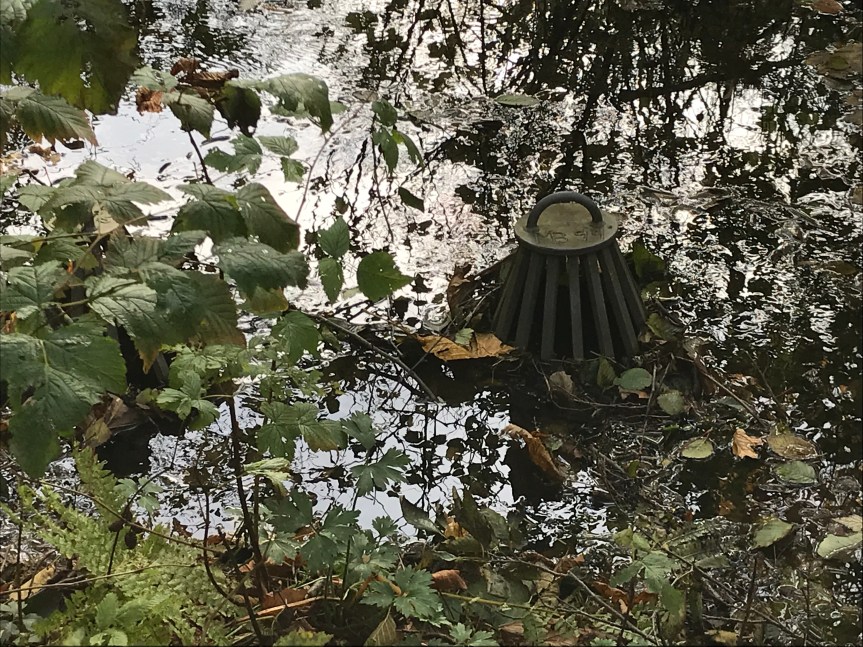
Further on in our walk we saw another type of drain.

And then another. This one is more like the drains I have seen in the past.

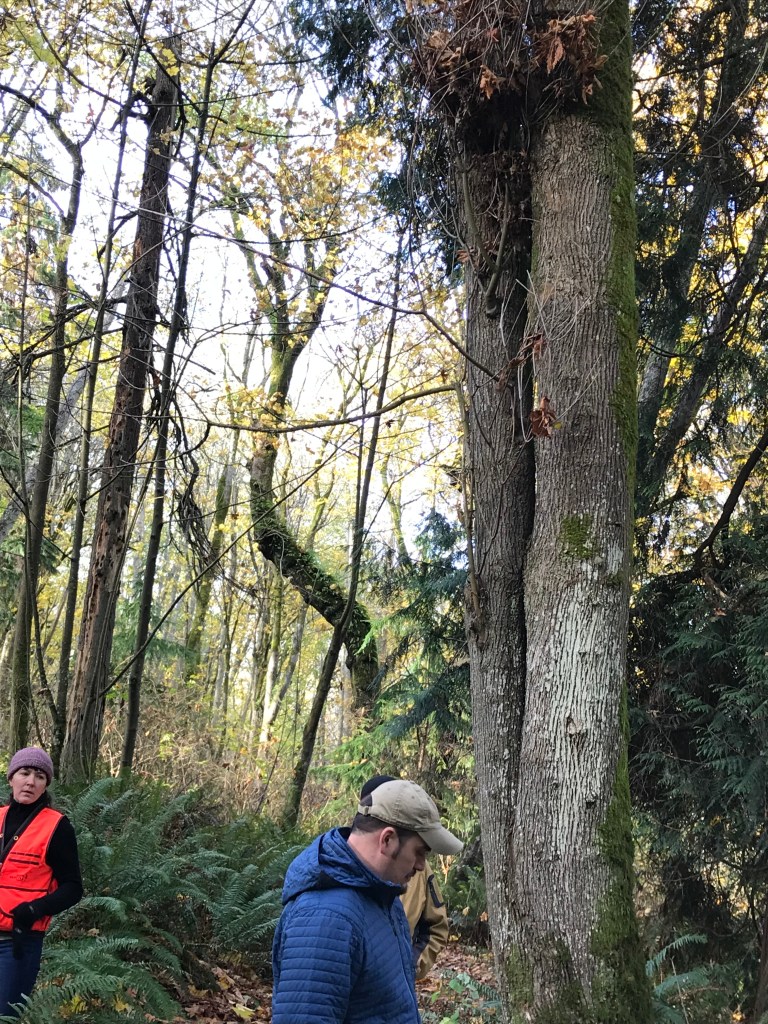
We saw trees that were growing diagonally. Someone speculated that they grew that way because the dirt is so wet that it can’t support the weight of the tree trunks.

I wondered if the shape of the tree in the background of the photo below was the result of the wet land or if it occurred because the tree was seeking more light.

We were shown different types of wet lands and also land that was in different stages of restoration. At one point, we were taken to an area that had not been worked on at all. We were asked to spread out and explore the land, talking about how we would handle the restoration if we were in charge of that project, i.e. what area would we work on first, how many volunteers would we want to have, etc.

As we were walking back to the Environmental Learning Center, we saw some interesting plants. Someone said they thought this gigantic shrub was a huckleberry. Another person guessed that it was boxwood. I had never heard of boxwood before.

On our way out of the park, another shrub caught my eye. It was the white one in the photo below. I asked what it is called, and learned that it is known as Pearly Everlasting. The shrub in the foreground is really beautiful too. I will have to find out what it is. I hope they will both be available when we make our 2018 plant order!

There is no way I can share all the information that was given to me in this post, but hopefully I at least gave you a tiny glimpse of what I learned about wetlands during the class. I look forward to studying  more about them in the future.