On March 4, members of the GreenFriends Pacific Northwest Litter Project held a cigarette butt pick up in the International District of Seattle. The event was in honor of Kick Butts Day, a day of national activism sponsored by the Campaign for Tobacco Free Kids. The actual day is later in the month, but since that day is mid-week we always hold our work party early. This is the seventh year we have supported Kick Butts Day in this way.
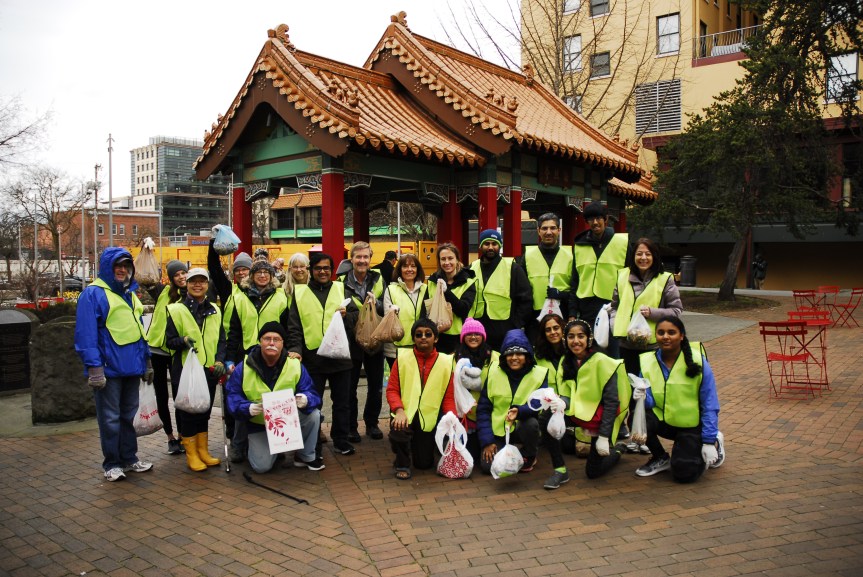
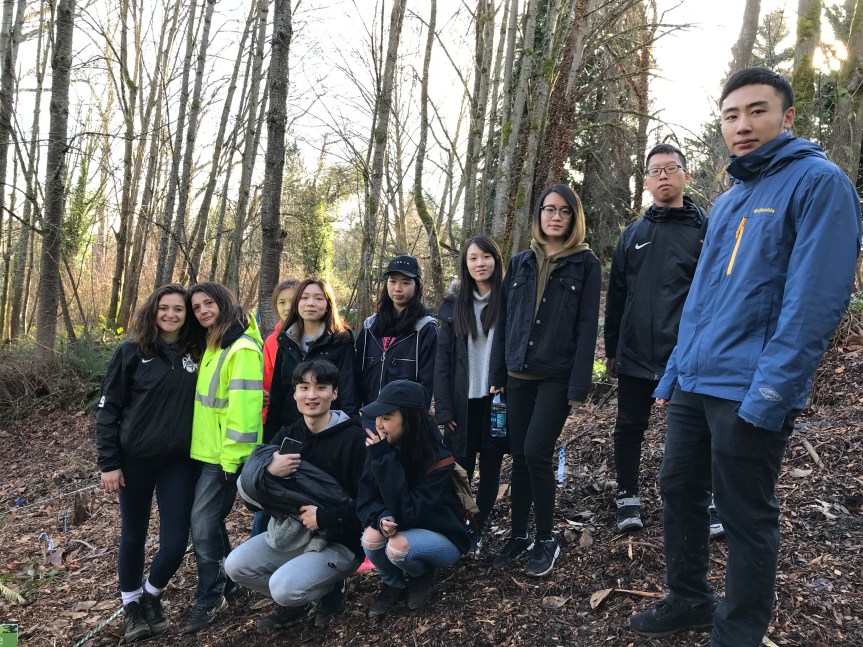
Twenty-one people participated in the butt pickup. We met at Hing Hay Park and then spread out throughout the District. Each person worked for 1-2 hours. At the end, we met back at the park to take a group photo.
Cigarette filters are NOT made of cotton, they are made of cellulose acetate tow, which is a form of plastic, and they can take decades to degrade. Investigators in a past San Diego State University study discovered that if you put fathead minnows and a single cigarette butt in a liter of water, half of the fish will die.
We take the attitude that every cigarette we pick up is one less that could end up being swallowed by a fish, bird or other form of wildlife. By sending them to TerraCycle to be recycled into plastic pallets, we will also keep them out of the landfill.
At the end of the work party, we put all of the butts we had collected into a bag. It was amazing to see how many we had picked up in such a short time.
When we weighed the bag later, we discovered that in two hours we had picked up 12.81 pounds of butts. That is approximately 12,810 cigarette filters. It had been another successful Kick Butts Day.
Amma teaches us to “Be like a bird perched on a dry twig, ready to fly at a moment’s notice.” She also teaches us that “What we need will be provided” and to “Put in the effort and let go of the results.” Taking those attitudes can help us to stay in the moment which in turn can decrease the tendency to worry about the future. The Greenbelt restoration work parties we held during the last half of February provided me with many opportunities to practice each of those attitudes.
Students who take the University of Washington’s Introduction to Environmental Science course are required to do three hours of volunteer work. I had scheduled a work party for February 17 because it was the weekend before their assignment was due. That is always our biggest work party of the quarter.
I was concerned about that work party though, because the people who usually lead teams at our events were going to be at a retreat in Oregon that weekend. I decided to “think outside the box” and started inviting neighbors and people in the Amma community who weren’t going to the retreat. None of them had worked on this project before, but I knew they would do a good job. Pretty soon I had three volunteers. They all came to the site ahead of time for an orientation. We were ready!
I soon discovered more good news was in store. Someone who had planned to go to the retreat, decided not to go, and volunteered to help at the work party. She had lead teams many times so that was a real bonus. Then, the Forest Steward from Mt. Baker park wrote me and said he would help. Just before the work party, another neighbor volunteered to lead a team. I was excited. We had an abundance of staff. While all of this was coming together, 31 students registered for the work party. We were set. What a good example it had been of “What you need will be provided.”
Then “Be like a bird perched on a dry twig” took over. Days ahead of time, we heard that a big wind storm was coming on the same day as the work party. You can do forestry work in the rain, but you can’t do it in high winds; branches might break or trees might fall. On the 16th, it became obvious we couldn’t hold the work party. In fact, the Parks Department canceled work parties that day on a park by park basis. Ours was one that was canceled.
That left both me and the students in a dilemma. I needed to have the land prepared for a corporate group that was coming to plant trees, shrubs and ground covers on Monday, February 26. And the students needed their volunteer hours. I knew that most or all of the team leaders would be at work if I planned events during the week. I decided I would hold three small work parties on Wednesday, Thursday and Friday and be prepared to lead them by myself.
The “Be like a bird” lesson continued as the weather forecasters talked about the possibility of breezy weather and snow. Would these work parties have to be canceled too? The first indication that what I needed would be provided was when I found out that two of the people who had been scheduled to lead teams on the 17th had the week off from work and would help with one of the work parties!
Wednesday, February 21
Wednesday arrived and all was well. In fact it was better than just “well.” A half hour before the work party began, Peter, the Forest Steward from Mt. Baker, emerged from the forest. Not only was he going to help with this work party, he was going to help with all three of them! What a surprise blessing he was. So we had two Forest Stewards and 7 students that day. We began to clear new areas of ivy and blackberries vines. We dug out some big blackberry roots!
(Click on the galleries to enlarge the photos.)
Thursday, February 22
Knowing that Peter would be helping made it possible for me to accept more students than I had originally planned. The work party grew to 23 students.
Maintaining the “Be like a bird” attitude was still important as the forecast was for snow and by Wednesday evening it was snowing, and sticking to the ground. Would I have to cancel the work party? I would decide in the morning.
Thursday’s work party had been scheduled to go from 2:30-5:30 to accommodate the students’ class schedule. The snow was very wet and was beginning to melt when I woke up that morning. Around 10 a.m. I decided to walk to the light rail and around the Greenbelt to see how much snow there was and whether we could work in it. I discovered the streets and sidewalks were clear and most of the Greenbelt was free of snow. What snow remained was melting. Even though the temperature was in the 30’s, it felt warmer than the day before because it was sunny.
My neighbor John also worked with us that day so we had three staff. We continued clearing the land that we had worked on the previous day.
After a snack break, we formed a bucket brigade and carried wood chips from the street into the site. The chips would be used as mulch during the February 26 planting work party.
While we were moving the wood chips, it started to snow lightly. When we finished, we cleaned and put away the tools and quickly headed back to our respective homes.
Friday, February 23
During the week’s third work party, we two Forest Stewards and three GreenFriends members served as staff. Twenty-one students participated. I experienced such a sense of abundance…. an abundance of staff and an abundance of students. Once again, what I had needed was provided.
About half of the students worked in the area we had been clearing during the previous work parties. We had cleared land that I hadn’t expected to clear until later this year! Peter, the Mt. Baker Forest Steward, worked with the students to create swale-like structures that will help prevent erosion. I appreciated learning new skills from him.
Another team worked in an area that has a big ivy mass. That team moved the big piles of ivy to the place on the site that has racks where ivy and blackberries can dry out rather than re-root.
A different group of students placed burlap around flags that were scattered through the site. Those flags marked the places we will be planting on the 26th.
After the break we formed another bucket brigade and finished moving the wood chips into the site.
After the remainder of the wood chips were onsite, we cleaned up and put away the tools, celebrated our accomplishments and went on our way.
What a week it had been. I was consistently challenged to stay in the moment, to let go, to trust what I need would be provided and to put in the effort and let go of the results. And I had certainly felt like a bird perched on a dry twig. We accomplished so much during these three work parties. Grace had flowed.
After every work party, I tell anyone who will listen that it was an amazing work party. And it always is. The transformation in the land that occurs during each three hour work party is mind-boggling, at least to my mind.
Four GreenFriends members, 3 neighbors and 21 students from the University of Washington’s Introduction to Environmental Science class participated in the February 3rd event. Towards the beginning, we divided into 4 teams. The GreenFriends members, who were serving as team leaders, wore orange vests so that they could be spotted easily.
Team 1
During our last work party, volunteers had focused on removing ivy from an evergreen tree and from the ground in an area on the northwest part of the site. At this work party, Team 1 continued that work, this time clearing ivy and blackberry root balls from an ever widening area. All of the debris was taken to an area we call The Rack Zone where it is put on racks that keep it from re-rooting. Having the vines and rootballs on the racks also enhances air flow and the debris will decompose faster than if it was left on the ground.
At the beginning of the work party the area looked like this:
The volunteers worked diligently and had a good time in the process. Even though I don’t have a “before” photo, know that the shed and stone wall shown in the last photo in this section was completely covered with ivy. Until recently, I didn’t even know there was a shed there.
(You can enlarge the photos in a photo gallery by clicking on any of the photos.)
At the end of the work party, the space looked like this. There is still work to do in this area but so much was accomplished during those three hours.
Team 2
The area where Team 2 worked is adjacent to Team 1’s section of the property. When English ivy grows unchecked and begins to flower, the leaves may change shape and become waxy. It may become a gigantic mass, developing thick stalks that may look more like a tree trunk than an ivy vine. One of the neighbors who has worked on this project from the beginning discovered such a mass in early January. Since then, he has been working to cut it down.
The first set of pictures below show what the area looked like at the beginning of the February 3rd work party. Notice the ivy mass in the background of the first photo. It is not nearly as big as it was originally but it is still huge. The second two photos show some of the piles we would be dealing with at this work party.
Here is a close up of different parts of that mass. It is SO dense.
The volunteers worked on the piles of debris, cutting the leaves and small branches of ivy away from the bigger branches. The leaves and small branches were moved to the rack zone to dry and the bigger branches either stayed in the area or were stacked near the rack zone.
The Rack Zone
By the end of this work party, the rack zone was almost completely full of ivy.
I wonder how long it will take for us to completely remove the mass. I suspect there will be many more work parties and many more piles before this task will be finished. But, at least, when the work party was over, the piles of debris that were there at the beginning were almost gone.
Team 3
On February 26, Silver Capital Management employees are coming to plant trees, shrubs and ground covers in this Greenbelt site. Team 3 helped prepare the ground for that planting work party.
In the days prior to the February 3rd work party, pink flags were placed around the site, marking where each plant will go. Written on each flag was the type of plant that will be planted there.
We’ve found that planting proceeds smoother and faster if the areas where things will be planted are prepared ahead of time. Prior to the work party, I made two demonstration areas so that the volunteers could see what they would be doing. In one area, I used burlap that had been placed on the ground when we first cleared the land, and in the other I used new burlap.
Team 3 cleared weeds, if there were any, from around the flags and then placed burlap bags around them, leaving a place for the people who will be planting to dig a hole. Once the planting is finished the burlap will be adjusted, if necessary, and then covered with wood chips. Both the burlap and the wood chips will decompose and enrich the soil.
This team prepared spaces for about 70 plants. In the photos below, you can see the burlap that is now scattered throughout the site.
Team 4
The fourth team cleared an area that our volunteers had not tackled before. Seattle Parks Department staff had done an initial cutting of the blackberry vines in that area in March 2017 and then cut them back again during the summer. At the February 3rd work party, the volunteers dug out blackberry root balls and removed ivy.
This is how that land looked at the beginning of the work party. (I think this would be a particularly good gallery for you to click on!)
After instruction on how to clear the land, the team “rolled up their sleeves” and went to work.
The students dug up many blackberry root balls. These are photos of the biggest one they found!
The transformation that took place was remarkable. By the end, this section was clear of invasive plants and covered by burlap bags (the bags help prevent weed growth).
While the students were working, my neighbor John started removing blackberry vines in a nearby area, one where the blackberries are even denser. A team will work in that section during our next work party.
On February 26, these newly restored areas will become home to seven Douglas Fir trees as well as a variety of shrubs and ground covers.
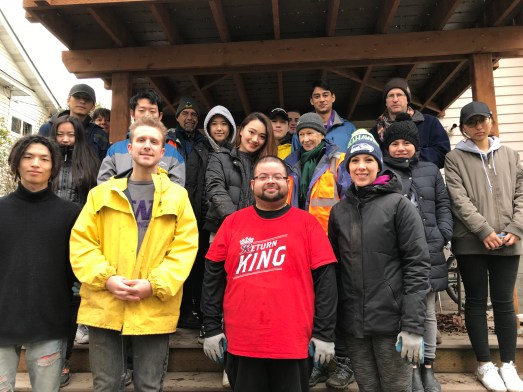
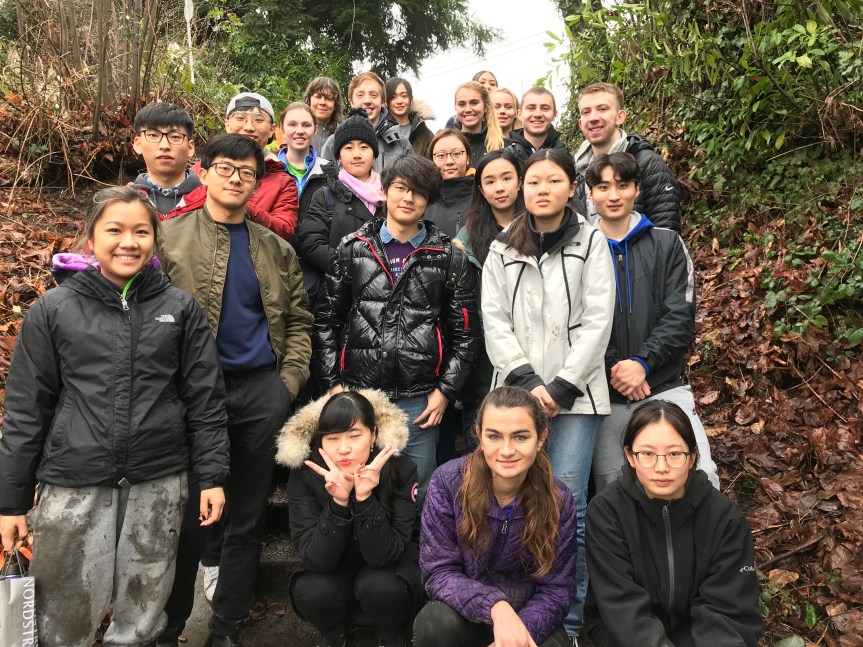
By 12:50 p.m., the tools we used had been cleaned and put away. We then gathered on the Hanford Stairs, which are on the north border of this site, to take a group photo and celebrate the completion of a very successful work party.
I spend a significant amount of my time each month working with a team of people to create the monthly Pacific Northwest GreenFriends online newsletter. We published our 79th issue today! What began in September 2011 as a several page Microsoft WORD document has turned into a beautiful newsletter filled with interesting articles and photos. Sometimes, I think we should call the publication a magazine rather than a newsletter.
GreenFriends is a global grassroots environmental movement which promotes environmental awareness and local participation in conservation efforts throughout the world. GreenFriends is one of the projects of Embracing the World, a not-for-profit international collective of charities founded by internationally known spiritual and humanitarian leader, Mata Amritanandamayi (Amma)
It is my experience that readers who live outside of the Pacific Northwest also find the newsletter interesting and valuable so starting with this February 2018 issue I’m going to post them on my blog.
Nature on its own is indeed beautiful and clean. The hills and rivers do not need us to clean them. In fact, it is nature’s water which cleans us; it is trees which purify air for us. Because we have littered, we have spoilt its pristine beauty.
~Amma
I once read that every piece of plastic that ever existed still exists. While that statement has been challenged (politifact.com), there is no disputing the fact that plastics decompose very slowly and some may never decompose.
We have certainly seen evidence of the long life of plastic in the GreenFriends Greenbelt Restoration Project that Seattle Satsang members are leading. The areas we are restoring have been covered by blackberry, ivy and bindweed vines for 30-60 years. With the aid of Green Seattle Partnership, the City of Seattle Parks Department, and volunteer groups such as students from the University of Washington’s Introduction to Environmental Science course, we are helping to return this stretch of Greenbelt to the beautiful forest it once was.
When the Seattle Parks Department staff initially cut down the blackberry vines for us, they discovered the foundation of a house that had burned down in the 1950’s. We found many plastic items in or near that foundation. It appears that a lot of plastic trash was also thrown into the Greenbelt by nearby residents and passersby.
My house borders this Greenbelt property. When I cleaned out my bird houses last winter, I found a sizable bird nest. I was shocked by the amount of plastic a bird had used in constructing it (Photo 1). Photo 2 shows the pile of plastic I removed when I took the nest apart.
Photo 1
Photo 2
My experience with the bird nest opened my eyes to all the plastic that was in our Greenbelt site. After than, anytime I walked through the property, I saw that the ground was littered with flecks of plastic. I worried about the toxicity of the plastic and also remembered a photo that I once had seen of the contents of the stomach of dead albatross at Midway Island. (See Photo 3.) I felt an urgency for us to remove as much plastic from the site as possible, before the birds could start using it for nesting material.
We invited Seattle Satsang’s Bala Kendra group (our spiritual community’s children’s group) to come pick up litter. Photos 4 and 5 show the litter they picked up in one hour’s time. In addition to this diverse pile of garbage, they removed many small flecks of plastic from the ground.
Photo 4
Photo 5
Much of the trash our volunteers have removed from the site during the past year has been plastic. While the items might be dirty, as you can see in Photos 6-13, many of them look basically the same as they did decades ago.
Photo 6
Photo 7
Photo 8
Photo 9
Photo 10
Photo 11
Photo 12
Photo 13
Yesterday, I picked up the remains of a pile of burlap bags that we use to cover the ground after we clear it. Under the pile I saw this:
Photo 14
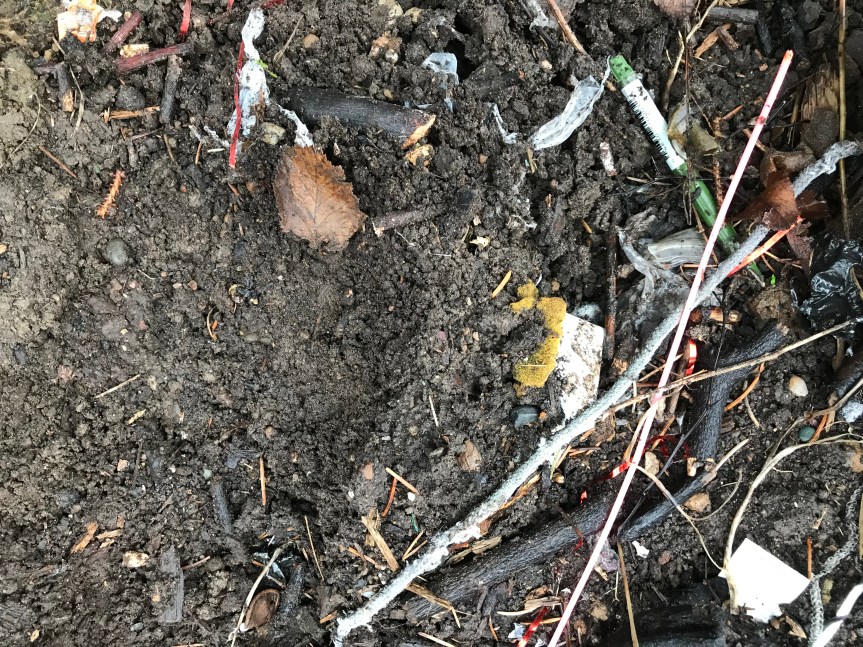
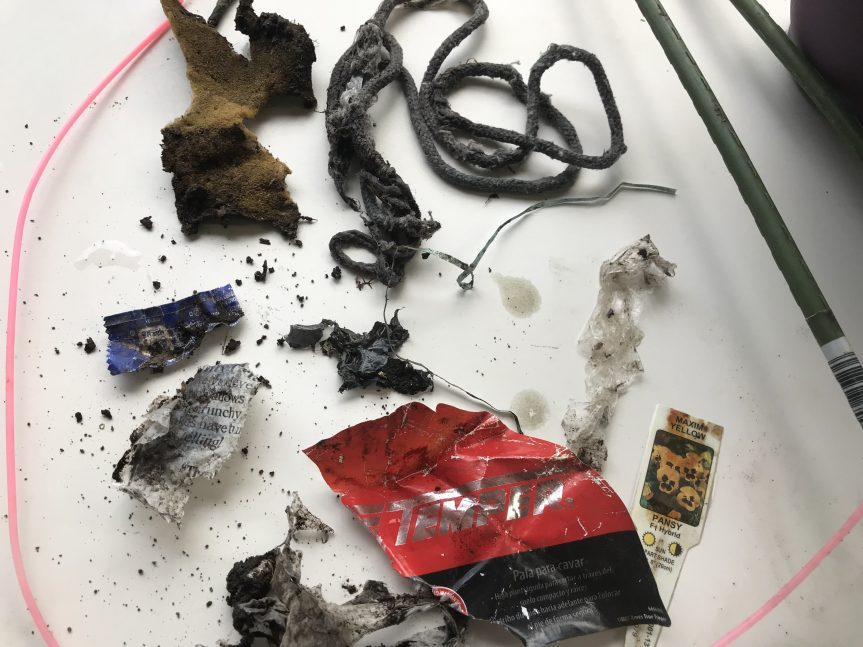
I went back later and pulled out some of that trash so that I could photograph it. Photo 15 shows those items. There was rope, candy wrappers, a garden stake, line string for a trimmer/edger, a plant sign, carpet pad and assorted other kinds of plastic.
Photo 15
Today I remembered another piece of plastic I had recently seen. I went back to that place and began to pull the plastic bag out of the ground. Photo 16 and Photo 17 show what I uncovered. Often, when I pull out plastic, what emerges is even bigger than this!
Photo 16
Photo 17
I wonder if we will ever come to the end of the plastic trash on this site! Maybe not, but every piece someone removes helps reduce the negative impact that humans have had on nature in this space and gives nature a chance to restore itself to its pristine beauty.
I returned from India on the afternoon of Saturday January 13 excited to get back to my work in the Greenbelt. I had scheduled a work party for the first day that I thought I would be reasonably fit after such a long trip. That day was Sunday January 21.
Sixteen people participated in the work party: 2 GreenFriends members, 9 students from UW’s Introduction to Environmental Science course, 3 neighbors, a high school student and her mother.
The group was enthusiastic and accomplished so much. One team worked to remove ivy and blackberry rootballs from a section of the property we haven’t tackled before.
(You can enlarge the photos by clicking on the galleries.)
Another team worked in the “rack zone”. When the blackberry vines that had been growing on this property for 30-50 years were initially cut down, we discovered an old house foundation. A volunteer suggested that we use the foundation to store all of the racks that hold the blackberry rootballs, ivy and bindweed that we dig out. [Note: We put the debris on racks so it stays off the ground. That way the plants won’t re-root, and by having air flow coming up from the bottom of the rack, the debris will decompose faster. Also keeping the racks in one area, rather than scattered throughout the site, gives us more planting space.]
When the debris decomposes, it becomes new soil. Our plan is to spread the partially decomposed materials throughout the foundation and build new racks on top of them. Eventually there will be a thick layer of dirt in the foundation and we will be able plant beautiful shrubs and ground covers in it.
During this work party, we started taking the racks apart for the first time.
As each one was disassembled, a new rack was built on top of the partially decomposed debris, and then the ivy and blackberry rootballs the other team had just removed from their work area were placed on top of the new racks. It will take several work parties to redo all of the racks but we got a good start. (Click on the photos below to see the full captions.)
Rebuilt rack ready for new rootballs and ivy
Rebuilt rack that has new rootball and ivy debris on top
Rack that is ready to be rebuilt because the debris on top of it is dead
Rack zone as it looks today
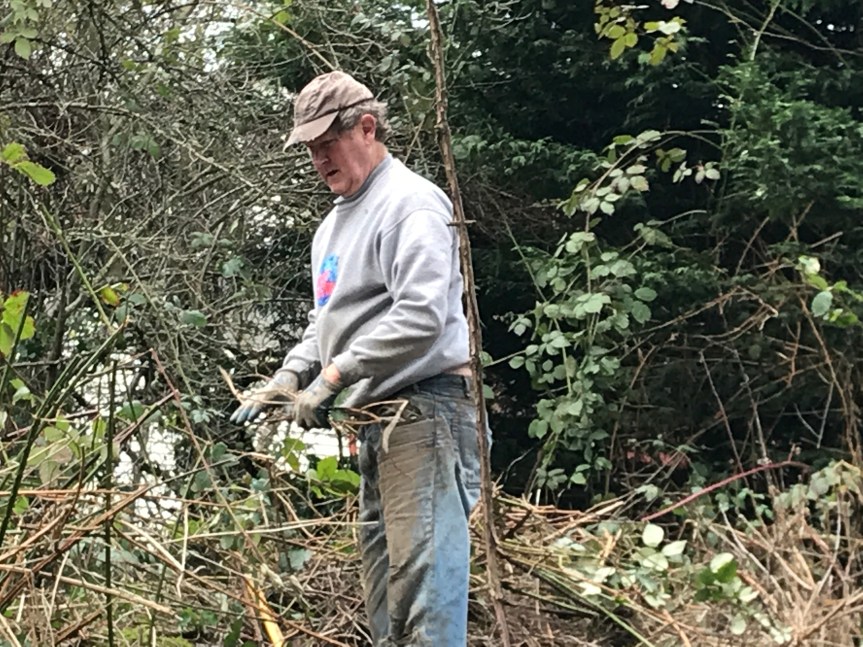
My neighbor John, who has diligently worked on this project from the beginning, cleared an area of blackberry canes and rootballs.
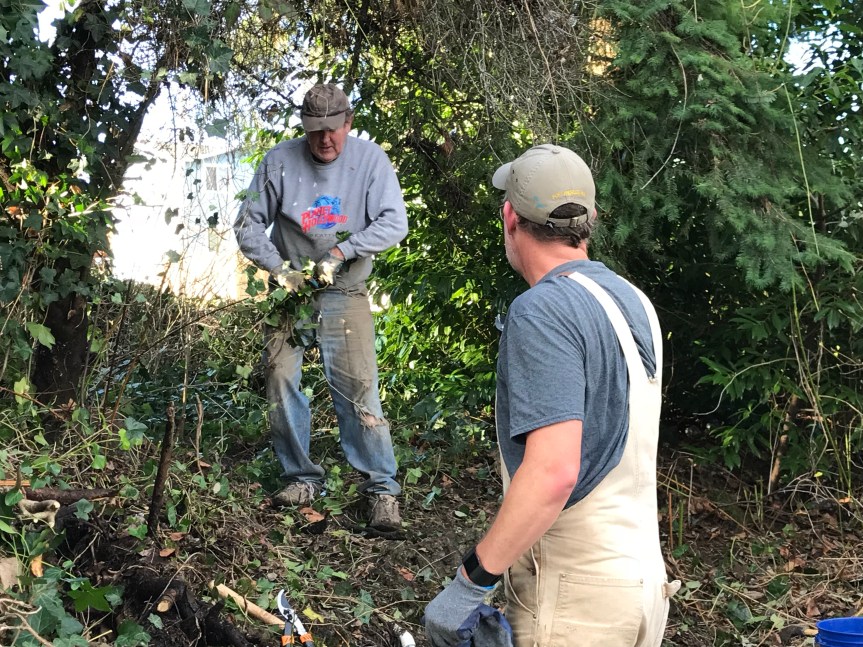
For the last part of the work party, John and Jason worked in an area where ivy had killed two trees by wrapping itself around the tree trunks.
While they were doing that, the rest of us moved 1000 square feet of burlap bags from the street into the Greenbelt. I had no idea we would be able to move all of it in an hour, but we did!
Having the bags in the Greenbelt will give us easier access to the burlap when we are ready to spread it over newly cleared land. [Note: Spreading burlap bags over the cleared land helps prevent weed growth. Over time they will decompose and enrich the soil.]
In the past, we have dumped the burlap into mounds.
At a work party last fall, one group of students laid the burlap bags flat. Those bags were so much easier to spread than the wrinkled ones, so we decided to place all of burlap we were moving into flat piles!
Mother Nature really blessed this work party. The weather forecast app said the chance of rain at the beginning of the event was 90% and that the rain would continue throughout. The reality was that it sprinkled as I was setting up ahead of time and we had NO rain during the three hour work party. About an hour after the work party was over, it poured. Grace prevailed.
Even though I was still dealing with jet lag from my India trip, I was in bliss throughout this event. I love this work!
I give special thanks to everyone who helped by leading or being part of a team as well as to the neighbor who was willing to come early and help everyone sign in as they arrived.
Our next work party will be Saturday, February 3. If you live close enough to Seattle to participate and want to join us, you would be more than welcome! If you are interested in attending, leave a comment below.
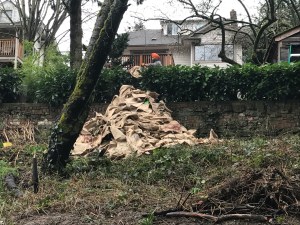
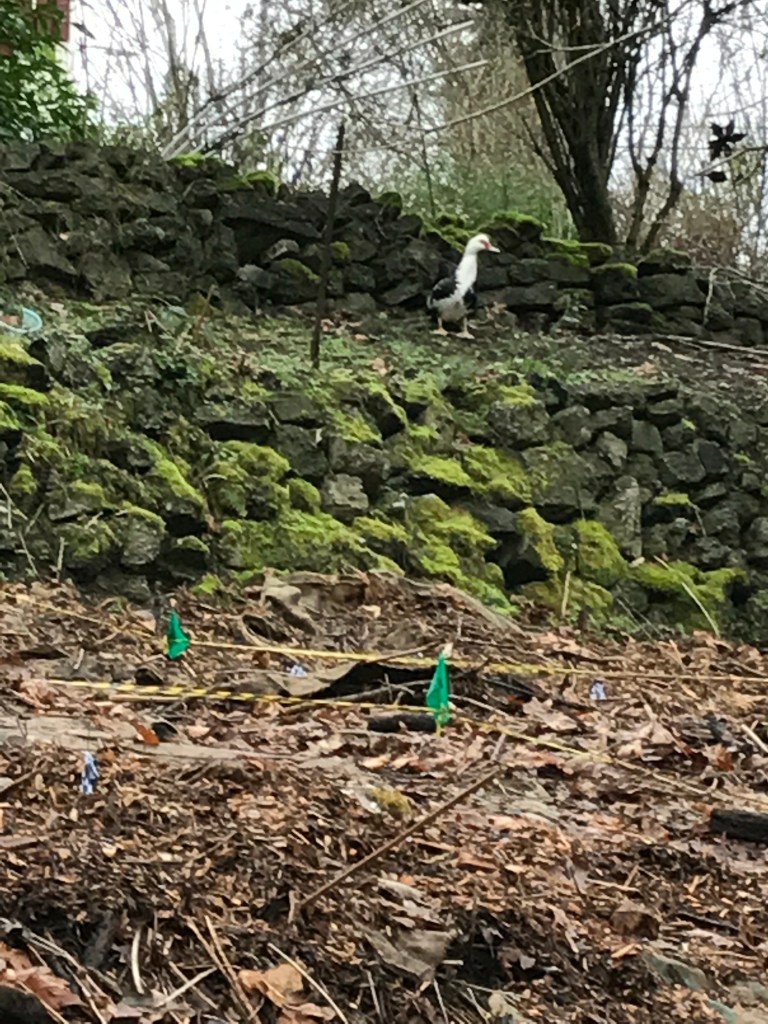
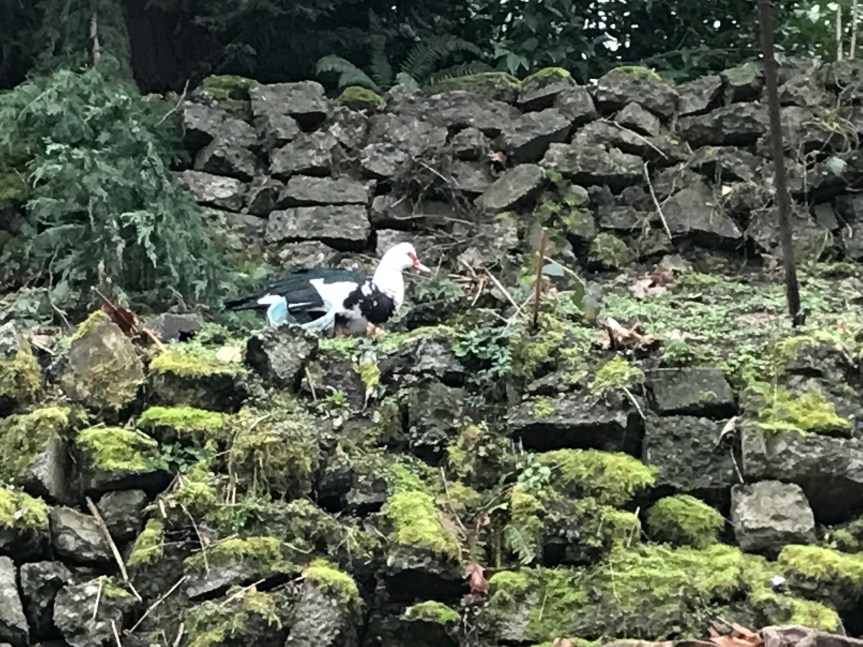
When I was working in our Greenbelt restoration site a few days ago, I was startled to see this bird staring at me. I walked closer to it so I could take its picture.
We looked at each other for a while. Then the bird walked over to a broken bowl and started drinking rain water.
At first, I thought the bird was a duck. Then, I decided it was too big to be a duck, that it must be a goose. I was concerned that it might start eating our newly planted shrubs.
As I pondered the situation, I wondered how a goose managed to get to Beacon Hill; we aren’t that close to Lake Washington.
Eventually, I started working again and just ignored it. At one point, when I looked towards the ledge, the bird was gone.
A few days later, people started posting notices on NextDoor, commenting on a duck that had been spotted in a variety of places in my neighborhood. One person said that it had even stopped traffic.Another person included a photograph. It sure looked like the bird that had visited me. Future posts revealed that it was a pet.
I felt embarrassed that I didn’t know the difference between a duck and goose, until I googled it. There are so many similarities between the two birds. One of the main differences is that a goose is usually bigger.
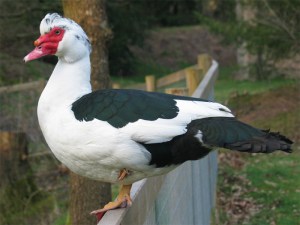
Someone wrote on NextDoor that the bird was a Muscovy duck. Wikipedia says this about Muscovy ducks:
The Muscovy duck (Cairina moschata) is a large duck native to Mexico, Central, and South America. Small wild and feral breeding populations have established themselves in the United States, particularly in Florida and the lower Rio Grande Valley of Texas as well as in many other parts of North America, including southern Canada. Feral Muscovy ducks are found in New Zealand, Australia, and in parts of Europe. They are large ducks, with the males about 76 cm (30 in) long, and weighing up to 7 kg (15 lb). Females are considerably smaller, and only grow to 3 kg (6.6 lb), roughly half the males’ size.
This photo from Wikimedia was included in the Wikipedia article:
I didn’t get very close to the duck but this description and photo sure looks right to me. I have no trouble believing that the bird I saw was 30 inches long and weighed 15 pounds. It sure is a long way from Mexico, Central and South America, Florida and Texas though!
I appreciate that it visited me that day, but still hope it stays away from the trees, shrubs and ground covers that we have planted.
My friend Ramana had asked if I would take him to some of the ashram gardens when he arrived in Amritapuri. Since he didn’t come to India until the 9th and I was returning to the U.S. at 5 a.m. on the 12th, I decided it was only reasonable for me to take him to one of them. I chose Kuzhitura.
You may remember when I visited this farm on December 27, 2017, I saw some tubs that I thought might be a new way to catch water.
Later, I learned that the structures that were originally built for water catchment had become homes for turtles. I found a picture of one of those structures that I took in January 2016. I can see why turtles would want to live there!
One of the problems with the turtles living in that “pond” is that the water dries up during the dry season. It is not a safe place for the turtles to live. The new tubs are meant to be homes for the turtles.
When I returned to Kuzhitura on January 10, I enjoyed seeing how much homier the tubs looked than when I had been there two weeks before.
Sarvaga, a friend who works in this farm, introduced Ramana and me to some of the turtles living in the current “pond.” She talks to them as she offers them treats and they come right up to her!
The staff are not going to move the turtles into their new homes. Sarvaga said they will find their own way there. I look forward to seeing where the turtles are living when I return to Amritapuri later in the year.
To read the previous posts in this series click here.
“The fool doth think he is wise, but the wise man knows himself to be a fool.” “Love all, trust a few, do wrong to none.” “Love looks not with the eyes, but with the mind, And therefore is winged Cupid painted blind.”-William Shakespeare

























 Living, Learning and Letting Go