Living and Learning in Amritapuri (December 27, 2015 to January 2, 2016)

2015Dec24-ukn-9387
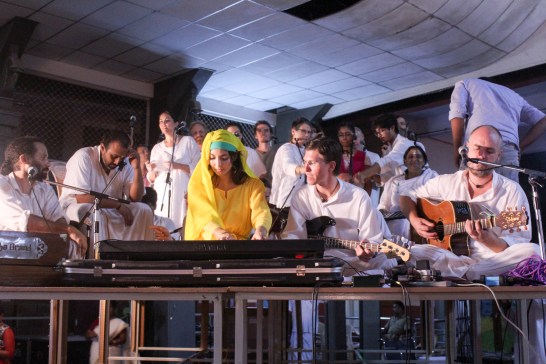
Musicians with vocalists standing behind

In an earlier post, I shared pictures of the actors and scenes from this year’s Amritapuri Christmas play, “Blessed Art Thou.” In this one, I will focus more on the musicians and vocalists. Their work was magnificent.

In many, if not most, of the plays in Amritapuri, the musicians and vocalists are off stage. The actors are actually lip syncing when they appear to be speaking. They do such a good job of lip syncing many who watch the play don’t realize that they aren’t speaking, unless they know that this practice is traditional in Indian dramas.
Vocalists
Vocalists

Sreejit coordinates the group of musicians and vocalists. He and his musician friends start writing tunes as soon as one year’s play is over; long before they know what the next year’s play will be about. They write many tunes during the year but only a small fraction of them become part of the production.

Here are some of my favorite songs from this year’s play.  Two of the tunes are original and two aren’t.

Sabbath dinner
Sabbath dinner

Part of this song is in Hebrew.  It is traditionally sung in Jewish homes on the Sabbath. I think it is so beautiful.

***

2015Dec24-dvd-201512241346
Mary yearning for Jesus to return home

My favorite song in this play is “Each and Every Night.”  Mary, mother of Jesus, is singing about how hard it is for her, as a mother, to wait for Jesus to come home again.

***

John the Baptist
John the Baptist

The John the Baptist song was written and sung by Puneet Gabriel McCorrison.  He is the person on the right side of the photo at the top of the post.

***

Satan tempting Jesus

This music and song is about the 40 days and 40 nights that Satan tempted Jesus.  If you listen closely you will hear both the voice of Satan and the voice of Jesus.  Sreejit is the voice of Satan!  He is also in the photo at the top of the post, sitting on the left side.  During the play, Sreejit played the harmonium and was the voice for both Goliath and Satan.


While there were many other songs in the performance, I believe these four will give you a good sense of how much the musicians and vocalists contributed to the play’s success!

New Year’s Eve

I was super busy on December 31. I left my room at 7:30 a.m. and didn’t make it back there, except for a few minutes, until 8:30 p.m. By then, I was so sleepy I couldn’t keep my eyes open. I knew the New Year’s Eve events would last until around 1:30 a.m., so decided to get some rest.

I slept from 8:30 to 10:30 p.m. When I woke up, I could tell that the entertainment portion of the evening program had already begun. I arrived at the auditorium in time to see a group led by Sashwat, an Amrita TV camera man. Two or three years ago he had surprised so many ashram residents by doing a rap performance on New Year’s Eve.  This year, I sat on a table to the side of the hall and was able to see well. The singers and musicians were all sitting on the floor, as is typical in India.  At one point a member of the group stood up and led several rap songs. He was the same man I mentioned in an earlier post, the one who practices Kung Fu moves on the beach! I was so surprised.

16-newyear-2

That group’s performance turned out to be the end of the entertainment program. Thursday was a darshan day and Amma continued to give hugs until just before midnight. She then led a meditation and a Lokah Samastha Sukhino Bhavantu (May all beings in the world be happy) chant. Next came her New Year’s message. Amma talked about a variety of topics.  Among them were 1) welcoming the new year with joy and alertness, 2) compassion, 3) facing obstacles and 4) protecting nature’s harmony. You can read excerpts from her speech at: http://www.amritapuri.org/50825/16-newyear.aum.

Afterwards, Amma led several beautiful bhajans (devotional songs) and then did a Badaga dance. The crowd loved it all. The picture below was taken after one of the more rousing songs.

16-newyear-3

Following the bhajans, Amma served payasam (sweet pudding) to the thousands of people in the hall. She poured the pudding into cups and they were handed down from the stage on trays.  Devotees then passed the cups of pudding to the people behind them until everyone had one. (Some of the brahmacharis also helped pour the payasam.)

After that, Amma left the hall and the devotees began to clean up. What a wonderful New Year’s Eve it had been.

New Year’s Day

Each year, about a week after the play, the cast get together to watch the newly created play video. It is always so much fun to watch it as a group. This year the viewing was on New Year’s Day and, as always, there was lots of laughter and applause.

That evening I went to the beach to meditate with Amma. On the way, I noticed one of the devotees who often represents the ashram was escorting a man and woman to the meditation. A young woman was walking nearby and when she saw the male visitor her jaw dropped in amazement. She came up to him and said she was a BIG fan of his. She turned around saying she couldn’t wait to tell her mother he was there.

I had no idea who he was but was definitely intrigued. Later I found out it was Russell Brand. I rarely see movies or watch other kinds of shows so I didn’t know anything about him. When I did an internet search, I discovered he is a British comedian, actor, and activist. I also learned he wrote an article about Amma last year so I looked that up as well. I was impressed with what he wrote. Many of his words were funny, but a lot of the things he wrote about Amma were profound. If you want to read his article you can find it at: https://web.facebook.com/RussellBrand/posts/10152650768708177

Time with Amma

In my last post, I had said I was going to make being with Amma a major priority for myself during the following week since she would be leaving on her North Kerala tour soon. While I did not always keep that commitment, I did make my decisions around use of time carefully. I think that was the life lesson, i.e. to make plans but be willing to let them go when it seems important to do so.

I received my last hug from Amma (for this trip) on December 30. I love it when Amma laughs while she hugs me. This time, it seemed like she held me for a long time while talking and laughing with the people who were nearby!  What a great ending for that part of my trip

Celebration

One of the two elevators in our building has been out of service for a week or so. On New Year’s day there were so many people waiting for the elevator, I decided to walk up the stairs. There are fifteen flights of stairs to climb in order to get to my room on the fifth floor.

As I trudged up the stairs, I remembered I was carrying something for a friend living on the NINETH floor! I would have waited for the next elevator if I had remembered that, but I decided to just keep going. The celebration is that when I reached the eighth floor my pulse was 103 beats per minute (per Fitbit). On the nineth floor it was 105. A few months ago my pulse was 150 when I leisurely walked around a flat track at a park near Seattle. As far as I was concerned, for it to stay that low after climbing up 27 flights of stairs was worthy of a big celebration!  I am so much healthier than I was when I arrived in India five weeks ago.

There is more I could say, but I will save it for another post.  I hope that you all had a wonderful holiday season and wish you a very happy new year.


To read the earlier posts in this series go to: https://livinglearningandlettinggo.wordpress.com/india/

Self-Care or Selflessness?

911px-Helping_hand_logo
Photo Credit: Wikimedia

As I mentioned in a previous post, I have a long history of overdoing. At one point in my life, I was holding three jobs at the same time. When I have become involved with organizations, I have often done more than is reasonable for one person to do. My overdoing has led to serious illnesses that have been breaking points, where slowing down became a necessity rather than a choice. I believe it was this pattern of overdoing that led to me to having Chronic Fatigue Syndrome for five or more years in the mid to late eighties, and to the high blood pressure I am dealing with today.

To some degree, the types of overdoing I am referring to were caused by a pattern of rescuing.  In his Drama Triangle construct, Stephen Karpman describes the Rescuer in this way:

“The rescuer’s line is ‘Let me help you.’ A classic enabler, the Rescuer feels guilty if he/she doesn’t go to the rescue. Yet his/her rescuing has negative effects: It keeps the Victim dependent and gives the Victim permission to fail. The rewards derived from this rescue role are that the focus is taken off of the rescuer. When he/she focuses their energy on someone else, it enables them to ignore their own anxiety and issues. This rescue role is also very pivotal, because their actual primary interest is really an avoidance of their own problems disguised as concern for the victim’s needs.”

Jean Illsley Clarke once taught me five questions to ask myself when I think I might be rescuing.

  • Was I asked to do what I am doing?
  • Do I want to do it?
  • Am I doing more than my share?
  • Do others appreciate me for what I am doing? (Rescuers are often not appreciated.)
  • Am I doing something for someone that they can do for themselves?

Answering yes to one of those questions does not mean that I am rescuing, but if yes is the answer to many of them, the chances are that I am. So shifting my pattern of rescuing was an important part of my healing journey.

From a therapy perspective, focusing on self-care by stopping rescuing makes sense.  Even though I valued being in service, it was still my job to keep myself healthy.  When I began to look at self-care and selflessness from a spiritual perspective though, I started to have doubts. There are many who have forsaken their health, their comforts and sometimes even their lives, to live a life of service.  They have shown us what is possible for one person to accomplish in a life time.  They have been, or will be, a source of inspiration long after they are gone from this world.

To me, Amma, my spiritual teacher and mentor, is one of those people. Her form of blessing is through a hug. Amma has hugged more than 34,000,000 people in her lifetime. She needs almost no food or sleep. If she is not giving darshan (hugs) she is serving humanity in some other way, including her massive network of humanitarian projects known as Embracing the World. Her life is a model of selflessness.

When I thought about people present and the past who have inspired others through their selflessness, the following individuals came to mind.  All have taught the importance of serving humanity.

Jesus:

John 13:34 “A new commandment I give to you, that you love one another, even as I have loved you, that you also love one another.

Acts 20:35 “It is more blessed to give than to receive.”

Matthew 25:35-40: ”For I was hungry and you gave me food, I was thirsty and you gave me drink, I was a stranger and you welcomed me,  I was naked and you clothed me, I was sick and you visited me, I was in prison and you came to me.’  Then the righteous will answer him, saying, ‘Lord, when did we see you hungry and feed you, or thirsty and give you drink? And when did we see you a stranger and welcome you, or naked and clothe you? And when did we see you sick or in prison and visit you?’ And the King will answer them, ‘Truly, I say to you, as you did it to one of the least of these my brothers, you did it to me.’”

Mahatma Gandhi :

“The best way to find yourself is to lose yourself in the service of others.” “You must be the change you wish to see in the world.”

Martin Luther King Jr.:

“Everybody can be great…because anybody can serve. You don’t have to have a college degree to serve. You don’t have to make your subject and verb agree to serve. You only need a heart full of grace. A soul generated by love.”

St: Francis of Assisi:

“O Divine Master, grant that I may not so much seek to be consoled as to console,
to be understood as to understand, to be loved, as to love.”

Mother Theresa:

Prayer in action is love, and love in action is service.” 

As I pondered the importance of self-care versus selflessness, I could rationalize that I am not Amma, Jesus, Gandhi, Martin Luther King, St. Francis or Mother Theresa and therefore could not expect myself to serve at that level.

My thoughts on this topic took another turn, though, in the late 90’s when I read a book, A Promise is a Promise, by Wayne Dyer. It was an account of a teenager who in 1970 asked her mother to promise that she would never leave her. Soon thereafter the 17 year old slipped into a diabetic coma, one she never came out of. The mother kept her word and, with help, cared for her daughter until she herself died 25 years later. (A Promise is a Promise was written while the mother was still alive.) Then others cared for the daughter until she died on November 21, 2012, forty-two years after she became comatose.

Reading that book had a profound impact on me. I still remember Dr. Dyer saying that walking into their home felt like being in the holiest of temples.

When I first started reading A Promise is a Promise, I made the judgment that the mother was not taking care of herself appropriately. But as I continued to read, my attitude began to change. Her actions seemed like unconditional love, perhaps the highest form of spiritual practice. While I wasn’t aware of it at the time, I now see that her actions actually conformed to the guiding questions I had learned from Jean Clarke:

  • The mother had been asked and had agreed to what she was doing
  • She wanted to do it
  • Even though she devoted her life to caring for her daughter, she had help.
  • Her daughter would have undoubtedly appreciated her efforts
  • She was clearly doing something for her daughter that the girl could not do for herself

Reading about a “regular” person who was so selfless, presented me with another dilemma. When I lived a life of uncontrolled doing, even if when it was in the spirit of service, I became sick to the point I couldn’t function.  How do I know when to focus on self-care and when to make service the priority?

I continue to ponder that question to this day. I believe for me it has to be about balance. I must practice good self-care by nourishing my body, mind and soul and at the same time make sure that I am not over-committing or over-stressing myself.  I must also continue to watch out for my tendency to rescue.  I can be in service to others and still do my best to keep myself healthy.

Written for Dungeon Prompts: Breaking Point

Living and Learning in Amritapuri: Jan – 7, 2015

20150105_171038

(Note:  The dates on this post overlap with my January 5 post.  That is because there were some important events that I didn’t mention in  the previous one!)


Stopping Critical Self Talk

Visitors and residents at the ashram offer classes they think would be of interest to the visitors. It is a chance to raise funds for Amma’s humanitarian projects as well as give valuable information and experiences to those who take the classes.

The date and time of the class I was to teach on Stopping Critical Self Talk was changed four times so I had plenty of opportunities to practice patience, flexibility and detachment. I ended up holding the workshop on January 3.

When I taught a class two years ago 5 people signed up ahead of time. More registered the morning of the class. I think the final total was about 10. This year, the evening before the class 15 people had signed up and by the time it started there were 23!

Teaching here provides challenges I don’t face in Seattle because most of the people who attend Amritapuri classes are from Europe or other places around the world where English is not the first language. Conditions are also different because in India there is noise from the fans, and lots of noise from the street below; quite a change from teaching in America.

Attendees were very interested in what I had to say and participated actively in the various components of my class. They  expressed a lot of gratitude for the new information and experiences. I was very excited and look forward to teaching again next year. I felt and still feel a lot of gratitude for the two friends who helped me with the logistics of running the workshop, and the emotional support their presence offered.


Cast Viewing of the Play

A week or so after each year’s Christmas play, everyone involved in putting on the drama meet to see the first draft of the play DVD. I love participating in that event. Since most of the cast weren’t able to see the play at the time it was presented this is their first opportunity to see the final production. It is always a time of laughter and celebration.

Below are some more play photos:

To see photos closer click on the gallery.  To see the original photos I posted go to:


Then and Now

When I came to the ashram the first time in January 1990, there were a total of 30 Western visitors. At the height of the holiday season this year, i.e. December 2014, there were 1,800 Western visitors! Such a tangible example of the difference between then and now.

On January 7th I was in the dining room when people at the end of the room started standing up. I looked to see what was going on, but all I saw was more and more people standing.  When the senior Swamis (monks) enter the hall to sing or if they walk up to us we generally stand up.  But that doesn’t generally happen when they are just walking down a corridor. Besides, the number of people coming to their feet seemed bigger than a Swami’s presence would warrant.

I quickly realized it was Amma that was walking by!  She was on her way to the auditorium stage to do some bhajan (devotional songs) recording.  Seeing her in an unexpected way was such a nice surprise for us.  It must have also been a surprise for the people involved in the recording.  Minutes later, I saw three of the brahmacharinis (female monks) and one of the senior Swamis running for the stage.  It must have been an impromptu bhajan recording!  Amma teaches us to be like a bird perched on a dry twig, ready to fly at a moment’s notice.  This looked like it was an experience in doing that.

It was also an example in the difference between then and now.  In the “old” days it was not unusual for Amma to show up at any time.  Now she gives darshan 14-21 hours on every public darshan day and spends time every other day doing scheduled activities with us.  She is no doubt busy directing all of the humanitarian projects during a majority of her remaining time.  We certainly still have spontaneous experiences with her, but it is rare to have her show up at unexpected times.


Preparing for the South India Tour

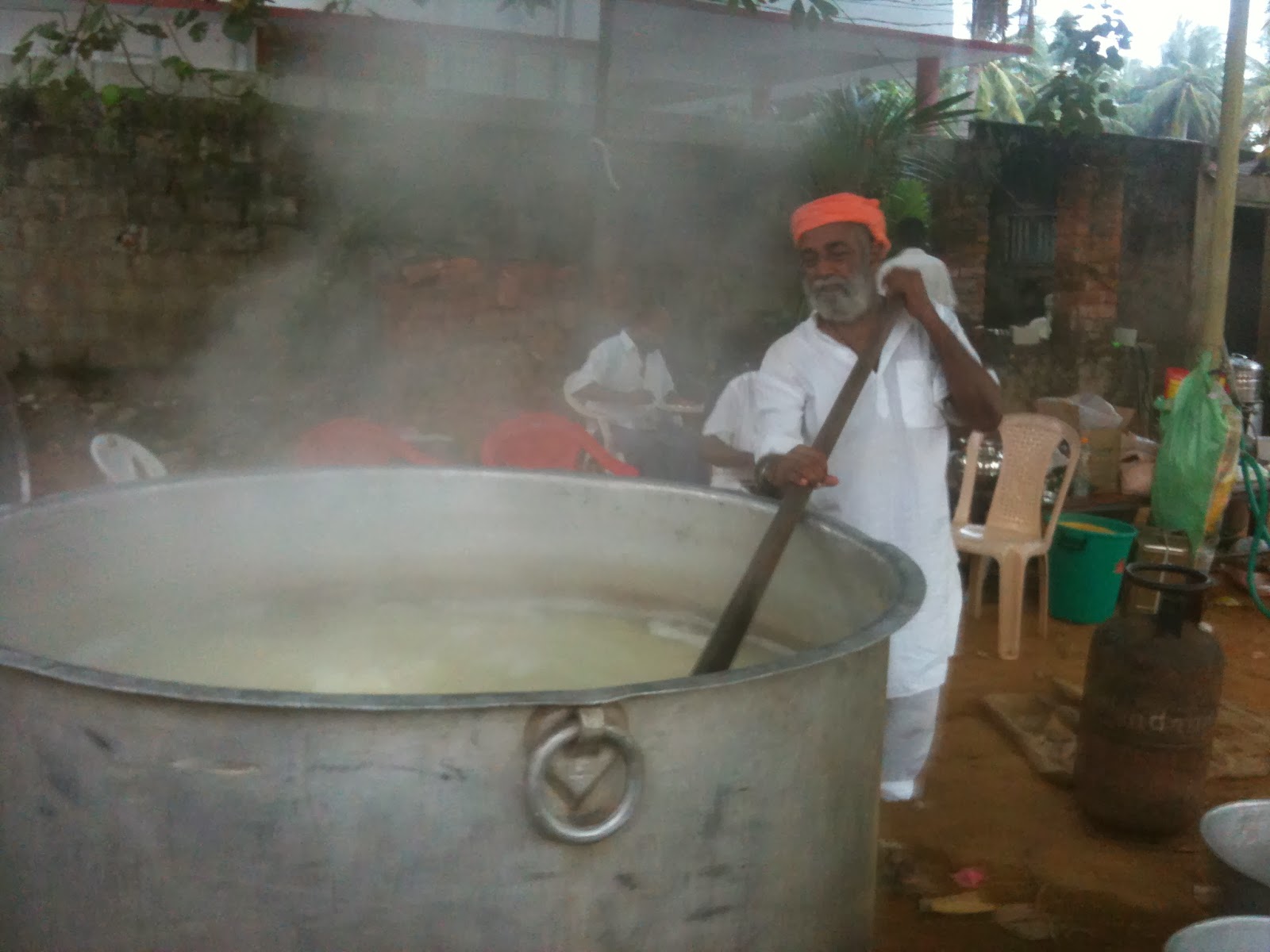
Early in the second week of January, the level of activity at the ashram skyrocketed as preparations were being made for Amma’s upcoming South India Tour. Everywhere vehicles were being loaded with the equipment and supplies needed for the tour. There are cities where 50,000 people or more will attend the programs on a given day. Imagine what it would take to feed that many people! Here is a picture of one of the pots they cook in!

Kanji Making

High numbers of ashramites, as well as the local devotees will do the work required to organize and carry out the programs. Twelve bus loads of Amritapuri devotees will be part of the tour.  All will work at the programs in one capacity or another.


Organic Gardens

A day or two after I wrote my January 5 post about the small Organic Gardens that have been popping up all over Amritapuri, I had an opportunity to visit two of the larger ones. Those are a fifteen minute walk south of the ashram. I had visited one of those gardens last year. Oh how it has grown! It started off as a tulasi farm but now contains so much more. I will be writing about it in detail for a GreenFriends newsletter towards the end of the month so will add the link to that article after it is published. For now, here are some pictures.


The other garden is called Amma’s Grace Garden. Amma’s goal is to eventually have all food served at the ashram be organic. The first step in reaching that goal is to have the meal Amma serves everyone at the ashram on Tuesdays be organic. This garden is producing a lot of the vegetables needed for that meal.