
During the week leading up to the April 14 party, there were plenty of opportunities to practice Amma‘s teaching to “Be like a bird on a dry twig, ready to fly at a moment’s notice”. The weather forecast looked pretty good a week out but then it got worse and worse. The night before the event, it seemed like there was a chance that it might not rain during the work party, but when I checked the next morning it had shifted back to 90% chance of rain during the last two hours.
We don’t cancel work parties for rain, we only cancel for high winds, so I also got practice in maintaining equanimity. There was no use in worrying about what might or might not happen; that would only result in me creating an emotional roller coaster for myself. Instead, I needed to come up with a variety of plans and decide what we would do in the moment.
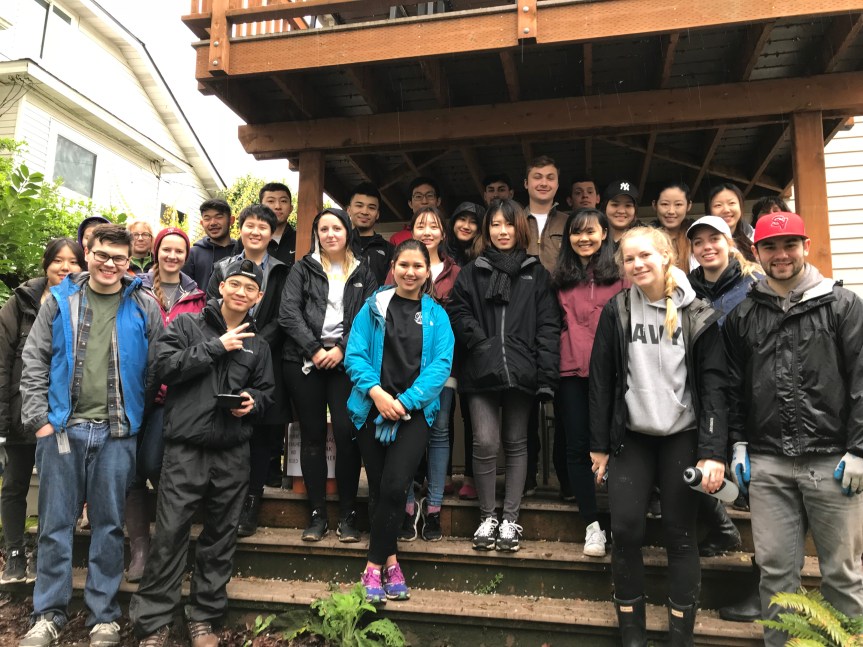
Twenty-five students from the University of Washington’s Introduction to Environmental Science class participated in the event. I felt so grateful that they were willing to work knowing that it might rain. Three GreenFriends members served as team leaders.
After an orientation, we started the day with a bucket brigade that everyone could participate in, moving wood chip mulch from an area on the street that is north of our Greenbelt site to a planting area in the southern part of the site.


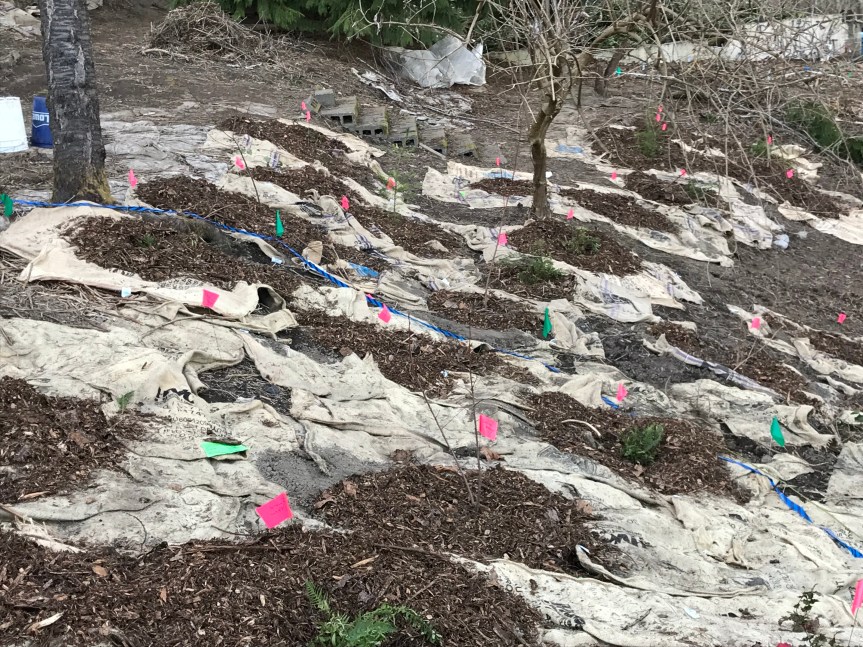
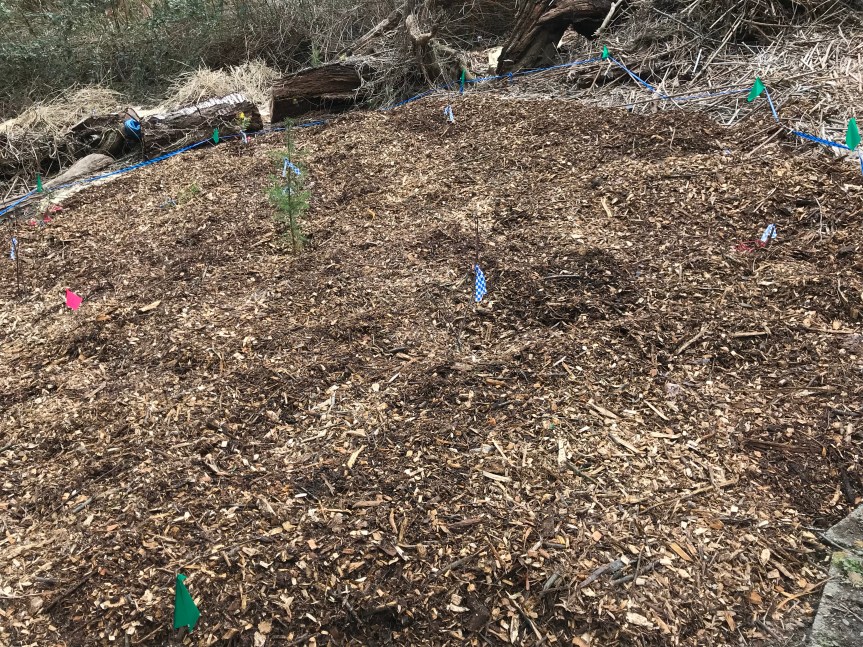
When the mulch arrived at its destination, a few students spread it four to five inches thick throughout the area. Trees and shrubs had been planted there on February 26th. Being heavily mulched will keep the ground moist making it make it more likely that the plants will survive the dry summer months. The mulch also deters weed growth and prevents erosion.
The 600 sq. ft. of land we covered that day is on a continual slope. There are several swale-like structures towards the bottom of the strip that will also help reduce erosion.


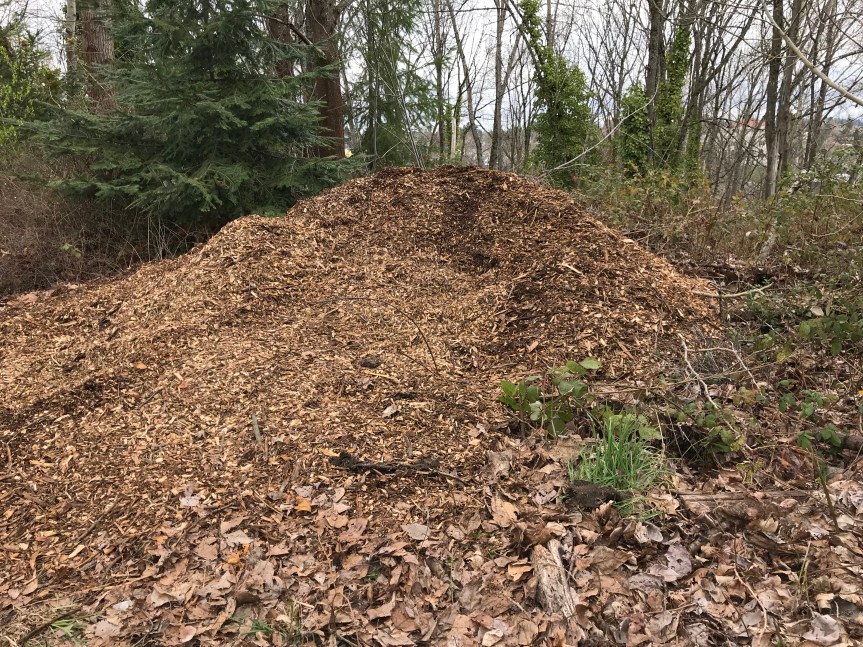
The mulch we were getting the wood chips from had been delivered on March 5. At that time, there were 15 cu. ft. of them and the pile was 6-8 feet tall. (Susan was standing on a slope so the pile was actually taller than it looks in the second photo.)


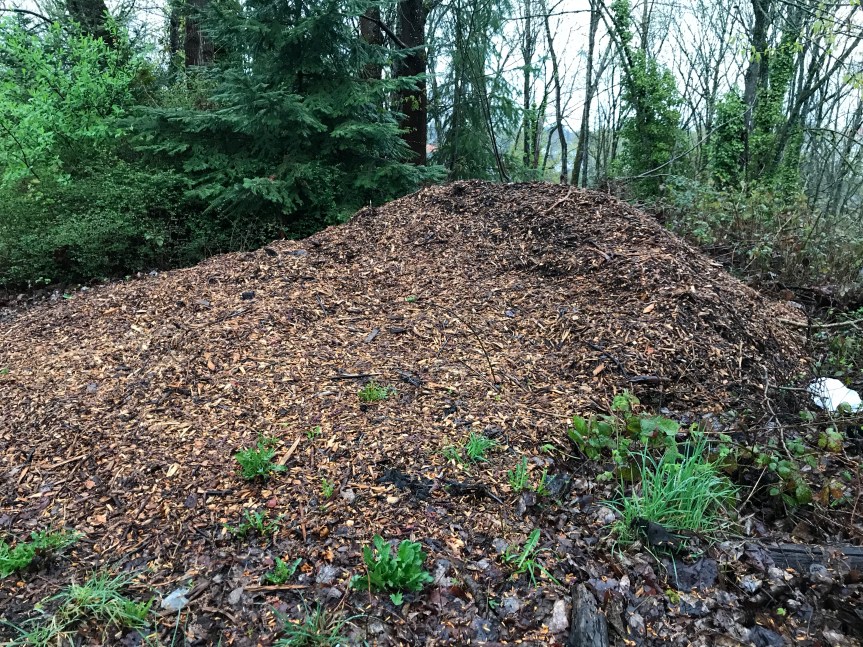
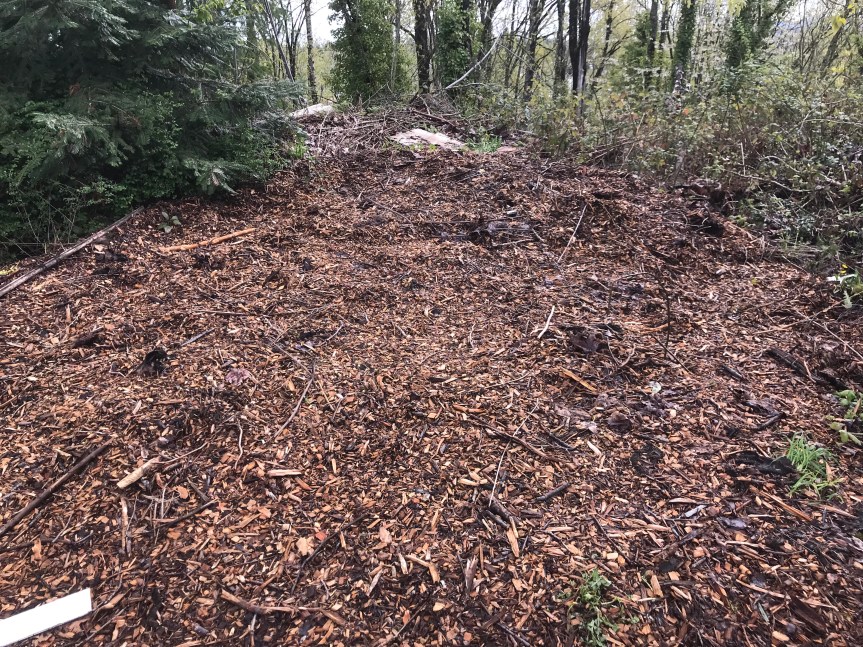
We have had three bucket brigade work parties since that time. I have enjoyed watching the pile decrease in size. I have no idea how many hundreds of buckets filled with wood chips have been passed down the line during those work parties.
After the March 17 work party the pile looked like this:
After the April 8 work party:
And after the April 14 work party:
The bucket brigade continued until it was time for a snack break. By that point, it had started to rain; luckily, it was a light rain. After the break, we broke into three groups for the last 45 minutes of work time. During that time, the groups would focus on removing non-native invasive plants- blackberry and ivy vines, bindweed, laurel, holly and bamboo.
There is a Douglas Fir tree on the northwest corner of the property that had been partially topped in the past because it was too close to power lines. On the day of the work party, the tree was surrounded by a patch of laurel so thick that the bottom part of the Douglas Fir trunk was barely visible.
The students cut off the laurel plants lower branches. As the lower branches were removed, we could see that the laurel was covering and/or displacing Pacific ninebark, Oregon grape and other shrubs. I also saw new laurel shoots nearby. Finding the native plants being crowded out by the laurel made it obvious to me why laurel is considered an invasive plant. I know that the part of the Greenbelt that is north of the site we are working on has big areas of laurel.
I appreciated being able to see more of the Douglas Fir tree truck and look forward to the day when I will be able to see all of it. I feel sad that the treetop had needed to be cut away from power lines. Seeing the deformity, though, will serve as a constant reminder that we need to be careful where we plant trees as we restore this piece of forest.


Now that it is spring, all of the trees, shrubs and ground covers we have planted since October are growing rapidly. Simultaneously, new shoots of blackberries and bindweed are emerging from the ground. There are also several areas on the site that still have ivy.
A second group of students scoured a section of the land that is full of old maple trees, sword ferns, and other older shrubs. Their purpose: locate and remove invasive plants. Everything was wet and it was still raining. The students worked diligently even in these less than desirable conditions.


The third group worked in an area that was new to us. Our plan had been to clear a path, dig out holly and cut bamboo. The group cleared a path that led to the holly and bamboo, but after a week or more of rain, the ground was too muddy to work with the holly. (We didn’t want to make the area any muddier than it already was.)
Instead the group focused on cutting and stripping the bamboo. Last year, we used the bamboo branches from another bamboo field in building the racks we create to dry out the invasive plants. We gave the stripped stalks to gardeners to use as stakes.


When the last forty-five minute work period was up, the students from all three groups took the invasive plants they had removed to the racks to dry and then gathered, cleaned and put away all of the tools. Afterwards, we celebrated our accomplishments. Then everyone brushed the mud from their shoes and headed home.
Soon after the work party was over, the rain became very heavy. April 14, 2018 turned out to have the largest rainfall that has ever been recorded in Seattle in April. Mother Nature had certainly blessed our work party. Two hours of the three hour work party had been rain-free and even though it rained during the last hour, the rain was comparatively light.
Next on our to do list:
- Finish mulching some small areas on the property that have not been mulched yet
- Weeding, weeding and more weeding
- Remulch areas that were planted in October and November of 2017
- Finish cutting down the bamboo
- Dig out the holly and bamboo
The list could go on and on but that is enough to think about today!



 Living, Learning and Letting Go