Living and Learning in Amritapuri, India: December 11 to 20, 2018


I love doing forest restoration work in the Greenbelt so much that it is becoming increasingly difficult for me to leave Seattle. As the time approached for my December/January visit to Amritapuri, I felt an increased pull to stay in Seattle. In the days before my departure, I wrote two or three people and said I wasn’t sure I wanted to go to India.

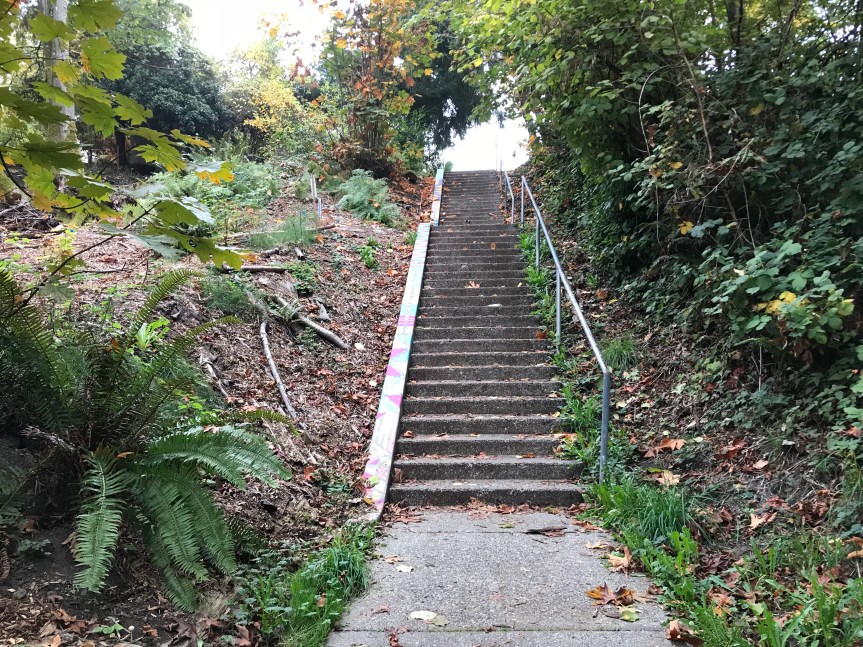
An hour before I was to leave the house for the airport, I decided to take some last minute Greenbelt photos for a post I would write when I got to India. I planned to take the pictures from the Hanford Stairs so I wore my sandals. When I arrived at the area I wanted to photograph, I decided to take two steps off of the stairs. It was on a hill but it was a spot where I had walked many times during the previous work party. What I didn’t take into account was that it had rained all week.

The instant I stepped onto the ground, I slipped in the mud and landed on my thumb. I couldn’t believe I had hurt myself again, and this time it was right before I left for India. I could move my thumb without pain so I knew I hadn’t broken anything, but I was definitely hurt… and my pants were covered with mud.

This was clearly another lesson in slowing down, staying conscious, and wearing appropriate footwear, but it also made me abundantly aware that I did want to go to India. I would miss being in the Greenbelt, but I wanted to visit my other home. Now.
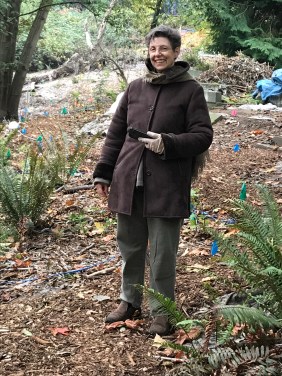
asrham-07

Before long, I was at the airport, and at 4:30 p.m. we boarded the airplane. After a 14 hour flight to Dubai, a 2 hour layover, a 4 hour flight to Trivandrum, 1 1/2 hours going through immigration and collecting my baggage, and a 2 hour taxi ride, I was at Amma’s ashram in Amritapuri.

Today is my 8th day in Amritapuri. To say my days have been full is an understatement. When I started listing what I’ve done since I’ve been here, I was surprised at the length of the list. It included projects, seva, self-care activities, classes and keeping up with challenges as they came.

My Activities list

Set up my room and washed the clothes I store in India… and the ones I wore on the trip
Daily seva (volunteer work) in the café from 7:15- 8 a.m. and 4-6 p.m.
Meals, usually with friends
Tai Chi class 8:45-9:45
Recover from jet lag and a 13 1/2 hour time change- slept or rested whenever I needed to
Coordinated the creation of January’s PNW GreenFriends Newsletter and wrote articles for it
Wrote a Pacific Northwest Tree Planting report for the national Amma e-news
Ordered bare root plants for the Greenbelt Restoration Project
Caught up on writing a backlog of blog posts
Kept current with US political events
Attended evening bhajans (devotional singing)

Healing

My hand swelled up significantly on the plane. Thankfully, once I arrived at the ashram, the swelling began to dissipate. Today, my thumb and hand are almost back to normal. My thumb is still a little sore and there are some things I can’t do fully, but the healing process is progressing steadily.

I have been dealing with shoulder, rib and shoulder blade issues for months. The physical therapy I have done recently has helped a lot. I think the Tai Chi classes I have taken at home and in Amritapuri have helped too.

Darshan with Amma

I could have put darshan on the activity list above, but it is so important to me that I decided it belonged in a category of its own. I’ve gone for Amma’s hug twice since I’ve been here. As always, that experience was “home” to me. She was so gentle. The first time was the day I arrived at the ashram. As I melted into her, I could feel the agitation and exhaustion in my body lessen and a sense of well-being spread through me. The second time, Amma held me as she talked and laughed with the people who were standing near her. Having her laugh while she holds me may be my favorite kind of darshan.

Christmas activities

There will be no Christmas Eve play this year; there will be a variety of performances instead. I was asked to be part of a choir. Practice for the song we will be singing started today. I am very excited about being part this activity. I will have a lot to say about it after Christmas, but I don’t want to spoil the surprise so am not going to say any more now.

Leelas

Leela is a Sanskrit word that is often defined as “God’s play”. I also see it as a word that describes challenges that come so frequently that it leaves one shaking their head wondering what is going on. Leelas are common in my life but their frequency increases when I am around Amma. The one that come to my mind now is the frequency at which things in my room seem to disappear. I’m used to having trouble finding things at home, but I’m always surprised about how things can disappear in a room this small. Yesterday, I couldn’t find my shampoo. I searched high and low but eventually gave up and used bar soap. Much later in the day, I found the shampoo under an upside-down bucket in the bathroom. I still haven’t found my tape measure and a variety of other things.

Prasad Giving and Prasad Assist

Two of the activities I enjoy doing here are Prasad Giving (Handing Amma the packet of ash and the piece of candy she gives each person that comes to her for a hug. Prasad Assist is making sure that the people who are giving Amma the prasad know how to do it, keeping  the line of people waiting to hand her the prasad stays full, and letting each individual know when it is time for them to move from the waiting area to the area where Amma is greeting people. I haven’t done either of those activities so far. I plan to join the prasad giving line during the next darshan day. If I do the Prasad Assist seva on this trip it will be sometime after the Christmas play.

Activities of Daily Living

Activities of daily living (laundry, bathing, etc.) usually takes longer than if I was in Seattle. I wash my clothes using three buckets; one for washing the clothes and two for rinsing. I then hang the clothes on clothes lines that are located on a nearby balcony. It always amazes me how fast the clothes dry in India. I love it!

There is a shower in my room but it only has cold water. On hot days that may be fine, but I often take a bucket bath so that I can add a small amount of hot water to the cold water. (I fill a small pan with water and heat the water using a propane burner.)

I walk considerably more when I am in Amritapuri than when I’m in Seattle. Many times a day, I walk down five flights of stairs and the distance between my flat and my destination. I usually use the elevator when I return to my room though. I enjoy tracking the number of steps I take each day on my Fitbit.

I was already having trouble getting dressed and undressed with my upper body issues. Now I’m having to get dressed a with some hand/thumb limitation as well. Luckily, I have been able to figure out how to do it, but it takes me longer than normal.

Weather

It is hotter here this year than it was at the same time last year, but it doesn’t feel as hot as it did the year before. I was with someone when they checked their weather app a few days ago. It said “87 degrees, feels like 97”. I was surprised it was that hot. I have found it quite comfortable, as long as there are fans in the vicinity! It rained the first day I was in Amritapuri but I don’t think it has rained since.

Crowds

As Christmas approaches, more and more people are coming to the ashram. The numbers of both Indian and International visitors will probably be at their highest during the week between Christmas and New Year’s.

Papaya

One of the activities I like to do in India is to buy a papaya and split it between Sreejit, Chaitanya and Akshay, my son, daughter and son-in-law, and myself. I bought a big one yesterday but it didn’t wasn’t ripe enough to eat right away. When I returned from my Tai Chi class today, I  cut up the papaya and distributed it. It was SO good!
To read previous posts in this series click here.

Practice in Letting Go: November 2018

I have found that our GreenFriends Greenbelt Restoration Project has provided me with seemly endless opportunities to practice life lessons and spiritual practices such as persistence, flexibility, being in the moment, surrender, impermanence, non-attachment, equanimity and letting go.

When I think of letting go, I think of the title of a book that I purchased in the mid-80’s, Life is Goodbye, Life is Hello: Grieving Well Through All Kinds of Loss. The title reminds me that loss is inevitable and it often, if not usually, leads to grief. I know that grief includes anger and fear as well as sadness.

I believe that every ending brings with it a new beginning and that it becomes easier for us to let go as our faith grows; e.g. faith in God, faith in ourselves, faith in others. As I reflect on letting go, I also remember that I wrote 23 Affirmations for Letting Go in 1994 and shared them in this blog in March of 2014. To see those affirmations click here.

I knew early on that the reforestation work would give me many opportunities to practice letting go. In my initial Forest Steward training, the students were told that we should be prepared to lose 30% of the trees, shrubs and ground covers that we plant. The thought of so many plants dying was totally unacceptable to me, but I also realized that I have no control over the weather and very little control over disease.

A forest is not like a garden that you can keep well watered; the amount of water that the plants receive is determined by the weather. I did have some control over whether the plants were planted properly and stayed free of invasive blackberry, ivy and bindweed vines. And I could give them my attention and my love. My job would be to put in the effort and let go of the results.

Just before we did our first tree planting in November of 2017, our GreenFriends group performed rituals asking Mother Nature for permission to plant and requesting that she protect and nurture everything we planted. We didn’t lose anywhere near 30% of our initial planting. In fact, during this summer’s long drought, only one of the trees died and almost all of the shrubs and ground covers grew substantially.

While I have experienced lessons in letting go throughout the project, November 2018 seemed to bring more of them than ever before. Before I tell you about some of those events, I will share a bit of back story. In April of 2018, I decided we would clear some of the invasive vines on Cheasty Boulevard, the street on the east side of our site. As I walked down the road looking for a place to start, my eyes fell on some gigantic cottonwoods hidden among dense blackberry and ivy vines. I thought that was a perfect area for us to begin the new endeavor.

On April 27, a corporate group from DocuSign came to work on our site. We divided the participants into several groups with each group having a team leader. One group worked on freeing those cottonwood trees from the invasive vines.

In the months after the work party, I enjoyed walking down Cheasty Blvd. to visit the trees. They were so big and majestic. The photos above don’t accurately reflect their height or their width. Then, on November 5th, I received a notice from one of the Green Seattle Partnership staff saying that a number of cottonwood trees on Cheasty Blvd. were going to be cut down. Tests had been done that showed the trees were hollow and had significant decay in the lower part of the trees and roots. If they fell, they would be dangerous.

I had a sense that some of the trees that were to be removed were “my trees” so I walked down the Hanford stairs to look. Two of those trees had big R’s written in white chalk on the trunks which confirmed my fear. I was not surprised though. The trees were very old and one had a big fungus (Ganoderma) on it, which is also a sign of decay.

My lack of surprise was also because in July, a smaller cottonwood tree had fallen across the road. I say smaller but it was still very tall; tall enough that when it fell, it took down the power lines on the far side of the street. When I looked at at the remains of that tree later, I had seen that it was hollow. So even though I was sad that the big cottonwoods were going to be cut down, I understood the importance of the act. Safety was of primary importance. It was much easier for me to accept this situation and let go than it might have been in a different circumstance.

The trees that were to be removed were so big that the city had to hire a crane company to cut down the top part of the trees. I didn’t go anywhere near the work that day, but I did look at and take pictures of it from my back yard, which borders the site. I was shocked when I saw the size of the crane through the trees. My uneducated guess was that it was 250 feet high. (There is a steep drop off between the main part of our site and Cheasty Blvd. so the bottom quarter of the crane and tree trunks can not be seen in the photos below.)

(Click on any of the galleries to enlarge the photos.)

The person in the basket not only cut off the top portion of the tree, he/she also cut off most or all of the branches . At one point during the day, my whole house shook. I thought that must have been caused by one of the tops falling to the earth, or was it a whole tree?

I thought it was curious that several of the largest trees were left standing. I later found out that Seattle Parks Department will be finishing the job.

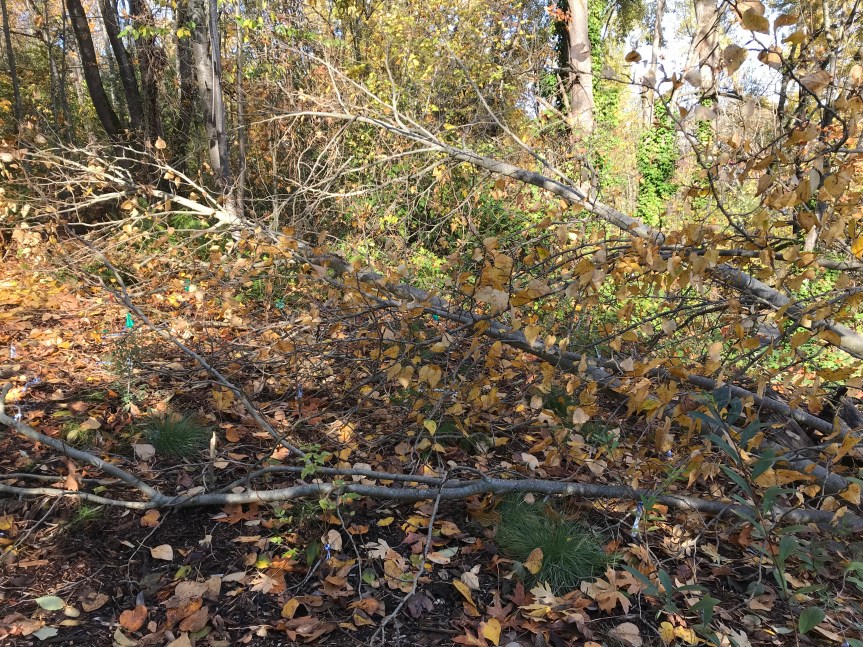
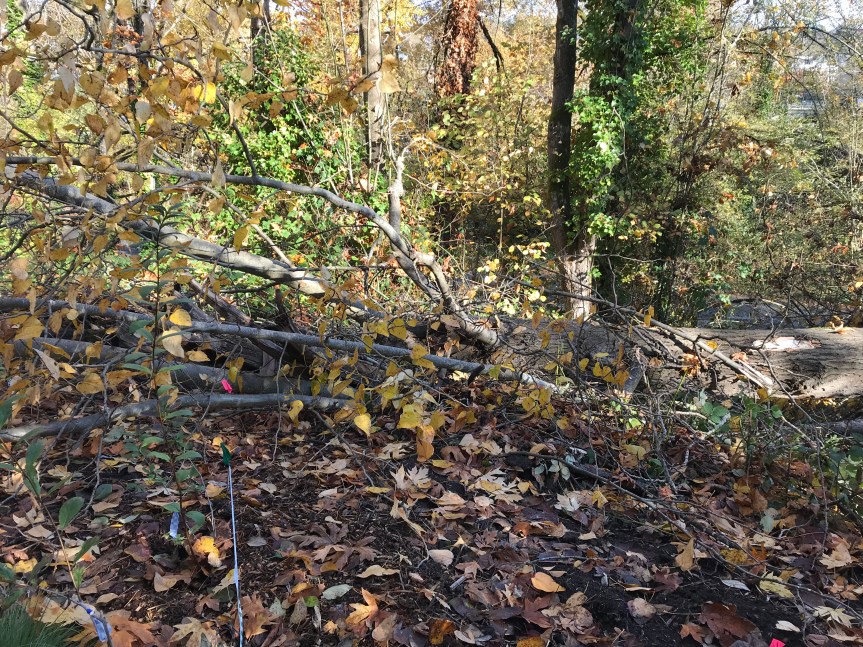
The next day, I walked into the Greenbelt, as I do most days. When I arrived at our eastern planting areas, I was horrified to see that the top of one of the trees was covering all of one planting area and part of another. I had never considered that as a possibility. There didn’t seem any chance that our plants could have survived such an event. I knew it was another letting go opportunity, but this one wasn’t going to be easy, I was way too attached.


When I looked closely, I could see one of the trees through the branches. I walked back to my house to get a pair of hand clippers and cut away some of the branches. I could tell that the tree was going to be okay.

We had a work party scheduled for the next day. It was obvious that we would need to let go of at least part of our plans for the work party. I didn’t know how we would manage to move the big branches but that wasn’t the task for the present, dealing with the smaller branches would be the first step.

I called Andrea, one of my Green Seattle Partnership supervisors. We talked about what had happened and she agreed we could remove some of the small branches but said we would need to be sure none of the ones that were holding the tree off the ground were cut. We didn’t want to chance anyone getting hurt.

Andrea mentioned that some Parks Department staff would be coming later that day and would take a look at the situation. When I walked down to that part of the site that evening, I was astounded by what I saw.

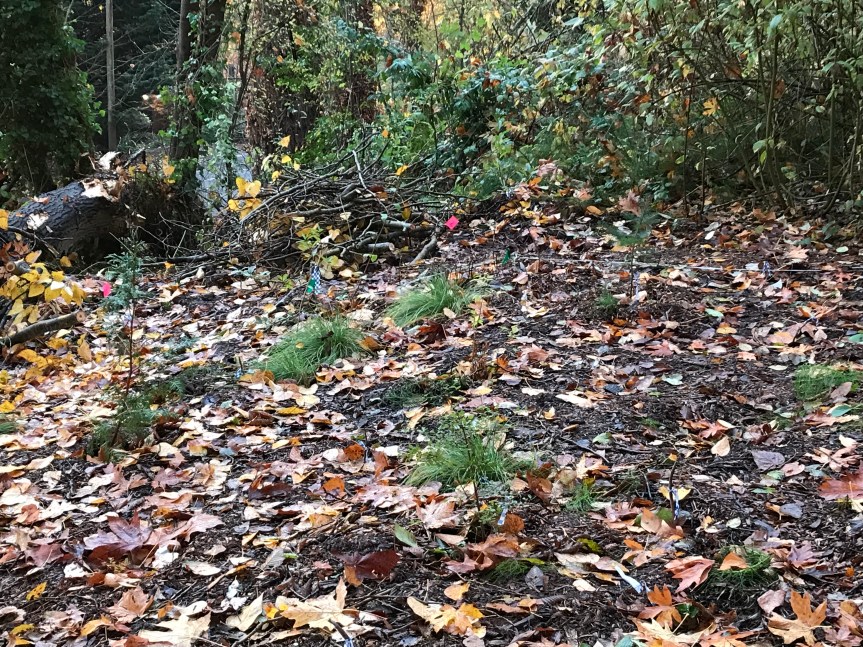
The Parks Department staff had indeed come. They had cut up all of the branches and had stacked them neatly out of the way. I soon discovered that not a single plant had been injured by the falling tree or by the staff’s work. In fact, the planting areas were neater than they had been before the event. The branches, and the trunk that had fallen outside of the planting area, would decrease the chance of erosion and would become a home for insects and other wildlife.


What an experience this had been. I felt like I had been on a roller coaster. I had been willing to let go, but not until I put in the effort to do what I could do to save the plants. I had also been willing to let go of the plans for the work party so we could do things that were more important.

In the end, the plants were fine and we were able to return to the original work party plan. My faith in the support that is available from Green Seattle Partnership and the Seattle Parks Department had grown.

As I reflected on the incident during the next few days, I remembered the rituals we had done asking Mother Nature to protect the plants. My faith in that process also grew.

One morning during the next week or two, as I was waking up, I was pondering how I would write this post. When I got out of bed and checked my email, I received another shock, and another letting go opportunity. Again, the challenge was related to the Greenbelt reforestation work.

But that is a story for another post!

Interview by Maya Klem: “Forest Steward Spotlight- Karuna Poole”

What park do you work at?

Cheasty Greenspace on North Beacon Hill.

How long have you been involved with Green Seattle and why did you chose the park where you work?

This stretch of Seattle’s Greenbelt is behind my house. The land had been overrun by blackberry vines and ivy for about 30-50 years. By 2016, the densely packed blackberry vines were five to nine feet tall on most of the property. One day in August of that year, I decided I wasn’t willing to stand by and watch trees die anymore. I found my shears and started cutting the vines away from the trees. Then I had an idea. I belong to a group known as GreenFriends. Some of the GreenFriends members in our area agreed to take on this endeavor as one of their projects. Soon thereafter, we started working with the Green Seattle Partnership.

What keeps you volunteering with the Green Seattle Partnership?

I love the work. I love watching the land transform in front of my eyes. I love working with the Green Seattle Partnership staff. I love working with the volunteers. I love serving Mother Nature. I am so grateful for all the help I receive from Green Seattle Partnership. The Partnership provides classes and supervision that is invaluable. They also provide us with the supplies we use and the trees, shrubs and ground covers we plant.

Do you have a favorite memory from your involvement?

I remember a time when I was cutting through a mass of blackberry vines and saw what looked like a small section of a concrete block. Over the next few weeks, I saw more glimpses of concrete. I remember thinking the block was at least eight feet long. What could it be? How did it get here? In March 2017, Seattle Parks Department staff cut down blackberry canes throughout the site. It was at that time, we discovered that the concrete was part of the slab foundation of a house. We think it might have burned down in the 1950’s. We turned that foundation into a place we call “The Rack Zone.” The rack zone contains the racks where we dry most of the invasive debris we have removed from the site.

What is something funny or unusual that has happened at an event/while volunteering?

It may seem strange, but I am fascinated by the trash we have found during work parties. We have removed around a hundred golf balls, four golf clubs, stuffed animals, and much, much more. My favorite items have been toy dinosaurs, a plumber’s tool kit from the 50’s, metal handcuffs and a gold bracelet studded with 27 “diamonds.” I found the bracelet, about six inches underground, when I was digging out a blackberry root ball. I assumed it was costume jewelry but as days went by, I kept thinking, “What if it isn’t?” I took it to a jeweler who, after looking at it under a microscope, determined that it was “fun jewelry”.

What part of the work makes you feel that you are making a difference in your community through forest restoration?

During the last 27 months we’ve replaced invasive plants with 88 trees and 750 shrubs and ground covers. There is no question that we are making a difference in our community as we restore this part of the Greenbelt to a place that provides shelter and food for wildlife, enhances air quality, and provides beauty and tranquility for humans and other living beings.

Is there a specific time when you looked at your restoration and felt like you were finally making progress? If so, tell us about it. If you haven’t had that moment yet, what do you think will make you feel like you are finally making progress on the ground?

Soon after I started the project, I realized that it would become much bigger than the area behind my house. Still, I was stunned and overwhelmed when the Seattle Parks Department staff cut down the invasive vines on most of the site. How in the world would we manage this huge amount of work with such a small number of volunteers? After a sleepless night, it occurred to me that it was a good opportunity to practice staying in the moment by focusing on one task at a time. That day, I decided to clear blackberries and weeds from one small area. Three hours later, I was amazed by how much I had accomplished. Suddenly, the project seemed doable. We would do it one step at a time.

If you were plant species found at your restoration site (native or non-native) which would it be and why?

I don’t have a clue how I am like Roemer’s fescue but I do know that the plant fascinates me!

If you aren’t working in the park where would we most likely find you and what would you be doing?

You would probably find me inside, in front of my laptop. I coordinate the process of putting together a monthly GreenFriends online newsletter that is usually 30-35 pages long. I also write for my blog, “Living, Learning and Letting Go.”

Anything else you want us to know?

We’ve offered around 40 work parties since we started this project. Some events have had three volunteers, our biggest had 47. I appreciate Shirley Rutherford, Claire Oravec, Haley Rutherford, and the other volunteers who have served as team leaders during our events. I appreciate Susan Zeaman, a Forest Steward from another Cheasty Greenspace park, who has been a mentor to me. I appreciate my neighbor John O’Brien who has attended almost every work party and has worked many hours on his own, or with me, in addition to the work parties. I appreciate the environmental science students, corporate groups and other volunteers who have supported this project through their enthusiasm and their labor.

To learn more about Karuna and her team’s work visit her blog by clicking here

Want to have your own chance to meet Karuna and to hear more about her time as a Forest Steward with Green Seattle? Then starting in the new year, you should attend one of the upcoming volunteer work parties at Cheasty Blvd. and help Karuna to continue her Forest Steward legacy!

~~~

Maya Klem

Stewardship Associate, Forterra

Maya was born and raised in the Pacific Northwest, and is thrilled to be part of a team dedicated to protecting the land she has always called home. Maya recently graduated Western Washington University where she studied Biology, Chemistry, and Spanish.   During her time in college, she discovered a passion for conservation and restoration work while studying in the jungles of Costa Rica and Peru. Aside from exploring tropical and temperate forests, Maya enjoys cooking, traveling, skiing, and smiling at dogs. Maya is serving a one year AmeriCorps term with Forterra.

Greenbelt Restoration Work Party: A New Beginning- December 10, 2018

In August of 2016, if you had stood on the property that borders the western section of our GreenFriends Greenbelt Restoration Project, you would have seen land covered by blackberry, bindweed and ivy vines.

If you viewed the Greenbelt from that same place today, you would see an expanse of cleared land. The invasive plants have been replaced by more than 800 native trees, shrubs and ground covers.

While there will always be more work to do on this site… lots more… it also seemed like it was time for us to begin to focus on the adjacent Greenbelt site, the one to the north of the Hanford Stairs. I have been eager to begin that work in earnest for some time.

On December 10, we held a tiny work party. Four of the five people who registered for the event were individuals who have served as team leaders at previous work parties.  Most of them have been involved with this project from the beginning. (The fifth person was a neighbor we had not met before. She and her daughter came for the last hour of the work party and dove right in; helping wherever they were needed. I look forward to working with the two of them in the future.)

This small group was an ideal way to begin our new focus. The photos below show what the area looked like when we began to work that morning.

(Click on any of the galleries to enlarge the photos.)

Before the work party:

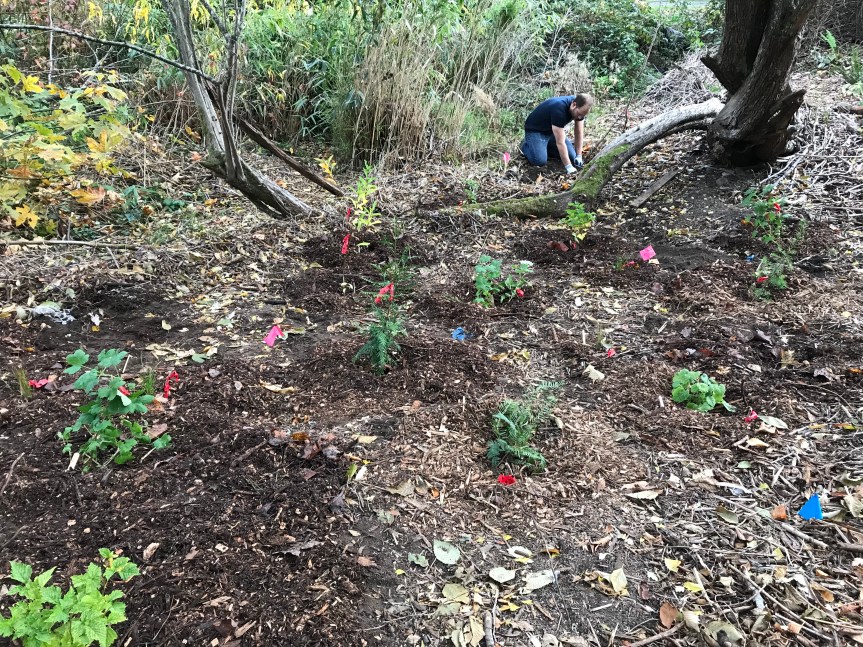
Three of the participants worked in areas along the Hanford Stairs; one worked towards the top of the stairs, one in the middle and one towards the bottom. I cleaned up an old trash dump that was about 20 feet into the site. When I needed a break from trash, I pulled out ivy in the surrounding area.

This work party was interesting for a variety of reasons. It was the first time in years that we were working as individuals instead of leading teams of volunteers. Also, since we were each working in a different area, there was almost no interaction between us. From time to time, it was so quiet that I wondered if everyone had gone home. Soon after having that unlikely thought, I would see or hear the rustling of a branch and know I wasn’t alone. Working in the silence felt very sacred to me.

We accomplished so much during that three-hour period. The transformation was remarkable.

After the work party:

This land seems very different than our original site. There are fewer blackberry vines and more ivy. There are a lot of sword ferns and Oregon Grape shrubs. It will be interesting to see what other native plants are present when as everything begins to bloom in the Spring.

We’ve barely begun to explore this site, but we only need to look beyond the Hanford Stairs to see what our next steps will be.

GreenFriends Newsletter: December 2018

To download the latest PNW GreenFriends newsletter, click on the photo.

Enjoy!


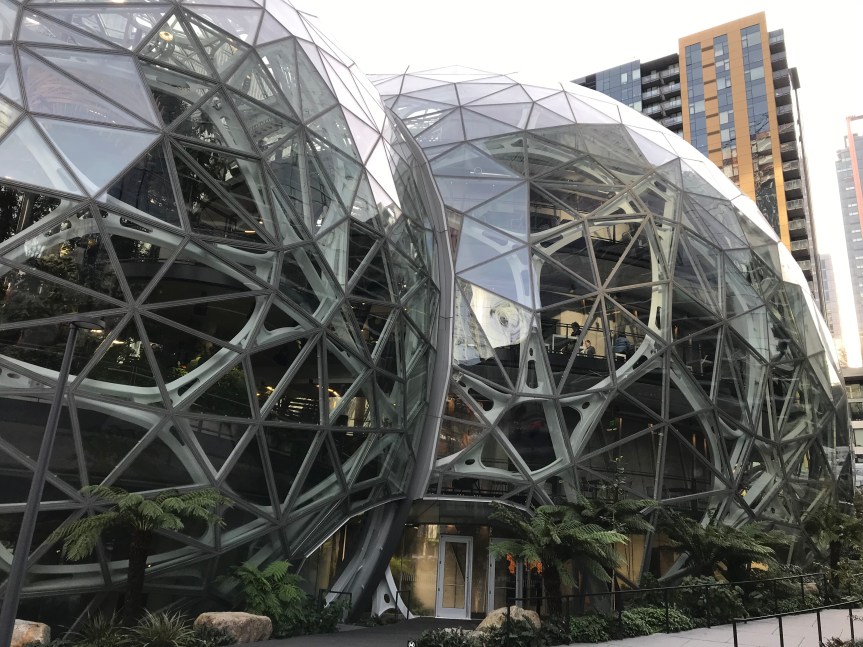
My Visit to the Amazon Spheres


I have wanted to see the Amazon Spheres since they opened on January 30, 2018. Amazon’s website says:

The Spheres are a place where employees can think and work differently surrounded by plants.

The Spheres are a result of innovative thinking about the character of a workplace and an extended conversation about what is typically missing from urban offices– a direct link to nature. The Spheres are home to more than 40,000 plants from the cloud forest regions of over 30 countries.

Amazon offers two public showings a month, but at the time I checked on them the reserved spaces were full far into the future. I decided to ask a friend who works at Amazon if employees were allowed to bring visitors. He said “Yes”, and offered to show me the Spheres. It took me until November 20th to take him up on his generous offer, but the day finally arrived.

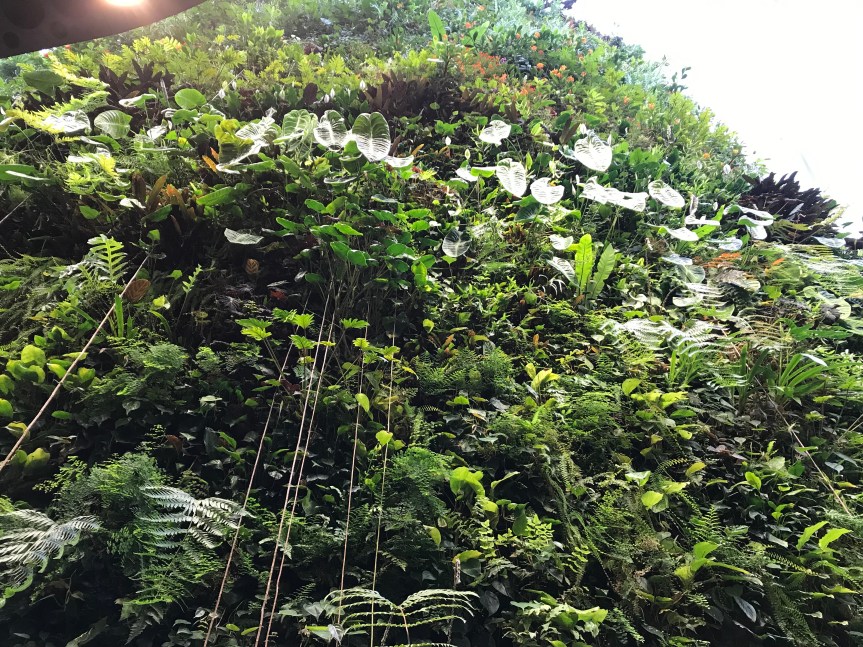
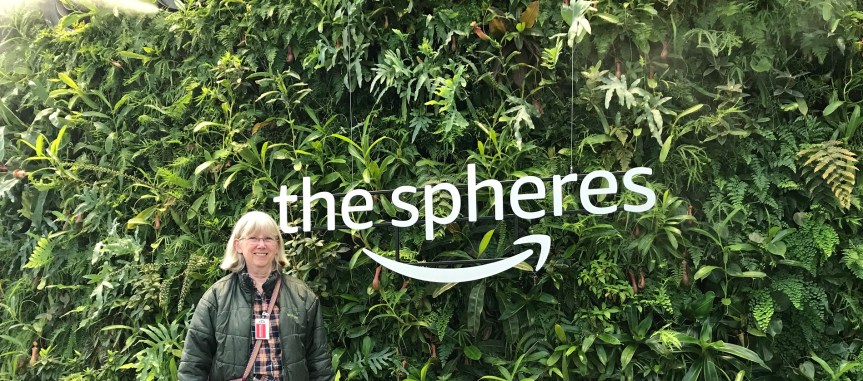
When we entered the Spheres, the first thing I saw was a living wall (aka green wall). I had looked up living walls when I was working on a PNW GreenFriends Newsletter (Issue 87, page 23) a few months ago. I was impressed by the concept and by seeing photos of living walls throughout the world. And now I was standing in front of one.

This living wall was 3 stories high. It was impossible for me to photograph it in its entirety but I did my best.


When I left the wall, I looked around me. I felt as if I had entered a wonderland. The area shown in the photo below had small waterfalls.


There were so many beautiful plants.

(Click on the galleries to enlarge the photos.)

I was surprised to learn that these were ginger plants.

I thought these carnivorous plants were fascinating. They reminded me of the Venus fly trap plant I had when I was a kid.

As Rashmesh and I walked up the stairs, we had various views of the big living wall.

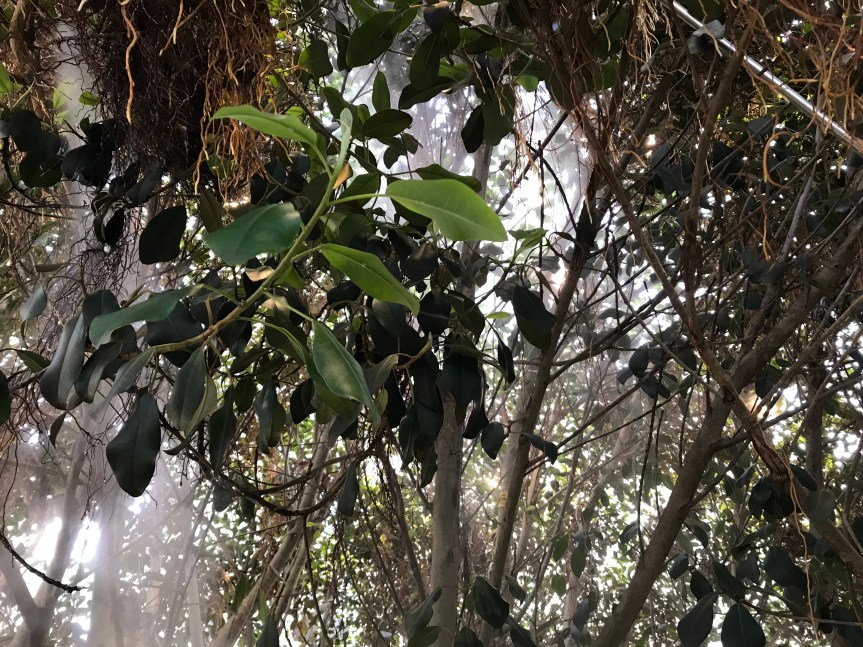
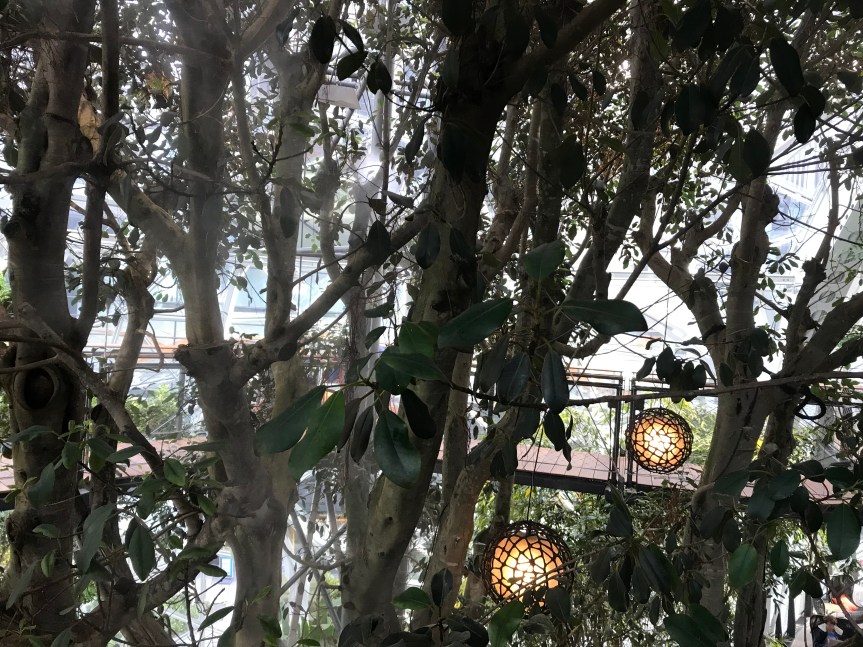
There was a tree inside the spheres that was three stories high. How in the world had they brought it to Seattle?  And how did they get it into the building, or did they build the spheres around it? I wish I had asked. The first photo shows the top part of the tree; the second shows the middle section; and you can see part of the trunk on the right side of the third photo.


The plant in the first photo below was called fan aloe. I’ve never seen aloe that looks like that! I don’t know the name of the plant in the second and third picture but I thought it was beautiful… and fascinating.

Before I knew it, we had made it through the spheres. I imagine I could visit these structures over and over and each time see plants I hadn’t seen before. Perhaps I will do that.

Thank you Rashmesh… for giving me this experience!

Guest Post: A Morning With The Greenbelt Crew by Lin Rose

Lin

“I’m looking for Karuna,” a tall young man said as he descended the first tier of the Hanford Stairs to the Greenbelt work party.

He was the last of 20 volunteers from the University of Washington’s Introduction to Environmental Science class that turned up on a cold, foggy morning in Seattle to volunteer their labor. Below us, the silver cars of the Light Rail Transit system rattled across the horizon, headed for SeaTac. Tall maples showing fall colors formed a canopy overhead, and ferns filled the understory.

“Just sign your name here on the roster,” I said, offering my clipboard. “Then follow the blue flags along the trail to find Karuna and the others and get some work gloves.”

He strode off enthusiastically into the greenery, leaving me free to walk around the work site and take pictures. I had been afraid the footing would be too uneven for me to handle, but the expertly built wood-chip trails were cushy and sturdy. I just followed the dozens of little blue flags marking the way.

Seeing what the crews have accomplished during this year’s and last year’s work seasons blew me away. The photographs over the months have simply not done the scene justice! For one thing, the drying piles of blackberry and ivy debris are bigger than they look, and areas that have been re-planted with native trees and plants have a more complex flagging and labeling system than can be captured in photos.

I could tell the layout has been carefully thought out and executed. The site will become a lovely forest as everything begins to take hold and mature.

Another way to tell what has been accomplished is to compare the left side of the Hanford Stairs to the right side.

To the right of the stairs (see the photo below—the north side of the site) is a solid wall of greenery—you can’t even make out individual trees among the tall tangle of blackberries, miscellaneous vines, and other invasive plants. It’s a telling indication of what the greenbelt volunteers had to deal with when they began the cleanup!

To the left of the stairs—the south side of the site—is an open slope dotted with ferns and tiny new plantings below the maples, cedars, cherry, and alder trees that now stand in the open, free of their former strangulation by ivy and blackberry vines.


My photos don’t do any better justice to the project than those before them—but I can’t resist trying to give a sense of the work that’s being done.

Watching the students’ bucket brigade reminded me of a line of ants as they carried wood chips from a giant pile at the foot of the stairs, across the road, up the stairs, and handed them off to other workers lined up along the trail. The trail ants ferried buckets to an area where they were being emptied around some new plantings to form a trail. Then the ants headed back down the stairs and started over. I was transfixed by all that youthful energy and willing teamwork.


Karuna unobtrusively walked a circular loop that went up and down the stairs and back and forth on the trail as she conferred with coordinators spotted around at strategic points to direct the volunteers. Clearly, she loves this place. If she stood still long enough, she might grow roots right in the middle of a cluster of ferns.

I Feel Grateful and Blessed

I dealt with numerous challenges yesterday… and this morning. Today, those challenges have been resolving one after another.

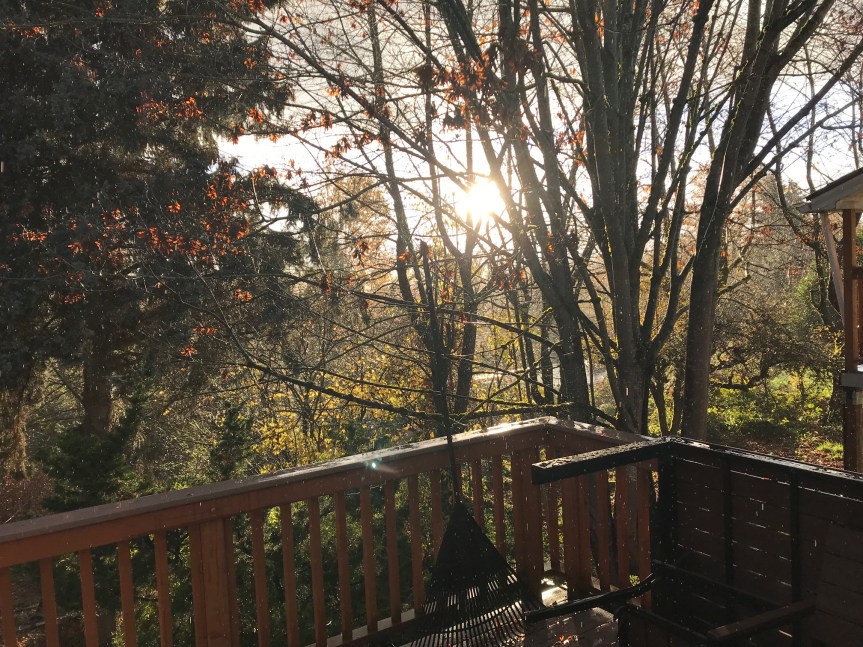
just after 8 a.m., I looked out of my dining room window and saw sunlight streaming through the trees. At the same time this was happening, it was raining. The sunlight made the raindrops sparkle. My photo doesn’t do this experience justice, but I hope, along with my words, it gives you a sense of the beauty I witnessed.
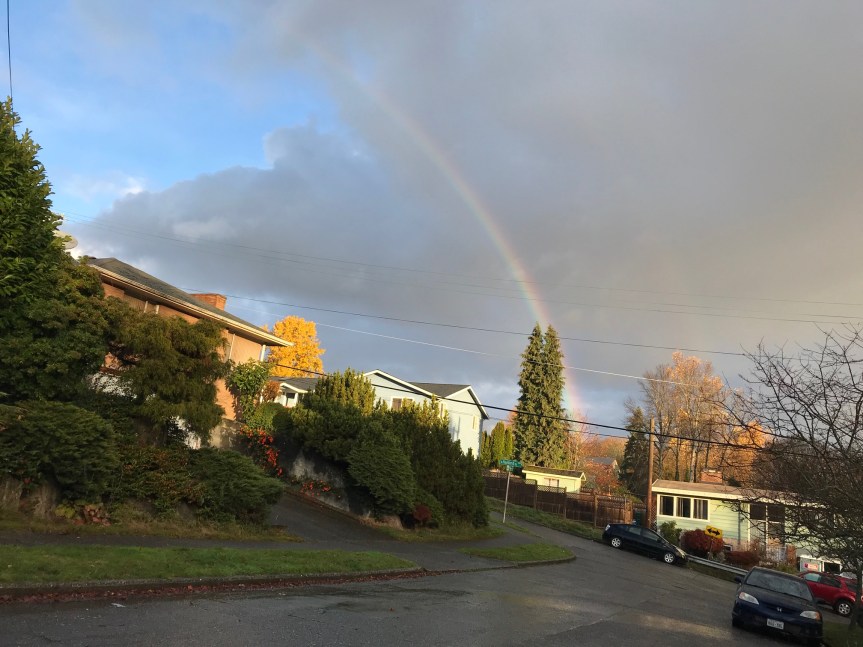
Then I got into my car so I could drive to the bakery to pick up the pumpkin pies I’m taking to a Thanksgiving dinner later in the day. As I drove out of the driveway, the first thing I saw was a beautiful rainbow. I parked the car so that I could take another photograph. The rainbow was already beginning to fade when I snapped the picture, but I think the photo offers a glimpse of its beauty. Fifteen seconds later, the rainbow was gone.

I feel grateful and blessed.

Happy Thanksgiving to all.

Greenbelt Restoration Work Party: DocuSign Planting Day- November 15, 2018

The November 15th planting day work party was the sixth forest restoration event we had held in six weeks. The first five work parties focused on preparing the site for the 33 native trees and 220 native shrubs and ground covers we would be planting. This was our fall 2018 plant list:

On November 15, 2017, a corporate group from DocuSign came to work at our restoration site. The event was held on their Global IMPACT Day. At that time, I looked up the philosophy behind Impact Day and found this statement:

We believe character is defined through action. With DocuSign IMPACT, we are committed to putting this character into action by harnessing the power of DocuSign’s people, products, and profits to make a difference in the global communities in which our employees and customers live and work.

Employees from DocuSign returned for another IMPACT day on April 27, 2018  and they would also be doing our Fall 2018 planting. I love working with them and was eager for their arrival.

The big day finally arrived. This time, 22 employees participated. Our staff consisted of Maya from Forterra; Susan, a Forest Steward from another Cheasty Greenspace site; Claire and Shirley from GreenFriends and me.

After a brief orientation, we got to work. I think the photographs below say it all!

(Click on any of the galleries to enlarge the photos.)


Once again, the DocuSign employees did amazing work and I think everyone had a good time. Rumor has it that they may come back again in April. I sure hope that is the case!

I offer my heartfelt thanks to everyone who participated in our planting day and to everyone who helped prepare for it. Each person made a significant and important contribution to returning this stretch of Seattle’s Greenbelt to a healthy forest.