Sreejit thought of me when he saw this fascinating flower on Friday. Thanks Sreejit!


Sreejit thought of me when he saw this fascinating flower on Friday. Thanks Sreejit!
The relationship between cattle and cattle egrets seems graceful to me. The photo below portrays a common scene in India. This year, I learned that cattle trust the egrets so much that they will even allow the birds to remove flies and other insects that are located near their eyes.
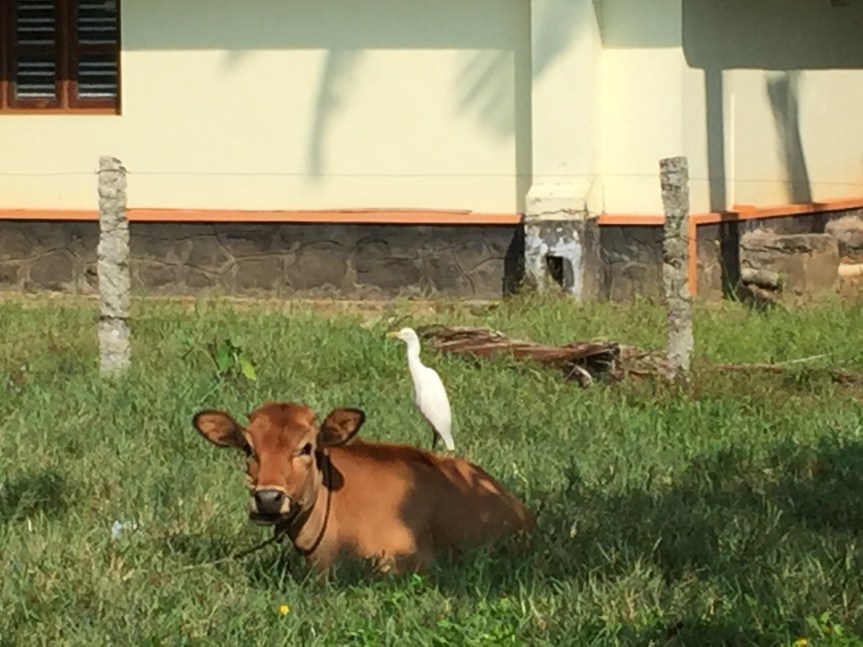 .
.
When I think of the word graceful, I think of flowers I have seen in India and in the U.S. I also thing of Brahminy kites, birds which are in the same class, order and family as eagles. Every year, I watch them soar above Amma’s ashram in Amritapuri, India.


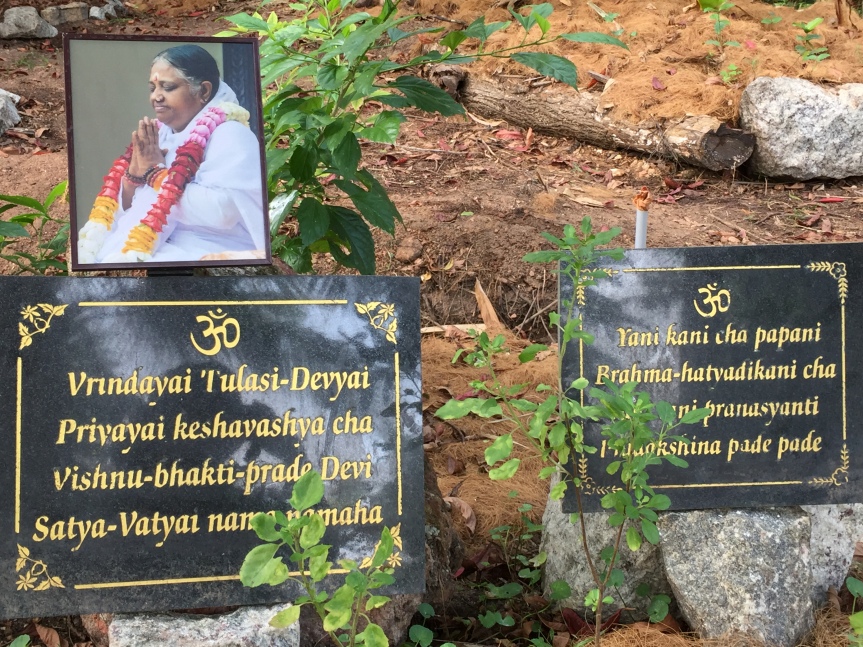
On January 8th, I visited one of the oldest gardens in Amritapuri. While it is known as Amma’s Vrindavan Tulasi Field, it has become so much more.
In the early years, growing tulasi was the main focus. Then, the volunteers who worked at the farm discovered that Rudraksha trees were scattered around the property. Rudraksha seeds are considered sacred in India so they started harvesting the seeds and planting more of the trees. They also began growing vegetables and other plants.
Farming on that property has been such a struggle over the years. Among the problems they faced were lack of water, poor soil, and bugs. When I visited the farm last year, what I saw took my breath away. It had turned into paradise. (To see photos of last year’s visit, click here.)
When I went there this year, I was amazed by all the new projects that were underway. The first thing I noticed was an irrigation system that was under construction. I thought about all the years they have watered using small hoses. What a difference the irrigation system will make.


Then I noticed all of the raised beds. I was told that when there are heavy rains, the farm floods. With raised beds, the plants will be higher than the water. Several swales have been constructed to drain off the flood waters, but the photos I took of those ended up looking like flat ground, so I didn’t use them.


There is a big pond on the property. The plants that are growing in the pond are used for mulching. I saw, and talked to, volunteers who were constructing stairs that will go into the pond to make harvesting those plants easier.


There are rudraksha trees on several parts of the property. They are easy to spot because their trunks have all been painted white. Next year I will ask why they do that!

The numerous tulasi fields are thriving.


Many fruits and vegetables grow on the property.


I was surprised by the many varieties of eggplant. Later, I saw a bright yellow eggplant at Saraswati Garden but it was on the phone I lost on my last day at the ashram so you will have to use your imagination to see that one. I was particularly fascinated by the eggplant that looked like an egg!


The plant below is called Lakshmi Taru, The Paradise Tree, The Tree of Heaven, Simarouba or Simaroubaceae. It is a medicinal tree that has been used to treat dysentery, malaria, cardiac palpitations, asthma and epilepsy. It may have a role in cancer treatment.


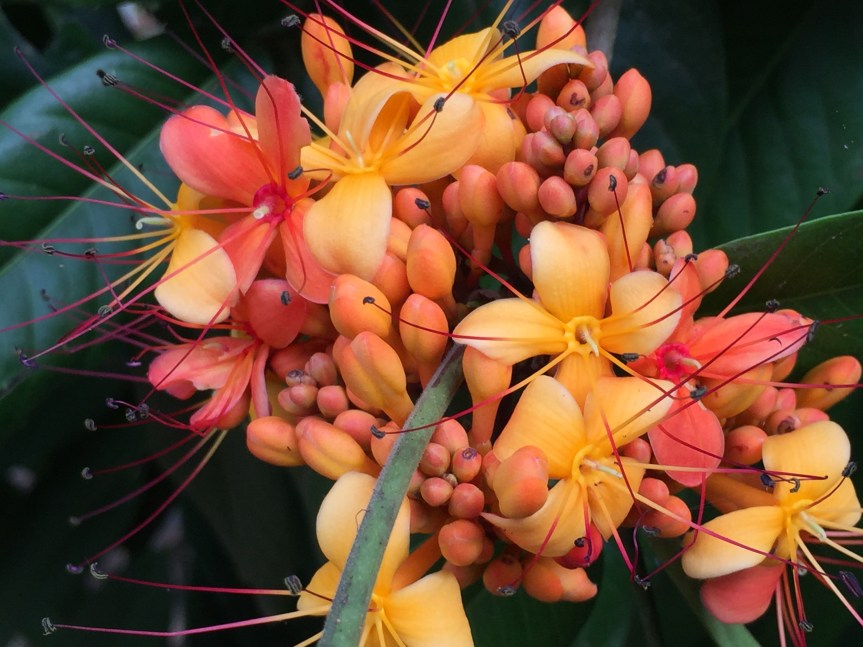
I was intrigued by this flower.

Later, I learned it is a Sita Ashoka flower. Ashoka means “without sorrow”. Hindus believe that Sita, wife of Lord Rama, sat in a grove of Ashoka trees after she was abducted by the evil Ravana. Buddhists believe that Lord Buddha was born under an Ashoka tree.
I found this photo of an Ashoka tree on Wikimedia.
I will leave you with some final images of Amma’s wonderful Vrindavan Tulasi Field.


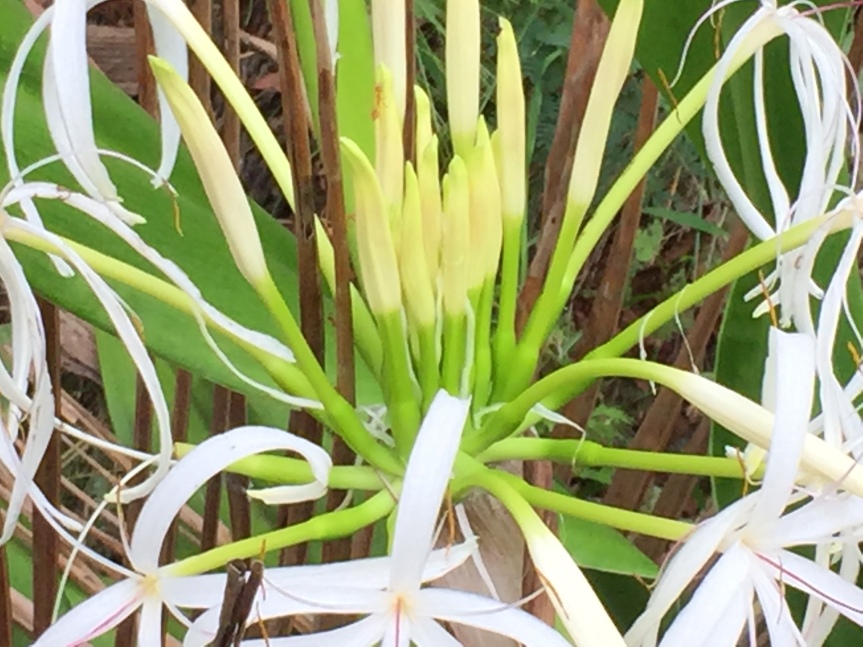
This gallery includes of some of the flowers I saw in my last few days in India. Some are from the ashram, some are from the farms and some I saw when I was walking.


Monday, January 9 was another full and rewarding day. My main goal was to visit Vrindavan Farm, which is located in a part of Vallikavu that is south of the Amrita Ayurvedic College. I wasn’t sure how to get there so I decided to go by rickshaw and then walk back to the ashram when I was finished.
I will be writing a whole post about that farm later, but will share some photos, including the one above, with you now so that you can get a sense of what it was like.


A sevite (volunteer worker) offered to take photos of me. Normally I would say no, but I decided to let her do it. I enjoyed seeing the shots she took. I had no idea how much my hat protected me from the hot sun!


While I was at the farm, I talked with one of the other sevites. I discovered that he works at the Amrita Serve Garden in addition to Vrindavan Farm. I have been trying to find out the location of that garden so was excited that I had met someone who knew the answer to that question. He was willing to take me there later in the week, but our schedules didn’t line up very well. I asked him for directions so I could go on my own.
He said it might be hard for me to find it, since I had to locate a particular foot path. I decided to try. If nothing else, my Fitbit would record a lot of extra steps!
On the way, I walked by a building that I have thought was a new supermarket. I had seen the supermarket sign, but the store it was on looked so small, I didn’t bother to check it out. When I walked by the sign this time, I noticed it was just an advertisement. The supermarket itself was located off the road behind the small store. I was astounded. I’d guess it is nearly ten times the size of the other “super” market in town. There is no other shop in Vallikavu that is anywhere near that size.
I continued walking, passing by the supermarket and a new temple that was under construction. I saw two foot paths. I started down one path, but in a short time decided it was the wrong one, so I turned around and came back to the main road and took the other path. On that path I saw these:


After some time on the new path, I reached a paved road. I was clearly on the wrong path so I again walked back to where I had started and re-took the original path. After some time, I saw the garden I had been looking for.
No one was present to show me around, so I just wandered. Before I leave Amritapuri, I’m going to meet up with the man that gave me directions so I can learn more about that garden. I will pass on the information he gives me when I write the main post about the Amrita Serve garden. For now, here is a glimpse of some of the plants. [Update: I met with the sevite on 1/12. When he looked at the photos he told me that wasn’t the Amrita Serve garden. I apparently was on a private farm that grows tapioca, coconuts and bananas! There aren’t signs on either property and there are private houses on both so I had never considered that option. I had been told that it was after a purple house. There was a purple house just before this one too. I’m going to see the Amrita Serve garden this morning, 1/13.]


When it was time for me to walk back to the ashram, I decided to take the canoe rather than walk over the bridge. It the first time I had done that since the bridge was built, eight years ago.


I felt so peaceful floating on the water, and the ride to the peninsula only cost 10 rupees (about 15 cents). I may never walk over the bridge again.
In addition to having a wonderful morning exploring the gardens, I had walked more than 13,000 steps!
To see all of the posts in this Amritapuri series, click here.
To see all of the posts in this Amritapuri series, click here.
On Friday, this banana leaf shoot caught my eye.

I found it interesting to look at the leaf-in-the-making up close.


When I went to the garden on Saturday, this was what I saw.


On Sunday, I had a big surprise awaiting me!


The new leaf felt like soft vinyl. I wish I had been present at it’s moment of birth.
To see all of the posts in this Amritapuri series, click here.


To see all of the posts in this Amritapuri series, click here.
The Art and Craft of Blogging
A collection of discussions on the environmental issues
“The fool doth think he is wise, but the wise man knows himself to be a fool.” “Love all, trust a few, do wrong to none.” “Love looks not with the eyes, but with the mind, And therefore is winged Cupid painted blind.”-William Shakespeare
...moments of unexpected clarity
Home of Lukas Kondraciuk Photography
Wellness, Support and Mindset
Thoughts on Creativity & Deeper Things
A Blog by Novella Carpenter
Ramblings of an Irish ecologist and gardener
Teaching the art of composition for photography.
Blog from SathyaSaiMemories ~ stories of love in action and the benefits of giving
There are 11,507 stories in Haddonfield; this is one of them.
Perennial gardening and more from the Green Mountains of Vermont
Whatever it will be...
Welcome to my little slice of the blogosphere
 Living, Learning and Letting Go