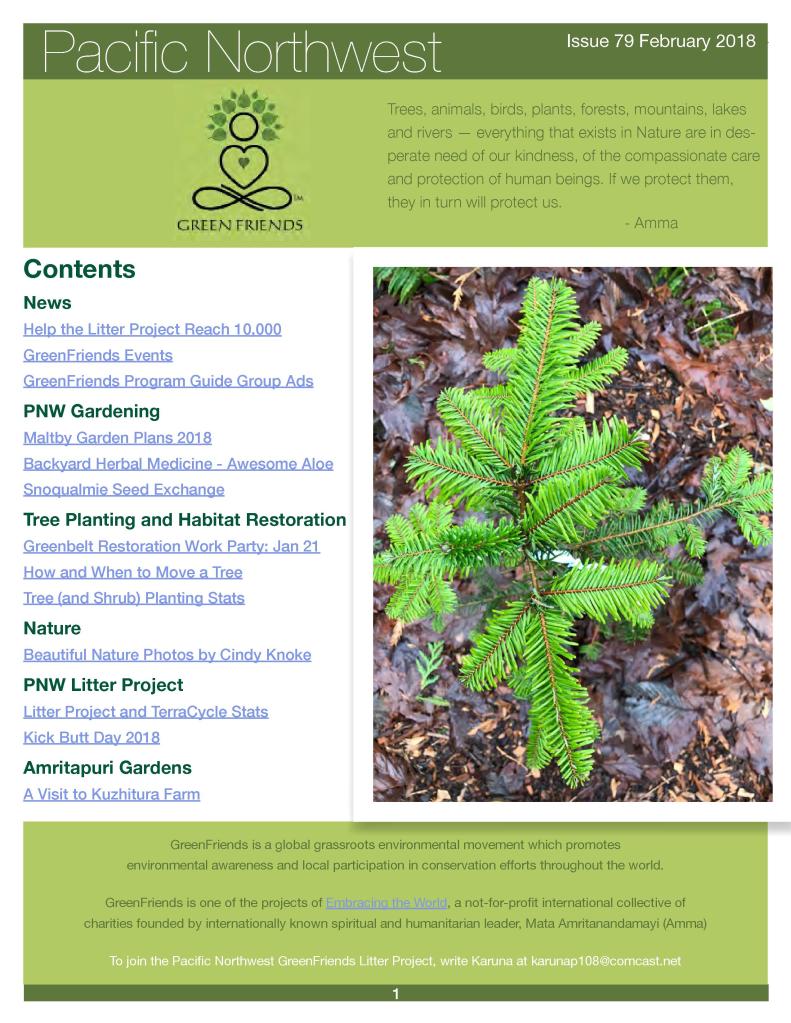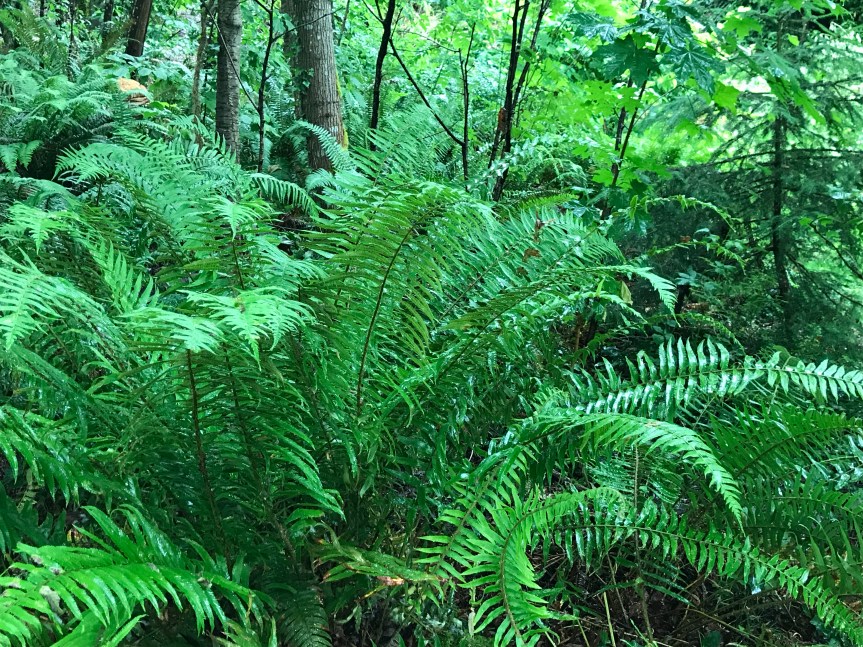
PNW GreenFriends Newsletter: February 2018

I spend a significant amount of my time each month working with a team of people to create the monthly Pacific Northwest GreenFriends online newsletter. We published our 79th issue today! What began in September 2011 as a several page Microsoft WORD document has turned into a beautiful newsletter filled with interesting articles and photos. Sometimes, I think we should call the publication a magazine rather than a newsletter.

GreenFriends is a global grassroots environmental movement which promotes environmental awareness and local participation in conservation efforts throughout the world. GreenFriends is one of the projects of Embracing the World, a not-for-profit international collective of charities founded by internationally known spiritual and humanitarian leader, Mata Amritanandamayi (Amma)

It is my experience that readers who live outside of the Pacific Northwest also find the newsletter interesting and valuable so starting with this February 2018 issue I’m going to post them on my blog.


To download the newsletter, click on the photo.

Enjoy!

One Piece at a Time

Nature on its own is indeed beautiful and clean. The hills and rivers do not need us to clean them. In fact, it is nature’s water which cleans us; it is trees which purify air for us. Because we have littered, we have spoilt its pristine beauty.                                                                                                               

~Amma

 I once read that every piece of plastic that ever existed still exists. While that statement has been challenged (politifact.com), there is no disputing the fact that plastics decompose very slowly and some may never decompose.

We have certainly seen evidence of the long life of plastic in the GreenFriends Greenbelt Restoration Project that Seattle Satsang members are leading. The areas we are restoring have been covered by blackberry, ivy and bindweed vines for 30-60 years. With the aid of Green Seattle Partnership, the City of Seattle Parks Department, and volunteer groups such as students from the University of Washington’s Introduction to Environmental Science course, we are helping to return this stretch of Greenbelt to the beautiful forest it once was.

When the Seattle Parks Department staff initially cut down the blackberry vines for us, they discovered the foundation of a house that had burned down in the 1950’s. We found many plastic items in or near that foundation. It appears that a lot of plastic trash was also thrown into the Greenbelt by nearby residents and passersby.

My house borders this Greenbelt property. When I cleaned out my bird houses last winter, I found a sizable bird nest. I was shocked by the amount of plastic a bird had used in constructing it (Photo 1). Photo 2 shows the pile of plastic I removed when I took the nest apart.

My experience with the bird nest opened my eyes to all the plastic that was in our Greenbelt site. After than, anytime I walked through the property, I saw that the ground was littered with flecks of plastic. I worried about the toxicity of the plastic and also remembered a photo that I once had seen of the contents of the stomach of dead albatross at Midway Island. (See Photo 3.) I felt an urgency for us to remove as much plastic from the site as possible, before the birds could start using it for nesting material.

512px-albatross_at_midway_atoll_refuge_8080507529
Photo 3 – Photo Credit:Wikimedia

We invited Seattle Satsang’s Bala Kendra group (our spiritual community’s children’s group) to come pick up litter. Photos 4 and 5 show the litter they picked up in one hour’s time. In addition to this diverse pile of garbage, they removed many small flecks of plastic from the ground.

Much of the trash our volunteers have removed from the site during the past year has been plastic. While the items might be dirty, as you can see in Photos 6-13, many of them look basically the same as they did decades ago.

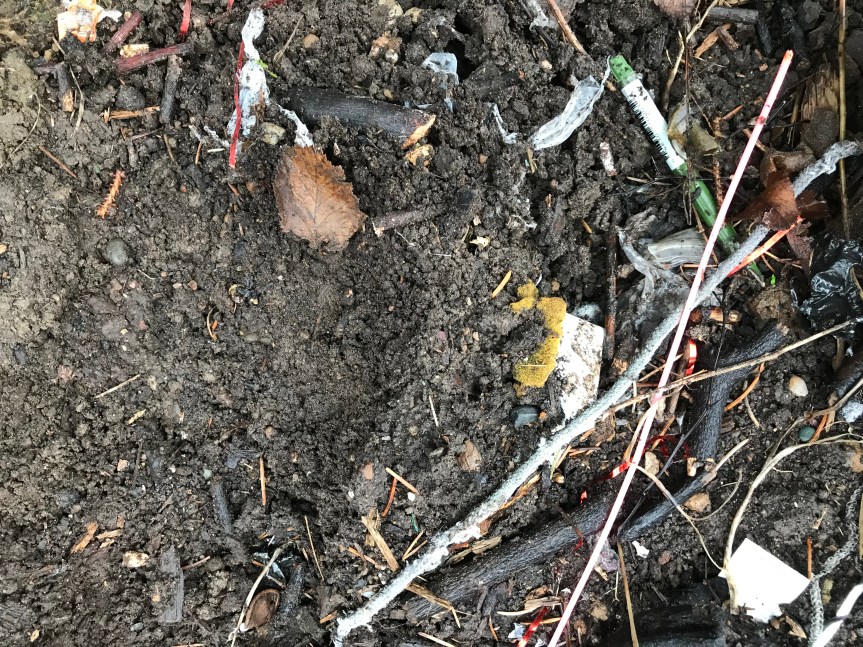
Yesterday, I picked up the remains of a pile of burlap bags that we use to cover the ground after we clear it. Under the pile I saw this:

Photo 14

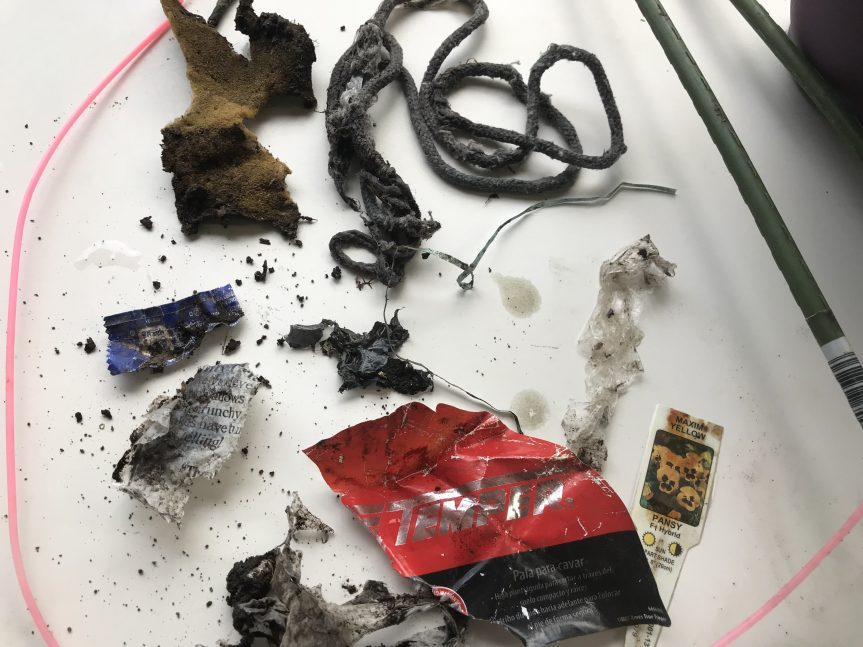
I went back later and pulled out some of that trash so that I could photograph it. Photo 15 shows those items. There was rope, candy wrappers, a garden stake, line string for a trimmer/edger, a plant sign, carpet pad and assorted other kinds of plastic.

Photo 15

Today I remembered another piece of plastic I had recently seen. I went back to that place and began to pull the plastic bag out of the ground. Photo 16 and Photo 17 show what I uncovered. Often, when I pull out plastic, what emerges is even bigger than this!

I wonder if we will ever come to the end of the plastic trash on this site! Maybe not, but every piece someone removes helps reduce the negative impact that humans have had on nature in this space and gives nature a chance to restore itself to its pristine beauty.

Greenbelt Restoration Work Party: January 21, 2018

I returned from India on the afternoon of Saturday January 13 excited to get back to my work in the Greenbelt. I had scheduled a work party for the first day that I thought I would be reasonably fit after such a long trip. That day was Sunday January 21.

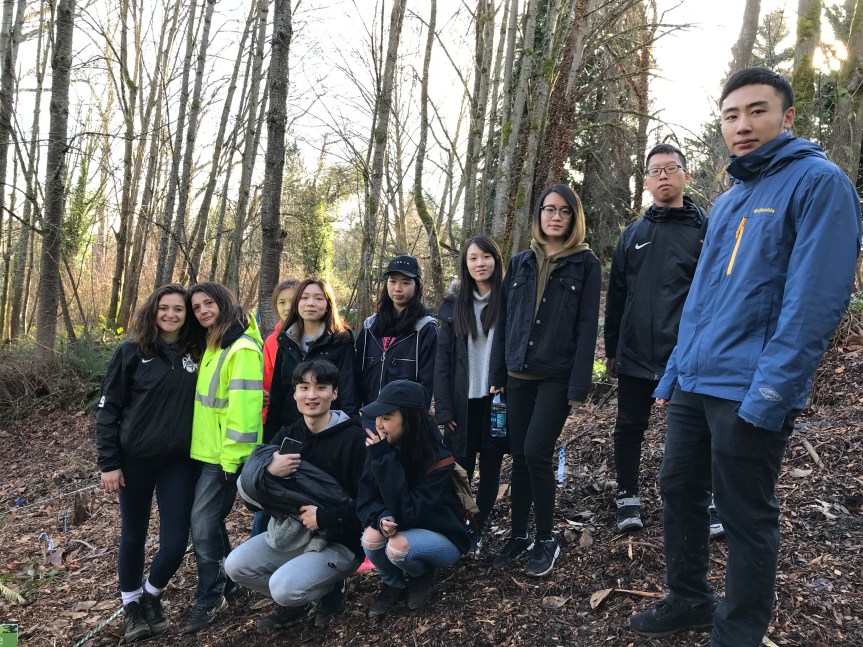
Sixteen people participated in the work party: 2 GreenFriends members, 9 students from UW’s Introduction to Environmental Science course, 3 neighbors, a high school student and her mother.

The group was enthusiastic and accomplished so much. One team worked to remove ivy and blackberry rootballs from a section of the property we haven’t tackled before.

(You can enlarge the photos by clicking on the galleries.)

Another team worked in the “rack zone”. When the blackberry vines that had been growing on this property for 30-50 years were initially cut down, we discovered an old house foundation.  A volunteer suggested that we use the foundation to store all of the racks that hold the blackberry rootballs, ivy and bindweed that we dig out. [Note: We put the debris on racks so it stays off the ground. That way the plants won’t re-root, and by having air flow coming up from the bottom of the rack, the debris will decompose faster. Also keeping the racks in one area, rather than scattered throughout the site, gives us more planting space.]

When the debris decomposes, it becomes new soil. Our plan is to spread the partially decomposed materials throughout the foundation and build new racks on top of them. Eventually there will be a thick layer of dirt in the foundation and we will be able plant beautiful shrubs and ground covers in it.

During this work party, we started taking the racks apart for the first time.

As each one was disassembled, a new rack was built on top of the partially decomposed debris, and then the ivy and blackberry rootballs the other team had just removed from their work area were placed on top of the new racks. It will take several work parties to redo all of the racks but we got a good start. (Click on the photos below to see the full captions.)

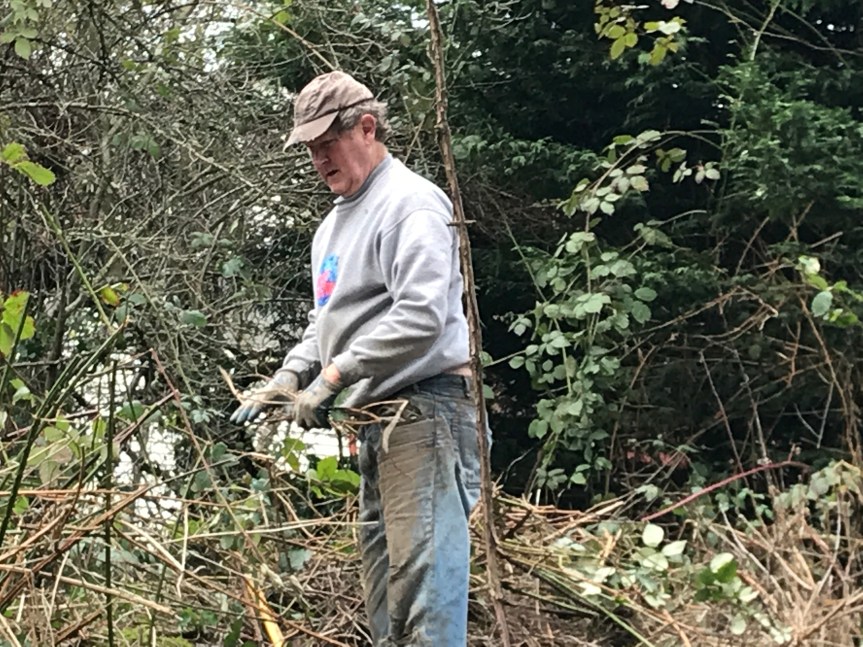
My neighbor John, who has diligently worked on this project from the beginning, cleared an area of blackberry canes and rootballs.

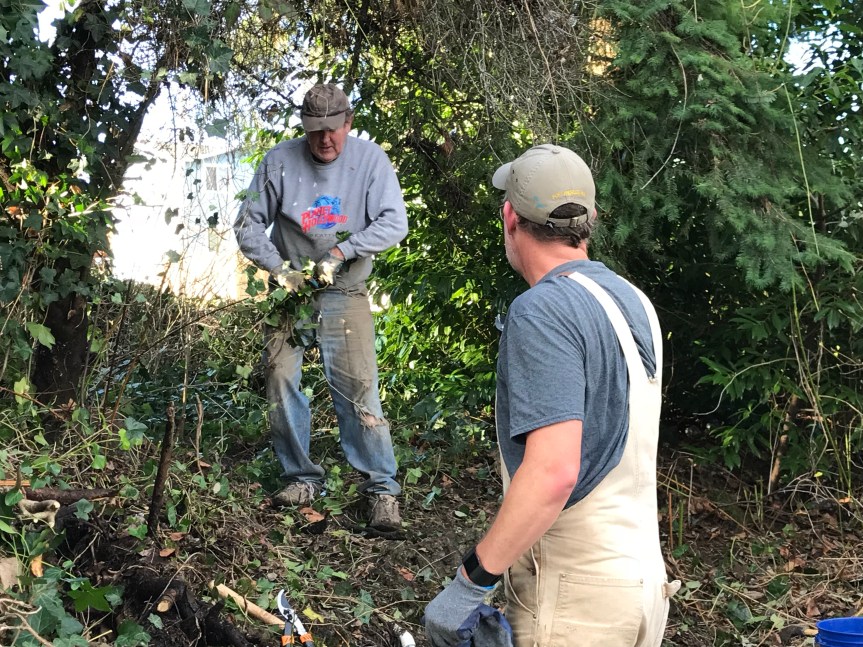
For the last part of the work party, John and Jason worked in an area where ivy had killed two trees by wrapping itself around the tree trunks.

While they were doing that, the rest of us moved 1000 square feet of burlap bags from the street into the Greenbelt. I had no idea we would be able to move all of it in an hour, but we did!

Having the bags in the Greenbelt will give us easier access to the burlap when we are ready to spread it over newly cleared land. [Note: Spreading burlap bags over the cleared land helps prevent weed growth. Over time they will decompose and enrich the soil.]

In the past, we have dumped the burlap into mounds.

At a work party last fall, one group of students laid the burlap bags flat. Those bags were so much easier to spread than the wrinkled ones, so we decided to place all of burlap we were moving into flat piles!

Mother Nature really blessed this work party. The weather forecast app said the chance of rain at the beginning of the event was 90% and that the rain would continue throughout. The reality was that it sprinkled as I was setting up ahead of time and we had NO rain during the three hour work party. About an hour after the work party was over, it poured. Grace prevailed.

Even though I was still dealing with jet lag from my India trip, I was in bliss throughout this event. I love this work!

I give special thanks to everyone who helped by leading or being part of a team as well as to the neighbor who was willing to come early and help everyone sign in as they arrived.

Our next work party will be Saturday, February 3. If you live close enough to Seattle to participate and want to join us, you would be more than welcome! If you are interested in attending, leave a comment below.

A New Video from Sooryagayathri

I was excited to see that Sooryagayatri has a new video. Her voice is as pure as it was when she was nine. What a blessed person she is.

You can learn more about her from a post I wrote in August of 2016 Sooryagayathri- A Mesmerizing Child Singer. Thank you Ramana for introducing me to her music.

An Unexpected Visitor

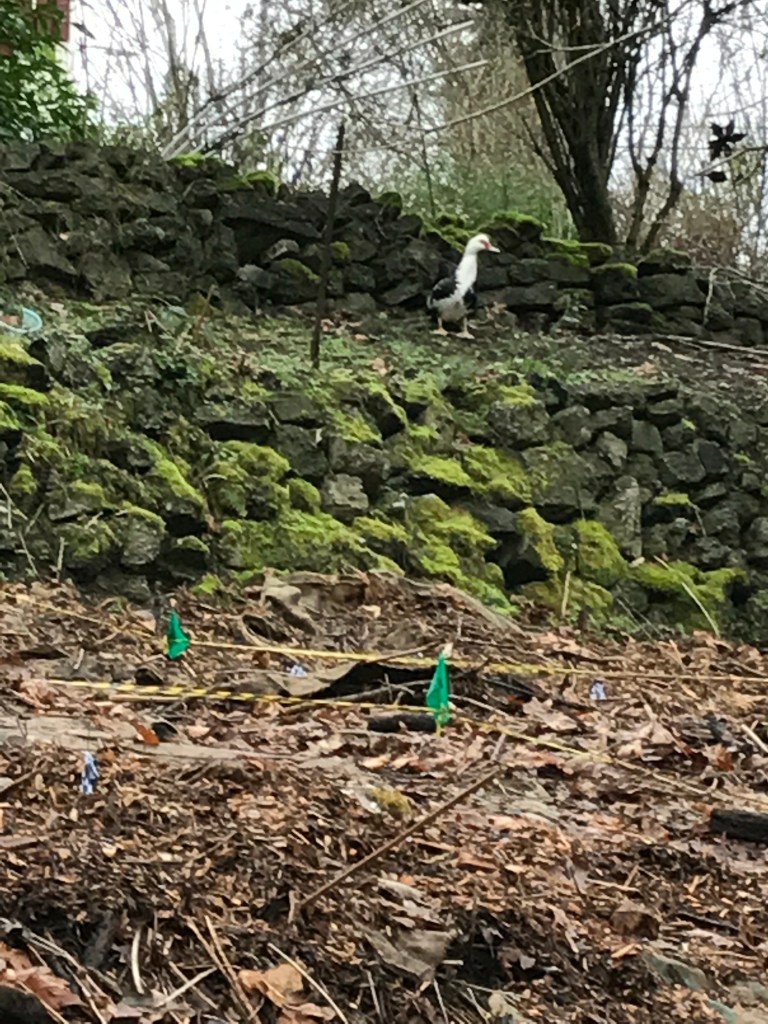
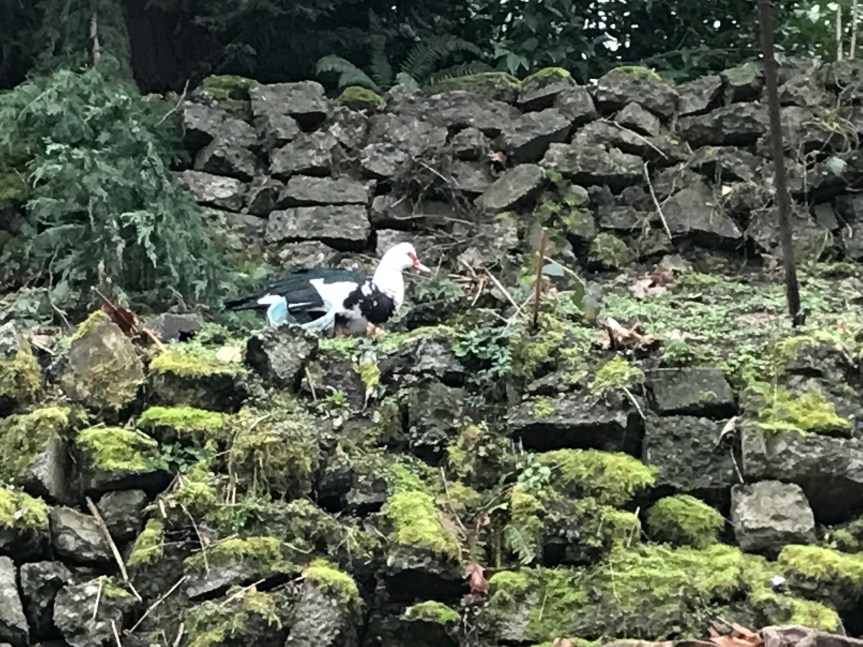
When I was working in our Greenbelt restoration site a few days ago, I was startled to see this bird staring at me. I walked closer to it so I could take its picture.

We looked at each other for a while. Then the bird walked over to a broken bowl and started drinking rain water.

At first, I thought the bird was a duck. Then, I decided it was too big to be a duck, that it must be a goose. I was concerned that it might start eating our newly planted shrubs.

As I pondered the situation, I wondered how a goose managed to get to Beacon Hill; we aren’t that close to Lake Washington.

Eventually, I started working again and just ignored it. At one point, when I looked towards the ledge, the bird was gone.

A few days later, people started posting notices on NextDoor, commenting on a duck that had been spotted in a variety of places in my neighborhood. One person said that it had even stopped traffic.Another person included a photograph. It sure looked like the bird that had visited me. Future posts revealed that it was a pet.

I felt embarrassed that I didn’t know the difference between a duck and goose, until I googled it. There are so many similarities between the two birds. One of the main differences is that a goose is usually bigger.

Someone wrote on NextDoor that the bird was a Muscovy duck. Wikipedia says this about Muscovy ducks:

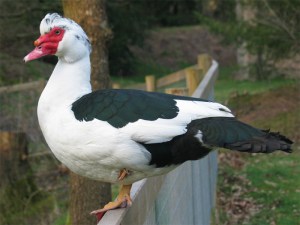
The Muscovy duck (Cairina moschata) is a large duck native to MexicoCentral, and South America. Small wild and feral breeding populations have established themselves in the United States, particularly in Florida and the lower Rio Grande Valley of Texas as well as in many other parts of North America, including southern Canada. Feral Muscovy ducks are found in New Zealand, Australia, and in parts of Europe. They are large ducks, with the males about 76 cm (30 in) long, and weighing up to 7 kg (15 lb). Females are considerably smaller, and only grow to 3 kg (6.6 lb), roughly half the males’ size.

This photo from Wikimedia was included in the Wikipedia article:

CC BY-SA 3.0, https://commons.wikimedia.org/w/index.php?curid=117668

I didn’t get very close to the duck but this description and photo sure looks right to me. I have no trouble believing that the bird I saw was 30 inches long and weighed 15 pounds. It sure is a long way from Mexico, Central and South America, Florida and Texas though!

I appreciate that it visited me that day, but still hope it stays away from the trees, shrubs and ground covers that we have planted.

Living and Learning in Amritapuri, India: January 4-13, 2017

Even though I’m back in Seattle now, it is important to me that I tell you stories about the last part of this visit to Amritapuri.

Baby Feeding Photos

In Hinduism, it is traditional for a baby to be fed its first solid food as part of a sacred ceremony. When a parent asks Amma to perform that ritual, she holds the baby on her lap and feeds him or her some payasam, a sweet pudding. An ashram photographer takes a photo of Amma feeding the baby; thus, providing the parents a memento of the experience.

Soon after I arrived at Amma’s Amritapuri ashram this year, I noticed that there were five big photos of Amma under the windows of the outside portion of the west wall of the auditorium stage.  I had never noticed them there before.

The pictures were visible to every person who walked up the ramp that goes from the auditorium floor to the stage. From a distance, the photos looked identical. They were each about 40 inches high and 24 inches wide. When I saw the photos up close, and read the sign that was next to them, I learned that the big photos of Amma were actually comprised of tiny photos of Amma feeding babies. Each big photo contained pictures of 6000 different baby feedings. I remember believing they were tile mosaics but now that I think about it, I’m having doubts about that.

Since each of the baby feeding photos were of a different baby, and there were five large pictures of Amma, 30,000 babies feedings were part of that exhibit. I was intrigued and astounded by that display throughout my trip; astounded by the display itself and by the fact that Amma has performed that many baby feedings.


Friends

Many of my friends were participating in a nine-day silent retreat (meditation, yoga, silence) during the end of my trip. It was over the evening of the 11th and I was on the road to the airport by 5:00 a.m. on the 12th. It felt strange to leave not having seen so many friends for nine days. A highlight though was that my friend Ramana arrived from Seattle on the 9th. He and I hadn’t been in Amritapuri at the same time for several years. It was fun to spend some time with him during the last days of my visit.

Synchronicities

I was trying to get some information for friends who were coming to India a few days after my departure. I was walking to an ATM when my friend Do walked up to me and asked if I had been able to get the information I was needing. When I said no, he told me that Prabha could probably help. I proceeded to the ATM. As I was returning to my building, I had a momentary glimpse of someone who looked like Prabha. I wasn’t sure since I was seeing her from behind. After a moment’s thought, I decided to check it out. It was her, and she did give me the information I needed. I found out that Do had seen her right after I talked to him, and told her that I was looking for her and why, so by the time I talked to her, she already knew what information I was looking for. This whole scenario seemed so synchronistic to me and it was all the more amazing because there were around 5000 people living in the ashram. There are always some people I don’t see during my whole visit, and all of these connections were made within a five minute period.

***

I never know what Amma’s schedule will be when I plan a trip. Her India tour dates are often not announced until a week or two before the event occurs. As it turned out, Amma started her South India tour hours after I boarded the plane for Seattle. Sreejit and Chaitanya were both going on that tour. So, we all left the ashram on the same day. Perfect timing!

Lessons

Many experiences and lessons were contained within this trip. I visited gardens, farms and fields. Through those experiences, I came to some sense of peace around the fact that not all of the trees, shrubs and ground covers in our Seattle forest restoration project will live. This kind of work is trial and error and will also be affected by weather, soil conditions and many other factors. Whether or not a plant survives is not in my hands. My job is to put in the effort and let go of the results.

My experience with the ants was a challenge that reminded me to “wait, watch and wonder” rather than immediately react. It also gave me the opportunity to practice equanimity. Sometimes I was able to get there and sometimes not.

Being able to witness and participate in the production of the Christmas play, as always, gave me joy. It also reminded me that when we work together great things can be accomplished. I could see how far the cast have come in learning to take whatever comes. No matter the challenge, the participants do what needs to be done and hold on to a positive attitude throughout. Their growth is obvious and their work inspires many.

One of our Seattle satsang members died while I was in Amritapuri. I still can’t believe that is true; it feels surreal. His death reminds me to make every day count.

My respect for the importance of “going with the flow” rather than trying to force things to happen has grown. When I try to force my will, I am likely to exhaust myself and cause myself pain. During the month I was in Amritapuri, there were so many times that a person I needed to talk to walked in front of me moments after I became aware of the need.

Here are some of my favorite memories from this trip. There are so many others that I don’t have photos of, such as my darshans with Amma and time with my family and friends.

Traveling back to Seattle

My trip home would be as long as it always is: a 2 1/2 hour taxi from the ashram to the airport, a 4 hour flight from Trivandrum to Dubai, followed by a 14 1/2 hour flight from Dubai to Seattle. This time I planned to take a LYFT taxi from SeaTac airport to my house.

For several years, I have made the trip more tolerable by taking a long layover in Dubai. During that time, I have stayed at the Dubai International Airport Hotel. It is expensive but the opportunity to sleep, or at least have my feet up, in a quiet room for 15-19 hours has been well worth it.

Sometime during this last year, I heard that Emirates would give me a free hotel and food if I asked for it. They provided the accommodation without question. Having the free hotel turned out to be a mixed blessing though. I hadn’t realized I would have to go through immigration and that took well over an hour. Also, I didn’t know where to go when I got to the baggage claim area. Everyone I asked told me to go to exit 1. When I finally found that exit, and the hotel bus, I was told I  should have checked in with someone in the terminal. Luckily, that person brought a group of people to the bus at that moment and I was able to get on the bus.

Once I was at the hotel, there was a very long check in line. The hotel was also very noisy. While I was waiting in the check in line, I decided it was unlikely I would make this choice again.  That thought was followed by another; if the hotel room had a bathtub I would consider returning. After a month of cold showers, taking a tub bath would be heavenly. (At Dubai International airport hotel there was  only a shower.) One of the first things I saw when I entered the room was the bathtub!

There were more challenges at the hotel than the ones I mentioned above, but the hotel staff were very friendly and the food was excellent. Another challenge occurred when I returned to the airport for my flight to Seattle. After going through immigration again, I looked for a restroom. I was in the old wing of the airport and every restroom had a very long line. I finally found one with a somewhat shorter line at the end of the wing, so joined the line. That restroom ended up having only two stalls. If I had been staying in the airport hotel, I would have been able to stay in my room until it was time to board the plane.

Was the bathtub and the free room and food worth it to me or will I choose to pay more and stay in the airport? Only time will tell.

Greenbelt restoration project

Within five minutes of walking into my house, I changed shoes and went outside to look at the plants in the Greenbelt. They seem to be surviving well. None had been broken by falling branches and the snow didn’t seem to have affected them. I was so excited and eager to start the restoration work again. Our first work party will be on Sunday, January 21.

Jet lag

Even now, I am in the throws of jet lag. I really dislike the experience of turning my night and day around (there is a 13 1/2 hour time difference between India and Seattle). Sometimes I can’t sleep for more than 2-3 hours at a time for many weeks. While my sleep is still disrupted, I think it is going to be shorter this time. I returned to Seattle a week ago today, and last night I slept 5 hours. May that shift continue!

The end and the next beginning

While I could write so much more about this trip, I hope that my posts have given you an idea what it is like to be in Amritapuri. Every trip is filled with adventure, challenge and learning. Even though I’ve only been back in Seattle a week and I’ve been hampered by jet lag, I have had so many experiences since I’ve returned. I look forward to posting about them in the next few days.

To read the previous Amritapuri posts in this series click here.
Return to Kuzhitura Farm: January 10, 2018

My friend Ramana had asked if I would take him to some of the ashram gardens when he arrived in Amritapuri. Since he didn’t come to India until the 9th and I was returning to the U.S. at 5 a.m. on the 12th, I decided it was only reasonable for me to take him to one of them. I chose Kuzhitura.

You may remember when I visited this farm on December 27, 2017, I saw some tubs that I thought might be a new way to catch water.

Later, I learned that the structures that were originally built for water catchment had become homes for turtles.  I found a picture of one of those structures that I took in January 2016. I can see why turtles would want to live there!

One of the problems with the turtles living in that “pond” is that the water dries up during the dry season. It is not a safe place for the turtles to live. The new tubs are meant to be homes for the turtles.

When I returned to Kuzhitura on January 10, I enjoyed seeing how much homier the tubs looked than when I had been there two weeks before.

Sarvaga, a friend who works in this farm, introduced Ramana and me to some of the turtles living in the current “pond.” She talks to them as she offers them treats and they come right up to her!


The staff are not going to move the turtles into their new homes. Sarvaga said they will find their own way there. I look forward to seeing where the turtles are living when I return to Amritapuri later in the year.


To read the previous posts in this series click here.

Amritapuri Christmas Play- Part 3

Surprise! I’m able to write the third post about the Amritapuri Christmas play after all. Enjoy!

***

As I’ve mentioned before, this year’s Christmas musical was about the nativity story as told by a 9 year old child named Grace. Grace was living in a school for girls. She is the second child from the left in the first photo below. She is wearing a blue dress.

In many Indian plays, the actors don’t speak or sing, they lip sync. The musicians and people singing or speaking for the actors are out of sight. In this play, they were sitting on the left side of the stage.

The children were amazing. They had practiced their roles so thoroughly that you couldn’t tell they weren’t saying anything.

***

In Grace’s version of the nativity story, one of the wise men came from Africa. She named him Tsabo Babatunde. Tsabo was very, very old. When he received God’s direction to follow the star to Bethlehem, so that he could welcome another great soul to the world, he obeyed.

Tsabo was able to talk to animals, and they talked to him. One of the songs in the musical was Come Awake Africa.

[Note: You can enlarge the photos in this post by clicking on the photo galleries. To hear the songs, click on the audiofiles.]

***

Joseph and Mary sang and danced with their friends before they traveled to Bethlehem.

***

One of the  most intense scenes of the play occurred when it was time for Mary to give birth and no one would give them the couple a place to stay. I think you will get a sense of the intensity by listening to the song. I still get goose bumps when I hear it.

***

An angel was present during the nativity scene. As you look at the photos and listen to the music know that she was 30-40 feet above the floor!

***

One of the most touching scenes was near the end when Mary let Grace hold baby Jesus.

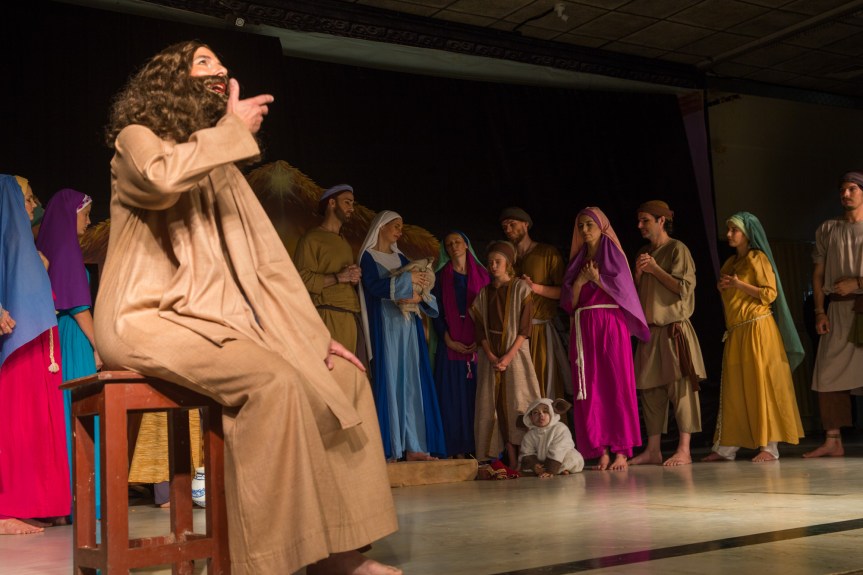
Throughout his journey, Tsabo had visions of what the adult Jesus would do in his life. Those visions were enacted. The photo below is from one of the last scenes in the play when Jesus was talking about love.

It was a wonderful musical. I hope you were able to get a sense of that from the photos and songs in this post.

To read the previous posts in this series click here.