This and That

I’ve been wanting to provide updates on subjects I’ve written about in the past, so I decided to publish a This and That post.

img_4914

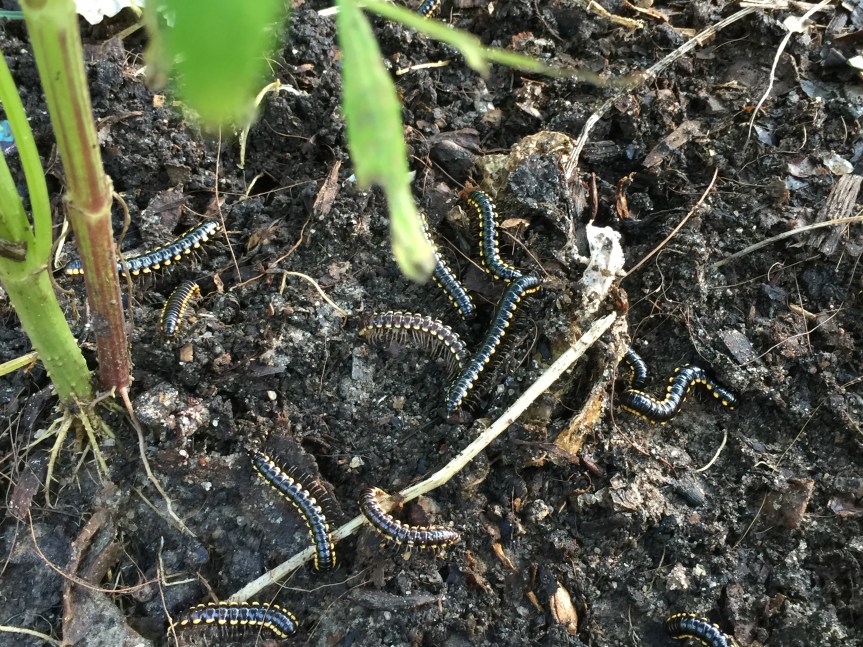
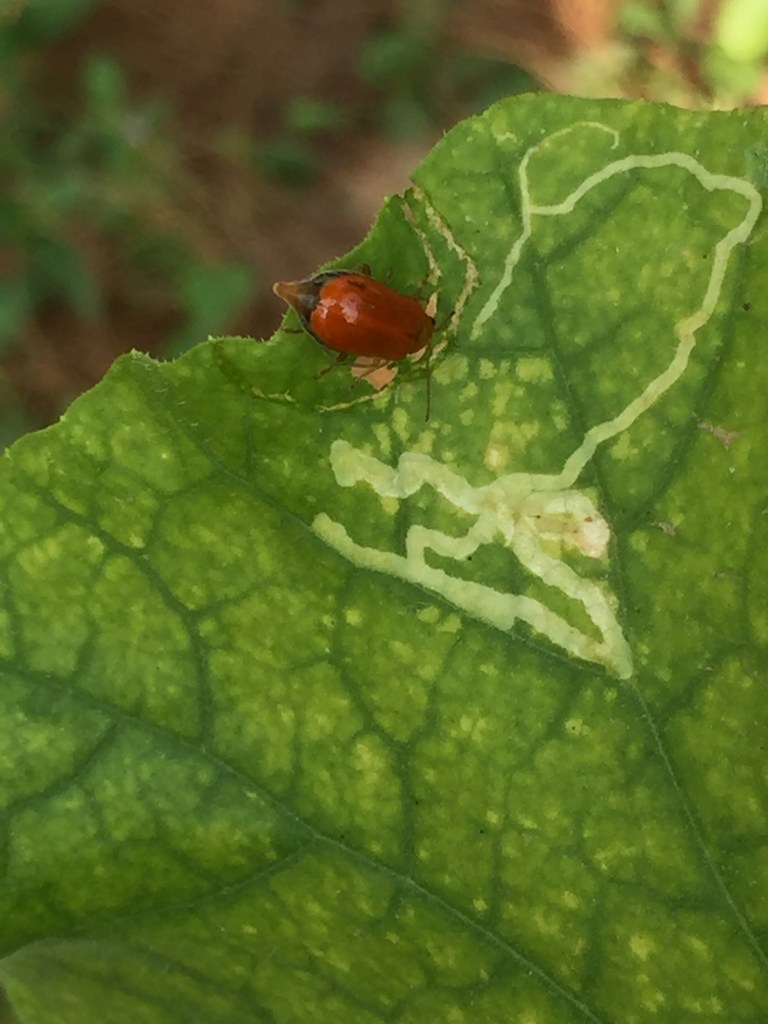
Those of you who followed my recent journey to Amma’s ashram in Amritapuri, India may remember that in January I was wondering why these “caterpillars” didn’t eat the Saraswati Garden plants. I’m used to seeing caterpillars demolish plants.

Two readers informed that the creatures weren’t caterpillars; they were centipedes. I had never considered that possibility. As I look closely at the photo above, I can see all of the legs, but I sure didn’t see them at the time.

I saw a centipede in Amritapuri two years ago. I remember it moved so fast that it left me speechless.

IMG_0148

That one was more like centipedes I’ve seen in the United States. I had no idea that centipedes could be brightly colored. Those readers also told me that centipedes don’t eat plants; they are carnivorous. Their diet consists primarily of insects and spiders.

*****

While I was in Amritapuri, crosswalks were painted on the street down the beach road. I saw about a mile of them, so I suspect they go the whole length of the peninsula. At the time, I wondered what crosswalks meant in India. I still don’t know what they mean.

I don’t believe that the crosswalks give pedestrians right-of-way, or if they do, that fact is being completely ignored. I didn’t see any change in driving patterns. I suspect a policeman or policewoman would have to stand there before the drivers would stop.

*****

When I wrote my Women’s March on Seattle post, I was not able to get the video I took of a group of drummers turned from vertical to horizontal. I have recently accomplished that feat, thanks to some advice from a friend. You can see a clip of the performance in the video above, and I also added it to the post.

I had edited the post once before so I could include two addendum. One of them contains beautiful Women’s March photos from around the world. I cried as I scrolled down that article. If you would like to see the added content click here.

*****

20150109_142236

In January of 2015, I spent the night in the Dubai airport hotel. I was mystified when I walked into the bathroom. What was that on the left? Was it a man’s urinal? That didn’t make sense but neither did anything else.

There wasn’t even a flush on it. It was more like a bath tub. A bath for your dirty butt? I couldn’t get myself to try it that year or even the next. By then, I had been told that it was a bidet, and that you wash yourself some before you use it. The idea still seemed gross to me. It sure wasn’t like any bidet I’d ever seen.

This year I got brave and tried it out. Not bad. It was  a bidet that had better aim than the kind I was familiar with.

*****

I never found my lost iPhone, so have not been able to recover the photos I took on my last days in Amritapuri. I was able to find the Work With Nature YouTube channel that Lokeshwar, the man who organized the Amritapuri seed-saving garden, created. I just looked at that channel for the first time. There is SO much information there.

I also watched some of the videos. Lokeshwar’s Amritapuri garden has three of the plastic hives that you will see in the video below. They are for tiny sting-less bees. My understanding is that 50,000 bees can be housed in each of these bee hives and that the bees will always come back to that hive. (Lokeshwar is the man on the right.)

In this seed-saving garden, they are conducting experiments with biochar and terra preta.

There are so many videos on his site. I look forward to exploring more of them in the future.

*****

Photo Credit: Wikimedia

I slept 7 hours last night. Hallelujah! I know better than to assume my jet lag is over, but I can still hope! Sleeping only three hours at a time is exhausting.

*****

I think this is the end of my updates, at least for now!

Amma’s Vrindavan Tulasi Field… tulasi and so much more

img_5508

On January 8th, I visited one of the oldest gardens in Amritapuri. While it is known as Amma’s Vrindavan Tulasi Field, it has become so much more.

In the early years, growing tulasi was the main focus. Then, the volunteers who worked at the farm discovered that Rudraksha trees were scattered around the property. Rudraksha seeds are considered sacred in India so they started harvesting the seeds and planting more of the trees. They also began growing vegetables and other plants.

Farming on that property has been such a struggle over the years. Among the problems they faced were lack of water, poor soil, and bugs. When I visited the farm last year, what I saw took my breath away. It had turned into paradise. (To see photos of last year’s visit, click here.)

When I went there this year, I was amazed by all the new projects that were underway. The first thing I noticed was an irrigation system that was under construction. I thought about all the years they have watered using small hoses. What a difference the irrigation system will make.

Then I noticed all of the raised beds. I was told that when there are heavy rains, the farm floods. With raised beds, the plants will be higher than the water. Several swales have been constructed to drain off the flood waters, but the photos I took of those ended up looking like flat ground, so I didn’t use them.

There is a big pond on the property. The plants that are growing in the pond are used for mulching. I saw, and talked to, volunteers who were constructing stairs that will go into the pond to make harvesting those plants easier.

There are rudraksha trees on several parts of the property. They are easy to spot because their trunks have all been painted white. Next year I will ask why they do that!

img_5550

The numerous tulasi fields are thriving.

Many fruits and vegetables grow on the property.

I was surprised by the many varieties of eggplant. Later, I saw a bright yellow eggplant at Saraswati Garden but it was on the phone I lost on my last day at the ashram so you will have to use your imagination to see that one. I was particularly fascinated by the eggplant that looked like an egg!

The plant below is called Lakshmi Taru, The Paradise Tree, The Tree of Heaven, Simarouba or Simaroubaceae. It is a medicinal tree that has been used to treat dysentery, malaria, cardiac palpitations, asthma and epilepsy. It may have a role in cancer treatment.

I was intrigued by this flower.

img_5547

Later, I learned it is a Sita Ashoka flower. Ashoka means “without sorrow”. Hindus believe that Sita, wife of Lord Rama, sat in a grove of Ashoka trees after she was abducted by the evil Ravana. Buddhists believe that Lord Buddha was born under an Ashoka tree.

I found this photo of an Ashoka tree on Wikimedia.

sita-ashok_saraca_asoca_leaves__flowers_in_kolkata_w_img_4175

I will leave you with some final images of Amma’s wonderful Vrindavan Tulasi Field.


Living and Learning in Amritapuri, India: January 9, 2017

img_5522

Monday, January 9 was another full and rewarding day. My main goal was to visit Vrindavan Farm, which is located in a part of Vallikavu that is south of the Amrita Ayurvedic College. I wasn’t sure how to get there so I decided to go by rickshaw and then walk back to the ashram when I was finished.

I will be writing a whole post about that farm later, but will share some photos, including the one above, with you now so that you can get a sense of what it was like.

A sevite (volunteer worker) offered to take photos of me. Normally I would say no, but I decided to let her do it. I enjoyed seeing the shots she took. I had no idea how much my hat protected me from the hot sun!

While I was at the farm, I talked with one of the other sevites. I discovered that he works at the Amrita Serve Garden in addition to Vrindavan Farm. I have been trying to find out the location of that garden so was excited that I had met someone who knew the answer to that question. He was willing to take me there later in the week, but our schedules didn’t line up very well. I asked him for directions so I could go on my own.

He said it might be hard for me to find it, since I had to locate a particular foot path. I decided to try. If nothing else, my Fitbit would record a lot of extra steps!

On the way, I walked by a building that I have thought was a new supermarket. I had seen the supermarket sign, but the store it was on looked so small, I didn’t bother to check it out. When I walked by the sign this time, I noticed it was just an advertisement. The supermarket itself was located off the road behind the small store. I was astounded. I’d guess it is nearly ten times the size of the other “super” market in town. There is no other shop in Vallikavu that is anywhere near that size.

I continued walking, passing by the supermarket and a new temple that was under construction. I saw two foot paths. I started down one path, but in a short time decided it was the wrong one, so I turned around and came back to the main road and took the other path. On that path I saw these:

After some time on the new path, I reached a paved road. I was clearly on the wrong path so I again walked back to where I had started and re-took the original path. After some time, I saw the garden I had been looking for.

No one was present to show me around, so I just wandered. Before I leave Amritapuri, I’m going to meet up with the man that gave me directions so I can learn more about that garden. I will pass on the information he gives me when I write the main post about the Amrita Serve garden. For now, here is a glimpse of some of the plants. [Update: I met with the sevite on 1/12. When he looked at the photos he told me that wasn’t the Amrita Serve garden. I apparently was on a private farm that grows tapioca, coconuts and bananas! There aren’t signs on either property and there are private houses on both so I had never considered that option. I had been told that it was after a purple house. There was a purple house just before this one too. I’m going to see the Amrita Serve garden this morning, 1/13.]

When it was time for me to walk back to the ashram, I decided to take the canoe rather than walk over the bridge. It the first time I had done that since the bridge was built, eight years ago.

I felt so peaceful floating on the water, and the ride to the peninsula only cost 10 rupees (about 15 cents). I may never walk over the bridge again.

In addition to having a wonderful morning exploring the gardens, I had walked more than 13,000 steps!


To see all of the posts in this Amritapuri series, click here.

Living and Learning in Amritapuri, India: January 2-7, 2017

img_0746

Grace is Flowing

I have felt graced many times lately. The ones I’m remembering in the moment are:

-I wear a Fitbit that serves both as a pedometer and as a watch. For some unknown reason, the Fitbit hasn’t synced for the last six weeks, so I’ve had to add 1 ½ hours every time I looked at the watch. That has been a nuisance. One day this week, I looked at my watch and the time was correct. It felt surreal.

-Last week I made an appointment for a massage. (Various forms of body work and classes are available here. The proceeds help fund Amma’s humanitarian projects.) When I arrived at the session, the massage therapist asked if I wanted a Swedish massage or Reflexology. I said “Both!” That wasn’t an option so I got the massage.

When I was in Tai Chi class on Thursday, I started feeling the nerve pain I get in my toes when my low back muscles are too tight. Towards the end of the class, a friend who was on a break from the Reflexology class she was teaching, walked up to me and asked if I wanted to have a Reflexology treatment in a half hour. She had an uneven number of people in her class, and needed to have someone receive a treatment when the students paired up and worked on each other. I, of course, was delighted to serve in that way!

-Amma held darshan in the temple again on Wednesday and Thursday of this week. That felt like such a gift. Being in the temple brings back so many memories for me plus it feels more intimate than being in the big auditorium.

-I’d been feeling down for awhile and hadn’t been able to shake it. On Wednesday, the crowd was small so I decided to go for darshan and ask Amma, internally, to help me lighten up. When I entered the darshan line, I learned that the man next to me was from the UK but had been living in a Buddhist monastery for many years. He was on his way back to the UK, where he plans to start an intentional living community focused on mindfulness and sustainability. He had never met Amma before. I loved talking to him while we proceeded through the darshan line. When I reached Amma, she held me for what seemed like a very long time. I feel so blessed to have her in my life.

-Someone asked me a few days ago if I would be willing to be the first person to hand Amma prasad this coming Sunday. They always like to have an experienced person do that job at the beginning. Needless to say, I didn’t have to think twice before I said yes to that!

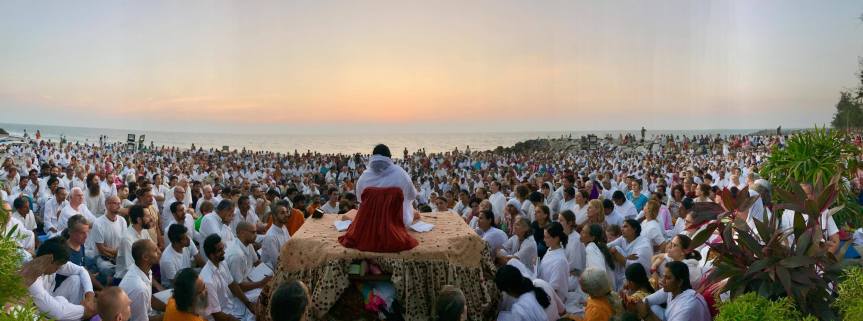
– Amma comes to the beach for meditation and a question and answer period on Monday and Friday evenings. I didn’t go on Monday, but I heard afterwards that instead of being next to the Ayurvedic building, sandbags had been put on the beach and the meditation was held there. I felt sad that I had missed that experience so I made sure I went yesterday. It was wonderful to be there although I was sitting on the side and much lower than most of the people so I could see Amma but not much else. I had no idea what a big area our group covered until I saw this photo on Amma’s Facebook Page. I will go earlier on Monday!

15800400_10154203394178302_1787274714082444955_o

-Tonight Swami Amritasvarupananda sang a song that used to take me into such a deep state of meditation. I haven’t had that experience for many, many years, but it happened again tonight. I am feeling so much gratitude.

Saraswati Garden and Eco Textile Work Center

I’ve continued to work an hour or two in the Saraswati Garden and Work Center most days. On Wednesday, we harvested the rest of the turmeric. Yesterday it was boiled and today another devotee and I sliced it. It will then be dried and ground into powder for use in dying fabric. After two hours of slicing, my hands were even yellower than when I did it for the first time. I know from experience that I will be yellow for days.

I’ve seen big lizards in the garden several times on this trip, but they always move so fast that a photo is out of the question. Two days ago, one scooted in front of me and then up the side of a wall. It then stayed in one place while I took out my camera. As soon as I snapped the shot, it sped off.

img_5443

The garden has lots of caterpillars. I turned over a coconut shell yesterday and it was filled with caterpillars. I walked back to the house to get mye camera. There were still a lot of them in the shell when I returned. I associate caterpillars with destroying gardens and trees but I don’t see any evidence that these are hurting the plants in any way. I wonder what they are eating.

img_5436

Wrapping up

A week from today I will be in Dubai waiting for my flight back to Seattle. I’m starting to sort through my belongings and pack. Before long I will be cleaning my room in preparation for the next person that stays here.

Even though I’m starting my ending process, I know my trip is not over yet. I have almost a week of experiences still ahead of me. On Monday, I’m going to Vrindavan Gardens, the oldest of the tulasi gardens. I’ve heard new things are happening there and I’m eager to find out what they are!

To see all of the posts in this Amritapuri series, click here.

My Morning Adventure

img_5230

It has only been three days since I visited Kuzhitura Farm but it feels like it has been much longer than that. I decided I’d better write about the trip while it is still fresh in my mind.

I left the ashram soon after breakfast on Tuesday morning. I’ve been to the farm before but wasn’t sure where to turn off the main road, so I decided to take a rickshaw there and walk back to the ashram after my visit.

The Amritapuri farms and gardens have been through so much in the years of their existence. The close proximity to salt water, lack of fresh water, poor soil, and disease have all caused problems. When I visited this farm last year though, it was obvious that a major change had taken place. I remember feeling as if I had entered paradise.

One of the first things I noticed this year was the extensive network of paths. Any path I followed led me to beauty. I found an altar on one path.

After years of trial and error, and the gardeners persistent effort, the tulasi plants are now thriving. Tulasi is also known as holy basil. It is a component of many Ayurvedic medicines.

img_5243

img_5217

I saw one garden bed that looked like it had been recently planted.

img_5239

One of my goals for the trip was to go by myself and sit quietly. I wanted to take photos of birds, butterflies and bugs.

I saw beautiful birds, butterflies and the biggest bumblebee I’ve ever seen, but they all moved so fast I couldn’t catch them with the camera. One insect seemed like it was playing with me. Every time I got close to snapping the picture it flew a few inches away.

I only took one photo of a bird and, even if it was in focus, you wouldn’t be able to see its beautiful colors.

img_5178

I did take a picture of one bug!

img_5317

Part of the problem was that I didn’t have the patience to sit. And I was so hot. The kind of experience I had originally envisioned will have to wait for the future. This time, I was content to immerse myself in the flowers and other sights. (See Flowers at Kuzhitura Farm.)

Adjacent to the farm are the ashram’s food composting and vermi-composting facilities. West of those buildings were other gardens.  Amma is committed to serving as many organic vegetables at the ashram as possible. I had no doubt that some of those vegetables come from this garden.

After taking the photos above, I started my walk back to the ashram. I noticed numerous houses that Amma had built for the villagers after the 2004 tsunami. Seeing them brought back memories of my own experience during that disaster. The tsunami occurred on December 26, so it is always on my mind at this time of year.

I also saw a cow scratching its head on a tree, some pretty flowers and friendly people.

Before long, I was back at the ashram, feeling happy about my morning adventure.

To see all of the posts in this Amritapuri series, click here.

Flowers at Kuzhitura Farm

I spent part of this morning at Kuzhitura Farm, a site that is a 20 minute walk south of the main part of Amma’s Amritapuri ashram. I will be writing at least two posts about that visit. I’m eager to show you the flowers I saw, so I’m going to start with that one! You can click on the gallery to enlarge the photos.

To see all of the posts in this Amritapuri series, click here.

Living and Learning in Amritapuri, India: December 1-4, 2016

img_0360

Surrounded in Beauty

Amma’s ashram is located on a peninsula between the the Arabian Sea and the backwaters. The view from my room is of the backwaters. The photo above is of the Arabian Sea, which is a five minute walk from my flat.

A Fascinating View of Construction

When I returned to my room on Thursday night, I heard an unusual sound, the sound that men sometimes make in unison when they are doing heavy lifting or other repetitive jobs. (There may be a word for it but I don’t know what it is.) I looked out the window to see what was going on.

A structure in the courtyard, which I soon realized was one of two bookstore stalls that had been there for years, had been turned on its side. (I’d say each stall is around 20 feet long and 10 feet wide. The floor may have been made from concrete.) The men were now surrounding the second one and they were trying to push it over as well. Once they had accomplished that goal, the men returned to the first one that had been over-turned.

Some long rails were brought to the courtyard. The men laid two of them down 6-8 feet apart. Somehow, they up-righted the bookstall and got it onto the rail. (I think during the time it had been turned on its side, something had been removed from the roof.) Then one group of men pushed the bookstall, while another group of them pulled it with ropes. In so doing, the bookstall moved along the rails. Each time it reached the end of the rails, more rails were added. That process continued until the bookstalls reached the end of the courtyard. Then they did what it took to turn it 90 degrees so it could move in a different direction.

There is a new building in that area. The backside has a big slab of concrete, with pillars along it. That part of the building looked like a veranda to me. As I continued to watch, the men put the bookstall up onto the veranda. Once it was there, they pushed it to the end of the new building.

I left my room at that point, but when I returned, I discovered that the second bookstall had also been moved to the veranda. When I looked closer, I realized the bookstalls would still open onto the courtyard, they will just be part of  a building now rather than free-standing in the courtyard.

I was thankful to have been given the opportunity to watch that process. (Note: I don’t take photos on the main ashram grounds. I hope you were able to “see” it in your mind’s eye from my description.)

Wi-Fi

Obtaining Wi-Fi was an opportunity for me to practice flexibility, persistence, equanimity, letting go and patience. While it only took a week to get my personal Wi-Fi system fully functioning, it sure felt like a lot longer than that to me.

I made some helpful discoveries because of the wait though. One day, I used the ashram computer room. There we have a 30 minute limit and the connection is very slow. It was helpful for checking my email but not for blogging. The next day, I walked over the bridge to town and found a travel agency that had computers I could use. The connection was a bit slow, but reasonable, and it only cost me 10 rupees for half an hour. (67 rupees= $1).

As I was walking out of that building, I noticed there were people working on their laptops on the porch outside. I realized the travel agency also had Wi-Fi, which is what I really needed. When I returned the next day, I found out that the speed was very fast. I used it for one hour, for 30 rupees, less than fifty cents.

Then someone suggested I use the  Personal Hotspot on my iPhone. I knew I had one, but I had never checked it out. Once I set it up, I was shocked by how fast the connection was. The only downside was that it used a lot of data.

Waiting for the MTS Hotspot to be activated no longer bothered me. Between the iPhone Hotspot and the travel agency Wi-Fi, I had the ability to do whatever I wanted/needed to do.

As of Saturday morning, the MTS Hotspot process was complete, so I can now do computer work in the comfort of my room without using as much data.

Amma

amma-singing

Amma returned to the ashram around 3 a.m. on Saturday morning. I did not see her come but I loved knowing that she was here. As anticipated, the ashram began to fill with people as soon as she returned. Saturday night she led bhajans (devotional songs). She sang two of my favorite songs; Karunalaye Devi and Radhikesa Yadunatha. Needless to say, I was in heaven.

As I was writing this post today (December 4), I heard singing coming from the auditorium. Amma wouldn’t be holding a large public darshan on her second day back from the Europe and U.S. tour would she? Then I heard the bell that sounds when Amma is coming outside. I headed out to see what was happening. The post could wait!

It is now three hours from when I wrote the above comments. I never found out what the music in the auditorium was, because it became abundantly clear as I walked down the stairs from my flat, that Amma was in the temple. She talked with us for awhile and then led a meditation. Afterwards, we were told everyone could come for darshan (hugs).

The instructions kept changing. The first change was that the Indian visitors should go first and Westerner visitors could go afterwards. (That is because many of the Indians visitors come just for the day and the Western visitors are staying here.) When the Western line started, we were told people who were meeting Amma for the first time should go for their hug, and the rest of us should wait. Then it changed to anyone that wasn’t new and will be here on Wednesday should wait to get their hug on Wednesday. I was not surprised by any of this, but the possibility of receiving darshan that day had kept me in the temple with Amma, which is a good thing!

On the way back to my room, I ran into a woman that a man in my Tai Chi class in Seattle had asked me to give a message to. I found out that she is only here for one day and will go back to the U.S. tomorrow. If I hadn’t stayed in the temple all that time, it is unlikely our paths would have crossed this year. That kind of synchronicity is the magic of being in Amritapuri.

Saraswati Gardens

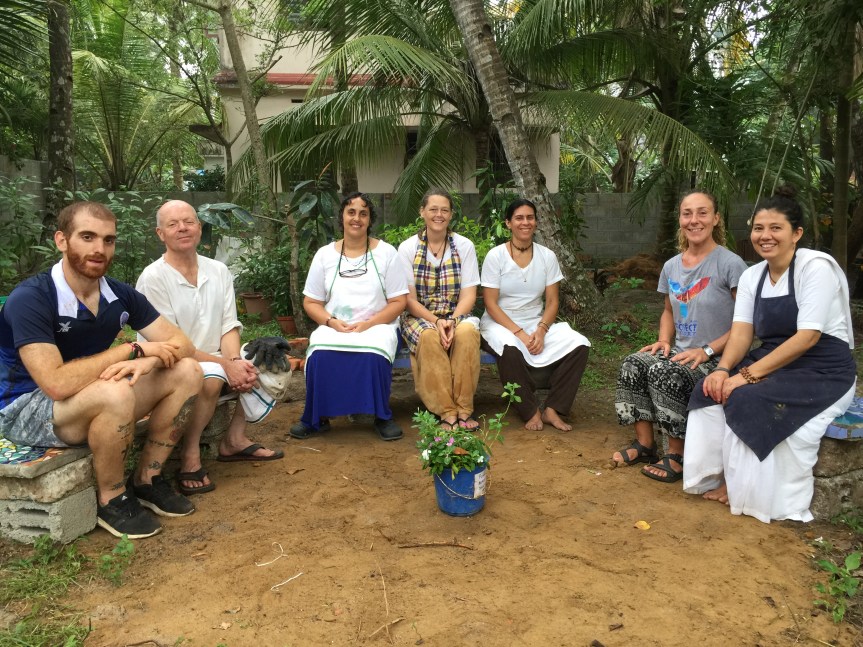
After my first visit to the gardens, I decided I would do short periods of work at the gardens throughout my stay. One day, I helped spread coconut coir in the garden beds; it is being used for mulch. I raked up leaves two other days. I laughed as I raked the small number of leaves, thinking of my yard in Seattle which I know is covered by big Maple and Magnolia leaves. The second day, I helped the other garden workers create a sitting area in the garden.
img_4784

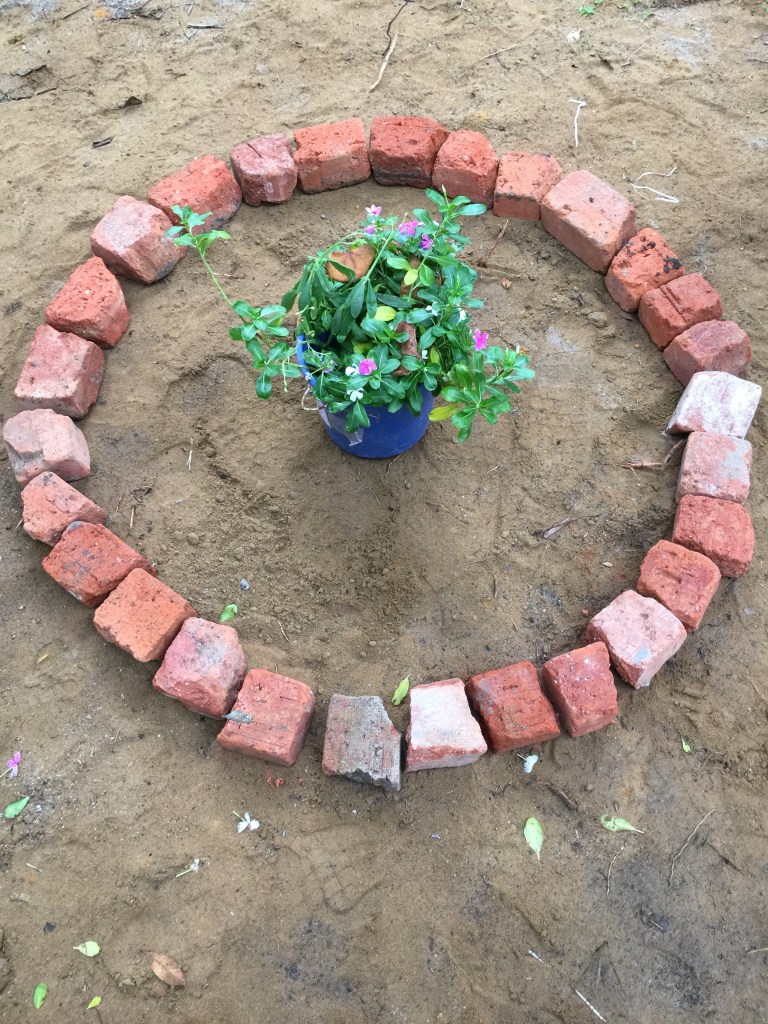
We constructed this circle for the center of the sitting area. The brick is salvaged from construction site waste. Yesterday, I helped Advait gather pieces of brick for future use.
img_4788

One of the main purposes of the Saraswati Garden is to grow plants that can be turned into dye. Padma showed me some of the materials she has dyed from flowers in the garden.The dye made from the rose was mixed with alum. It looks mostly silver in the photo but when you handle it you can see tinges of pink.

I haven’t seen the actual plant that indigo dye is made from yet. Padma said the plant substance in the bucket is living and it can last for a long time. When she wants to use it to dye something indigo, she strains it. I watched as she sponged it onto the white part of a fabric, turning it bluish. I believe she said the indigo fabric on the right was silk.

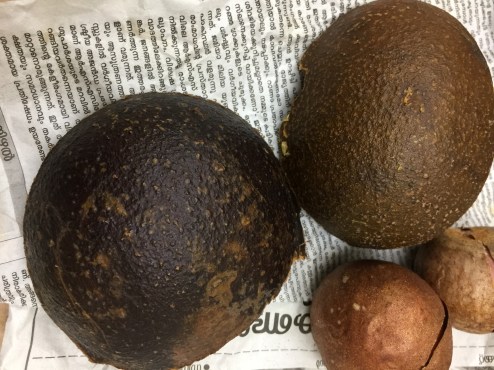
Dye can also be made from avocado peels and pits. You can see both of those in the photo below. I haven’t seen any fabric dyed with avocado dye yet, but I understand from what I have read that the peel will produce a rusty red color and the pit will produce a light to medium pink dye.
img_4820

Chaitanya is back

My daughter Chaitanya returned from Germany on Wednesday. It is wonderful to now be with both of my adult children. Chaitanya writes and directs the Christmas musical each year. Yesterday, she gave me the script and asked me to edit it. I love having the opportunity to read it ahead of time, and then to watch as the play comes alive once the practices begin. Sreejit and his friends have been working on the music for some time.

Tai Chi

My Amritapuri Tai Chi teacher and her husband arrived several days ago. Yesterday, she talked to the person who organizes classes in the ashram. I should be able to start doing Tai Chi soon. I have seen the wait as a chance to practice patience, but I am excited, and so ready to start!

Jet Lag

As far as I’m concerned, it is a miracle. I have had NO jet lag this year. When I travel to India in the future, I will definitely arrange for a layover in Dubai.

To look at previous posts in this series, click here.

Living and Learning in Amritapuri: November 29-30, 2016

img_4638

Even though I’ve been coming to Amritapuri for 27 years, every day is still filled with new experiences and learnings.

Saraswati Gardens

On the evening of Nov. 28, a friend told me that she had found a garden in the ashram that she thought I would want to see. It is on the north side of the ashram, but is only a five-minute walk from the ashram’s center. The next day, I went to look. When I walked into the gate, I gasped. For me, it was like walking into heaven. (The photo on the top of this post is from that garden.) I will be writing many posts on this topic but here are some photos to wet your interest! (You can click on the gallery to see an enlarged version of the photos.)

I also saw the projects that are being done inside the Saraswati house. They have looms for weaving, a room for dying fabric, and a room for block painting. So many items are being produced here and then sold in the ashram stores and on Amma’s tours. All proceeds go towards Amma’s humanitarian projects.

I look forward to sharing more about the handmade items with you later.

Synchronicities

One of the things that I enjoy most about being in Amritapuri is how many synchronous events occur. So often when you need to find someone, your path crosses theirs a moment later.

Every year, there are people who I see constantly. Sometimes it feels like they are on the other side of every corner. Around 5,000 devotees live at Amma’s ashram and there usually hundreds to thousands of other people visiting each day, so constantly seeing the same people must be more than chance.

The people I have the “around every corner” experience with are usually individuals who end up becoing a major part of my trip. Starting on the first day of this visit, I’ve had that experience with three people. Two of them were in my Tai Chi class last year.  I have since discovered that the third person is responsible for organizing work in the Saraswati gardens!

I’m seeing a different person “around every corner ” now. She is a long-term friend, but I’ve never passed by her so often. It’s gotten to the point that we laugh every time we see each other.

Bhajans

At 6:30 each evening, we sing bhajans (devotional songs) for 1 ½ hours. Whenever Amma is away from the ashram, the women sing in the temple and the men sing in the auditorium. I have always felt drawn to the men’s music, but have stayed in the temple. Last year I observed there were increasing numbers of women sitting on the side of the auditorium during the evening bhajans. This year, I saw considerably more women sitting in the auditorium. In fact, I think there were as many women in the auditorium as men. Next, I noticed that most of the ashram’s elderly women were sitting in the auditorium. That is all I needed to see. I have joined them!

Fox Bat

One night on my way to bhajans, I saw a group of people looking up into a tree. It was dusk, but there was a man with a huge camera taking pictures. When I was close enough, I asked the photographer what was going on. He told me a fox bat was in the tree. He said that these bats are only seen seven days a year, during the short period that the figs are ripe.

When I researched “fox bat” on Wikipedia, I learned they are the largest bats in the world. They are also known as flying foxes or fruit bats. I didn’t take any photos but I found one on Pixabay.com.

bat-1268650_1920

Recycling Center

I stopped by the recycling center the day after the floor had been changed from concrete to tile. I imagine the devotee’s feet will be very happy to no longer be sorting garbage standing on concrete.

I noticed that the cages of sick birds being nursed back to health are no longer located in that room. I wonder if they are in a different part of the center or have been moved to another location.

Behind the recycling center, I saw many nets full of recently washed milk bags drying in the sun.

Gardens in the central part of the ashram

I know I will be showing you photos of these gardens throughout the trip, but here are some pictures to start you off!

San Jose programs

We were able to see Amma conducting the Atma Puja on the last day of the San Jose programs via live feed. It was 7 p.m. in the evening there time, and 8:30 a.m. our time. That evening, we listened to Swamiji chanting the archana that occurs towards the end of each program. After the archana we watched as Amma gave darshan until the program ended. (Darshan- Amma gives her blessing through hugging each person that comes to her. At this point she has hugged 36 million people worldwide. We call that hugging process darshan.)

(When I first came to India I had to take a rickshaw to a town twenty minutes away to use a telephone. It sat on a table in the middle of an alley. A crowd gathered around to watch and listen as I made the call. I never would have dreamed that 27 years later, I would be watching Amma live from halfway across the world.

Lessons in patience

In my last post, I talked about receiving lessons in flexibility, equanimity and letting go. I will add patience to that list.

One of my favorite activities last year was doing Tai Chi. I have been very eager to start taking the daily Tai Chi classes again this year. Before I came, I knew that the main teacher, Dave, would probably not be coming this year, but I hoped that Stephanie, who is in teacher training with him, would be here. She was very instrumental in teaching our class last year so I know she is very skilled and dedicated.

Two days ago, I talked to a devotee who had seen Stephanie’s husband at the end of the European tour, so I knew she was indeed coming. Then yesterday, I was told she had arrived at the ashram, but I have not seen her yet. It is certainly an opportunity for me to practice patience.

I’m also having to try to find some patience within me in regards to the Wi-Fi hook up. It is so frustrating to have posts ready but not be able to publish them! There is no way to know when the company will send me a text saying I can activate it.

(You can tell by the fact I’m publishing now that I found another way to do it. That story will be in the next post!)

To read the rest of the posts in this series click here.

I’m Laughing at Myself

51g-buogkpl

I recently finished reading Novella Carpenter’s book Farm City. Years ago, Novella turned an empty lot in Oakland into an urban farm. On it she had a big garden, as well as bees and animals. At one time or another, she raised chickens, ducks, turkeys, rabbits and pigs! I loved the book and felt sad when I reached the end. I related to many parts of it.

One part that I related to was Novella’s comment that when you have an urban farm, part of the farm ends up in the house. In her case, she had beekeeping and gardening equipment throughout the house. Even though my gardening attempts can not be considered farming, I do end up with so many outdoor items inside. This weekend when I looked around my house, I remembered her statement and laughed.

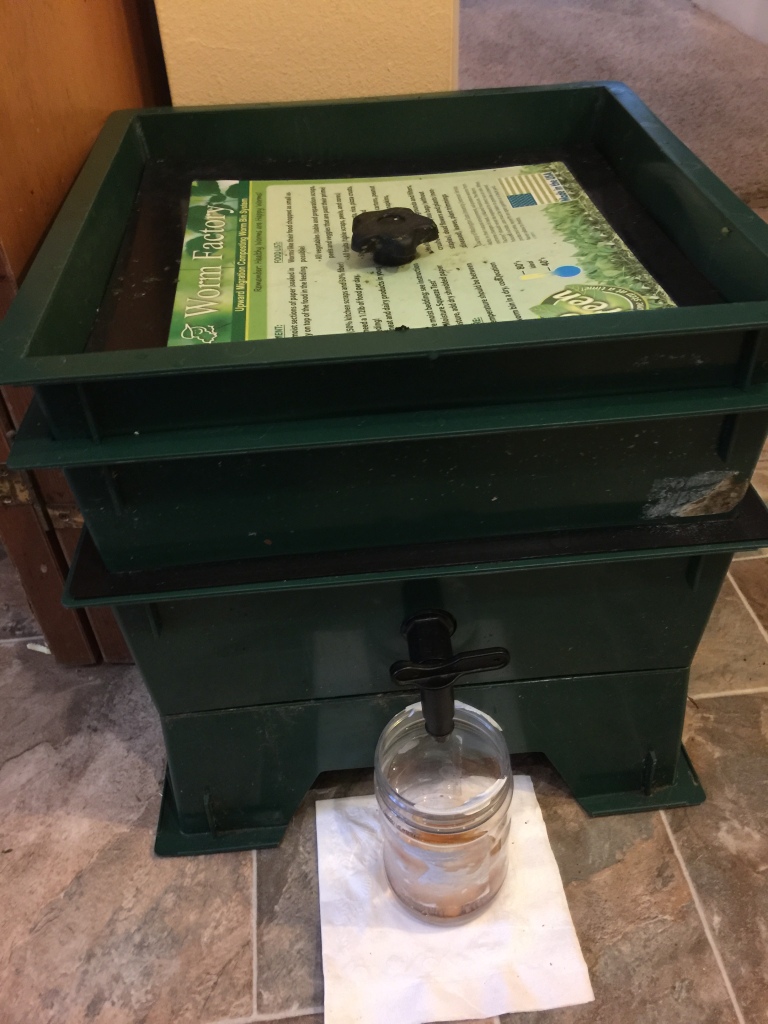
I don’t raise bees, but I have two worm bins; one inside and one outside. The indoor one stays in the kitchen. In addition to transforming food into vermi-compost, a high quality fertilizer, the worms produce a liquid that can be turned into “worm tea.” I’ve been diluting it and pouring it around plants, or just pouring it around the plants undiluted. Today I read some articles that have shown me that much more goes into making worm tea than draining the liquid from the worm bin, so I need to change that practice.

Anyway, back to the subject of how the outside world ends up inside my house. As I looked around my kitchen yesterday I saw:

My worm composting bin with a jar to collect the liquid they produce in addition to the castings.
My worm composting bin with a jar in front to collect the liquid they produce.

Inside the bin are my worm friends and all of their castings.

img_4467

Novella went dumpster diving to feed her animals. I’ve never done that, but the worms now eat way more than I can give them from my food waste, so I beg grocery stores for some of their damaged or wilting produce. Therefore, I have bags of produce for the worms in my refrigerator. That is certainly not something that would be inside of a “normal” household!

img_4483

img_1472

As I continued to look around the kitchen I saw:

img_4492

img_4486
Egg shells that I will grind up to put in the worm bins
img_4488
I recently separated the worms from the compost and took a big box of the compost to the outside shed. This container has some extra compost.
img_4490
This is a jar of the liquid from the worms; there were four jars there a few days ago. Behind it is the food waste bin. Food I don’t use for the worms goes into the big yard and food waste bin that the city picks up and this container is for that. To the right of it is a jar with some vinegar in it that is used to trap fruit flies that may be in the food waste bin. I have no problem with fruit flies in any part of the vermi-composting processes.
img_4462
I use a food processor to chop up the food that I put in the worm bins. That really increases the speed of vermi-compost production. Sometimes I also add coffee grounds that my friends give me. The worms really love that!

My outdoor clippers are also in the kitchen at the moment.

img_4500

I have something new in my kitchen. It will be there until I figure out what to do with it.

Three years ago my dahlia plant was in the back yard. It would grow tall but it only produced one flower a year. That fall, I dug out the tubers and in the spring planted them in two parts of the front yard. What a difference that made! By summertime, the new plants were six feet tall and often had stalks that were more than an inch in diameter. They produced flowers until November, lots of them.

The dahlias have been taking up so much of my garden space, that I decided to dig the tubers out again and give most of them to the neighbors and friends who had asked for them.

So this past Friday my friend Rachael and I set out to accomplish that task. We were amazed at what we found.

img_4438
Rachael saying “It’s SO big!”

My plan had been to separate the tubers and give them to people right away, but I couldn’t separate them without breaking them. Rachael looked on the internet and discovered they should be placed upside down for a few weeks so that any liquid could drain out and be then stored inside for the winter.

What would I do with them? I decided to put them upside down in a wheelbarrow at first and leave them outside. I put a tarp over them but that night we had a big windstorm and the tarp blew off. And rain was expected for the next day.

So, yes, for the moment the tubers from one of the plants resides in my kitchen. I need to figure out what to do with it.

img_4484

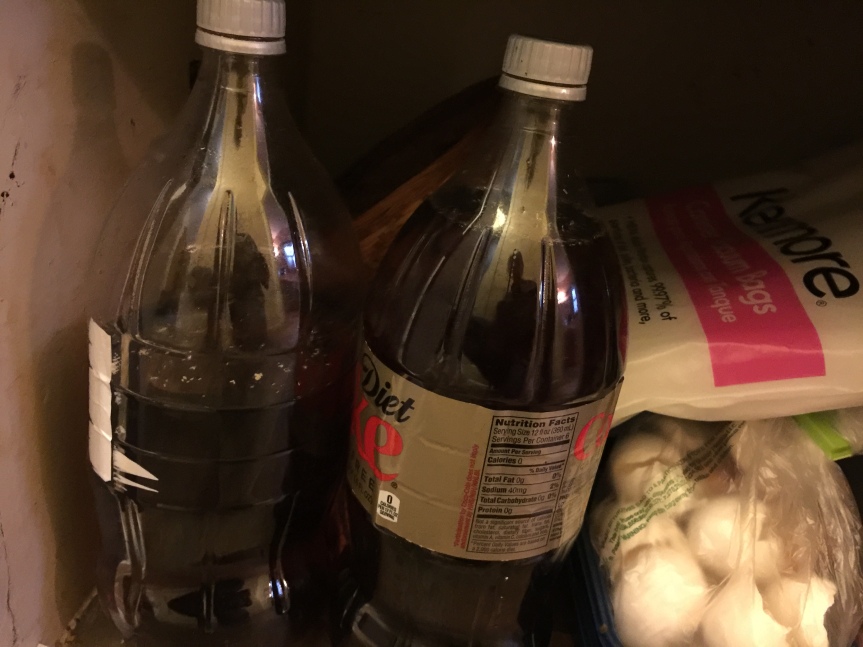
In my hallway closet, I have two bottles of the diluted vermi-compost liquid. My friend Vince gave me some Coke bottles to put the liquid into. Eventually, this will make it to the outside shed. Next to the bottles are some egg shells that I need to grind up for the worms.

img_4497

Inside my front door is the room I call the “entry way.” Garden tools often occupy part of that space.

img_4503

At this point there is also box with a bit of vermi-compost there.

img_4475

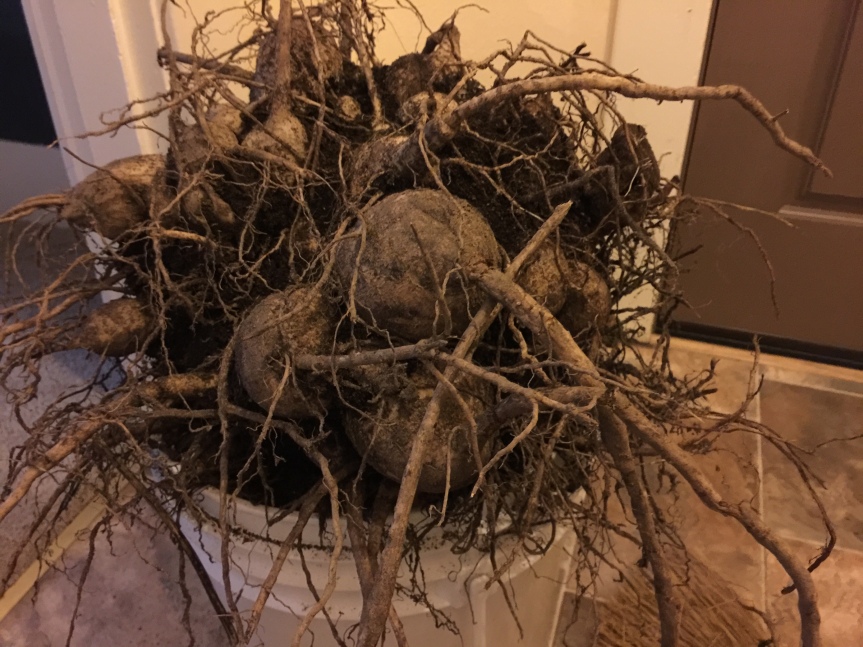
When I brought in the tuber ball from the second plant, it was so big and heavy that the best I could do was get it through the front door. So at this moment, that is where it is living.

img_4472

I decided to weigh the bundle of tubers so I could share that information in this post. It is almost 30 pounds! In the process of weighing it, I created a mess.

img_4506

I think I made my point. There is a whole lot of outside, inside my house. It is time for me to finish this post and go clean up the mess in my entry way!


cropped-senior-salon

Shared on Senior Salon

Cee’s Fun Foto Challenge: Yellow

I have been eagerly awaiting this week’s Cee’s Fun Foto Challenge. My favorite yellow photo is one I took two years ago near Amma’s Engineering College in Amritapuri, India. The bright yellow flowers were such a stunning contrast to all the greenery that surrounded it.

20141222_113554

Here are some of the other “yellow” photos I’ve taken during the last two years. (Click on the gallery to enlarge the pictures.)

Yellowcffc