To download the latest PNW GreenFriends newsletter, click on the photo.
Enjoy!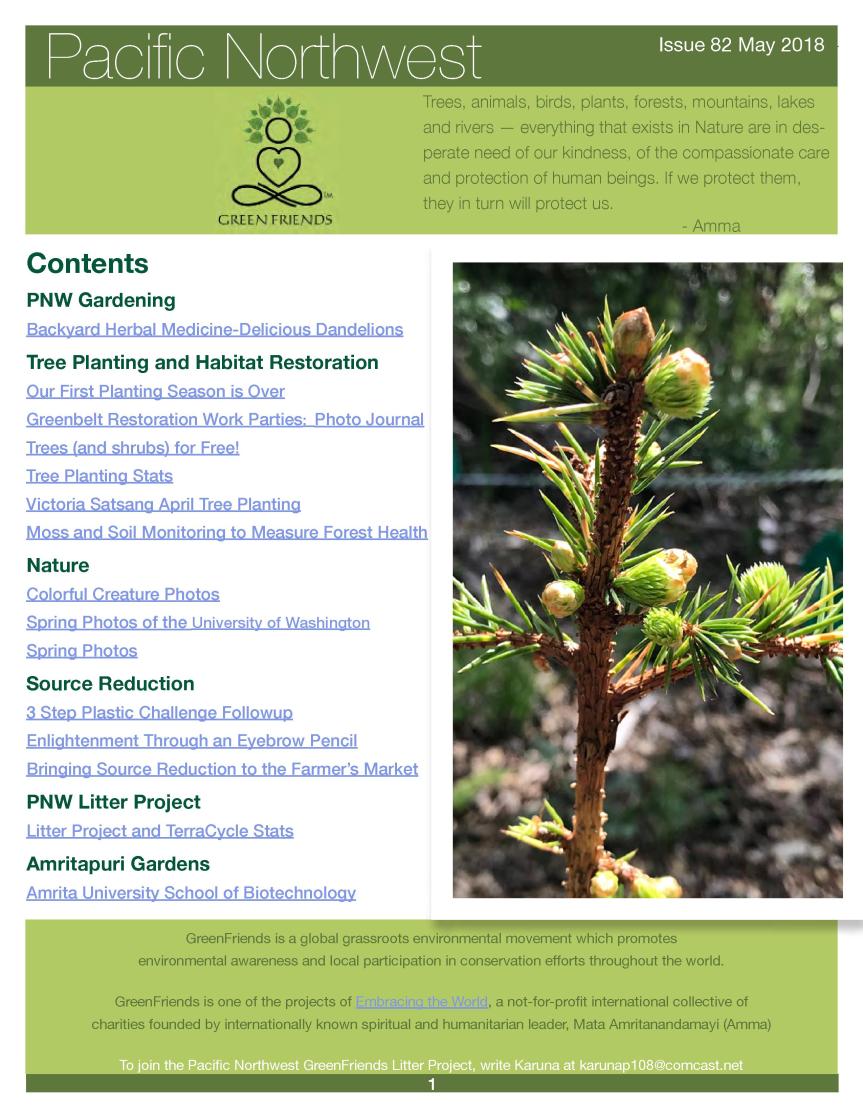
Tag: GreenFriends
Greenbelt Restoration Project: Our First Planting Season is Over

The planting season in Seattle’s parklands starts when the autumn rains begin and ends in mid-March. The reason for planting during those months is that it gives the plants time to root before they have to deal with the dry summer months. During our first planting season, we have planted 55 trees and 530 shrubs and ground covers.
All of the new plants are native to the Pacific Northwest. This chart lists the types of plants we planted during our first season.
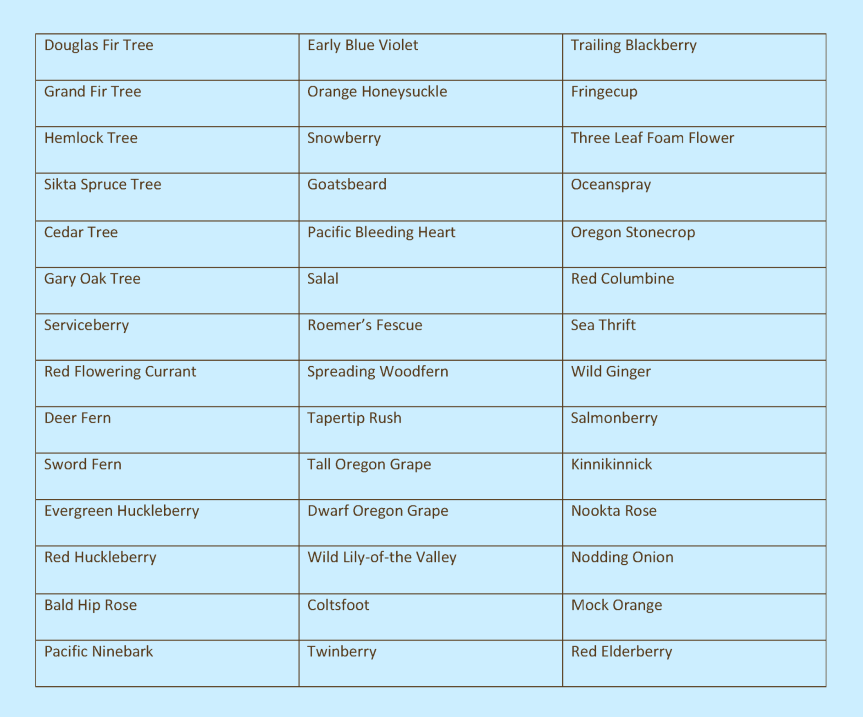
I love watching the plants grow. Some have doubled or tripled in size since we planted them. Almost all of them have leaves now and some even have flowers.

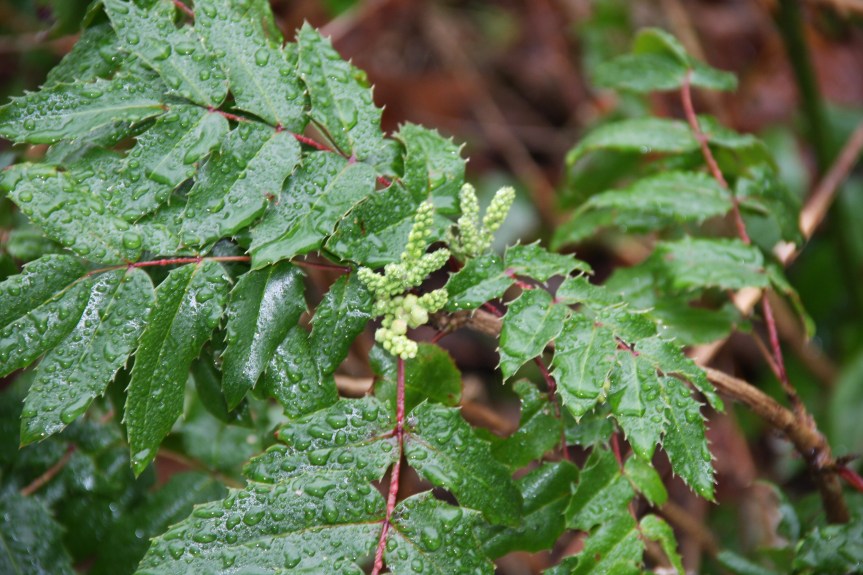
Oregon Grape

Red Flowering Currant

Roemer’s Fescue

Salmonberry

Wild Ginger

Fringecup

Orange Honeysuckle

Snowberry

Oceanspray
There are plants emerging from the ground that are a complete surprise. One day, I noticed long stalks scattered around one area.


Later, I was told they are Bracken ferns. I found some photos of Bracken ferns on Pixabay.


We are going to have a LOT of Bracken ferns in that area. I hope they get along with the new plants.
When I was outside taking photos today, a tiny hummingbird came within two feet of me. It is going to be an exciting spring and summer. I hope I see some butterflies too!
PNW GreenFriends Newsletter: April 2018
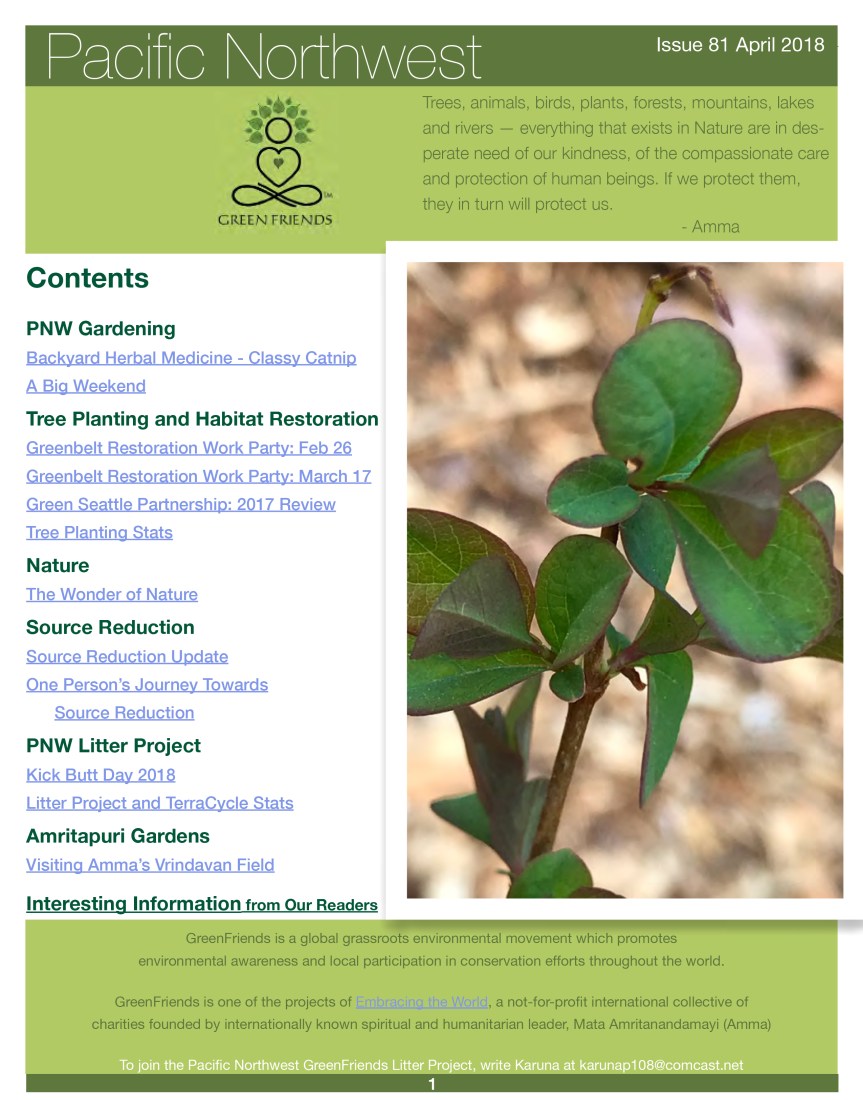
To download the latest PNW GreenFriends newsletter, click on the photo.
Enjoy!
Greenbelt Restoration Work Party: March 17, 2018

On March 17, thirteen hardy volunteers gathered to spread wood chips in areas that had been planted during the February 26 work party. The wood chip mulch will hold in moisture, reduce weed growth and enrich the soil.
Two neighborhood parents brought their children for part of the event. I felt moved when I realized that this forest may become important to these children as they grow up.
Most of the group had worked on this restoration project before, but for some it was their first time on the property. There was also a nice mix of GreenFriends members, neighbors and friends.
We didn’t have enough participants to do the traditional type of bucket brigade; i.e., handing buckets from person to person down a long line of people. Instead, everyone filled buckets for a short period of time and then most volunteers began to carry them to their destination on the other end of the site. Later on, the system changed again. At that point, part of the group carried the buckets the first half of the way, and then left them for others to carry to the planting areas. Once the buckets of wood chips reached a planting area, someone poured the chips onto the burlap.


My neighbor Christine was in two of my favorite photos from this work party. I took the first one during a time when she and I were filling buckets. At one point, she climbed to the top of the eight or nine-foot pile of wood chips and filled her bucket from there!
If you look closely you may be able to see steam rising from the wood chips. It reminded me of the steam I’ve seen coming from decomposing compost piles whenever I visit the compost center at Amma’s ashram in Amritapuri, India.

Marine took the other photo when Christine was talking with one of our young visitors.

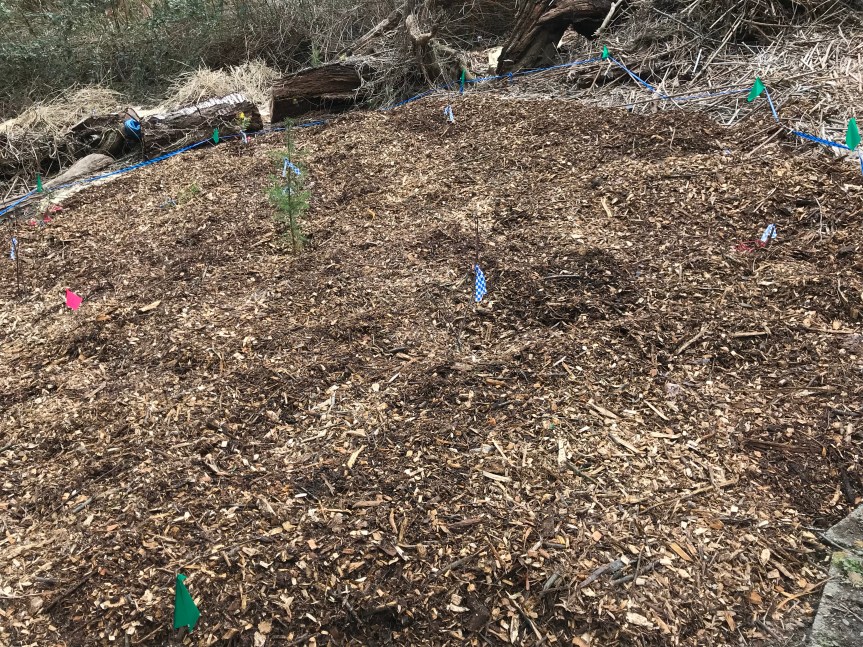
We accomplished more than I thought was possible; spreading wood chips throughout three large planting areas and several small ones. The transformation in the look of the land was remarkable.
At the beginning of February 2018, the property looked like this:


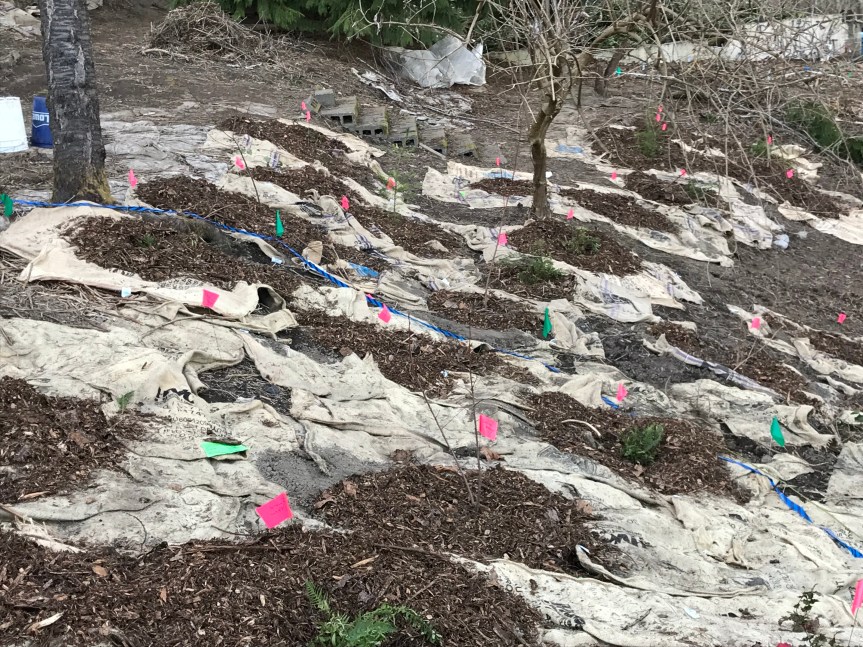
During the first three weeks in February, work party participants removed blackberry root balls and ivy from the land. On February 26, another group planted trees, shrubs and ground covers, and placed burlap and two buckets of wood chips around each plant. By the end of that work party, this is what the land looked like:

And this was the beautiful sight that greeted my eyes at the end of the March 17th work party:

We have many more wood chips to spread. It is gratifying to know that the work we are doing now will give the plants a better chance of surviving the summer, a season when rainfall may be minimal.
Greenbelt Restoration Work Party: February 26, 2018 Planting Day
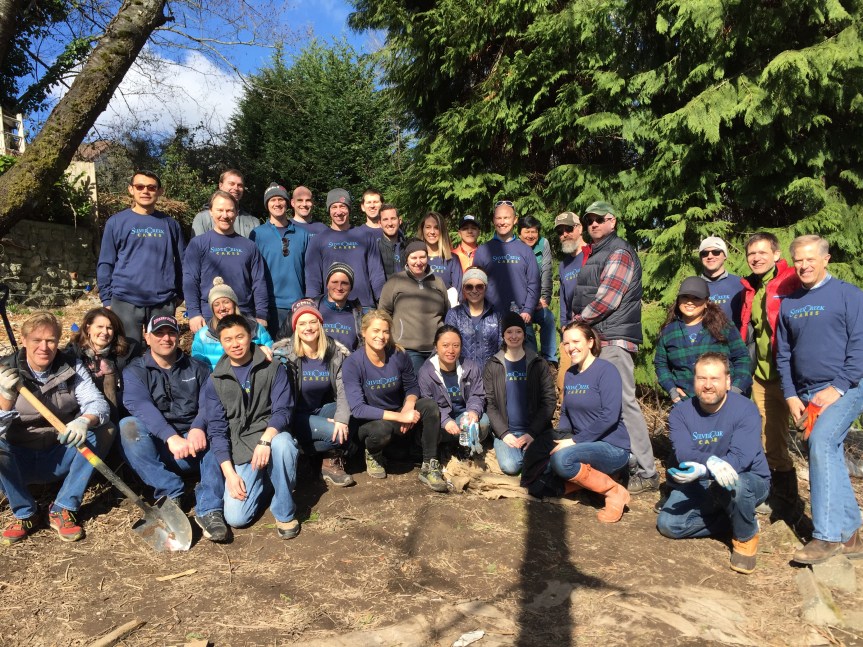
Monday, February 26 was an exciting day. On that day, 31 enthusiastic employees from Silver Creek Capital Management came to plant trees, shrubs and ground covers in our Greenbelt site. Our staff consisted of Nicole from Forterra, Claire a master gardener, and two Green Seattle Partnership Forest Stewards- Peter from Mt. Baker Park and me. Claire and I also belong to GreenFriends, the environmental arm of Embracing the World.
During the three-hour work party, we planted 17 trees, 75 shrubs and 77 ground covers! Every new plant is native to the Pacific Northwest. We spread two buckets of wood chip mulch around each plant to reduce weed growth and retain water. (The burlap we place on the ground after removing blackberries and ivy from the land also helps with weed reduction and water retention). At future work parties we will be covering any exposed burlap in the planting areas with wood chips.


(Click on the gallery above to enlarge the photos.)
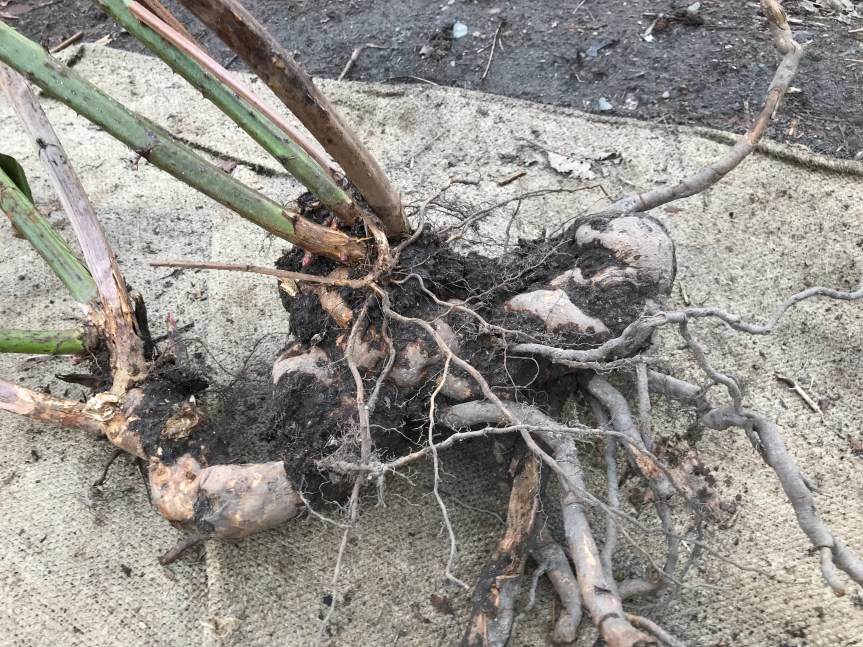
Towards the end of the event, part of Nicole’s team cleared more land. They dug up some huge blackberry root balls.
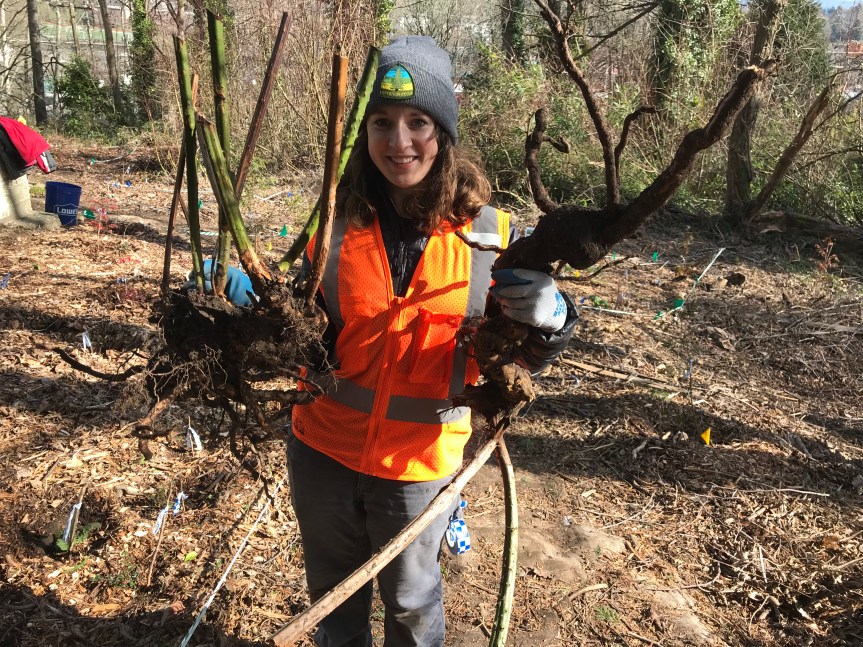
A few days later I weighed the biggest one. It weighed almost 10 pounds!
When the work party was over, we cleaned and put away the tools and celebrated all we had done. I think everyone had enjoyed their experience.
Later, I took another look at what we had accomplished. Once again, I was awed by how much the land had been transformed by a single work party.

Douglas Fir

Oregon Grape

Red Columbine

Wild Ginger

Oregon Stonecrop

Sea Thrift

Newly planted field

Photos by Laurel Webb, Nicole Marcotte and Karuna Poole
PNW GreenFriends Newsletter: March 2018
To download the latest PNW GreenFriends newsletter, click on the photo.
Enjoy!
Greenbelt Restoration Project: February 3, 2018
After every work party, I tell anyone who will listen that it was an amazing work party. And it always is. The transformation in the land that occurs during each three hour work party is mind-boggling, at least to my mind.
Four GreenFriends members, 3 neighbors and 21 students from the University of Washington’s Introduction to Environmental Science class participated in the February 3rd event. Towards the beginning, we divided into 4 teams. The GreenFriends members, who were serving as team leaders, wore orange vests so that they could be spotted easily.
Team 1
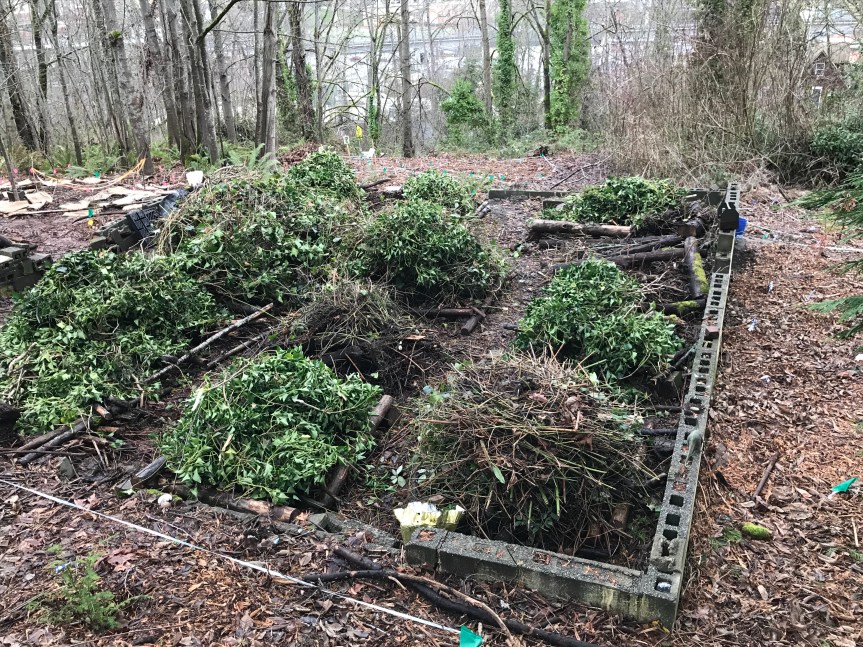
During our last work party, volunteers had focused on removing ivy from an evergreen tree and from the ground in an area on the northwest part of the site. At this work party, Team 1 continued that work, this time clearing ivy and blackberry root balls from an ever widening area. All of the debris was taken to an area we call The Rack Zone where it is put on racks that keep it from re-rooting. Having the vines and rootballs on the racks also enhances air flow and the debris will decompose faster than if it was left on the ground.
At the beginning of the work party the area looked like this:


The volunteers worked diligently and had a good time in the process. Even though I don’t have a “before” photo, know that the shed and stone wall shown in the last photo in this section was completely covered with ivy. Until recently, I didn’t even know there was a shed there.


(You can enlarge the photos in a photo gallery by clicking on any of the photos.)
At the end of the work party, the space looked like this. There is still work to do in this area but so much was accomplished during those three hours.

Team 2
The area where Team 2 worked is adjacent to Team 1’s section of the property. When English ivy grows unchecked and begins to flower, the leaves may change shape and become waxy. It may become a gigantic mass, developing thick stalks that may look more like a tree trunk than an ivy vine. One of the neighbors who has worked on this project from the beginning discovered such a mass in early January. Since then, he has been working to cut it down.
The first set of pictures below show what the area looked like at the beginning of the February 3rd work party. Notice the ivy mass in the background of the first photo. It is not nearly as big as it was originally but it is still huge. The second two photos show some of the piles we would be dealing with at this work party.


Here is a close up of different parts of that mass. It is SO dense.


The volunteers worked on the piles of debris, cutting the leaves and small branches of ivy away from the bigger branches. The leaves and small branches were moved to the rack zone to dry and the bigger branches either stayed in the area or were stacked near the rack zone.


By the end of this work party, the rack zone was almost completely full of ivy.
I wonder how long it will take for us to completely remove the mass. I suspect there will be many more work parties and many more piles before this task will be finished. But, at least, when the work party was over, the piles of debris that were there at the beginning were almost gone.


Team 3
On February 26, Silver Capital Management employees are coming to plant trees, shrubs and ground covers in this Greenbelt site. Team 3 helped prepare the ground for that planting work party.
In the days prior to the February 3rd work party, pink flags were placed around the site, marking where each plant will go. Written on each flag was the type of plant that will be planted there.
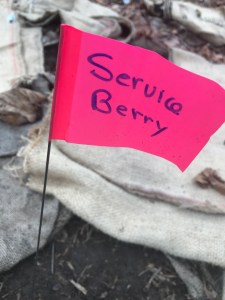


We’ve found that planting proceeds smoother and faster if the areas where things will be planted are prepared ahead of time. Prior to the work party, I made two demonstration areas so that the volunteers could see what they would be doing. In one area, I used burlap that had been placed on the ground when we first cleared the land, and in the other I used new burlap.


Team 3 cleared weeds, if there were any, from around the flags and then placed burlap bags around them, leaving a place for the people who will be planting to dig a hole. Once the planting is finished the burlap will be adjusted, if necessary, and then covered with wood chips. Both the burlap and the wood chips will decompose and enrich the soil.


This team prepared spaces for about 70 plants. In the photos below, you can see the burlap that is now scattered throughout the site.


Team 4
The fourth team cleared an area that our volunteers had not tackled before. Seattle Parks Department staff had done an initial cutting of the blackberry vines in that area in March 2017 and then cut them back again during the summer. At the February 3rd work party, the volunteers dug out blackberry root balls and removed ivy.
This is how that land looked at the beginning of the work party. (I think this would be a particularly good gallery for you to click on!)


After instruction on how to clear the land, the team “rolled up their sleeves” and went to work.


The students dug up many blackberry root balls. These are photos of the biggest one they found!


The transformation that took place was remarkable. By the end, this section was clear of invasive plants and covered by burlap bags (the bags help prevent weed growth).


While the students were working, my neighbor John started removing blackberry vines in a nearby area, one where the blackberries are even denser. A team will work in that section during our next work party.
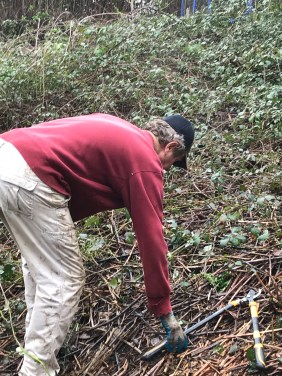
On February 26, these newly restored areas will become home to seven Douglas Fir trees as well as a variety of shrubs and ground covers.

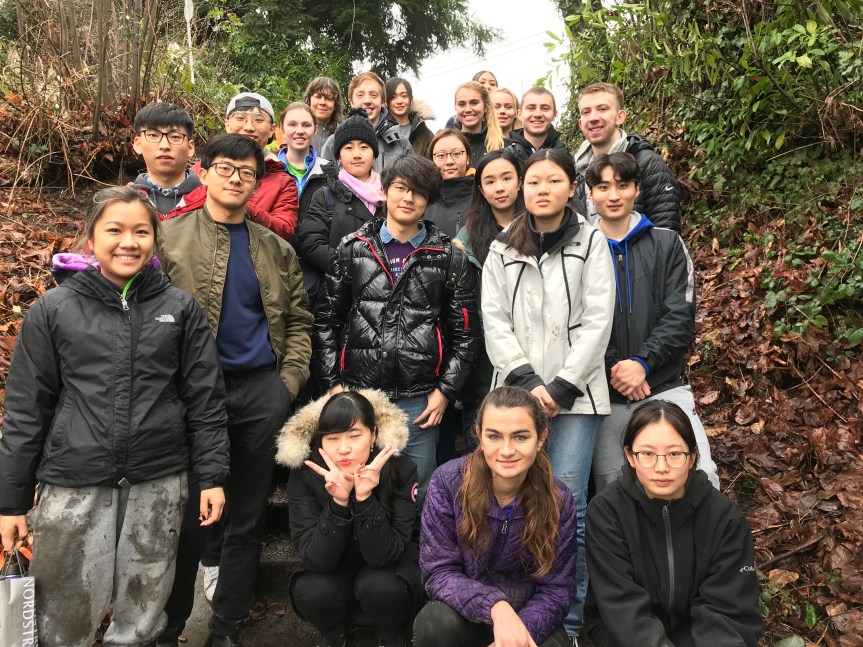
By 12:50 p.m., the tools we used had been cleaned and put away. We then gathered on the Hanford Stairs, which are on the north border of this site, to take a group photo and celebrate the completion of a very successful work party.
PNW GreenFriends Newsletter: February 2018
I spend a significant amount of my time each month working with a team of people to create the monthly Pacific Northwest GreenFriends online newsletter. We published our 79th issue today! What began in September 2011 as a several page Microsoft WORD document has turned into a beautiful newsletter filled with interesting articles and photos. Sometimes, I think we should call the publication a magazine rather than a newsletter.
GreenFriends is a global grassroots environmental movement which promotes environmental awareness and local participation in conservation efforts throughout the world. GreenFriends is one of the projects of Embracing the World, a not-for-profit international collective of charities founded by internationally known spiritual and humanitarian leader, Mata Amritanandamayi (Amma)
It is my experience that readers who live outside of the Pacific Northwest also find the newsletter interesting and valuable so starting with this February 2018 issue I’m going to post them on my blog.
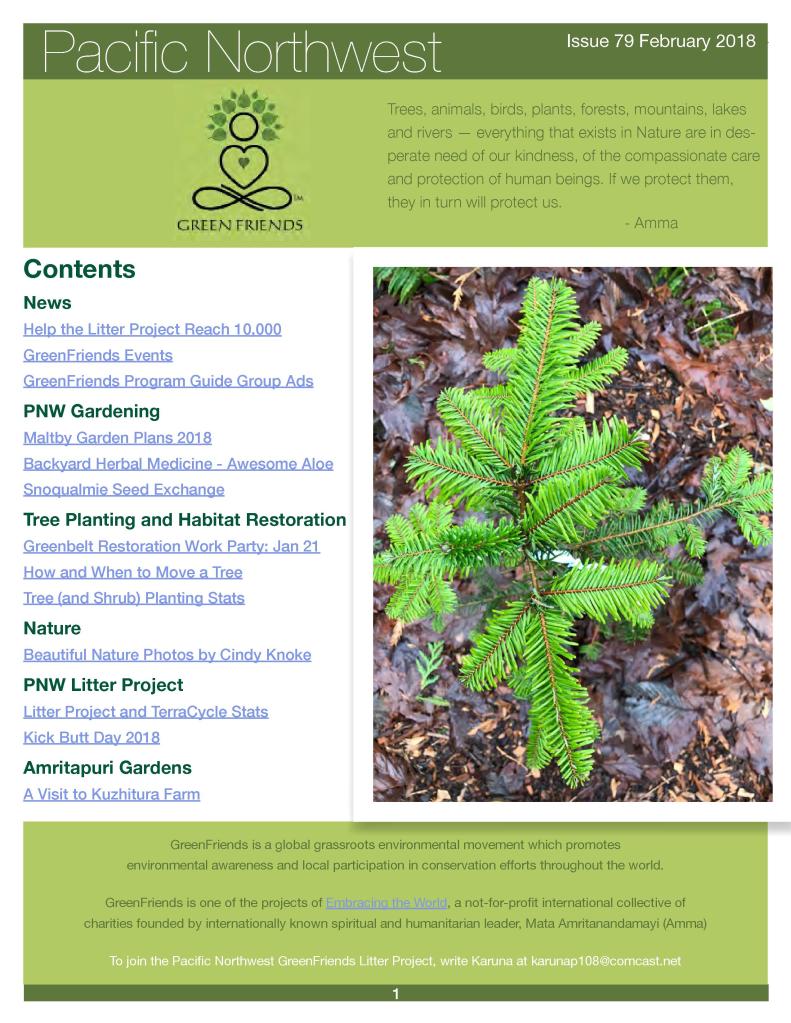
To download the newsletter, click on the photo.
Enjoy!
Greenbelt Restoration Work Party: Shrub and Groundcover Planting Day 2017

Wednesday, November 15 was a big day, one I’ve been eagerly awaiting. On that day, a corporate group from DocuSign came to our restoration site to plant the 330 shrubs and ground covers Seattle Parks Department had given us. November 15 was DocuSign’s Global Impact Day. I looked up the philosophy behind Global Impact and found this:
We believe character is defined through action. With DocuSign IMPACT, we are committed to putting this character into action by harnessing the power of DocuSign’s people, products, and profits to make a difference in the global communities in which our employees and customers live and work.
On that day, buses picked up the employees at their corporate headquarters and traveled to projects all over the city. I felt so grateful to have 42 of their volunteers helping us; and they were wonderful people to work with.
(Note: You might be wondering why we plant at this time of year. In the forest, planting starts after the fall rains begin. That way the plants have a chance to root before the summer comes. We’ve had almost no rain during the summer for a few years and there is no water source on this property. The plants have the best chance of survival if they have developed a healthy root system before the dry period.)
Prior to the work party, we prepared eight planting areas. Any remaining blackberry vines and rootballs, ivy and bindweed were removed and the areas were marked off with green and white, or yellow and black, tape. The University of Washington students who helped during our November 11 work party moved the potted shrubs and groundcovers to the areas where they would be planted.
The photo below is of the Dogwood Area, so named because it is near a large area of red twig dogwood and because a small patch of red twig dogwood came up within this planting area during the summer.
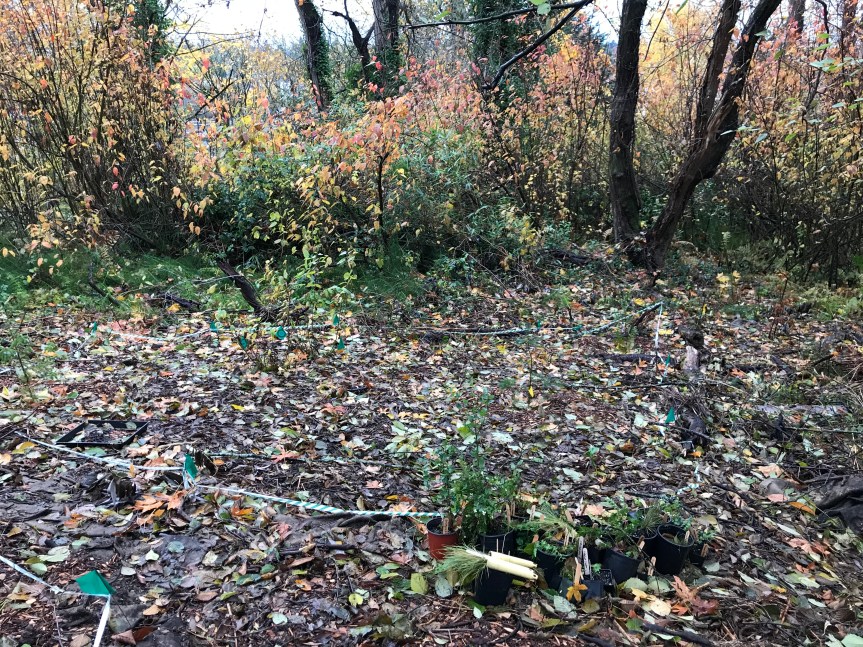

Location of the dogwood volunteers

Closeup of the dogwood
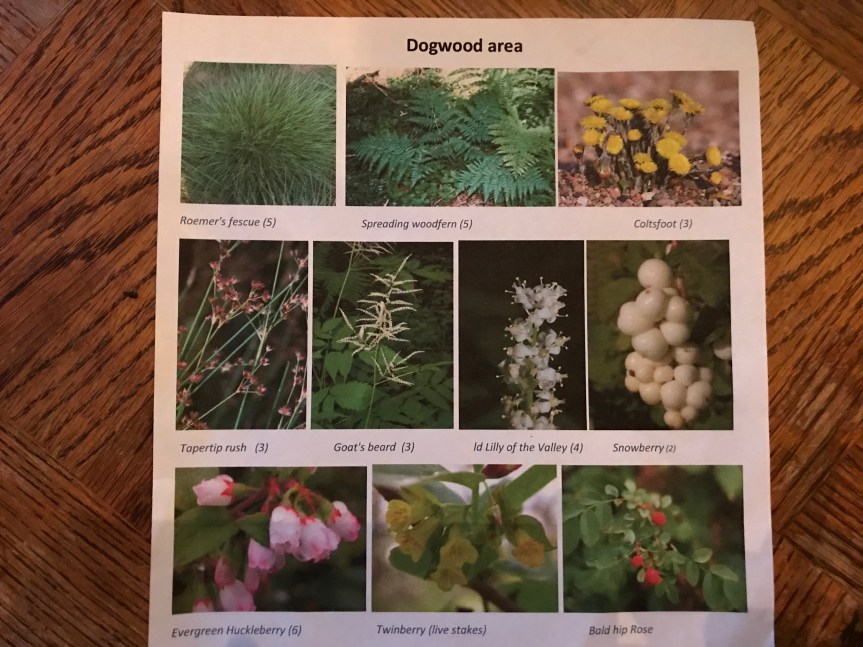
Another way we prepared for the work party was to create and distribute photo galleries of the plants that would go in each area. That way the workers could see the beauty they were helping to create.
I already mentioned that the DocuSign group was wonderful to work with. We had a dream staff too, consisting of Joanna Nelson de Flores, the director of Forterra’s Green Cities program, Nichole Marcotte, Forterra’s Stewardship Coordinator, Anavadya Oravec a Master Gardener and GreenFriends member and me! The staff arrived an hour and a half early so I had a chance to show them around the site. We spent part of our November 15th pre-work party time placing each plant on the spot where the DocuSign employees would plant it.

Joanna

Nichole and Karuna

Anavadya
When the participants arrived, I talked about the history of the project and gave information about safety relating to this particular site. Then the group was divided in half and walked to the part of the property where they would soon be planting. Joanna and Nichole each led a group. They talked about tool safety and then showed participants how to plant the shrubs and ground covers. I really appreciated having the opportunity to hear the experts teach! During the work party, all four of us supervised the work and helped as needed. (Click on the gallery to enlarge the photos.)


After each plant was planted, a blue and white tape was tied loosely on one of its branches, or on a stick that was placed next to it. Every year, Seattle Parks Department uses a different color of tape to tag the plants. So from here on out, whenever we see a blue and white tape in any of Seattle’s parks, we will know that the item was planted in 2017!
Once a shrub or groundcover was planted, four burlap bags were placed around it. When all of the planting in an area was complete and the burlap was down, the entire area was covered with wood chips. (The burlap and wood chips reduce weed growth, retain moisture, and prevent erosion. Both the burlap and the chips will decompose and enrich the soil.)
Below are photos of the completed planting areas. You can see the blue and white tape I mentioned throughout them.


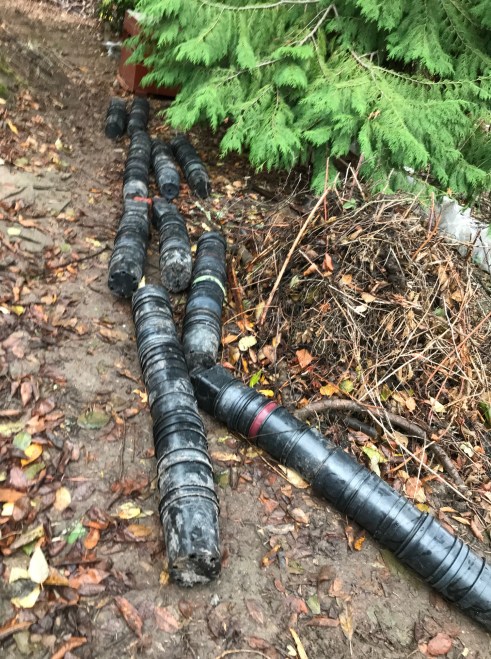
And this is a photo of the empty pots!
I am so excited for Spring to arrive so I can see every bud, every flower, and every berry! I hope most (or better yet, all) of the plants survive the winter.
Greenbelt Restoration Work Party: Tree Planting Day!
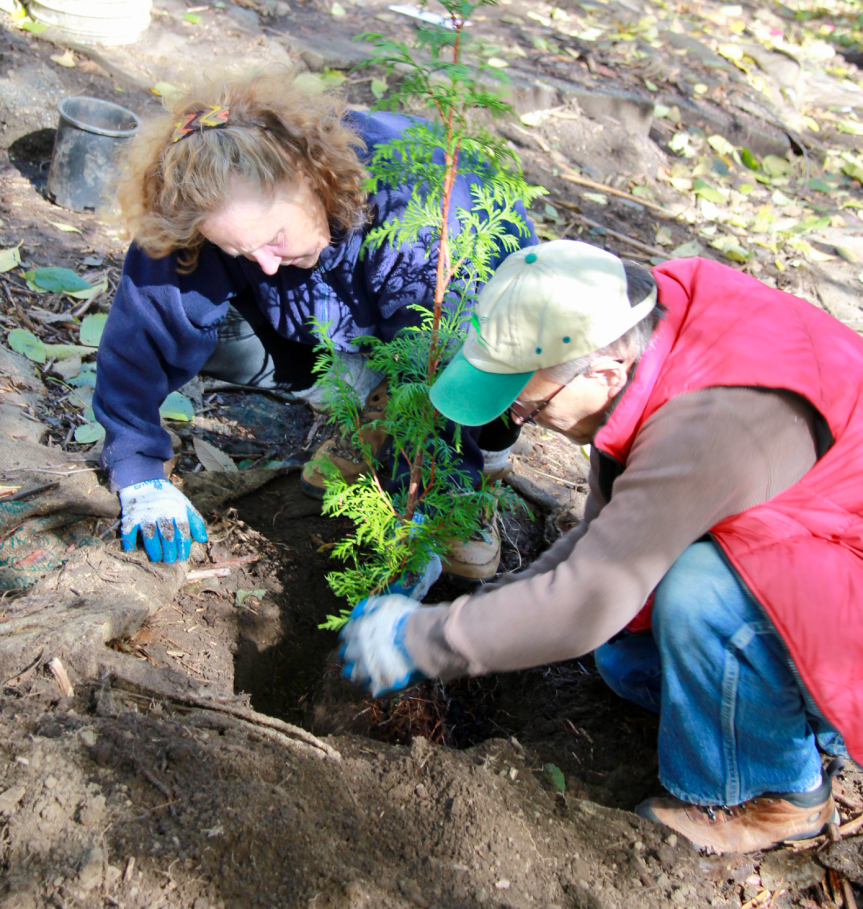
For many years, Amma has been encouraging us to plant trees as a way of healing the Earth. This year, devotees in the Pacific Northwest decided to honor Amma’s 64th birthday by planting trees. We asked everyone to let us know how many trees they would plant and to complete the planting by November 5th. We were hoping at least 64 trees would be pledged. At the time I am writing this post, the pledge count is up to 211!
Seattle Parks Department gave us 37 trees to plant in our Greenbelt site. That work party was held last Sunday, October 22nd. Thirty-two GreenFriends members participated. Many of them had never seen the site before and others hadn’t been there for a long time. I enjoyed seeing and hearing their reactions to the work we’ve done over the last year.
The work party began with an orientation to the site…
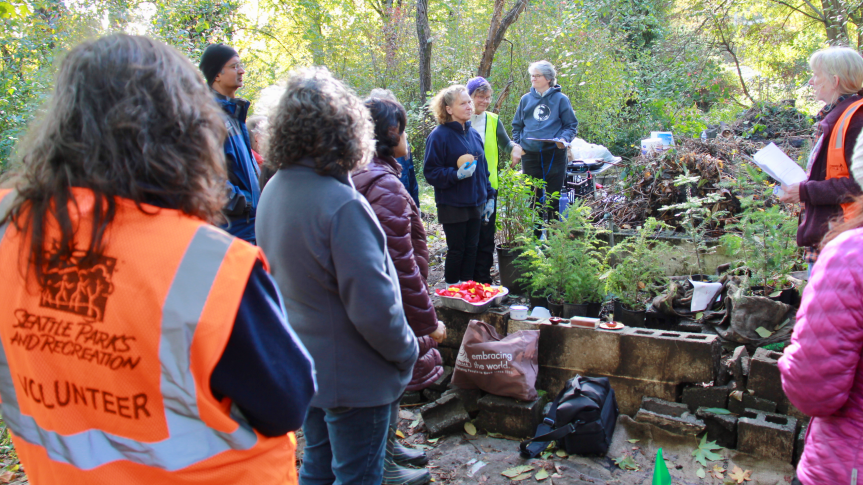

and then Pujarini Meera conducted a series of rituals asking Mother Earth for permission to plant the trees and to nurture and protect them after they are planted. I thought it was a beautiful ceremony. (Click on any of the galleries to enlarge the photos.)


After the rituals were over, Ananya and I gave planting instructions…


and then came the fun of planting the trees.


Amma’s birthday project will be over on November 5, but our work in the restoring this Greenbelt site will, of course, continue. We will finish preparing nine planting areas at a work party on November 11 and then will plant 360 shrubs in those areas on November 15!
 Living, Learning and Letting Go