


On January 24, 2014 there were 9294 homeless people men, women and children in Seattle/King County.
How can so many be homeless in this city/county? The following facts certainly give some big hints:
1 bedroom $249,975
2 bedrooms $392,000
3 bedrooms $470,000
4 bedrooms $599,000
There are City of Seattle and King County programs which help the homeless find shelter and food. Many churches and missions also devote a great deal of time and resources to this endeavor. In addition, numerous churches are now allowing homeless people who own cars to park in their parking lots at night.
While I could present a lot more information about the shelters and the feeding programs, I’m going to limit most of my focus to the tent cities. (Know that these communities are set up in a way that allows their residents to have some degree of privacy, so I took most of my pictures from a distance.)
The Seattle Housing and Resource Effort and Women’s Housing Equality and Enhancement League (SHARE/WHEEL) set up the first tent cities in 1990. Over time the first two disbanded but Tent City #3 and #4 are still active. The early tent cities had to move every 3 weeks to 3 months. Now they are allowed to stay in one place for six months, and an additional six month extension is sometimes possible.
Tent City #3 is currently located near the freeway entrance at NE 64 Street and 8th Avenue NE. They are able to shelter up to 100 residents.
Tent City #4 is now hosted by the Redmond Family Church in Redmond, Washington. It serves 80-100 people.
In 2008, a group of homeless people set up a group of pink tents that had been donated by the Girl Scouts. Mayor Greg Nickles had them evicted three days later; twenty people were arrested in the process. In protest, the camp was named Nicklesville! The group has moved 20 times over the years. After disbanding for a year, they were recently given a new Seattle location at 1010 S. Dearborn. Approximately 80 people are living there now.
In addition to the tent cities, there are individual tents scattered throughout the city. It is not unusual to see them on a street, under a freeway, or in the forested areas of the city. I was recently told that a group of homeless men and women had set up a camp on the sidewalk of the park that borders the King County Courthouse. When I checked it out I noticed people were also sleeping on the sidewalk.
May the day come when everyone in the world has both adequate food and shelter.
Lokah Samastha Sukhino Bhavantu
Shanti, Shanti, Shanti
May all beings in the world live in peace
Peace, Peace, Peace
The challenge this week is to show our minimalist photos.
Minimalist photography is characterized by a large portion of negative space, a fairly monochromatic color palette with good contrast, and an interesting subject that is able to stand on its own to capture the interest of the viewer.
I think this picture my father took of me in 1951 or 1952 would fit into this category.

Written for Weekly Photo Challenge: Minimalist
The assignment for this weekend was to use the concepts we have been taught so far in the course and to create a gallery. I kept in mind the concepts of wide angle, vertical/horizontal, foreground/background, and Rule of Thirds.


In March 2014, I started my Living, Learning and Letting Go blog. Creating posts for the blog has without doubt been a major source of bliss for me. When I think of which post I associate most with the word bliss, Bastet Pixelventures: One Point Perspective photography challenge comes to mind.
When first I read her challenge on June 2, I had no idea what a one point perspective was. I read Bastet’s directions and also looked the phrase up on Wikipedia. Wikipedia says:
A one-point perspective drawing means that the drawing has a single vanishing point, usually (though not necessarily) directly opposite the viewer’s eye and usually (though not necessarily) on the horizon line. All lines parallel with the viewer’s line of sight recede to the horizon towards this vanishing point. This is the standard “receding railroad tracks” phenomenon.
Now I knew what it was, but what photo could I take? As I started on my morning meditation walk, ideas began to enter my mind. I knew I wanted it to be a useful photograph, i.e. something that had a purpose beyond my post. Next I thought of the PNW Litter Project I coordinate. I could take a photo that could not only be used for the challenge, but also in our monthly GreenFriends newsletter and for Litter Project promotion.
Soon thereafter, it dawned on me how I could accomplish my goal. I was so excited. As soon as I returned home, I set to work.
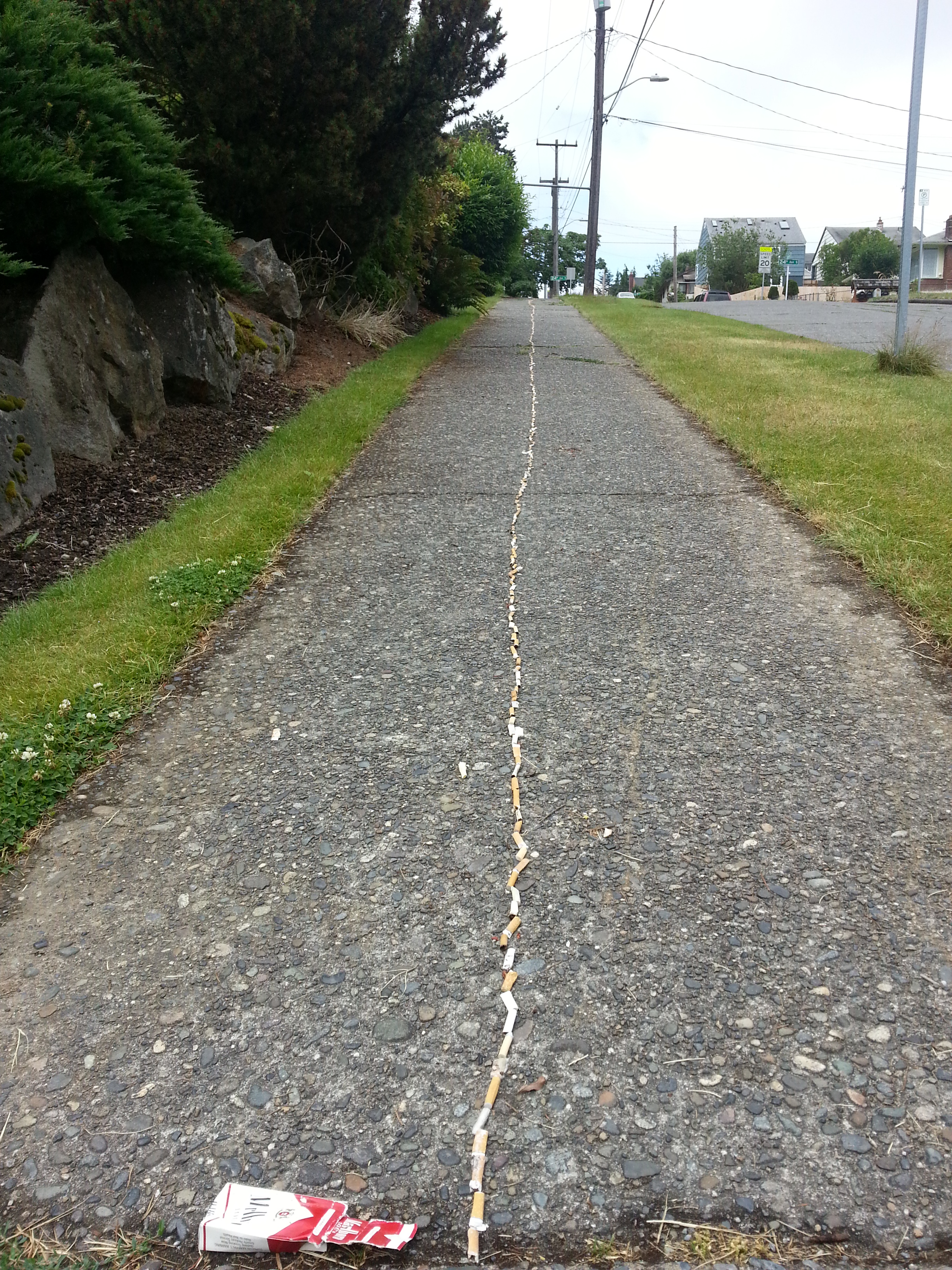
A main focus of the Litter Project is to pick up cigarette butts, the biggest form of litter in the world. The butts are so toxic to the earth and to our waterways, marine animals, birds, etc. To date we have picked up more than 225,000 butts. We send them to TerraCycle to be turned into plastic pallets.
My idea was to create a photo that shows the never ending nature of the problem. To do that, I placed 1375 cigarette butts in a straight line on a sidewalk near my home. It worked!
I definitely felt blissful while creating the imagery and when I saw the photograph!
Written for Photography 101: Bliss

I had hoped I would be able to address the Photography 101 assignment and the Weekly Photo Challenge in one post and I can!
The Photography 101 assignment is:
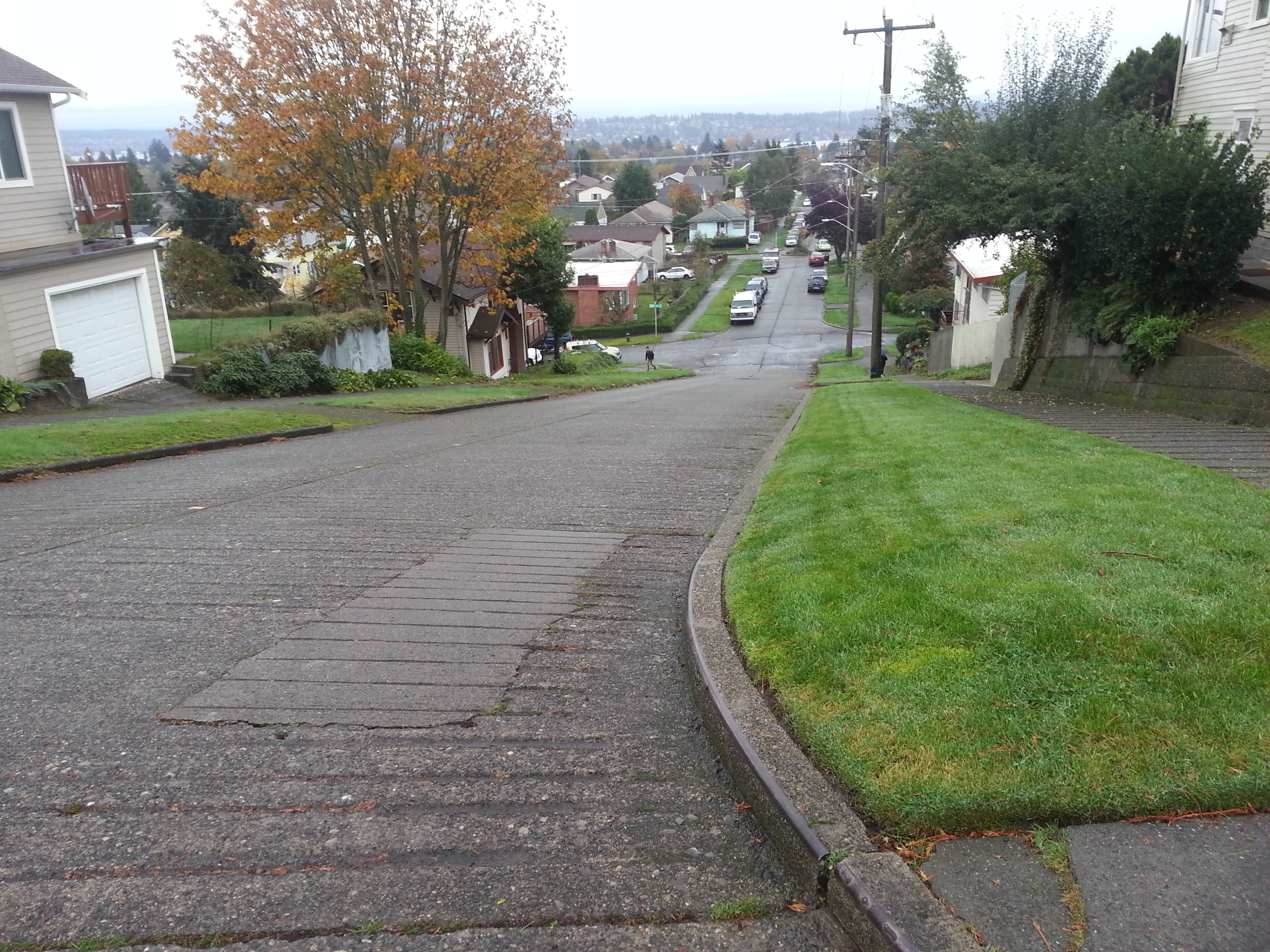
Today, let’s focus on a street. It can be a quiet road in a small town, an alley near your apartment, or a busy street where pedestrians weave between cars and motorbikes….In your shot, think about its basic components: a foreground and a background. The foreground is the part of you that’s nearest to the viewer, and where you can place a subject or focal point of your picture.
I took this photo in a way the viewer might think that my focus was the texture of the road in the foreground.
The Weekly Photo Challenge is:
This week, show us your interpretation of descent — experiment with your point of view and angle, or go even deeper with the theme.
I think the picture above captures the concept of descent well!
*****
Completing these assignments reminded me of an incident that happened decades ago. When it snows in Seattle it is nearly impossible for me to drive to or from my house. This photo shows the road going west from my house. There are 8-10 more blocks of steep incline beyond what you see here; so driving uphill when there is snow on the ground is not an option.

One year, I thought the one block decline going east was potentially doable so I decided to try it.
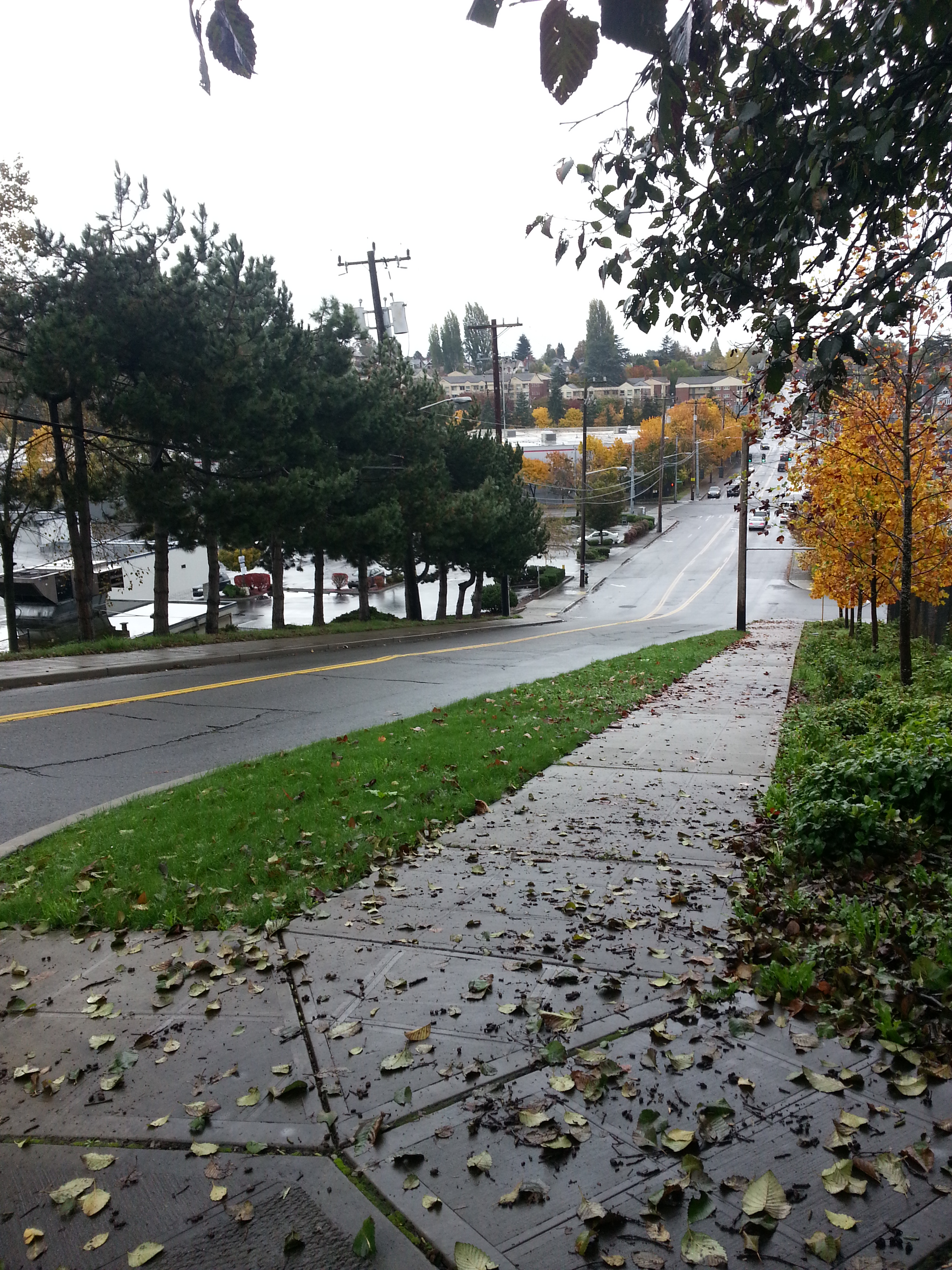
I took a deep breath and turned the corner onto McClellan St. When I looked into my rear view mirror, a moment or two later, I saw a station wagon sliding down the hill sideways. Somehow, I avoided a collision, but that was the end of my driving when it is snowing in Seattle! If I need to go somewhere I walk, take the bus or go by light rail!
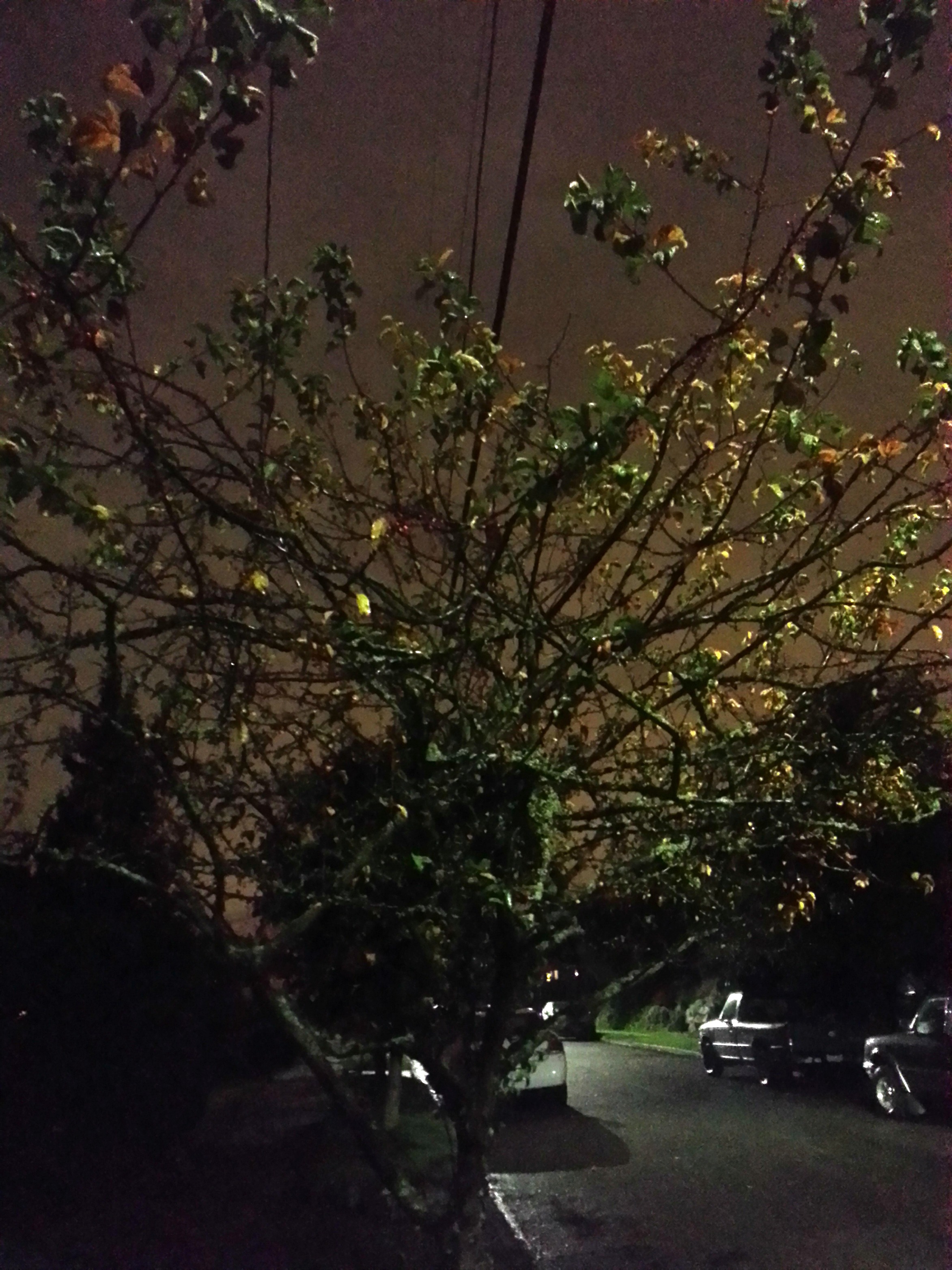
Today is the first day of Blogging University’s Photography 101 course. Our assignment is to take a photo that shows what home looks like to us and to share the image in a new post.
I have several homes and have written posts about two of them (Seabeck: A Home in the Universe for Me and A Place for Me).
I will be going to India later this month, but at this moment I am in Washington State. I moved to Seattle in 1966 to go to college and have lived in the same house since 1973. A few minutes ago I walked outside. It was dark, and it had been raining. The air was cool and fresh and I could smell the fragrance of firewood burning in nearby houses. I decided to take my first Photography 101 picture of the tree in front of my house. During the time I am in the heat of India, I will remember this moment and this home.
Written for Photography 101: Home
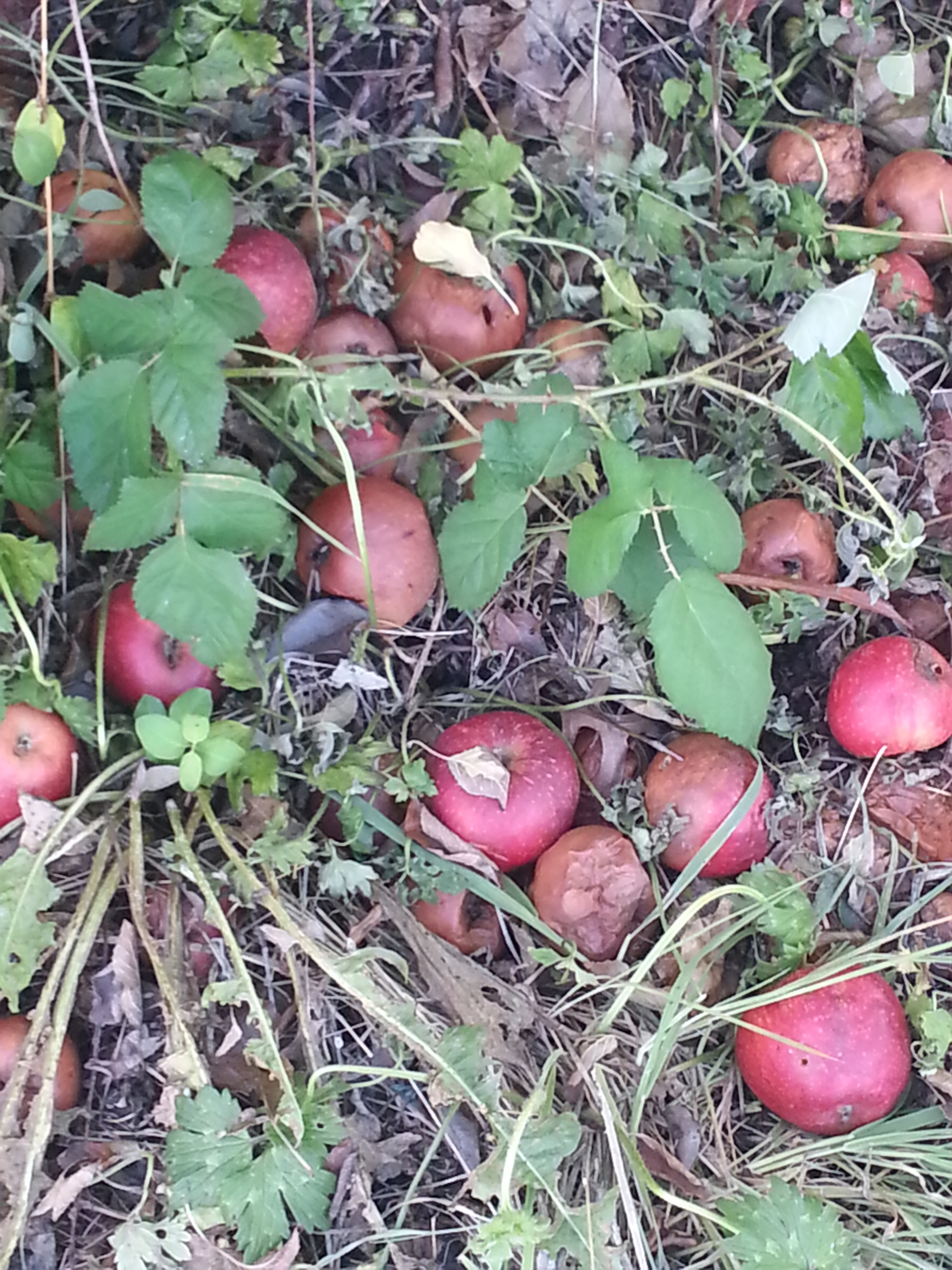
On a morning walk several weeks ago, I passed by a number of homes where the ground under fruit trees was covered with rotting fruit. Seeing the apples reminded me of a post I wrote in August. At that time, The Daily Post challenge had been to identify what we considered to be the 8th Cardinal Sin. I decided to add “Wasting Food” to the 7 Cardinal Sins from the Bible. (See The Eighth Cardinal Sin: Wasting Food)
In doing the research for that post, I learned that in 2012, the National Resources Defense Council (NRDC) of the United States concluded that the U.S. wastes 40 percent of its food. My response to the challenge reviewed many of the ways we waste food in this country. When I saw the rotten apples, I realized I should also consider letting the fruit and vegetables in our gardens rot as a form of wasting food. After all, if we don’t need the produce, we could give it to individuals and families in need or to organizations such as missions and/or food banks.
Earlier this summer, I had considered sending a note to neighbors reminding them that the food banks welcome garden fruit and vegetables but I never did it. I regret not having followed through on that impulse.
A few days go, I discovered in Seattle we have a group called City Fruit. Their website states:
City Fruit promotes the cultivation of urban fruit in order to nourish people, build community and protect the climate. We help tree owners grow healthy fruit, provide assistance in harvesting and preserving fruit, promote the sharing of extra fruit, and work to protect urban fruit trees.
Since 2008, City Fruit volunteers have harvested and donated more than 80,000 pounds of fruit (24,000 pounds were harvested in this year alone). This is definitely a group I could tell my neighbors about next year.
The spiritual group I belong to feeds the homeless in Seattle once or twice a month. That project is called “Mother’s Kitchen.” In August, one of our members decided to plant a garden dedicated to Mother’s Kitchen so that the people we serve would be eating more organic produce. She also asked us to donate vegetables from our gardens. I did not have a very good harvest this year so did not donate anything.
I pledge to those of you who are reading this, that next year I will inform neighbors of places that would welcome their unwanted fruit and vegetables and will do a better job of not wasting garden produce myself. I will continue to give extra produce to family members and friends, but will also share what I have grown with food banks and Mother’s Kitchen.
How do you, or will you, prevent vegetable and fruit wastage in your gardens?
The Art and Craft of Blogging
A collection of discussions on the environmental issues
“The fool doth think he is wise, but the wise man knows himself to be a fool.” “Love all, trust a few, do wrong to none.” “Love looks not with the eyes, but with the mind, And therefore is winged Cupid painted blind.”-William Shakespeare
...moments of unexpected clarity
Home of Lukas Kondraciuk Photography
Wellness, Support and Mindset
Thoughts on Creativity & Deeper Things
A Blog by Novella Carpenter
Ramblings of an Irish ecologist and gardener
Teaching the art of composition for photography.
Blog from SathyaSaiMemories ~ stories of love in action and the benefits of giving
There are 11,507 stories in Haddonfield; this is one of them.
Perennial gardening and more from the Green Mountains of Vermont
Whatever it will be...
Welcome to my little slice of the blogosphere
 Living, Learning and Letting Go