There Is No “Other”

IMG_0379

In the mid 90’s, I read a book that really spoke to me. It was called “The Balkan Express: Fragments from the Other Side of the War” by Slavenka Drakulic. She is a respected journalist and commentator from Croatia. The publication contained a series of essays about the effect the Serbo-Croatian war had on her colleagues and fellow countrymen.

The portion of the book that I remember to this day is her essay “High Heeled Shoes.” In it she described her growing awareness that she had turned citizens of her country, even close friends, into “others.”

First, she saw that instead of seeing refugees as people who had escaped slaughter by the Serbians, she had started stereotyping them. “They are just sitting smoking, doing nothing. Waiting. Waiting for what? For us to feed them. They could work, there are plenty of jobs around, houses to be repaired or working the land.” She heard a woman on a train say “This city stinks of refugees” at a time when there were refugees sitting beside her.

As she continued to examine her own attitudes, she saw that she had reduced individuals to the category of “they” and from there to “second-class citizen” or “non-citizen.” She realized when we do this, they soon become “not-me” or “not-us.” We may feel some sense of responsibility for them, but it is the type of responsibility that we feel towards beggars.  “The feeling of human solidarity turns into an issue of my personal ethics.” We help only if we want to.

As her reflection continued, she wondered :

Perhaps what I am also witnessing is a mechanism of self-defence as if there were a limit to how much brutality, pain or suffering one is able to take on board and feel responsible for. Over and above this, we are often confronted with more less abstract entities, numbers, groups, categories of people, facts– but not names, not faces. To deal with pain on such a scale is in a way much easier than to deal with individuals. With a person you know you have to do something, act, give food, shelter, money, take care. On the other hand, one person could certainly not be expected to take care of a whole mass of people. For them, there has to be someone else: the state, a church, the Red Cross, Caritas, an institution.

and

Out of opportunism and fear we are all becoming collaborators or accomplices in the perpetuation of war. For by closing our eyes, by continuing our shopping, by working our land, by pretending that nothing is happening, by thinking it is not our problem, we are betraying those “others” – and I don’t know if there is a way out of it. What we fail to realize is that by such divisions we deceive ourselves too, exposing ourselves to the same possibility of becoming the “others” in a different situation.

I still resonate with everything Slavenka Drakulic said in that essay. I know I put panhandlers in the “other” category. When I see someone whom I think might be about to ask me for money, a whole litany of judgments erupt within me. While I’ve worked on this issue, it is not gone. While I don’t believe I have the same negative judgments about the victims of war and the natural disasters that are occurring with increasing frequency in the world, I believe I am still seeing them as “others.”

I need to confront my judgments, help more, and remember to think of people as individuals who like me have needs and wants. I need to remind myself that we belong to the same human family. They are a part of me; we are one. No, I can’t fix all of the problems in the world, but I can do more than I am doing and it can be from a place of love, caring and inclusion rather than from some “better than thou” place within myself.

As I was completing this post, I remembered a part of a guided imagery meditation from “Legacy of the Heart: The Spiritual Advantages of a Painful Childhood.” by Wayne Muller. I will leave you with his words.

Observe how birth, suffering, illness and death touch each one of us who lives on the earth. This is the pain we all share, in which we all partake, the pain of being human that touches our common bodies, hearts and minds. You may say to yourself as each image arises. “I am your other self.”

Embrace each image with forgiveness, mercy and love, touching the pain your heart, touching all the beings who suffer with your heart. This is the inheritance of the family of creation. This is your family.

Feel the depth of connection to all beings as you allow the pain to be the doorway into community with your greater family. Feel the truth of that belonging. Gradually return to the awareness of your breath as it naturally flows in and out of your body; feel your body as a tiny cell in the larger body we all share.


Lokah Samastha Sukhino Bhavantu
May all beings in the world be happy.


Written for Challenge for Growth Prompts: Looking for the Good in Others.

Amma’s Vrindavan Tulasi Field

IMG_1541

After Lalita and I left Amrita Herbal Gardens, we walked to the Vrindavan Tulasi Field, the farm I had originally planned to see that day.  This property contains the gardens I have heard about most over the years. The devotees who have worked there have faced so many obstacles. Year after year it has been a process of trial and error. Amma teaches us to put in the effort and let go of the results.  Those who have worked at this farm have done such a good job of doing that.

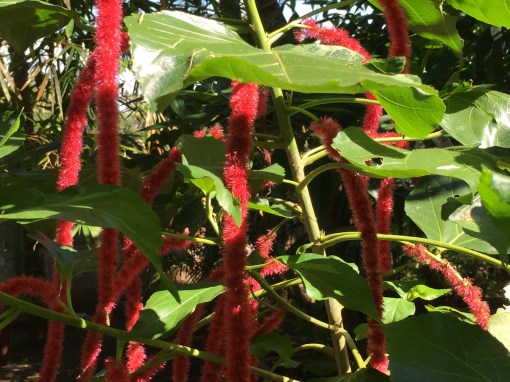
When I walked onto the property, I gasped at what I saw.  The place had truly become paradise. The first plants that caught my eye were some that had beautiful flowers, different from any I had ever seen.

After leaving that area, Lalita and I walked from place to place, marveling at everything we saw.  There were coconut trees of course, but so much else.  We saw many banana circles, each with its own compost pile in the middle. We viewed many different types of plants, all looking healthy and luscious. (Click on the gallery to enlarge the pictures.)

This farm was first known as the Tulasi Field.  (Tulasi is also called holy basil and is known for its medicinal and religious properties.) Several years later, they discovered that Rudraksha trees were growing there and throughout the ashram.  The devotees started planting Rudraksha trees in all of the gardens.  For a while the Tulasi Field became known as the Rudraksha Farm.  This year I discovered it has been renamed Amma’s Vrindavan Tulasi Field.

Lalita noticed that the bottom portion of all of the Rudraksha trees had been painted white; I didn’t think to ask one of the workers why that was done.  A worker told us that 10,000 rudraksha seeds had been harvested this year.  Those were produced by a small number of trees, as the trees that had been planted in the last few years were not mature enough to produce fruit.  One thousand seeds had been harvested from the tree in the picture on the right side of the gallery below.  It was the most prolific tree on the property.

Rudraksha seeds are considered sacred in India. They symbolize the dissolution of desires and the awakening of truth. A rudraksha seed is divided into 1-21 segments. Those segments are also known as faces or mukhi. While all rudraksha seeds have healing properties, the properties change depending on the number of mukhi. The five mukhi rudraksha seed is the most common form. It can help with regulating blood pressure, heart problems, stress, mental disability, obesity, anger management, diabetes, piles, neurotic and behavioral problems.

5mukhi
Wikimedia

Here are some pictures I took the first year they started harvesting the fruit of the rudraksha trees. After the fruit is picked, it is opened and the seed is taken out, soaked and then brushed until it is clean. To read an article I wrote about the rudraksha seeds two years ago go to: Rudraksha Farming at Amritapuri, pages 7-9.  That document contains more information and many pictures.

There may have been tulasi plants growing throughout the property, but one of the last areas we came upon before we returned to Amritapuri was a field of tulasi.  The plants were so big and so healthy.  A woman who had recently come to the ashram was watering them.  I had the feeling she didn’t understand why we were so astounded by what we were seeing.  She probably didn’t know about all of the years and effort that had been spent trying to get anything to grow in the dry, barren ground.

I found myself teary as I wrote this post.  The earth in so many of the pictures looks dark and rich; so different from how it used to be.  This property is certainly proof that when you put in the effort and let go of the results, miracles can happen.

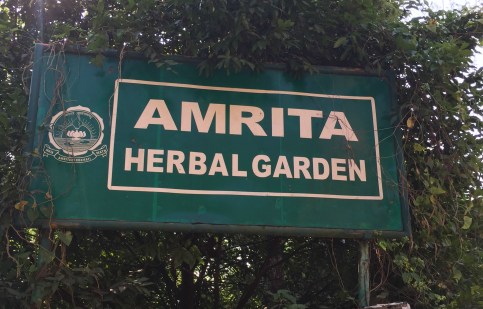
Amrita Herbal Garden

Amrita Herbal Garden

The Friday before I left India, my friend Lalita and I decided to go a garden near Amma’s Amrita School of Ayurveda. Even though I had been to the property before, I wasn’t sure how to get there so we hired a rickshaw.

When I saw a garden across from the college, I told the driver to stop and let us out. It turned out not to be the garden I had planned to see, but it was “no accident” that we stopped. We were soon walking in a wonderland.

The garden is named Amrita Herbal Garden and it is part of the School of Ayurveda. I learned later that it covers 5 acres and that there are 500 rare species of medicinal plants growing on the land.  The plants are used for research and for making Ayurvedic medicines.

I will let the pictures speak for themselves.

(Click on the gallery to enlarge the photos.)

Recycling and Composting in Amritapuri

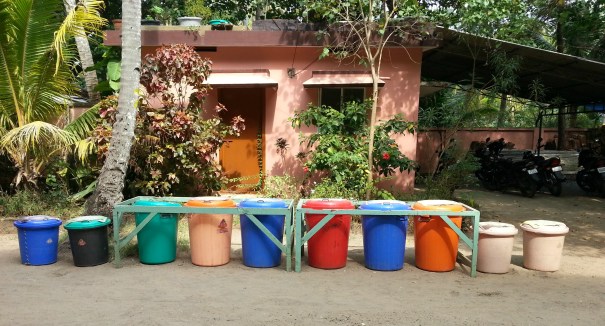
Recycling station

Amma has made recycling and composting a major priority for the ashram. Every resident and visitor sorts their trash into separate bins labeled for paper, soft plastic, hard plastic, yard waste, food waste, sharps, sanitary, cloth, dust and hair. Last year there were 16 recycling stations, such as the one in the photo above, scattered throughout the ashram grounds. Since so many more flats have been built since then, I imagine the number of recycling stations have increased as well.

The yard and food waste from these bins plus the leftover food from the various kitchens and dining areas are taken to the composting center and the rest of the items go to the recycling center. Think about how much waste 5000-15,000 residents and visitors might produce in a day and you will get a sense of the scope of these projects.

Once the bins arrive at the recycling center they are re-sorted by volunteers. Items that were placed in the wrong bin are removed and put in the appropriate bin. Once that process is completed, the items are sorted for a third time, in a much more detailed way. For example, items in the paper bin are divided into 10 different subcategories.

The recycled items are sold and help to fund Amma’s humanitarian projects.

To learn more about the ashram’s recycling program go to: Recycling: A Model for the World

~~~

IMG_1048
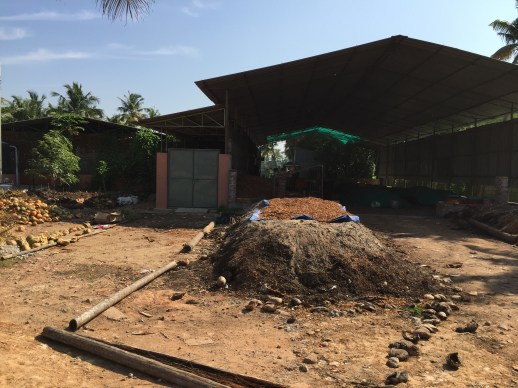
The vermi-composting center is the small building on the left; the food and yard waste composting center is on the right.

The food and yard waste bins are taken to the composting center. The food is put on a metal table and volunteers take out any non-food items such as plastic bags, spoons, etc. Then large food items are cut. Next, items such as fresh cow dung from the ashram cows, egg shells, shredded yard waste as well as wood chips and sawdust from the carpentry shop are added to the food in order to increase the bacterial culture and nitrogen or to make the mix drier. Once the food waste has been processed, it is formed into piles. The piles are covered with more shredded wood and yard waste. As the food composts, the piles can become very hot. You can even see steam rising from them. Volunteers aerate the compost by turning it with pitchforks.  (This year I saw signs asking for volunteers to turn the compost at 2 a.m.!) The piles stay at the composting center for two to three weeks and then go to a farm or to the vermi-composting center to finish the composting process.

The yard waste is being processed at the same time as the food waste. The yard waste consists of materials that are gathered when the ashram grounds are swept each morning, along with other garden waste. The waste is put into a container that has a metal grate on the bottom. The grate allows the sand, pebbles and dust to fall through. Next, rocks, seeds, plastic and other items that shouldn’t be part of the compost are removed. What is left is the usable yard waste. That yard waste is then put into a shredder. Once shredded, it may be added directly into the food waste as described above, or it may be spread on the surface of the compost piles.

To see photos of this process go to: Food and Yard Waste Composting in Amritapuri, Pages 19-21

For years, the composting center has been located on the main ashram grounds. When I arrived at the ashram in November, I discovered it had moved. Now it is near Kuzhitura Farm, a 20 minute walk from the ashram. Pick-up trucks take the food and yard waste to the new center and the volunteers who work there generally ride bicycles.  The new center is about three times the size of the original one.

~~~

The Red Worm Composting blog states that “Worm composting (also known as vermi-composting) involves the breakdown of organic wastes via the joint action of worms and microorganisms (although there are often other critters that lend a hand).”  That process creates some of the highest quality fertilizer that exists.  Red worms are the type of worms used for vermi-composting.

In the vermi-composting center, worm beds are formed from the food and yard waste compost.  When the beds are ready, the worms are then added to the piles.  Each day, a “slurpee” made from cow dung and water is poured on the top of the beds.  The worms rise to the surface and feast.  It takes about three months for the worms to turn the compost into fertilizer.

The ashram’s vermi-composting project moved to the Kuzhitura Farm location over a year ago.  When I visited the new center last year, there were eight to ten worm beds.  This year there were only the two shown below.  I asked one of the people in the food composting center about the change and he told me they had discovered they were using way too much bedding material for the number of worms they had.  Taking care of two big beds would certainly decrease the amount of time it took to maintain the beds!

There was another big change this year.  In the past, when the fertilized compost was ready, volunteers separated the worms from the compost by hand.  It took many volunteers and a lot of time to accomplish that process. (That was a job I loved to do!) The worms are now separated from the compost with a machine that is like a sifter.   There was no staff present when I visited so I didn’t have the opportunity to talk to anyone about it, but I did take some pictures of the sifter.

The fertilized compost produced at Amritapuri has always been dark in color and very light weight.  I’ve been jealous because it is so much nicer than what my vermi-composting system in Seattle produces.  One of the people from the food composting center showed me some of the compost that is created using the new shifting process.  It was even darker than it has been in the past…. and was so light-weight.  I hope to learn more about these changes the next time I visit Amritapuri.


Challenge for Growth Prompt #2: Looking for the Good in Others

20150726_193656

Looking for the good


This week’s challenge is:

“Today I look for the good qualities in others.”

When we are in a bad mood, we may find ourselves focusing on someone else’s faults. When we focus on the negative, we are likely to see negativity all around us. From time to time, Amma reminds us that even a broken clock is right twice a day.

People often get triggered into negative thinking when they are with someone who reminds them of a person that hurt them in the past. In the psychotherapy model I use, we refer to that as “putting someone else’s face” on the present day person. That process is also referred to as projection.

Clients in therapy frequently project their parents’ faces on their therapists. I remember a time in the mid 90’s when a client was always angry with the male co-therapist in one of my therapy groups. He knew that the therapist reminded him of his father, but he was having a hard time “getting his dad’s face” off of the therapist.

This therapist had some unusual characteristics so I said to the client, “Did your dad ever wear an earring?” and “Did your dad sometimes wear red toenail polish?” The client started laughing. His father would NEVER have considered doing either of those things. Seeing the differences really helped him separate the therapist from his father.

This week, for one, two, three days or longer, focus on looking for the good in others. If you have trouble finding anything positive about a person, consider whose face you might have on them.  If you decide it is a parent, or a boss, or someone else from your past, identify ways the current day person is different from the one in your past.  Then “de-role” the present day person by saying to yourself, “You are not (insert the name or role of person from the past), you are (insert the name or role of the person in the present).”  After you de-role the current day person, you may be better able to identify some of their good qualities.
Also consider making lists of the positive qualities of anyone you have negative thoughts about, whether they be from your past or present.

Sometime during the week, write a post about some aspect of this topic or about your experience when focusing on seeing the good in others. Feel free to use whatever form you desire: i.e., prose, story, poem, photograph, etc.
I look forward to seeing where this challenge takes you.

The article that you link to this prompt should be a new post written specifically for this challenge.


General Prompt Information:

Since it is easier to make behavioral changes if we focus on them one day at a time, each of the weekly challenges will start with “Today, I focus on…….” It will be up to you to decide how long you want to focus on a particular challenge— one, two, three days or even longer. At some point during the week, publish a post that relates in some way to the subject of the week.

Link your post back to this prompt post. If the pingback doesn’t work, then leave the link to your post in the comment section of this post.  Be sure to include “Challenge for Growth Prompts” as one of your tags.

Throughout the week, I will publish the links for the posts that were created as the result of this prompt.  I will also post the links from those who participated the previous week. That way they will be seen by anyone who comes to the this page.

If you don’t have a blog, please feel free to submit your contribution to the prompt in the comment section below.


This week’s contributors to Looking for the Good challenge:

On Humans and Humanity- The Seeker’s Dungeon

Today I look for the good qualities in others- Journey of a Warrior Womyn

There is No “Other”- Living, Learning and Letting Go

Khuśiyōm Kī Bahār- Living, Learning and Letting Go

Through the Shadows- Nik’s Place

finding the light side (free verse)- Traces of the Soul

Challenge for Growth Prompt #2- Annette’s Place


Last week’s contributors to Needs vs Wants challenge:

The Bliss We Seek- The Seeker’s Dungeon

2016 Needs- Self Therapy

Needs vs Wants (Haibun)- Traces of the Soul

Resolve- Dream Cloud Diaries

Compassion’s Desires (Haibun)- Tournesol dans un Jardin

Are My Trips to Amritapuri Fulfilling a Need or a Want?- Living, Learning and Letting Go

The Needing Want- Nik’s Place

Needs vs Wants- Journey of a Warrior Womyn

My thanks goes to each of the bloggers listed above and to those of you who wrote your response to the challenge in the comments section of the challenge post.


To see the most recent Challenge for Growth Prompts Click Here


Kuzhitura Farm in Amritapuri

IMG_1053

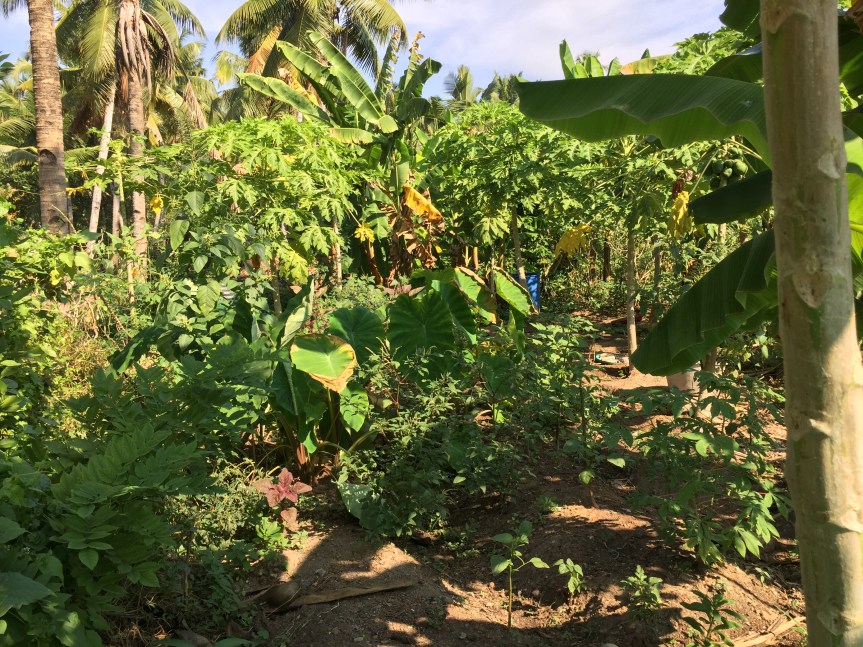
One of my goals for the last week of my trip was to visit the garden/farm south of the ashram as well as the one across the bridge near Amma’s Amrita School of Ayurveda. The land in both places is very dry, and water is scarce, so developing the gardens has been a process of trial and error over many years. This year the change was mind-boggling. In both places, I felt like I was walking into paradise.  This post will be dedicated to the garden south of the ashram which is now called Kuzhitura Farm.

When I visited this farm last year, I had learned that they were focusing on using permaculture techniques. One of those techniques was the banana circle. I still remember how shocked I was when I researched bananas and banana circles later and learned that banana palms are not trees, they are actually considered a grass! (Banana Circles in Amritapuri).

When Premarupa and I arrived at the farm this year, I was struck by how different it looked. It is amazing how fast trees and plants grow in the tropics. While there are vegetables growing throughout the area, the big vegetable garden I remembered from the previous year wasn’t even in the same place. My guess is the trees and banana palms had grown so big that there was no longer enough sunlight in the original area. There is now a garden that is about triple the size of the previous one a distance away.

Here are pictures of the farm this year.

(Click to enlarge pictures)

This property is also now home to Amritapuri’s food composting and vermi-composting (worm composting) centers.  I will share more about those projects in the next post.

Weekly Photo Challenge: Weightless

This is one of my favorite photos.  It came to mind when I thought of weightless.

hummingbird in bee balmWeekly Photo Challenge: Weightless

Are My Trips to Amritapuri Fulfilling a Need or a Want?

Since I wrote the “Needs vs Wants” prompt, I have been reflecting on my own relationship to that subject.  Sitting here in my flat at Amma’s ashram in Amritapuri, India, it occurred to me that the reason I have been able to come here 26 times since January 1990 is because I have made that trip a major priority in my life. I value experience over material possessions so I have never been pulled into the world of consumerism and accumulation.  There have only been two years when I was not able to save enough money to allow me to make that sojourn.

Is going to India a need or a want? At first I thought it was a want, but then I remembered there were many years I went to India even though I felt a lot of resistance to going. Continue reading “Are My Trips to Amritapuri Fulfilling a Need or a Want?”

Living and Learning in Amritapuri: Jan 3-5, 2016

IMG_0372

Swami Ramakrishna

I saw Swami Ramakrishna a few days ago for the first time on this trip. He is the swami that oversees Amma groups in North and South America and in Chennai, India. He may be responsible for other areas of the world too.

The reason I hadn’t seen him in Amritapuri was that he has been in Chennai helping with the flood relief efforts. If I understood him to say that the water had hit as high as 23 feet on the outside of the buildings and that there had been 8 to 9 feet of water inside the houses. Amma sent 500 volunteers to help. They rescued people from their homes, provided medical aid, food, clothes, blankets, cooking stoves, etc. Amma also donated $749,000 to the government for use in their ongoing relief efforts.

Amma

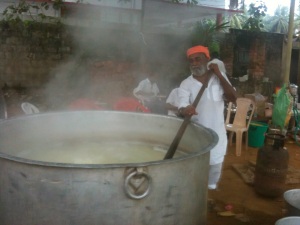
Many people in the ashram spent the days after New Year’s getting ready for Amma’s North Kerala tour. The caravan consisted of 11 buses of ashramites as well as numerous supply trucks. The crowds are huge at these programs and there is a tremendous amount of work that needs to be done during them. Take a look at the size of one of the many cooking pots.

Kanji Making

The tour group left the ashram at 4:00 a.m. on the 5th. There are still a lot of people in the ashram but so many fewer than when Amma is here. It is nice to have some days of comparative quiet before I leave India.

Sadhus

People_of_Varanasi_005

I really enjoy seeing sadhus when they come to Amritapuri. Sadhus ascetics/holy people who wear saffron and often wander from place to place. They dress in different ways. The sadhu in this picture reminds me of some of the sadhus I see here, even though he is wearing clothes that are primarily yellow

(Photo Credit: “People of Varanasi 005” by Antoine Taveneaux – Own work. Licensed under CC BY-SA 3.0 via Wikimedia Commons -)

Sadhvi_-_Gangasagar_Fair_Transit_Camp_-_Kolkata_2013-01-12_2727

One difference this year is that I have seen two female sadhus. I found them even more intriguing. This picture reminds me of them. The color and type of cloth she is wearing is more typical of what sadhus wear than the man in the picture above.

Photo Credit: Wikimedia.


Seva (volunteer work)

Prior to the Christmas play, I helped sew and iron costumes. On and off throughout the trip, I have also helped Chaitanya in the café by doing some of the prep work for dinner. My job has been to butter stacks of bread and cut buns. I also chop up capsicum for salads and other menu items.

I had worked in the café as a cashier for 15 years, or more. I stopped doing that job three years ago when I was having so much trouble with my blood pressure. This week, I decided I wanted to work at the café once again. Nowadays, people receive a token when they order their food. My job is to get the food from the kitchen window and then call out the token number.  When the person comes to the counter I take their token and give them the food.

Each night, we serve so many people in a short amount of time. It’s fun! I think I will do that job again next year.

A couple of times this week, I also helped with processing the Matruvani magazines. Matruvani is one of the magazines published by the ashram that goes to devotees all over the world. If I remember right, when I first came here in January of 1990, they were sending out 40,000 copies a month. The pages came on big pieces of paper and had to be folded by hand. At some point, each publication would be checked to make sure every page was present and in order. After they were cut and stapled together, we would then fold a piece of paper around them that served as a mailing envelope.  Next we would paste on the address labels, using our finger and some watery paste. There weren’t that many people living here in those days, so a mailing of 40,000 was a major endeavor. I remember working on them past midnight.

Now the ashram publishes about 350,000 Matruvani magazines as well as many other publications each month! The work is still a major endeavor and much of it is still done by hand. In addition to all of the components that had to be done in the past, they now have zip codes (called pin numbers here) to contend with.  My job this week was to paste on checking labels that verified that the zip codes in each packet had been properly sorted.

Flexibility, Ingenuity

There was one story that I debated about sharing. After all, I don’t want you to think I’m crazy. I’ve decided to share it anyway. My hair grows really fast in India. My bangs had been getting longer and longer and were at the point where they were really annoying me. Two days ago, I had just had it. I had forgotten to bring scissors this year so didn’t know what I was going to cut it with, but I was going to find a way.

I could have found someone who had scissors but that would have taken effort and the scissors probably would have been dull anyway. Regardless, I didn’t want to look for scissors, I wanted it fixed NOW. I thought about the items I had in my room that could cut my hair.  I realized the only thing that could cut anything was a pair of nail clippers. That seemed absurd but I used them anyway. While it isn’t a good cut, I have to say it ended up looking way better than when I use scissors! If someone would have told me I would be using nail clippers to cut my hair, I wouldn’t have believed them.

Photos

I will end this post with some photos.

(Click gallery to make pictures bigger.)

To read the earlier posts in this series go to: https://livinglearningandlettinggo.wordpress.com/india/