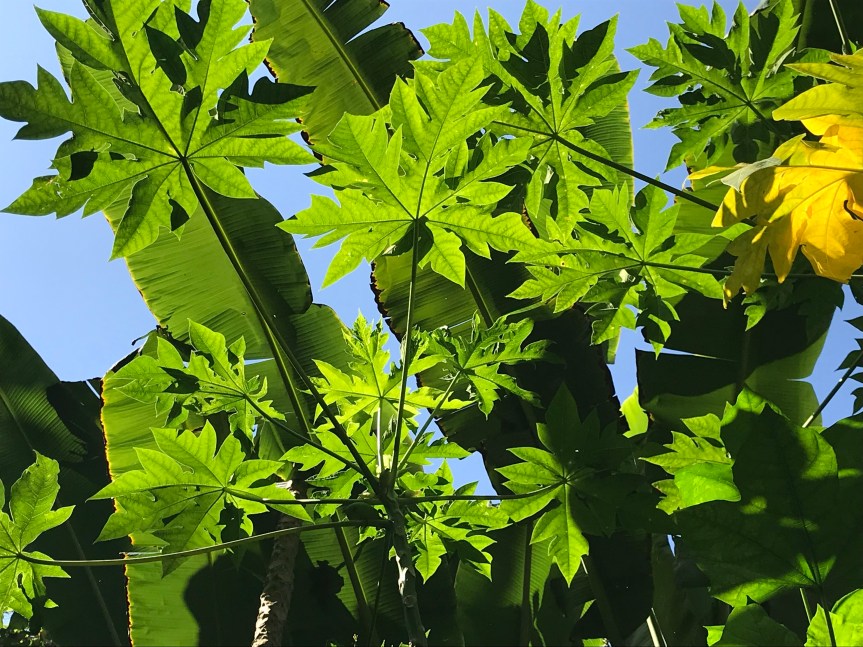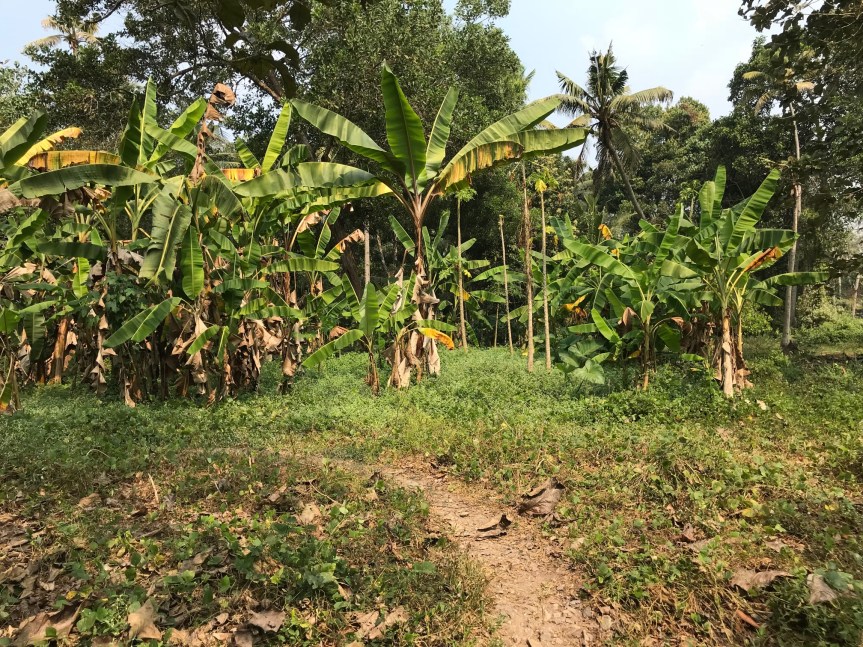
Visiting the Seed-Saving Farm

I talked about my challenges in finding the Seed-Saving farm in my last post and said I would tell you more about my visit there in a separate post. That time has come!

When I arrived at the farm, Lokesh, the volunteer who manages this project, told me that in Kerala they can grow four sets of crops each year. Since they had just finished harvesting the last crop and were only beginning to prepare for the next one, he was disappointed that he couldn’t show me more.

While I thought he shared an abundance of information with me, I found a delightful video on his YouTube channel that gave me a sense of what would be like to participate in this community gardening activity.

The soil on the farm, and in most, if not all, of the land in this area is very sandy and of poor quality.
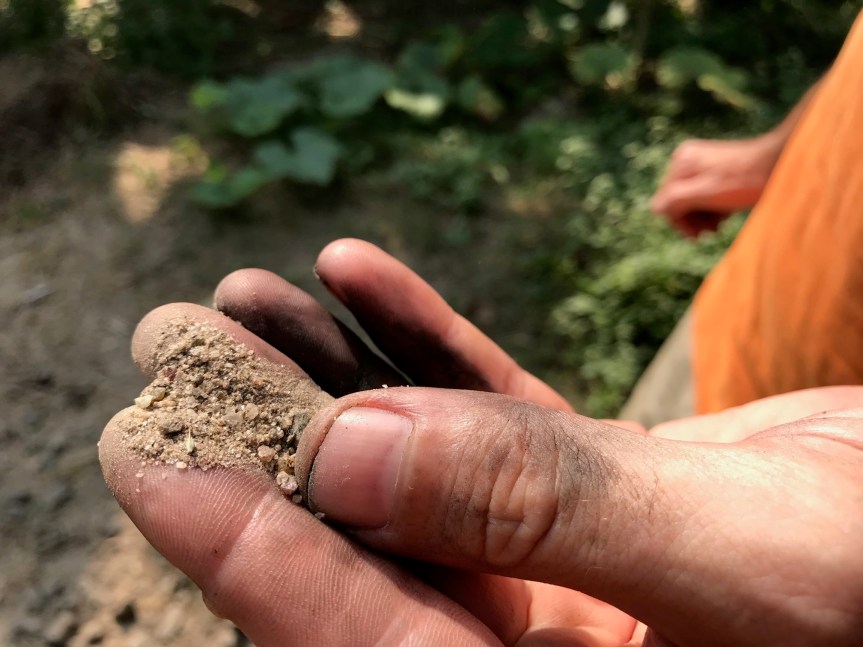
At the seed-saving farm, volunteers are making charcoal by burning coconut husks. The charcoal is then turned to powder and added to dried cow dung and dirt. Charcoal is used because it holds in nutrients. The first video in this post had a segment where the devotees were adding the charcoal to the dung/dirt mixture.  In the video that mixture was put into pots and then seeds were planted in the pots. The mixture may also be spread on the land and covered with cut up coconut palm fronds or mixed with other kinds of mulch.

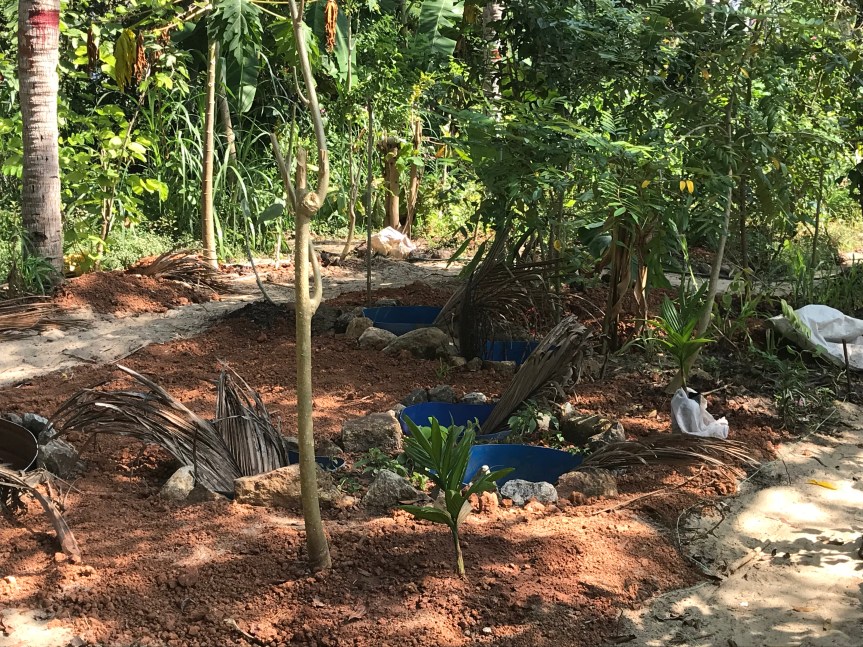
Ideally, Lokesh would like to have seven planting fields on  this 13 acre property. At this point, they are working primarily on an eggplant field. So far, the volunteers have dug 100 holes and filled them with mulch. They add more mulch and other soil enhancers, such as the charcoal mix, as the mulch breaks down. While I was at the farm, there were two women cutting up coconut fronds to add to that area.  Sticks surround each space that will eventually hold a seedling.

Another part of the farm is dedicated to producing tapioca. Tapioca is easy to grow in Kerala and it usually doesn’t need to be watered. In this farm, a plant called cirra is often grown under it. (Note: I’m not sure of the spelling of cirra.) Chaitanya told me later that cirra is one of the many forms of spinach that is grown at the ashram. There is also a red leafed plant that is being grown. In some of the other gardens, it is called red spinach and used as a vegetable. Lokesh told me it is actually a form of amaranth.

One part of the property had ridge gourds growing. I had never seen anything like them. When I read about them, I learned that they can grow up to 13 inches long. I believe the ones I saw were longer than that. I also saw remnants of pea and bean plants.

There were several nurseries at this farm. The first photo shows echinacea seedlings. I don’t remember what the other ones were.

I’m realizing that I haven’t said anything about seed-saving at the Seed-Saving farm. They are indeed saving seeds but as I understand it, part of that process is knowing how to select the right seeds and also how to grow plants that will produce healthy seeds. I know from this visit and my visit last year, that Lokesh is doing a lot of experimenting to determine how to provide the most support to the plants so that they create the best seeds possible.

On this visit, he told me that he had been given an old Kerala type pumpkin, a pumpkin that is very rare. He used four plants that were grown from that pumpkin; two of them he grew as they were and the other two he crossed with a pumpkin from the agricultural university.  The pumpkins that grew from the old Kerala pumpkin seeds looked like this:
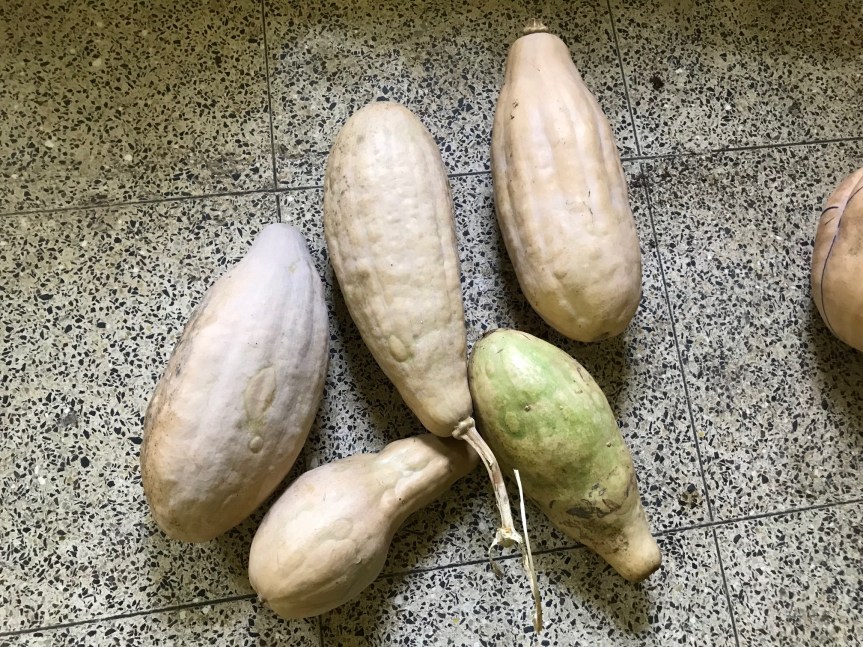
The ones that were crossed with the university pumpkin had similarities to the old Kerala pumpkin, but also differences.

Lokesh explained that he was crossing these varieties because when a vegetable is grown without diversity it becomes very weak and will eventually “fizzle out”. By crossing them, he will be able to develop a stronger strain of pumpkin and then will eventually breed out the university strain. The new plant will produce a pumpkin that will have the characteristics of the old Kerala pumpkin that gave it its superior quality, but it will be a much stronger plant. That process is called back dropping.

This video will give you more information about this topic:

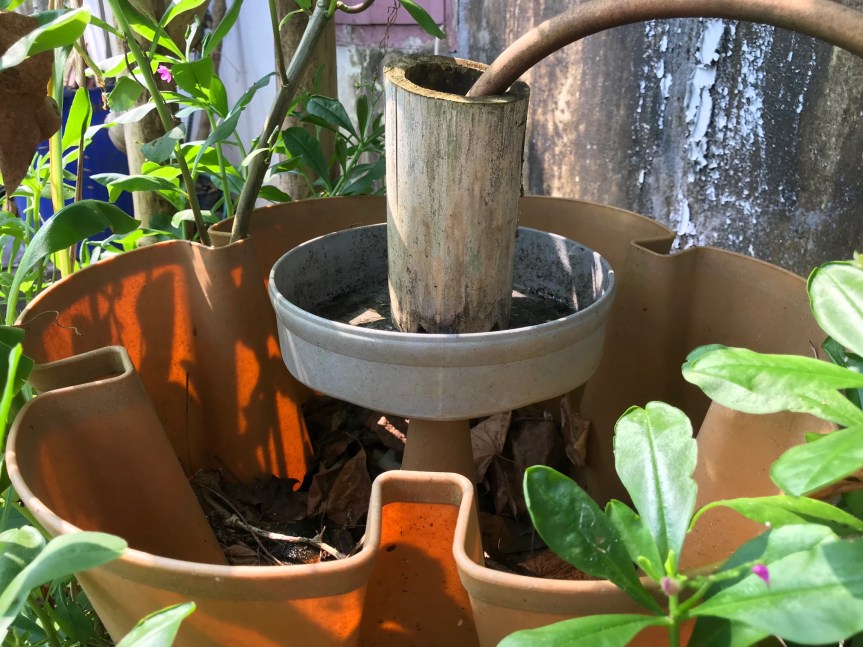
I was fascinated by two other things I saw on that day. One was a structure that provided water to a group of plants, one drip at a time. To use it, you put a bucket of water in the tub that is at the bottom of the structure. I don’t understand exactly how it works but I know that when a machine is turned on, air is pumped intermittently in a way that causes water to be pumped from that bottom tub into a container at the top of the structure. The water then drips down to the plants below it, over a week’s time.

The first photo shows the plants and glimpses of the structure I don’t know what the main plants are, but the big ones with the long leaves are tumeric plants.

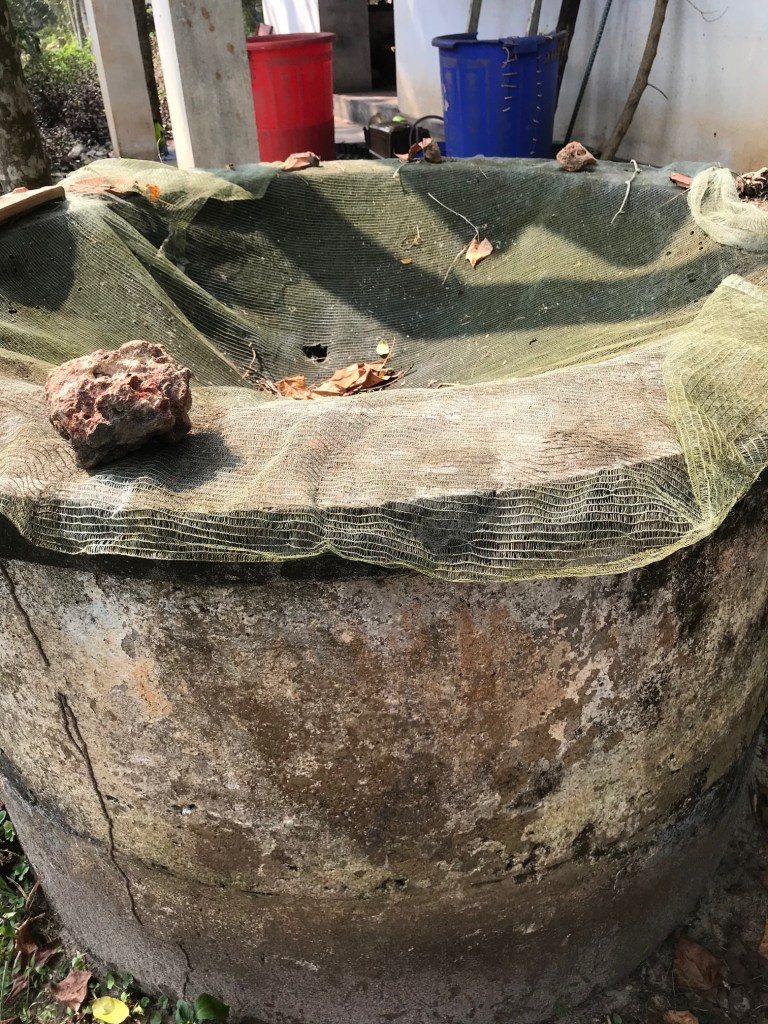
There is a well located next to the plants. Water from this well is used to fill a tub at the bottom of the structure.
The next photo shows the top part of the structure. Lokesh turned the machine on when I was there. I think some water will begin to pool in the blue-gray part after it runs for a while.)
This photo shows the body and the bottom of the structure. You will notice that the tumeric plant is drooping. That plant starts to die when it is ready to be harvested. We checked in the soil around it and could feel big tumeric bulbs.

I’m going to end this post by telling you that Lokesh is creating a blacksmith shop on the property. He is inventing all sorts of things there. His most recent invention is a power hammer made from an old bicycle!
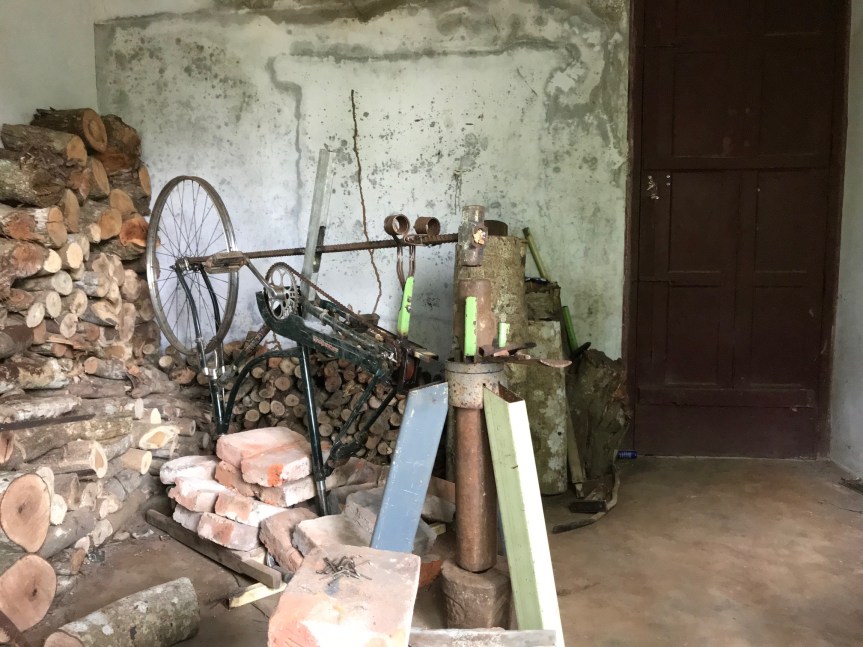
Below is a video that shows how he made the hammer. There are several other blacksmithing videos on his YouTube channel, as well as videos on many other interesting subjects.

As I imagine you can tell from my post, I thoroughly enjoyed my time at this farm and look forward to going back there the next time I am in Amritapuri.

[Note: I apologize for any mistakes I may have made in relaying the information I learned that day. These subjects are all so new to me.]

To read the previous posts in this series click here.
Living and Learning in Amritapuri, India: January 3, 2018

IMG_1002

January 3 was a particularly good day for me, full of so many things I love about my visits to Amritapuri. I decided to give the day a post of its own.

That morning, I woke up at 5:50 a.m. I showered and dressed, read and answered email, looked at the news on cnn.com, and then, at 7:15,  headed to the cafe.  Once there, I assisted with breakfast preparation and handed out meals to customers until the first rush was over. Then I ordered breakfast for myself and visited with friends while I ate.

At 9:00 a.m., I left the ashram for my next adventure. This time I was going to the seed-saving farm. I had visited that site for the first time the year before. Before I tell you about going to see it this year, let me give you some back story.

January 2017

Last January, a devotee told me about the seed-saving farm and gave me directions for getting there. He said I should walk to end of the main road in Vallikavu and turn left. After I passed the temple, I should turn right. That sounded easy but I soon discovered there were two paths north of the temple, paths that were quite close together.

I took the first path and walked a long way. After some time, I decided I must have taken the wrong one so went back to the temple and took the second  path. I walked a long way on that one too but still couldn’t find the farm. I returned to the road and decided to take the first path again; I would walk further along it this time.

I had been told the farm would be next to a blue house. Before long, I came to a blue house where tapioca, banana palms and some other plants were growing. It was a smaller farm than I had expected, but it was very nice. No one was there, so I wandered around taking photos.

After exploring that farm, I returned to the ashram feeling very successful. When I showed my photos to the person who had given me the directions, however, he said that I had not been at the seed-saving farm; I had been on private property! He told me that the farm was further down that path.

The next day, I headed out to find the seed-saving farm and this time I found it. Lokesh, who manages that farm, showed me around and told me many fascinating things. I took lots of photos and looked forward to writing a post about the farm.

After visiting the seed-saving farm that day, I went to the tulasi farm that is closest to the ashram and took photos there as well. Then I stopped by Saraswati garden.  At some point between my visit to the tulasi farm and the time I returned to the ashram, I lost my iPhone.  I retraced my steps numerous times that day and went to various Lost and Found stations in the ashram as well, but I never found the phone. I had downloaded the photos of the private farm the same day I took them, but losing the phone meant I had lost all of the photos I had taken at the seed-saving farm and the tulasi farm. I was leaving India the next day, so there would be no way to replace them until my next trip to Amritapuri.

January 3, 2018

Back to my story about this year. I left the ashram at 9:00 a.m. on January 3rd, heading for the seed-saving farm. I took the first turn to the right after passing the temple. In time, I passed the private farm I mentioned above. I kept walking but never found the seed-saving farm.

When I realized this path wasn’t working, it occurred to me that maybe the second path had been the correct one and my memory was wrong. On my way back to Vallikavu, I came to a small road. I decided to go north on that one rather than return to town and start over. I walked a short way on the small road, stopping when an Indian man who didn’t speak English, indicated I should go the other direction. I turned around just in time to see a Western woman crossing the road not far from where I was standing. I asked if she was going to the garden and she said yes.

The gate to the farm was a short distance from the road. That was not how I entered the farm last year, but that was irrelevant. I was where I wanted to be thanks to the man turning me around and the woman crossing the road.

The area looked completely different than I remembered it. Part of the reason for that was that it is a 13 acre farm and the volunteers were focusing on a different part of the property than they were last year.

Lokesh was a bit dismayed when he saw me. He told me there are four growing seasons in Kerala and one had just ended. Everything had recently been harvested. They were just beginning to prepare for the next season, so there wasn’t much to show me. He gave me a tour anyway, and in my mind showed and taught me a lot. I will write a separate post about that garden but will share some photos below as a preview and perhaps as a teaser.

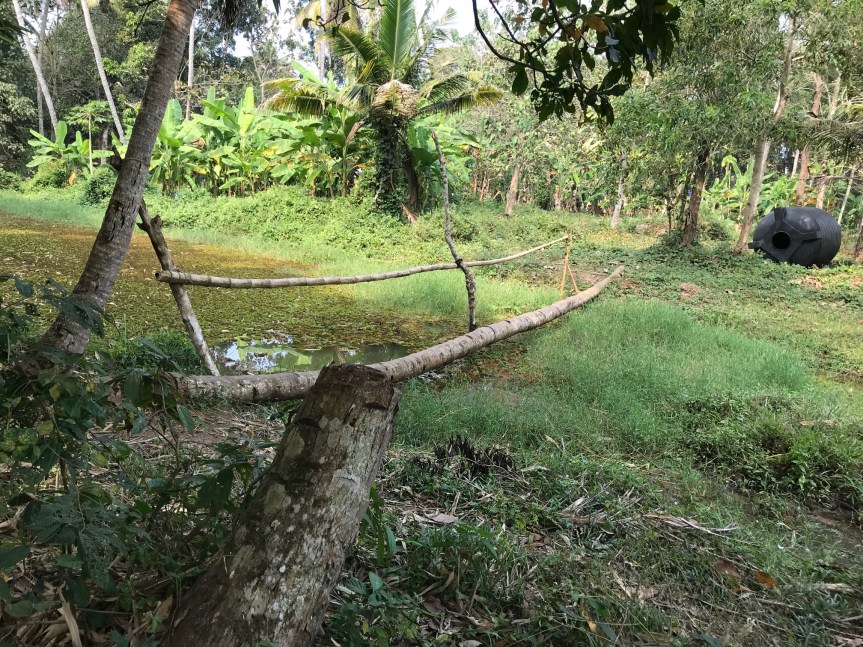
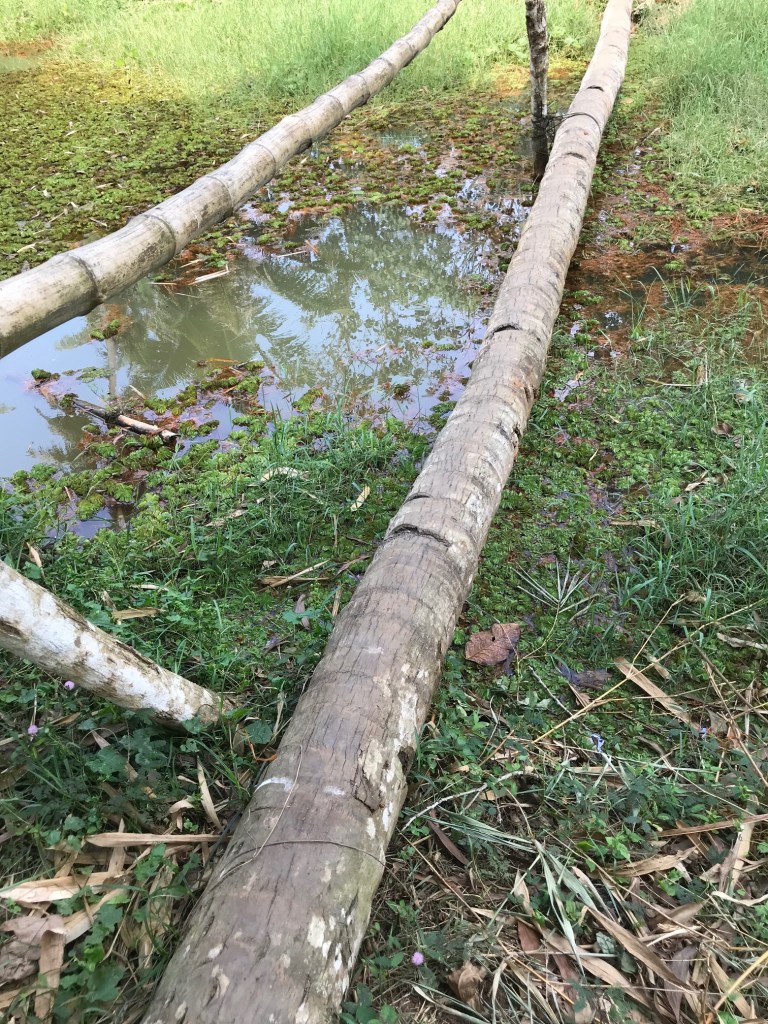
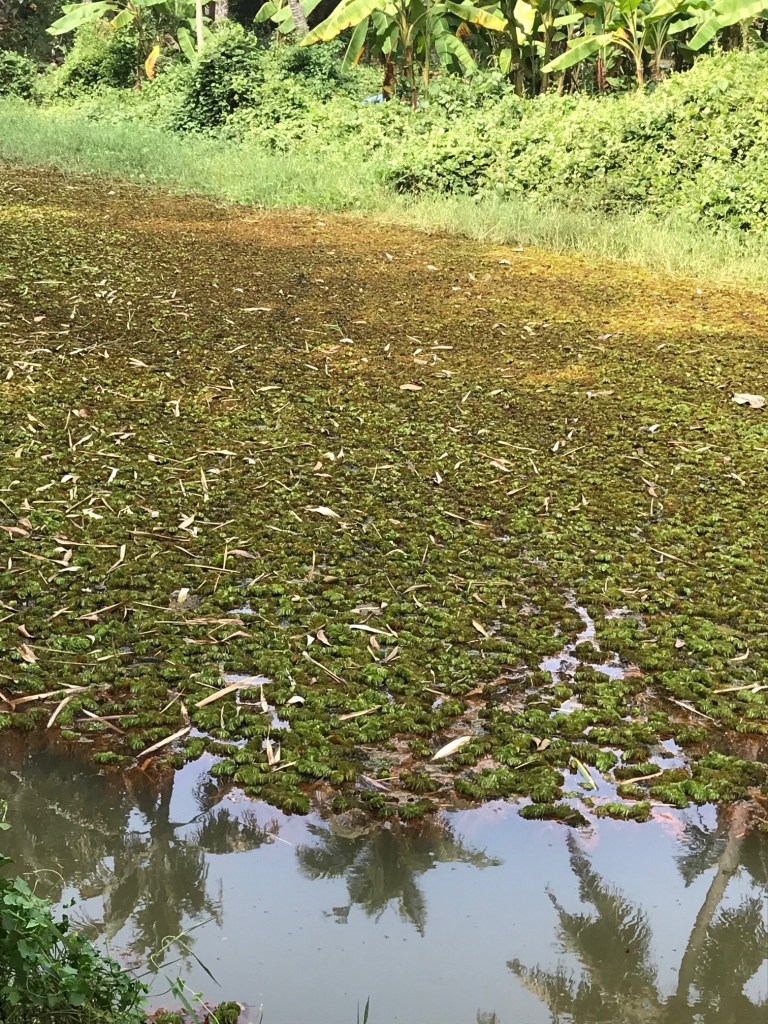
There was another reason that this farm was an important part of my day. Last year, there had been a rickety bridge that went from one section of the farm to another section. As I remember it, the bridge swayed and it was scary to walk across it. Sometime during the year, that bridge had been replaced by a new one. It is hard to call it a bridge, though,  because it was only a coconut tree that had been cut down or fallen. There was something I could hold on to as I crossed but it wasn’t as close to the tree trunk as I would have liked. I made my way across the bridge tentatively and carefully. I believed that the the water underneath the bridge was shallow but I sure didn’t want to fall into it!

As I walked back to Vallikavu, I realized I was taking a different path than when I had come. It ended up being the second path from the temple. I think I will remember how to find it when I come back later in the year.

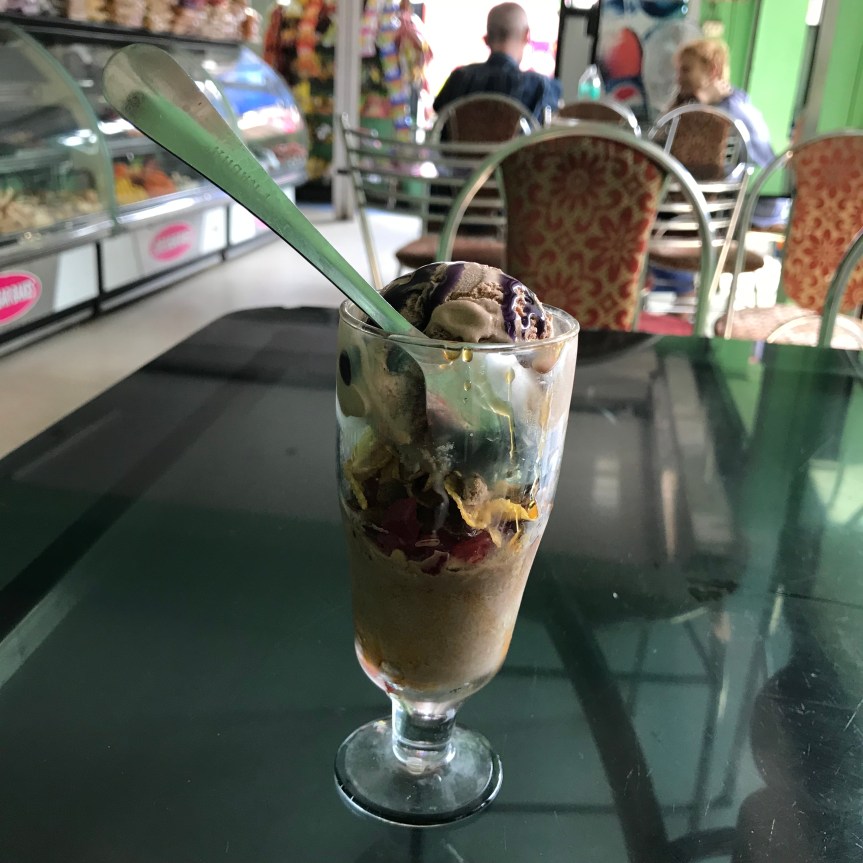
When I arrived in Vallikavu, I decided to visit this bakery. Seeing or thinking about the name of it always brings a smile to my face.

img_5712

Once there, I bought my favorite treat. (It isn’t as big as it looks!)

I returned to the ashram sometime between noon and 12:30. Lunch begins at 12:30 but I wasn’t ready to eat since I had just had a treat. I checked my phone and saw a text from Chaitanya asking if I wanted to join her for lunch at 1:30. That was a surprise, and a very welcome one. I usually only get time with my kids if I go to where they are working. I, of course, said yes!

From 4:00-5:00 p.m., I did the prasad assistant job I’ve mentioned in previous  posts. It is one of my favorite sevas. When I did it in August I was overwhelmed, partially because the job was new to me, but also because I was dealing with the stress from living with a broken wrist. This time, for the most part, it was stress-free.

When I left the stage, I decided to join the prasad-giving line so I could be the person handing Amma the ash and candy packets that she gives to those who come to her for a hug. So from 5-6 p.m. I made my way through the prasad line and ultimately had the joy of being so close to Amma and serving her in that way.

The canteen dinner doesn’t start until 7:00 p.m. and I would be working in the cafe from 7:00 to 9:00 so after giving prasad, I went to my room and made some oatmeal. After my shift, I sat in the auditorium and listened to the bhajans (devotional singing) for a while and then went back to my room.

I no doubt checked email and the news again and perhaps worked on an article I was writing for another publication. I went to bed around 11 p.m.

What an enjoyable and full day it had been.

To read the previous posts in this series click here.

Living and Learning in Amritapuri, India: December 20-January 2, 2017

I have been writing individual posts about many of the things I have experienced over the last two weeks but decided it is time for me to update you on some of the other parts of my day-to-day life in Amritapuri.

Temple Music

The loud music from a temple in town played from 5 or 6 a.m. until 5 or 6 p.m. my first weeks here. I learned that the music came from a Narayana temple that was in the midst of a 41-day festival. I had no idea when the festival started or when it would end. One day last week, the music began as usual but it was MUCH louder than it had been the other days. It reminded me of the time in the early 90’s when the music coming from that side of the water started at 5 a.m. and lasted until 2 a.m. the next day, day in and day out. While the music had been loud this year, it was nowhere near as loud as it had been back then. I had even enjoyed listening to it when I was in my room. But I did not enjoy the blasting music that came into my room on that early morning last week.

The following morning, I slept later than I had slept since I’d been here. It wasn’t until someone else mentioned it that I realized there was no music coming from town. The 41-day festival was over! They must have played the music louder on that last day to mark the ending.

Equanimity

When I started this section I labeled it construction. Soon it became obvious that I should change the heading to equanimity. Amma teaches us to strive for equanimity in all situations. I have had plenty of opportunities to practice that lesson on this trip.

This has been the first time in the 28 years I have been coming here when there was no construction noise. That quiet ended a few days ago when workers started making the stair railings in my building higher. The railings had already been raised on the first four floors so they started this time on the 5th floor, my floor. So for the last few days I’ve been dealing with the sound of an electric saw cutting through metal pipe. I have NOT been feeling equanimity.

Notes:

1) After I finished writing this part of my post, it occurred to me that they had finished my 5th floor railing in one day and the pipes have still been being cut on my floor. Is it possible that they are using the 5th floor as their staging ground and the racket will continue until they finish all 16 floors?

2) I went to lunch shortly after writing Note 1. While I was there, I was griping about the noise and the possibility that it might not end for days. When I returned to my room, the saw, the workers and most of the pipe was gone. I don’t know if they’ve already finished the job, moved higher up in the building, or just stopped for the day. Regardless, if this was a test, I flunked it.

The other area where I have struggled to maintain a sense of peace has centered around having ants in my flat. For the most part they are not a big problem now, but when they come back in large numbers, I have no equanimity.

Christmas play

I promised I would publish one more post about the Christmas play but that is not to be. In the past, I have been able to get play photos and audio recordings of some of the songs but that is not possible this year. I will put some of my photos from the rehearsals in this post instead. As you look at the pictures, keep in mind that the cast had only 15 days to make the costumes, backdrops and props; learn the acting roles, dances, songs and musical accompaniment; make power point slides in English and Malayalam; and figure out the sound and lighting and much more.

When I meet people by watching them rehearse for a play, I tend to think of them in relation to that role forever. This year, I find myself doing that with the actors who played the gorilla and the giraffe. I saw the person who played the giraffe on the bridge to Vallikavu yesterday and asked him if he missed being a giraffe. I told him I’m likely to continue thinking of him in that way. He laughed.

Seva

I have been handing prasad to Amma on most darshan days and doing the prasad assistant seva twice a week. I love those sevas. In addition, I have cleaned rudraksha seeds twice and plan to do it again. I’ve also been helping Chaitanya in the cafe in the morning, making the pancake batter and helping getting everything needed for the orders, such as putting honey, butter or peanut butter on toast or adding oatmeal, ragi porridge or hash browns to orders. I then pass the plates to the person who gives them to the customers. Sometimes I cut up tomatoes, wiping down counters or do other tasks. Last night, I helped keep the bakery and the cold drink counters stocked. I’ve been enjoying participating in this way.

Rudraksha seeds

In the past, devotees climbed the rudraksha trees to harvest the fruit. During that period, I remember seeing volunteers separating the fruit from the seeds and then brushing the seeds clean. I learned this year that, at some point, they realized they were harvesting the fruit before it was ripe. Now they wait until the fruit ripens and falls from the trees. After the fruit falls, the animals and other critters eat the fruit. Then the garden staff can just pick-up the seeds from the ground.

Once the majority of the fruit has been removed, the seed is soaked. After soaking, any remaining fruit is much  easier to remove and the seed can be brushed clean. It is still a painstaking and slow process but much less so than when they were dealing with unripened fruit.

Funeral

I attended a funeral last week. I always feel honored to participate in that experience. It is unlikely I will be in Amritapuri when I die, but every time I see a funeral, I think of how wonderful it would be to have Amma at mine. While I love that image, I fully believe that she will be there to meet me when I pass no matter where I am in the world.

Synchronicity

I love the increased level of synchronities that happen whenever I am in Amritapuri. I remember two from last week.

The first one occurred on Thursday. In the early evening, Amma told the person in charge of Western tokens he should hand out more darshan (hug) tokens. He gave one to the person sitting next to me, but didn’t say anything to me. I wasn’t feeling the need for a hug so I didn’t think twice about it. As I watched more and more people I knew lining up for a hug I began to feel the familiar longing… but I also felt tired. I started to walk towards the cafe but decided to not go that direction because I might run into the person handing out tokens and if I did, I would have to make a choice. I turned instead to go to my room and instantly walked into him. So much for avoiding putting myself in that position. He offered me a token. I laughed and took it… and had a wonderful darshan.

On Saturday evening, I was passing out plates of food in the cafe when Chaitanya told me I could leave early. I was surprised that someone was taking over for me and wondered if I had done something wrong. That didn’t seem at all likely, but it went through my mind.

As I walked out of the cafe, Swami Amritasvarupananda was singing Manyukal Mutum, my favorite Swami Ayyappa bhajan. There was no doubt in my mind that this was one of the synchronicities that are so common for me here. I sat and listened to the rest of the song. When it was over, I walked out of the auditorium only to find three Ayyappa devotees standing in front of me. They were the first I had seen on this trip. I believed this was no accident. (To learn more about my Ayyappa experiences from the past, read Story 2 and 3 in Overcoming Myself.)

To read the previous posts in this series click here.

Visiting Amma’s Vrindavan Field

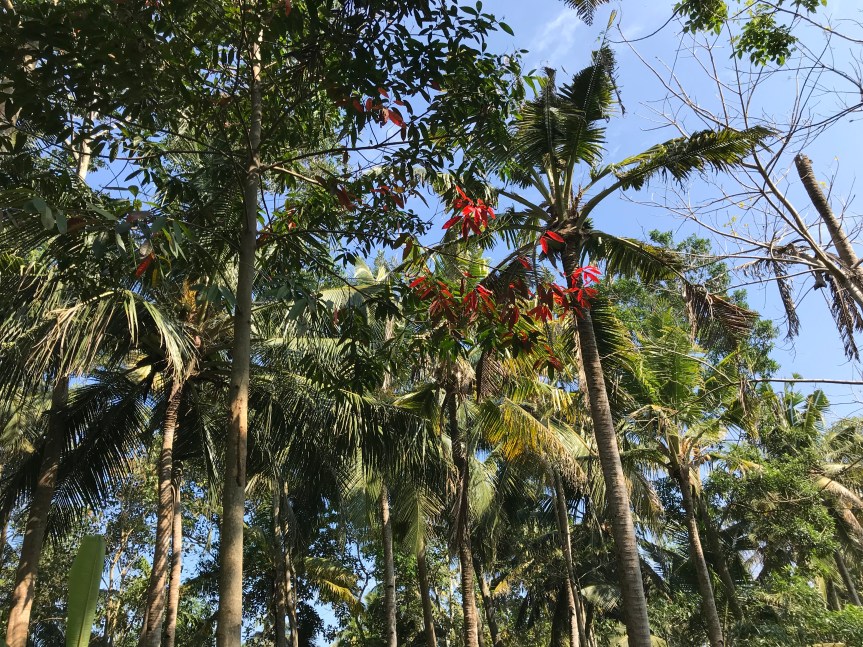
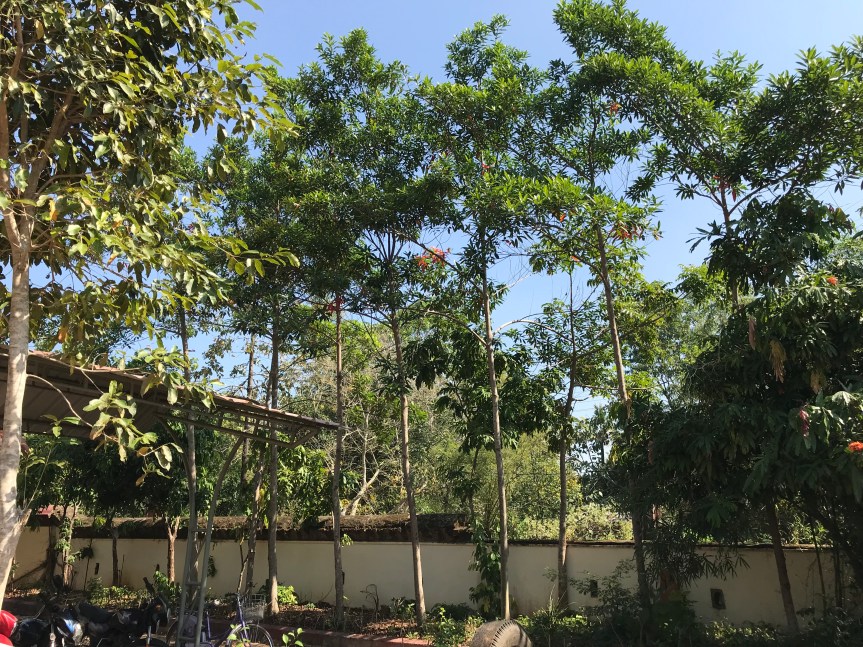
On December 29, Gopika and I visited Vrindavan Field. This garden was started many years ago. At that time it was a tulasi garden. Over time, the devotees added many other kinds of plants. Several years ago, they discovered that some of the trees on the site were rudraksha trees. The seed that is inside of the rudraksha fruit is sacred. Since then, gardens all over the ashram have been raising rudraksha tree seedlings. The photo above shows an area that contains a combination of coconut palm trees and rudraksha trees. The tree in the foreground on the left is a rudraksha tree.

One of the first plants I was drawn to on this visit was a banana palm sprout that was growing out of a nearly dead banana palm stalk that was lying on the ground. You can see a tiny bit of the sprout on the left side of the first photo below; most of the photo is of the stalk. The second photo shows the full sprout. Banana palms only give fruit once; then they die and new sprouts take their place.

(Click on any of the galleries to enlarge the photos.)

The gardens and farms in this field have had to deal with so many problems over the years. For example: lack of water, flooding, disease, and poor soil.  The staff have experimented with so many processes to enrich the soil and to retain water. Their effort has definitely paid off, but challenges still come and go.

This year a lot of the tulasi plants died and the garden doesn’t seem as lush as it did last year. But there is still plenty of beauty and the site is producing a considerable amount of food. I saw bananas, coconuts, tapioca, many kinds of spinach, beans, eggplant, okra, basil and moringa growing. There were plants that I didn’t recognize and I suspect many of them are edible.

I didn’t see as many flowers as in the past, but there were some…

… and there were plenty of interesting plants.

As we were leaving, one of the staff offered to take us to see the rudraksha trees on the School of Ayurveda grounds. She said those trees were much smaller than the ones in Vrindavan Field. We  gladly took her up on her offer and it was well worth it; the trees were beautiful.

To read the previous posts in this series click here.

Blatant Irony or Planting a Seed?

Today, an Amritapuri friend showed me this photo she took in Fort Kochi.

When she pointed out all of the litter behind the sign, I thought of how many times I have been picking up cigarette butts in Seattle and someone has stood watching me and then dropped the butt from the cigarette they were smoking on the ground right in front of me.

I like to think that if people see the trash bins in Ft. Kochi or watch others pick up cigarette butts in Seattle, it will plant a seed in their minds that will sprout sometime in the future. Perhaps at that time they will stop contributing to the litter problem. Perhaps they will even start picking up litter themselves!

I Was Wrong!

Three days ago, I wrote a post about my visit to Kuzhitura Farm. In it, I showed some tubs that were buried in the ground. I said they were being used to collect water. A friend of mine from Seattle asked me to give her more information about the new water catchment method. When I thought about it some more, I realized I had made an assumption that was probably wrong; while the tubs could hold rain-water, they weren’t big enough to provide much of a water source for a farm that size.

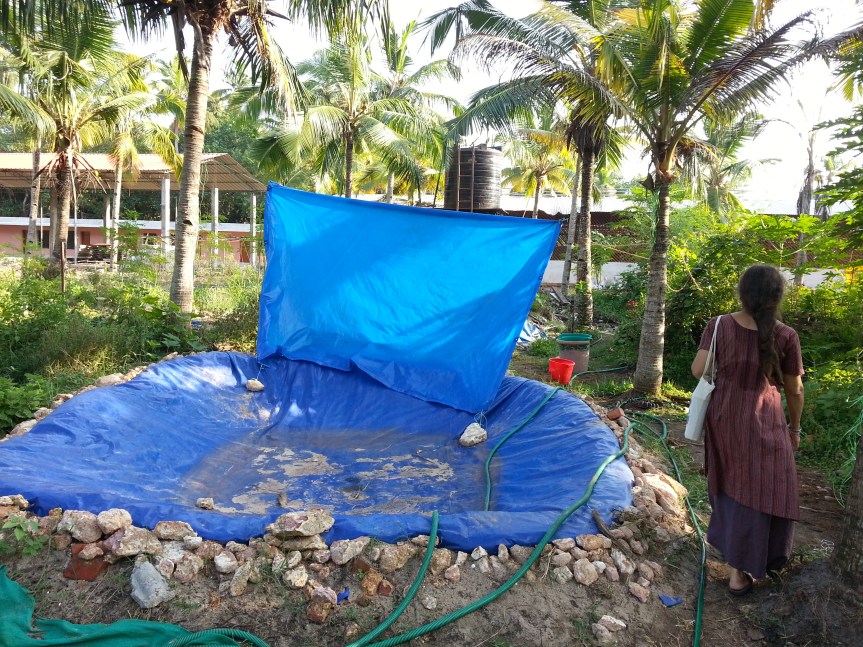
Yesterday, I had a chance to talk to an Amritapuri friend who works at that farm. She told me that the water catching system they have used for the last few years didn’t work well. The old system looked like this:

While the plastic did catch some water, it turned into a pond for turtles instead of a way to store water. The devotees who take care of this farm often found turtle eggs in it.

It was not a suitable  home for the turtles or their eggs, however. It is hot here and many months there is little to no rain. During those times, the pond dries up. The staff decided to build homes for the turtles that would be more sustainable. Soon they will live in the tubs!

So Much Stillness and Beauty

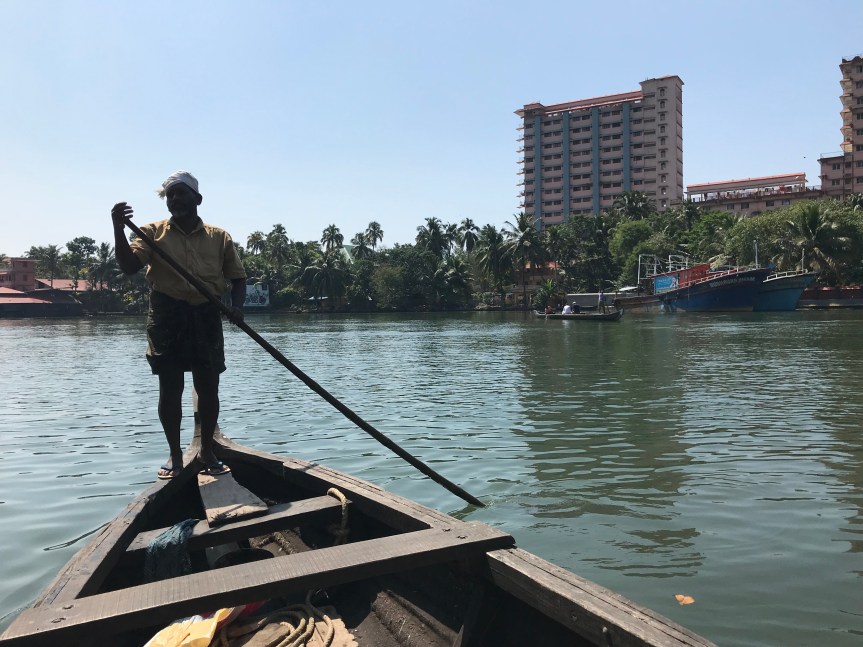
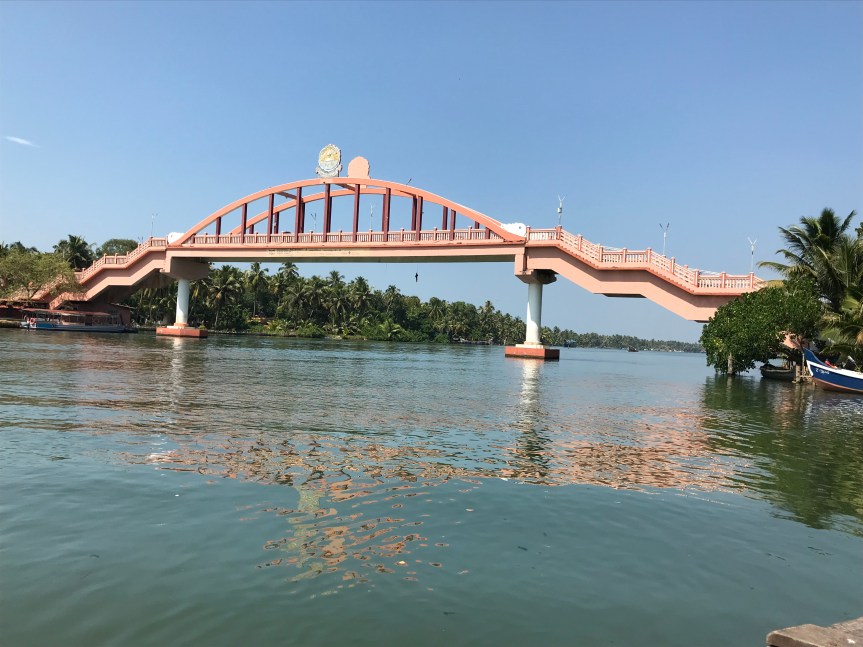
Gopika and I decided to take a canoe back to the ashram yesterday after visiting Amma’s Vrindavan Field, the Ayurvedic Herbal Garden, and the Ayurvedic College, School of Engineering and School of Biotechnology grounds. I will write about our visit to those places another time but wanted you to see the canoe photos now.

Pushing away from the dock on the town side of the backwaters.


Starting to turn towards the Amritapuri ashram. I’m looking to the south.


I’m looking to the north.


A Visit to Kuzhitura Farm

On Wednesday, I went to Kuzhitura Farm. The farm is a 20 to 30 minute walk south of the ashram. I think I have visited it for five years straight.

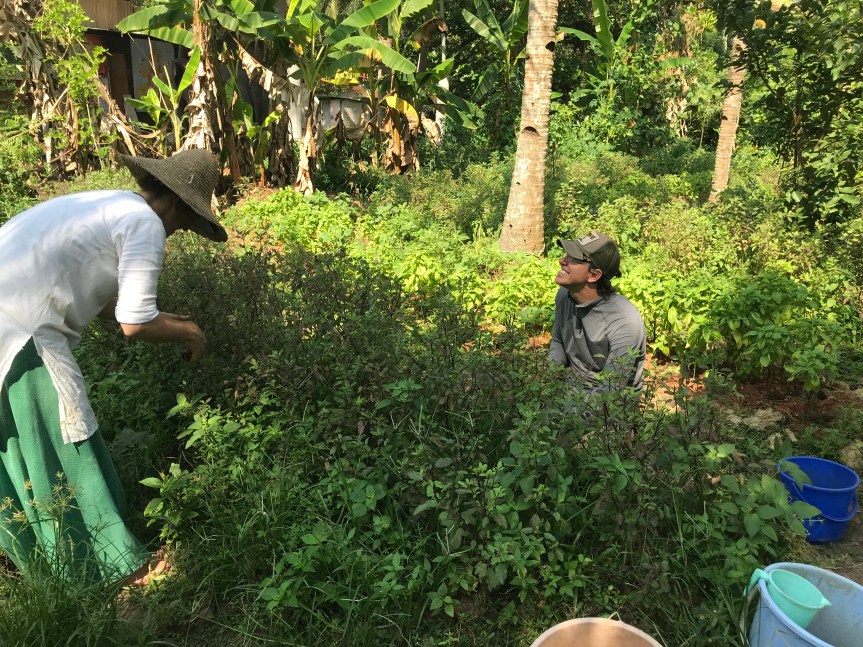
When I walked onto the land, I saw two friends weeding a tulasi and basil field.

My attention was then pulled to a form of “spinach” I was introduced to last December. It is so tender and can be eaten either raw or cooked. I loved it so much that I found some seeds in the U.S. and planted them, but they didn’t sprout. I’m going to try again this year even though it probably doesn’t get hot enough in Seattle to grow that type of spinach.

Over the years, the devotees who have worked at this farm have tried various ways of catching and storing water. They had a new method this year. [Note: I was wrong about these tubs being used to catch water. Read I Was Wrong for an update!]

I saw so many beautiful flowers. (Click on any of the galleries to enlarge the photos.)

In the middle of the property, there was an Amma altar…

… and many other beautiful and interesting sights. Everything grows so fast in the tropics. Some plants that were a foot tall last year or the year before have grown to a height of five feet.

I saw butterflies, birds, and a dragonfly. I tried to take photos to show you but they all moved too fast, so I gave up and looked at them for myself. When I took the time to observe them, I noticed there were at least a dozen types of butterflies. The colors and markings on their bodies were exquisite. Maybe some day you will come here and see them for yourselves!

To read the previous posts in this series click here.