
Wordless Wednesday
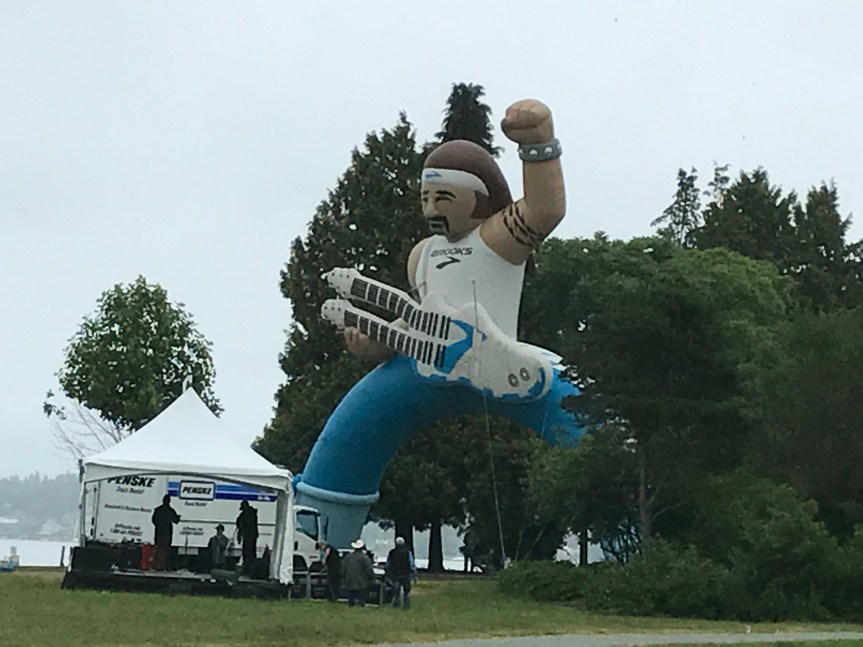
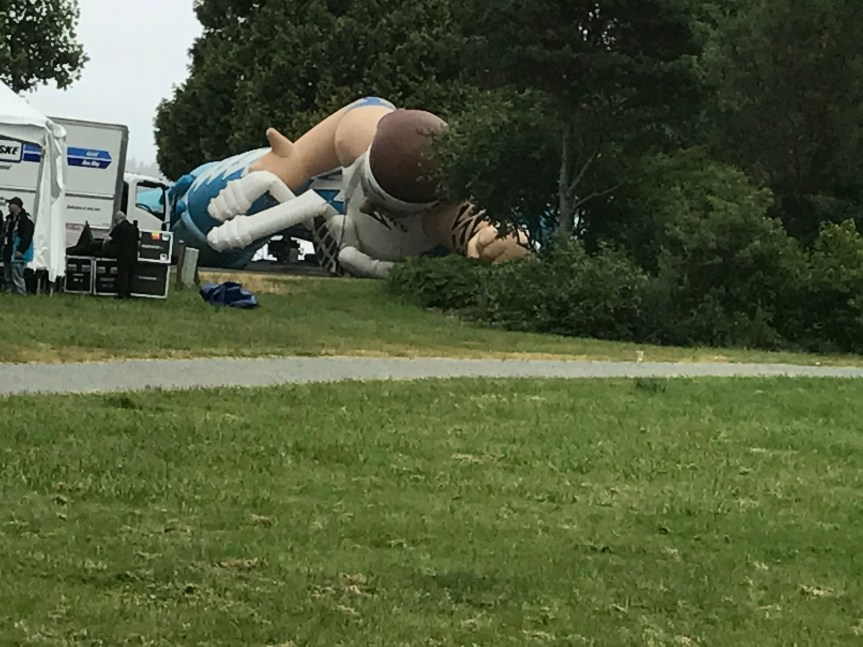
Greenbelt Restoration Work Party: June 14


For three hours on June 14, eight volunteers worked diligently in our Greenbelt restoration site. A week before, Seattle Parks Department staff had cut down a large area of blackberry vines, leaving a lot of debris and uncovering an astonishing amount of trash.
We spent the first hour of the work party picking up trash. There is more garbage for us to pick up, but we got a good start on it.


When we began this project, there were two fields of invasive bamboo on this site. Seattle Parks Department cut the bamboo down last March. We placed the cut bamboo on drying racks so that they didn’t re-root. That bamboo is now dry.
On Wednesday, we stripped the branches from the dried bamboo canes. The canes were given away to gardeners and the branches are being used as part of our newest drying racks. (I will write a post about the drying racks soon.)


We also removed blackberry vines from plants and trees…
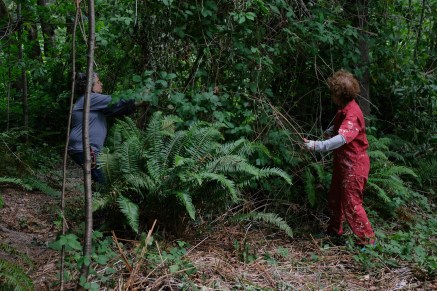
…. and rescued ferns and a fringe cup plant.


It was another productive and rewarding day in the Greenbelt!
Mother Nature’s Creation
I’ve been so involved in the Greenbelt restoration work that I’ve given my front yard garden very little attention. I’m loving how Mother Nature filled in the gap and made it beautiful in her own way.
For the last few years I have planted five or six pansies in the garden. Occasionally one has come back after the winter. This year, though, pansies of all colors have sprung up throughout the garden. There are so many of them! It seems so strange since that has never happened before.
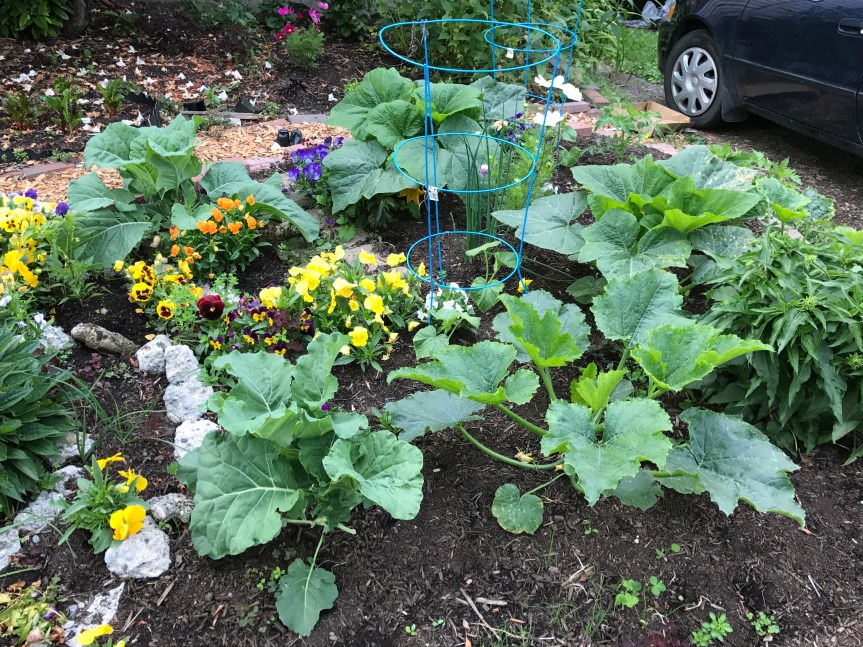
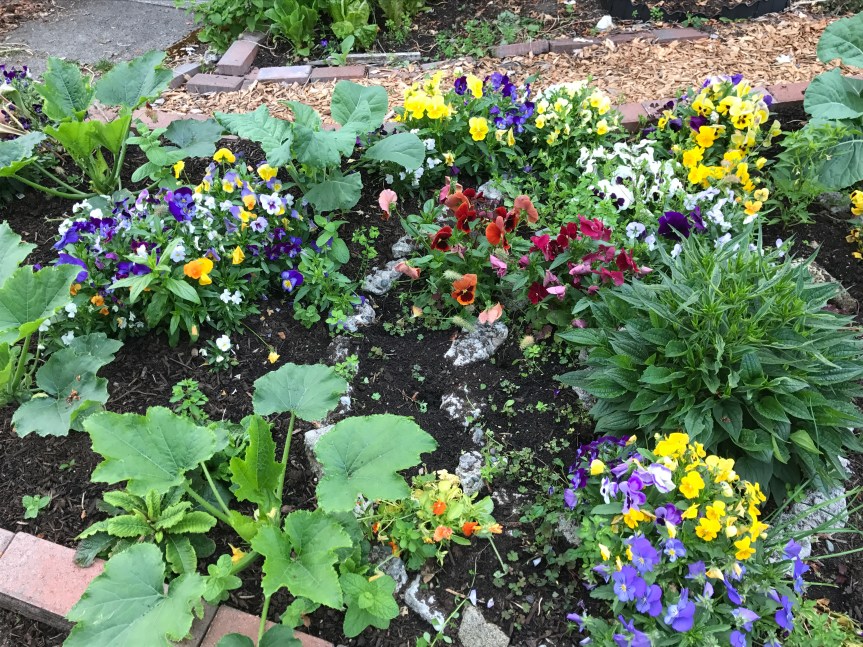

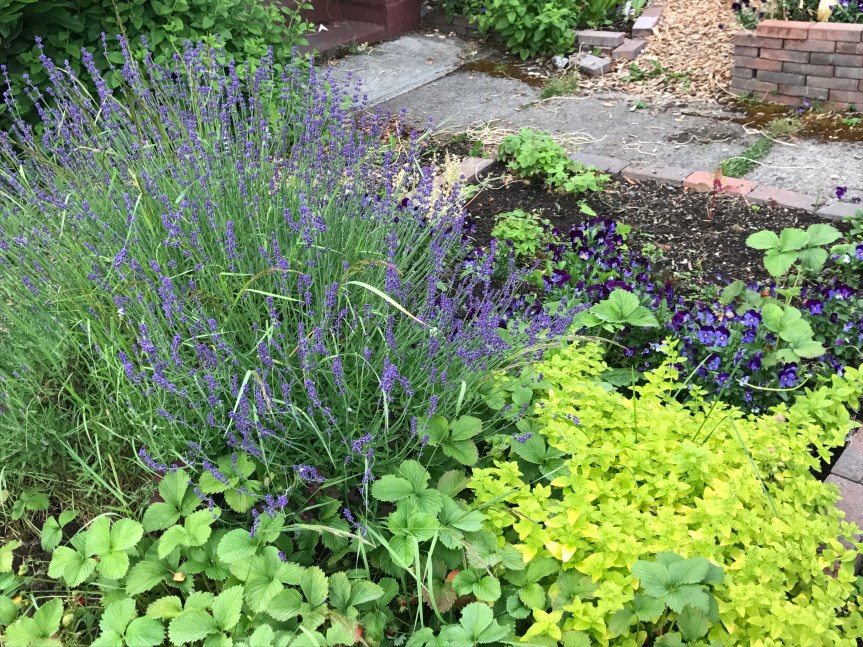
Many of the blooms are withering but the combination of colors are still beautiful.


I had an early bloom on one of the squash plants……..
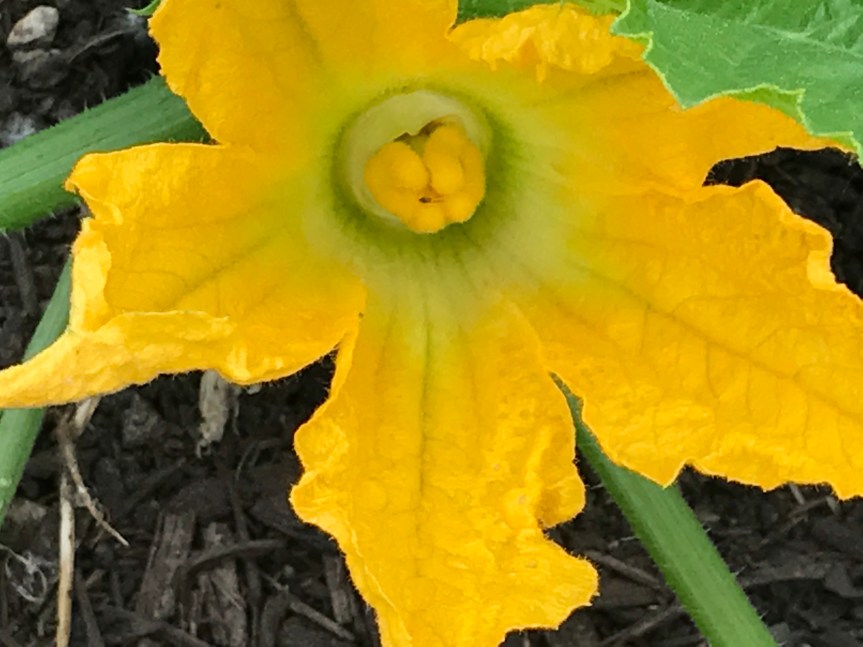
…. but so far there isn’t any squash. The plants seem healthy but I haven’t seen both male and female blooms on any variety and I haven’t seen any bees. I will hand fertilize when that becomes possible.
The Lazy Susan plant and the Echinacea plants have buds. I look forward to seeing their flowers.

Lazy Susan

Echinacea


Echinacea
There is a seemingly endless supply of lemon balm and peppermint.

Lemon Balm

Pepperment
Thank you Mother Nature for all that you do for me, and for the world. You are a paragon of compassion and an artist that has no equal.

Interesting Facts about Ferns

One part of our Greenbelt restoration site has so many ferns. I decided to read some articles about ferns and was fascinated by what I learned.
- Ferns have been on earth for 360 million years.
- The type of ferns we see now have been here for 45-50 million years.
- Dinosaurs ate ferns, conifers, cycads and mosses.
- Ferns were on earth 200 million years before flowers.
- Ferns are helpful in preventing or eliminating pollution because they remove heavy metals from the air and the soil.
- Today’s ferns are not edible because of toxicity. [Note: Maybe that is because of the heavy metal mentioned above.]
- Some ferns have a life span of 100 years.
- The height of ferns ranges from 2 inches to 30 feet.
- Compressed ferns turned into fossil fuel and became the basis for oil, gas and oil.
- Ferns reproduce from spores. They don’t have seeds or flowers.
- There are at least 12,000 types of ferns on earth today. There may be up to 20,000 different species.
- In North America there are 441 varieties of native ferns.
- Ferns are vascular, circulating water and nutrients through their veins.
- In the past, there were people who believed if they ate ferns they would become invisible. Still others believed ferns protected them against goblins and witches.
When I took this photo today, I imagined dinosaurs walking through this forest. Doing that reminded me of the Jurassic Park movies!
You can learn more about ferns from the articles below:
________
Daily Prompt: Taper
Mystery, Adventure and Reward
Yesterday I took on the challenge of removing bindweed (morning glory) and blackberry vines from a thimbleberry shrub.

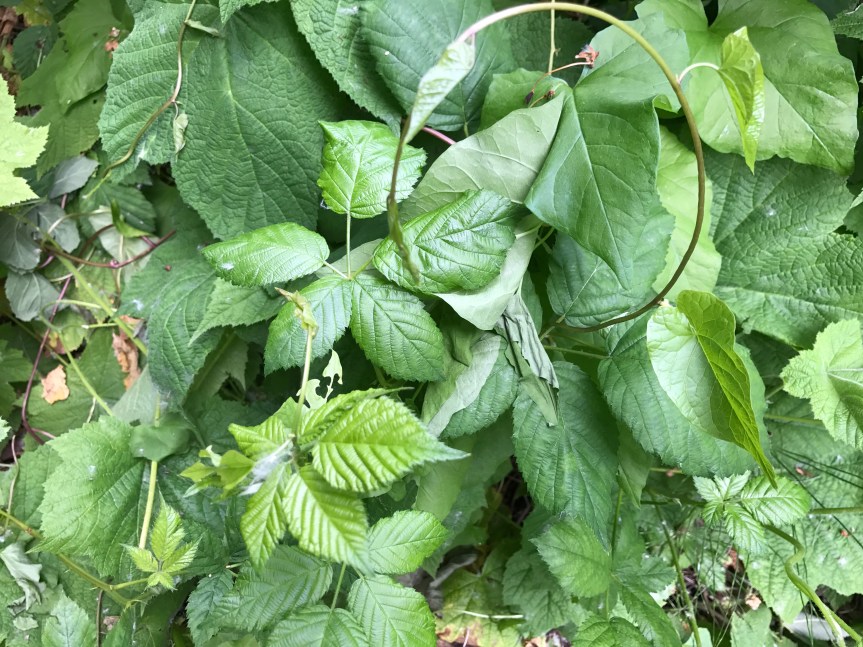
The bindweed wraps itself around each stem, weighing it down and eventually killing it.


The thimbleberry leaves are beautiful. They have three to seven lobes and are soft and hairy.

I tried to unwind the bindweed from each thimbleberry stem carefully, but the leaves and stems are so fragile that I lost many of them in the process of trying to free them. The stems are now free from blackberry and bindweed vines but I’m going to have to get under the shrub and dig out the blackberry roots to keep it that way. We will probably have to deal with the bindweed every year.
It was fun to watch the stems straighten once they were relieved of the weight of the bindweed. The shrub still looks scraggly but it will fill in and return to the beauty it is meant to be.


The density of the bindweed made it hard to tell where the shrub began and ended. The area towards the back had a much thicker layer of bindweed.


As I started to cut it away, I realized that it wasn’t thumbleberry that was under it, it was a gigantic fern. With renewed energy, I started cutting away the bindweed. Before long, the fern was free!
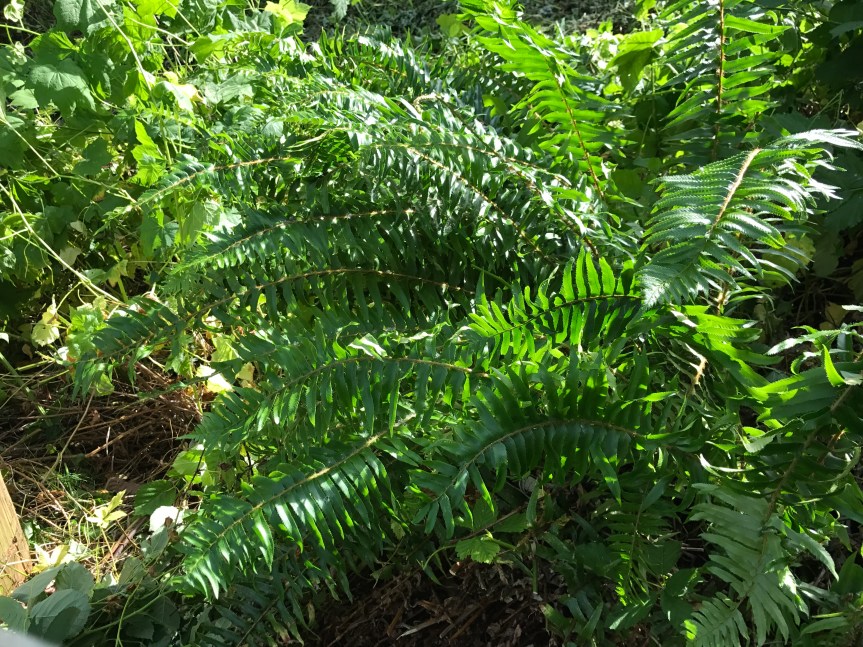
I love doing this work. It is full of mystery and adventure and is so rewarding.
Found in the Greenbelt: Dinosaur
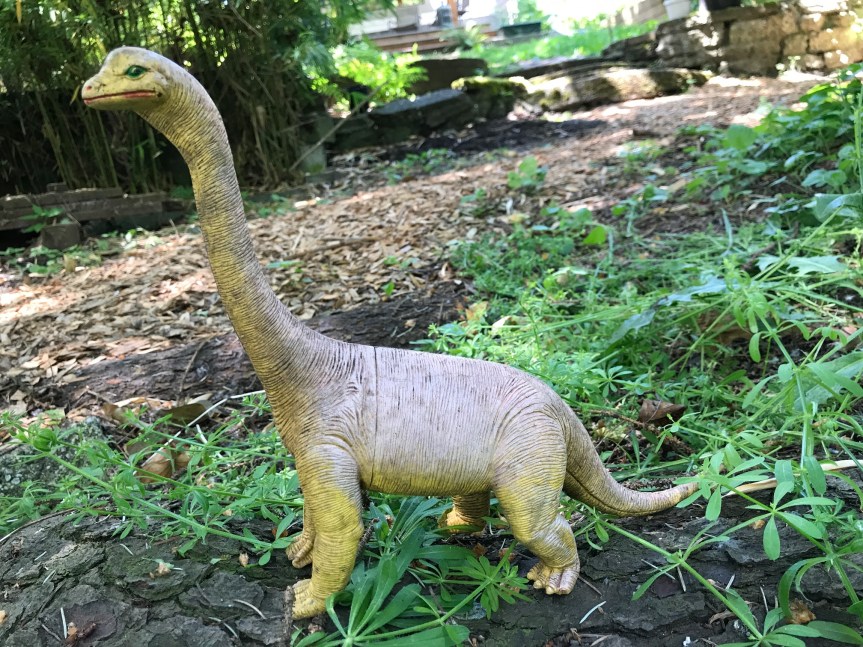
On May 13th, we had a work party that included 20 University of Washington students needing volunteer hours for an Introduction to Environmental Science class. A few days later, I discovered that one of them had left me a surprise. The student had placed this toy dinosaur near, but not in, a pile of Greenbelt trash. I’m not going to throw it away either.

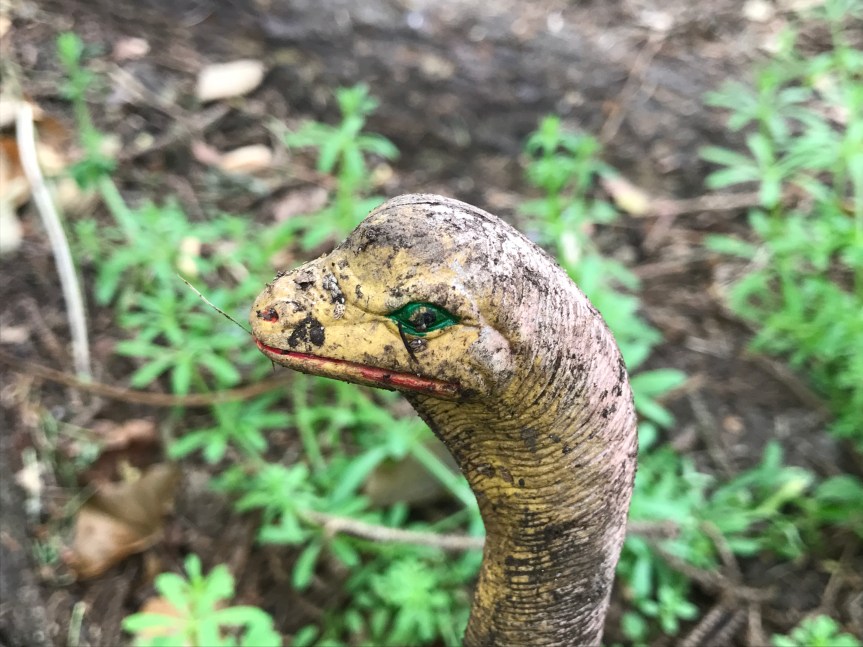
At the time I found it, I washed it and waited for the pile of trash to be picked up. Today, I put it back where the student had left it. I hope it enjoys its new home. I’m imagining it experiencing a sense of freedom and triumph after having survived 30-40 years buried in the dirt.
Song Lyric Sunday: 99 Bottles of Beer

Helen’s theme for this week’s Song Lyric Sunday is alcohol. For me that song will be 99 Bottles of Beer on the Wall. It is a folk song that can be traced back to the mid-20th Century.
I grew up as an army brat; generally moving every three years. We also visited my grandparents in Florida. That combination made for a lot of cross country car trips. Singing this song was one of the ways my brothers and I passed the time. When I think about it now, it seems like a very strange song for children to sing. Hmmmm, I wonder if I taught it to my children using beer as the object. I’ve never drunk beer, don’t even like the smell.
Lyrics:
99 bottles of beer on the wall, 99 bottles of beer.
Take one down, pass it around, 98 bottles of beer on the wall…
Every time you sing it, you take off a number, i.e. 98, 97, 96, 95 etc. There are several variations for the ending. I don’t remember how we ended it.
I found a fun country video to share. It is by Zane Williams. Wikipedia describes him as an “anomaly in today’s country music scene, a modern-day “throwback” who is equal parts bar-room entertainer and introspective poet.”
On a day hot enough to make the Devil cuss
I walked into a bar so thirsty I was spittin’ dust Barkeep asked me what’ll it be?
I said whatcha got?
He said well let’s see, we got
Lone star, PBR, Rolling Rock, Shiner Bock
Moose Drool, O’Doul’s, Hefeweizen, Ziegenbock
Keystone, Coors Light, ‘course we got Red Stripe
Amstel, Amsterdam in the tall can,
Michelob, Miller Light, Guiness by the pint glass
Doppelbock Lager, take a swaller ‘cause it’s goin’ fast
Oatmeal stout and a lot of Leinenkugel’s
Open up your wallet, no time to be frugal there’s
99 bottles of beer on the wall
99 bottles of beer
Take one down, pass it around
98 bottles of beer on the wall
Well needless to say I was pretty impressed
As he handed me an ice cold beer from a chest
I said, Not bad for a hole in the wall
Barkeep grinned, said That ain’t all, we got
As he handed me an ice cold beer from a chest
I said, Not bad for a hole in the wall
Barkeep grinned, said
That ain’t all, we got
Rio Grande, River Rock, Tecate with a twist top
Dos Perros, Dos Equis, Foster if yer Aussie
Bud Light in the new Zane Williams coozie
A dozen wheat beers on tap if you’re choosy, got
Heineken, Killian’s, Labatt’s and Beck’s
Ice cold na with the limes in the necks
Yuengling chilling with the Old Milwaukee’s best
Sam Adams and that ain’t even half of the rest of them
98 bottles of beer on the wall
98 bottles of beer
Take one down, pass it around
97 bottles of beer on the wall
Well I settled down with my favorite brew
I ordered me another and before I knew
It was 2 AM and I was under a table
Bein’ choked by a dude that smelled like a stable
And finally I was able to throw him through the screen door
Pick up my hat off the hardwood floor
Get on back to the barkeep’s daughter who was
Puttin’ “Pop a Top” on the jukebox, dancin’ non-stop
And sippin’ on a beer that I bought her
We were drinkin’ it like it was water
There were cowgirls everywhere wearin’ their
Pretty hair down to their derriere and there were
2 more bottles of beer on the wall
2 more bottles of beer
Took one down and passed it around
1 more bottle of beer on the wall
1 more bottle of beer on the wall
1 more bottle of beer
We raised it up high and drained it dry and there were
No more bottles of beer on the wall
So we started on the
Cuervo, Bacardi Gold, margaritas, straight tequila
Jim Beam, George Dickel, then we wet our whistle with a
single malt scotch, peach schnapps in a jello shot
Captain Morgan, pour some more of them
Cider Sliders, Flyin’ Tigers
Dr Pepper for the designated drivers
Everclear, Absolut and Amaretto I
don’t remember much but I never will forget those
99 bottles of beer on the wall
99 bottles of beer
There ain’t nothin’ finer than an ice-cold Shiner and
99 bottles of beer on the wall
Shocking Revelation

I am still reeling from some information I received today. It just occurred to me to look and see if today’s Daily Prompt would fit for this situation. Revelation is perfect!
For the last month, I’ve been looking forward to taking a Plant Identification course that was offered to Forest Stewards and other volunteers who work in Seattle’s reforestation projects. When I arrived at the class today, I discovered most of the students had been Forest Stewards for a long time and the others had at least some experience in plant identification. I, on the other hand, only know a few of these native plants.
Last month, Ananya and I had to choose the trees, shrubs and ground covers that we will be planting in our group’s Greenbelt site the end of October. We ordered nearly 400 plants. In the course of today’s class, I learned that those plants will be delivered to us unmarked. Not only that, most will be in their winter state so we may have only a twig to use for identification.
WWWWWWHHHHHHAAAAAAATTTTTTTT?
The need for me to learn to identify our plants has certainly taken on a new intensity. As I sat down to write this post, though, a couple of other thoughts came to my mind. When we ordered the plants, we had to order in quantities of 10. We ordered 10 for some varieties and 20 for others. So even though we will have to identify 400 plants, there will only be 26 different types. That seems doable. Also, sometime prior to October we will have the opportunity to take a Winter Twig class. I will make taking that class a priority.
I am sure glad that I learned this information today, rather than discovering it when the plants are delivered. I can do it. I can do it. I can do it. I can do it. I can do it. Yes I can. Yes I can. Yes I can. Yes I can. And I don’t have to do it alone! Ananya and I will do it together and if we need help we will get it.
The Wonder of Nature
After making my way to the rhododendron flower last week (Keeping My Eye on the Goal), I turned around and came face to face with what became my next Greenbelt restoration task.
S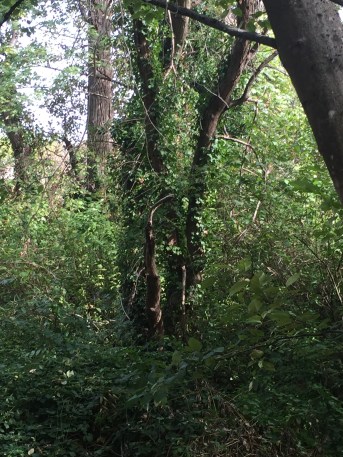 o many trees this Greenbelt site have been killed by ivy. One of the first trees I focused on freeing from blackberries and ivy last September was the one in the photo to the left. It had a split trunk at the bottom and both trunks split again further up. The trunks/branches on the west side were dead; the east side of the tree had leaves.
It was this tree that I saw when I turned away from the rhododendron bush. I noticed ivy was growing on it again so I started cutting. Since the time I originally worked on the tree, I have learned that our job is to cut the ivy at the bottom and at shoulder height. That is called a “survival ring.” We don’t pull down the ivy above the survival ring because dead tree limbs could fall on us. The City Parks Department usually leaves dead trees standing because they are a habitat for many bugs and other insects, as well as smaller organisms.
Some of the ivy vine roots are thin and others are thick. It usually takes a saw to cut through the larger ones. The second two photos below show a root that I’ve already cut at the bottom and pulled it away from the tree. Sometimes we have to use a crow bar to separate the root from the tree.


[Aside: Here are photos of an ivy ring that was pulled off of another tree in March. It is so dense… and hard. Looking at it helps me understand how it can kill a tree.]


Back to the story at hand: When I removed the ivy from around the bottom of the tree, I noticed that it looked as if the ivy had separated the bark from what seemed like the core of the tree.


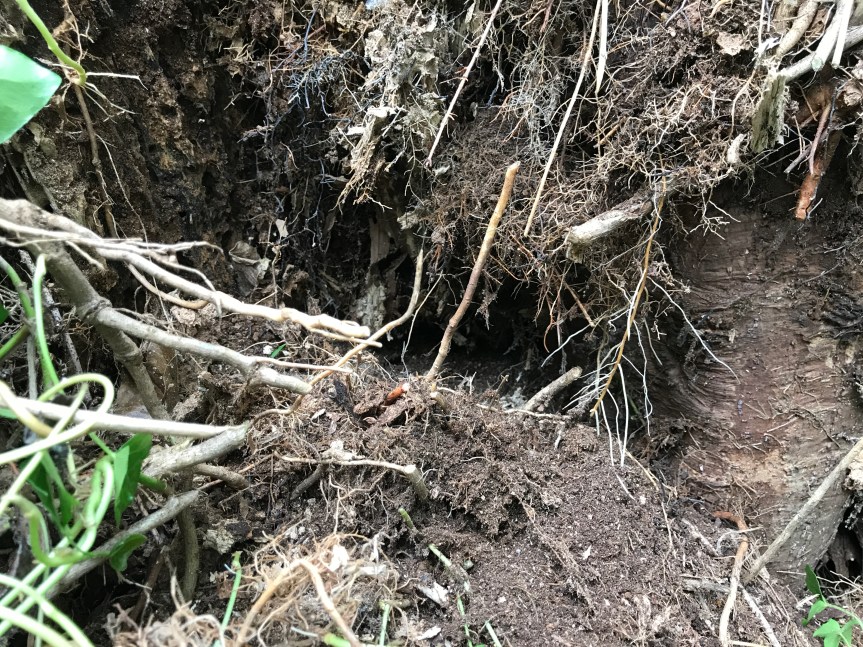
It amazed me that the tree was still standing with a core this small. The separation of bark from core gave me the impression that there was a deep hole under the tree, but I don’t think that was the case.
I enjoyed looking at the inside portion of the bark.


As I was finishing the work, I noticed that fungi is growing on the portions of the tree that are dead or dying.


In closing, I will share words that my brother Bill wrote shortly before he died in 1992 at 39 years-of-age.
I can’t walk outside without seeing the beauty of our created world, from the rainbow in a line of earthworm slime, to another visible ring on Jupiter. We have been given this magnificent world to study and enjoy in limitless detail at any level, microscopic to cosmic. (The Truth I Live By)
I’m becoming more like my brother. I can now see that there is so much wonder even in this one tree.


[Note: It just occurred to me that what I call the core is under the dead part of this tree. Now I am really confused, especially since I didn’t see anything similar under the other side of the tree. I do see wood shavings, but I would have expected the empty space to be under the east side of the tree and the rotten wood to be on the west. I will have to investigate this more and will add an addendum to the post … or write a new one… if I get answers! If anyone who reads this post notices mistakes in my interpretations, please let me know. I’m a novice.]
 Living, Learning and Letting Go