Amma’s Vrindavan Tulasi Field… tulasi and so much more

img_5508

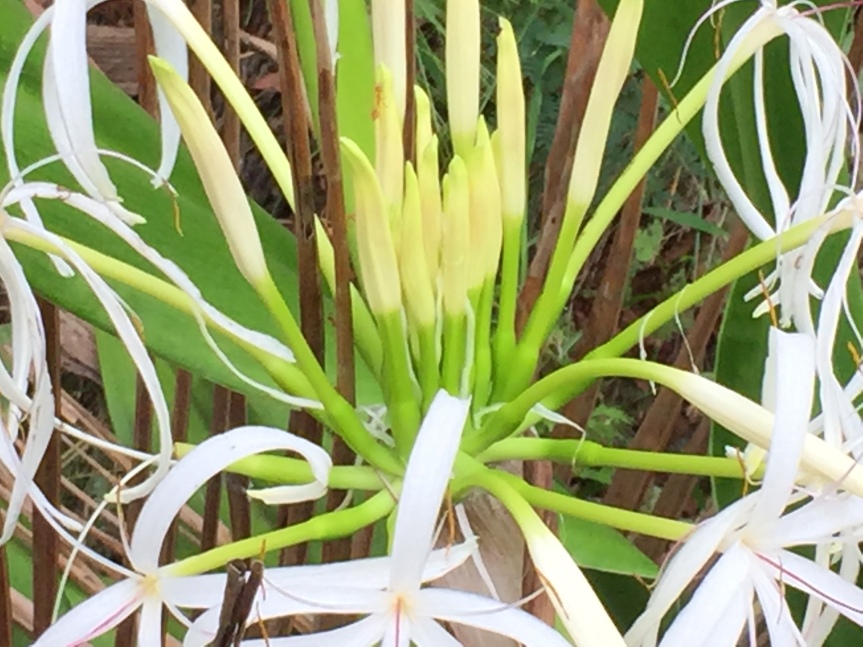
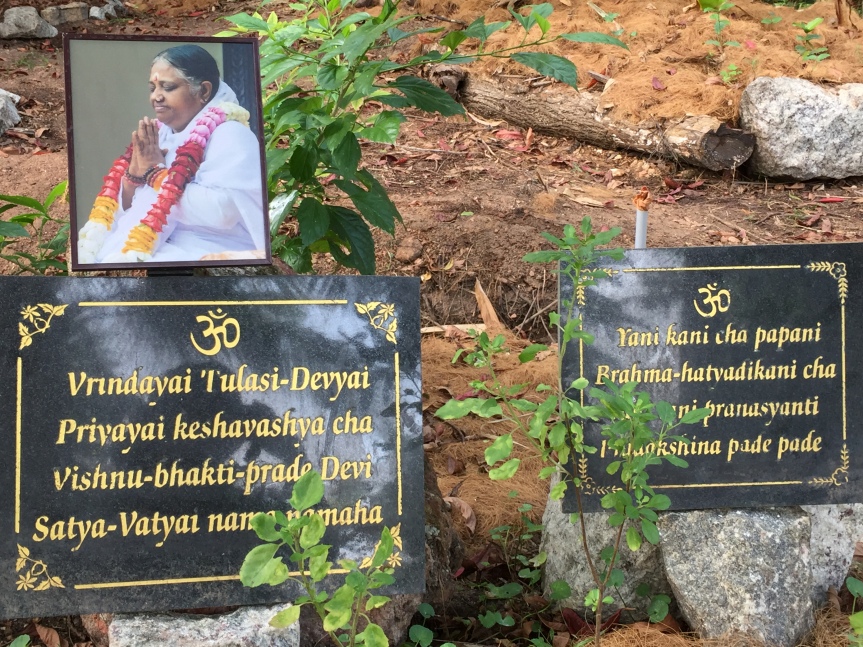
On January 8th, I visited one of the oldest gardens in Amritapuri. While it is known as Amma’s Vrindavan Tulasi Field, it has become so much more.

In the early years, growing tulasi was the main focus. Then, the volunteers who worked at the farm discovered that Rudraksha trees were scattered around the property. Rudraksha seeds are considered sacred in India so they started harvesting the seeds and planting more of the trees. They also began growing vegetables and other plants.

Farming on that property has been such a struggle over the years. Among the problems they faced were lack of water, poor soil, and bugs. When I visited the farm last year, what I saw took my breath away. It had turned into paradise. (To see photos of last year’s visit, click here.)

When I went there this year, I was amazed by all the new projects that were underway. The first thing I noticed was an irrigation system that was under construction. I thought about all the years they have watered using small hoses. What a difference the irrigation system will make.

Then I noticed all of the raised beds. I was told that when there are heavy rains, the farm floods. With raised beds, the plants will be higher than the water. Several swales have been constructed to drain off the flood waters, but the photos I took of those ended up looking like flat ground, so I didn’t use them.

There is a big pond on the property. The plants that are growing in the pond are used for mulching. I saw, and talked to, volunteers who were constructing stairs that will go into the pond to make harvesting those plants easier.

There are rudraksha trees on several parts of the property. They are easy to spot because their trunks have all been painted white. Next year I will ask why they do that!

img_5550

The numerous tulasi fields are thriving.

Many fruits and vegetables grow on the property.

I was surprised by the many varieties of eggplant. Later, I saw a bright yellow eggplant at Saraswati Garden but it was on the phone I lost on my last day at the ashram so you will have to use your imagination to see that one. I was particularly fascinated by the eggplant that looked like an egg!

The plant below is called Lakshmi Taru, The Paradise Tree, The Tree of Heaven, Simarouba or Simaroubaceae. It is a medicinal tree that has been used to treat dysentery, malaria, cardiac palpitations, asthma and epilepsy. It may have a role in cancer treatment.

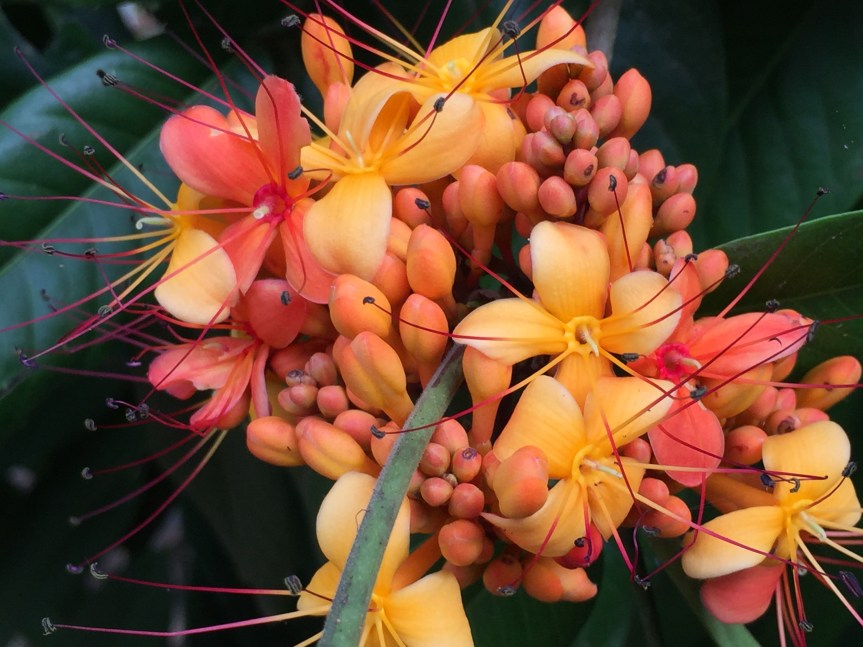
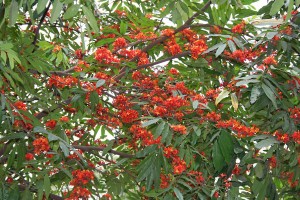
I was intrigued by this flower.

img_5547

Later, I learned it is a Sita Ashoka flower. Ashoka means “without sorrow”. Hindus believe that Sita, wife of Lord Rama, sat in a grove of Ashoka trees after she was abducted by the evil Ravana. Buddhists believe that Lord Buddha was born under an Ashoka tree.

I found this photo of an Ashoka tree on Wikimedia.
sita-ashok_saraca_asoca_leaves__flowers_in_kolkata_w_img_4175

I will leave you with some final images of Amma’s wonderful Vrindavan Tulasi Field.


Jane Goodall: A New Kind of World

Photo Credit: Wikimedia
Photo Credit: Jeekc on Wikimedia

“I think one of the most important things for people to understand,” says Goodall, “is don’t feel helpless when you look at all the problems of the world.

Realize that if you think about the consequences of the small choices you make each day — what you buy, what you eat, where did it come from, how was it made, did it harm the environment, cruelty to animals, child slave labor — [you] make more ethical decisions.

It’s not just you. It’s more and more people around the world. In the end, it’s hundreds of millions of people making small choices, that are the right choices, that leads us to a new kind of world.”

Source

Letting Go of Suffering- Week Nine: Mistakes

heart-157895_1280

You are lovable even when you make mistakes.

Making mistakes is important for your growth.

You can learn from every mistake.

heart-157895_1280

Making a mistake is one of those life situations that often leads to suffering. A mistake is “a wrong action or statement proceeding from faulty judgment, inadequate knowledge or inattention.” (Merriam-Webster, Inc. 1988 p. 760.)

An important step in letting go of the suffering is to adopt the mind-set that mistakes are an important and necessary part of living, and that something can be learned from every mistake. In time, you may even come to see making a mistake as a positive event rather than a negative one.

35

This week, record every mistake you make. Write down the tiny mistakes as well as the big ones. Next to the mistake, write what you learned from making it and what you will do differently in the future. Add more paper if you need to.

36

37

38

heart-157895_1280

You are lovable even when you make mistakes.

Making mistakes is important for your growth.

You can learn from every mistake.

heart-157895_1280


See you next Monday for the tenth lesson.

To find the lessons in this series that have already been published click here.

Living and Learning in Amritapuri, India- Catching Up (Jan 2017)

img_4926

There have been pieces of information, I’ve wanted to share throughout this trip, but have postponed in attempt to keep the posts short. Before I write about the end of my trip, I decided to publish a “Catch Up” one.

Western Cafe

The Western Cafe has been anticipating a major remodel for several years. That time has come. While I was flying back to Seattle yesterday, they were moving the cafe and bakery to a temporary location.

A large structure has been set up in the courtyard west of the Indian canteen. The cafe food will be prepared and sold there. The bakery is being relocated to an area east of the Indian Canteen. The dining area will still be in the west side of the auditorium.

I don’t think the entire building is being torn down; I believe the existing structure is being completely remodeled and a second floor is being added. When the construction is complete, the bakery will move to the upper floor.

For the last four or five years, Sreejit has cooked for the Western Canteen in an area behind the Indian kitchen. When the remodel is finished, he will be located in the new building. The construction will take until August to complete.

Elevator etiquette

There is an informal type of etiquette that is practiced by many people at the ashram. To prevent residents and visitors from having to stop at every floor, when those people get on an elevator, they look to see if someone has already pressed the button for a floor near their destination. If a button for a nearby floor has already been pressed, they get off there rather than pressing another button.

For example, I live on the fifth floor. If someone else is getting off on the fourth or the sixth floor, then I leave the elevator at the same time they do and walk up or down a floor. I think it is a respectful gesture, as well as gives some extra exercise. I would continue the practice in the U.S., if stairs here were as easy to find. In Amritapuri, they are located directly across from the elevator.

Spinach

The most abundant food produced by the Amritapuri gardens is organic spinach. It was so nice to have spinach added to many of the soups, curries, stews and salads this year.

Below are photos of several types of spinach; there are more. My favorite one is the first one. If anyone knows what that variety is called let me know. I’d like to see if I could plant it in Seattle. I ate some of it right off the vine and loved it.

Moringa

Many of the Amritapuri Gardens are now producing Moringa. It is considered a superfood and is being used to combat malnutrition in several parts of the world. According to Wikipedia, it is an “exceptionally nutritious vegetable tree” that can grow in dry, sandy soil. Every part of the tree can be used for food. Wikipedia states that it may reach 10 meters in height, but is usually cut back to 1 meter each year.

Since I lost my phone, I cannot share my photos of the Amritapuri Moringa plants/trees with you but I found some on Wikimedia.

Song Lyric Sunday: He Ran to Me

img_1345

The prompt for this week’s Song Lyric Sunday is parent/child relationships. I had hoped that there would be a prompt soon that would give me an opportunity to share my favorite song from this year’s Amritapuri Christmas Eve play with the Song Lyric Sunday readers. Little did I know it would show up on the same day I returned to Seattle from India!

The play, The Loving Father was based on Jesus’ parable of the prodigal son. Most of the music in the play was original, but they did include a song that is widely used in Christian churches. That song, When God Ran, was written by Benny Lester. Some of the words were changed to fit the script of the play, but most are the same as in the original.

In the Amritapuri play, when the son came home, the father ran to him, took him in his arms, and told him that he loved him. The son had been prepared to beg for forgiveness but there was no need, the father welcomed him wholeheartedly.

A little later in the play, the son sang He Ran to Me as he reflected on his father’s welcome. I still cry every time I hear him sing.

Matthew sings about his father's love

Lyrics

Respected Sir, honored father, immovable rock, successful, gracious businessman
Strong and stern, commanding scores of men, mighty businessman
And the only time, the only time I ever saw him run,
Was when he ran to me, he took me in his arms,
Held my head to his chest, said my son’s come home again
Lifted my face, wiped the tears from my eyes, with forgiveness in his voice
He said Son, do you know I still love you
He caught me by surprise
When He ran

The day I left home, I knew I’d broken his heart
But I never stopped to wonder if I was wrong
Yet my time, left me hungry and all alone
I needed him, I came home to plead
And yet from far away, from far away I saw his relief
And then he ran to me, he took me in his arms,
Held my head to his chest, said my son’s come home again
Lifted my face, wiped the tears from my eyes, with forgiveness in his voice
He said Son, do you know I still love you

I was so confused, how could he not be angry
With no excuse, he just forgave
I saw him run to me, he took me in his arms,
Held my head to his chest, said ‘my son’s come home again’
Lifted my face, wiped the tears from my eyes, with forgiveness in his voice
I felt his love for me

He ran to me, he took me in his arms,
Held my head to his chest and said my son’s come home again…

Living and Learning in Amritapuri, India: January 10-13, 2017

img_5729

Nearing the end of my trip

In an attempt to prevent a last minute rush, I started sorting through my belonging early in the week. I put anything I wanted to keep, but didn’t want to take with me, into two small trunks, washed clothes and towels, and began to clean. My flat is used by ashram guests throughout the year, so it is important that the room is prepared for them.

I spent as much time as I could with Chaitanya and Sreejit, which isn’t easy since they are both working in their respective jobs most of the time. I could tell that they were going out of their way to be with me too, which was very nice.

Lunch with Amma

Tuesday was the day that Amma serves lunch to everyone. I love the new process that has been implemented this year. Instead of thousands of people getting their plate directly from Amma, she passes the food to some people near her and then the food is distributed to everyone through a series of human chains that weave throughout the room. I have really enjoyed being part of one of those chains each week.

Stage sevas

I made sure that I joined the prasad-giver line on the last two darshan days, and on Thursday I also signed up for a prasad passing shift. I am so grateful that I have realized that I need to increase the amount of time I spend near Amma. I plan to start doing more of the stage sevas next year.

Darshan

The public darshan programs on Wednesday and Thursday were both in the temple. That has happened so many times on this trip. I love, love, love it. It not only brings back good memories from the past, but, for me, creates an increased sense of intimacy. My last darshan (hug) was wonderful. I felt like she held me forever. A wonderful ending for that part of my trip.

Canoe

I have continued to use the canoe to cross the backwaters. It has been such a good gift to myself. I feel so peaceful as we glide across the water.

An unexpected ending

It was a good thing I had been getting ready to go all week because my last day had an ending that was far different from the one I had “planned.”

In one of my last posts, I mentioned that I was going to meet with someone review and ask questions about the Amrita Serve Garden photos. When I did that, I learned that I had not been at the correct garden, instead I had apparently stopped at a private farm where tapioca, bananas and coconuts were grown! When I described the route I had taken, he said if I had gone a little further on the second path, I would have seen it. I decided I would go there on my last day.

So Friday morning, I went to see the Amrita Serve garden. It is a demonstration garden that will be used to show Indian visitors ways they can raise food in small spaces. I saw avocados, sweet potatoes, tapioca, papayas and many other plants and trees. I took lots of photos.

Adjacent to that garden is a seed producing farm. I learned so much there and saw so many fascinating things. It is going to take me more time to put that experience into words. I took lots of photos there too.

Those two experiences took most of the morning. In the afternoon, I decided to go to a garden that is close to the ashram. I was stunned to see how much everything had grown during the last year. I could barely recognize the place. When the sevite who is in charge took me around, she showed me an area where they are not doing any watering. There are compost piles throughout and those piles produce enough water to sustain the water-less garden. She said the plants in that area grow slower than the others, but they remain green and healthy. I took pictures there as well.

I then walked back to the ashram, picked up my passport from the International Office and went to Saraswati garden to say goodbye to the staff. It was there that I discovered my phone was missing, and with it, all of the photos I had taken that day and the three preceding days. I was in shock. I had just used it. I retraced my steps to no avail; I couldn’t find it anywhere. It was like it had disappeared into thin air.

When Amma was at the beach that night, she talked about detachment as a process of being able to deal with anything that comes our way in the process of life. (That is my understanding of her words, not an exact translation.) I was certainly receiving a BIG lesson in detachment.

I probably had dropped it somewhere between the water-less garden and the ashram. That path wound through many different areas of the village. Before and after bhajans, I walked to all the places in the ashram where the phone could have been turned in, but no one had seen it.

It is probably safe to say that the phone is gone, although I haven’t accepted that as fact yet. I’m still hoping for a miracle. In addition to the lesson in detachment, my Fitbit showed I had walked 18,000 steps during the day.

Since the phone is missing, I won’t be able to share any pictures of the most recent gardens/farms I visited. That will have to wait until next year. When I write more about the seed saving garden I will see if I can find some online photos that show some of the interesting plants I saw.

It was 10 p.m. before I returned to my room to complete the packing and cleaning. Soon I was ready for my last night of sleep in Amritapuri.

January Amritapuri Flowers

This gallery includes of some of the flowers I saw in my last few days in India. Some are from the ashram, some are from the farms and some I saw when I was walking.

Living and Learning in Amritapuri, India: January 9, 2017

img_5522

Monday, January 9 was another full and rewarding day. My main goal was to visit Vrindavan Farm, which is located in a part of Vallikavu that is south of the Amrita Ayurvedic College. I wasn’t sure how to get there so I decided to go by rickshaw and then walk back to the ashram when I was finished.

I will be writing a whole post about that farm later, but will share some photos, including the one above, with you now so that you can get a sense of what it was like.

A sevite (volunteer worker) offered to take photos of me. Normally I would say no, but I decided to let her do it. I enjoyed seeing the shots she took. I had no idea how much my hat protected me from the hot sun!

While I was at the farm, I talked with one of the other sevites. I discovered that he works at the Amrita Serve Garden in addition to Vrindavan Farm. I have been trying to find out the location of that garden so was excited that I had met someone who knew the answer to that question. He was willing to take me there later in the week, but our schedules didn’t line up very well. I asked him for directions so I could go on my own.

He said it might be hard for me to find it, since I had to locate a particular foot path. I decided to try. If nothing else, my Fitbit would record a lot of extra steps!

On the way, I walked by a building that I have thought was a new supermarket. I had seen the supermarket sign, but the store it was on looked so small, I didn’t bother to check it out. When I walked by the sign this time, I noticed it was just an advertisement. The supermarket itself was located off the road behind the small store. I was astounded. I’d guess it is nearly ten times the size of the other “super” market in town. There is no other shop in Vallikavu that is anywhere near that size.

I continued walking, passing by the supermarket and a new temple that was under construction. I saw two foot paths. I started down one path, but in a short time decided it was the wrong one, so I turned around and came back to the main road and took the other path. On that path I saw these:

After some time on the new path, I reached a paved road. I was clearly on the wrong path so I again walked back to where I had started and re-took the original path. After some time, I saw the garden I had been looking for.

No one was present to show me around, so I just wandered. Before I leave Amritapuri, I’m going to meet up with the man that gave me directions so I can learn more about that garden. I will pass on the information he gives me when I write the main post about the Amrita Serve garden. For now, here is a glimpse of some of the plants. [Update: I met with the sevite on 1/12. When he looked at the photos he told me that wasn’t the Amrita Serve garden. I apparently was on a private farm that grows tapioca, coconuts and bananas! There aren’t signs on either property and there are private houses on both so I had never considered that option. I had been told that it was after a purple house. There was a purple house just before this one too. I’m going to see the Amrita Serve garden this morning, 1/13.]

When it was time for me to walk back to the ashram, I decided to take the canoe rather than walk over the bridge. It the first time I had done that since the bridge was built, eight years ago.

I felt so peaceful floating on the water, and the ride to the peninsula only cost 10 rupees (about 15 cents). I may never walk over the bridge again.

In addition to having a wonderful morning exploring the gardens, I had walked more than 13,000 steps!


To see all of the posts in this Amritapuri series, click here.

Wordless Wednesday

img_5548

To see all of the posts in this Amritapuri series, click here.