Recovering from Over-Doing

Two years ago, in a The Seeker’s Dungeon prompt, Sreejit asked us to fill in the blank in this sentence: “I am a Recovering _________.” There was no doubt in my mind what my behavior would be. If I was at a 12 Step meeting, I would say: “Hi! I am Karuna, and I am a recovering over-doer.”

As I thought about how I would present this topic, I decided to create a new mental health disorder. My fictitious disorder is called “Being versus Doing Disorder.”

The “Being vs Doing disorder” is on a continuum where the center, a balance between being and doing, is the healthy portion of the continuum. The more someone moves to either end of the continuum, the more likely it is they will have dysfunction in their lives.

When I think of the over-being end of the continuum I think of non-productivity, passivity, and lack of motivation. I don’t know as much about that part of the spectrum since I have almost no personal experience there. I have seen it at work in some of my psychotherapy clients and friends though.

Over-doing has many facets. It commonly begins in childhood when the only or main way to get positive attention from parents is to do impressive things. It also develops when parents criticize their children anytime they are relaxing or are doing things the parents consider nonproductive.

As a result, adults with an over-doing disorder may be seeking validation and praise for what they accomplish. An over-doer is also likely to be a rescuer. As such, they do things they aren’t asked to do and are likely to do things they don’t want to do. In addition, they do more than their share of the work that needs to be done and do things for other people that they could do for themselves. Those with this “disorder’ are likely to over-commit and seem incapable of being still.

Over-doing has been a major characteristic of my adult life. At one point, I was raising two children, working three jobs, doing my personal therapy and studying for a PhD. During my therapy, I realized I didn’t want a PhD, I was just seeking attention from the father, who had disowned me. I stopped my schooling but was still overdoing. Before long, I began to experience extreme exhaustion and was diagnosed with Chronic Fatigue Syndrome (CFS).

With CFS, I was in survival mode and it was impossible for me to do as much as I had been doing, although I still tried to. When it began dissipating after five years, I went back to over doing. There is no doubt that a part of me believed it was only acceptable for me to stop if I was sick. Eventually I developed high blood pressure and other physical problems.

I reached a point where I had to cut back on all of my commitments. Nowadays, I am putting my emphasis on doing the things I want to do, and am saying no to many requests. I still have trouble with “simply being” but I no longer am into major over-doing. I hope some day I will be much closer to the center of the being-doing continuum.

At one point, I realized a behavior that really fueled my over-doing disorder was the desire to be “in the know.” That put me in the place of being asked for information that I didn’t want to share, which then created stress, whether I shared it or not. As I continue to slow down, I am finding myself holder of less information. I am loving responding to requests with “I’m not in that loop anymore. You will have to ask someone else.”

I learned many skills during my over-doing years. When friends of mine were in a life and death crises, I stepped in to help immediately. There is a time and place for those skills, but it takes discrimination to use them correctly. In that instance, I have no doubt that my choices were appropriate.

I am very committed to my recovery from over-doing. While I may find myself immersed in the old behaviors from time to time, I don’t think I will ever be drawn so deep into them again. I see what I am doing much sooner and and change course when needed.

In evaluating myself on the scale found in Portia Nelson’s Autobiography in 5 Short Chapters, I find I am in generally in Chapter 4 or 5.

Chapter IV

I walk down the same street.

There is a deep hole in the sidewalk.

I walk around it.

Chapter V

I walk down another street.

Every time I walk around an invitation to over-do or avoid putting myself in the situation where I know I am going to be tempted, I consider my choice worthy of celebration! I am truly moving towards a life of balance.

Do you have a “Being vs Doing” disorder? Where do you fall on the continuum? How does it disrupt your life?

Photo Credit: Pixabay

This post was originally published on April 12, 2015

Letting Go of Suffering- Week Seventeen: Lighten Up!

The more we become immersed in suffering, the more difficult it may be to get out of it. Sometimes it may feel as if we are being pulled down into muck. In this course, you have learned many techniques for letting go of suffering. This last lesson will be about consciously working to “Lighten Up!”

One of the ways to lighten up is to do things that will make you laugh. Decades ago, I gave one of my psychotherapy clients a toy frog and encouraged her to carry it around with her when she was suffering. She was irritated with me at the time, but soon thereafter brought clown noses to group and distributed them. She wore hers whenever she realized she was suffering and found that it helped her to lighten her mood. I imagine seeing her also helped lighten the mood of a lot of other people!

Many years ago, I learned a technique from a therapist named Mary Goulding. She instructed us to push our tongues into our cheeks and then talk nonstop about all of the things we were suffering about. When we say those statements that way, they may lead to laughter instead of suffering.

Another way to lighten up is to talk about the problems that are bringing us down in a dramatic and highly exaggerated way. This past December, I was at Amma’s ashram in Amritapuri, India when the the Western residents performed their annual Christmas play. There was a point in that play when an actor portrayed his suffering in a way that resulted in the audience bursting into laughter. To me, the scene and the song that went with it, are a perfect example of this type of lightening up. Listen to the song and see if it might be a useful tool for you to use in the future!

You may also help yourself to lighten by going for a walk, immersing yourself in  nature, going to a movie, reading a book, watching a funny movie, or listening to music.  In the balloons below, write your favorite ways of lightening up.

Every day this week, spend some time practicing ways to lighten your mood. At the end of the day, journal about your experience.

Day 1

52c

Day 2

52c

Day 3

52c

Day 4

52c

Day 5

52c

Day 6

52c

Day 7

52c

As I mentioned in the beginning, this is the last lesson in the Letting Go of Suffering series. Thanks so much for participating in all or part of it. I hope you find the tools you have learned during the last seventeen weeks helpful in your life journey.

Sometime this week, I will be publishing a post that will provide links to all of the lessons, and will put a widget on the sidebar that will link to that list. I will also be publishing a poll asking some feedback questions.


To find all of the lessons in this series click here.

Photo Credits: Pixabay.

Letting Go of Suffering- Week Sixteen: More Tools!

tools-864983_1920
Photo Credit: Pixabay

During this course you have been introduced to many tools which can aid you in moving out of suffering. In this  chapter, you will have the opportunity to learn how to use seven more tools.

#1

Suffer Box

cardboard-1689424_1280
Photo Credit: Pixabay
  1. Stand in a cardboard box (or on a pillow).
  2. Suffer out loud, i.e. whine, bitch, moan, pout, etc.  Say anything and everything that comes to your mind.
  3. Exaggerate your feelings and thoughts.
  4. Stick with it until you feel an energy shift (may be 5-10-15-20 minutes).
  5. Step out of the box
  6. Identify one thing you will do to work on the situation you were suffering about.

(The Suffer Box was adapted from the Fuss Box concept, Jean Illsley Clarke and Connie Dawson, Growing Up Again: Parenting Ourselves, Parenting Our Children.)

#2

Suffer Ring

happy_rainbow_love_hand_with_costume_jewelry_free_creative_commons_4001180062
Photo Credit: Wikimedia
  1. Pick a ring to be your suffer ring.
  2. Wear it anytime you are suffering.
  3. Check in with yourself several times a day to determine whether or not you should be wearing the ring.

(Suggestion: Keep the ring on your watch band or necklace when you aren’t using it, so you have access to it at all times.)

#3

Distract Yourself

autumn-walk-1792812_1280
Photo Credit: Pixabay
  1. Go for a walk, watch a movie, play tennis, talk to a friend (on any topic other than what you are suffering about), listen to music, read a book, exercise, etc.
  2. After the suffery energy has shifted, identify one thing you are going to do to solve the problem that is related to your suffering.

#4

Release Anger

anger-18658_1920
Photo Credit: Pixabay
  1. Make a written list of all the things you are angry about. I am mad that_____. I am mad that_____. I am mad that _____.
  2. Write a poison pen letter saying all of the negative things you would like to say to the person you are angry with. Be sure to destroy the letter afterwards. This is an opportunity for you to vent. No one should ever see it.
  3. Hit a pillow with your fists or a tennis racket
  4. Stomp your feet.
  5. Twist a towel and let your anger flow into the towel.

#5

Release Fear

piranhas-123287_1920
Photo Credit: Pixabay
  1. Make a written list of your scares. I am scared that _____. I am scared that _____. I am scared that _____.
  2. Scream into a pillow.
  3. Call a friend and talk with them about your fear.
  4. Say positive affirmations to yourself
  5. Call someone and ask them for an affirmation.

#6

Do a Clearing

pair-707506_1920
Photo Credit: Pixabay

If you are feeling distant from someone, or you are aware you have unfinished business with them, then do a clearing. I find the model below to be very helpful.

  1. I feel _________________ (mad, sad or scared)
  2. Because when you _________________________
  3. I think it means ___________________________
  4. What I need from me is ______________________
  5. What I need from you is ______________________

Example 1:

  1. I feel scared
  2. Because when you didn’t acknowledge me when I walked into room
  3. I think it means you are mad at me
  4. What I need from me is to remind myself that I’m okay even if you are upset with me.
  5. What I need from you is to know if you are mad at me, i.e. check out your fantasy

Example 2:

  1. I feel mad
  2. Because when you do things I haven’t asked you to do
  3. I think it means you believe I’m incompetent.
  4. What I need from me is to remind myself that I am competent regardless of what you think.
  5. What I need from you is to know whether you think I am incompetent, i.e. check out your fantasy.

Most often our fantasies are wrong, but if you happen to be right, read what you wrote in the fourth line and focus on that. There may be problems that the two of you need to solve but wait until you are both feeling grounded and ready to work on them.

#7

Sharing Resentments and Appreciations

img_5548

  1. Ask a friend to work with you as learn how to share and hear resentments and appreciations.
  2. Share two resentments with your friend and listen to two of hers/his. Focus on events that have occurred recently. The person giving the resentment uses the format “I resent that you ______.” The listener responds “Thank you” or “I hear you.” When you are hearing resentments, remember that you are hearing the other person’s experience. It does not mean that you are “bad” or have done something wrong or that you have to agree with their perception. Do not defend or argue, simply listen.
  3. Share two appreciations with your friend and listen to two of hers/his. Focus on events that have occurred recently. The speaker uses the format “I appreciate that you_____.” The listener responds “Thank you” or “I hear you.”

Examples

I resent that you left the cap off of the toothpaste tube.

I resent that you didn’t put your dishes in the dishwasher.

I appreciate that you gave me a hug when I came home.

I appreciate that you called me today.

[Note: Thanks to Elaine Childs-Gowell, Jean Illsley Clarke, Al Chase, and the other therapists who created and/or revised the 1) clearing and 2) resentment and appreciation models.]


Every day this week, use one or two of these tools and then journal about your experience.

Day 1

52c

Day 2

52c

Day 3

52c

Day 4

52c

Day 5

52c

Day 6

52c

Day 7

52c


See you next Monday for the seventeenth and last lesson.

To find the lessons in this series that have already been published, click here.

DEAR YOU

Neal's avatarNeal's Epiphany

Disclaimer – A letter to my former self.  A probable epilogue to my “DEAR ME” post. 

Dear You,

There is nothing I can say to prepare you for where life will take you in the next ten years.

You will have experiences you never imagined possible or plausible—there will be great heartaches and devastating blows—and you will be taken to places you never knew existed. You will feel like you can’t go on, and you will feel like you will explode.

Your greatest fears will come to reality and you will never be the same, but you will fumble your way through.

I want to tell you specifics, I want to tell you where you should try harder and hold on more and not give up; I want to tell you where you should give in and let go and how to take care of yourself when the unthinkable…

View original post 679 more words

Letting Go of Suffering- Week Fourteen: Making It Bigger

elephant-1598359_1280

Dr. Ed Beckham, Associate Professor of Psychiatry and Behavioral Sciences at the University of Oklahoma Health Science Center in Oklahoma City, once developed a series of tips to aid you in ruining your day.

      1. Plan twice as much as you can get accomplished.
      2. Don’t be flexible
        -demand others do everything your way
        -know it will be a catastrophe if you don’t get your way
        -view everyone who disagrees with you as an obstacle
      3. Worry about anything that can be worried about
        -think a lot about anything that is going wrong even if you can’t do anything about it
      4. Take things personally
        -think about how others aren’t treating you fairly
        -ruminate about how others don’t have the right to do what they do to you
        -brood about how you don’t deserve what is happening to you
      5. Don’t be humorous about anything
        -take everything very seriously
        -consider everything to be a life and death situation

(Source: Stimulate Your Stress, US Air Magazine, p. 10, July 1991.

Paradoxically, these same tips can be used to help you stop your suffering.

Your assignment this week is to make everything BIGGER:

        1. For 15 to 60 minutes a day
          -plan twice as much as you can get accomplished
          -don’t be flexible
          -worry about anything that can be worried about
          -take things personally
          -don’t be humorous about anything
        2. Pick a specific time period to complete the assignment, i.e. do not do “10 minutes here and 10 minutes there.” If possible, do the assignment the same time each day.
        3. Do NOT set yourself up
          -don’t do this assignment at work
          -do not do this assignment around people who are not supportive of you
          -let the people who will be around you when you are doing the assignment know what you are doing
        4. If you are tempted to suffer at any other time during the day, tell yourself that it is important for you to wait until the assigned time.
        5. Each day, after you complete your assignment, spend a few minutes journaling about your experience and about your day in general.

Day 1

52c

Day 2

52c

Day 3

52c

Day 4

52c

Day 5

52c

Day 6

52c

Day 7

52c

See you next Monday for the fifteenth lesson.

To find the lessons in this series that have already been published, click here.

Photo Credit: Pixabay

Daily Prompt: Squat

800px-20060730160336_-_t27_-_toilet
Photo Credit: Wikimedia

I laughed when I saw that the Daily Prompt for today was “Squat.” My laughter was because it reminded me of something that happened in the 90’s.

First I will give some back story. When I first started going to Amma’s Amritapuri, India ashram in January of 1990, all of the toilets were squat toilets. I found them uncomfortable to use. My balance was shaky and as far as I was concerned they were just plain weird. Over the years, I became more used to them but I still didn’t like them, and I internally grumbled about them a lot.

Eventually, I became irritated by my own negativity. By then I had learned Byron Katie’s process for addressing negative judgments. At one point in her process you create “turnarounds” for a negative judgment and then examine the turnarounds to see if there is any truth in them. For example, if my belief is “Susan is angry with me”, the turnarounds would be “I am angry with me” or “I am angry with Susan.” The belief “My boss should listen to me more” could be turned around to say “I should listen to me more” or “I should listen to my boss more.”

One day in the mid-90’s, the familiar thought, “I hate Indian toilets,” ran through my mind. A voice within me said, “Now turn it around.” My immediate response was that the turnaround would be “I love Indian toilets.” That statement was so unacceptable to me that I wouldn’t even entertain the possibility that there could be truth in it. Then another sentence came to mind. “I love to hate Indian toilets!” That turnaround sent me into laughter and my energy shifted completely.

As the the years went by, most of the toilets in the ashram became toilets that combine the two styles, but once I had accepted the belief that “I love to hate Indian toilets,” I no longer had the strong negative reaction to them. Even today, I smile when I recall that long-ago incident.

Letting Go of Suffering- Week Thirteen: Holding Yourself Accountable

accountable

It is easier to make contracts than it is to keep them. For example, if you made a contract not to eat chocolate, how long would you be able to resist if there was a piece of chocolate on the table next to you?

One way to increase the likelihood that you will keep your contract is find ways to hold yourself accountable. In my psychotherapy groups, clients do “Accountability Work” whenever they break their contracts. The structure we use looks like this:

The contract I broke:

How I broke it:

The mistaken belief that caused me to break the contract:

One or two things that I will do to prevent myself from breaking the contract again:


Here are some examples:

EXAMPLE #1

Contract I broke: I won’t eat junk food.

How I broke it:  I ate a bag of cookies.

Mistaken belief that caused me to break it: My feelings are not okay. [Note: People often use overeating as a way to shove down their feelings.]

One or two things that I will do to prevent myself from breaking the contract again:
1) I will remove all of the junk food from my house.

2) When I crave junk food, I will call a friend and ask for support.


EXAMPLE #2

The contract I broke:  I will not work more than 50 hours per week.

How I broke it: I worked 65 hours last week.

The mistaken belief that caused me to break the contract: It is not okay for me to say “NO.” [Note: You can’t say NO to everything you don’t want to do, but many people with this belief develop an unhealthy pattern of saying YES to everything.]

One or two things that I will do to prevent myself from breaking the contract again:
1) I will let my friends know that I am going to practice saying NO and would like their help. If they agree to help me, I will ask them for something every day for two weeks. [Note: This will also give you practice in hearing “NO.” When I did this exercise I asked someone to pay for my graduate school tuition!]

2) I will say the mantra “My needs are important” 1000 times a day for twenty-one days.


If you find yourself breaking a contract regularly, you may find it helpful to add a consequence to the contract.

Example #1 

Contract: I will clean the kitchen before I go to bed.

How I broke it: I watched TV after dinner. I went to bed without cleaning the kitchen.

Consequence: For the 7 days, I will not watch TV until the kitchen is clean.


Example #2

Contract: I will exercise 3 times a week.

How I broke it: I did not exercise at all.

Consequence:  Any week I do not keep my exercise contract, I will pick up litter for 45 minutes. I complete this consequence within 5 days of breaking the contract.


The assignment for this week is to be accountable for your contracts. In the box below, write the two contracts you will focus on this week. They can be the same ones you worked on last week, or new ones.

54a

Do accountability work any time you break one of your contracts:

The contract I broke:

How I broke it:

The mistaken belief that caused me to break the contract:

One or two things that I will do to prevent myself from breaking it again:


After completing your accountability work, ask yourself if you need to add a consequence to these contracts. If so what consequence will you set?

Consequence Contract 1:

Consequence Contract 2:


Each day this week, journal about your experience with contracts and holding yourself accountable.

Day 1

25a

Day 2

25a

Day 3

25a

Day 4

25a

Day 5

25a

Day 6

25a

Day 7

25a


See you next Monday for the fourteenth lesson.

To find the lessons in this series that have already been published, click here.

Photo Credit: Pixabay

Letting Go of Suffering- Week Twelve: Using Contracts to Heal

pen-661970_1920

A contract is usually an agreement between two or more people but you can also use contracts to make agreements with yourself. It is a structure that can be invaluable when you are serious about making changes in your life.

Here are some examples of this type of contract:

Example #1

Problem: I work 65 hours a week

Contract: I will work no more than 50 hours a week for the next month and will reduce my work time to 45 hours a week after that.


Example #2

Problem: I constantly criticize myself.

Contract: Every time I am self-critical, I will internally say the affirmation “I am worthy of respect. I will not harm myself by thought, word or deed.”


Example #3

Problem: I eat when I am not hungry.

Contract: For the next week, I will record every time I am tempted to eat when I’m not hungry. Next to the date and time, I will write what incident or thought triggered my desire to eat, as well as the emotion that followed the trigger.


Example #4

Problem: When someone asks me to do something, I automatically say yes, even when it is something I don’t want to do.

Contract: I will not say yes to requests without taking time to think about the request first.


In the next section, you will make a list of your self-sabotaging behaviors, such as those in the examples above. After you make your list, you will formulate a contract for each one. Don’t worry, I’m not going to ask you to commit to keeping a lot of contracts. The purpose of the first exercise is to help you learn how to write simple, clear contracts.

It is important that you word your contracts in a way that promotes you in being successful. For example, if you would like to exercise 5 days a week for 30 minutes, it would be best to start with a contract that says “I will exercise a minimum of 3 days a week for 20 minutes.” That way you won’t break the contract if you only do 3 or 4 sessions on a busy week. You can always do more than your contract requires.

Exercise #1

In the box below, list 4-8 behaviors you desire to change and write a contract for each one. If you have trouble identifying the changes you want to make, you might find it helpful to look through the Week 1 and Week 2 lessons of this course. If possible, complete Exercise #1 on the first day of this week so that you have the rest of the week to work on Exercise #2.

l51

Exercise #2

Pick two of the contracts from the list above, and commit to keeping them for the rest of the week. At the end of each day, jot down some notes about your experience.

52a

52b

At the end of the week, answer the questions below:

Was it easy for you to keep the two contracts?

If it wasn’t easy, then commit to continue keeping them. It takes time to change behavior patterns.

When you are ready to add one or two new contracts to the original two, write them in the box below.

52c

If you would like feedback about the contracts you write, feel free to put them in the comment section. I would be happy to answer questions or make suggestions.

Pen Photo Credit: Pixabay


See you next Monday for the thirteenth lesson.

To find the lessons in this series that have already been published click here.

Letting Go of Suffering- Week Eleven: Stopping the Critical Self Talk

depression-1250870_1920

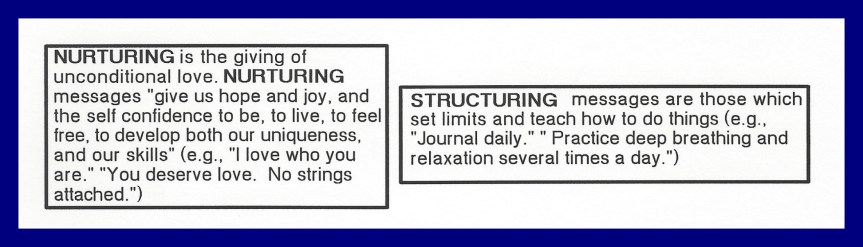
Suffering is created or enhanced by critical self-talk. An important step in ending suffering is to replace the negative critical messages with positive nurturing and/or structuring messages.

Source: Growing Up Again: Parenting Ourselves, Parenting Our Children.

Creating nurturing and structuring messages is a skill that takes practice. This lesson will focus on helping you to learn that skill by walking you through a multi-step process. At the end of the lesson you find a worksheet you can copy for future use.

EXAMPLE:

State the problem in one sentence:

I forgot to bring my children’s sack lunches when I drove them to the bus that would take them to summer camp.

What critical messages are you telling yourself?

1) Stupid! There were 300 children there and you were the ONLY parent who forgot her children’s lunches.
2) You are a terrible parent.
3) Why are you making such a big deal out of nothing? They won’t be allowed to go hungry.

Identify nurturing messages you can use to counteract the critical messages (messages that are gentle, caring, supportive, and unconditional).

1) You do care for your children and they know it.
2) You are a good parent even though you make mistakes.
3) It is highly unlikely that you were the only parent who forgot their child’s lunch.
4) It is important for your children to know that you make mistakes. When they see you make a mistake, they learn that it is okay for them to make mistakes.
5) You were feeling very sad because your friend Jean was leaving today and you won’t see her for a very long time. It is understandable that you didn’t remember everything.

Identify structuring messages you can use to counteract the critical messages (messages that set limits, show how and give options. 

1) Talk to the camp counselors. Tell them what happened and ask if they have arrangements for children who come without lunches.
2) Tell your children that you forgot the food and have them help brainstorm solutions.
3) Check and see if there is time for you to go to a convenience store and buy them some lunch. Continue reading “Letting Go of Suffering- Week Eleven: Stopping the Critical Self Talk”

Living and Learning in Amritapuri, India: Wrapping Up (Jan 2017)

12512718_10153228699456805_4784682354021587162_n

Every year, as my trip to Amritapuri is winding down I think of a statement I read decades ago in a book by Malidoma, an African shaman who lives most of the year in the U.S. In the book, Of Water and the Spirit, Malidoma commented that he goes to Africa every year to learn from his elders and detox from Western civilization.

I resonated with that statement when I first read it, and I still do. For me, being with Amma, especially in India, is like taking a vacuum cleaner to my whole system. While the living and learning experiences may be difficult at times, I always see my growth when I return to Seattle. I am softer, healthier, and more able to handle the challenges that life sends my way.

When I went to India the first time, I loved it. In fact, during my first three visits, I cried every time I thought about leaving. Then there was a period, that lasted for at least five years, when I had a love-hate relationship with India. The heat and the never ending physical and emotional challenges were difficult for me to cope with. I felt on overload most of the time. Even then, though, I had a deep internal sense that it was very important for me to take that annual trip. I often used the metaphor, to myself and others, that it was like going to a doctor knowing the treatment would be painful.

Thankfully, that period passed, and for a long time now I have eagerly anticipated my yearly trip. I know that every visit will be filled with learning and adventure and that the challenges that come to me will help me grow.

It is my experience that being with Amma, whether it is in India or the U.S., increases the frequency and intensity of the life lessons that come my way, along with the ability to work through them at a faster rate. When I’m in the middle of an emotional roller coaster, the growly declaration that “this is going to be the last time I’m going to do this” inevitably goes through my mind. At least now I know that the thought is just a thought, and it will pass. I fully believe that it is important for me to continue going to Amritapuri each year, and that those visits will cleanse my mind and body, and feed my soul.

As I was preparing to leave Amritapuri this year, it occurred to me that once I retire I can go to the ashram whenever I want to go, and stay as long as I want to stay.

I almost always travel to Amritapuri in November and December, the busiest time of the year; a time when my son and daughter’s lives are filled with creating the Christmas play on top of their regular seva responsibilities. While I love seeing the play and being involved in play preparation, I am also faced with the reality that I can’t spend as much time with my adult children as I want to. When I retire, will I go to India at a different time of the year? Am I willing to miss the play in order to spend more time with my kids? Will I go earlier and stay longer? Will I go twice a year even though that would mean facing jet lag twice? I know those questions will be answered as my life unfolds.

For the last few years, I have felt an increasing desire to do panchakarma, an Ayurvedic therapy that provides deep cleansing and detoxification. Panchakarma was one of those things that I used to say I would “Never” do, but since I discovered that my high blood pressure and high cholesterol would eliminate several of the procedures I’m resistant to doing, I have felt more inclined to consider it. I have no doubt that the treatments would be in my best interest and the people I know who have done it have loved it. Maybe I would too.

If I do panchakarma, I would want to do it in Amritapuri, but I’m still resistant. I know the protocol involves staying out of the sun, rain, and wind and that I would be expected to keep the fan off in my room and to avoid other places with fans. That’s a big deal, considering I’d be in India. I also would be expected to refrain from doing seva, napping, writing, or reading. There are many dietary restrictions as well. Am I willing to make those commitments for most or all of my trip?

My biggest resistance is to the activity restrictions. As an over-doer I am stumped by how I would fill my time if I avoided doing all of the items on that list. Am I willing to give up blogging, working in the gardens, taking Tai Chi, and the other things I love doing in Amritapuri? What WOULD I do? Would I spend those weeks staring at a wall?

No doubt, I would be confronting all the garbage that is inside my mind. I would also be confronting my reluctance to simply “BE.” Am I willing to do that?

So, as I wrap up this year’s trip to Amritapuri, my mind is filled with questions. It is also filled with gratitude for all I experienced on this trip, and excitement as I look forward to discovering where the next steps in my life will take me.


Photo Credit: Amritapuri Facebook Page