I am recently retired psychotherapist who now spends much of my time working as a forest and habitat restoration volunteer.
For decades, I have focused much of my attention on watching for and learning the lessons life sends my way. I share my stories and reflections, both past and present, in my blog Living, Learning and Letting Go.
The day after our January 21 work party, I was taking photos of our work and was shocked to see a shovel propped up against the foundation of an old house that is in the middle of the site. I was particularly surprised to see the shovel there because all of the team leaders had been standing close-by that area at the end of the work party. If the shovel was present at that time, one of us would certainly have seen it and put it in the job box where our tools are stored.
The fact that the team leader who had gone through the site looking for tools later hadn’t seen it either added to the mystery. Where did it come from? Who had put it there?
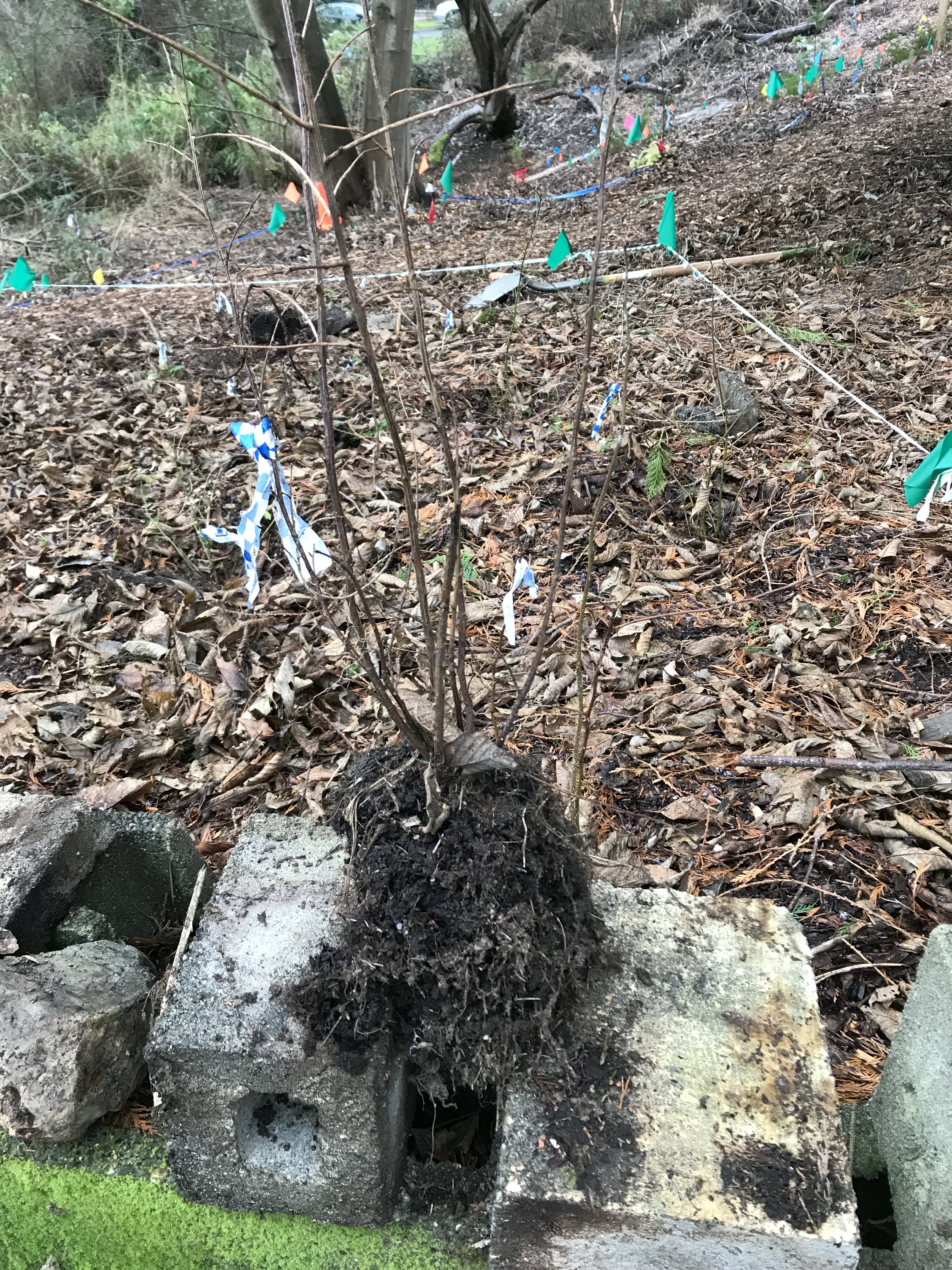
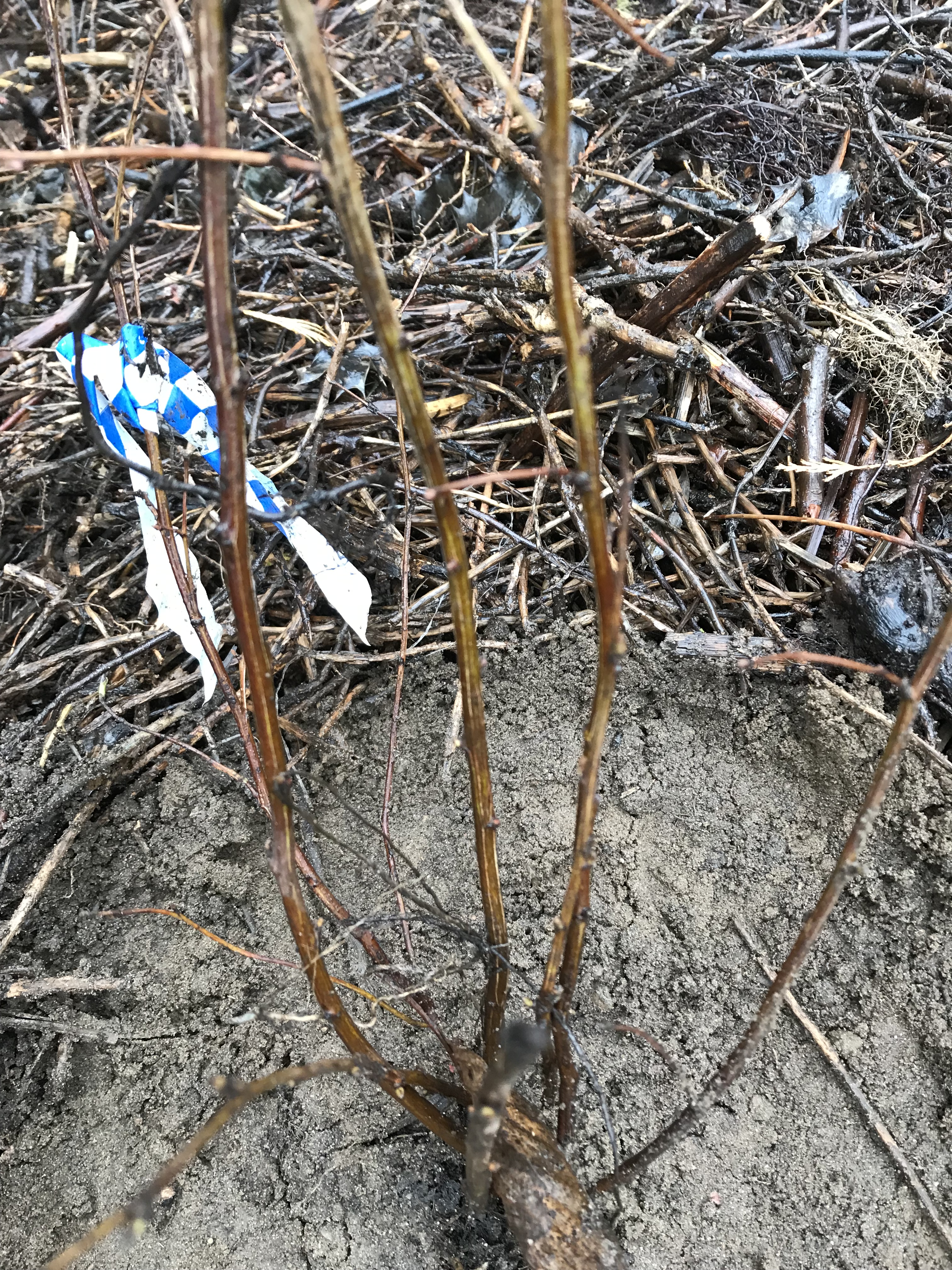
On January 23, I was shocked to see an un-potted plant sitting on the ledge not far from where the shovel had been. I hadn’t seen it the day before. Had it been sitting there when I found the shovel? I didn’t think so but I will never know.
I assumed someone had removed a plant from one of the planting areas. The mystery deepened when I couldn’t find any holes that had missing plants. Inside that foundation is the area we call The Rack Zone. Until the January 21 work party, it had contained drying racks for most of the invasive plants we had cut down or dug out since the project began. During the work party, some of the volunteers had taken apart the drying racks and spread the dried debris. We have planned to plant beautiful shrubs and ground covers in that area at some point in the future.
Had this shrub been in one of the racks that had been taken apart? That seemed unlikely, but I called the team leader who had been working on that project. He said, “NO” and that if he had seen it, he would have shown it to me.
It occurred to me that since there was no rational explanation for how the shovel and the plant got there, I should look for a non-rational explanation. The thought that came to my mind was that this was to be the first shrub to be planted in The Rack Zone.
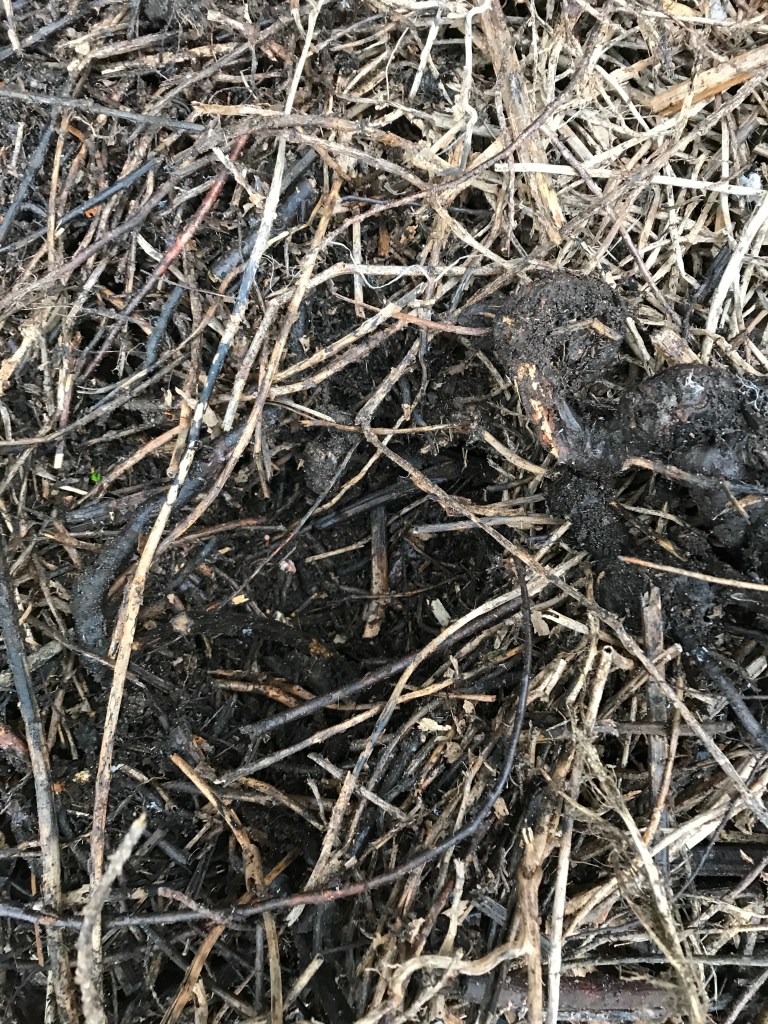
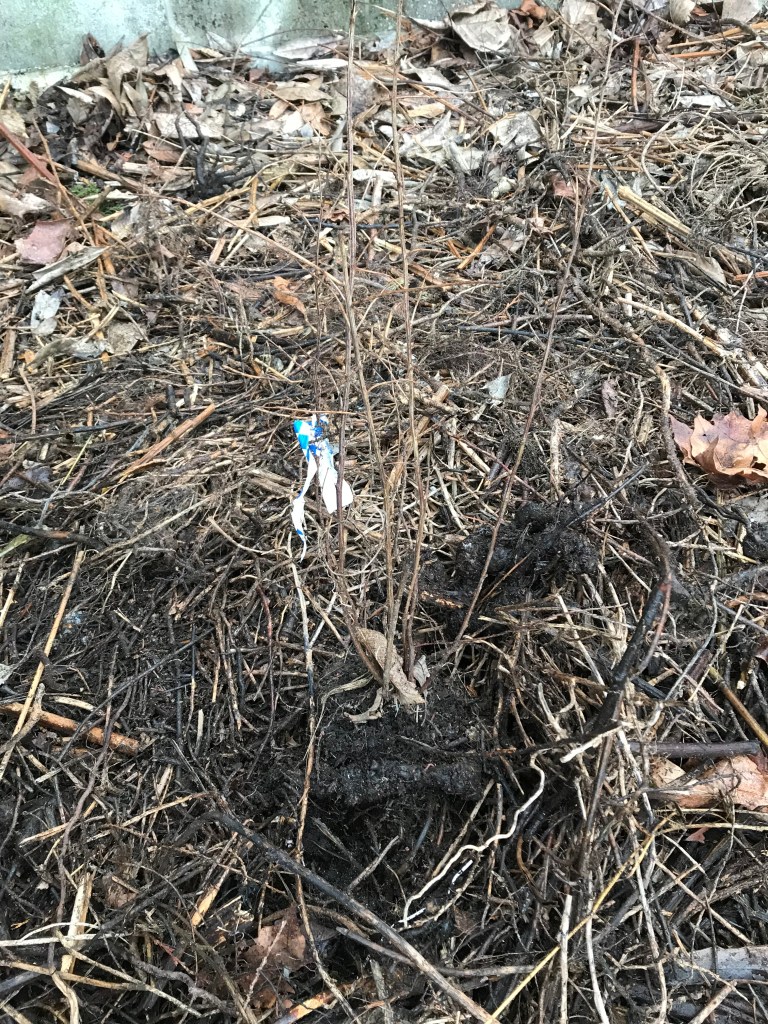
I walked into The Rack Zone and looked for an area where the new “ground” looked higher than the rest of it. Once I found a suitable place, I pulled back the surface debris that hadn’t fully decomposed to see whether there was composted dirt under it. There was, and it was deep enough to plant the shrub. I made the hole bigger and then inserted the shrub. I also made sure that there were no inter-twined ivy vines that would strangle it as it grew.
I needed more dirt to fill in the hole. After thinking about it for a moment, I remembered that I had seen mole mounds nearby. I also remembered a friend once helping me re-frame how I saw the moles in my own yard. She told me that the moles were providing me with free aeration for my soil. I decided to use the dirt from mole mounds for completing the planting process.
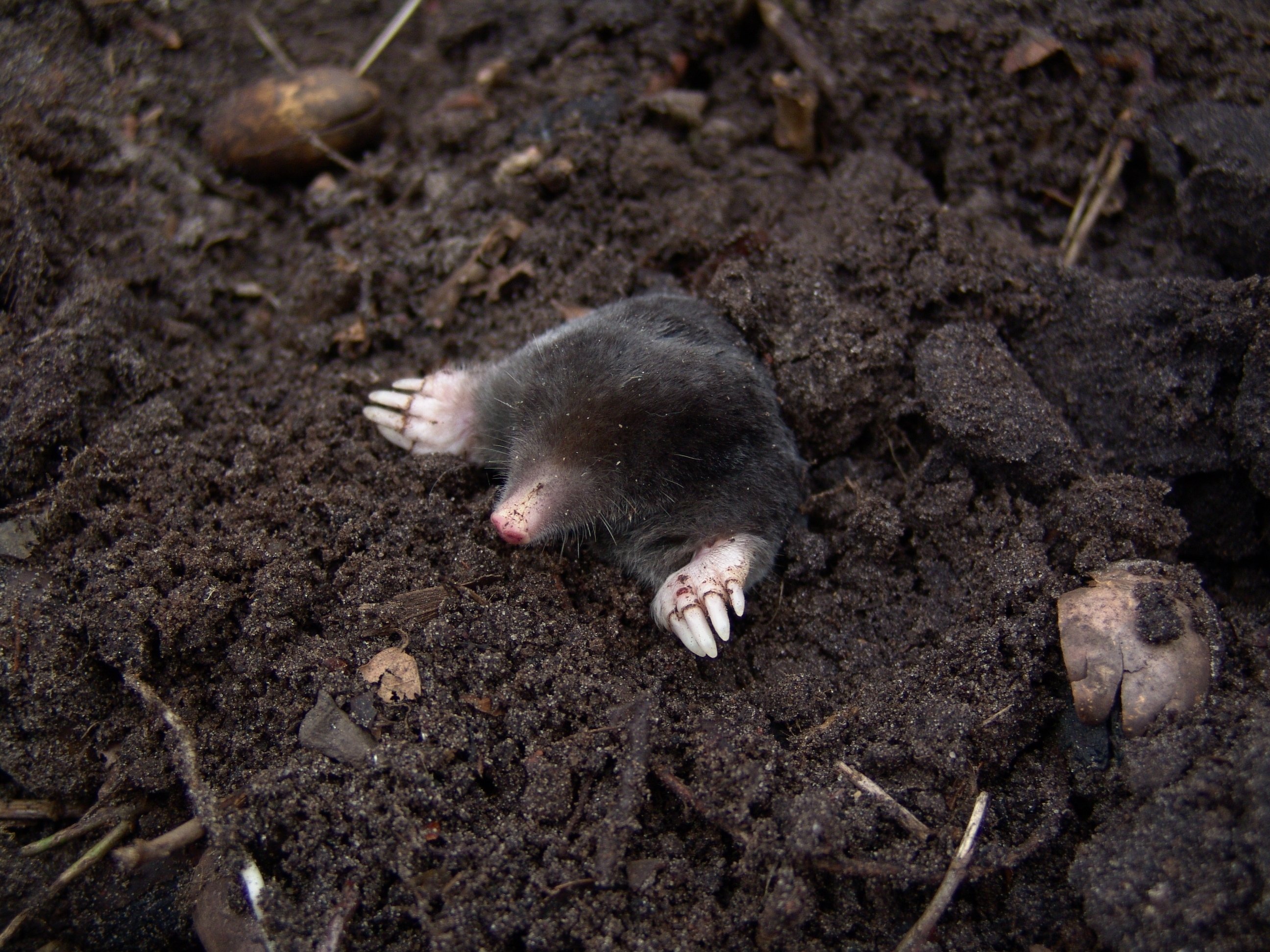
Another memory resurfaced when I was thinking about moles. Soon after we started this Greenbelt project, the person who was co-leading the project with me at the time, was sitting on the ledge of the foundation. A mole came out of the ground and looked up at her. While the photo below comes from pixabay.com, seeing it reminds me of that incident.
That shrub is now securely planted in its new home. It remains to be seen whether or not it is alive. There are no buds on it that look alive, but the branches are not brittle. Even though many of the Greenbelt plants are budding, it is only January. Maybe this is a plant that buds later. If it is living, our first shrub has been planted in The Rack Zone!
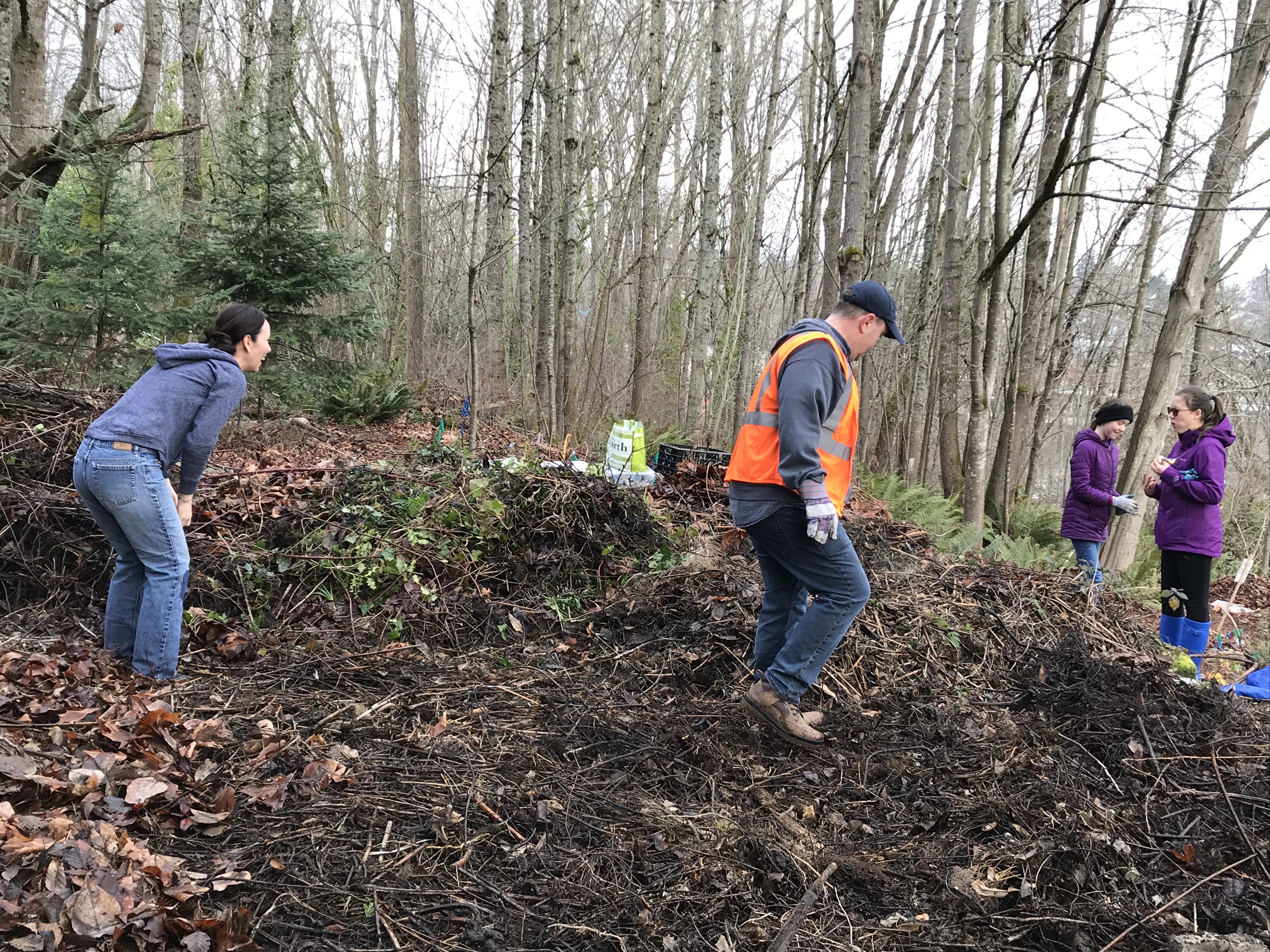
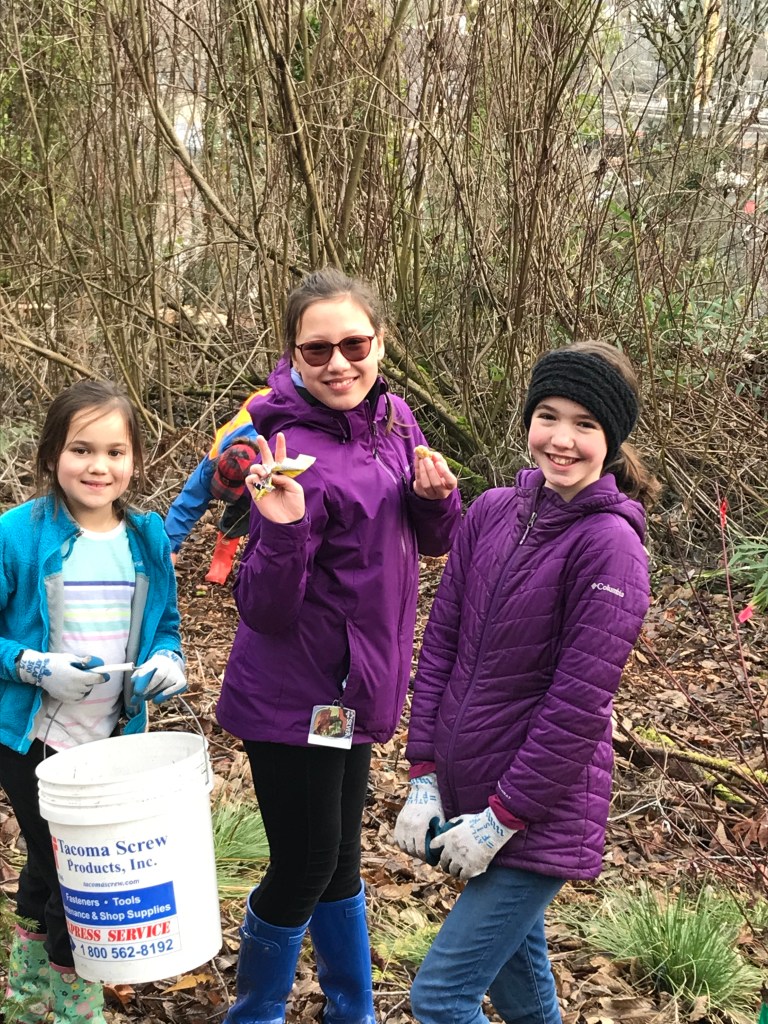
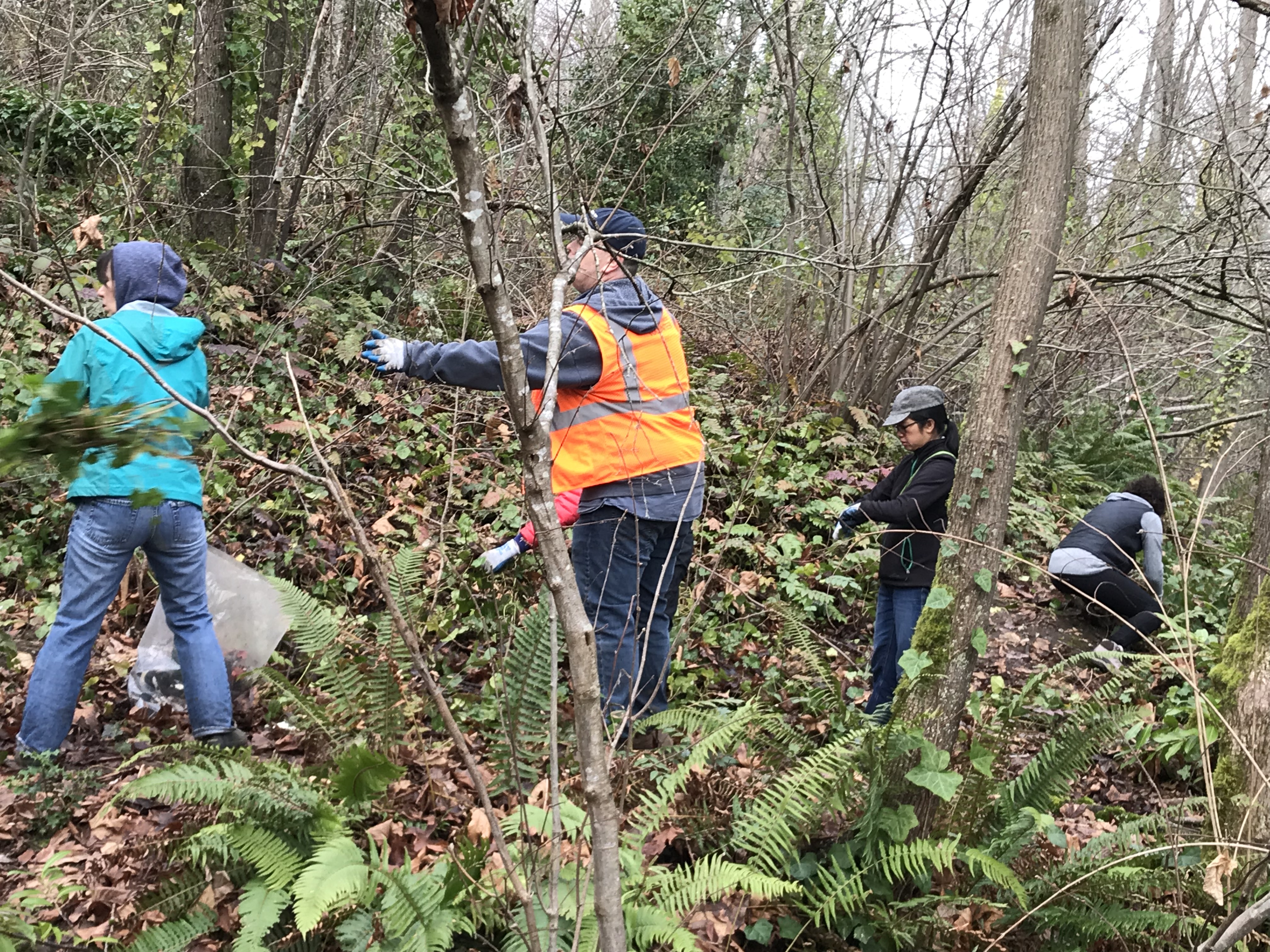
On January 21, twenty-two eager volunteers met to do forest restoration work in our North Beacon Hill Greenbelt site. Four of the volunteers were veterans of this project and served as team leaders. Most of the other volunteers found out about the work party from Green Seattle Partnership listings; two found out about it from one of the local or regional Amma newsletters. Three children between 6 and 8, a pre-teen (12 years) and a teenager (13 years) participated.
This work party was held on the Martin Luther King Jr. National Day of Service. When that holiday was being created his wife, Coretta Scott King, said it should be substantive as well as symbolic. Since his was a life of service, the holiday became a National Day of Service.
While I knew of Martin Luther King’s role in civil rights, I didn’t know that he inspired the environmental justice movement, a movement that believes everyone has the right to clean air, water, and soil, as well as a right to live in safe and healthy communities.
After receiving an initial orientation, the volunteers divided into four groups.
Group 1
One of the team leaders and three of the other volunteers started the process of taking down the racks in The Rack Zone. When we clear land of blackberry, ivy and bindweed vines, all of the cuttings and root balls are put onto racks so that they don’t touch the ground before they dry out. If the vines touch the ground, they may re-root. I refer to the invasive plants we have cut down or dug out as “debris”.
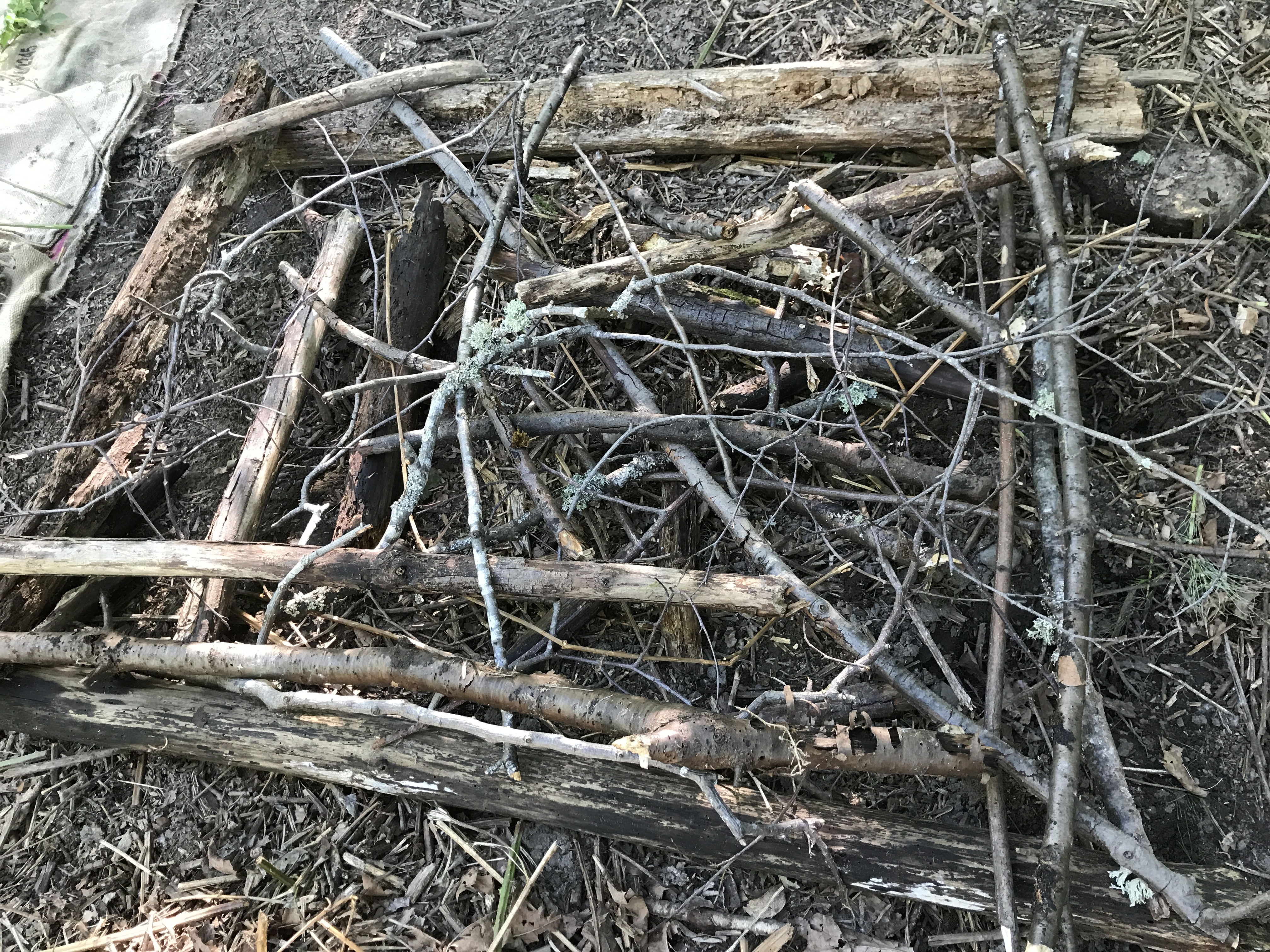
The racks are made from logs and branches. This is a photo of one of the racks we built early on.
In most parks, racks are scattered throughout a site, but since we had a house foundation on the property, we decided to put most of the racks there. The concrete slab that was under the foundation would also prevent re-rooting. We named that area The Rack Zone.
Our plan was to let all of invasive plant cuttings dry out and decompose. In that way good dirt would build up and we could plant beautiful flowering shrubs in that area.
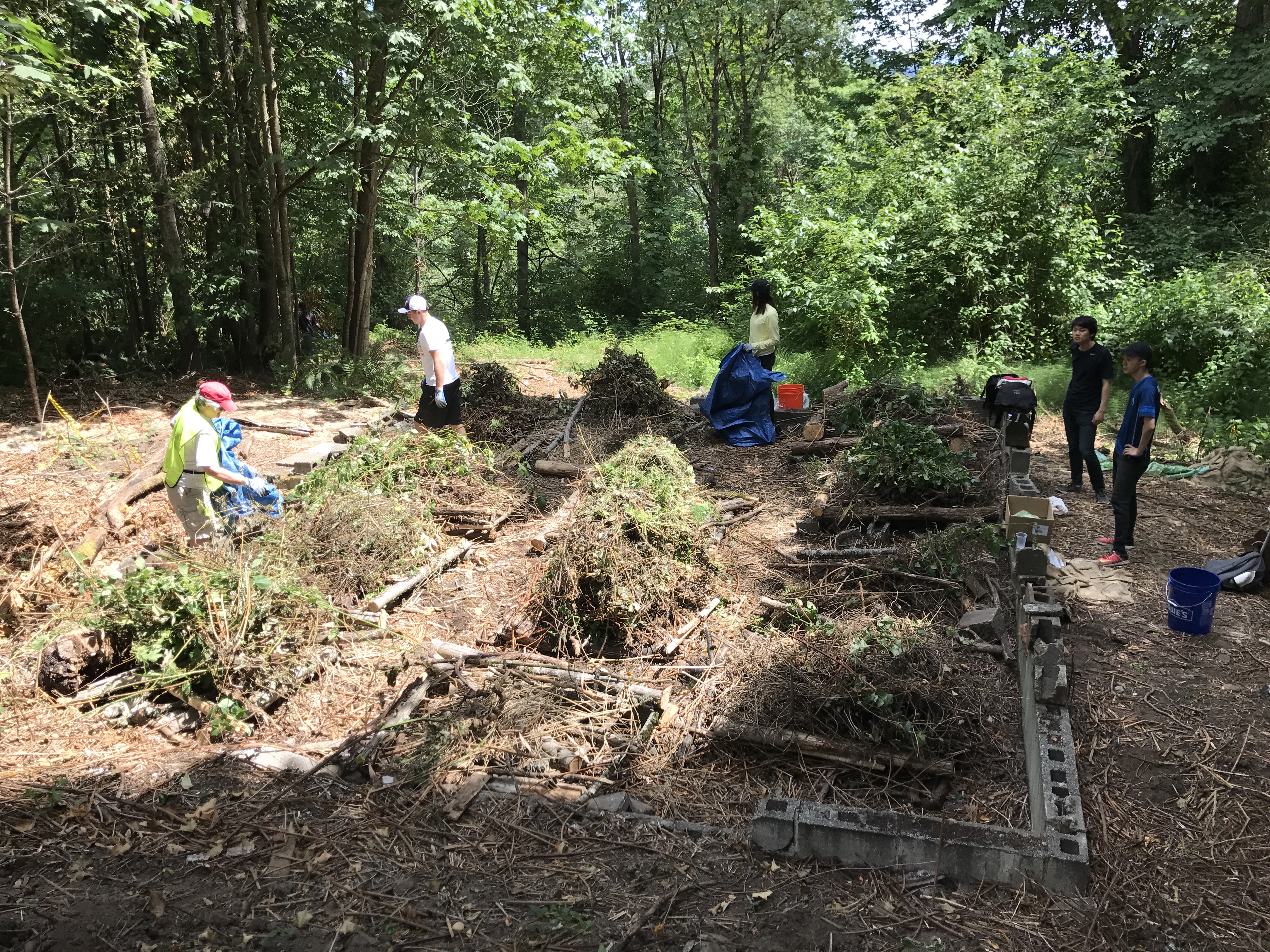
This was what The Rack Zone looked like in July of 2017, several months after we started using it. You can see that under the new cuttings there is a lot of debris that is becoming dry. There are at least two racks in the photo that have been used yet.
In January of 2018, we took most of the racks apart but didn’t spread the debris; we just built new racks on top it. During 2018, the new racks became filled and overflowing. We would start the process of taking them down completely at this work party.
I thought that would be a long process since what taking them apart the previous year had taken a long time. I thought that these volunteers would disassemble one to three racks during the first portion of the work party. That process would include separating the dried debris from the debris that was still living, taking out any logs or branches that were too big to readily decompose, and spread the debris that was dry.
When I checked on the group later, I was astounded by what they had already accomplished.
By the end of that segment of the work party, they had finished taking apart all but three of the racks!
We still have to figure out what to do with all the branches and logs that were too big to spread in this future planting area. Right now they are stacked on the north and south sides of The Rack Zone. In addition, there was a lot of broken concrete under the racks. Those are stacked on the ledge of the foundation and will also need to be moved to some yet unknown location.
Groups 2 and 3
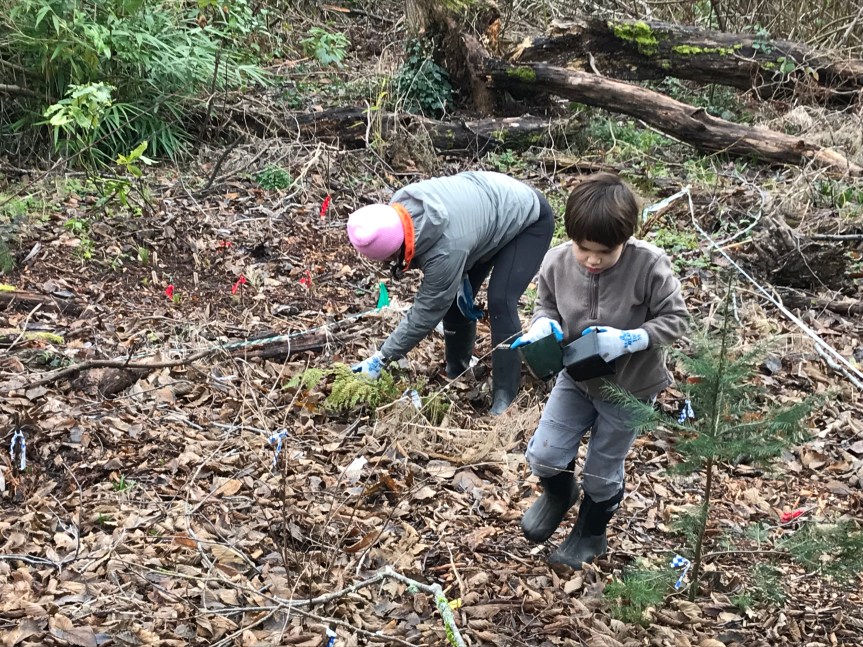
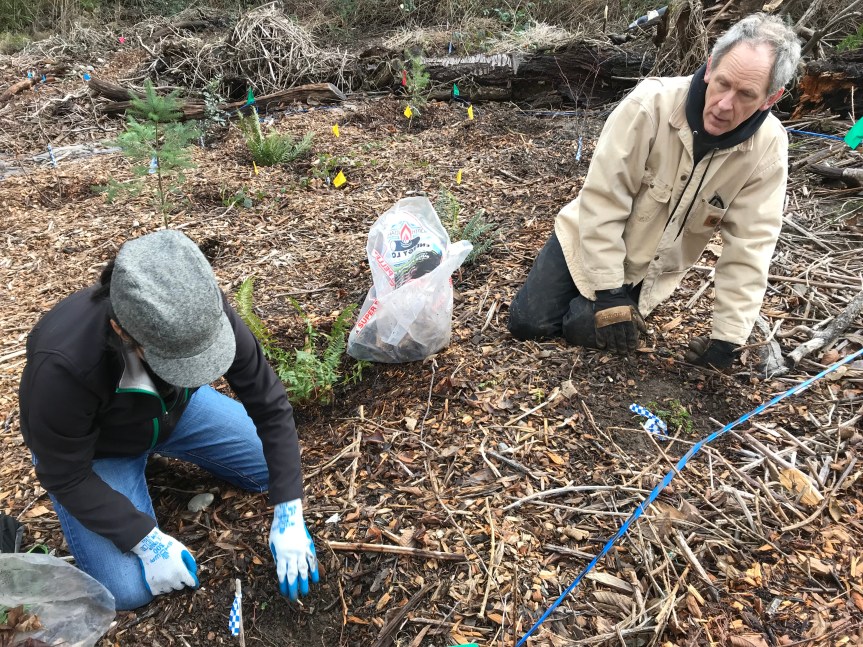
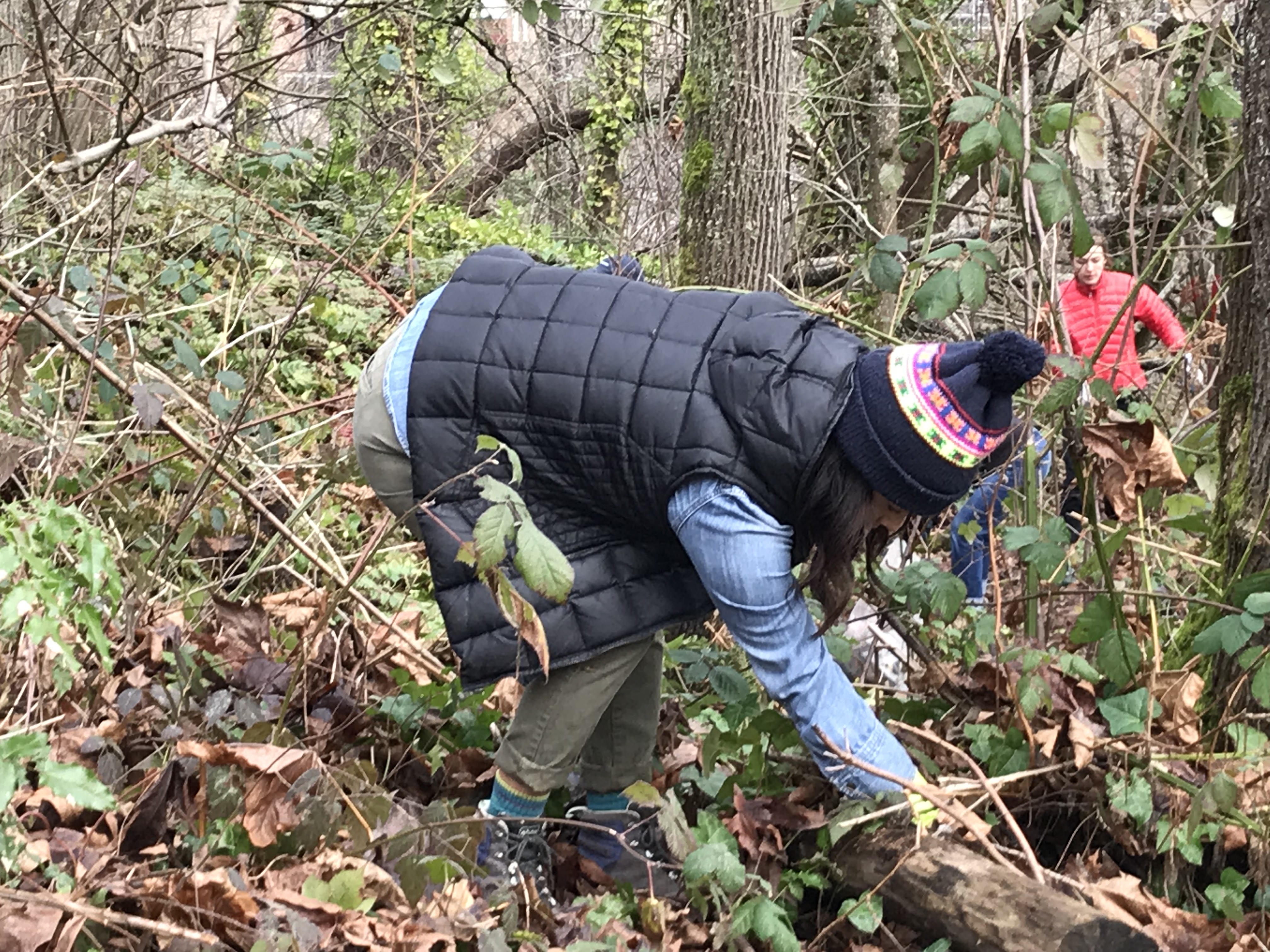
Two groups worked in the planting areas, clearing out leaves and wood chips from around each plant. We refer that area as a donut hole. In addition, some members of those groups cleared branches that had fallen onto the paths during the winter winds and/or carried buckets of leaves to the newly cleared areas of The Rack Zone. Once there, they will decompose and become part of the composted soil.
The groups cleared the donut holes in most of the site. Each area looked so nice when they finished.
Group 4
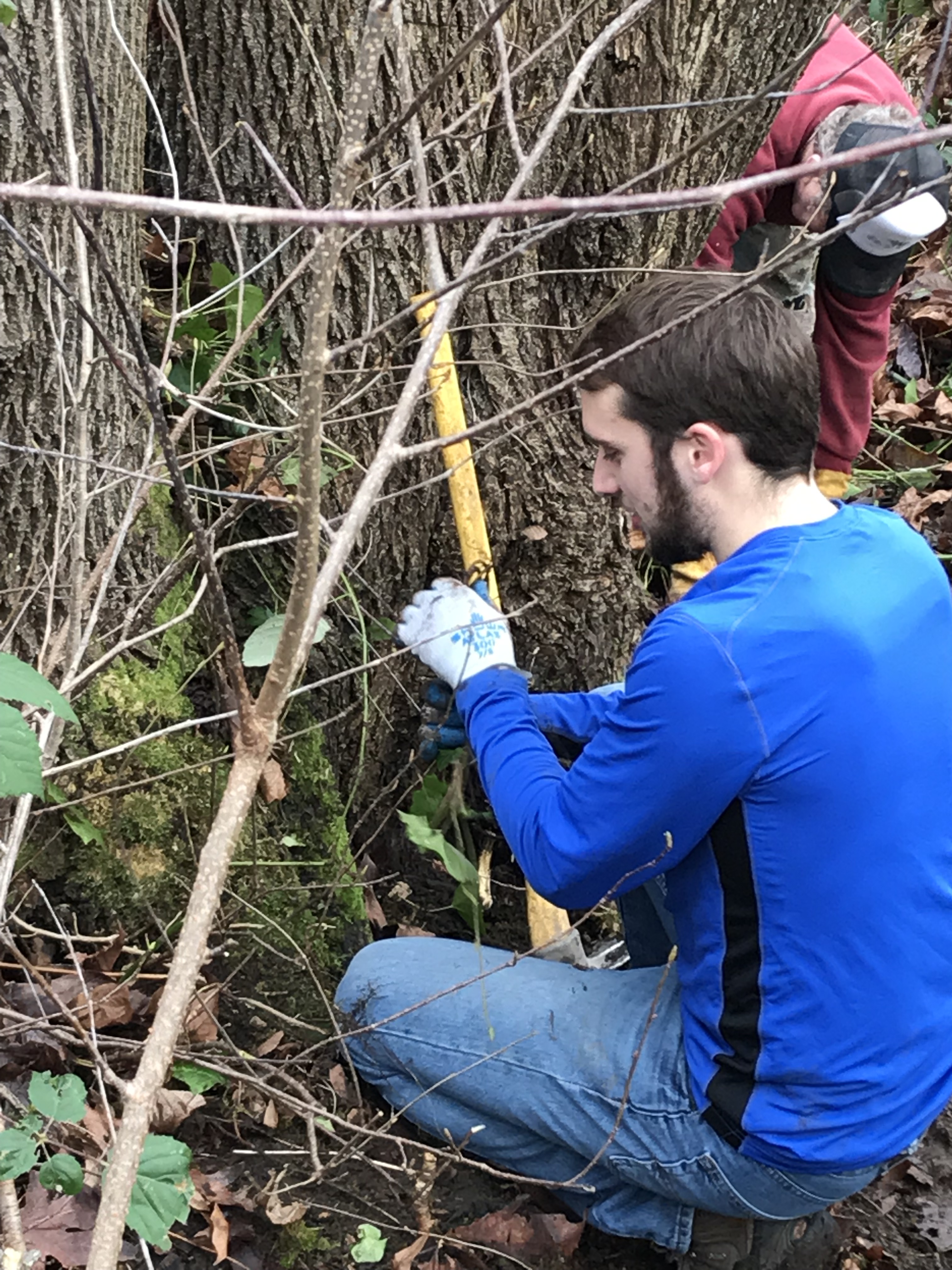
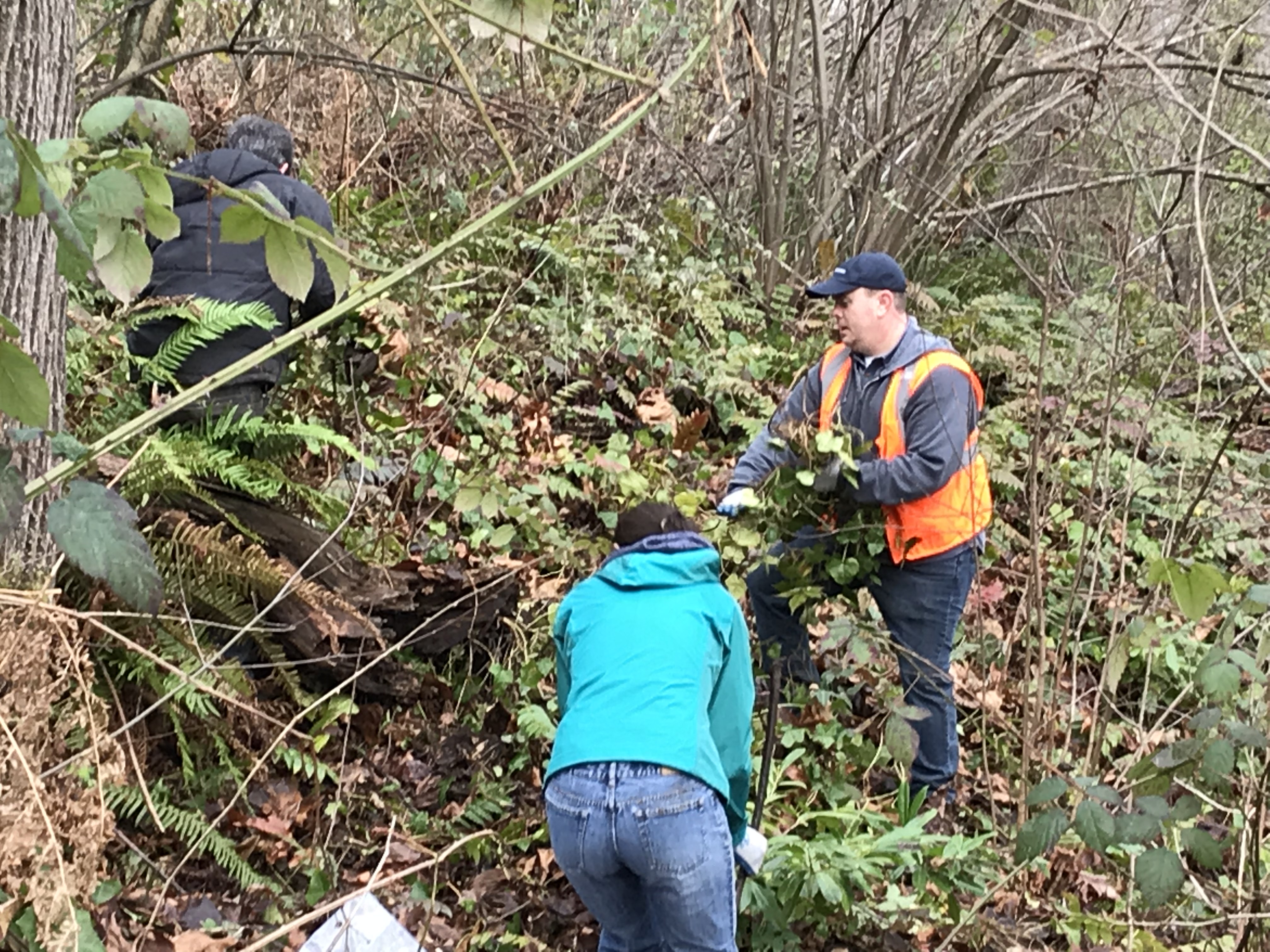
Another team leader and a volunteer began to clear an area that was full of blackberry vines and ivy.
This is part of what that area looked like by the time the work party ended.
The work party had begun at 10 a.m. At 11:30 a.m. we took a short snack break. Before we went back to work, we gathered for a group photo. While we took some serious photos, the one that I loved most was a funny one.
The parents with young children planned to go home early, and did. Most of the remaining volunteers moved to the Greenbelt site that is on the north side of the Hanford Stairs; our main site is south of the stairs. I have been eager to start restoration work in that area.
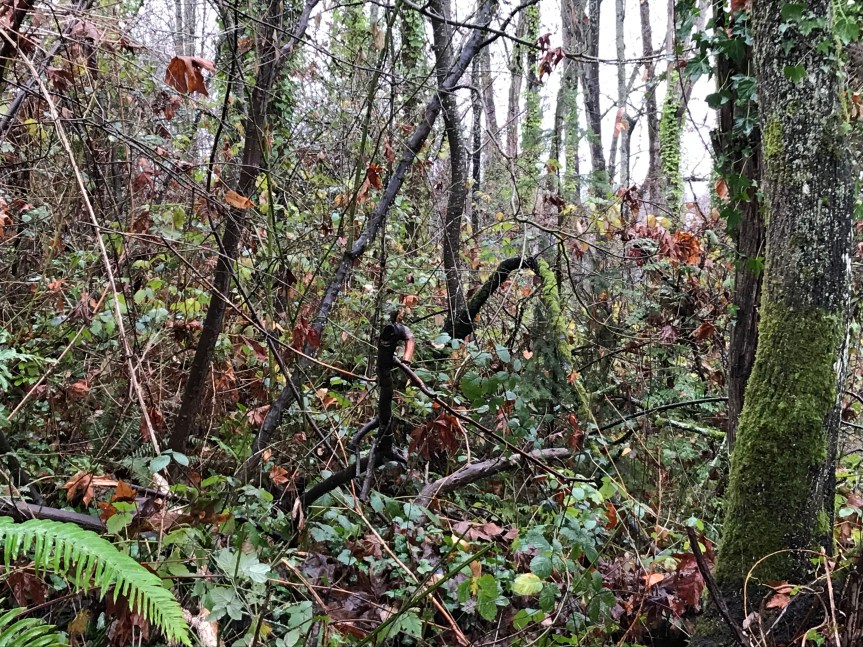
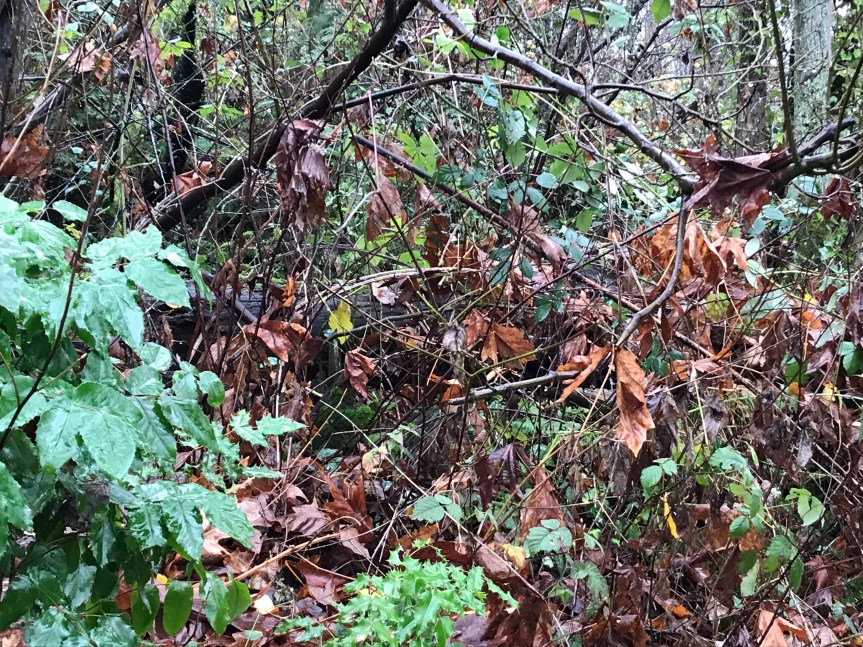
This is what that that land looked like in December 2018.
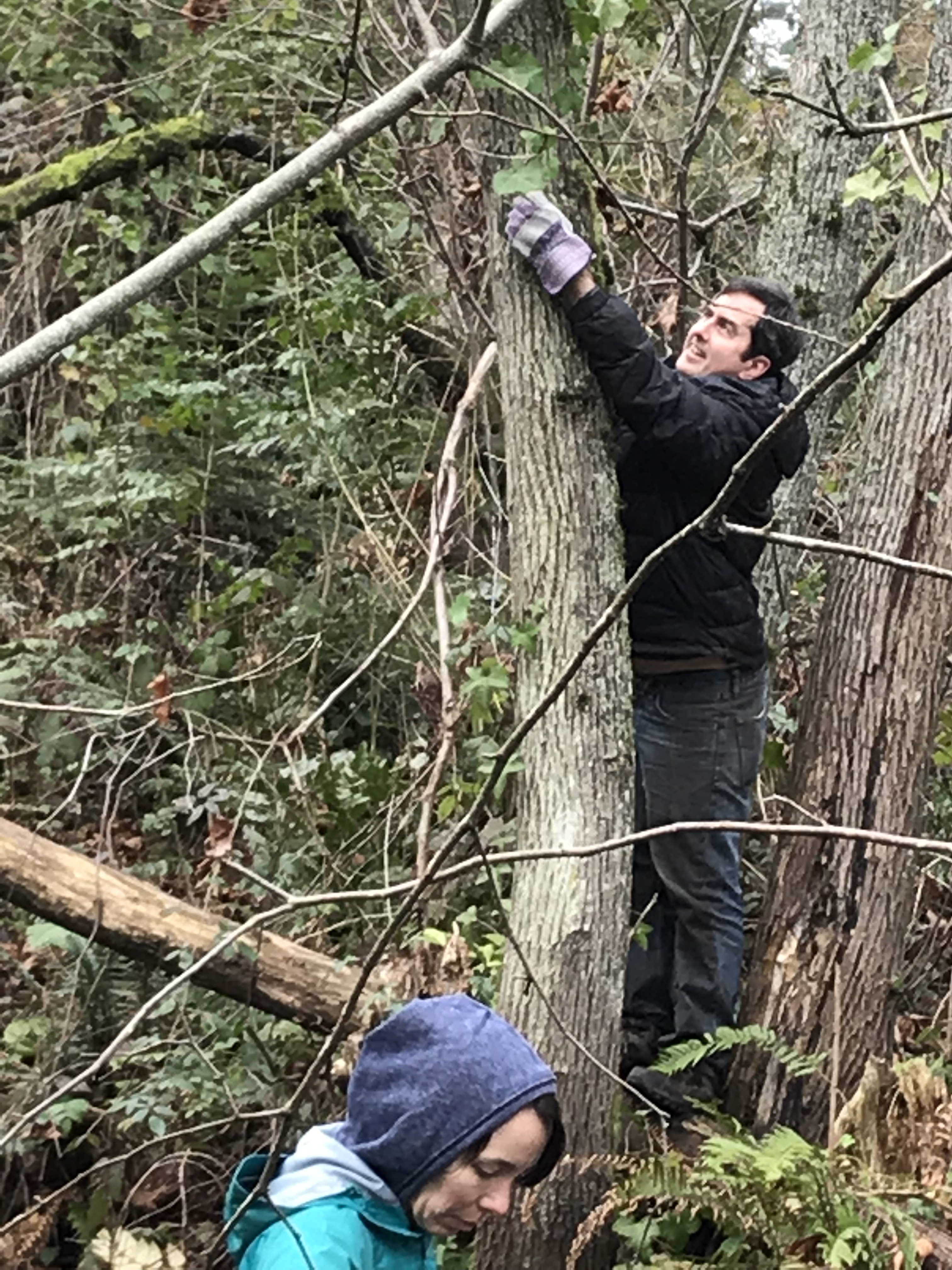
January 21, 2019 work party photos:
This photo was taken after we finished that day.
The volunteers had removed a lot of trash and ivy.
It always amazes me how much can be accomplished during a three-hour work party. The land always looks substantially different when the volunteers leave, after having given freely of their time and their energy. Together we are helping this part of Seattle’s Greenbelt to once again become a healthy forest.
If you live in the Seattle area and would like to help with a future work party, write hanfordstairsgreenbelt@gmail.com.
Someone recently took a video of Sreejit cooking during Amma’s South India tour. I thought you might find it interesting to have a glimpse of what it’s like to cook for such a large crowd. When he saw this post, he commented that the pot in the video is their smallest pot!
(To see the full screen version of the video, click on the icon that’s in the bottom right corner.)
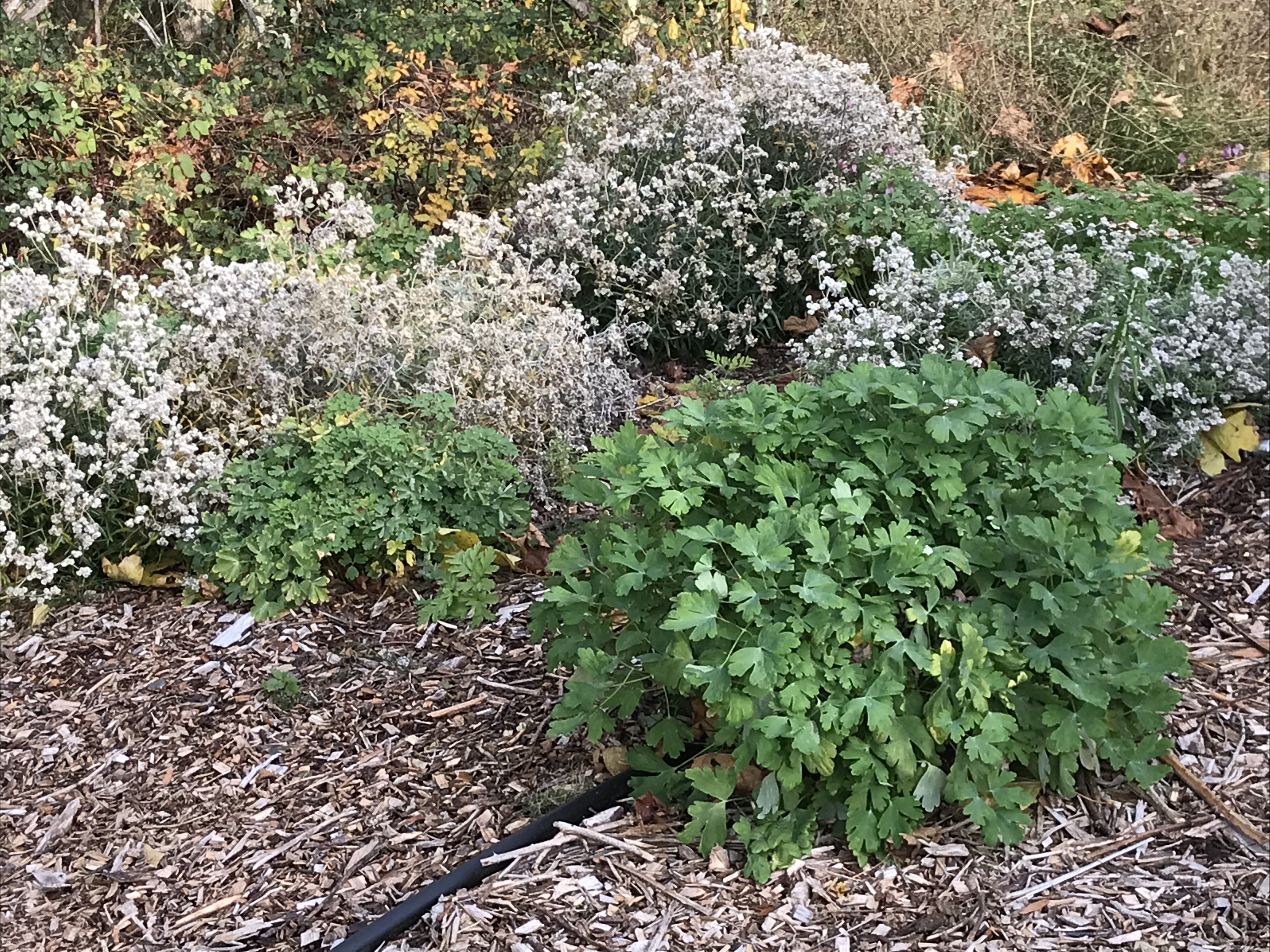
In November of 2017, I took a Wetlands Best Practices workshop that was offered by Green Seattle Partnership and held in Seattle’s Discovery Park. As we were about to leave the park, several shrubs covered in white flowers caught my eye. I asked the instructor about them and learned that they were called Pearly Everlasting. In that moment, I committed to myself to include that plant in my 2018 plant order.
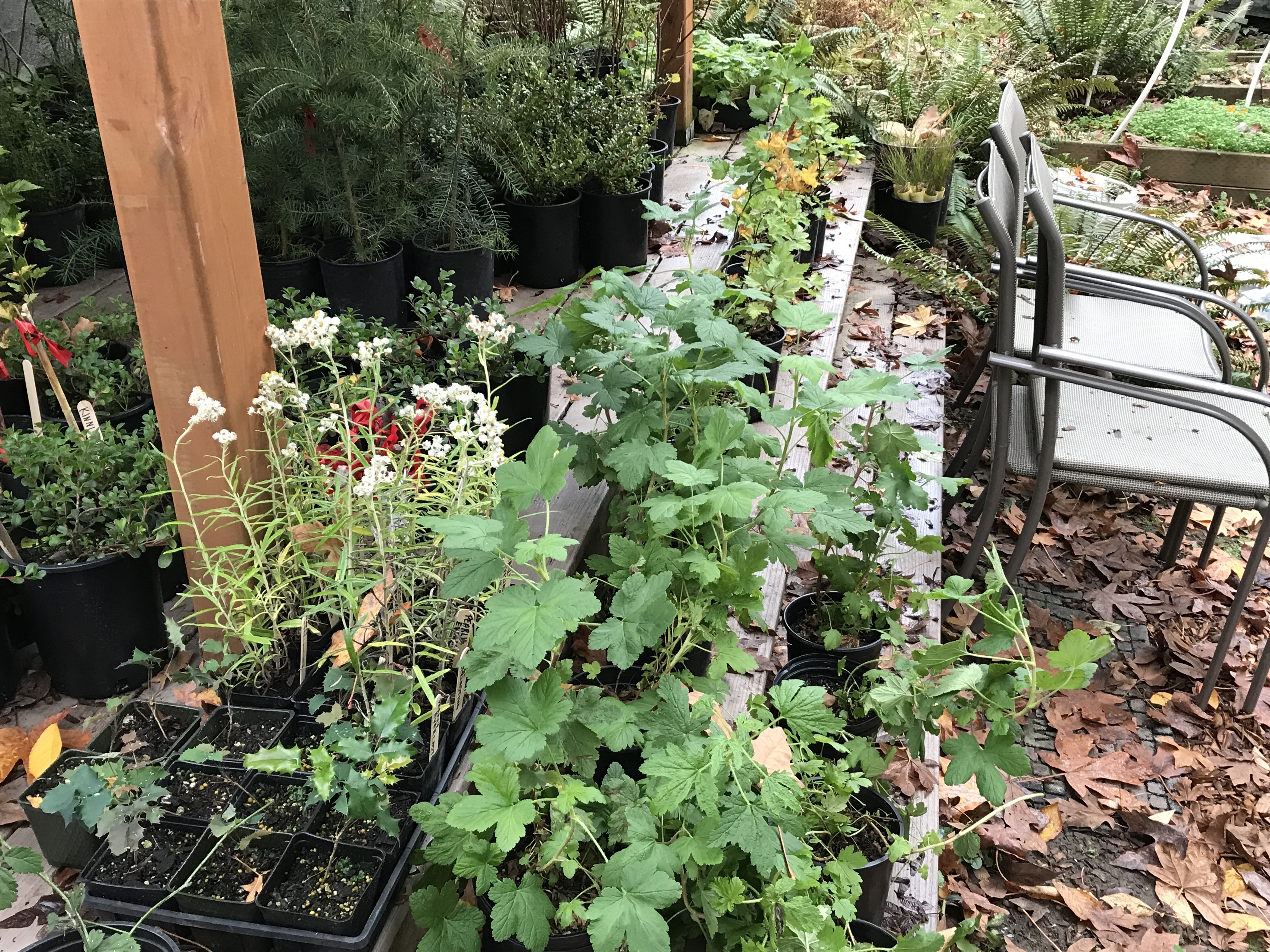
When the plants arrived at our forest restoration site in November of 2018, I was surprised by how small they were. In the photo below, there are ten Pearly Everlasting seedlings next to the deck post.
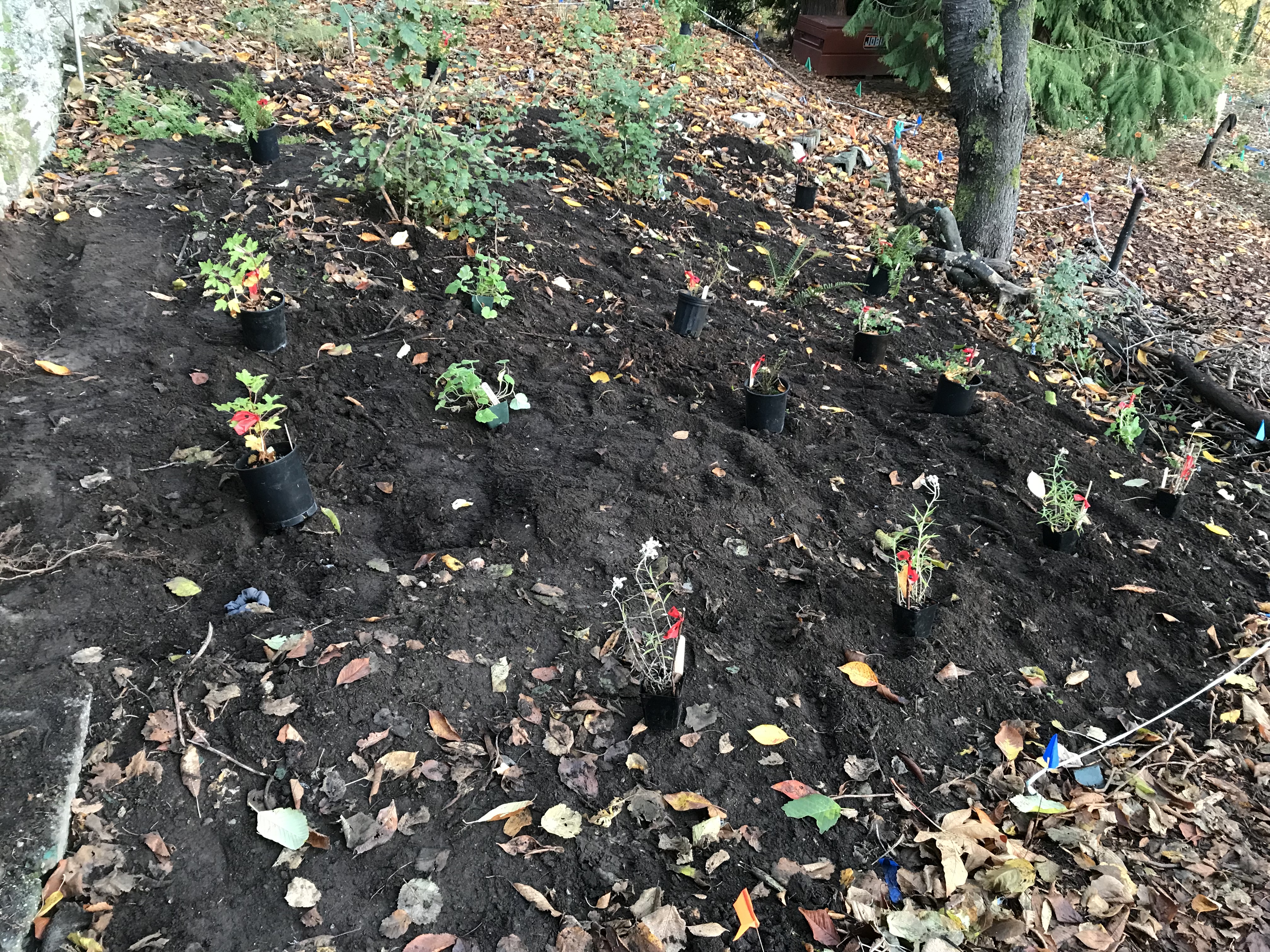
The Pearly Everlasting plants I saw in Discovery Park had been used as a border in hopes that they would keep park visitors on a trail rather than walking through vulnerable plants. I decided to try that rationale in our site too. Four of the Pearly Everlasting plants, still in their pots, are in the forefront of the photo below.
Most of the Pearly Everlasting plants seemed to wither and dry up soon after we planted them. I wondered if we were going to lose them. I don’t have photos from back then, but this is what they look like now.
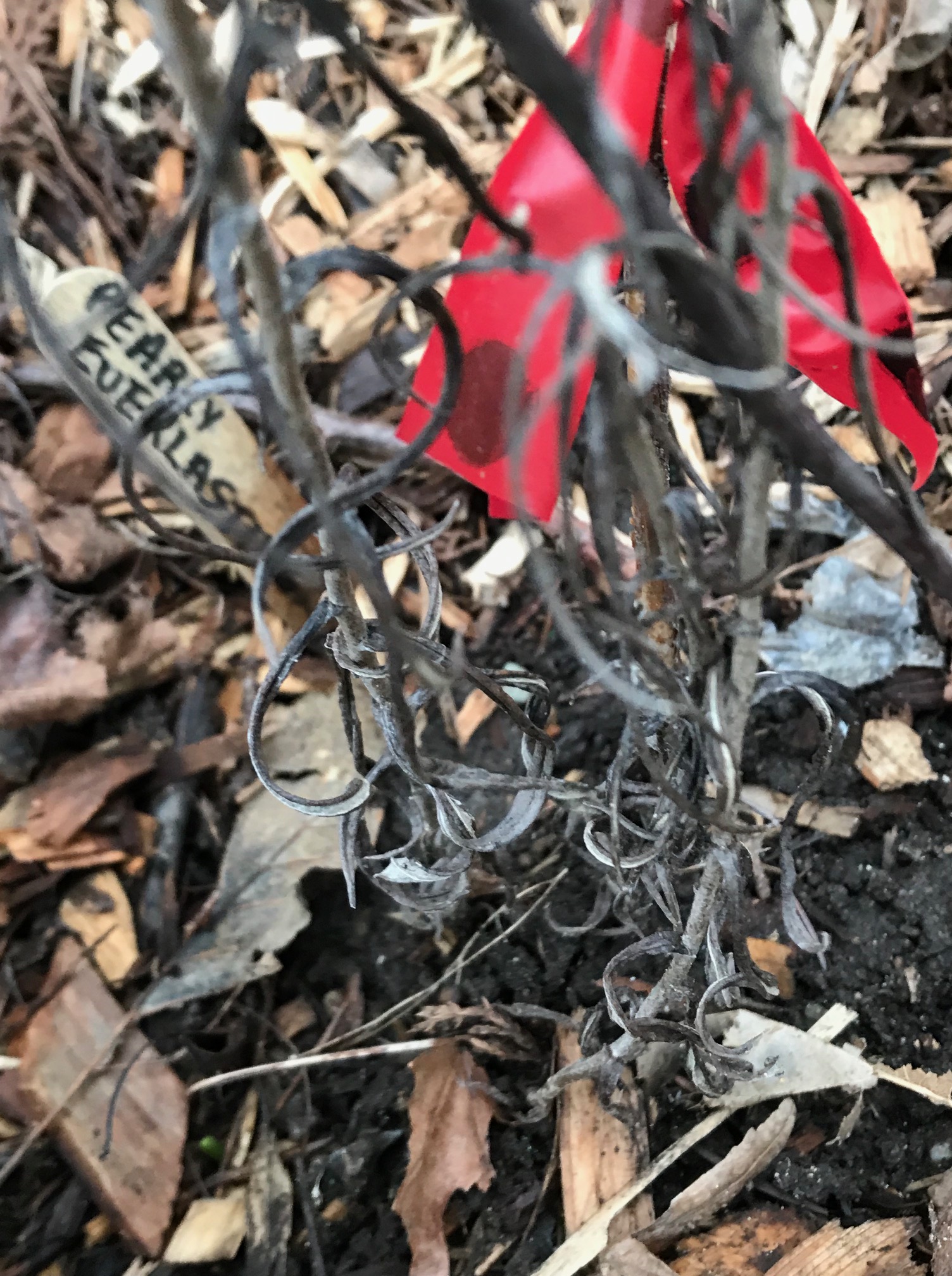
Two weeks ago, I moved the leaves from around the base of one of the plants and found a few shoots coming out of the ground near it.
I looked at the ground around that plant again on January 25th and this is what I saw!
I’m excited and eager to see how these shoots/shrubs change day to day, month to month, and year to year.
I have a list of posts waiting to be written. This will be a busy weekend for me but now seems like a good time to start!
Journey home
I left Amritapuri on the afternoon of January 12, the day before my international flight. If I had stayed in the ashram, I would have probably gone to bed late, slept poorly, arisen at 3 am, finished last minute tasks and then started the two-hour taxi ride to the airport sometime between 4:30 and 5 am. By spending the night in Kovalam, I was able to get a good night’s sleep and leave for the airport at 6:40 am. That trip took about 20 minutes.
Once there, the Emirates agent asked if I would like to have an upgrade to Business Class for $150. I was ecstatic. My excitement was short-lived however. I soon realized that the $150 fee was too good to be true and that he was talking about the leg of the trip between Trivandrum and Dubai. I wasn’t going to spend $150 for a four hour flight, especially since I had spent the previous night in a hotel, and would be spending the night in another hotel once I was in Dubai.
When I arrived in Dubai, I was met by a hotel staff member and taken to the Dubai International Airport Hotel. I was there for 19 hours, which allowed me to rest throughout the day and get another solid night’s sleep before the long journey back to Seattle. I love staying in that hotel. From the time you get into the elevator and the time you leave it, you are immersed in silence.
I can’t sleep on airplanes, so nothing can make the 14-hour leg of the journey easy, but having two nights of restful sleep helps. I watched two good documentaries. I don’t remember the first one at this point, but the second one was called Drowning in Plastic. If I remember right, it was a BBC production. Since I’ve been focusing on the world-wide plastic problem being able to see the documentary seemed synchronistic.
Eventually, I was in Seattle. The immigration and customs process was speedy and I even got my baggage quicker than normal. I ordered a Lyft “taxi” and was soon on my way to Seattle. Before long, I was in my house!
Challenge after challenge
The last time I stayed two nights in hotels on my way home, my reentry was much easier than it has been in the past. Amritapuri is 13 ½ hours ahead of Seattle, so nothing can make the transition easy but the time in the hotels at least helped. If it helped this time, it wasn’t obvious. I’ve been back for 12 days and sleeping has been an ongoing problem. I slept almost 7 hours last night though, so maybe that problem is almost over.
The other thing that has been different this time is that I’ve
experienced challenge after challenge. They started almost immediately. The
ones I’m remembering now are:
When I drove my car for the first time, there was a several inch crack in the windshield. It immediately grew to 9 inches.
When I drove my car for the second time, the crack grew to 5 feet.
The lights and fan in my bathroom went out soon after I got home. The circuit breaker hadn’t tripped. The electric company I chose had a diagnostic fee that was around $250. When the electrician came, he went to the downstairs bathroom and pushed the reset button. It reset the upstairs system as well. I knew the button would work if the problem was downstairs, but I had no idea that it would work in another room. I was frustrated that the company didn’t troubleshoot with potential customers over the phone.
I discovered that the 30 buckets we have in our forest restoration site were stolen.
Someone dumped all of the debris from cutting down a tree into an area of our restoration site that we had cleared. It had to have been a professional company because the debris was sorted and banded.
Someone dumped disgusting garbage along the street on the edge of the Greenbelt. The garbage was further scattered by rodents or animals. I reported it and then eventually picked it up.
My bathroom scale doesn’t work.
The physical therapy appointment I had made before my trip was canceled, and I had to wait a week to get another one.
There were more challenges but that is all I remember at the moment. I would guess my list is complete enough for you to get a sense of what my reentry has been like. Lack of sleep has been the hardest part of it.
The Good
Everything hasn’t been a downer though. There has been a lot
of good.
Since the electrician was in my house, I decided to spend a little more money and have him install an outlet in my kitchen that has two USB ports in it. I have wanted to do that for a long time.
I have been dealing with a carpet problem for about a year; carpet that was put in three years ago unraveled. That type of carpet was no longer available, so the company couldn’t patch it. That meant that they had to replace all of the carpet in the living room and dining room. The carpet was installed three days ago and it’s beautiful.
I hired a friend to move the furniture out of the area where the carpet was going to be installed. That gave me a chance to sort through the books in the book case and give away any I didn’t really want. He also cleaned and organized the big storage area under the stairs. (I’ve worked on that area from time to time, but wanted to do a deeper level of cleaning.) Many items went to Goodwill or the trash and the storage room looks beautiful.
There is a big maple tree in my back yard that has grown so big that it was covering part of my back deck. It also covered part of my neighbor’s house. I have worried that if a branch broke off, it would damage my neighbor’s roof. I had not done anything to that tree in the 45+ years I’ve lived here. That tree was pruned two days after my return. I received validation that it is a healthy tree and it now looks even more beautiful than ever.
We had a wonderful work party on Monday, the Martin Luther King National Day of Service, and many of the volunteers who participated want to come back! It was the first time we had opened one of our work parties up to children and that was a good experience too.
I’ve had numerous chances to work in the Greenbelt myself. Most of the plants are beginning to bud. I am so eager to see what the land looks like in Spring.
Replacing the car’s windshield was easy.
The Seattle Parks Department is going to take away the 10′ x 10’x 6′ pile of tree debris that was dumped into our restoration site. They will also replace the missing buckets.
I’ve almost finished the part of the February PNW GreenFriends newsletter that I am responsible for.
I went to Seattle Satsang last Saturday and will be going to satsang activities today and tomorrow. One of my goals for this year is to once again get more involved with this group. I’m off to a good start.
I had a physical therapy appointment yesterday. While I still am having problems related to shoulder, neck and ribs, I was pleased to discover I had made progress during the time I was in India.
There have been more good experiences too, but that is enough for now. So, to summarize, it has been a difficult reentry, but all is well.
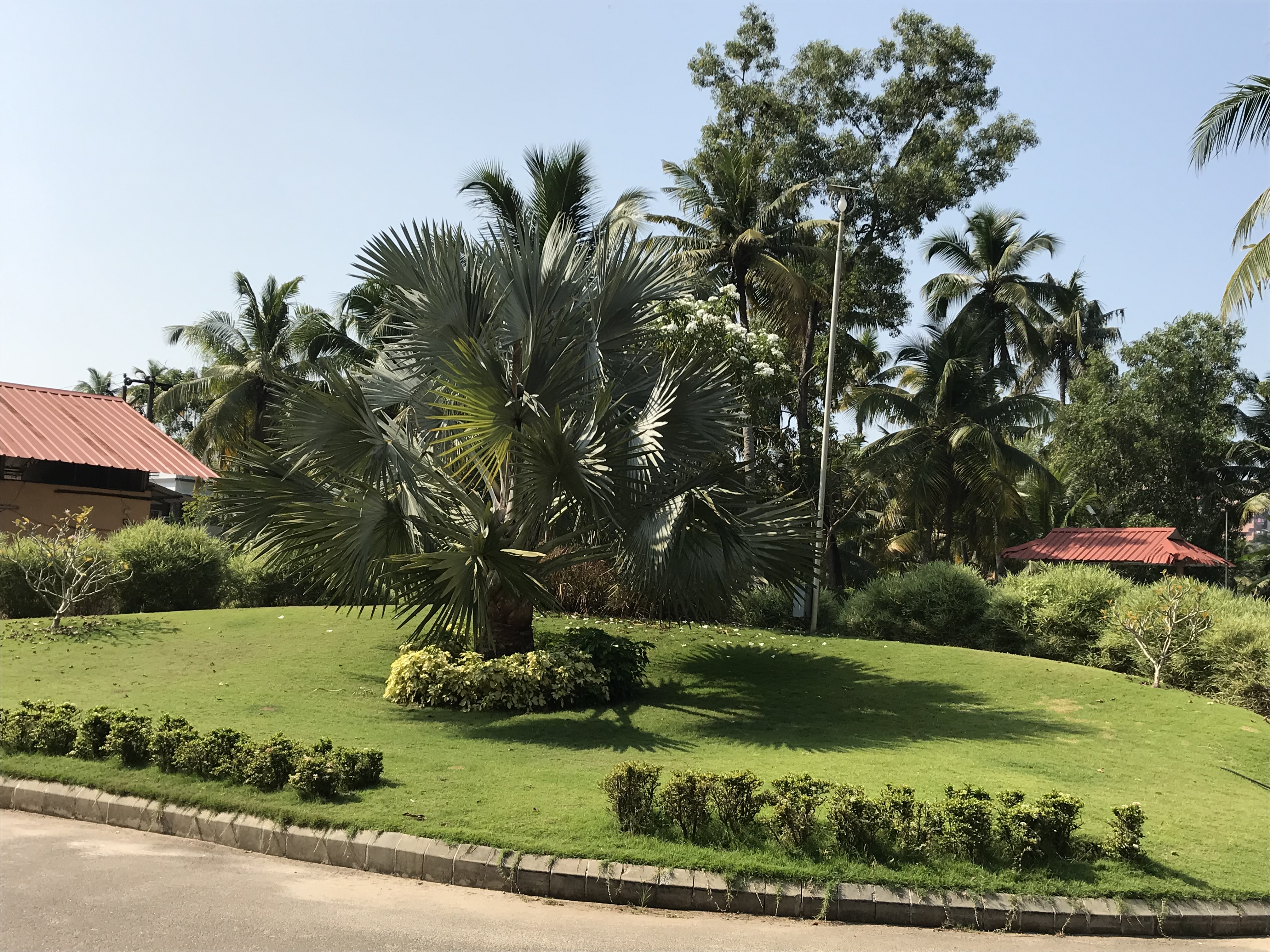
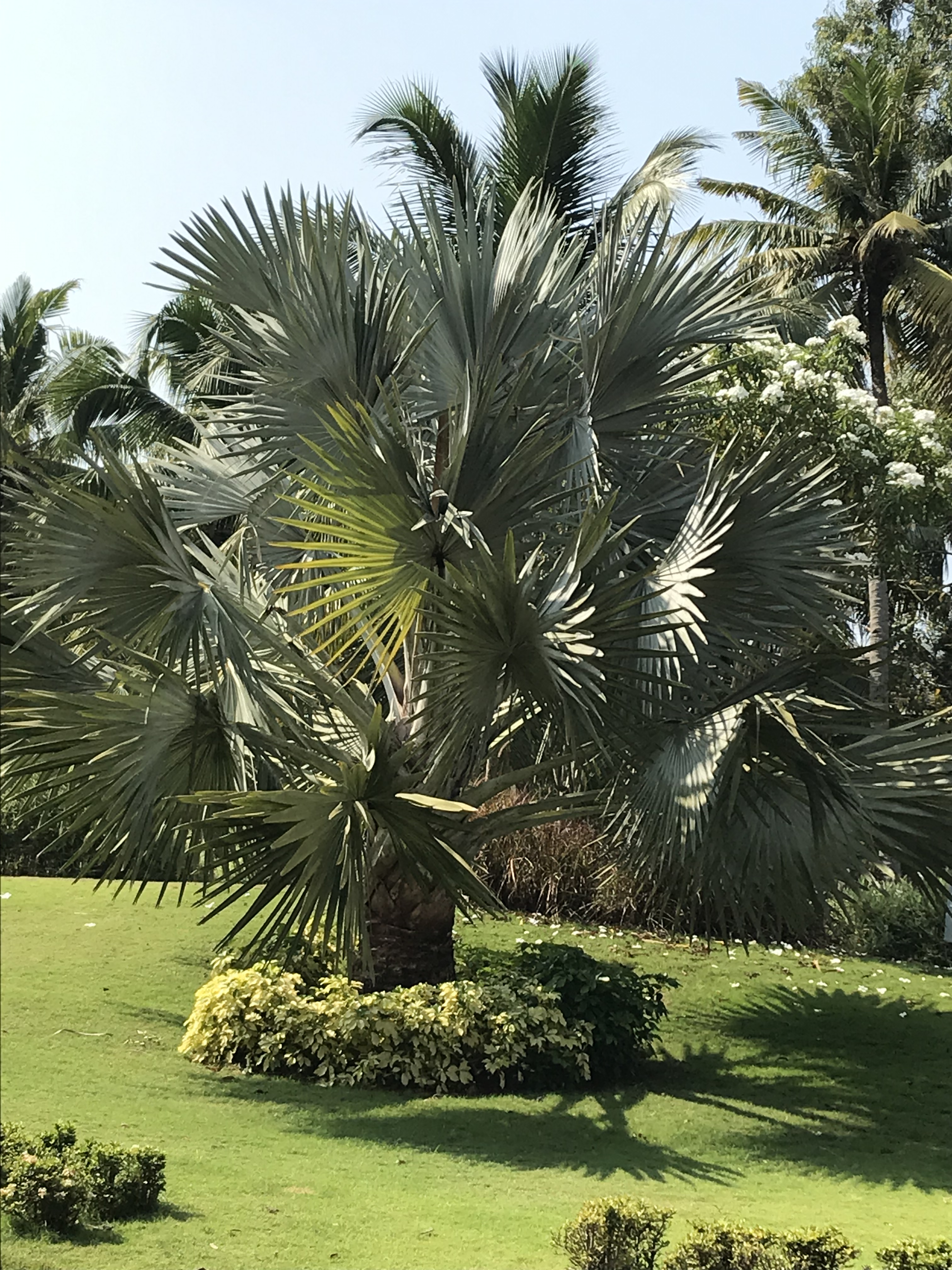
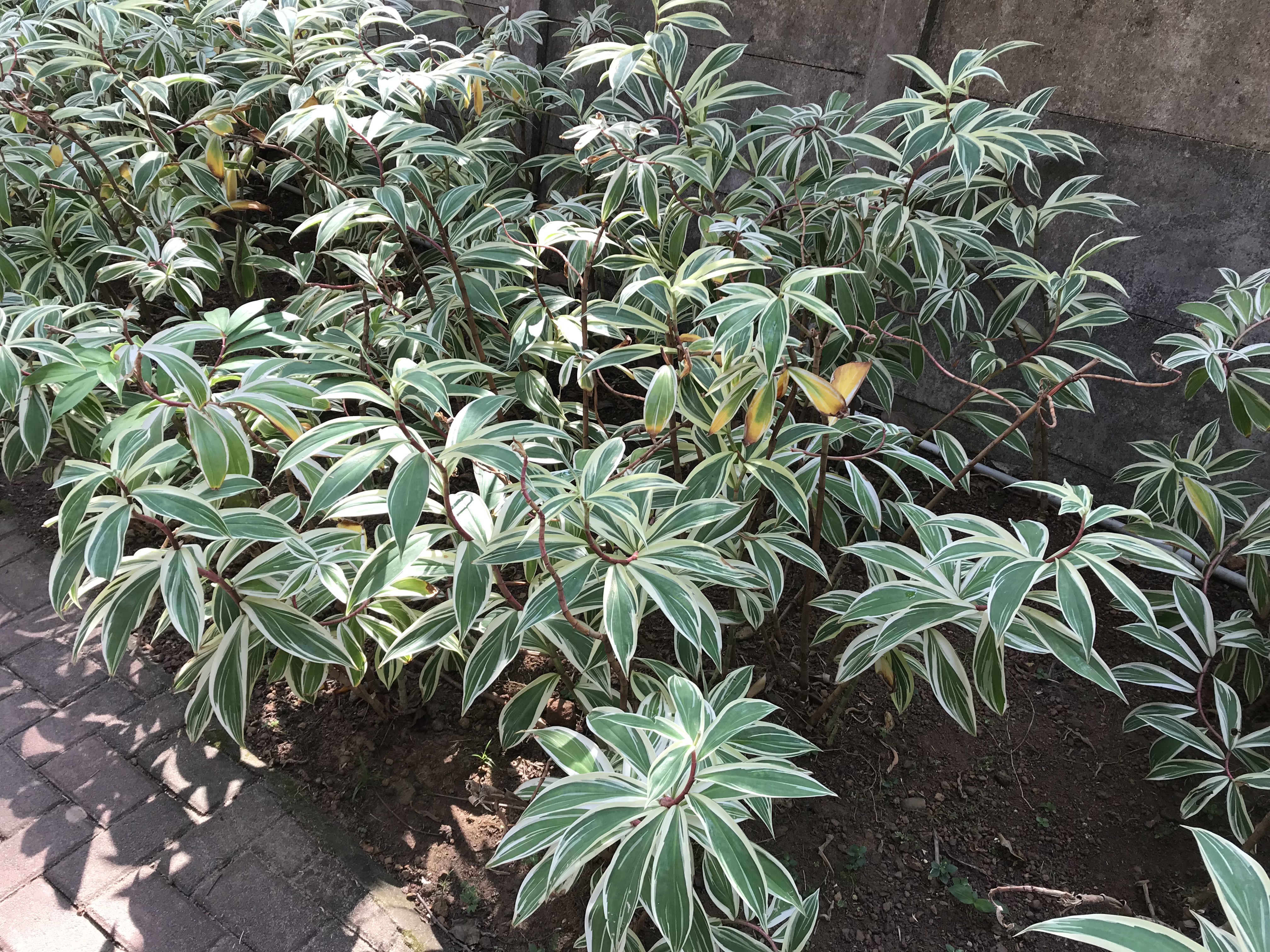
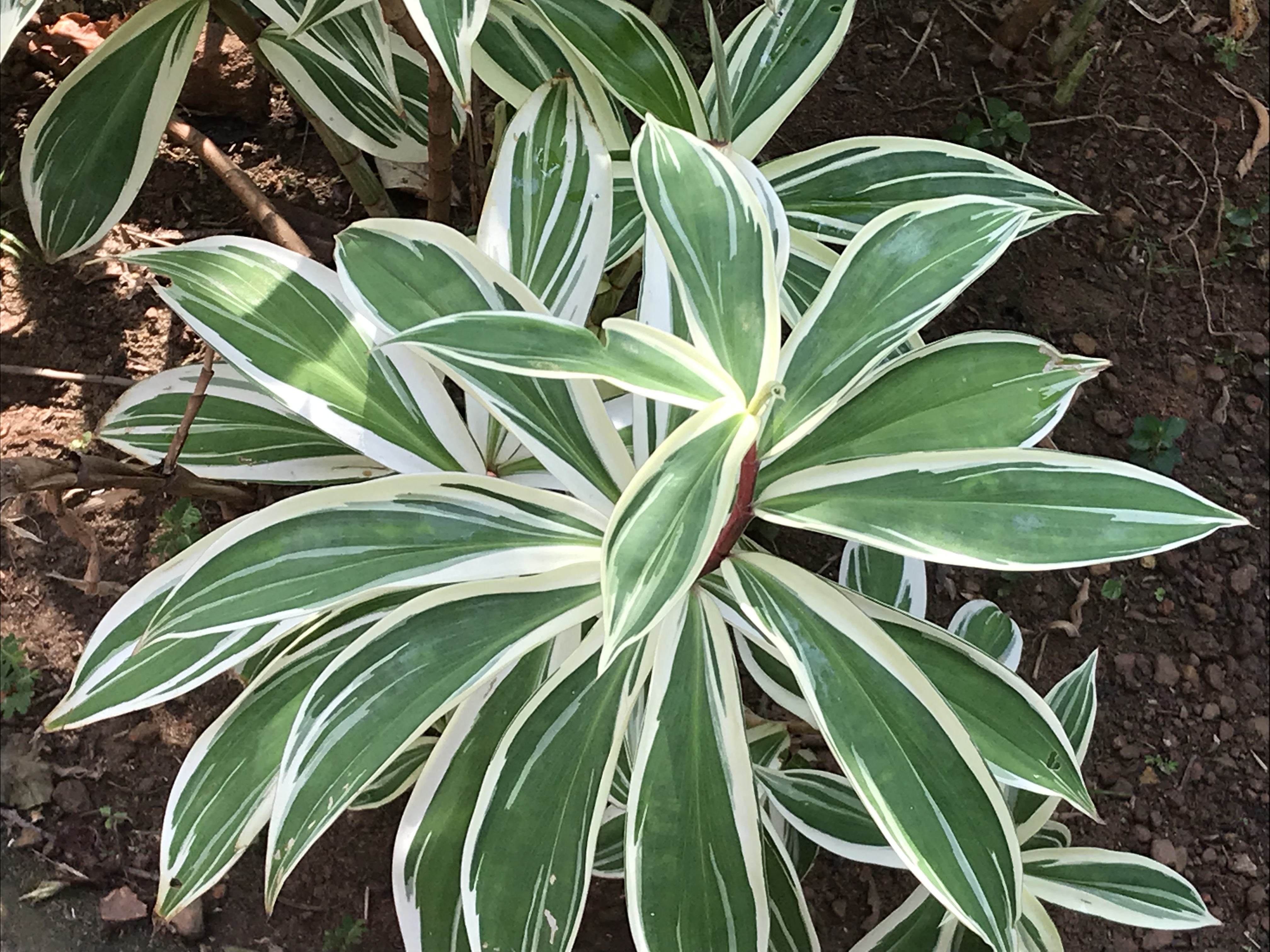
Last week, I posted pictures of one of the interesting plants that I found on the grounds of Amrita University’s School of Biotechnology. Here are more photos of that school’s beautiful grounds:
Towards the end of December, we were told there would be a transportation strike on January 2nd. During that type of strike there are no rickshaws, taxis and buses on the road. I imagine the trains are also grounded.
On that day, I decided to walk into Vallikavu, the town closest to the ashram. I remembered the strike when I noticed there were no rickshaws near the bridge that joins the peninsula where the ashram is located and the mainland. I had planned to walk to town anyway so the lack of rickshaws was not a problem.
The only forms of transportation on the roads were bicycles, scooters and motorcycles. There weren’t even any private cars. Private cars are probably not driven during strikes either. The businesses I passed were all closed. I noticed that there were no Indian women on the streets. That seemed really strange.
There was a big group of men on the street ahead of me. I’ve heard that transportation strikes can get violent, but happens when someone breaks the strike. I wondered if I should go back to the ashram but this wasn’t a group of angry men. When I got closer, I was able to see that they were buying or selling fish. Since the market was closed, selling it on the roadside was probably their only option.
Once I reached the center of the town, I discovered the only stores that were open were the pharmacies. I was relieved since one of those pharmacies was my destination. I placed my order and then returned to the ashram.
On January 8 and 9 there was a two-day national strike. (I don’t know if the January 2nd one was state wide or just for the district, but it wasn’t national.) It was called a transportation strike on the announcements here but I noticed on one flyer that the word “transportation” was crossed out and “general” was written above it.
When I walked to Vallikavu on January 8 (for reasons that will become evident in a later section of this post), my experience was completely different from the one on January 2. I saw one rickshaw and a couple of cars on the road that day. I also saw several closed businesses on the way to town, but when I arrived at the center of town, I discovered that almost everything was open, including the market and some of the banks. The number of women on the street seemed normal.
I believe the January 2nd strike was about the current events in Sabarimala. The national strike on January 8 was called by the Central Trade Unions and was against the government. Twenty million people participated in that one. Based on what I saw in Vallikavu on the 8th, my guess is that people here may not be as dissatisfied with the government as people in other parts of India.
Ashram Visitors
The number of Indian visitors was significantly lower during the strikes. The people probably couldn’t get here, but there may have been other factors at play as well. The crowds were large during the week between Christmas and New Year’s Day so it would be natural for them to be lower the week after the holidays. Also, the fact that Amma’s South India tour starts on the 18th may have been responsible for some of the decrease too.
All of the darshan programs prior to the holidays were in the auditorium rather than the temple. I assume that was because there has been restoration work occurring in the area above the front stairs of the temple; there was no way for a crowd to enter the temple from the front.
When the number of people at the ashram decreased, Amma began to hold darshan in the temple. Everyone walks up and down the stairs on the east side of the building. That creates an interesting dilemma since the stairs wind and are quite narrow. Two people can’t go up or down two across without turning to the side to squeeze by each other. But it works. It is nice to have programs in the temple from time to time.
Being there always brings to mind these photos from my first visit to the ashram in January of 1990. I was in Amritapuri the week that the temple was used for the first time.
A separate trip to Vallikavu
When I ordered my medications on January 2, I was told to return on Monday, January 7 and I did. That was an interesting journey. I decided to stop by the optometrist to get my glasses adjusted. When I walked into that office, I was told that the technician was not there. Then I went to the pharmacy and was told that my medications had not arrived and to come back the next day. Then I went to Love Sugar bakery to get my first, and only, Chocolate Fantasy sundae on this trip. I was told that the person who makes the sundaes wasn’t there. I had intended to go to the School of Biotechnology to take photos of the plants, but I had forgotten to bring my phone, which meant I didn’t have a camera.
So, I had walked the 15-20 minutes from the ashram to Vallikavu, in the hot sun, and accomplished none of the things I had planned to do. At least I got some exercise. I returned to the ashram and went directly to the Indian store. I purchased and ate a Magnum Triple Chocolate ice cream bar that I had seen in the store earlier in the week. I was in heaven!
Watching the
Christmas Eve entertainment
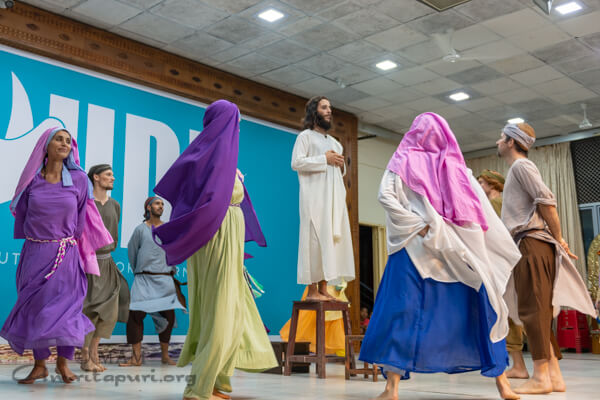
Generally, the people who perform during the Christmas Eve cultural events aren’t able to see all of the performances. Usually, we have a chance to see a video of the event at a later time. This year, we watched that video on January 8.
I had a chance to see the choir performance part of the video ahead of time and was upset when I saw how stiff I looked. My problems with remembering the words and my off beat clapping were also all too visible. I thought about not going to the viewing, but decided not to chicken out. During the viewing, I was relieved to discover that seeing the video on a screen from across the room was very different than seeing it up close on a computer screen. I like to think that no one even noticed me!
As I was writing this section, I discovered that some photos taken during the Christmas Eve entertainment are on amritapuri.org now. I’ve put some of them below:
You can click on the gallery to enlarge the photos.
Letting Go Reflections
Resentment
If you’ve been reading my posts from this trip you will know that I’ve been sharing information and experiences I’ve had regarding letting go. In the last week, I’ve been reflecting on what is NOT letting go. I believe if I’m feeling resigned to an outcome then that is not letting go. In those cases, it might be more accurate to say I am giving up and accepting the fact that I can’t have what I want. I also believe that if I have resentment about not getting something I want, then it is an indication that I haven’t let go.
I imagine Transactional Analysis theory would consider both resignation and resentment to be racket feelings, i.e. something that covers the core feelings of mad, sad, scared and glad. I think resignation could easily cover anger and resentment definitely does. Also, we can be attached to something through our anger and our fear, or to say it a different way, anger and fear may prevent us from truly letting go.
Preparing to return
to Seattle
My trip is nearing its end. I’ve started the process of cleaning my room, putting away the things I leave here and packing my suitcases. I have also been doing the administrative work necessary to prepare for future forest restoration work parties once I get back to Seattle. Today, I met with a friend to learn more about Power Point. I’m giving a talk about our restoration project at Seattle University on February 12 and want to put project photos on Power Point slides.
I will probably get my last hug from Amma on this trip tonight.
“The fool doth think he is wise, but the wise man knows himself to be a fool.” “Love all, trust a few, do wrong to none.” “Love looks not with the eyes, but with the mind, And therefore is winged Cupid painted blind.”-William Shakespeare
































 Living, Learning and Letting Go