Living and Learning in Amritapuri, India: August 24-28, 2016

Kerala Flood Update

A few days ago, I saw a newspaper lying on a table. When I glanced at it, the article that caught my eye was announcing that the Chief Minister of Kerala (the chief executive of the state) requested that all Keralites living in or out of the state, donate a month’s salary to the relief effort. It was suggested that they donate three days a week of their salary at first and then pay the rest over a 10-month period.

What a difference it would make in the recovery effort if people did this. I wonder how many Keralites will be this generous or have enough income to be able to participate. I would guess that he will have more response than if the same request was made, after a tragedy, by any U.S. president or governor.

In researching this event today, I read this statement by the Chief Minister:

As you are aware, this is the worst calamity in the history of Kerala. This calamity has affected the entire stretch of Kerala and 12 out of 14 districts severely. The devastation and destruction are extremely severe and beyond a description. The loss of life, livelihood, homes, roads, bridges, agriculture, power lines and public infrastructure will have far-reaching impact on socioeconomic fronts. Though it was unprecedented, the government swung into action immediately and concentrated fully on rescue and relief. I need to underline the fact that all sections of the people held their hands together along with government agencies to conduct rescue and relief operations. The selfless efforts of the fisherfolks have to be specially underlined. Read more

I also learned that on August 26, the death toll was 302 with more bodies being discovered. There were 1435 relief camps still in operation and the population in those camps was 462,000.

I then looked for an update on Amma’s relief work. I found this statement on amritapuri.org.

As the flood waters recede, and as the spotlight wanes, Amma and MAM remain fully committed to helping the survivors with their recovery for as long as it takes. Next steps for the Math include focusing on disease prevention, ongoing treatment of injury and disease, and finding ways to re-house those who have lost everything. Read more

To read Amma’s Kerala flood rescue and relief day-to-day updates – click here

Onam 2018

This year, Onam occurred on Saturday, August 26. Onam is a family holiday in Kerala, one that celebrates the agricultural harvest. Amma decided that the ashram event would not be celebratory in nature because of the devastation caused by the floods. The tug of wars and cultural entertainment that would normally be part of the festivities were pulled from the program.

Huge crowds usually come to the ashram for Onam. I wondered how many people would be able to attend this year. Even though there weren’t as many people as normal, it was still big. The program began with Amma’s satsang (spiritual talk). She spoke in Malayalam, but the English translation was put up on screens. I find I am much more attentive when the translation is done this way. There were so many parts of Amma’s talk that spoke to me. I haven’t found the text of the full satsang anywhere, but you can read some of it here.

(The photo below shows only half of the auditorium.)

After the satsang, Amma sang three songs and then gave darshan (hugs) for a short period of time. When darshan was over, it was time for lunch. Amma handed a plate to every person in the auditorium.

The Onam lunch was quite a feast. There were so many types of food on each plat. A lot of tables had been set up and brahmachinis and other helpers walked around aiding devotees in finding a place to sit, handing out hot water to drink and a buttermilk sauce to put on the rice, and cleaning up the tables in-between diners. The meal really felt like a family event to me. I realized, once again, that I have a VERY large family.

(Click on any of the galleries to enlarge the pictures.)

After the lunch, Amma fed Lakshmi, the ashram elephant, her lunch. This is always one of my favorite parts of Onam. After Lakshmi finished eating, Amma had her pick up, with her trunk, any food that had dropped on the floor. It always amazes me to see how well Lakshmi can clean up her mess.

Once the floor was clean, a bucket of water was brought to her. Lakshmi drunk quite a bit of it and then pulled up more water into her trunk. Next, she sprayed the water all over the children who were standing or sitting close to her. There were screams of delight and laughter from all over the auditorium, especially from everyone who was sprayed. That process occurred over and over. I think they even brought Lakshmi a second bucket of water.

When the water in the buckets was gone, the lunch program was over. Lakshmi was taken away and the devotees dispersed.

Amma came back to the hall at 6:30 p.m. for the evening bhajan (devotional singing) program. The songs were beautiful, as always.
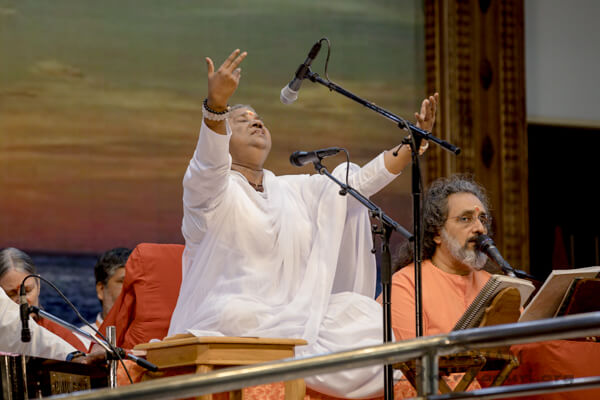
Since there would be no entertainment that night, I expected bhajans to be the end of the Onam program. That was not Amma’s plan, however. Instead of going back to her room when she finished singing, Amma announced that she would be continuing to give darshan.

Amma gives and gives and then gives some more. I don’t know when she stopped for the night, but I know I went to bed before she did.

Photo Credits: Onam Photos are from Amma’s Facebook Page and Amritapuri.org

Continuing to Explore

In my last post, I talked about making the decision to sit closer to the front of the room during programs instead sitting at the back or far sides of the hall. I have followed through on that commitment. Most often, I have been sitting on the floor in the section closest to Amma. I had forgotten what it is like to be surrounded by devotees who know the songs. The sound is so full and powerful.

I am still finding my limits though. I can sit cross-legged for an hour or even an hour-and-a-half. However, when I tried sitting in that way through Amma’s meditation and question and answer session, followed by the bhajan program, on Monday night, I found that my legs hurt a lot. Three-and-a-half hours was too much for me, even though there was a short break in the middle.

That night, Amma sang a lot of old bhajans, including one I hadn’t heard in many, many years. It was Shyam Radhe Shyam Radhe Shyam… Aarati Kunjavihari Ki Sri Giridhara Krishna Murari Ki. I was in heaven.

Salad Day

Sreejit cooks for the Western Canteen. One day last week was salad day. He made potato salad (potatoes, pickles) , 3 bean salad (pinto beans, chickpeas and green beans), and beet salad. Someone took a picture of him surrounded by the ingredients. I think it gives a good sense of the amount of food Sreejit prepares for lunch, six days a week, and for every dinner. Needless to say, I am very proud of him.

To read the previous posts in this series click here.

Living and Learning in Amritapuri, India: August 19-23, 2018

Western Cafe

I started helping my daughter Chaitanya in the Western cafe on August 19, my second day at the ashram. The first four days, I buttered the bread that would be cooked on the grill. On Thursday, August 23, I started doing a 7:30 to 9:00 a.m. shift calling out cafe orders as they are ready. When I am given the plates from the kitchen, I check that what is on the plate matches the ticket. I then call out the ticket number and make sure each person gets the correct order. Some of the time, I work at a leisurely pace, but at other times the orders come out fast and furious and I have a whole crowd of people standing in front of me. The job certainly gives me practice in staying focused.

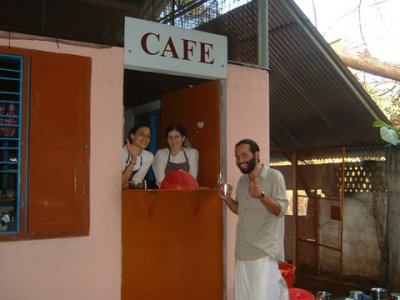
There are so many more people involved in ordering, cooking and serving the food than when I started working at the cafe in the late 90’s or early 2000’s. In the “old” days people would line up outside the cafe window to order and pay for their food. I would be sitting inside the cafe, taking orders and cashiering through the window. The photo above was probably taken in the early 2000’s. The window where I used to sit is the one on the left. Over the years, much of the process has moved outside with the people who take the orders, the cashiers, and much more being in front of the cafe. The whole building was remodeled and enlarged two years ago.

Crow

Photo Credit: Pixabay

A funny thing happened on Monday or Tuesday. When I sat down to eat my breakfast, two crows flew over to me and perched on nearby chairs. Sometimes, one was on the chair directly in front of me and sometimes he was one chair over. The other crow was always on the back of the chair to the south of him. I’m used to crows perching on various ledges above me but don’t remember them being at eye level before. These crows rarely looked at me directly, but they were on constant alert, looking one way and then another.

At one point, a friend carried her breakfast plate to the table and set it down in the care of someone not far from me. She had covered her food with another plate. The person who was watching her food stepped away briefly. In an instant, the second crow flew to the plate, knocked the cover off and started pecking at her breakfast. I spontaneously stood up to shoo him away. Without hesitation, the crow that had been sitting in front of me grabbed part of my omelet and flew away with it.

From my perspective, the crows were working as a team and I had been a sucker in a conspiracy! I laughed.

Kerala Floods

(The photos below are of a 24 hr/day call-in rescue hotline operated by Amrita University’s faculty and students.)

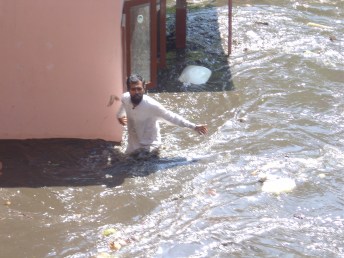
It is estimated that one million people are being housed in flood relief camps. Four hundred and twenty people have died or are missing, Ten thousand kilometers of roads have been destroyed or damaged and 50,000 homes have been “wiped out”.

The flood cleanup has been hampered because when people return to their homes they are finding poisonous snakes (including pythons and cobras), centipedes and scorpions in their cupboards and personal belongings. Some have even found crocodiles in their houses.

The Cochin International Airport is the world’s first solar powered airport. The solar panels, along with the runway, taxi bay, shops as well as other areas of the airport were submerged during the flood. The damage is estimated to be more than three million US dollars. The airport was due to reopen on August 26 but the reopening has since been moved to the 29th.

Safe in Amma’s ashram, I feel separate from the nightmare in which many of the people of Kerala are living. It was good for me to research and write this summary. If you feel inspired to donate to the relief effort you can do that at: Amma.org (US) or Amritapuri.org (India). I’m sure there are many other ways to donate, but those are the two places I am aware of.

Onam

Saturday is Onam, Kerala’s biggest festival. It is a harvest festival and a family festival. I’ve heard that this holiday is similar to Christmas in the West, although it is a secular holiday. The government has canceled Onam celebrations this year because of all the flooding in the state. I know that some of Amma’s centers in the other parts of the world will host programs that will include praying for the Kerala people and Kerala relief fundraising dinners. There will be an Onam event of some kind in Amritapuri, but I don’t know the schedule or the content. I will be reporting on it in the next post.

Is a New Day Dawning for Me?

On Tuesdays, Amma serves lunch to the devotees and visitors who are living in the ashram. Amma blesses each plate and then the plates are passed to everyone by long lines of devotees. When it is time to form the lines, I eagerly join in. Once everyone has a plate of food, we eat together.

This past Tuesday, after finishing my lunch, I saw that Kumuda was sitting in one of the first rows of chairs in the middle section of the auditorium.  The lunch was over, but Amma hadn’t started giving darshan yet; she was playing with some children.

When I walked over to Kumuda, an old but familiar energy washed over me. I realized being that close to the front of the room felt like being with Amma before the crowds got big. In those days, I spent many hours sitting and watching Amma; I was mesmerized by her. It has been a long time since I have had that experience. I don’t remember when it ended, but the shift probably started around the time I became the tour coordinator for Amma’s Pacific Northwest programs. I was tour coordinator for about 15 years, and it has been at least five years since I gave up that role.

In the last decade, I have developed the habit of sitting in the back or side of the program halls and just watching Amma on the screens. My relationship with Amma has not been affected by my moving to the back of the room, but my relationship to the music is a different story. For years, I have longed for my mind and body to react to Amma’s bhajans (devotional songs) the way it did in my early years with her. At that time, it was as if my body, mind and soul was fully immersed in the music. I remember feeling like the music was feeding my soul.

I resolved to test out sitting closer when I am in Amma’s presence and during any other program that I attend. Tuesday evening, I sat in the fourth row of auditorium chairs during the bhajan program. On Wednesday, I sat cross-legged on the temple floor watching Amma give darshan and later did the same sitting next to the brahmacharinis (female monks) when they sang. Tears ran down my cheeks as I experienced the music, just like they used to in the early days.

[Note: I’m making a big deal about sitting cross-legged because I didn’t know that I could still do that, especially for a whole program. I discovered that my back felt better sitting that way than it does when I sit in a chair. Also, there is a large section for floor sitting in front of the chairs, so if I sit there I will be closer to the front of the room.]

On Thursday, I sat cross-legged on the floor during morning archana and did that again when the women residents sang their series of Sanskrit chants soon after darshan started. That same evening, I sat cross-legged on the floor when Swami Pranavamrita sang during darshan. Once again, I experienced the bhajans in a way that I hadn’t experienced for years. My mind was (relatively) silent and I experienced a combination of joy and peace.

Is a new day dawning for me? It sure feels like it is.


To read the previous posts in this series click here.

Living and Learning in Amritapuri, India: August 15-18, 2018

I left Seattle for Amritapuri, India at 5:50 p.m. on the 15th of August. Fourteen hours later, I arrived at the Dubai airport. While I was there, I received notice that Amma had asked the Amritapuri ashram residents and visitors to chant the peace mantra 108 times at 10 p.m. That mantra and translation is:

Lokah Samastha Sukhino Bhavantu
May all beings in the world be happy

The chant ends with:

Shanti, Shanti, Shanti
Peace, Peace, Peace

Even though I didn’t know for sure why Amma had made that request, I assumed it was because of flooding that was occurring in the Kochi area. I decided I would also participate. I finished the chant minutes before boarding my plane to Trivandrum.

After the 14 hour flight between Seattle and Dubai, there is a 2 1/2 hour layover in Dubai, followed by a 4 hour flight to Trivandrum. Usually, I start the 2 1/2 hour taxi ride to Amritapuri as soon as I retrieve my baggage. This time, however, I was traveling with my friend Kumuda. When she comes to India, she spends a day in Kovalam so that she has a chance to rest before making the last leg of the journey. I decided I would also do that this time. Maybe resting at that juncture would reduce the amount of jet lag I experience.

We arrived at the hotel about 5 a.m. It is off-season now so the hotel was really quiet. In fact, we may have been their only guests! It was wonderful to lie down for a while and then walk to the beach for breakfast.

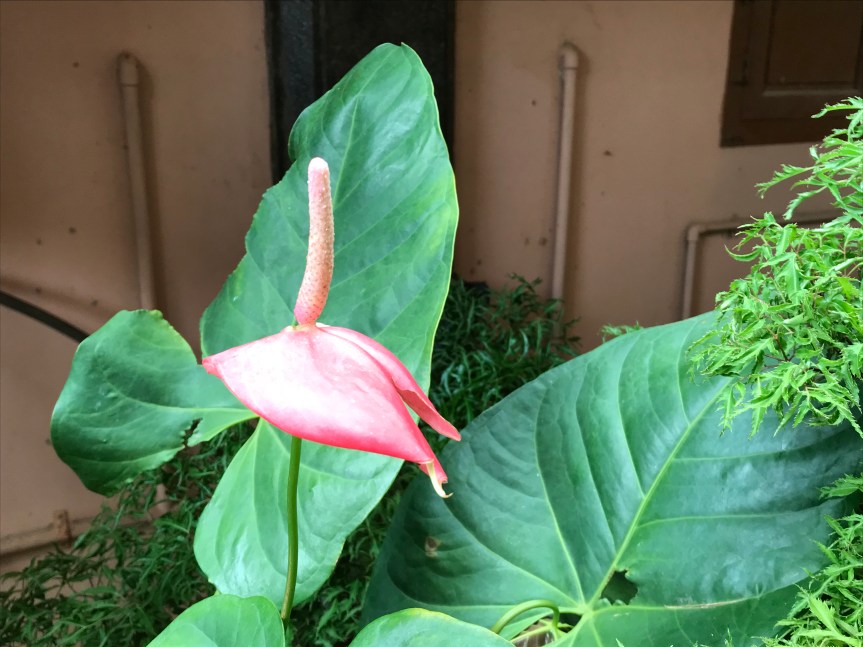
I hadn’t been to Kovalam since 1993 and at that time I had stayed in a different area. After we had breakfast, Kumuda showed me around. Two types of flowers caught my eye. They were so beautiful.

I also saw a vine on a trellis that was growing a fruit that looked like limes. I say “looked like” because the fruit was perfectly round and the skin was shiny. At first I wondered if it was an artificial plant. When I glanced at the leaves, though, it was obvious that the plant was real.

There was heavy rain from time to time on the day we were in Kovalam. When I checked the news that evening, I learned that 13 out of the 14 districts in Kerala had been put on red alert due to the rain.  By morning, the last district was also on red alert. The worst flooding was in Kochi. [An article written on August 18 said the floods in Kerala were  the worst in a hundred years. The article also  said the flood had killed at least 324 people and 220,000 others had been displaced. Kochi airport was still completely submerged and was expected to be closed until August 26.]

The weather forecast predicted there would be thunderstorms the next day. I began to wonder if it would be safe to take the taxi ride from Kovalam to Amritapuri. When I checked the forecast the next morning, I discovered that it had changed. Now, it called for clouds or light rain during the time that we were planning the drive to the ashram. We left Kovalam at 5:30 a.m. and arrived at the ashram at 8:00.

I was grateful…. and relieved…. to be back at my spiritual home!

asrham-07
Amritapuri temple

I checked in at the International Office and then took my luggage to my room. Shortly thereafter, I went to see Sreejit and Chaitanya, my son and daughter, who both live at the ashram. I love every reunion we have. It is always so good to be with them.

Amritapuri during the 2004 tsunami

Being in a situation where flooding is possible, brings up memories for me of being in Amritapuri during the 2004 tsunami. After the tsunami hit, all the people from the nearby villages and the ashram were evacuated. Amma provided food and shelter for everyone at Amrita University and her nearby schools.

Many of the ashram residents and visitors and some of the villagers stayed at the Engineering College for five days. I remember witnessing the grief of the villagers who had lost family members. I also remember being thankful to have the clothes on my back and a mat to sleep on.

More than two hundred people had died in the village closest to the ashram that day and many more had died in other parts of India and beyond. Amma’ provided food, shelter, clothing, and medical care both locally and to Tamil Nadu and Sri Lanka. In the years that followed, she also provided job training and built many houses for tsunami victims. To read more about Amma’s 2004 tsunami relief programs click here.


Amrita Institute of Medical Sciences (AIMS)

Soon after I arrived at the ashram this year, I learned that Amma had sprung into action once again. Even though the first floor of her multi-specialty hospital (AIMS) in Ernakulum had flooded, it took in the patients from hospitals that had needed to be evacuated. Amma sent many of the ashram’s brahmacharis and brahmacharinis (male and female monks), as well as Western visitors who wanted to help, to AIMS to deal with the influx of patients and to do the manual labor needed to move everything from the flooded first floor of the hospital to higher floors. They also filled sandbags and dug structures to protect the hospital from future flooding. [ I haven’t seen those structures so I don’t know what they looked like.]

Amma has also started dozens of medical relief camps and provided water, food, clothes and bedding to people who needed it. Thirty out of 40 of her schools around the state have become relief shelters. She has also made a large donation to aid the government’s relief program. To learn more about the current relief efforts go to the Latest News section in Embracing the World.

After having breakfast, I went back to my flat and continued the process of moving in. At some point, I decided to go to the temple to watch Amma giving darshan to those who came to the ashram that day. [Amma’s form of darshan/blessing is to give hugs. She has embraced more than 37 million people world-wide.] When I visit India, I often wait for several days or even a week before I go to Amma for a hug. That day, darshan was being held in the temple and the crowd was much smaller than normal.

Usually, bus loads of people come to see Amma on darshan days. I realized that the devotees couldn’t get here because of the floods. And since the Cochin airport was closed, many of the international visitors weren’t able to be here either.

I decided I would go for darshan. Before long I was in Amma’s arms. Now I was truly …. and fully …. home.

Photo Credits: Amma’s Facebook Page

Living and Learning in Amritapuri, India: January 4-13, 2017

Even though I’m back in Seattle now, it is important to me that I tell you stories about the last part of this visit to Amritapuri.

Baby Feeding Photos

In Hinduism, it is traditional for a baby to be fed its first solid food as part of a sacred ceremony. When a parent asks Amma to perform that ritual, she holds the baby on her lap and feeds him or her some payasam, a sweet pudding. An ashram photographer takes a photo of Amma feeding the baby; thus, providing the parents a memento of the experience.

Soon after I arrived at Amma’s Amritapuri ashram this year, I noticed that there were five big photos of Amma under the windows of the outside portion of the west wall of the auditorium stage.  I had never noticed them there before.

The pictures were visible to every person who walked up the ramp that goes from the auditorium floor to the stage. From a distance, the photos looked identical. They were each about 40 inches high and 24 inches wide. When I saw the photos up close, and read the sign that was next to them, I learned that the big photos of Amma were actually comprised of tiny photos of Amma feeding babies. Each big photo contained pictures of 6000 different baby feedings. I remember believing they were tile mosaics but now that I think about it, I’m having doubts about that.

Since each of the baby feeding photos were of a different baby, and there were five large pictures of Amma, 30,000 babies feedings were part of that exhibit. I was intrigued and astounded by that display throughout my trip; astounded by the display itself and by the fact that Amma has performed that many baby feedings.


Friends

Many of my friends were participating in a nine-day silent retreat (meditation, yoga, silence) during the end of my trip. It was over the evening of the 11th and I was on the road to the airport by 5:00 a.m. on the 12th. It felt strange to leave not having seen so many friends for nine days. A highlight though was that my friend Ramana arrived from Seattle on the 9th. He and I hadn’t been in Amritapuri at the same time for several years. It was fun to spend some time with him during the last days of my visit.

Synchronicities

I was trying to get some information for friends who were coming to India a few days after my departure. I was walking to an ATM when my friend Do walked up to me and asked if I had been able to get the information I was needing. When I said no, he told me that Prabha could probably help. I proceeded to the ATM. As I was returning to my building, I had a momentary glimpse of someone who looked like Prabha. I wasn’t sure since I was seeing her from behind. After a moment’s thought, I decided to check it out. It was her, and she did give me the information I needed. I found out that Do had seen her right after I talked to him, and told her that I was looking for her and why, so by the time I talked to her, she already knew what information I was looking for. This whole scenario seemed so synchronistic to me and it was all the more amazing because there were around 5000 people living in the ashram. There are always some people I don’t see during my whole visit, and all of these connections were made within a five minute period.

***

I never know what Amma’s schedule will be when I plan a trip. Her India tour dates are often not announced until a week or two before the event occurs. As it turned out, Amma started her South India tour hours after I boarded the plane for Seattle. Sreejit and Chaitanya were both going on that tour. So, we all left the ashram on the same day. Perfect timing!

Lessons

Many experiences and lessons were contained within this trip. I visited gardens, farms and fields. Through those experiences, I came to some sense of peace around the fact that not all of the trees, shrubs and ground covers in our Seattle forest restoration project will live. This kind of work is trial and error and will also be affected by weather, soil conditions and many other factors. Whether or not a plant survives is not in my hands. My job is to put in the effort and let go of the results.

My experience with the ants was a challenge that reminded me to “wait, watch and wonder” rather than immediately react. It also gave me the opportunity to practice equanimity. Sometimes I was able to get there and sometimes not.

Being able to witness and participate in the production of the Christmas play, as always, gave me joy. It also reminded me that when we work together great things can be accomplished. I could see how far the cast have come in learning to take whatever comes. No matter the challenge, the participants do what needs to be done and hold on to a positive attitude throughout. Their growth is obvious and their work inspires many.

One of our Seattle satsang members died while I was in Amritapuri. I still can’t believe that is true; it feels surreal. His death reminds me to make every day count.

My respect for the importance of “going with the flow” rather than trying to force things to happen has grown. When I try to force my will, I am likely to exhaust myself and cause myself pain. During the month I was in Amritapuri, there were so many times that a person I needed to talk to walked in front of me moments after I became aware of the need.

Here are some of my favorite memories from this trip. There are so many others that I don’t have photos of, such as my darshans with Amma and time with my family and friends.

Traveling back to Seattle

My trip home would be as long as it always is: a 2 1/2 hour taxi from the ashram to the airport, a 4 hour flight from Trivandrum to Dubai, followed by a 14 1/2 hour flight from Dubai to Seattle. This time I planned to take a LYFT taxi from SeaTac airport to my house.

For several years, I have made the trip more tolerable by taking a long layover in Dubai. During that time, I have stayed at the Dubai International Airport Hotel. It is expensive but the opportunity to sleep, or at least have my feet up, in a quiet room for 15-19 hours has been well worth it.

Sometime during this last year, I heard that Emirates would give me a free hotel and food if I asked for it. They provided the accommodation without question. Having the free hotel turned out to be a mixed blessing though. I hadn’t realized I would have to go through immigration and that took well over an hour. Also, I didn’t know where to go when I got to the baggage claim area. Everyone I asked told me to go to exit 1. When I finally found that exit, and the hotel bus, I was told I  should have checked in with someone in the terminal. Luckily, that person brought a group of people to the bus at that moment and I was able to get on the bus.

Once I was at the hotel, there was a very long check in line. The hotel was also very noisy. While I was waiting in the check in line, I decided it was unlikely I would make this choice again.  That thought was followed by another; if the hotel room had a bathtub I would consider returning. After a month of cold showers, taking a tub bath would be heavenly. (At Dubai International airport hotel there was  only a shower.) One of the first things I saw when I entered the room was the bathtub!

There were more challenges at the hotel than the ones I mentioned above, but the hotel staff were very friendly and the food was excellent. Another challenge occurred when I returned to the airport for my flight to Seattle. After going through immigration again, I looked for a restroom. I was in the old wing of the airport and every restroom had a very long line. I finally found one with a somewhat shorter line at the end of the wing, so joined the line. That restroom ended up having only two stalls. If I had been staying in the airport hotel, I would have been able to stay in my room until it was time to board the plane.

Was the bathtub and the free room and food worth it to me or will I choose to pay more and stay in the airport? Only time will tell.

Greenbelt restoration project

Within five minutes of walking into my house, I changed shoes and went outside to look at the plants in the Greenbelt. They seem to be surviving well. None had been broken by falling branches and the snow didn’t seem to have affected them. I was so excited and eager to start the restoration work again. Our first work party will be on Sunday, January 21.

Jet lag

Even now, I am in the throws of jet lag. I really dislike the experience of turning my night and day around (there is a 13 1/2 hour time difference between India and Seattle). Sometimes I can’t sleep for more than 2-3 hours at a time for many weeks. While my sleep is still disrupted, I think it is going to be shorter this time. I returned to Seattle a week ago today, and last night I slept 5 hours. May that shift continue!

The end and the next beginning

While I could write so much more about this trip, I hope that my posts have given you an idea what it is like to be in Amritapuri. Every trip is filled with adventure, challenge and learning. Even though I’ve only been back in Seattle a week and I’ve been hampered by jet lag, I have had so many experiences since I’ve returned. I look forward to posting about them in the next few days.

To read the previous Amritapuri posts in this series click here.

Return to Kuzhitura Farm: January 10, 2018

My friend Ramana had asked if I would take him to some of the ashram gardens when he arrived in Amritapuri. Since he didn’t come to India until the 9th and I was returning to the U.S. at 5 a.m. on the 12th, I decided it was only reasonable for me to take him to one of them. I chose Kuzhitura.

You may remember when I visited this farm on December 27, 2017, I saw some tubs that I thought might be a new way to catch water.

Later, I learned that the structures that were originally built for water catchment had become homes for turtles.  I found a picture of one of those structures that I took in January 2016. I can see why turtles would want to live there!

One of the problems with the turtles living in that “pond” is that the water dries up during the dry season. It is not a safe place for the turtles to live. The new tubs are meant to be homes for the turtles.

When I returned to Kuzhitura on January 10, I enjoyed seeing how much homier the tubs looked than when I had been there two weeks before.

Sarvaga, a friend who works in this farm, introduced Ramana and me to some of the turtles living in the current “pond.” She talks to them as she offers them treats and they come right up to her!


The staff are not going to move the turtles into their new homes. Sarvaga said they will find their own way there. I look forward to seeing where the turtles are living when I return to Amritapuri later in the year.


To read the previous posts in this series click here.

Amritapuri Christmas Play- Part 3

Surprise! I’m able to write the third post about the Amritapuri Christmas play after all. Enjoy!

***

As I’ve mentioned before, this year’s Christmas musical was about the nativity story as told by a 9 year old child named Grace. Grace was living in a school for girls. She is the second child from the left in the first photo below. She is wearing a blue dress.

In many Indian plays, the actors don’t speak or sing, they lip sync. The musicians and people singing or speaking for the actors are out of sight. In this play, they were sitting on the left side of the stage.

The children were amazing. They had practiced their roles so thoroughly that you couldn’t tell they weren’t saying anything.

***

In Grace’s version of the nativity story, one of the wise men came from Africa. She named him Tsabo Babatunde. Tsabo was very, very old. When he received God’s direction to follow the star to Bethlehem, so that he could welcome another great soul to the world, he obeyed.

Tsabo was able to talk to animals, and they talked to him. One of the songs in the musical was Come Awake Africa.

[Note: You can enlarge the photos in this post by clicking on the photo galleries. To hear the songs, click on the audiofiles.]

***

Joseph and Mary sang and danced with their friends before they traveled to Bethlehem.

***

One of the  most intense scenes of the play occurred when it was time for Mary to give birth and no one would give them the couple a place to stay. I think you will get a sense of the intensity by listening to the song. I still get goose bumps when I hear it.

***

An angel was present during the nativity scene. As you look at the photos and listen to the music know that she was 30-40 feet above the floor!

***

One of the most touching scenes was near the end when Mary let Grace hold baby Jesus.

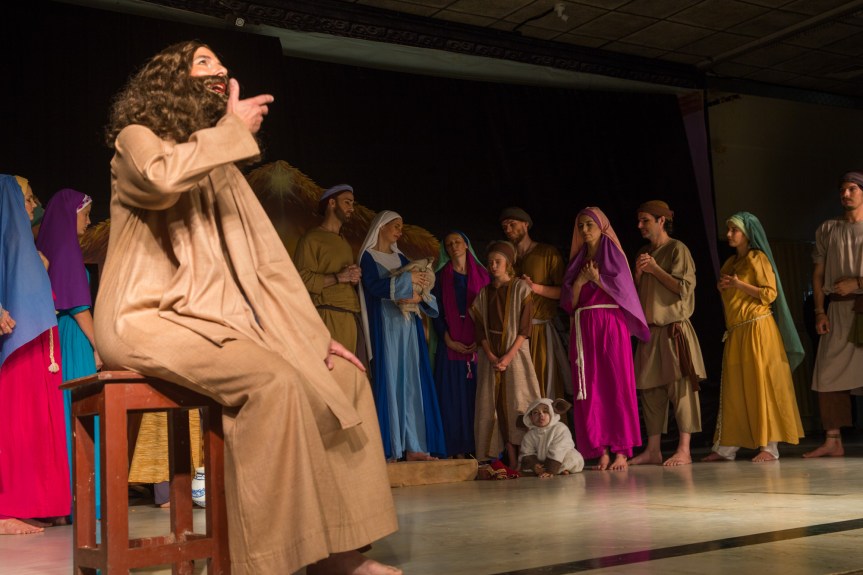
Throughout his journey, Tsabo had visions of what the adult Jesus would do in his life. Those visions were enacted. The photo below is from one of the last scenes in the play when Jesus was talking about love.

It was a wonderful musical. I hope you were able to get a sense of that from the photos and songs in this post.

To read the previous posts in this series click here.

Visiting the Seed-Saving Farm

I talked about my challenges in finding the Seed-Saving farm in my last post and said I would tell you more about my visit there in a separate post. That time has come!

When I arrived at the farm, Lokesh, the volunteer who manages this project, told me that in Kerala they can grow four sets of crops each year. Since they had just finished harvesting the last crop and were only beginning to prepare for the next one, he was disappointed that he couldn’t show me more.

While I thought he shared an abundance of information with me, I found a delightful video on his YouTube channel that gave me a sense of what would be like to participate in this community gardening activity.

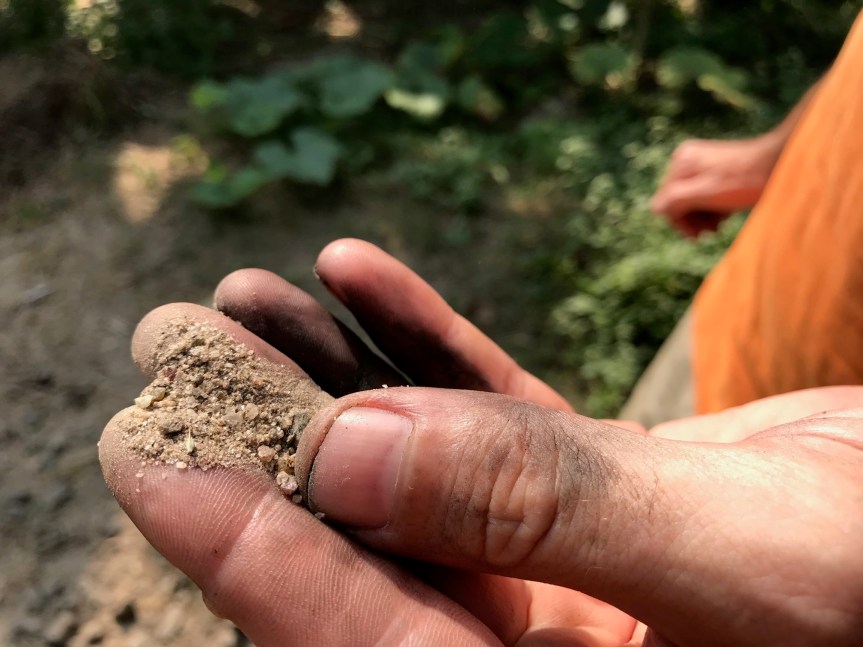
The soil on the farm, and in most, if not all, of the land in this area is very sandy and of poor quality.

At the seed-saving farm, volunteers are making charcoal by burning coconut husks. The charcoal is then turned to powder and added to dried cow dung and dirt. Charcoal is used because it holds in nutrients. The first video in this post had a segment where the devotees were adding the charcoal to the dung/dirt mixture.  In the video that mixture was put into pots and then seeds were planted in the pots. The mixture may also be spread on the land and covered with cut up coconut palm fronds or mixed with other kinds of mulch.

Ideally, Lokesh would like to have seven planting fields on  this 13 acre property. At this point, they are working primarily on an eggplant field. So far, the volunteers have dug 100 holes and filled them with mulch. They add more mulch and other soil enhancers, such as the charcoal mix, as the mulch breaks down. While I was at the farm, there were two women cutting up coconut fronds to add to that area.  Sticks surround each space that will eventually hold a seedling.

Another part of the farm is dedicated to producing tapioca. Tapioca is easy to grow in Kerala and it usually doesn’t need to be watered. In this farm, a plant called cirra is often grown under it. (Note: I’m not sure of the spelling of cirra.) Chaitanya told me later that cirra is one of the many forms of spinach that is grown at the ashram. There is also a red leafed plant that is being grown. In some of the other gardens, it is called red spinach and used as a vegetable. Lokesh told me it is actually a form of amaranth.

One part of the property had ridge gourds growing. I had never seen anything like them. When I read about them, I learned that they can grow up to 13 inches long. I believe the ones I saw were longer than that. I also saw remnants of pea and bean plants.

There were several nurseries at this farm. The first photo shows echinacea seedlings. I don’t remember what the other ones were.

I’m realizing that I haven’t said anything about seed-saving at the Seed-Saving farm. They are indeed saving seeds but as I understand it, part of that process is knowing how to select the right seeds and also how to grow plants that will produce healthy seeds. I know from this visit and my visit last year, that Lokesh is doing a lot of experimenting to determine how to provide the most support to the plants so that they create the best seeds possible.

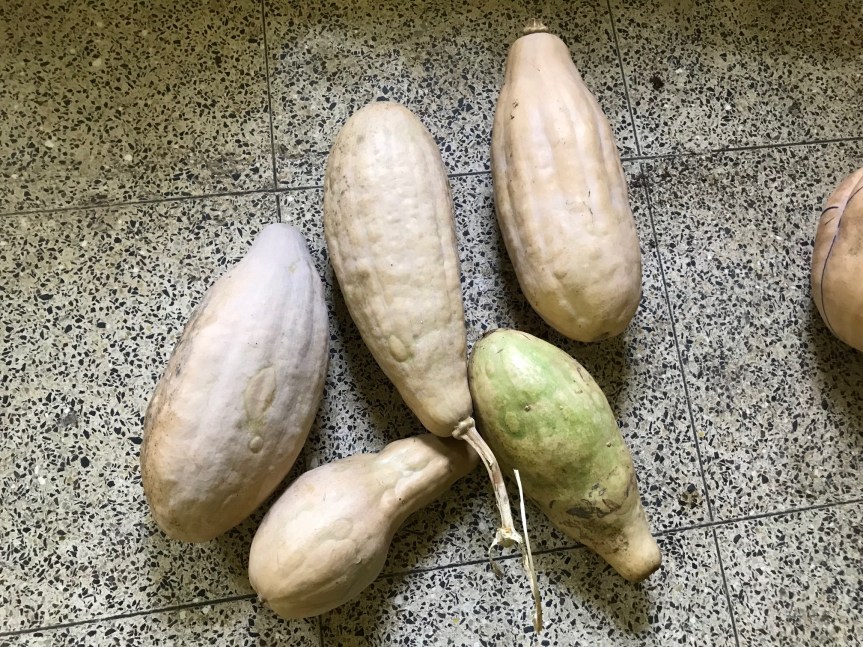
On this visit, he told me that he had been given an old Kerala type pumpkin, a pumpkin that is very rare. He used four plants that were grown from that pumpkin; two of them he grew as they were and the other two he crossed with a pumpkin from the agricultural university.  The pumpkins that grew from the old Kerala pumpkin seeds looked like this:

The ones that were crossed with the university pumpkin had similarities to the old Kerala pumpkin, but also differences.

Lokesh explained that he was crossing these varieties because when a vegetable is grown without diversity it becomes very weak and will eventually “fizzle out”. By crossing them, he will be able to develop a stronger strain of pumpkin and then will eventually breed out the university strain. The new plant will produce a pumpkin that will have the characteristics of the old Kerala pumpkin that gave it its superior quality, but it will be a much stronger plant. That process is called back dropping.

This video will give you more information about this topic:

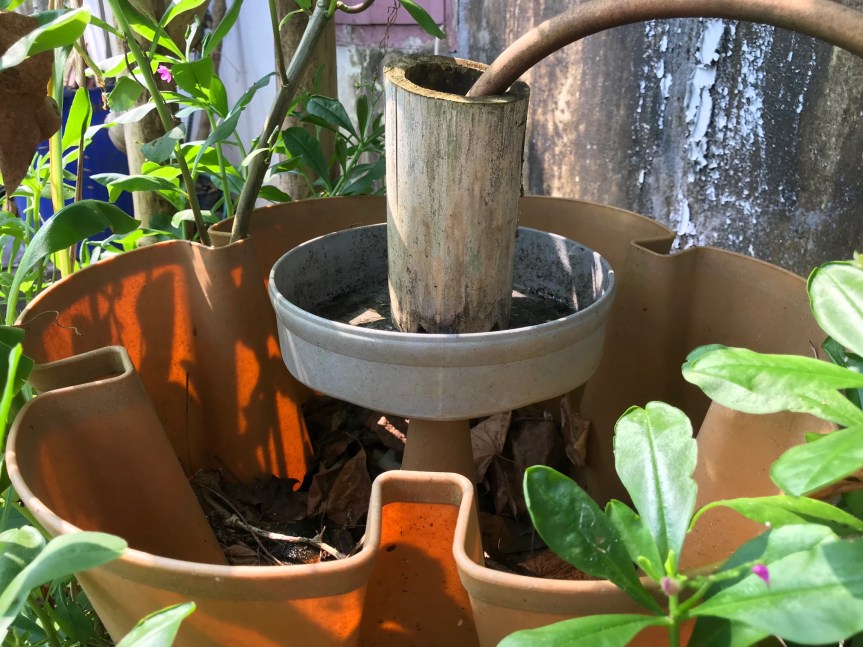
I was fascinated by two other things I saw on that day. One was a structure that provided water to a group of plants, one drip at a time. To use it, you put a bucket of water in the tub that is at the bottom of the structure. I don’t understand exactly how it works but I know that when a machine is turned on, air is pumped intermittently in a way that causes water to be pumped from that bottom tub into a container at the top of the structure. The water then drips down to the plants below it, over a week’s time.

The first photo shows the plants and glimpses of the structure I don’t know what the main plants are, but the big ones with the long leaves are tumeric plants.

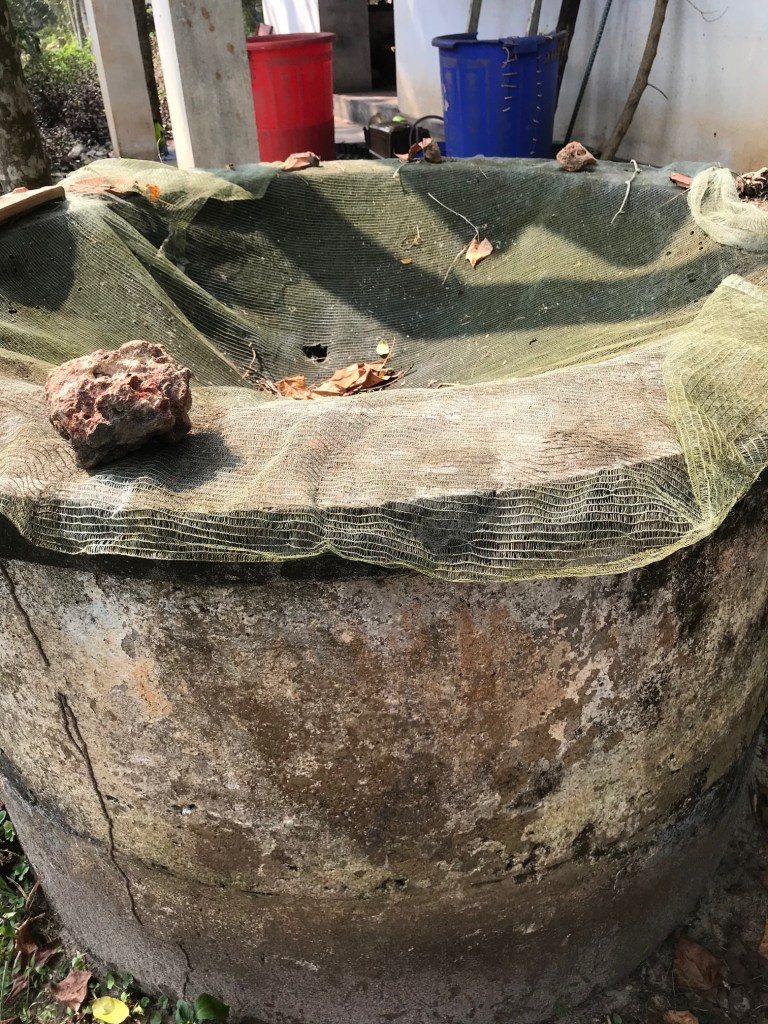
There is a well located next to the plants. Water from this well is used to fill a tub at the bottom of the structure.

The next photo shows the top part of the structure. Lokesh turned the machine on when I was there. I think some water will begin to pool in the blue-gray part after it runs for a while.)

This photo shows the body and the bottom of the structure. You will notice that the tumeric plant is drooping. That plant starts to die when it is ready to be harvested. We checked in the soil around it and could feel big tumeric bulbs.

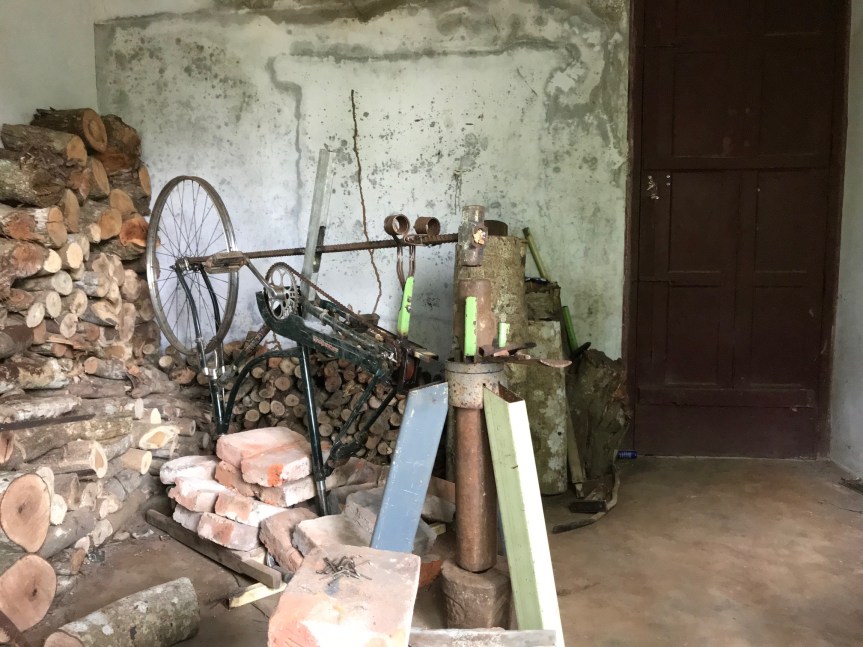
I’m going to end this post by telling you that Lokesh is creating a blacksmith shop on the property. He is inventing all sorts of things there. His most recent invention is a power hammer made from an old bicycle!

Below is a video that shows how he made the hammer. There are several other blacksmithing videos on his YouTube channel, as well as videos on many other interesting subjects.

As I imagine you can tell from my post, I thoroughly enjoyed my time at this farm and look forward to going back there the next time I am in Amritapuri.

[Note: I apologize for any mistakes I may have made in relaying the information I learned that day. These subjects are all so new to me.]

To read the previous posts in this series click here.

Living and Learning in Amritapuri, India: January 3, 2018

IMG_1002

January 3 was a particularly good day for me, full of so many things I love about my visits to Amritapuri. I decided to give the day a post of its own.

That morning, I woke up at 5:50 a.m. I showered and dressed, read and answered email, looked at the news on cnn.com, and then, at 7:15,  headed to the cafe.  Once there, I assisted with breakfast preparation and handed out meals to customers until the first rush was over. Then I ordered breakfast for myself and visited with friends while I ate.

At 9:00 a.m., I left the ashram for my next adventure. This time I was going to the seed-saving farm. I had visited that site for the first time the year before. Before I tell you about going to see it this year, let me give you some back story.

January 2017

Last January, a devotee told me about the seed-saving farm and gave me directions for getting there. He said I should walk to end of the main road in Vallikavu and turn left. After I passed the temple, I should turn right. That sounded easy but I soon discovered there were two paths north of the temple, paths that were quite close together.

I took the first path and walked a long way. After some time, I decided I must have taken the wrong one so went back to the temple and took the second  path. I walked a long way on that one too but still couldn’t find the farm. I returned to the road and decided to take the first path again; I would walk further along it this time.

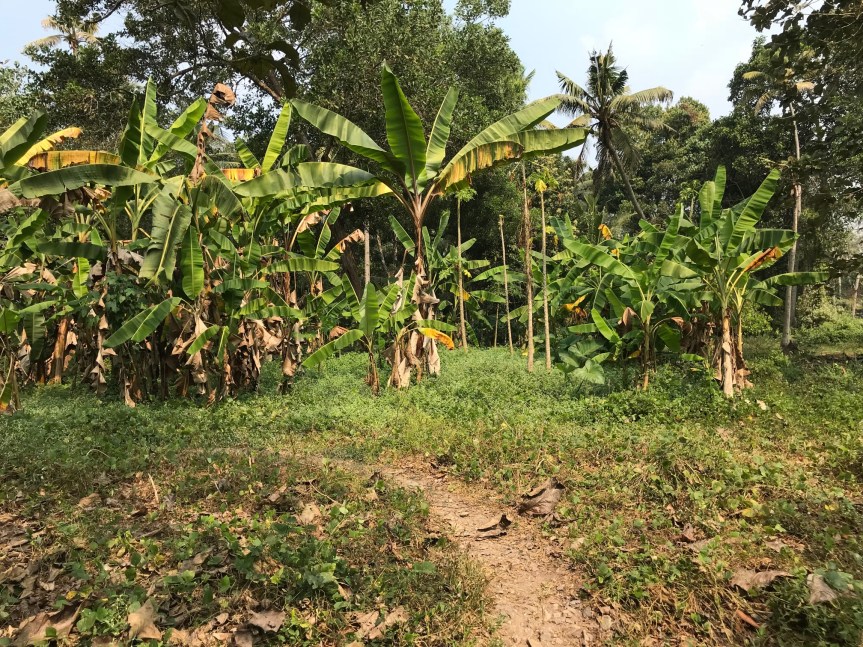
I had been told the farm would be next to a blue house. Before long, I came to a blue house where tapioca, banana palms and some other plants were growing. It was a smaller farm than I had expected, but it was very nice. No one was there, so I wandered around taking photos.
After exploring that farm, I returned to the ashram feeling very successful. When I showed my photos to the person who had given me the directions, however, he said that I had not been at the seed-saving farm; I had been on private property! He told me that the farm was further down that path.

The next day, I headed out to find the seed-saving farm and this time I found it. Lokesh, who manages that farm, showed me around and told me many fascinating things. I took lots of photos and looked forward to writing a post about the farm.

After visiting the seed-saving farm that day, I went to the tulasi farm that is closest to the ashram and took photos there as well. Then I stopped by Saraswati garden.  At some point between my visit to the tulasi farm and the time I returned to the ashram, I lost my iPhone.  I retraced my steps numerous times that day and went to various Lost and Found stations in the ashram as well, but I never found the phone. I had downloaded the photos of the private farm the same day I took them, but losing the phone meant I had lost all of the photos I had taken at the seed-saving farm and the tulasi farm. I was leaving India the next day, so there would be no way to replace them until my next trip to Amritapuri.

January 3, 2018

Back to my story about this year. I left the ashram at 9:00 a.m. on January 3rd, heading for the seed-saving farm. I took the first turn to the right after passing the temple. In time, I passed the private farm I mentioned above. I kept walking but never found the seed-saving farm.

When I realized this path wasn’t working, it occurred to me that maybe the second path had been the correct one and my memory was wrong. On my way back to Vallikavu, I came to a small road. I decided to go north on that one rather than return to town and start over. I walked a short way on the small road, stopping when an Indian man who didn’t speak English, indicated I should go the other direction. I turned around just in time to see a Western woman crossing the road not far from where I was standing. I asked if she was going to the garden and she said yes.

The gate to the farm was a short distance from the road. That was not how I entered the farm last year, but that was irrelevant. I was where I wanted to be thanks to the man turning me around and the woman crossing the road.

The area looked completely different than I remembered it. Part of the reason for that was that it is a 13 acre farm and the volunteers were focusing on a different part of the property than they were last year.

Lokesh was a bit dismayed when he saw me. He told me there are four growing seasons in Kerala and one had just ended. Everything had recently been harvested. They were just beginning to prepare for the next season, so there wasn’t much to show me. He gave me a tour anyway, and in my mind showed and taught me a lot. I will write a separate post about that garden but will share some photos below as a preview and perhaps as a teaser.

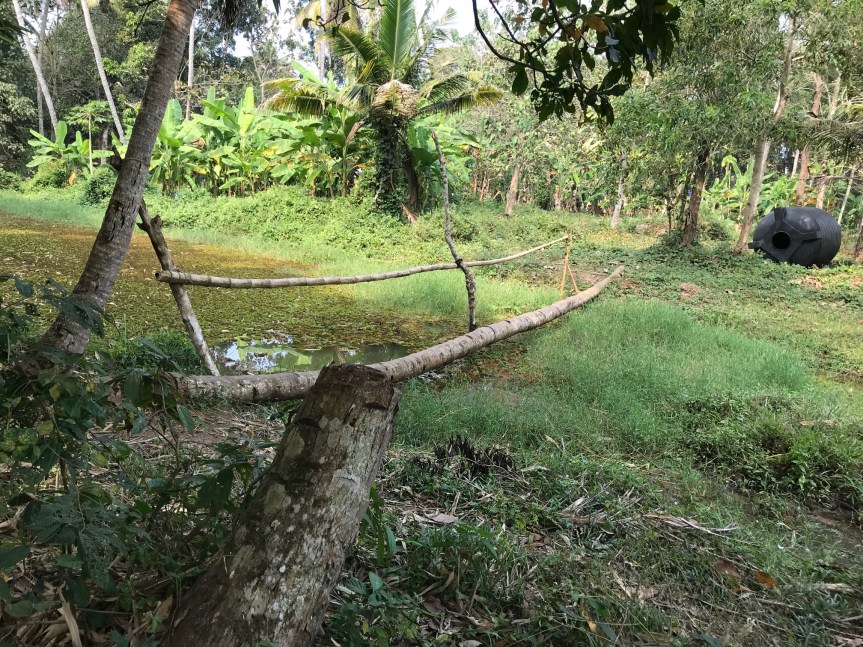
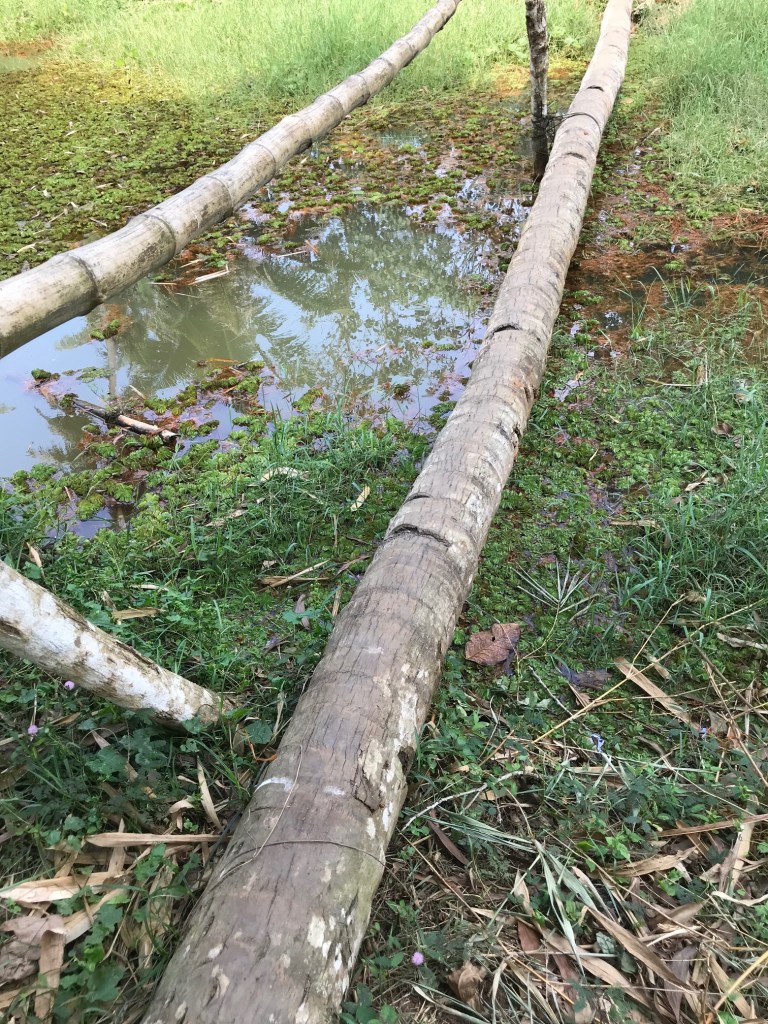
There was another reason that this farm was an important part of my day. Last year, there had been a rickety bridge that went from one section of the farm to another section. As I remember it, the bridge swayed and it was scary to walk across it. Sometime during the year, that bridge had been replaced by a new one. It is hard to call it a bridge, though,  because it was only a coconut tree that had been cut down or fallen. There was something I could hold on to as I crossed but it wasn’t as close to the tree trunk as I would have liked. I made my way across the bridge tentatively and carefully. I believed that the the water underneath the bridge was shallow but I sure didn’t want to fall into it!

As I walked back to Vallikavu, I realized I was taking a different path than when I had come. It ended up being the second path from the temple. I think I will remember how to find it when I come back later in the year.

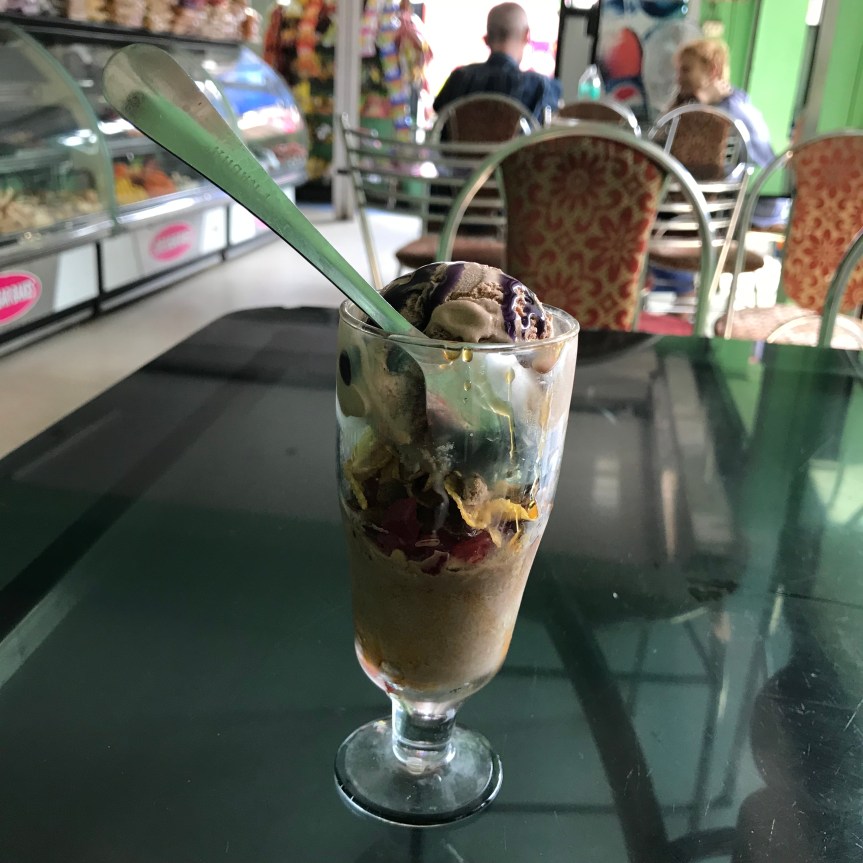
When I arrived in Vallikavu, I decided to visit this bakery. Seeing or thinking about the name of it always brings a smile to my face.

img_5712

Once there, I bought my favorite treat. (It isn’t as big as it looks!)

I returned to the ashram sometime between noon and 12:30. Lunch begins at 12:30 but I wasn’t ready to eat since I had just had a treat. I checked my phone and saw a text from Chaitanya asking if I wanted to join her for lunch at 1:30. That was a surprise, and a very welcome one. I usually only get time with my kids if I go to where they are working. I, of course, said yes!

From 4:00-5:00 p.m., I did the prasad assistant job I’ve mentioned in previous  posts. It is one of my favorite sevas. When I did it in August I was overwhelmed, partially because the job was new to me, but also because I was dealing with the stress from living with a broken wrist. This time, for the most part, it was stress-free.

When I left the stage, I decided to join the prasad-giving line so I could be the person handing Amma the ash and candy packets that she gives to those who come to her for a hug. So from 5-6 p.m. I made my way through the prasad line and ultimately had the joy of being so close to Amma and serving her in that way.

The canteen dinner doesn’t start until 7:00 p.m. and I would be working in the cafe from 7:00 to 9:00 so after giving prasad, I went to my room and made some oatmeal. After my shift, I sat in the auditorium and listened to the bhajans (devotional singing) for a while and then went back to my room.

I no doubt checked email and the news again and perhaps worked on an article I was writing for another publication. I went to bed around 11 p.m.

What an enjoyable and full day it had been.

To read the previous posts in this series click here.