Is My Path Taking a Turn?

img_5195

My favorite joke, and the only one I ever remember, is: Q: Do you know how to make God laugh? A: Tell him your plans for your life.

I think that is so true. There have been many turns in my life that I would have never predicted. If someone had told me those changes were coming, I would have said they were crazy. The most notable example is my relationship with Amma

At the time I met her, I had described myself as being somewhere between an agnostic and an atheist for 20 years. In those days, even hearing the word God made me feel sick to my stomach. I was a very logical, head based person and had no interest in spirituality or spiritually minded people.

In 1989, a new friend told me there was a woman saint coming to Seattle soon and invited me to attend her programs. My mind said NO but what came out of my mouth was OK.

My whole life changed the night I met Amma. Six weeks later, I was at her New Hampshire retreat and six months later I was in India. I have gone to India 26 times since that first visit. I have had other life plans change in unexpected ways since then, but none were as remarkable as that one.

On May 31 of 2017, I “plan” to retire. That is the time of year that Amma begins her annual North American tour so I have “planned” to attend some of those programs and then go to Amritapuri from mid-August until mid-January. I don’t remember when I developed this “plan”, but I think it has been firmly ingrained in my mind since I was in India this time last year.

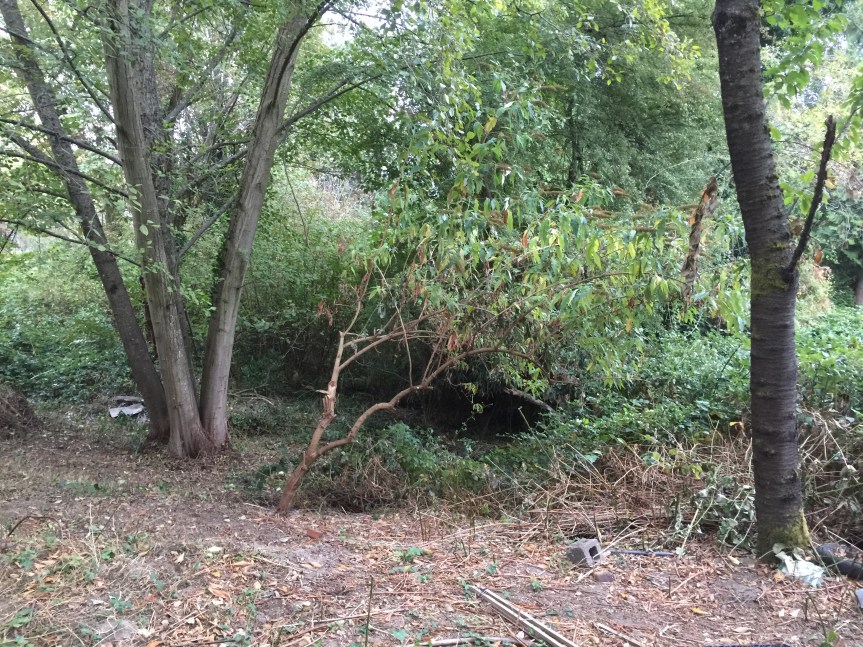
One day in August of this year, though, I woke up thinking that I wasn’t going to watch another tree in the lot behind my house die. Al,  my former husband, and I had bought that property in 1973. I sold it in the mid-80’s and it changed hands again about ten years later. When Seattle formed the Cheasty Greenbelt, that owner sold it to the city.

The property was originally beautiful but none of the subsequent owners did anything with it, so blackberries, ivy, morning glories and bamboo took over. Smothered by the invasive plants, many trees died.

After I had that early morning thought, I grabbed my shears and started to work. I enlisted my friend, Ramana, to help clear some of the land. While Ramana worked on the major clearing, I focused on freeing specific trees.
img_1112

I found so many beautiful and fascinating things on the land and know that there are many more buried under the remaining blackberries.

One day, it occurred to me that we could make this project a GreenFriends project. (GreenFriends is the environmental arm of Embracing the World, Amma’s network of humanitarian projects.) I called the people in our satsang who have coordinated our tree planting and habitat restoration work in the past. They were very interested in being involved. In October and November, they spent some time working on the lot with me.

We also talked with the Green Seattle Partnership about becoming one of their volunteer groups. In March, we will take the Green Seattle Partnership Forest Steward orientation. Once we do that, we will be able to host larger work parties.

Our project will be supervised by the Seattle Parks Department and the city will provide the saplings and other greenery that we will eventually plant there. The Park Department will do any work that requires power tools. If there is enough interest in the project, we may decide to clear all four lots that are in that strip of Greenbelt!

I feel a great deal of passion about this work and it has been on my mind since I’ve been in Amritapuri. Even before I left Seattle, it occurred to me that August and September would be prime time for working on that land and if I was in Amritapuri, I wouldn’t be available to organize the work.

I have an ever growing sense that I won’t be going to Amritapuri in August and that my path is taking a turn that gives working with nature more priority than spending extra time in India.

Starting last week, I found another thought creeping into my mind. I have kept close track of world events via CNN throughout this trip. I’m beginning to wonder if I will even make it to India next year. It seems like there is so much potential for war.
amma-and-me

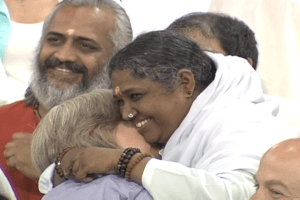
My years with Amma have taught me a lot about staying in the moment and not holding on to  plans. They have also taught me that Amma will hold me close to her no matter what comes my way. I trust that my life will unfold as it is supposed to and acknowledge that I have no idea what that will look like. What I do expect is that I will be participating in at least part of the Lokah Samastha Sukhino Bhavantu chant for world peace that will be held in the Amritapuri temple from 6 a.m. to 6 p.m. on January 1.

Lokah Samastha Sukhino Bhavantu
May all beings in the world be happy.
Peace, Peace, Peace


Weekly Photo Challenge: Path

To see all of the posts in this Amritapuri series, click here.

Letting Go of Suffering- Week 6: Using Affirmations to Heal

I often ask my psychotherapy clients what they would think and feel if they overheard a parent berating a child with the negative messages that they dump on themselves, e.g. “You are so stupid.” “Can’t you do anything right?” “You are selfish.”  “You are a disgrace.”

Clients often respond that they would feel angry and think that the child was being abused. I tell them when they speak that way to themselves, it is as if they were the parent who is abusing the child. In this case the child is their inner child. That awareness is often jolting enough to motivate clients to learn what they need to learn to stop the negative self talk.

Affirmations are positive statements which can be used to replace the negative messages you tell yourself. By using these positive statements, as one might use a mantra, i.e. saying them over and over, you can fill yourself with positive supportive energy instead of negative, discounting energy.

Below you will see two styles of affirmations. The affirmations in the first style are phrased so that you affirm the beliefs you want to have. These affirmations are stated as if they were already true. For example:

I belong

I am worthy

I am enough.

I am a competent, capable adult.

I am love.

I am lovable.

My needs are important.

I am learning and growing.

I deserve support.

The other option is to pick an affirmation that the healthy parent part of you says to your inner child. For example:

I love you.

Your needs are important to me.

I will teach you and guide you.

Pamela Levin and Jean Illsley Clarke created sets of developmentally based affirmations. Their affirmations use the parent to child style.

Pam Levin’s can be found her her book Cycles of Power. Some examples of her affirmations:

You have a right to be here.

You don’t have to hurry, you can take your time.

You don’t have to suffer to get your needs met.

Jean I. Clarke’s are in Growing Up Again. Here are a few of hers:

I’m glad you are you.

You can know what you need and ask for help.

You can learn when and how to disagree.

Creating Affirmations from Think Structures

You can use the Think Structures you wrote in Week Four and Week Five‘s Letting Go of Suffering assignments to create personalized affirmations. (The Think Structure and this affirmation structure are processes created by Pam Levin (Cycles of Power.)

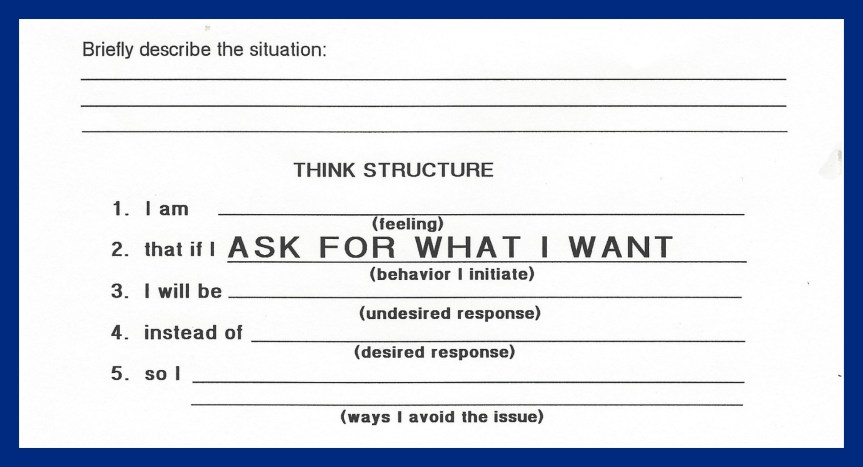
I will show you how to create affirmations using this Think Structure:

  1. I am scared
  2. That if I ask for what I want
  3. I will be ridiculed or punished
  4. Instead of being heard and supported
  5. So I pout, isolate and don’t ask for what I want.

To form the affirmation, you will use the 2nd and 4th line of the Think Structure.

So my affirmation would be:

I do ask for what I want and I am heard and supported.

Create affirmations from some of the Think Structures you wrote during the last two weeks. If you have not seen or done those assignments, consider going back to those lessons and completing them.

24b

If you like, you can use your Think Structure affirmations when you do the affirmation exercise I will describe in the next section of this post.

Another way you can  use your Think Structure affirmations is to set up life situations that will facilitate your healing. Using the example above, I could let my friends know that I am focusing on asking for what I want and would like to practice doing that with them. I could also let them know that when I ask for what I want, I would like to be heard and supported. (Being heard and supported doesn’t mean they will give you whatever you ask for. A long time ago, I practiced this exercise with someone by asking him if he would pay for my Masters of Nursing degree. He was very honoring of my request but, of course, did not agree to fund my education!)

Using the Affirmation

Pick one of the affirmations from this lesson, or create one of your own. For the rest of the week say it at least 1000 times a day; 5,000-10,000 would be even better! It is fine for you to say it internally, going as fast as you want. (A short mantra can be repeated 1,000 times or more in 20 minutes.) You can count using a tally counter from an office supply store or an app such as iPhone’s Counter +.

Even though this lesson only lasts a week, it would be best if you continue to say the same affirmation for 21 days. If you say it in the higher range (i.e. 10,000 a day or more) you may find that it starts flowing through your mind automatically. You may even wake up during the night and realize you were saying it in your sleep. Imagine what it would feel like to be listening to positive thoughts throughout the night instead of your self-critical ones.

What if my mind is fighting the affirmation?

Sometimes a particular affirmation is so far from what you believe, you may find yourself very resistant to saying it. If that is the case, take a piece of paper and make two columns on it. On the left side write your affirmation and on the right side write the negative response that comes to your mind. Keep doing that until you have written the positive one 50 times. Here is an example:

Positive affirmation               Discount

My needs are important…      No they aren’t

My needs are important…      I should be needless and wantless

My needs are important…      It isn’t safe for me to have needs

My needs are important…      No they aren’t

My needs are important…      No they aren’t

My needs are important…      That statement is nonsense

etc.

Do this two column affirmation exercise for several days if you need to and then start saying the 1,000 repetitions of the positive affirmation each day. Or do the 50 written affirmations in the morning and then say the affirmation during the rest of the day. As you continue to write and/or say the affirmation, the negative messages will decrease and then stop.

Another thing you can do when you find negative thoughts coming into your mind when you say the affirmation is to speed up the rate you are saying the affirmation. Speed it up until you drown out the negative message.

Journaling

Take a few minutes each day this week to write about your experiences with the affirmation.

Day 1

25a

Day 2

25a

Day 3

25a

Day 4

25a

Day 5

25a

Day 6

25a

Day 7

25a

See you next Monday for the seventh lesson.

To find the lessons in this series that have already been published, click here.

Letting Go of Suffering- Week 5: Why Do I Suffer? (continued)

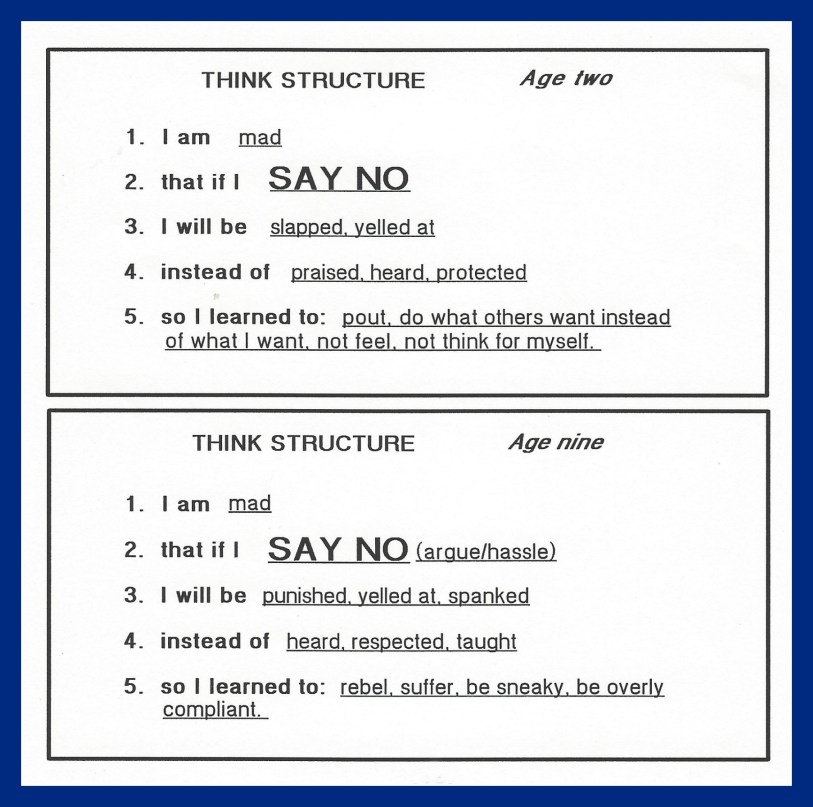
Most likely, the reason you suffer as an adult is because suffering was an acceptable method of expressing your feelings, or more accurately, a method of “stuffing” your real feelings, in your family of origin. This week you will explore some of the childhood origins of your suffery behavior. Again, Levin’s Think Structure (Cycles of Power) will be used as the tool to help you organize your thinking.

(The Think Structure process is taught in the previous lesson.)

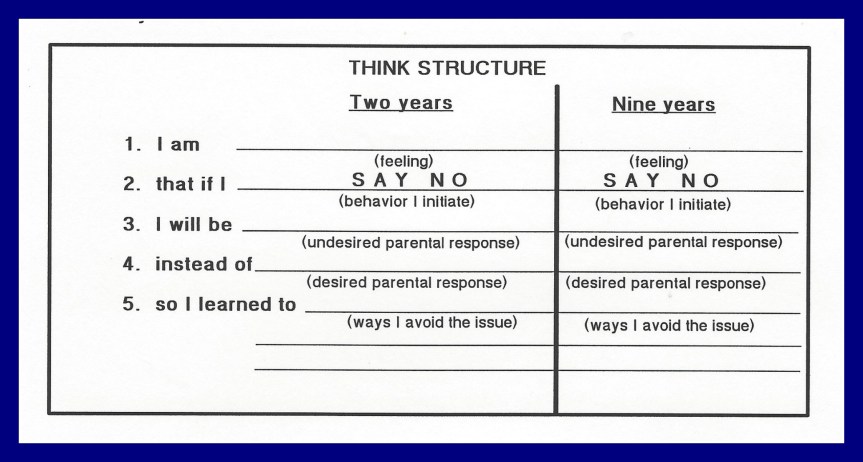
Example 1

Situation: As an adult, I have trouble saying “NO”. I will think about what happened when I said “NO” as a two-year-old and nine-year-old child.

18

Example 2

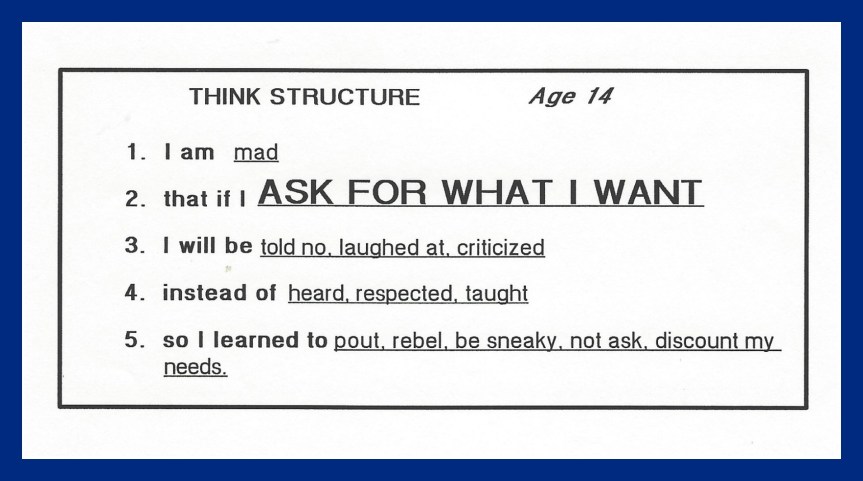
Situation: As an adult, I have trouble asking for what I want. I will think about what happened when I asked for what I wanted as an infant and a 14 year-old child.

19a

19b

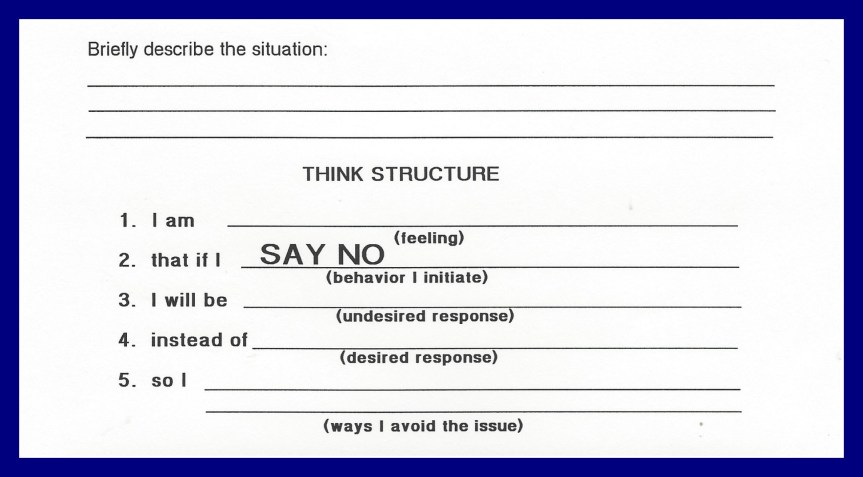
When you explore how your adult behaviors relate to your childhood, it would be helpful for you to look at one behavior over a variety of ages. In each of the examples below I ask you to look at an issue for two different ages. Fill in the blanks to come up with your own think structures.

Practice Exercise 1

20a

Practice Exercise 2

20b

During the rest of the week, complete Think Structures for some of the adult behaviors you worked on in Practice Exercise 3 in the previous lesson. Explore two childhood ages for each Think Structure. (Ages that tend to be particularly good to reflect on are infant, 2, 5, 9, 14 and 17.)

You may need to change the way you described the adult behavior in Practice Exercise 3 in the previous lesson, so that it becomes a childhood behavior. For example, if your adult behavior was “leave work early”, the child behavior might be “do what I want to do.”

21

See you next Monday for the sixth lesson.

To find the lessons in this series that have already been published click here.


Such a Special Day

img_4860

On the morning of December 15, I started to think of what I would include in my next Living and Learning in Amritapuri post. Little did I know that day would provide enough material for a full blog post.

When I returned from my morning Tai Chi class, I was surprised to discover that Amma was holding the public darshan program in the temple instead of the big auditorium. It had been years since she has done that in December since the crowds tend to be so big during the holiday season.

I went about my day, going to lunch, watching a bit of the play practice and then working for a while in the garden. When I came back to the main part of the ashram, I decided to go into the temple and join the prasad-giving line. [Note: The prasad-giver hands Amma the sacred ash and candy that she gives to each person who comes to her for a hug.]

When I entered the temple, many memories came into my mind. My first trip to Amma’s ashram in Amritapuri was in January 1990. I arrived at the ashram days after the temple had opened. The top floor was not even built yet. When I sat in the temple during those first days, I often wondered why Amma had built a temple that big. In those days, almost everyone was able to sit in the first third of the room.

amritapuri0007

It didn’t take long for me to realize that Amma had much better foresight than I did. The number people coming for her darshan (hug) grew rapidly.

In those days, there weren’t flats to live in; almost everyone stayed in rooms in the temple, or in huts outside. If there weren’t enough rooms available, visitors slept in any open space. I remember having trouble getting in or out of my room because sleeping people blocked the entrance.

A few years later, when Amma held a public program, the crowd looked like the one in the photo below. I remember at the time I purchased this photo, I considered the temple to be filled to capacity. When I look at it now, it seems like there is lots of empty space. I think there were times when nearly twice as many people crowded into the temple.

Eventually, it was necessary to build the huge auditorium that is now used for almost all of the ashram programs.

amritapuri0002

As I went through the prasad-giving line, I reflected on memories of sitting near Amma in the temple during that first visit. In particular, I remembered a time when I went into a deep meditative state and didn’t come out of it for two hours. Going that deep is so different from my current experience with meditation.

Finally, I made it through to the front of the prasad line and started handing prasad to Amma. It was truly an experience of “Home.” My eyes filled with tears. I felt so blessed.

amma

After I finished my two to three minute prasad giving shift, I walked from the inner temple where the darshan takes place to the main floor. I sat close to the front so I could get glimpses of Amma as she hugged the devotees.

Because of the back problems I have had this year, I have generally been unable to sit on the ground unless I was in a meditation chair. To be able to sit cross-legged on a tile floor for more than half an hour without having any problems was wonderful.

When I left that area, I decided to go to my room. As I walked by the darshan line, I saw that many residents and long term devotees were in the line. Generally, I go for darshan only when I arrive at the ashram and just before I leave, so I hadn’t planned on having darshan that day.

As I walked down the temple stairs, I realized it would mean so much to me to once again be held by Amma in the temple. When I reached the last stair, I stopped and reflected on the situation. Since I felt in a place of “want” instead of “need”, it didn’t seem right to go, but every time I took a step towards my flat, I changed my mind and went back to the first temple step and continued my reflection. In time, it occurred to me that I have missed many opportunities because of some standard I judged I should be following.

I had noticed the darshan token table was still open so I decided I would ask them if Amma had called for everyone to come for darshan that day. The person who was handing out tokens immediately said “Yes” and followed it with “So that means you.” He handed me a token and said “Go!” I was so happy.

When I returned to the temple, I saw that the darshan line was much longer than I had thought it was. I took a seat at the end of the line.

I had another unexpected treat in store for me. In my memory, since we started using the auditorium for bhajans, whenever Amma decided to give darshan in the temple, one or more of the senior swamis would still lead the evening bhajan program in the auditorium. I was so surprised when Swami Amritasvarupananda started singing in the temple. I was definitely transported back in time.

It took at least two hours to get to Amma, but it was well worth it. Soon, I was in her arms in the temple, just like I was 27 years ago, and for many years after that. I felt so grateful. Thank you Amma for seeing me, for loving me, and for all you have given me year after year.

It was a perfect ending to an amazing day.

To look at all of the posts in this Amritapuri series, click here.

Finding Peace in the Middle of Chaos

img_1008

It is not uncommon for my mind to be chaotic even when I am in a peaceful setting. I long to get to the point where my mind is at peace regardless of how much chaos is around me. I have a long way to go to meet that goal.

I am getting plenty of opportunity to work on that issue in my Amritapuri Tai Chi class. Tai Chi, by its nature, is meditative. It slows down my mind and body more than anything else I have ever done.

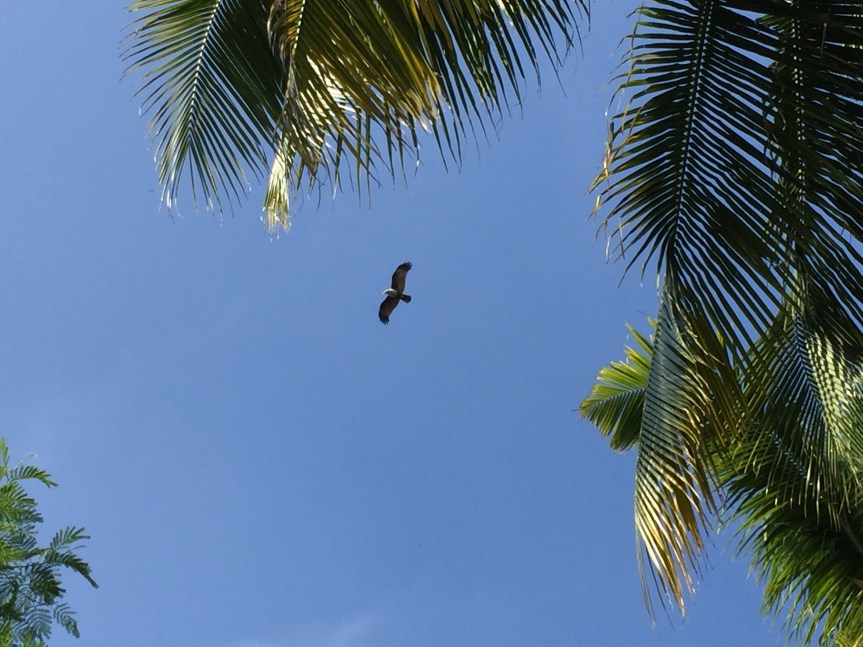
I would guess that most Tai Chi classes are held in peaceful settings with soft music playing or silence in the background. The place where our class meets in Amritapuri is gorgeous. There are palm trees, views of the beach and the Arabian Sea, eagles flying overhead, etc. As I’ve mentioned before, though, there are also trucks, bicycles, buses and cars that occasionally go through the space where we meet.

With most of life’s lessons, it seems like once you have adjusted to one level, another dimension is added. This year has definitely demonstrated that process. During my first class, I was stung by a red ant. It is amazing how much a bite by a tiny ant can hurt. In fact, the bite was still stinging hours after the class finished.

Soon thereafter, a red ant hill showed up at the perimeter of the space we use for the class, so it has been important for me to stay conscious of that danger, and to make sure new students are made aware of it. (I have stepped on a red ant nest twice in the 27 years I’ve been coming to India, once in the daylight and once at night. It is an unforgettable experience; one I hope never to repeat.)

Starting with our second class, students taking a silent meditation retreat have done a walking meditation in front of us during part of our class. They don’t disturb us but I’m tempted to watch them instead of staying focused on my own work.

In last week’s post Be Like a Bird Perched on a Dry Twig, I talked about the third class when there were even more vehicles in the area than normal. Midway through the class, a truck pulled into “our” space and parked. The workers got out of the truck and started carrying their supplies to the nearby construction site. Since their work had priority, we had  to move to a smaller area, one that was bordered by 8 ashram cows lounging in the shade!

Tai Chi is so powerful that it was reasonably easy for me to find that place of peace and contentment even in these circumstances, although I certainly didn’t have single minded focus.

On my fourth class, another set of challenges were added to those that I have already described. (BTW, the cows have not returned to the beach, at least a that time of day, since the third class.) The fourth class was held on a weekend, the first weekend since Amma returned from her European and U.S. tour. The crowds coming for darshan (hugs) were very big that day. At one point, there were 14 vehicles parked on the beach.

Then something new happened. At first, one or two village men started removing carts of sand from the beach to somewhere in the village. Next, two women started a chain. One woman would carry a big pan of sand on her head and walk to a spot next to our class. She would then shift the pan to the head of a second woman who would carry it out to the main road. We often had to divert our path to stay out of their way.

Fifteen minutes before that class was over, a cement mixer started making its piercing noise in the construction area near to us. By that time, the whole situation had become funny.

During the fifth class, a third woman was added to the chain of sand carriers. On the sixth, there were all of the previous challenges, except the cows. In addition, a new layer of sand had been added to our area 0f the beach. The sand was beautiful and felt good on my feet, but it hadn’t been compacted yet, so there was no smooth or level ground to walk on. That made doing the Tai Chi moves much more difficult.

As you can see, doing Tai Chi on the beach in Amritapuri is definitely an opportunity for me to find peace in the midst of chaos. It is also an opportunity to see the humor in the situations that arise in life.

To look at previous posts in this Amritapuri series, click here.

 

Letting Go of Suffering- Week 4: Why Do I Suffer?

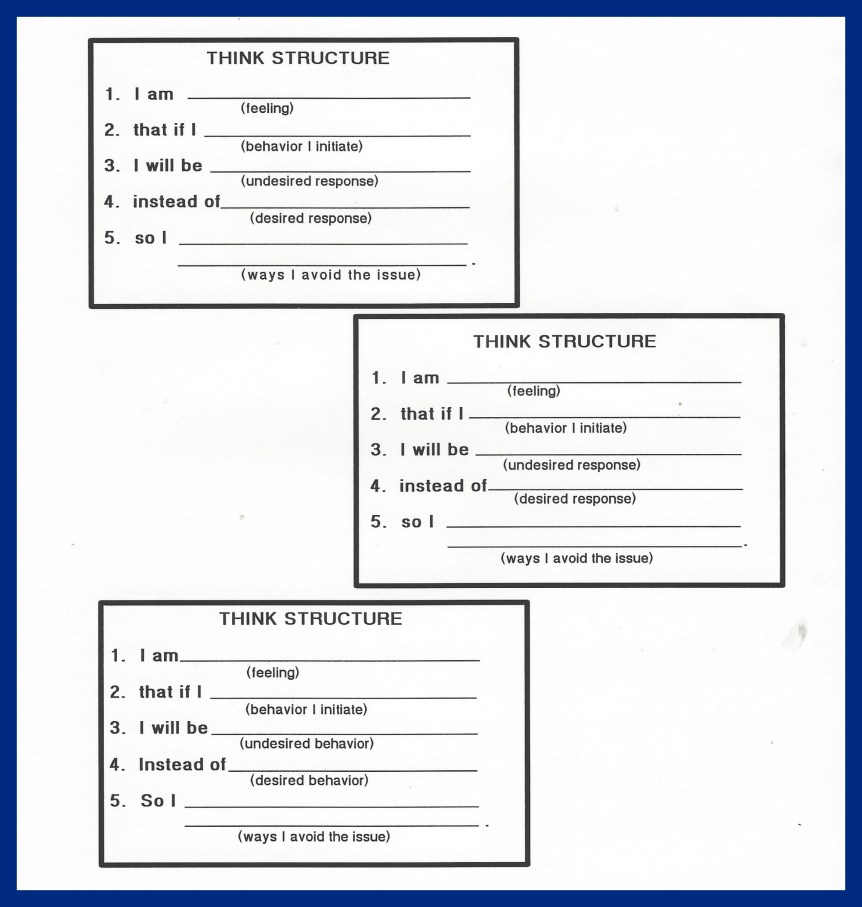
The task for this week and the next will be to explore WHY you suffer, e.g. why you are suffering now as an adult and why you learned to suffer as a child. The primary tool you will use is Pam Levin’s “Think Structure” (Cycles of Power). This structure will help you 1) organize your thinking and 2) determine what motivates or drives the behaviors that lead you to suffering.

week-3-a

Example 1

Situation: I agreed to help a friend move to a new apartment and even though I didn’t want to do it. I feel mad that I am not spending my day doing what I want to do. This would not have happened if I had said “No” in the first place, but I was afraid to do that.

think-1

Example 2

Situation: I want to go to the movie but I am afraid that if I ask my friend to go, she will say “NO” to me, so I stay home alone.

think-2

Your turn! Think of recent times when you had trouble 1) saying “NO” and 2) asking for what you want. Fill in the practice exercises below. If you can’t think of recent incidents, use experiences from the past.

Practice Exercise 1

think-3

Practice Exercise 2

think-4

During the rest of the week, be aware of times you are suffering. Use the Think Structure to help you sort out what is going on for you.  If you have no incidents of suffering during the week, complete the structures from incidents in the past. If you have trouble identifying when you are suffering, use some of the behaviors you identified in Exercise 1 of Lesson 2. Complete at least three more Think Structures this week.

Practice Exercise 3

think-5

Feel free to share or ask for feedback on Think Structures that you come up with!

See you next Monday for the fifth lesson.

To find the lessons in this series that have already been published click here.

Living and Learning in Amritapuri, India: December 8-11, 2016

img_4967

Tai Chi

We’ve had three Tai Chi classes so far. I so appreciate having the opportunity to take the daily class. In 2015, it lasted an hour; this year it is 1 ½- 1 ¾ hours. Needless to say, I’m in heaven. Being able to do Tai Chi near the beach with beauty in front and over me makes it even more wonderful.

Seva

Devotees are encouraged to do seva while they are here. Seva means selfless service, i.e. volunteer work. There is a seemingly endless number of seva opportunities at the ashram. Think about the fact that five thousand devotees live here and there may be a thousand, or more, visitors every day.

Closer to Christmas there will be 1600 Western visitors plus thousands of Indians. Imagine what it takes to feed and house them, and you will get a sense of the amount of work that needs to be done.

My seva has taken an unexpected turn. For many years, I have helped sew the costumes for the Christmas play. I have experienced an increasing amount of resistance to that job over the last few years, but have continued to do it because the work needed to be done and I wanted to support Jani who is in charge of the costumes and Chaitanya who produces the play.

A few days ago, two friends of mine invited me to join the Sanskrit class they are taking. I had stopped studying Sanskrit about eight months ago. The Indian students learn so fast, since their native languages have a lot of Sanskrit in them, so no matter how many times I take the classes, I reach a point where I am unable to understand the teacher or the students (the classes are all taught in Sanskrit).

My friends’ invitation re-ignited my desire to learn that language. I knew there was no way I could add anything to my schedule without giving something up. I was also concerned about how I would fit in the significant amount of homework the teacher gives.

As I pondered this situation, I started ripping out Velcro from old costumes. My head was lowered as I used the seam ripper on the tiny stitches. My neck started hurting and before long I had a painful headache. All of a sudden, I was flooded with, “I DO NOT want to do this work (i.e. sewing) anymore.”

My desire to stop was stronger than my desire to help Jani and Chaitanya. I told both of them what I had decided. Neither of them was upset that I was not going to help. I was filled with relief and felt so much lighter. (I generally have no trouble saying NO but this situation was an exception!)

I’m still deciding about the Sanskrit class. I have the homework for the next class and will see how long it takes me to do it. The class meets for an hour on Tuesdays, Wednesdays and Thursdays.

Now that I have stopped sewing, I will spend time every day working in the Saraswati Garden. I am very excited about that seva.

Schedule

My schedule is becoming more settled.

6:00-7:30 Wake up, shower, clean room, do laundry, check email, check CNN, check blog, work on blog posts or other computer projects.

7:45-8:30 Breakfast

8:45 -9:20 More of the above

9:30-11:30 Tai Chi (every day but Tuesday) I consider Tai Chi to be my form of spiritual practice.

12:30- 1:00 Lunch  (On Tuesday Amma comes for meditation, question and answers and then serves lunch. That process generally goes from 11:00-2:00.)

1:00-2:00 Watch play practice

3:00ish-5:00 Saraswati Gardens (If I take the Sanskrit class I will start earlier and leave earlier on those days because it is a 20-minute walk to the class.)

5-6 Sanskrit class on Tuesday, Wednesday and Thursday

5:30-6:30 Meditation and Q and A with Amma at beach… on Monday and Friday

6:30-8:30 bhajans (singing)

8:30-9:00 dinner

9-10:00 check email, work on blog

10:00 or 10:30 bedtime

Wednesday, Thursday, Saturday and Sunday are Amma’s public darshan days. They start around 10:00 a.m. and can go until 1 or 2 the next day; they rarely end before midnight. My goal is to give Amma prasad and/or spend some time watching her at some point during each darshan day.

Breakfast visitor

A Kingfisher bird was perched near the table where I had breakfast yesterday. I thought it was stunning. I found a photo to show you on Wikipedia.

alcedo_azurea_-_julatten

White flowers of peace

Every time Amma leads a mediation, she asks us to visualize white flowers of peace falling onto every person, animal, and plant on earth. When she does that, I always think of all the beautiful white flowers I have seen in Amritapuri.

Saraswati garden

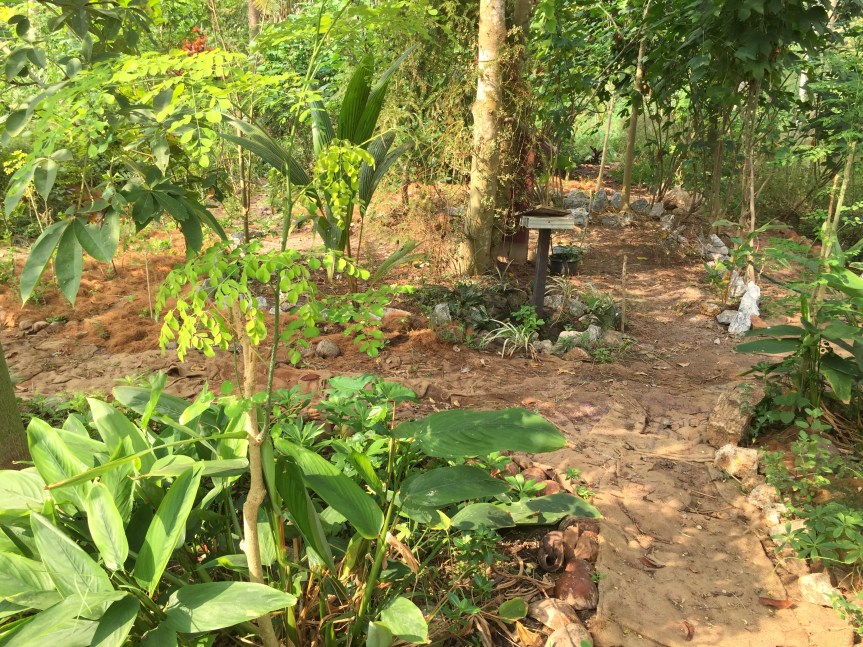
I love the path that leads to the Saraswati garden.

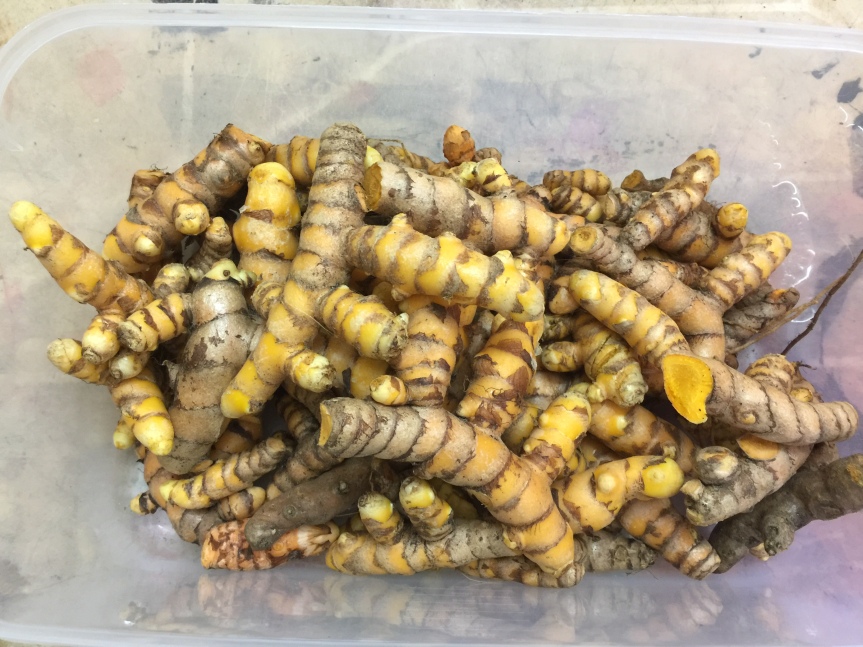
In a previous post, I mentioned that the garden staff had tried to harvest turmeric root earlier in the week but when they only found a few small roots they decided it wasn’t ready. The next day, they realized they needed to dig deeper. When they did, they found lots of roots; roots that were ready for harvesting.

img_4992

Yesterday, Padma cooked and then sliced them. When I went to the garden today, I saw that she had set them in the sun to dry.

Some days I work in the garden and sometimes I help Padma with the dye project. Twice, I’ve gathered and petaled marigold flowers.

One of the items they are making in the Saraswati center are prayer flags. If I remember right, the material at the top of the photo below was dyed with marigolds, and the one on the bottom was dyed with turmeric. img_5021

The last two days, I’ve helped research ways of making paint from marigolds.

Christmas Eve play

The play preparations are well underway. There are rehearsals going on all day, from morning to late at night. (Play participants also do their sevas so they have a very full day.)

Individual scenes are being rehearsed now and then the week before Christmas they will all be put together. I have watched at least part of a rehearsal every day, and when I am in my room at night, I can still hear the singers practicing. For a few minutes tonight, I watched the cast practice one of the dances.

The backdrop for the play is being painted on the porch of the Saraswati garden so I have been able to watch that process as well. I think it is beautiful.

img_5040-1

To look at previous posts in this Amritapuri series, click here.
Be Like a Bird Perched on a Dry Twig

european-bee-eater-852588__480

Amma tells us to be like a bird perched on a dry twig, ready to fly at a moment’s notice. That doesn’t mean that we should live from a fear based hyper-vigilance but rather we need to learn to live consciously, adapting to each change that comes our way.

Amma gives us a plenty of opportunities to learn that lesson, some directly, and some indirectly. I am going to share two recent experiences that were, in my mind, chances to practice that teaching.

Giving Prasad

In an earlier post, I mentioned that we are able to hand Amma the prasad that she gives each person who comes to her for a hug. For as long as I can remember, the type of prasad she has given in India has been a piece of hard candy wrapped in a packet of sacred ash. We have handed her those packets three at a time.

When I received the instructions for giving prasad on Wednesday, I was told we would be giving Amma chocolate Hershey’s kisses wrapped in an ash packet instead of the hard candy packets. Those would be given to her two at a time since the Hershey’s kisses are so much bigger than the hard candies.

When I joined the prasad line on Thursday, I was told that we would be alternating what we would give Amma. The first time we handed her prasad, we would give her three packets with the hard candy and ash. The next time, we would give her two packets with the Hershey’s kisses and ash.

When I reached Amma, however, I discovered that the devotees were handing her two packets, one with a Hershey’s kiss and ash, and one with the hard candy and ash. Amma had changed the instructions yet again!

I laughed at the leela. I laughed even more when I received my own hug that night and Amma handed me a flower petal and a Hershey’s kiss. That is the type of prasad we receive during the North American tour, but to my knowledge it has never been the custom in Amritapuri.

To me, this was a good example of being the bird perched on the dry twig. We had to be ready for the type of prasad to change at any moment and adjust accordingly.

Tai Chi

The second example occurred during my Tai Chi class. Soon after I arrived at the ashram this year, I visited the beach area we had used for the class last year. I found it full of construction debris. A few days later, it had been cleaned up so it seemed like we would be able to meet there after all.

Even in the best of times, the class is interrupted by an occasional truck, bicycle, or bus that wants to go through that area. Today was one of those days when so much came our way that it got funny. It was another darshan day, but this time the crowd was huge. When we arrived for the class, there were already two parked buses in the area. They bordered the space we were planning to use. Once the class started, two more buses drove onto the grounds and parked nearby.

About half way through the class, a truck with some construction supplies tried to go through our area to the building beyond. There was no room for them to do that, because of the parked buses, so the driver just parked in the space we were using and started carrying the supplies to the construction area. Clearly, we had no priority.

There are two other areas on the beach that could potentially work, but there seems to be a new routine at the ashram. When the ashram cows are walked in the morning, they are taken to the beach and tied to trees, where they “hang out” for hours.  Today there were eight cows in that area of the beach.

What could we do? We would have to hold our class a few feet from the cows.  So we did just that. And I loved it!

When we become like a bird perched on a dry twig, ready to fly at a moments notice, we are able to adapt what comes our way. Each challenge is an opportunity to practice detachment, surrender, equanimity, patience, persistence and flexibility.

To look at previous posts in this Amritapuri series, click here.

Amma Quote

16-newyear-2

The success of one’s life depends upon one’s ability to forget what is not relevant at the moment.  

Amma

Letting Go of Suffering: Week 3- What Would Your World Be Like If You Didn’t Suffer?

Walt Disney once said, “If you can dream it, you can do it.” Many years ago, Pam Levin taught me that the first step in manifesting your vision is to have one.

The exercises for this week are devoted to imagining what your life would be like if you didn’t ruminate about the past, worry about the future or do the unhealthy behaviors that you know make you miserable.

Exercise 1

Identifying Your Vision

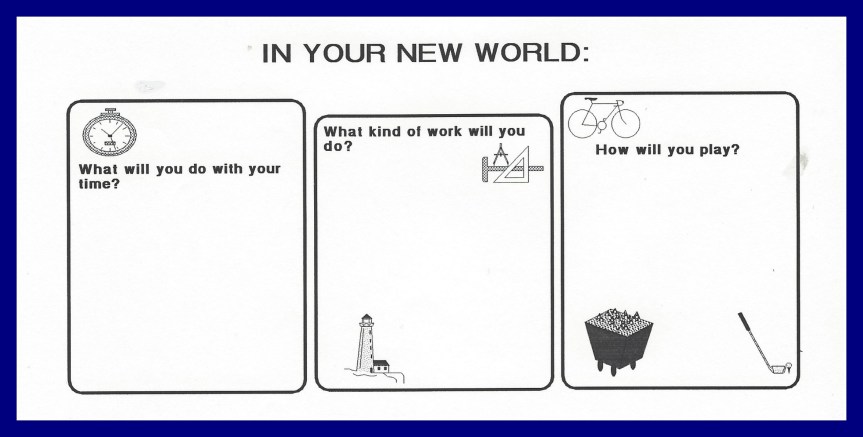
Take a few deep breaths. Focus on “breathing in relaxation” and “breathing out tension.” Let your body settle into the chair you are sitting on, or the bed or floor on which you are lying. As you begin to relax, let yourself imagine what your life would be if you were no longer immersed in suffering.

Let the images come and your new world develop. When you are ready, bring yourself back into the present and then answer the questions in this exercise. If you need to, close your eyes and go back into your new world to get the answer to a question.

vision1

vision2

Exercise 2

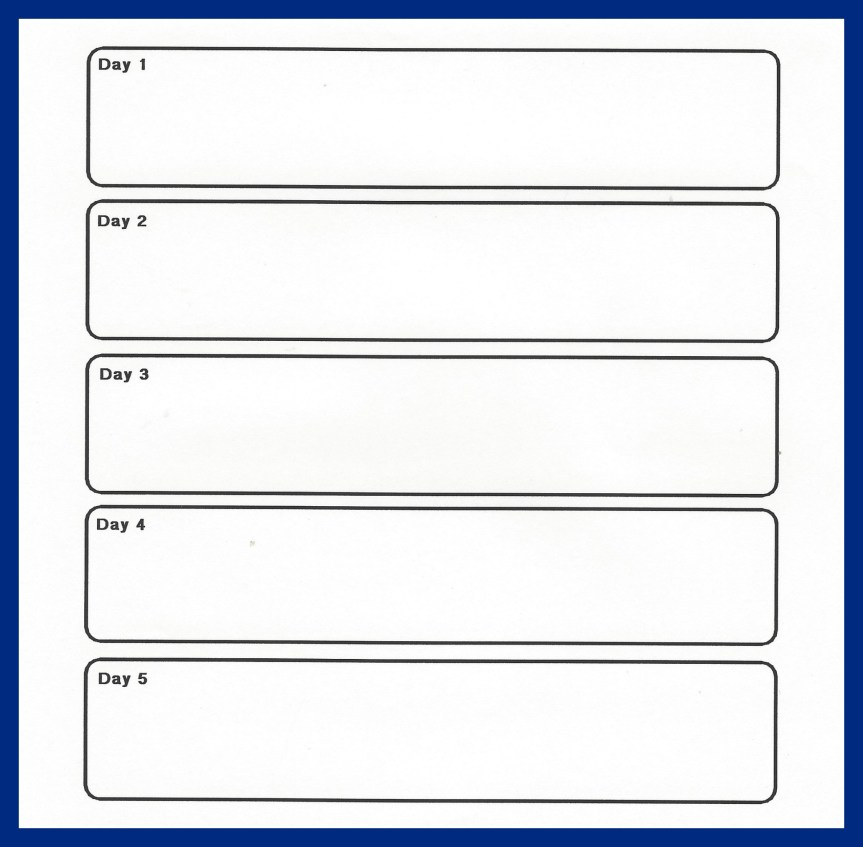
To make your vision become a part of your life, spend 10-30 minutes a day for the next five days putting yourself into a meditative state (through breathing slowly and allowing yourself to relax) and then experiencing your new world. Feel what it feels like to live there. Experience whatever you experience. Let your new life develop in your mind’s eye. Jot down some notes in the spaces below.

vision3

As you identify other components you would like to have in your new world, add them to your vision. Periodically, throughout your life, refer to the two exercises in this lesson to see where you are in creating that vision. Each time, see if there are areas you want to add, or parts you want to let go of. Decide which part of your vision you want to work on next. Don’t feed suffering by expecting your life to change all at once. You will create you vision one day, or even one step, at a time.

See you next Monday for the fourth lesson.

To find the lessons in this series that have already been published click here.