
Wordless Wednesday

This past summer, during Amma’s Chicago programs, ideas for how to design one of the planting areas in our Seattle forest restoration site started coming into my mind. The next day, I walked to the children’s program room, borrowed colored pencils and graph paper, and drew that design.
When I returned to Seattle, I transferred the design onto the ground as best as I could. It took hours and hours to accomplish that task as I was trying to lay it out perfectly. When I finally finished, I started laughing at myself. It had taken me that long to create placement for 12 plants. We had ordered more than 300 shrubs and ground covers. Clearly, that was not how I was going to maketo make planting plans for the whole site.
I enjoyed having “my area” though and dreamed of what it would look like in the future. This fall, I started noticing how often branches from nearby trees fell into “my area”. I also noticed that I was only seeing them in “my area”.
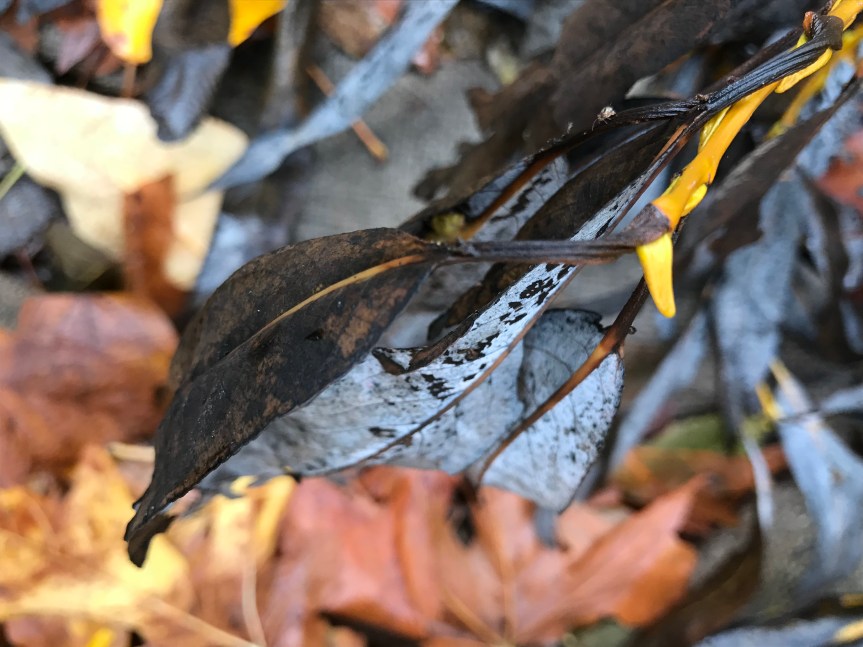
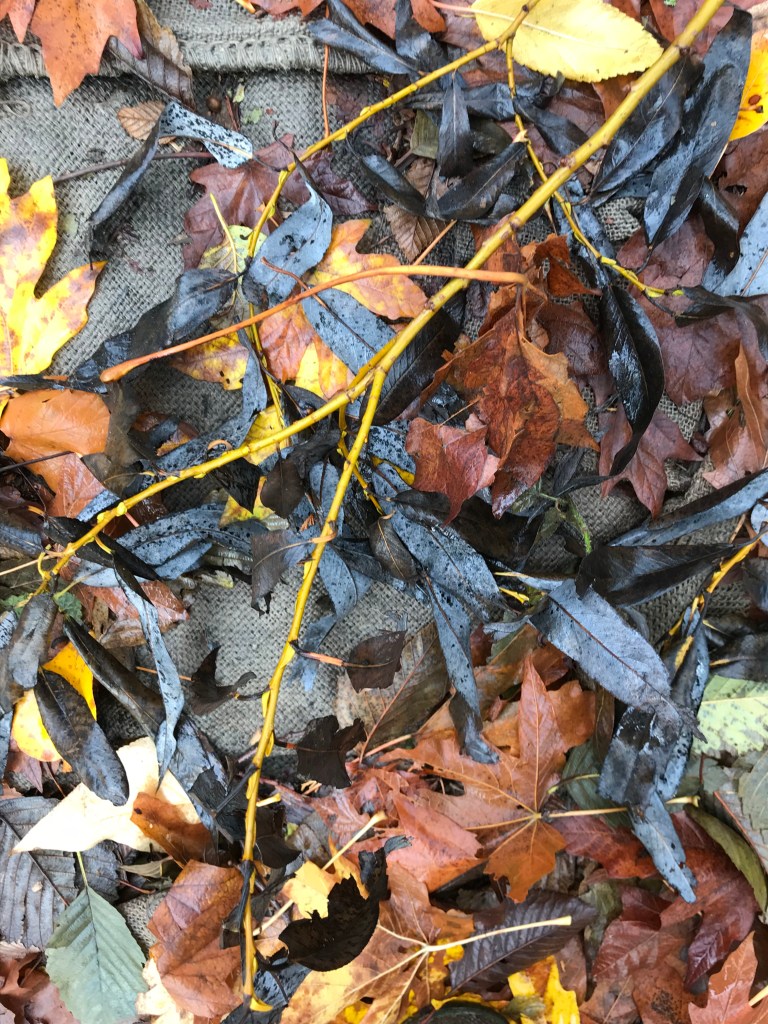
A few weeks ago we had a wind storm. In the photo below you can see some of the branches I took out of “my area” after the storm.

On November 15, we had the big planting work party. It was wonderful to finally have the native plants in “my area”. I day-dreamed about what the area would look like in the Spring.

Then I had a horrifying thought: “Those falling branches could kill ‘my plants’!” I’ve been resisting the apparent fact that in forestry 50% of what we plant may not survive. In fact, I haven’t dealt with it at all because I believe “our” plants will be different. And I hadn’t even considered the possibility that any of the plants in “my area” would die.”
At that point, I took a good look at the terrain surrounding “my area”.

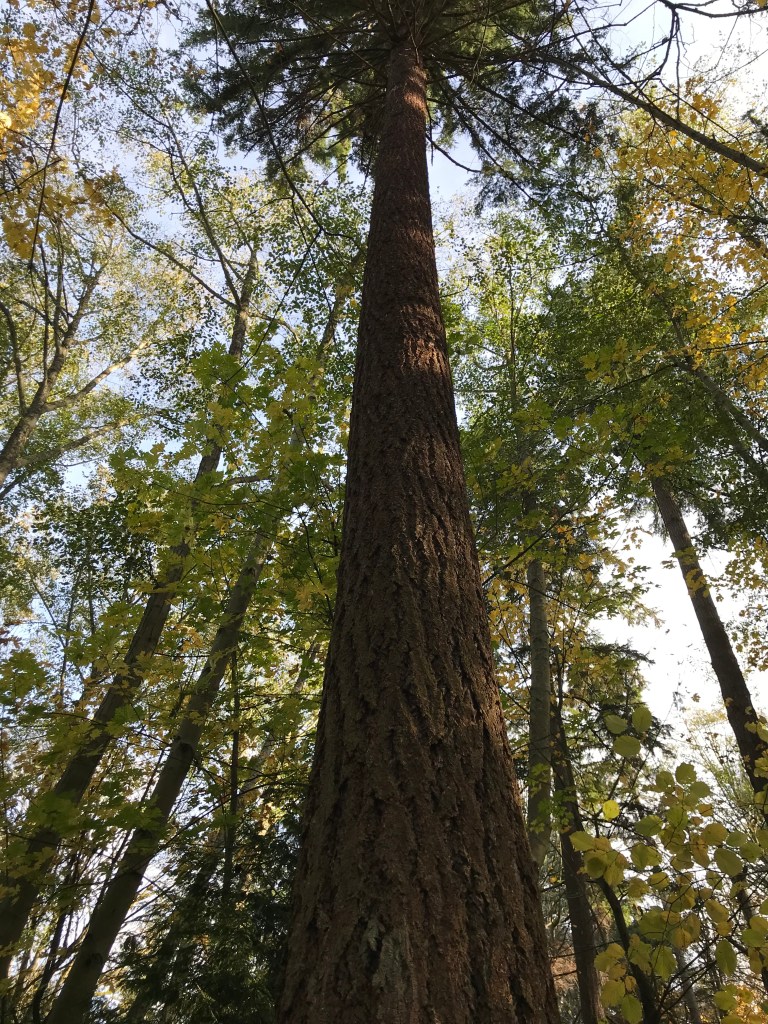
The trees are really tall, they are old, and “my area” is closest to them.


As I reflected on this situation, I had many thoughts.
As I was writing this post, I thought about the title that the Green Seattle Partnership gave those of us whom they trained to lead forest restoration work parties. We are called Forest Stewards. I decided to look up steward to see exactly what the word means. Merriam-Webster Dictionary defines steward as “a person hired to perform household or personal services.” It gives these words as synonyms: “domestic, flunky, lackey, menial, retainer, slavey, servant”. That’s it. I am not an owner, I am a servant of the forest.
I am a Forest Steward.
Last night, Sreejit posted the summary of his Rage Against the Machine event. He did it in a new way in that for each post he included a quote and one of the comments that a reader made. I think that is a valuable way to help new readers choose which posts to look at, so I’m passing his summary on to those of you who read my blog.
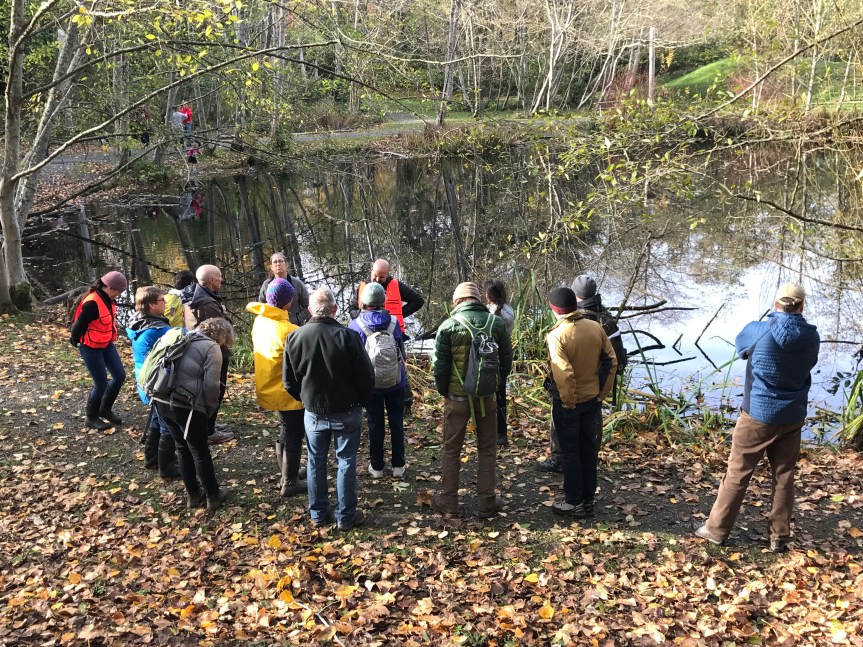
On November 18, I took a three hour Wetlands Best Practices class that was being offered to Green Seattle Partnership Forest Stewards. The class was held at Discovery Park. Seattle.gov says this about Discovery Park:
Discovery Park is a 534 acre natural area park operated by the Seattle Parks and Recreation. It is the largest city park in Seattle, and occupies most of the former Fort Lawton site. The site is one of breathtaking majesty. Situated on Magnolia Bluff overlooking Puget Sound, Discovery Park offers spectacular view of both the Cascade and the Olympic Mountain ranges. The secluded site includes two miles of protected tidal beaches as well as open meadow lands, dramatic sea cliffs, forest groves, active sand dunes, thickets and streams. The role of Discovery Park is to provide an open space of quiet and tranquility away from the stress and activity of the city, a sanctuary for wildlife, as well as an outdoor classroom for people to learn about the natural world. Maintained in its semi-natural condition the park will continue to offer a biologically rich and diverse natural area for urban dwellers and an unmatched opportunity for environmental education.
The park is immense. I can’t even imagine being a Forest Steward for this much property. My mind is totally occupied by the little patch of Greenbelt that I am a Forest Steward for and it is just under an acre in size.
The class began with a lecture by Doug Gresham, a Wetlands Specialist at Washington State Department of Ecology. The lecture portion was held in the park’s Environmental Learning Center.
I was very interested to learn that wetlands have many functions. Among them are:
We were told many ways to identify wetlands, the time of the year that it is appropriate to work there, the types of plants that will do well in wet soil, and much more. After the one hour introduction, we took a break and then walked into the park. Michael Yadrick, one of the Seattle Parks Department Plant Ecologists, led the experiential part of the class. Doug Gresham, whom I mentioned before, Lisa Ciecko, the Seattle Parks Department Plant Ecologist who supervises my work, and Elizabeth Housley the person who organizes trainings for Stewards who work with the Washington Native Plant Society and/or the Green Seattle Partnership, also participated in the outdoor segment.
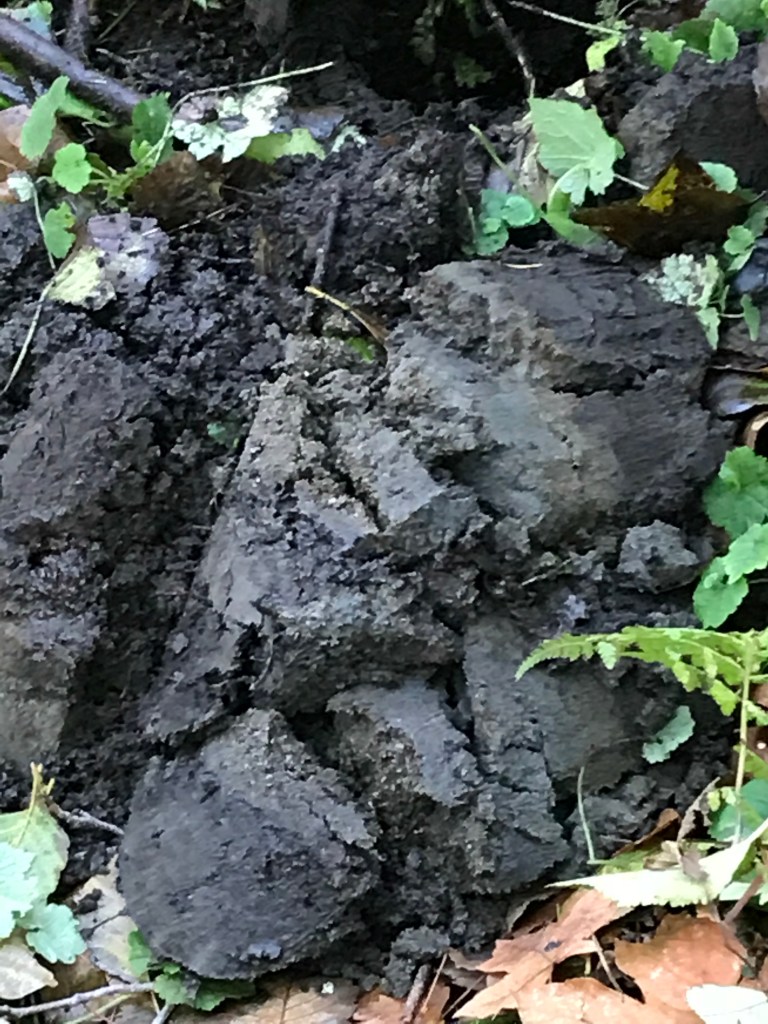
Doug had taught us how to identify wetland soil. On the walk, he dug up some dirt and showed us the difference up close. This first photo is of dry, sandy soil that came from a slope on higher ground.

The wetland soil looked dramatically different. I think the photo below makes that point even though it is not as focused as I would like it to be.
There are many different types of drainage systems for dealing with underground springs. The first one we saw was quite artistic. It consisted of a series of these structures. The series started close to the top of a hill and then similar structures were placed along the slope, each one draining into the next.
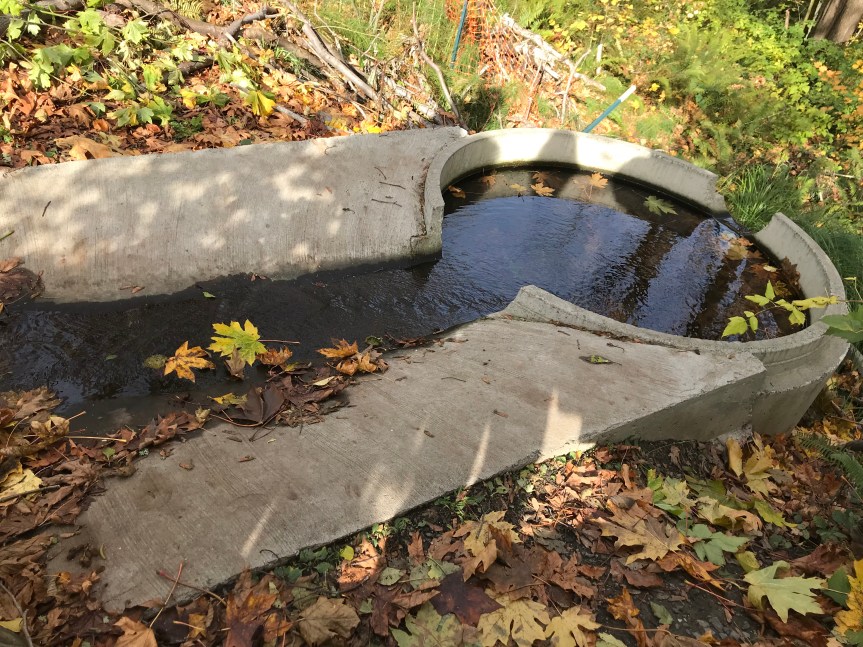
Further on in our walk we saw another type of drain.
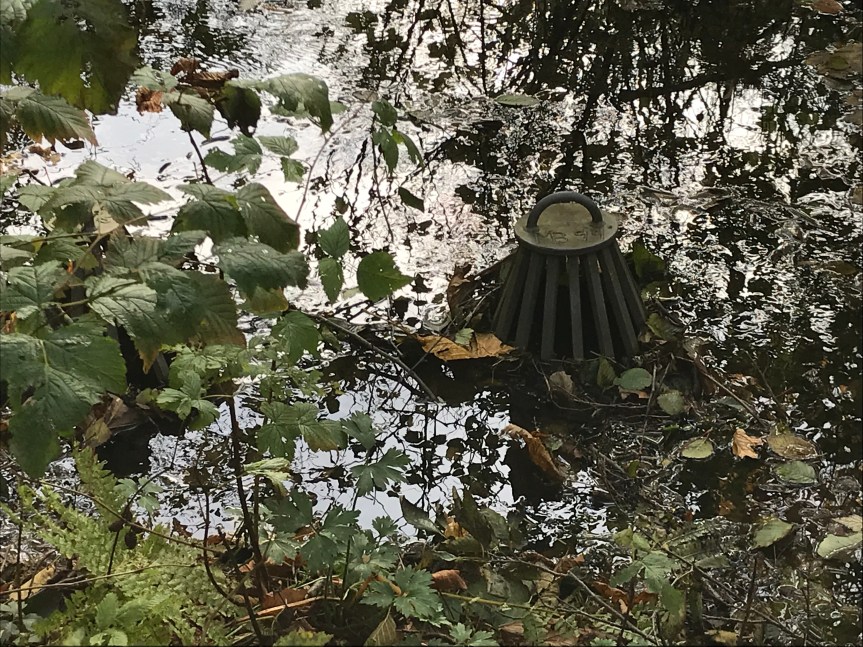
And then another. This one is more like the drains I have seen in the past.


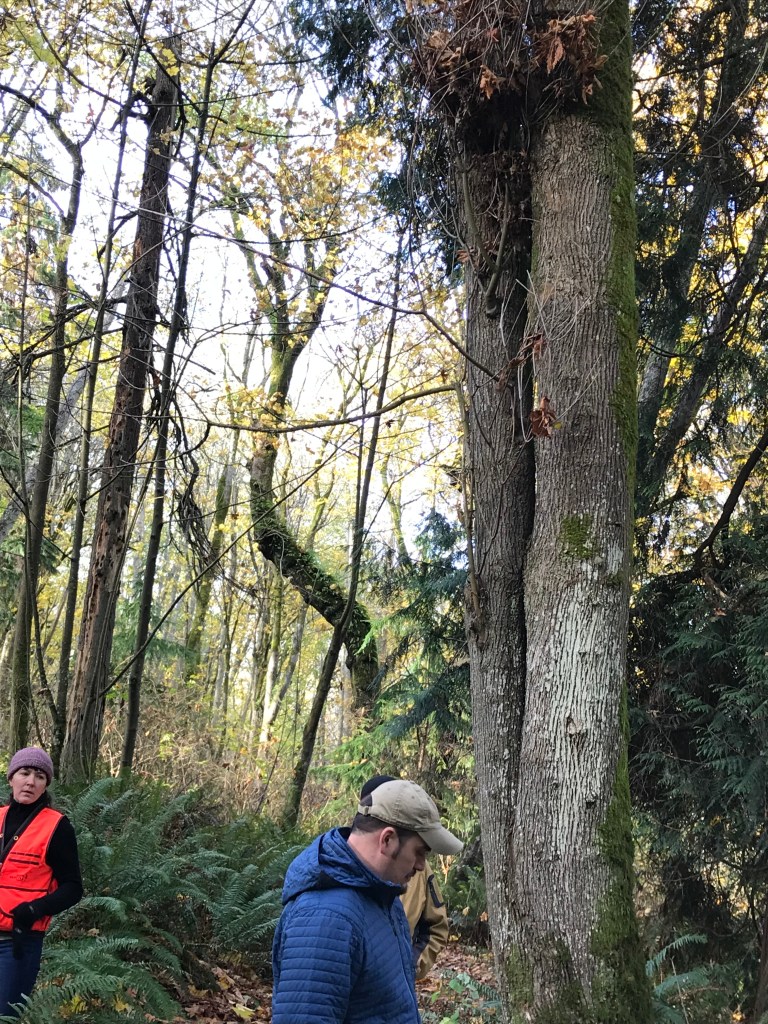
We saw trees that were growing diagonally. Someone speculated that they grew that way because the dirt is so wet that it can’t support the weight of the tree trunks.


I wondered if the shape of the tree in the background of the photo below was the result of the wet land or if it occurred because the tree was seeking more light.
We were shown different types of wet lands and also land that was in different stages of restoration. At one point, we were taken to an area that had not been worked on at all. We were asked to spread out and explore the land, talking about how we would handle the restoration if we were in charge of that project, i.e. what area would we work on first, how many volunteers would we want to have, etc.
As we were walking back to the Environmental Learning Center, we saw some interesting plants. Someone said they thought this gigantic shrub was a huckleberry. Another person guessed that it was boxwood. I had never heard of boxwood before.


On our way out of the park, another shrub caught my eye. It was the white one in the photo below. I asked what it is called, and learned that it is known as Pearly Everlasting. The shrub in the foreground is really beautiful too. I will have to find out what it is. I hope they will both be available when we make our 2018 plant order!

There is no way I can share all the information that was given to me in this post, but hopefully I at least gave you a tiny glimpse of what I learned about wetlands during the class. I look forward to studying more about them in the future.

Wednesday, November 15 was a big day, one I’ve been eagerly awaiting. On that day, a corporate group from DocuSign came to our restoration site to plant the 330 shrubs and ground covers Seattle Parks Department had given us. November 15 was DocuSign’s Global Impact Day. I looked up the philosophy behind Global Impact and found this:
We believe character is defined through action. With DocuSign IMPACT, we are committed to putting this character into action by harnessing the power of DocuSign’s people, products, and profits to make a difference in the global communities in which our employees and customers live and work.
On that day, buses picked up the employees at their corporate headquarters and traveled to projects all over the city. I felt so grateful to have 42 of their volunteers helping us; and they were wonderful people to work with.
(Note: You might be wondering why we plant at this time of year. In the forest, planting starts after the fall rains begin. That way the plants have a chance to root before the summer comes. We’ve had almost no rain during the summer for a few years and there is no water source on this property. The plants have the best chance of survival if they have developed a healthy root system before the dry period.)
Prior to the work party, we prepared eight planting areas. Any remaining blackberry vines and rootballs, ivy and bindweed were removed and the areas were marked off with green and white, or yellow and black, tape. The University of Washington students who helped during our November 11 work party moved the potted shrubs and groundcovers to the areas where they would be planted.
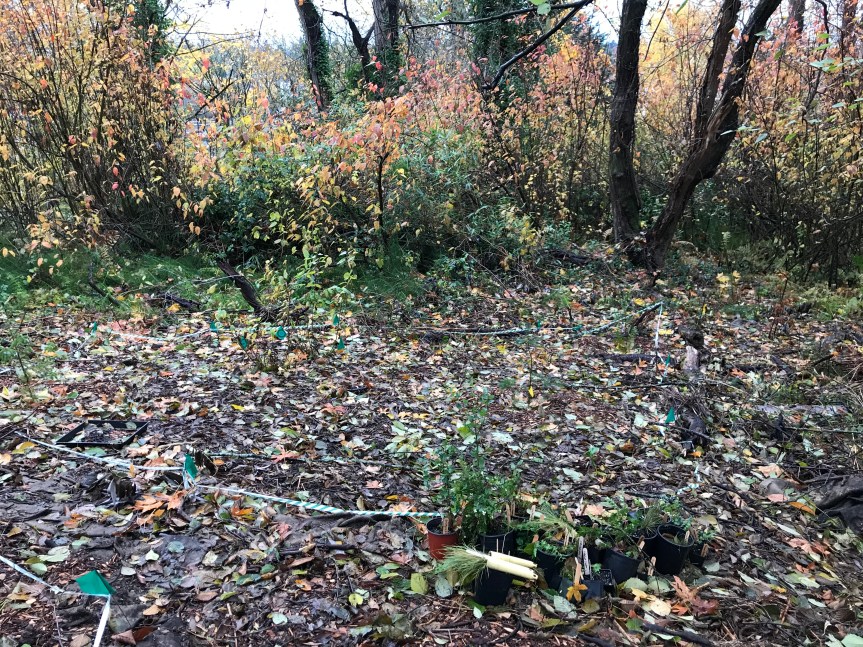
The photo below is of the Dogwood Area, so named because it is near a large area of red twig dogwood and because a small patch of red twig dogwood came up within this planting area during the summer.


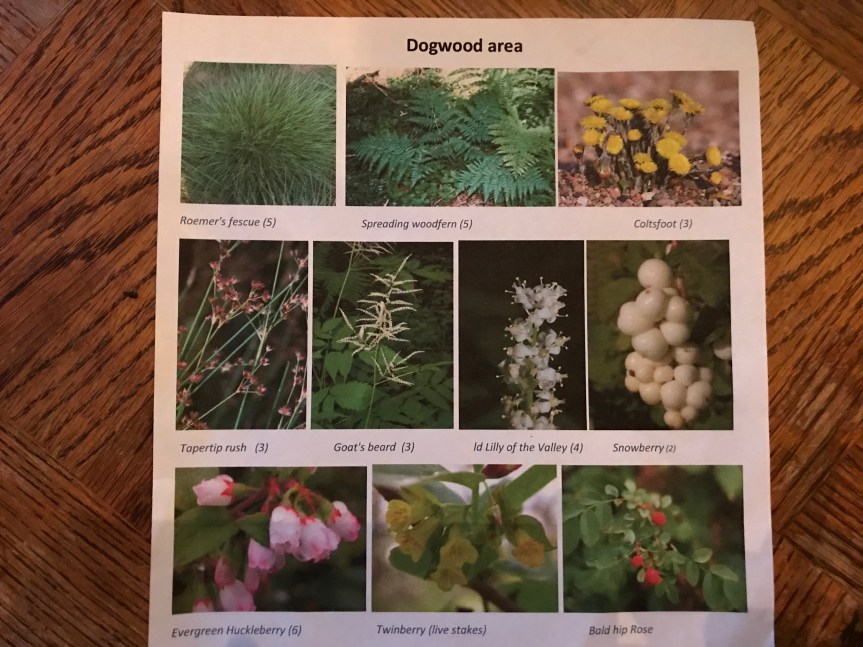
Another way we prepared for the work party was to create and distribute photo galleries of the plants that would go in each area. That way the workers could see the beauty they were helping to create.
I already mentioned that the DocuSign group was wonderful to work with. We had a dream staff too, consisting of Joanna Nelson de Flores, the director of Forterra’s Green Cities program, Nichole Marcotte, Forterra’s Stewardship Coordinator, Anavadya Oravec a Master Gardener and GreenFriends member and me! The staff arrived an hour and a half early so I had a chance to show them around the site. We spent part of our November 15th pre-work party time placing each plant on the spot where the DocuSign employees would plant it.


When the participants arrived, I talked about the history of the project and gave information about safety relating to this particular site. Then the group was divided in half and walked to the part of the property where they would soon be planting. Joanna and Nichole each led a group. They talked about tool safety and then showed participants how to plant the shrubs and ground covers. I really appreciated having the opportunity to hear the experts teach! During the work party, all four of us supervised the work and helped as needed. (Click on the gallery to enlarge the photos.)


After each plant was planted, a blue and white tape was tied loosely on one of its branches, or on a stick that was placed next to it. Every year, Seattle Parks Department uses a different color of tape to tag the plants. So from here on out, whenever we see a blue and white tape in any of Seattle’s parks, we will know that the item was planted in 2017!
Once a shrub or groundcover was planted, four burlap bags were placed around it. When all of the planting in an area was complete and the burlap was down, the entire area was covered with wood chips. (The burlap and wood chips reduce weed growth, retain moisture, and prevent erosion. Both the burlap and the chips will decompose and enrich the soil.)
Below are photos of the completed planting areas. You can see the blue and white tape I mentioned throughout them.


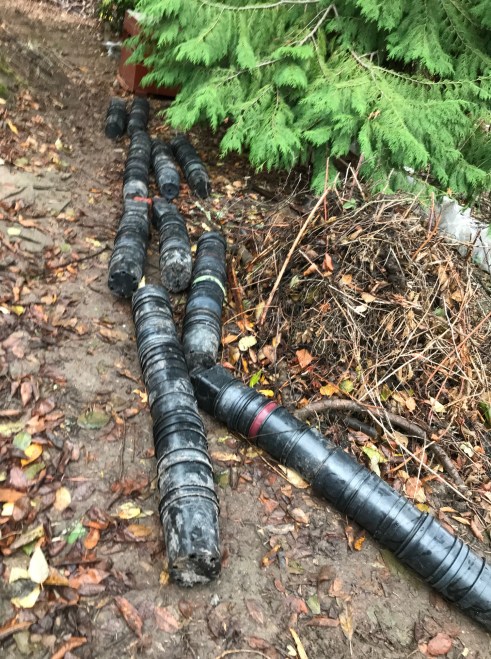
And this is a photo of the empty pots!
I am so excited for Spring to arrive so I can see every bud, every flower, and every berry! I hope most (or better yet, all) of the plants survive the winter.
In the year that we have been doing forest restoration work in Seattle’s Greenbelt, we have found many interesting types of trash. During one of the work parties last week, a participant brought a much dirtier version of this bottle to me.
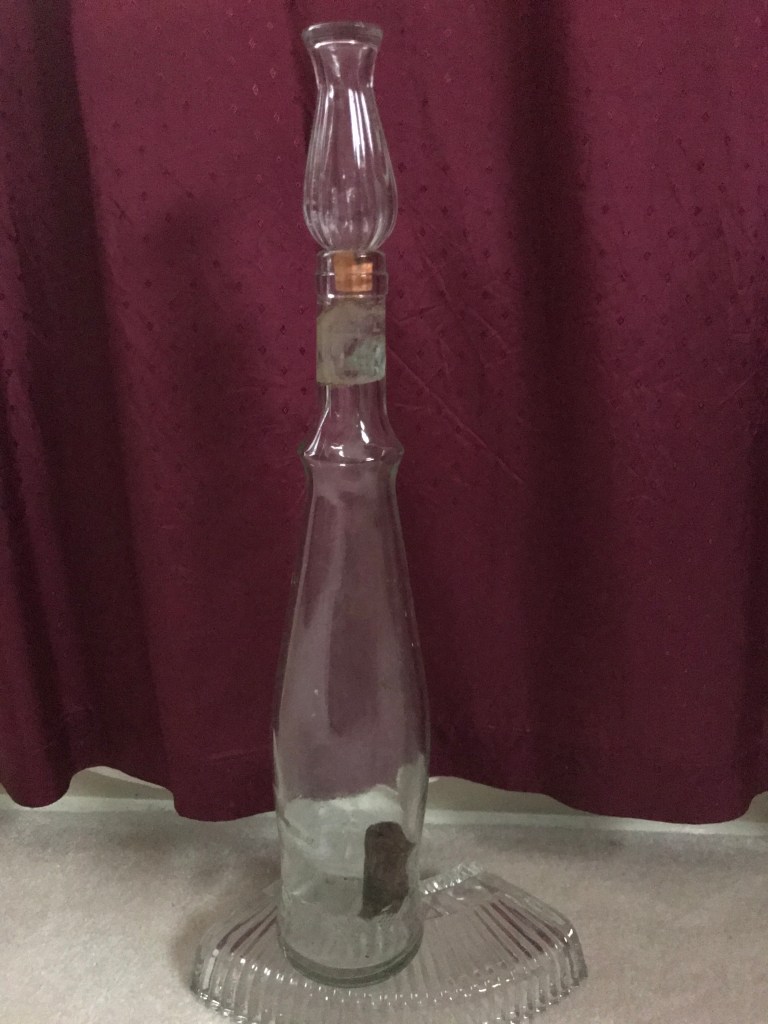
I thought it might be a decanter. I only had a vague idea of what a decanter was, but that was the word that came to my mind. I looked on the internet for photos of decanters from various decades, but didn’t see any that looked like this one.
When I showed the bottle to a neighbor later in the week, he pointed out that the top part didn’t belong to the bottom part. He thought the top was a cologne bottle, pointing out that it had a screw-on plastic top.


I felt embarrassed. I had noticed that the orange part was plastic when I cleaned the bottles but hadn’t thought about the implication of that fact. I wonder if the two parts were together when the work party participant found it. I believe they were, but I have no way to know for sure. Without the top, the bottle looks like this:

(By the way, the cork has decomposed enough that it is hollow.)
Here is a closeup of the top part of the bottle:

It is probably just a wine bottle but I’ve never seen one shaped like this. Have you? Do any of you have any idea how old it is? It could be current or it could be as far back as the 50’s.
Below are photos of some of the other trash we’ve found in the Greenbelt. We have also found more than 50 golf balls and three golf clubs! (Click on the gallery to enlarge the photos.)


You can learn more about this project by going to Greenbelt Restoration Project Update.
Every year at this time, Nimo Patel shares his Empty Hands Music video Grateful. This year he included this message with it:
Grateful for the many blessings that are always surrounding us. When our cup of gratitude overflows, we are inspired to want to give more to others: thanks + giving. May we all continue to be grateful and giving, and have a blessed and safe holiday season!
In that spirit, I am passing his message and video on to you.
The Art and Craft of Blogging
A collection of discussions on the environmental issues
“The fool doth think he is wise, but the wise man knows himself to be a fool.” “Love all, trust a few, do wrong to none.” “Love looks not with the eyes, but with the mind, And therefore is winged Cupid painted blind.”-William Shakespeare
...moments of unexpected clarity
Home of Lukas Kondraciuk Photography
Wellness, Support and Mindset
Thoughts on Creativity & Deeper Things
A Blog by Novella Carpenter
Ramblings of an Irish ecologist and gardener
Teaching the art of composition for photography.
Blog from SathyaSaiMemories ~ stories of love in action and the benefits of giving
There are 11,507 stories in Haddonfield; this is one of them.
Perennial gardening and more from the Green Mountains of Vermont
Whatever it will be...
Welcome to my little slice of the blogosphere

 Living, Learning and Letting Go