Living and Learning in Amritapuri, India: Wrapping Up (Jan 2017)

12512718_10153228699456805_4784682354021587162_n

Every year, as my trip to Amritapuri is winding down I think of a statement I read decades ago in a book by Malidoma, an African shaman who lives most of the year in the U.S. In the book, Of Water and the Spirit, Malidoma commented that he goes to Africa every year to learn from his elders and detox from Western civilization.

I resonated with that statement when I first read it, and I still do. For me, being with Amma, especially in India, is like taking a vacuum cleaner to my whole system. While the living and learning experiences may be difficult at times, I always see my growth when I return to Seattle. I am softer, healthier, and more able to handle the challenges that life sends my way.

When I went to India the first time, I loved it. In fact, during my first three visits, I cried every time I thought about leaving. Then there was a period, that lasted for at least five years, when I had a love-hate relationship with India. The heat and the never ending physical and emotional challenges were difficult for me to cope with. I felt on overload most of the time. Even then, though, I had a deep internal sense that it was very important for me to take that annual trip. I often used the metaphor, to myself and others, that it was like going to a doctor knowing the treatment would be painful.

Thankfully, that period passed, and for a long time now I have eagerly anticipated my yearly trip. I know that every visit will be filled with learning and adventure and that the challenges that come to me will help me grow.

It is my experience that being with Amma, whether it is in India or the U.S., increases the frequency and intensity of the life lessons that come my way, along with the ability to work through them at a faster rate. When I’m in the middle of an emotional roller coaster, the growly declaration that “this is going to be the last time I’m going to do this” inevitably goes through my mind. At least now I know that the thought is just a thought, and it will pass. I fully believe that it is important for me to continue going to Amritapuri each year, and that those visits will cleanse my mind and body, and feed my soul.

As I was preparing to leave Amritapuri this year, it occurred to me that once I retire I can go to the ashram whenever I want to go, and stay as long as I want to stay.

I almost always travel to Amritapuri in November and December, the busiest time of the year; a time when my son and daughter’s lives are filled with creating the Christmas play on top of their regular seva responsibilities. While I love seeing the play and being involved in play preparation, I am also faced with the reality that I can’t spend as much time with my adult children as I want to. When I retire, will I go to India at a different time of the year? Am I willing to miss the play in order to spend more time with my kids? Will I go earlier and stay longer? Will I go twice a year even though that would mean facing jet lag twice? I know those questions will be answered as my life unfolds.

For the last few years, I have felt an increasing desire to do panchakarma, an Ayurvedic therapy that provides deep cleansing and detoxification. Panchakarma was one of those things that I used to say I would “Never” do, but since I discovered that my high blood pressure and high cholesterol would eliminate several of the procedures I’m resistant to doing, I have felt more inclined to consider it. I have no doubt that the treatments would be in my best interest and the people I know who have done it have loved it. Maybe I would too.

If I do panchakarma, I would want to do it in Amritapuri, but I’m still resistant. I know the protocol involves staying out of the sun, rain, and wind and that I would be expected to keep the fan off in my room and to avoid other places with fans. That’s a big deal, considering I’d be in India. I also would be expected to refrain from doing seva, napping, writing, or reading. There are many dietary restrictions as well. Am I willing to make those commitments for most or all of my trip?

My biggest resistance is to the activity restrictions. As an over-doer I am stumped by how I would fill my time if I avoided doing all of the items on that list. Am I willing to give up blogging, working in the gardens, taking Tai Chi, and the other things I love doing in Amritapuri? What WOULD I do? Would I spend those weeks staring at a wall?

No doubt, I would be confronting all the garbage that is inside my mind. I would also be confronting my reluctance to simply “BE.” Am I willing to do that?

So, as I wrap up this year’s trip to Amritapuri, my mind is filled with questions. It is also filled with gratitude for all I experienced on this trip, and excitement as I look forward to discovering where the next steps in my life will take me.


Photo Credit: Amritapuri Facebook Page

DEAR ME

Yesterday, I read a post at Neal’s Epiphany that I thought was incredibly powerful. I don’t know how Neal sees it, but using my psychotherapy frame, I see him as having written a beautiful letter to his inner child. Neal has graciously consented to me sharing his letter with all of you.

Neal's avatarNeal's Epiphany

Dear Me,

You and I go way back, to the beginning. We’re one hundred percent connected in a way no one will–or could ever–understand. We’ve been there, standing together. Sometimes crying in the shower, sometimes snorting through our nose, but it’s always been you and me. Always and forever…

Or so it was supposed to be, but some time ago I left you–

I left you floundering on your own, to rely on love and encouragement and strength from others–from strangers–when it was I who should have held you up. When it was I who should have hugged you and praised you and appreciated you for the wondrous person you are–for all the beauty and life you bring to this world.

I seldom tell you how much I love you. How much I admire you. How beautiful and caring and intelligent and strong you are. That you are my hero.

View original post 383 more words

Seattle: A Sanctuary City

Seattle is a sanctuary city and proud of it. On this day that our new President signed an executive order blocking federal funds to sanctuary cities, I feel compelled to share the signs that I saw in my neighborhood when I came home from India last week. They speak for themselves.

img_0138

img_0140

img_0141

img_0144

img_0147

img_0148

img_0149

img_0150

img_0151

img_0152

img_0153

img_0154

img_0155

img_0156

img_0159

Daily Prompt: Ten (and in this case several more)

cropped-senior-salon Shared on Senior Salon

This and That

I’ve been wanting to provide updates on subjects I’ve written about in the past, so I decided to publish a This and That post.

img_4914

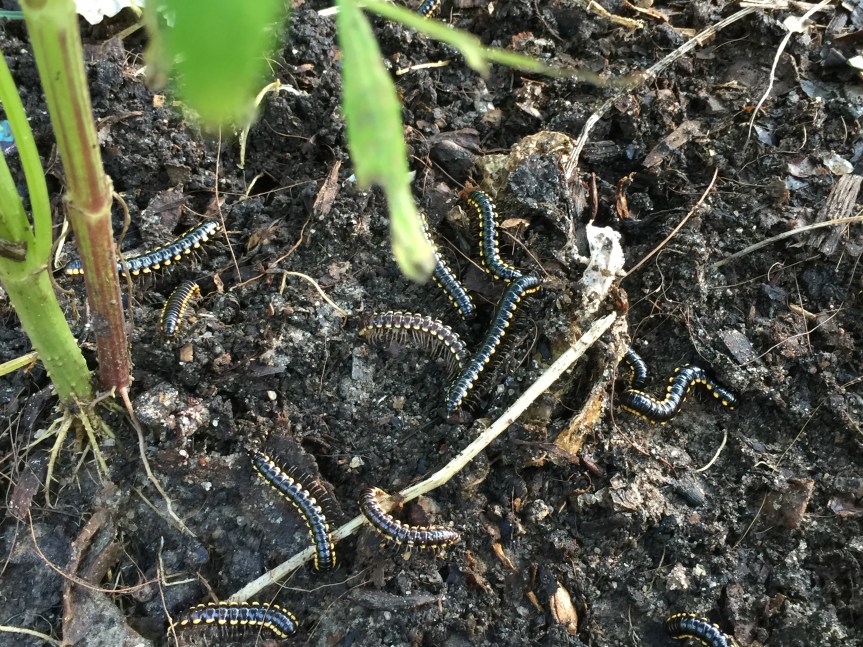
Those of you who followed my recent journey to Amma’s ashram in Amritapuri, India may remember that in January I was wondering why these “caterpillars” didn’t eat the Saraswati Garden plants. I’m used to seeing caterpillars demolish plants.

Two readers informed that the creatures weren’t caterpillars; they were centipedes. I had never considered that possibility. As I look closely at the photo above, I can see all of the legs, but I sure didn’t see them at the time.

I saw a centipede in Amritapuri two years ago. I remember it moved so fast that it left me speechless.

IMG_0148

That one was more like centipedes I’ve seen in the United States. I had no idea that centipedes could be brightly colored. Those readers also told me that centipedes don’t eat plants; they are carnivorous. Their diet consists primarily of insects and spiders.

*****

While I was in Amritapuri, crosswalks were painted on the street down the beach road. I saw about a mile of them, so I suspect they go the whole length of the peninsula. At the time, I wondered what crosswalks meant in India. I still don’t know what they mean.

I don’t believe that the crosswalks give pedestrians right-of-way, or if they do, that fact is being completely ignored. I didn’t see any change in driving patterns. I suspect a policeman or policewoman would have to stand there before the drivers would stop.

*****

When I wrote my Women’s March on Seattle post, I was not able to get the video I took of a group of drummers turned from vertical to horizontal. I have recently accomplished that feat, thanks to some advice from a friend. You can see a clip of the performance in the video above, and I also added it to the post.

I had edited the post once before so I could include two addendum. One of them contains beautiful Women’s March photos from around the world. I cried as I scrolled down that article. If you would like to see the added content click here.

*****

20150109_142236

In January of 2015, I spent the night in the Dubai airport hotel. I was mystified when I walked into the bathroom. What was that on the left? Was it a man’s urinal? That didn’t make sense but neither did anything else.

There wasn’t even a flush on it. It was more like a bath tub. A bath for your dirty butt? I couldn’t get myself to try it that year or even the next. By then, I had been told that it was a bidet, and that you wash yourself some before you use it. The idea still seemed gross to me. It sure wasn’t like any bidet I’d ever seen.

This year I got brave and tried it out. Not bad. It was  a bidet that had better aim than the kind I was familiar with.

*****

I never found my lost iPhone, so have not been able to recover the photos I took on my last days in Amritapuri. I was able to find the Work With Nature YouTube channel that Lokeshwar, the man who organized the Amritapuri seed-saving garden, created. I just looked at that channel for the first time. There is SO much information there.

I also watched some of the videos. Lokeshwar’s Amritapuri garden has three of the plastic hives that you will see in the video below. They are for tiny sting-less bees. My understanding is that 50,000 bees can be housed in each of these bee hives and that the bees will always come back to that hive. (Lokeshwar is the man on the right.)

In this seed-saving garden, they are conducting experiments with biochar and terra preta.

There are so many videos on his site. I look forward to exploring more of them in the future.

*****

Photo Credit: Wikimedia

I slept 7 hours last night. Hallelujah! I know better than to assume my jet lag is over, but I can still hope! Sleeping only three hours at a time is exhausting.

*****

I think this is the end of my updates, at least for now!

Letting Go of Suffering- Week Ten: Failure

heart-157895_1280

You are lovable even when you fail.

Failing is a normal and necessary part of living.

You can learn from every failure.

heart-157895_1280

Another behavior that often leads to suffering is failure. Failure is “to disappoint expectations or trust; to fall short; to be or become absent or inadequate; to be unsuccessful.” (Webster’s Ninth New College Dictionary, Springfield: Merriam-Webster, Inc. 1988, p. 445)

The reality is that any time we choose to act, we take the risk of failure. In order to succeed, we must be willing to risk failing. There is much that can be gained from acting, even if the result is failure. As with mistakes, it is important to see that failure is a necessary part of living and that something can be learned from every failure. Continue reading “Letting Go of Suffering- Week Ten: Failure”

Women’s March on Seattle

img_0114

I returned from India on January 15. Since then, I have not been able to sleep more than 3 1/2 hours at a time. Needless to say, I have been, and still am, exhausted.

When I heard about the January 21st Women’s March, I was interested, but it seemed like too much for me to do, unless my jet lag was over. After listening to President Trump’s inauguration speech, however, I started thinking about participating in the march again.

I remembered how eager I had been to go to the Seahawks parade that followed their Super Bowl win in 2014. That had involved long walks, difficult transportation, and standing for hours in 20 degree weather. I probably was still jet lagged then.

While, I loved attending the Seahawks parade, I knew the Women’s March was much more important. I also believed it would give me the sense I was doing SOMETHING in what sometimes feels like a hopeless situation.

The march started in South Seattle, not far from where I live, but I decided to join it in the International District (ID), a mile and a half north. While we were still in the ID, a Native American group started drumming and singing.

When they finished, the crowd parted like Moses and the Red Sea, allowing them to walk towards the front of the parade.

There were so many interesting and varied signs. Those signs were as diverse as the members of the crowd that carried them.

(Click on the gallery above to enlarge the photos.)

People lined the streets the whole way. Many of those people also carried signs, so I imagined that a good portion of them would join the march at some point.

There were a few individuals and groups protesting the march. I saw one man carrying a one of Trump’s “Make America Great” signs. There was also a group of evangelical Christians wanting us to “come to Jesus.”

We passed two groups of drummers. Here is a short video that I took as I walked by them.

We waved at window cleaners who were working at least 20 stories up on one of the skyscrapers. They waved back. Employees of the Cinerama Theater stood on the sidewalk, greeting us as we walked by. Some Seattle Center staff came out to meet us when we arrived, saying they had been looking forward to seeing us all day.

The march was meant to be in silence, and I think it was at first, but as people started joining the original marchers, that silence ended, and the atmosphere became celebratory.

At one point, I heard a sound that reminded me of the Blue Angels jets that fly over Seattle during Seafair celebrations every August. I looked up and didn’t see anything. Soon, I realized the sound was coming from the back of the march and moved forward like a wave as people joined it. Seahawks fans are known for making a LOT of noise during the games so I suspected this was the same sound that happens there. From time to time, that wave of sound went through the crowd for the rest of the march. I loved it.

The whole march was 3.9 miles long. I must have walked 2.4 miles of it. It was a very slow 2.4 miles. By the time I arrived at Seattle Center, I was exhausted and my feet were hurting. I laid down on wet grass for awhile and then walked to the Center House where there were food booths and restrooms. The Center House was packed. I wondered if there had ever been a crowd that big in the building before.

The thought of trying to get on the monorail and the light rail when all of those people were ready to go home was overwhelming. I also believed it would take another hour or two for everyone who was still marching to arrive at Seattle Center.

I decided to get into the monorail line then, until I saw it already had around 100 people in it. All of a sudden, it seemed like my feet didn’t hurt quite as much, so I walked the mile to the light rail station located at Westlake Center. Before long, I was home, exhausted but happy that I had participated in a meaningful and peaceful protest.

A few days before the march, the organizers were expecting 20,000 to 30,000 people. By the day of the march, that expectation had risen to 50,000. I think everyone was surprised, and happy, when it was announced that 120,000-130,000 women, men and children had participated. What a day it had been.

Addendum:

My friend, Priya, did a beautiful job of writing her experience. I asked for, and received, her permission to add her words to this post.

The mood was of joy, unity and strength, the weather perfect, the police were friendly and relaxed – it was an amazing march, which for many of us transformed a feeling of despair and confusion to renewed hope and commitment. So grateful and in awe of the power of the people! May we continue to support love, equality, and peace. One nation, under God, indivisible, with liberty and justice for all.

Another friend, Kathie, sent a link to photos from marches in the U.S. and around the world. I started crying as I looked at them. We are most definitely not alone. To see the photos click here. I think they are absolutely amazing.

Weekly Photo Challenge: Graceful 2

The relationship between cattle and cattle egrets seems graceful to me. The photo below portrays a common scene in India. This year, I learned that cattle trust the egrets so much that they will even allow the birds to remove flies and other insects that are located near their eyes.

img_1546.

Weekly Photo Challenge: Graceful

Weekly Photo Challenge: Graceful

When I think of the word graceful, I think of flowers I have seen in India and in the U.S. I also thing of Brahminy kites, birds which are in the same class, order and family as eagles.  Every year, I watch them soar above Amma’s ashram in Amritapuri, India.

Weekly Photo Challenge: Graceful