
Wordless Wednesday
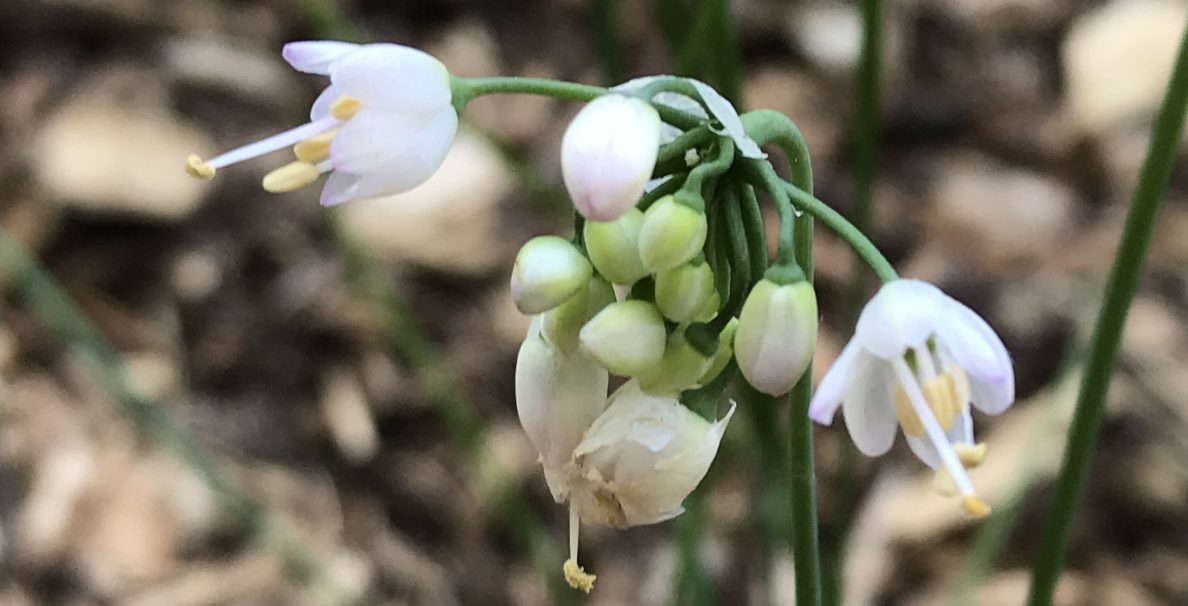
I have been anticipating going to Kuzhitura Farms since I came to Amritapuri on November 26th. I decided today was the day for that adventure.
I was so excited to see the wonders of nature I found there. I was particularly fascinated by this plant.
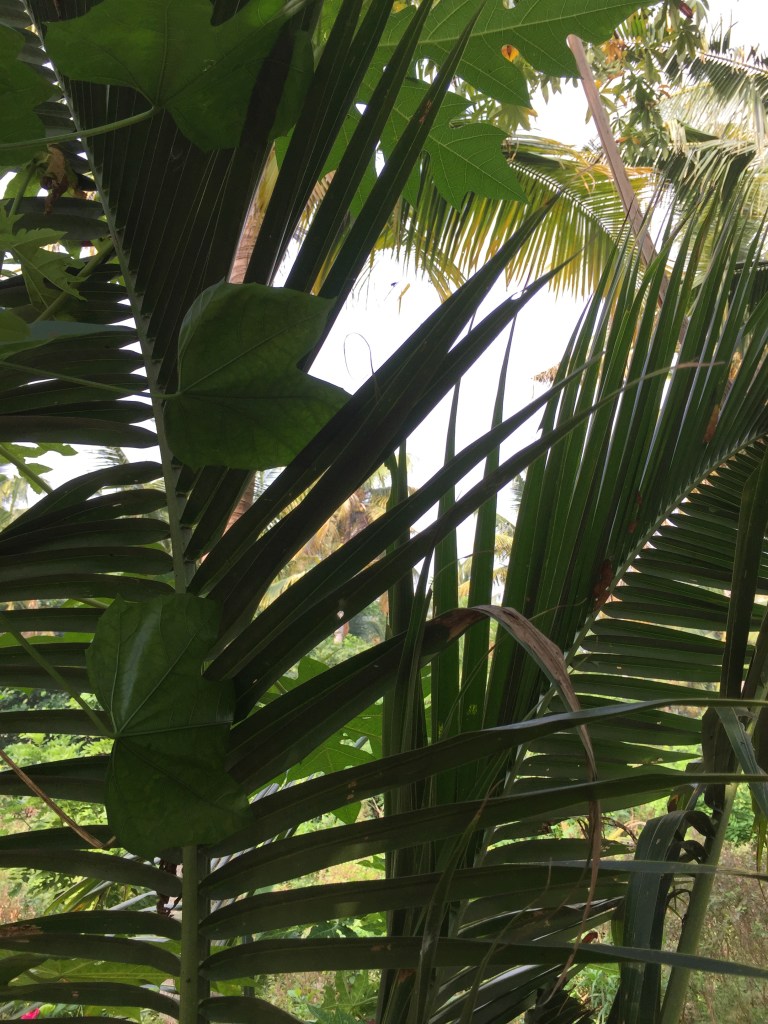


Weekly Photo Challenge: Anticipation
Daily Prompt: Fortune
To see all of the posts in this Amritapuri series, click here.
I spent part of this morning at Kuzhitura Farm, a site that is a 20 minute walk south of the main part of Amma’s Amritapuri ashram. I will be writing at least two posts about that visit. I’m eager to show you the flowers I saw, so I’m going to start with that one! You can click on the gallery to enlarge the photos.


To see all of the posts in this Amritapuri series, click here.

Most likely, the reason you suffer as an adult is because suffering was an acceptable method of expressing your feelings, or more accurately, a method of “stuffing” your real feelings, in your family of origin. This week you will explore some of the childhood origins of your suffery behavior. Again, Levin’s Think Structure (Cycles of Power) will be used as the tool to help you organize your thinking.
(The Think Structure process is taught in the previous lesson.)
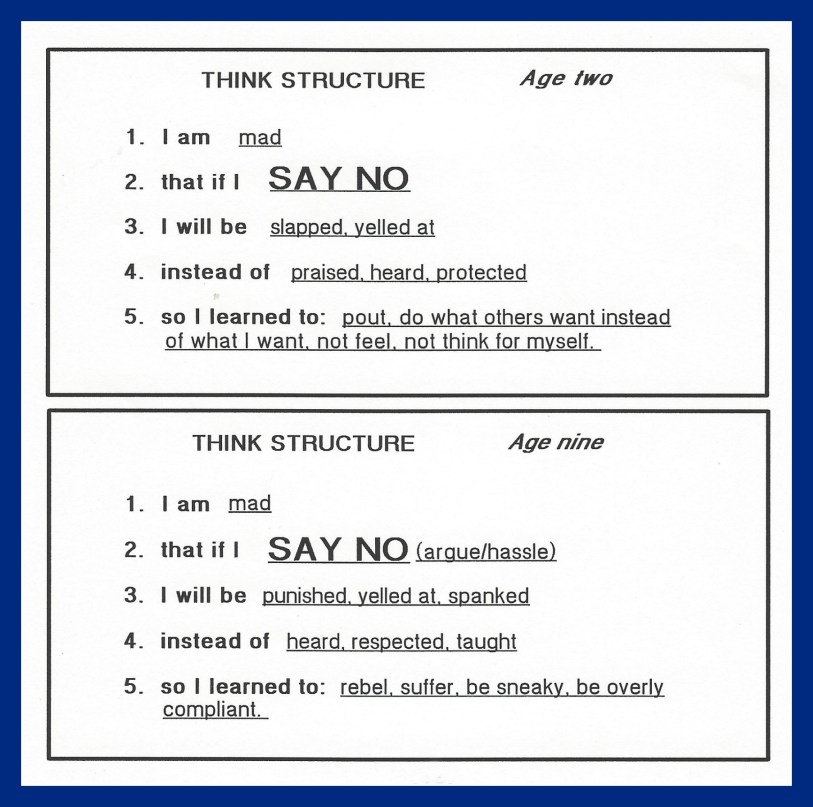
Example 1
Situation: As an adult, I have trouble saying “NO”. I will think about what happened when I said “NO” as a two-year-old and nine-year-old child.
Example 2
Situation: As an adult, I have trouble asking for what I want. I will think about what happened when I asked for what I wanted as an infant and a 14 year-old child.


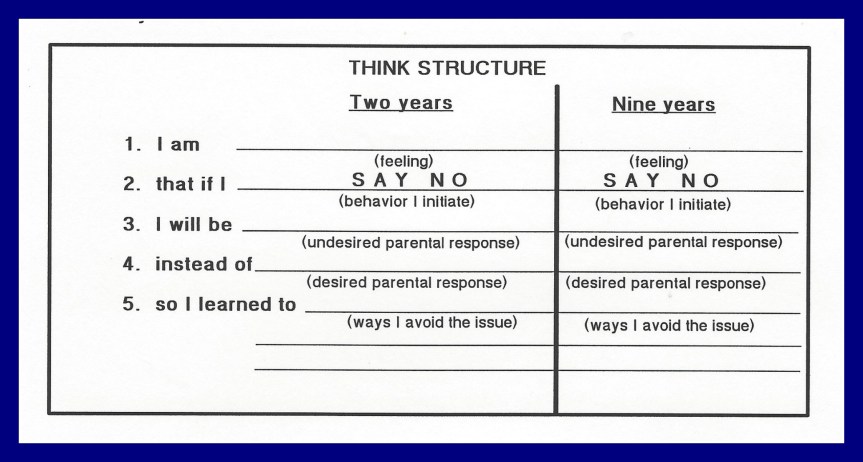
When you explore how your adult behaviors relate to your childhood, it would be helpful for you to look at one behavior over a variety of ages. In each of the examples below I ask you to look at an issue for two different ages. Fill in the blanks to come up with your own think structures.
Practice Exercise 1
Practice Exercise 2

During the rest of the week, complete Think Structures for some of the adult behaviors you worked on in Practice Exercise 3 in the previous lesson. Explore two childhood ages for each Think Structure. (Ages that tend to be particularly good to reflect on are infant, 2, 5, 9, 14 and 17.)
You may need to change the way you described the adult behavior in Practice Exercise 3 in the previous lesson, so that it becomes a childhood behavior. For example, if your adult behavior was “leave work early”, the child behavior might be “do what I want to do.”

See you next Monday for the sixth lesson.
To find the lessons in this series that have already been published click here.
A friend sent me the link to this video a few days ago, but I didn’t look at it until now. Tears are streaming down my face as I am writing this post. I hope it is as much a gift to you as it was to me.
The Following Morning Addendum:

When I woke up this morning (I’m in India), I realized I wanted to share this post with my Song Lyric Sunday family. I think the video fits the intent behind this week’s prompt even though it doesn’t fit the structure.
I wasn’t able to find out the name of the background song in part because I can’t understand all of the words. But to me the message is not in the song, it is in the video. I am very disturbed by what is unfolding in our country right now and it was so good for me to watch this video before I went to sleep last night. It allowed me to see light amidst the darkness.
Amme Yi Jivende
Last week, I wrote about hearing one of Amma’s swamis singing a song titled Amme Yi Jivende. I shared about a time in the early 90’s when I heard a different swami sing the same song. At that time, I was sleeping on a devotee’s roof during a program in Trivandrum. The house was near the Trivandrum ashram and the music filled the late night air. I felt as if the Swami was singing a lullaby to the infant part of me.
The day after I heard it sung this year, I walked by the auditorium when a group of brahmacharinis (female monks) were singing the very same song. I haven’t heard that song for many years so to have it sung in my presence twice in two days was quite a surprise. The tune has run through my mind numerous times since then.
Indian religions recognize both God and the Goddess. The words of Amme Yi Jivende are directed to the Goddess. As I mentioned above, the tune is very much like a lullaby and the sound still sooths the infant part of me… and there are times older parts of me relate to the lyrics.
O Mother of the Universe, there is no one other than you who can wipe the tears off this face, who can liberate this soul. Coming to your feet, this soul realizes itself.
Alas! This mind is even now wallowing in sorrow having lost its way in Maya before finding its Goal. Please bless me that I shall forever hold you in a tight embrace with pure devotion.
In this fearsome ocean of birth and death, the only refuge is your lotus feet. Won’t you come and sprinkle a little of the nectar of love on this smouldering self?
This little infant spends every single moment meditating on your form. Please do not keep me waiting any more– draw me close to you and bestow inner tranquility to this tortured soul.
I wish I could share a soundtrack with you but I don’t have a way to do that. If you belong to Spotify you will be able to find it there.
Kapok Tree
In an December 4th post, I shared pictures of two Kapok tree trunks. One I found on the internet; the other tree is in Amritapuri. At the time I wrote the original post, I couldn’t see anything that these trunks had in common.

Photo Credit: Wikimedia
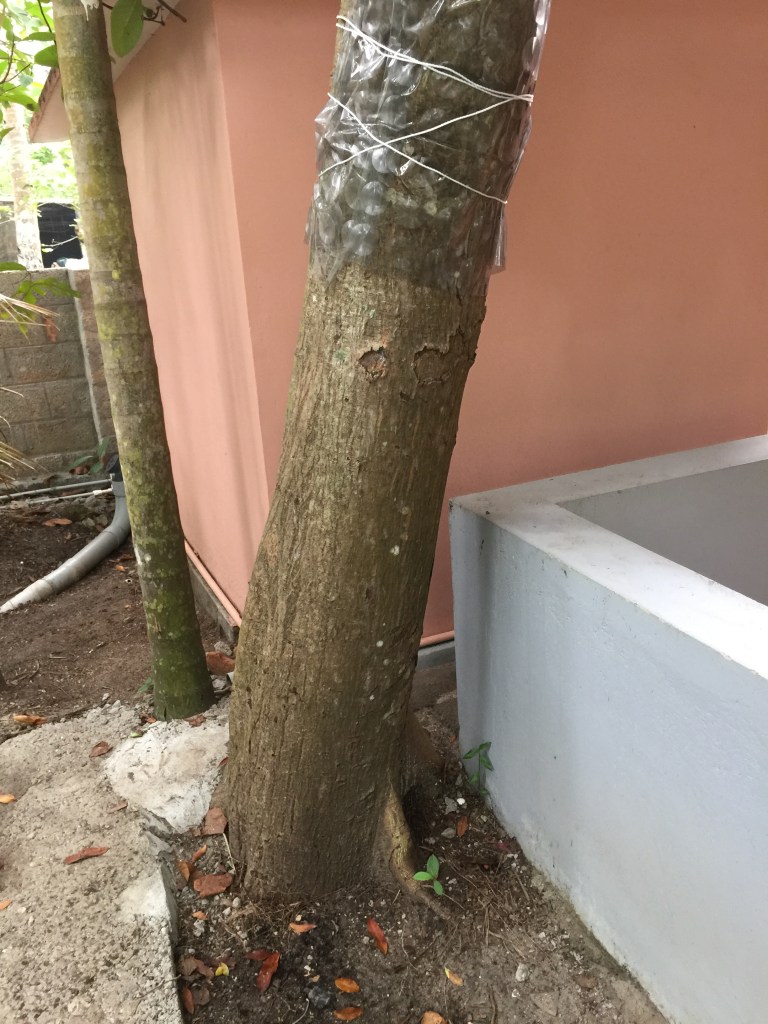
This week, I happened to look at the other side of the Amritapuri tree and this is what I saw:
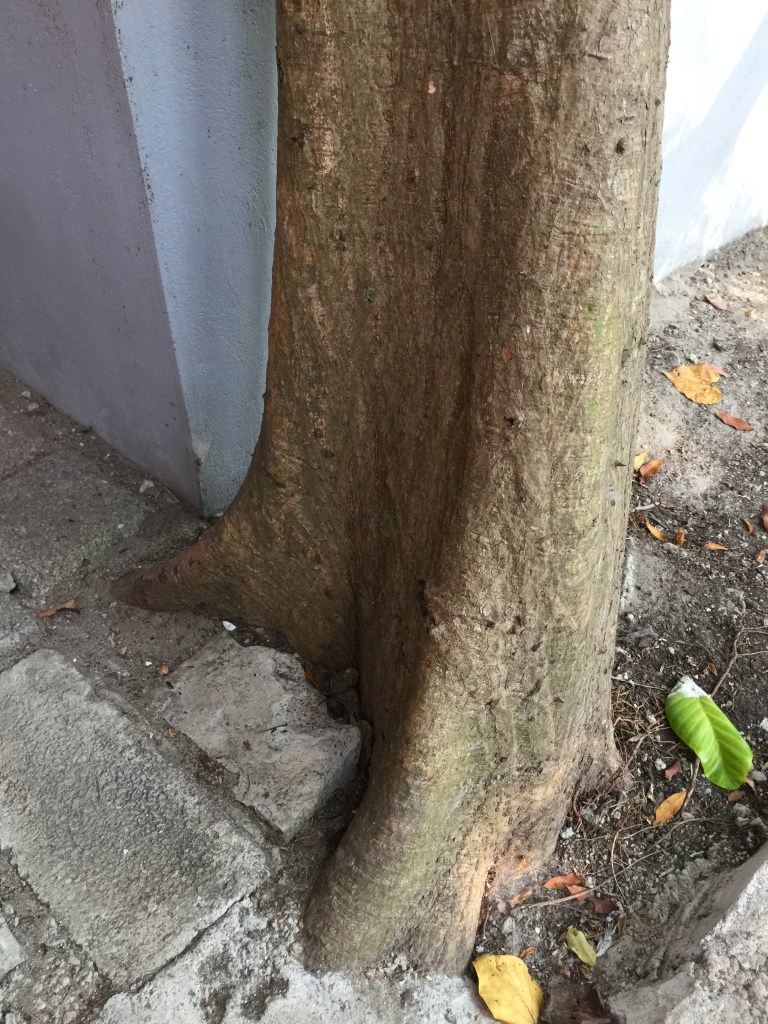
Even though the two tree trunks are vastly different in size, I can see that their trunks have some commonality.
Rupee update
Money is still a big problem here. The banks won’t give out much cash, if any. The ATM I go to won’t ever dispense more than 2000 rupees a day (about $30), and it is frequently empty. I went to two ATMs in town one day and they were empty too. The machines may stay empty for days.
If you luck out and are able to get some cash, it may still be difficult to use it because the merchants are often unable to make change. This problem has been going on since November 8th.
Weather
It was hot when I arrived at the ashram on November 26. Then the weather turned much cooler. There was even one day when I put on a flannel shirt for a while. Most of the time, though, it has been hot, but not too hot, during the day and cool in the early morning and during the night.
Elephant
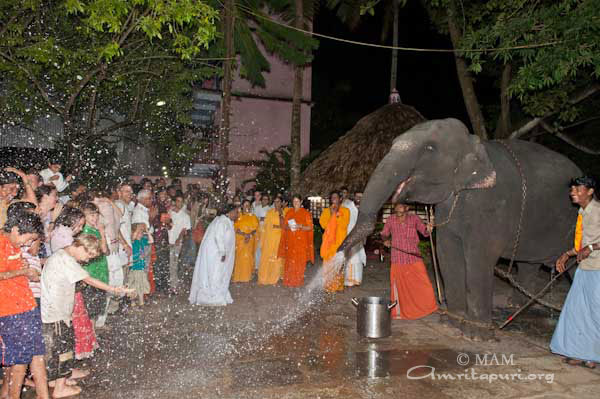
Two days ago, I saw Lakshmi, one of the ashram elephants, for the first time this year. She was walking down the road with her mahouts when I was returning to the ashram after working in the garden.
She had probably been in the courtyard by the auditorium. The mahouts often bring her there at this time of year so that children and adults can feed her bunches of bananas. I fed Lakshmi for the first time two years ago.
The following photos of Lakshmi and Amma were taken in 2011.


Drawing
This morning, a woman was sketching at the table where I had breakfast. I told her that I thought her drawing was beautiful. When she finished it, she gave it to me!

To see all of the posts in this Amritapuri series, click here.

On the morning of December 15, I started to think of what I would include in my next Living and Learning in Amritapuri post. Little did I know that day would provide enough material for a full blog post.
When I returned from my morning Tai Chi class, I was surprised to discover that Amma was holding the public darshan program in the temple instead of the big auditorium. It had been years since she has done that in December since the crowds tend to be so big during the holiday season.
I went about my day, going to lunch, watching a bit of the play practice and then working for a while in the garden. When I came back to the main part of the ashram, I decided to go into the temple and join the prasad-giving line. [Note: The prasad-giver hands Amma the sacred ash and candy that she gives to each person who comes to her for a hug.]
When I entered the temple, many memories came into my mind. My first trip to Amma’s ashram in Amritapuri was in January 1990. I arrived at the ashram days after the temple had opened. The top floor was not even built yet. When I sat in the temple during those first days, I often wondered why Amma had built a temple that big. In those days, almost everyone was able to sit in the first third of the room.

It didn’t take long for me to realize that Amma had much better foresight than I did. The number people coming for her darshan (hug) grew rapidly.
In those days, there weren’t flats to live in; almost everyone stayed in rooms in the temple, or in huts outside. If there weren’t enough rooms available, visitors slept in any open space. I remember having trouble getting in or out of my room because sleeping people blocked the entrance.
A few years later, when Amma held a public program, the crowd looked like the one in the photo below. I remember at the time I purchased this photo, I considered the temple to be filled to capacity. When I look at it now, it seems like there is lots of empty space. I think there were times when nearly twice as many people crowded into the temple.
Eventually, it was necessary to build the huge auditorium that is now used for almost all of the ashram programs.

As I went through the prasad-giving line, I reflected on memories of sitting near Amma in the temple during that first visit. In particular, I remembered a time when I went into a deep meditative state and didn’t come out of it for two hours. Going that deep is so different from my current experience with meditation.
Finally, I made it through to the front of the prasad line and started handing prasad to Amma. It was truly an experience of “Home.” My eyes filled with tears. I felt so blessed.

After I finished my two to three minute prasad giving shift, I walked from the inner temple where the darshan takes place to the main floor. I sat close to the front so I could get glimpses of Amma as she hugged the devotees.
Because of the back problems I have had this year, I have generally been unable to sit on the ground unless I was in a meditation chair. To be able to sit cross-legged on a tile floor for more than half an hour without having any problems was wonderful.
When I left that area, I decided to go to my room. As I walked by the darshan line, I saw that many residents and long term devotees were in the line. Generally, I go for darshan only when I arrive at the ashram and just before I leave, so I hadn’t planned on having darshan that day.
As I walked down the temple stairs, I realized it would mean so much to me to once again be held by Amma in the temple. When I reached the last stair, I stopped and reflected on the situation. Since I felt in a place of “want” instead of “need”, it didn’t seem right to go, but every time I took a step towards my flat, I changed my mind and went back to the first temple step and continued my reflection. In time, it occurred to me that I have missed many opportunities because of some standard I judged I should be following.
I had noticed the darshan token table was still open so I decided I would ask them if Amma had called for everyone to come for darshan that day. The person who was handing out tokens immediately said “Yes” and followed it with “So that means you.” He handed me a token and said “Go!” I was so happy.
When I returned to the temple, I saw that the darshan line was much longer than I had thought it was. I took a seat at the end of the line.
I had another unexpected treat in store for me. In my memory, since we started using the auditorium for bhajans, whenever Amma decided to give darshan in the temple, one or more of the senior swamis would still lead the evening bhajan program in the auditorium. I was so surprised when Swami Amritasvarupananda started singing in the temple. I was definitely transported back in time.
It took at least two hours to get to Amma, but it was well worth it. Soon, I was in her arms in the temple, just like I was 27 years ago, and for many years after that. I felt so grateful. Thank you Amma for seeing me, for loving me, and for all you have given me year after year.
It was a perfect ending to an amazing day.
To look at all of the posts in this Amritapuri series, click here.
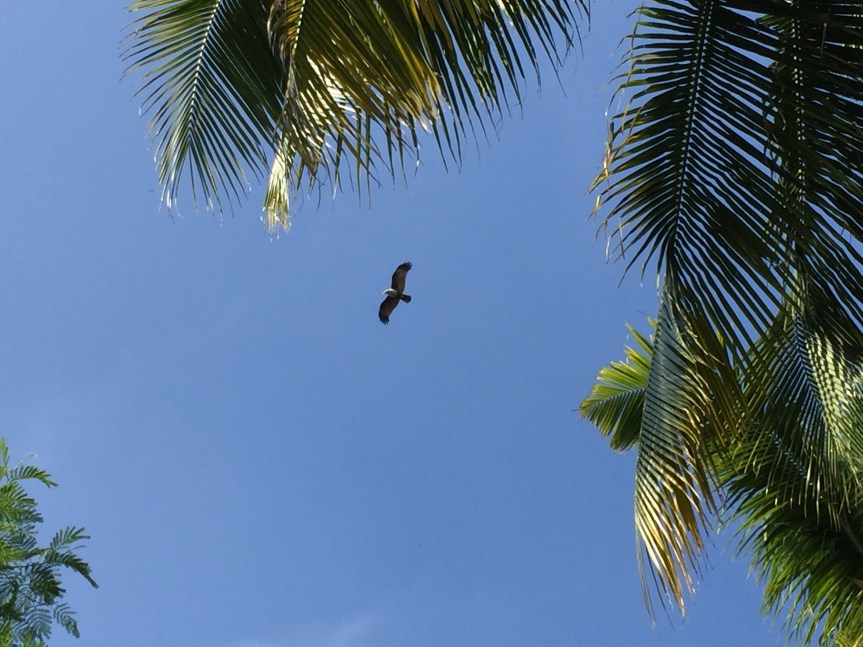
It is not uncommon for my mind to be chaotic even when I am in a peaceful setting. I long to get to the point where my mind is at peace regardless of how much chaos is around me. I have a long way to go to meet that goal.
I am getting plenty of opportunity to work on that issue in my Amritapuri Tai Chi class. Tai Chi, by its nature, is meditative. It slows down my mind and body more than anything else I have ever done.
I would guess that most Tai Chi classes are held in peaceful settings with soft music playing or silence in the background. The place where our class meets in Amritapuri is gorgeous. There are palm trees, views of the beach and the Arabian Sea, eagles flying overhead, etc. As I’ve mentioned before, though, there are also trucks, bicycles, buses and cars that occasionally go through the space where we meet.
With most of life’s lessons, it seems like once you have adjusted to one level, another dimension is added. This year has definitely demonstrated that process. During my first class, I was stung by a red ant. It is amazing how much a bite by a tiny ant can hurt. In fact, the bite was still stinging hours after the class finished.
Soon thereafter, a red ant hill showed up at the perimeter of the space we use for the class, so it has been important for me to stay conscious of that danger, and to make sure new students are made aware of it. (I have stepped on a red ant nest twice in the 27 years I’ve been coming to India, once in the daylight and once at night. It is an unforgettable experience; one I hope never to repeat.)
Starting with our second class, students taking a silent meditation retreat have done a walking meditation in front of us during part of our class. They don’t disturb us but I’m tempted to watch them instead of staying focused on my own work.
In last week’s post Be Like a Bird Perched on a Dry Twig, I talked about the third class when there were even more vehicles in the area than normal. Midway through the class, a truck pulled into “our” space and parked. The workers got out of the truck and started carrying their supplies to the nearby construction site. Since their work had priority, we had to move to a smaller area, one that was bordered by 8 ashram cows lounging in the shade!
Tai Chi is so powerful that it was reasonably easy for me to find that place of peace and contentment even in these circumstances, although I certainly didn’t have single minded focus.
On my fourth class, another set of challenges were added to those that I have already described. (BTW, the cows have not returned to the beach, at least a that time of day, since the third class.) The fourth class was held on a weekend, the first weekend since Amma returned from her European and U.S. tour. The crowds coming for darshan (hugs) were very big that day. At one point, there were 14 vehicles parked on the beach.
Then something new happened. At first, one or two village men started removing carts of sand from the beach to somewhere in the village. Next, two women started a chain. One woman would carry a big pan of sand on her head and walk to a spot next to our class. She would then shift the pan to the head of a second woman who would carry it out to the main road. We often had to divert our path to stay out of their way.
Fifteen minutes before that class was over, a cement mixer started making its piercing noise in the construction area near to us. By that time, the whole situation had become funny.
During the fifth class, a third woman was added to the chain of sand carriers. On the sixth, there were all of the previous challenges, except the cows. In addition, a new layer of sand had been added to our area 0f the beach. The sand was beautiful and felt good on my feet, but it hadn’t been compacted yet, so there was no smooth or level ground to walk on. That made doing the Tai Chi moves much more difficult.
As you can see, doing Tai Chi on the beach in Amritapuri is definitely an opportunity for me to find peace in the midst of chaos. It is also an opportunity to see the humor in the situations that arise in life.
To look at previous posts in this Amritapuri series, click here.
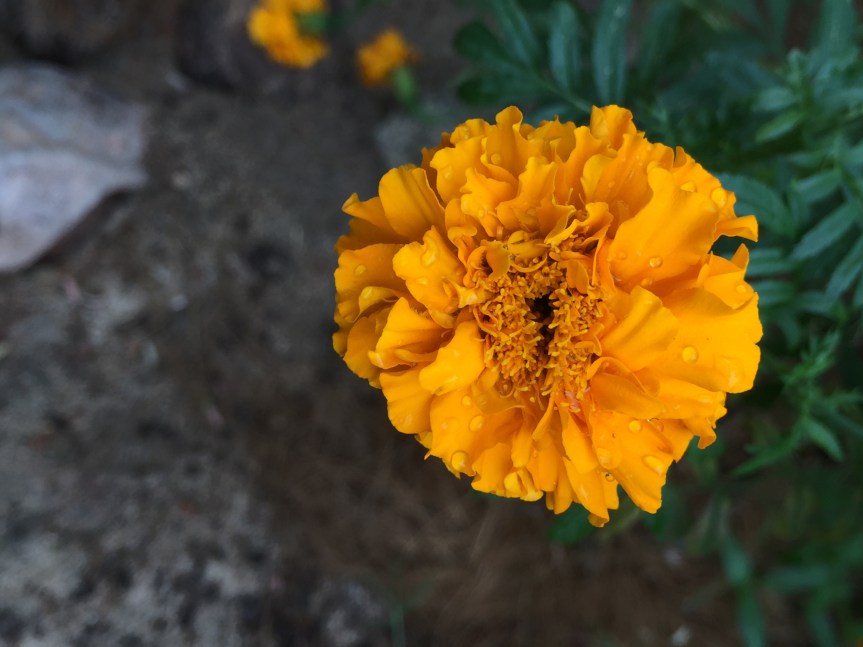
I have spent several days at Saraswati Gardens helping in the dye area. One day last week, Padma noticed how much color was still left in the pulp after she made marigold dye. We decided to dry it out and see if something could be done with it.
The next day, the pulp still wasn’t dry so I separated into smaller pieces and placed it on cotton and silk fabrics. I thought it would dry better that way plus it gave us a chance to see what effect it would have on the cloth.


As I was distributing the pulp, I kept looking at the newspaper I had originally spread the pulp on. The color that was left on that paper was a vibrant yellow.

By the next day, the idea of using the pulp to dye more cloth was discarded as it was obvious that the color it produced was too light.
Two days ago, the dye project staff finished the first prayer flag made using dye only from Saraswati garden flowers. I think it is so beautiful.
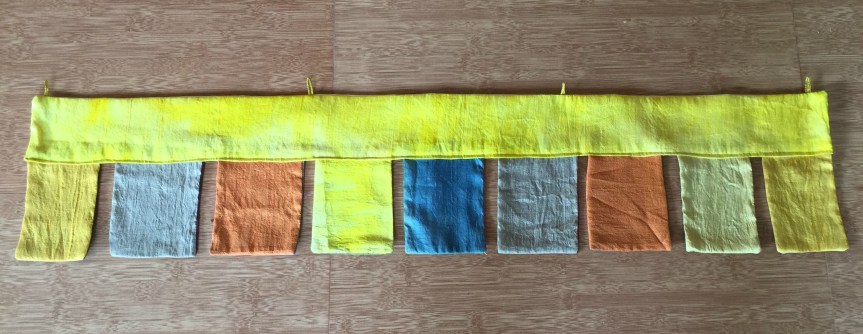
The first flag below was colored with marigold dye, the second was from a rose dye, and the third was dye made from madder root. The dye for the yellow strip that goes along the top was made from turmeric root.
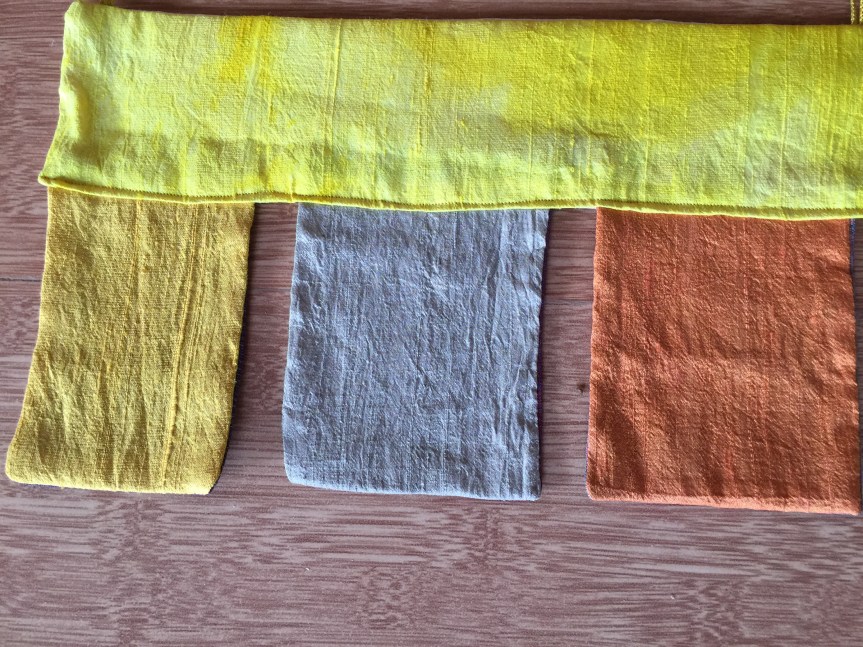
The dye used on the first flag below was made from turmeric root; the second is indigo and the third is rose.

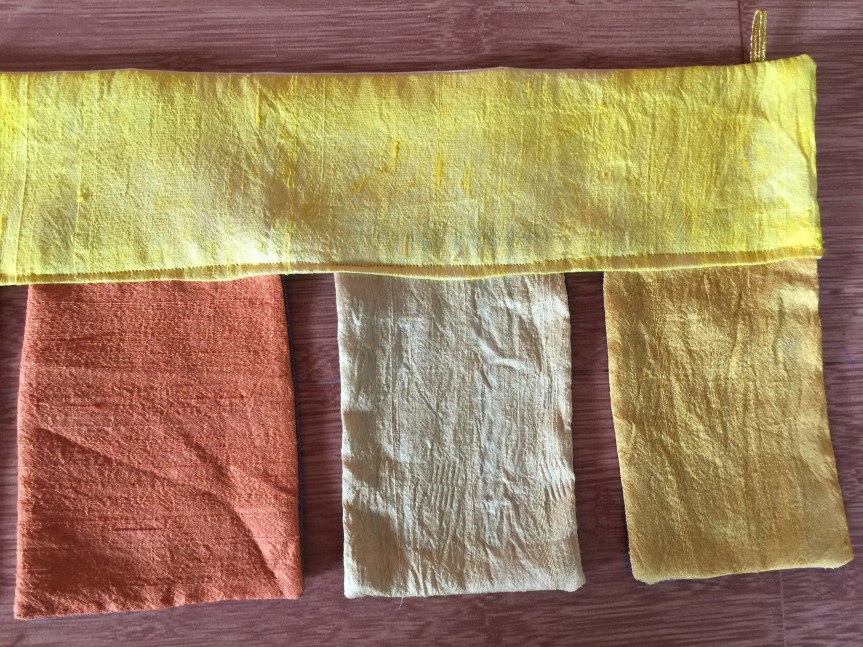
The first flag below is another one dyed with madder root, the second and third are both from marigold dye with one being a lighter version than the other.
Since I’m learning a bit about making dye from plants this year, I have wondered whether or not I will start making dyes when I return to Seattle. Growing the flowers sounds right; being creative with them sounds right; but at the moment I don’t feel called to dye cloth.
Last night, I thought about the bright yellow marigold dye I saw on the newspaper when I was working with the pulp. Then another memory came to me. Many years ago, I was intrigued by handmade paper. At the time, I wanted to learn how to make it, but never did.
Maybe in my retirement, I will make paper and find ways to dye it using flower petals or roots, or maybe even leaves. Or perhaps the flowers and leaves will be used in other ways, such as in this photo of papermaking in Burma.

Is papermaking on my horizon? It very well could be.
Weekly Photo Challenge: New Horizon
To look at previous posts in this Amritapuri series, click here.
The Art and Craft of Blogging
A collection of discussions on the environmental issues
“The fool doth think he is wise, but the wise man knows himself to be a fool.” “Love all, trust a few, do wrong to none.” “Love looks not with the eyes, but with the mind, And therefore is winged Cupid painted blind.”-William Shakespeare
...moments of unexpected clarity
Home of Lukas Kondraciuk Photography
Wellness, Support and Mindset
Thoughts on Creativity & Deeper Things
A Blog by Novella Carpenter
Ramblings of an Irish ecologist and gardener
Teaching the art of composition for photography.
Blog from SathyaSaiMemories ~ stories of love in action and the benefits of giving
There are 11,507 stories in Haddonfield; this is one of them.
Perennial gardening and more from the Green Mountains of Vermont
Whatever it will be...
Welcome to my little slice of the blogosphere

 Living, Learning and Letting Go
