Living and Learning in Amritapuri: November 29-30, 2016

img_4638

Even though I’ve been coming to Amritapuri for 27 years, every day is still filled with new experiences and learnings.

Saraswati Gardens

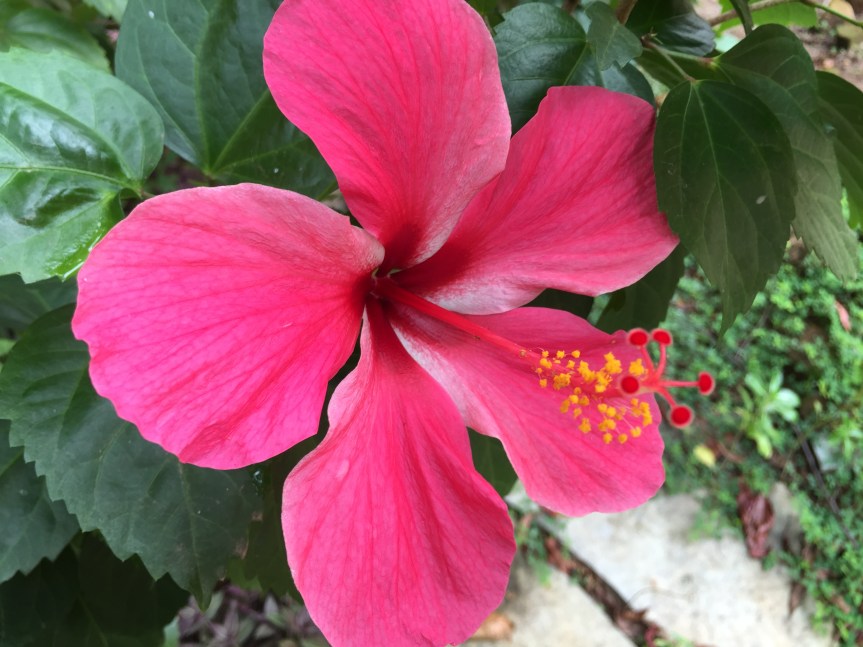
On the evening of Nov. 28, a friend told me that she had found a garden in the ashram that she thought I would want to see. It is on the north side of the ashram, but is only a five-minute walk from the ashram’s center. The next day, I went to look. When I walked into the gate, I gasped. For me, it was like walking into heaven. (The photo on the top of this post is from that garden.) I will be writing many posts on this topic but here are some photos to wet your interest! (You can click on the gallery to see an enlarged version of the photos.)

I also saw the projects that are being done inside the Saraswati house. They have looms for weaving, a room for dying fabric, and a room for block painting. So many items are being produced here and then sold in the ashram stores and on Amma’s tours. All proceeds go towards Amma’s humanitarian projects.

I look forward to sharing more about the handmade items with you later.

Synchronicities

One of the things that I enjoy most about being in Amritapuri is how many synchronous events occur. So often when you need to find someone, your path crosses theirs a moment later.

Every year, there are people who I see constantly. Sometimes it feels like they are on the other side of every corner. Around 5,000 devotees live at Amma’s ashram and there usually hundreds to thousands of other people visiting each day, so constantly seeing the same people must be more than chance.

The people I have the “around every corner” experience with are usually individuals who end up becoing a major part of my trip. Starting on the first day of this visit, I’ve had that experience with three people. Two of them were in my Tai Chi class last year.  I have since discovered that the third person is responsible for organizing work in the Saraswati gardens!

I’m seeing a different person “around every corner ” now. She is a long-term friend, but I’ve never passed by her so often. It’s gotten to the point that we laugh every time we see each other.

Bhajans

At 6:30 each evening, we sing bhajans (devotional songs) for 1 ½ hours. Whenever Amma is away from the ashram, the women sing in the temple and the men sing in the auditorium. I have always felt drawn to the men’s music, but have stayed in the temple. Last year I observed there were increasing numbers of women sitting on the side of the auditorium during the evening bhajans. This year, I saw considerably more women sitting in the auditorium. In fact, I think there were as many women in the auditorium as men. Next, I noticed that most of the ashram’s elderly women were sitting in the auditorium. That is all I needed to see. I have joined them!

Fox Bat

One night on my way to bhajans, I saw a group of people looking up into a tree. It was dusk, but there was a man with a huge camera taking pictures. When I was close enough, I asked the photographer what was going on. He told me a fox bat was in the tree. He said that these bats are only seen seven days a year, during the short period that the figs are ripe.

When I researched “fox bat” on Wikipedia, I learned they are the largest bats in the world. They are also known as flying foxes or fruit bats. I didn’t take any photos but I found one on Pixabay.com.

bat-1268650_1920

Recycling Center

I stopped by the recycling center the day after the floor had been changed from concrete to tile. I imagine the devotee’s feet will be very happy to no longer be sorting garbage standing on concrete.

I noticed that the cages of sick birds being nursed back to health are no longer located in that room. I wonder if they are in a different part of the center or have been moved to another location.

Behind the recycling center, I saw many nets full of recently washed milk bags drying in the sun.

Gardens in the central part of the ashram

I know I will be showing you photos of these gardens throughout the trip, but here are some pictures to start you off!

San Jose programs

We were able to see Amma conducting the Atma Puja on the last day of the San Jose programs via live feed. It was 7 p.m. in the evening there time, and 8:30 a.m. our time. That evening, we listened to Swamiji chanting the archana that occurs towards the end of each program. After the archana we watched as Amma gave darshan until the program ended. (Darshan- Amma gives her blessing through hugging each person that comes to her. At this point she has hugged 36 million people worldwide. We call that hugging process darshan.)

(When I first came to India I had to take a rickshaw to a town twenty minutes away to use a telephone. It sat on a table in the middle of an alley. A crowd gathered around to watch and listen as I made the call. I never would have dreamed that 27 years later, I would be watching Amma live from halfway across the world.

Lessons in patience

In my last post, I talked about receiving lessons in flexibility, equanimity and letting go. I will add patience to that list.

One of my favorite activities last year was doing Tai Chi. I have been very eager to start taking the daily Tai Chi classes again this year. Before I came, I knew that the main teacher, Dave, would probably not be coming this year, but I hoped that Stephanie, who is in teacher training with him, would be here. She was very instrumental in teaching our class last year so I know she is very skilled and dedicated.

Two days ago, I talked to a devotee who had seen Stephanie’s husband at the end of the European tour, so I knew she was indeed coming. Then yesterday, I was told she had arrived at the ashram, but I have not seen her yet. It is certainly an opportunity for me to practice patience.

I’m also having to try to find some patience within me in regards to the Wi-Fi hook up. It is so frustrating to have posts ready but not be able to publish them! There is no way to know when the company will send me a text saying I can activate it.

(You can tell by the fact I’m publishing now that I found another way to do it. That story will be in the next post!)

To read the rest of the posts in this series click here.
Living and Learning in Amritapuri: November 26-28, 2016

img_4768

The Lessons Begin

After checking in at the International Office, I took my suitcases to my flat (apartment). Then, I walked to the café to find my son Sreejit. He wasn’t there, but a friend phoned him to let him know I had arrived. I hadn’t been with him since January so it was so good to see him. We walked to my room and I became Santa Claus for the first time on this trip, by giving him the supplies and treats I had brought for him.

Being around Amma, or in her ashram, guarantees an increase in the frequency of life’s lessons. They often provide the opportunity to practice behaviors such as flexibility, equanimity and letting go. I received my first such challenge right away.

I will give you a little back story first. There is a long shelf that is located above the windows in my flat. Soon after I moved in, Akshay installed a wood door on that shelf so I could lock-up my belongings when I returned to the U.S. (When I am gone, the space is rented out to ashram visitors.) Eight years later, it became obvious that there were termites in the wood. The ashram is in the tropics, so it is not surprising that would occur. Last year, it became obvious that the structure wasn’t going to last much longer, but we thought it had another year. The day before I was to leave for the U.S., as Sreejit was putting my belongings on the shelf, the whole frame collapsed on him. It shocked him, and me, but thankfully he wasn’t hurt.

Not having that storage area meant there was no way for me to lock up my possessions while I was gone. I had two small trunks that could be locked, but my buckets, trash bins, laundry filter, cleaning supplies, and standing desk would be left unprotected. There was nothing I could do other than put everything in an unlocked storage area in the kitchen. While it was a risk, it seemed a reasonable one. The shelf was very high and not very visible. It seemed to me that the items, for the most part, were too bulky to easily take. Also, everything was prominently marked with my room number.

Now back to my present-day story! After I gave Sreejit his supplies, he climbed up to the shelf and handed down the items I had stored. I was shocked to discover that even though the trunks and the standing desk were fine, everything else was gone. I couldn’t believe it. It was certainly an opportunity to practice flexibility, equanimity and letting go.

I spent a good part of the day cleaning my room, putting clothes and supplies on my shelves, replacing some of the missing supplies, and ordering a SIM card for my phone. I was told to come back the next day to fill out the paperwork to renew the MTS Wi-Fi Homespot that will give me internet access.

I was dismayed to be told that since the next day was Sunday and there would be an all country strike (protesting the currency fiasco) on Monday, I would be unable to get my SIM card until Wednesday. The the earliest I would get the Wi-Fi Hotspot would be Friday and even that wasn’t guaranteed. That meant I couldn’t read or send emails, publish or read blog posts, respond to blog comments, or check CNN for the latest political developments for quite a while. I knew being disconnected from media would be good for me, but it wasn’t going to be easy. This was a big, and unwelcome opportunity for me to practice flexibility, equanimity, and letting go.

Amma

13925297_10153805379033302_5310794637485962343_n

When I arrived at the ashram, Amma was on her Autumn Tour in the United States. She completed her Michigan programs on Thanksgiving, the day I departed for India, and then went on to San Jose, California for five days of programs there. I think that Amma will return to Amritapuri on December 2nd or 3rd.

I enjoy coming to the ashram before Amma gets here since it is nice to be able to recover from the trip when the ashram is quiet. Once Amma returns, people begin pouring in and the sense of quiet is gone. (I’m laughing. With all the construction, it is never truly quiet. As I am editing this post, someone is hammering rebar in the courtyard below my window!)

It is also fun to be at the ashram when everyone is bustling around cleaning, painting and getting ready for Amma’s return. There is so much anticipation since the residents haven’t seen her since the beginning of October.

I am very excited that I will be seeing Amma soon.

Jet lag

It is not unusual for me to sleep my first night in India, but the second night, and many nights thereafter, are usually a different story. My pattern is to wake up after two hours of sleep and not be able to fall asleep again. This time, I slept well my first two nights at the ashram. It remains to be seen if that will continue, but I feel hopeful that I am not going to have the normal two to three weeks of feeling exhausted. What a difference a daytime flight from the U.S., combined with a layover in Dubai, has made.

One of the benefits of jet lag is that it makes going to the morning prayers (archana) that begin at 4:50 a.m. easier. As I sat in the temple my first morning, it was so wonderful to be amidst the familiar sights, smells and sounds.

Finishing my room set-up and another lesson

I spent a good part of my first two days, cleaning and setting up my room. I also washed the clothes that had been stored for a year in the trunk. I use three buckets, one for washing and two for rinsing. When I’m finished, I take the clothes to the 17th story of the building I live in, and hang them on clothes lines. I love watching the wind whip the laundry around. Between the wind and the hot sun, it doesn’t take long for the laundry to dry here, and there is no need for an iron since most of the wrinkles disappear as the clothes dry. (Irons can’t be used in these flats anyway. They take so much electricity that the fuse for the entire floor would blow out.)

In the afternoon of the second day, I had another opportunity to practice equanimity when construction workers started making concrete in the courtyard below my room. The level of noise was indescribable. I had visions of living with that racket for the next seven weeks; it would have been a nightmare. Luckily, that scenario does not appear likely. The noise lasted about an hour and afterwards the concrete-making machine was taken away.

Changes I’ve noticed so far

There was construction work occurring at the ashram when I first came here in 1990; and it has never stopped. In the old days, the construction noise went throughout the night. Thankfully that stopped years ago.

It is always interesting to see what improvements have been made since my last visit. So far, I have noticed:

There is a new building behind the Amrita Darshan building where I live. The front side of that building will hold the Ayurvedic store and the ashram bookstore. Above it will be new flats. The main supply store (referred to as the Indian store) was moved to the backside of the new building the day before I arrived. It is very nice and has much more room than in the old store.

The new International Office is now open. It is located close to the north gate. The office for renting bedding and other supplies is also in that building. I suspect the top floor contains flats, since that seems to be the pattern for new buildings nowadays.

A few days ago, they changed the big photos of Amma on the sides of the auditorium stage. The new ones are stunning. One is a picture of Amma meditating when she was young and the other is one of her sitting in front of a beautiful forest and next to an intriguing tree trunk. I was mesmerized by both photos.

I haven’t seen it but I’ve heard they are building rooms in the green roof part of the temple. They have been building flats continuously for years, but they never catch up to the demand. I’ve heard that there is still a two to three year wait to purchase a flat.

Last night, I went to fill my water bottle from the water station closest to my flat. I became disoriented when I realized the water station was gone and there was another new building in that area. Originally, a small guest house stood there. I stayed in that guest house for a few days during my first visit to the ashram, in January of 1990. Even in those days, the bottom part of that building housed a print shop. The building had been expanded over the years, but now it is almost an entirely new building. The print shop is still on the first floor but it is huge even in comparison to the one that was there last year.

Bhakti

img_4823

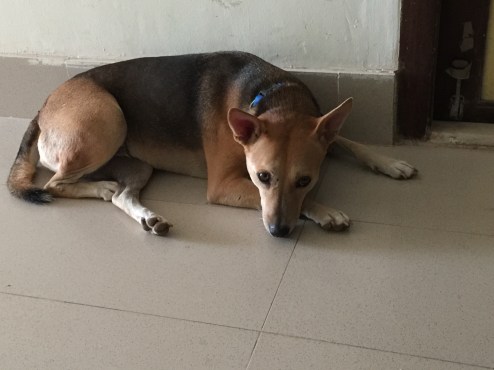
The devotee in the room next to me takes care of the two ashram dogs. One of them stays in her room most of the time, the other one is generally free to come and go. That dog’s name is Bhakti. I frequently come home to find Bhakti laying in front of my door. (She is doing that in the photo above.) The tile must feel cool on a hot day.

Last year, I was fascinated to watch her wait for the elevator at the bottom floor. When the elevator arrived, she walked onto it, and somehow, she knew exactly when get off.

This year, there is a new twist. In the past, she just walked down the stairs whenever she wanted to wander, and she still does that most of the time. However, she apparently has trained a few people to call the elevator for her. I was told that she would stand in front of them until they asked what she wanted. She refused food they offered her and indicated in some way that she wanted them to follow her. When they did, she guided them to the elevator. In time, they realized she wanted to go down, so they pressed the button. When the elevator door opened, Bhakti got on. Mission accomplished!

To read the rest of the posts in this series click here.

Arriving in India: November 26, 2016

img_20160414_171930167_top

I love those moments when my plane lands in India and I first take in the fragrance of the country. When I mentioned that to a fellow traveler a few years ago, he told me I was smelling diesel. I have no idea what diesel smells like but I knew that was not the fragrance I was talking about. Part of it may be incense, and at times smoke from cooking fires, but I know the odor is much more than that. This country is steeped in spirituality and I believe the distinct fragrance is the result of that. I often have the urge to bow down and kiss the earth when I get off the plane. While I don’t do that physically, I have no doubt that some subtle part of me doing just that.

This is the first time I have taken a layover in Dubai on my way to India and it sure made a big difference. While I was tired when I arrived in India, I didn’t feel overwhelming exhaustion.

I knew I was going to have to deal with something that has never been an issue in the past. On November 8, with no notice, the Indian government discontinued the use of 500 and 1000 rupee bills. (As I understand it, they did that because of the amount of black market money that was in the system and also because the money was being used by terrorists.) Having those bills become useless overnight has caused chaos in the country and a huge problem for many of India’s residents. I had read that people had been standing in long lines attempting to turn in the old bills. Sometimes they with success, sometimes not. Also, the country’s ATMs ran out of money, or would only give tiny sums of money. Many Indians don’t have bank accounts and before long the rule was made that the bills could only be exchanged if you found someone willing to put them into their bank account for you.

A few days before I left for India, I heard that the bills had to be exchanged by November 24. That left those of us who weren’t already in India with potentially worthless bills. I was advised to go directly to the bank in the airport as soon as I passed through immigration, before I picked up my luggage. As I looked at people walking up to the bank counter and leaving empty handed, I knew it wasn’t going to work. I still asked if I could exchange the bills, but received the same answer.

It took a long time for the baggage to come, but I eventually left with two heavy suitcases, loaded mostly with treats and/or supplies for other people. I always feel like Santa Claus when I distribute the items I bring. I enjoy that part of the trip. I also enjoy having nearly empty suitcases once everything is passed out.

From baggage claim, I walked to the currency exchange. That process went well, but they would only give us the new 2000 rupee notes. Even in normal circumstances, India’s small shops ask for payment in small bills, because they usually don’t have enough cash to make change for 500 and 1000 bills. These 2000 rupee bills were bound to cause a problem. I heard other people asking the currency exchange to give them smaller bills with no luck, so I didn’t even bother to try.

Soon I was in a taxi on my way to Amritapuri. I still marvel that taking a taxi to the ashram costs less than $40 even though the drive is 2 ½ to 3 hours. Since I was arriving at a time when there would be a lot of traffic, I expected that it would take the full three hours, if not more. I knew it was going to be an intense three hours when the driver started driving 130 km/hour in a 40 km/hour zone the minute he left the airport. This is not unusual for India but it has been a long time since I have had a driver who drove so aggressively.

In India, traffic seems to have rules of its own. The roads are filled with bicycles, scooters, motorcycles, rickshaws, lorries, trucks, taxis, buses, private cars and an occasional elephant. Pedestrians seem to have no right of way, so they get along as best as they can. The vehicles weave in and out with a precision that is mind boggling. The drivers pass each other by going into oncoming traffic, swerving back into their own lane just before impact. I’ve always said they seem to have incredible skill and nerves of steel.

I remembered the first time I took my daughter to India. I think she was 16 at the time. She sat in the front seat of the taxi and didn’t seem to react to any of this. Afterwards, I told her I was surprised she didn’t have a reaction. She responded that she had kept her eyes closed the whole time; that it seemed like one big game of “Chicken.”

Coming back to my current trip, I was happy there was so much traffic since it caused the driver to slow down. Still, he had more close calls than any other time I’ve taken this drive. I felt very relieved when, three hours later, we turned into the ashram gate.

I was (and am) home!

asrham-07

To read the rest of the posts in this series click here.
Weekly Photo Challenge: It’s Not This Time of Year Without…..

One of the reasons I go to Amritapuri at this time of year is because I love to be involved in the Christmas musical that is performed on Christmas Eve. During the first three weeks in December, the final touches are made to the script; actors are chosen and learn their lines; musicians and singers learn their songs; costumes, back drops and props are made; sound and lighting are planned for, etc. The list could go on and on. Simultaneously, there are rehearsals occurring all over the ashram.

Here are some photos, taken by various photographers, from last year’s Christmas play. I think they will give you a sense of why I love being part of the process so much. (Click on the gallery to enlarge the photos.)

Weekly Photo Challenge: It’s Not This Time of Year Without….

When You Feel Like Darkness Has You Bound

img_1345

I love watching the path my mind takes when I am determining what song to use for the Song Lyric Sunday challenge. I start by thinking about what songs would address the theme for the week, but I often don’t end up there.

This week the theme was protest songs. The song I used for my second week of doing this challenge was We Shall Overcome so I considered some of the 60’s protest songs. But then my mind went a different direction. I thought about two of the Blues songs my son Sreejit wrote some years back. I listened to them both, but as I was considering them, another song came to mind.

My daughter Chaitanya and my son Sreejit live at Amma’s Amritapuri ashram in Kerala, India. People for all religions come to Amma, and all religions are respected. For the last seven or eight years my son and daughter have been very instrumental in creating the Christmas play that is performed on Christmas Eve each year. Chaitanya writes and directs the plays and Sreejit and his friends compose most of the tunes. The plays are in the style of Broadway musicals.

The particular play that came to my mind was performed in 2012 and was titled God is Able. The setting was a Southern style Gospel church. Sreejit was the preacher! The story line covered the stories of Moses leading the Jews to the promised land, Rachael being healed by touching Jesus’ garment, and a fictional account of the heart of an angry store keeper being healed. I never will forget the moment in the play when the stage doors opened and our sparkling “Gospel Choir” became visible. It seemed like everyone in the auditorium did a collective gasp. Part of the reason I remember the gasp and the thunderous applause and shouts that followed our song so well is that I was part of the choir!!!

Choir

The song I have chosen is Dear God. The tune was written by Sreejit and the lyrics by Chaitanya.  It is not a protest song but it is a song that is very relevant to times of darkness which is often what proceeds protest.

The mp3 recording and the lyrics are below.  I hope you enjoy it as much as I still do!

When you feel like darkness has you bound
And you can’t see any way to get out
There’s a power which surrounds us all
Through God anything is possible

Never fear
Never let your doubts draw near
With courage face all that comes
Put your trust into God’s arms
He’ll protect you from all harm
His love will carry you on through

Dear God, hold us tight never let us leave thy sight
Dear God, fill our soul with your love make us whole

Sreejit singing above the choir:

God is able to calm the wild storm
God is able to make the weak strong
God is able to bring change within
God is able to do all things

Recycling and Composting in Amritapuri

Recycling station

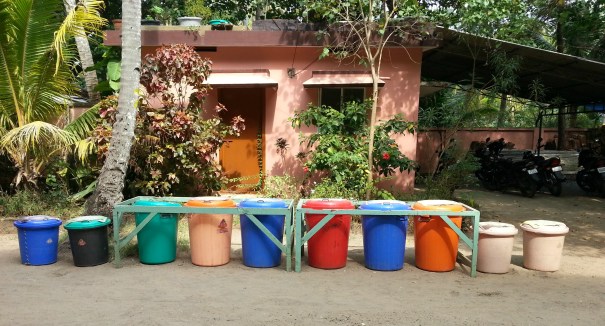
Amma has made recycling and composting a major priority for the ashram. Every resident and visitor sorts their trash into separate bins labeled for paper, soft plastic, hard plastic, yard waste, food waste, sharps, sanitary, cloth, dust and hair. Last year there were 16 recycling stations, such as the one in the photo above, scattered throughout the ashram grounds. Since so many more flats have been built since then, I imagine the number of recycling stations have increased as well.

The yard and food waste from these bins plus the leftover food from the various kitchens and dining areas are taken to the composting center and the rest of the items go to the recycling center. Think about how much waste 5000-15,000 residents and visitors might produce in a day and you will get a sense of the scope of these projects.

Once the bins arrive at the recycling center they are re-sorted by volunteers. Items that were placed in the wrong bin are removed and put in the appropriate bin. Once that process is completed, the items are sorted for a third time, in a much more detailed way. For example, items in the paper bin are divided into 10 different subcategories.

The recycled items are sold and help to fund Amma’s humanitarian projects.

To learn more about the ashram’s recycling program go to: Recycling: A Model for the World

~~~

IMG_1048
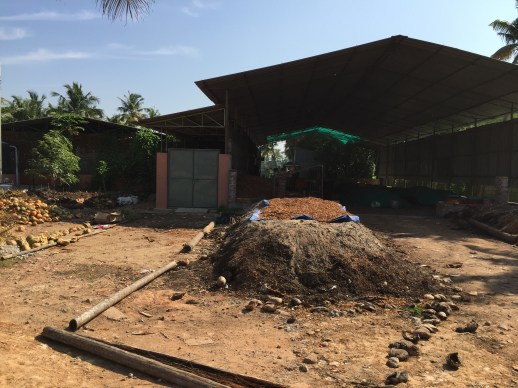
The vermi-composting center is the small building on the left; the food and yard waste composting center is on the right.

The food and yard waste bins are taken to the composting center. The food is put on a metal table and volunteers take out any non-food items such as plastic bags, spoons, etc. Then large food items are cut. Next, items such as fresh cow dung from the ashram cows, egg shells, shredded yard waste as well as wood chips and sawdust from the carpentry shop are added to the food in order to increase the bacterial culture and nitrogen or to make the mix drier. Once the food waste has been processed, it is formed into piles. The piles are covered with more shredded wood and yard waste. As the food composts, the piles can become very hot. You can even see steam rising from them. Volunteers aerate the compost by turning it with pitchforks.  (This year I saw signs asking for volunteers to turn the compost at 2 a.m.!) The piles stay at the composting center for two to three weeks and then go to a farm or to the vermi-composting center to finish the composting process.

The yard waste is being processed at the same time as the food waste. The yard waste consists of materials that are gathered when the ashram grounds are swept each morning, along with other garden waste. The waste is put into a container that has a metal grate on the bottom. The grate allows the sand, pebbles and dust to fall through. Next, rocks, seeds, plastic and other items that shouldn’t be part of the compost are removed. What is left is the usable yard waste. That yard waste is then put into a shredder. Once shredded, it may be added directly into the food waste as described above, or it may be spread on the surface of the compost piles.

To see photos of this process go to: Food and Yard Waste Composting in Amritapuri, Pages 19-21

For years, the composting center has been located on the main ashram grounds. When I arrived at the ashram in November, I discovered it had moved. Now it is near Kuzhitura Farm, a 20 minute walk from the ashram. Pick-up trucks take the food and yard waste to the new center and the volunteers who work there generally ride bicycles.  The new center is about three times the size of the original one.

~~~

The Red Worm Composting blog states that “Worm composting (also known as vermi-composting) involves the breakdown of organic wastes via the joint action of worms and microorganisms (although there are often other critters that lend a hand).”  That process creates some of the highest quality fertilizer that exists.  Red worms are the type of worms used for vermi-composting.

In the vermi-composting center, worm beds are formed from the food and yard waste compost.  When the beds are ready, the worms are then added to the piles.  Each day, a “slurpee” made from cow dung and water is poured on the top of the beds.  The worms rise to the surface and feast.  It takes about three months for the worms to turn the compost into fertilizer.

The ashram’s vermi-composting project moved to the Kuzhitura Farm location over a year ago.  When I visited the new center last year, there were eight to ten worm beds.  This year there were only the two shown below.  I asked one of the people in the food composting center about the change and he told me they had discovered they were using way too much bedding material for the number of worms they had.  Taking care of two big beds would certainly decrease the amount of time it took to maintain the beds!

There was another big change this year.  In the past, when the fertilized compost was ready, volunteers separated the worms from the compost by hand.  It took many volunteers and a lot of time to accomplish that process. (That was a job I loved to do!) The worms are now separated from the compost with a machine that is like a sifter.   There was no staff present when I visited so I didn’t have the opportunity to talk to anyone about it, but I did take some pictures of the sifter.

The fertilized compost produced at Amritapuri has always been dark in color and very light weight.  I’ve been jealous because it is so much nicer than what my vermi-composting system in Seattle produces.  One of the people from the food composting center showed me some of the compost that is created using the new shifting process.  It was even darker than it has been in the past…. and was so light-weight.  I hope to learn more about these changes the next time I visit Amritapuri.


Kuzhitura Farm in Amritapuri

IMG_1053

One of my goals for the last week of my trip was to visit the garden/farm south of the ashram as well as the one across the bridge near Amma’s Amrita School of Ayurveda. The land in both places is very dry, and water is scarce, so developing the gardens has been a process of trial and error over many years. This year the change was mind-boggling. In both places, I felt like I was walking into paradise.  This post will be dedicated to the garden south of the ashram which is now called Kuzhitura Farm.

When I visited this farm last year, I had learned that they were focusing on using permaculture techniques. One of those techniques was the banana circle. I still remember how shocked I was when I researched bananas and banana circles later and learned that banana palms are not trees, they are actually considered a grass! (Banana Circles in Amritapuri).

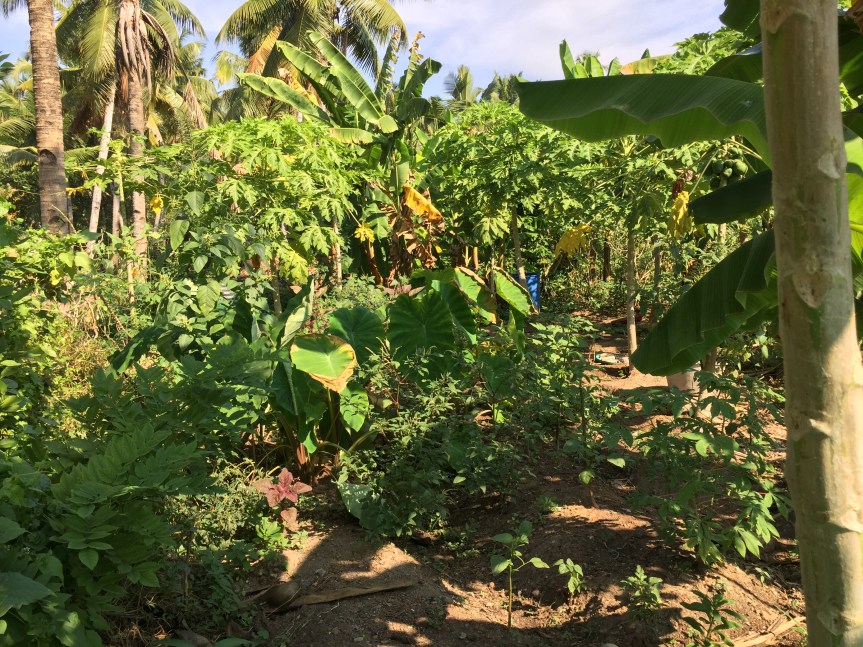
When Premarupa and I arrived at the farm this year, I was struck by how different it looked. It is amazing how fast trees and plants grow in the tropics. While there are vegetables growing throughout the area, the big vegetable garden I remembered from the previous year wasn’t even in the same place. My guess is the trees and banana palms had grown so big that there was no longer enough sunlight in the original area. There is now a garden that is about triple the size of the previous one a distance away.

Here are pictures of the farm this year.

(Click to enlarge pictures)

This property is also now home to Amritapuri’s food composting and vermi-composting (worm composting) centers.  I will share more about those projects in the next post.

शन्त्याः श्वेतपुष्पाणि (White Flowers of Peace)

IMG_0890


अम्मा वदति ध्याने श्वेतपुष्पाणि आकाशात् वर्षन्ति पश्यतु इति
Amma says: “During meditation, see white flowers raining from the sky.”

श्वेतपुष्पाणि सर्वम् आच्छादयन्ति
The white flowers are covering everything

लोकाय तानि शन्तिम् आनयन्ति
They bring peace for the world

***

सर्वानि एतानि श्वेतपुष्पाणि आम्बायाः अमृतपुर्याम् आश्रमे सन्ति
All of these white flowers are in Amma’s Amritapuri ashram.

Living and Learning in Amritapuri (December 22-26, 2015)

2015Dec24-dvd-201512241238

Be like a bird

Amma says we should be a bird perched on a dry twig, ready to fly at a moment’s notice. She is really good at giving us opportunities to work on that lesson. Last year, since the play was on public darshan day, we expected to present it on the floor of the auditorium instead of on the stage where Amma is hugging people.  The play was prepared with that plan in mind.

Then on December 20, Amma told us that she would stop darshan early so she could watch the play with us.  That meant that the play would be on the stage.  The backdrops were WAY too long for the stage and would all have to be altered. The stage was smaller than what had been designed for the auditorium so both the acting and dances had to be reworked to fit in the smaller space. It was amazing how well the cast worked together to make the changes.

The same thing happened this year, but in the opposite direction. We had prepared to present the play on the stage and three days before the event Amma said since the crowds were large, she would be giving darshan on the stage. Therefore, the play would  be performed on the auditorium floor in front of her.  That way she could watch it while she was hugging those who came to receive her blessing.  Again many aspects of the play had to be reconfigured. The cast was used to this type of challenge by now, so they laughed and cheered and began to make the necessary alterations.

Costumes

Once the costumes were made, they all had to be ironed. It took four for five people many hours over a three day period to accomplish that task. One day, I was irritated because the only iron available to me was so heavy. It reminded me of the heavy irons from centuries past, the ones that were placed on a stove to get hot. I learned to tip the iron onto the fabric rather than pick it up each time I moved it.  Once I got my technique down, I discovered that it was actually the best iron of all of them. It was so heavy it seemed like it flattened many of the wrinkles through its weight! It was a good lesson in remembering that there is a lot I don’t know and my judgments may be wrong.

Christmas Eve

The day of the play finally arrived. The last rehearsals had gone well and everyone was ready.

There is only one story in the Bible about Jesus as a child. This play was about what Jesus might have been like when he was growing up, as well as what it might have been like to be his parents, siblings or friends. It also contained scenes about John the Baptist and about the 40 days and nights Jesus was tempted by Satan. While Jesus is known as a peacemaker, he also challenged the traditional religious teachings, so that area was addressed as well.

At one point in the play, Joseph told the children the story of David and Goliath. Our Goliath was a 12 foot high puppet! A man was inside of the puppet carrying him on his shoulders. As I’m sure you can imagine, Goliath was a major attraction!

The play was absolutely wonderful. The singing, dancing and acting were remarkable. (You can click on any picture in the gallery to enlarge them all.)

After the play was over, Amma gave her Christmas message and then we all received Christmas cake. If you are interested, you can read Amma’s speech at: http://www.amritapuri.org/50818/15-christmas.aum

Crowds

Very late on Christmas Eve, big groups of Indians started arriving and on Christmas day the crowd was huge.   That evening we went to the beach to meditate with Amma and the whole time we were there people continued to come. I have never seen that many people on the beach at one time.

At 6:15 or so we returned to the auditorium for bhajans (devotional singing). There were so many people that everyone couldn’t fit in the auditorium. It has been quite a while since I’ve seen the auditorium that full!

Play cast celebration

On Christmas day the play cast had a party. Devapriya and Chaitanya had prepared a funny skit. Goliath was part of it as well. Sreejit was Goliath’s voice. I took some pictures so you could see Goliath close up.

Morning prayers (archana)

I had started staying in my room during the morning prayers and reading one of the chants in Devanagari (Sanskrit) script during that time.  At first I did that was because I had lost my archana book, and then because I wasn’t waking up in time to get to the temple before the prayers started. It was also a way for me to practice my Sanskrit. One day this week though I was awakened at 3:30 in morning, by the computer! I hadn’t logged out, but I had closed the cover and everything had turned off.  I had left the internet stick inserted but it was off too. At 3:30, the computer started making noise.  When I looked to see what was going on, there were lights flashing several feet around it. That had never happened before and I was mystified. It was as if the computer had turned itself on. I couldn’t go back to sleep so decided I was “supposed” to go to archana in the temple, and did.

Challenges

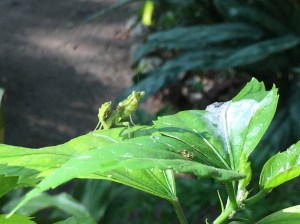
December 26 was a challenging day for me. I was very triggered by several things that happened in the early morning. Soon thereafter, someone approached me and asked if I would like to take a picture of an insect. I went with them and was very intrigued by what I saw.

IMG_0697

I chose to believe that being given the opportunity to see this creature, which I think was a very young praying mantis, was either a reward for weathering the challenges, or something to lift my spirits. Since that day ended with more triggering events, I was very glad when it was over.

Tai Chi

A positive thing about the 26th was that we had two Tai Chi classes! I am so in love with that process. We’ve had two teachers working with us. Dave returned to Canada a few days ago and Stephanie will leave on January 2. I will miss learning from them but look forward to practicing what I have learned on my own, and hopefully will find another teacher when I get back to Seattle.

I can already feel changes in my body from doing it. It seems to me that my body is more relaxed, that my posture has improved and that I am looking straight in front of me instead of down. I look forward to seeing if it has any effect on my scoliosis.  Most important though is that it brings me into a meditative state.

Time with Amma

I have been so busy since I’ve been here that I haven’t spent much time with Amma.  She leaves January 5 on her South Kerala tour  and I will be gone when she comes back to Amritapuri.  I am going to make sure that I go to the beach meditations on Mondays and Fridays and will hand her prasad (the candy and ash she gives everyone she hugs) every darshan day!

I can’t believe that there are less than two weeks left in this trip.  I wonder what other lessons and experiences will come my way before I leave.