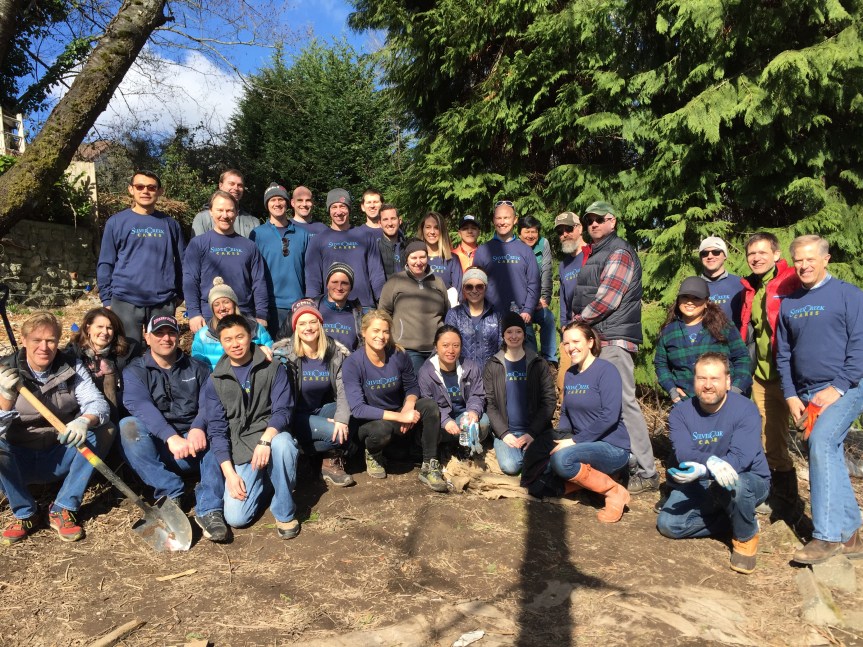
Monday, February 26 was an exciting day. On that day, 31 enthusiastic employees from Silver Creek Capital Management came to plant trees, shrubs and ground covers in our Greenbelt site. Our staff consisted of Nicole from Forterra, Claire a master gardener, and two Green Seattle Partnership Forest Stewards- Peter from Mt. Baker Park and me. Claire and I also belong to GreenFriends, the environmental arm of Embracing the World.
During the three-hour work party, we planted 17 trees, 75 shrubs and 77 ground covers! Every new plant is native to the Pacific Northwest. We spread two buckets of wood chip mulch around each plant to reduce weed growth and retain water. (The burlap we place on the ground after removing blackberries and ivy from the land also helps with weed reduction and water retention). At future work parties we will be covering any exposed burlap in the planting areas with wood chips.
(Click on the gallery above to enlarge the photos.)
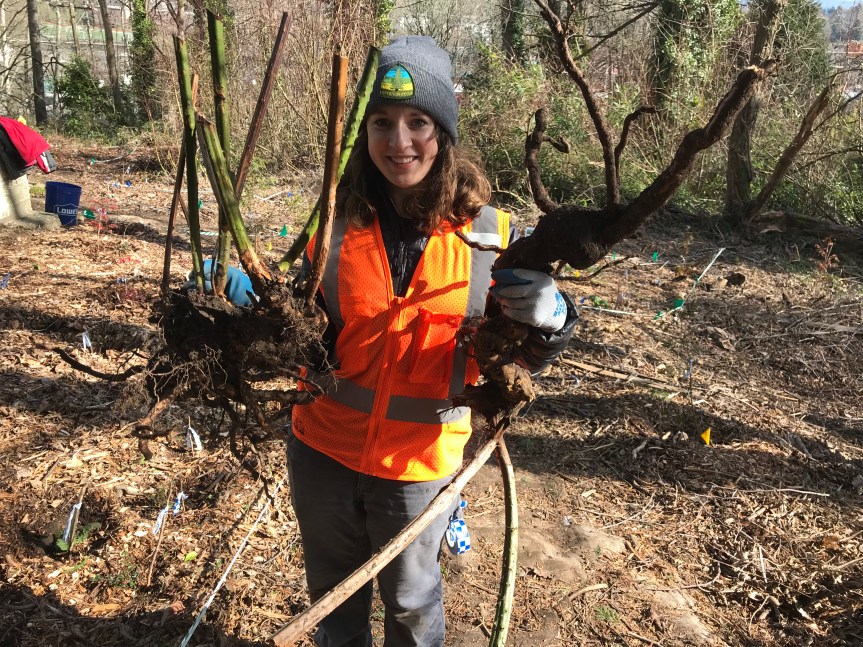
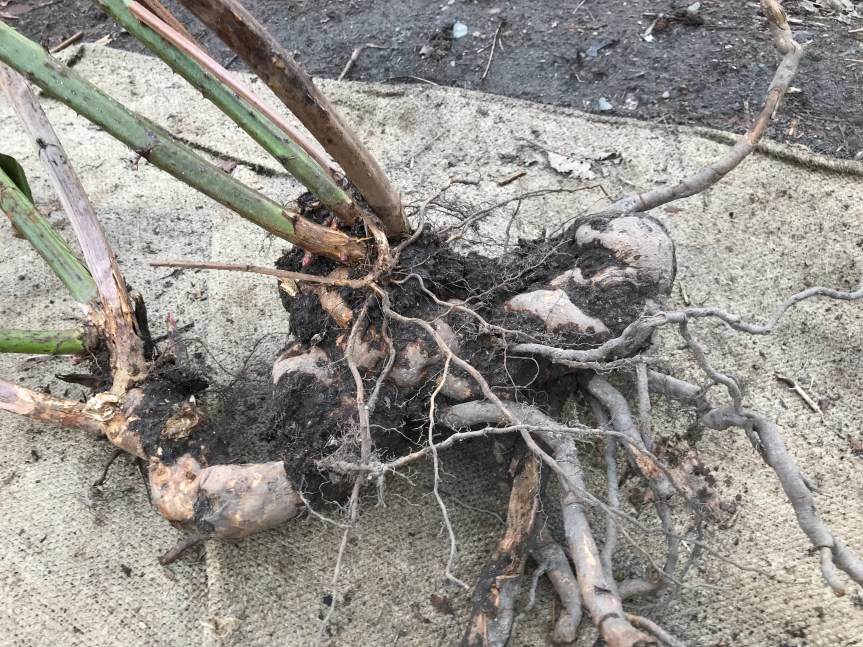
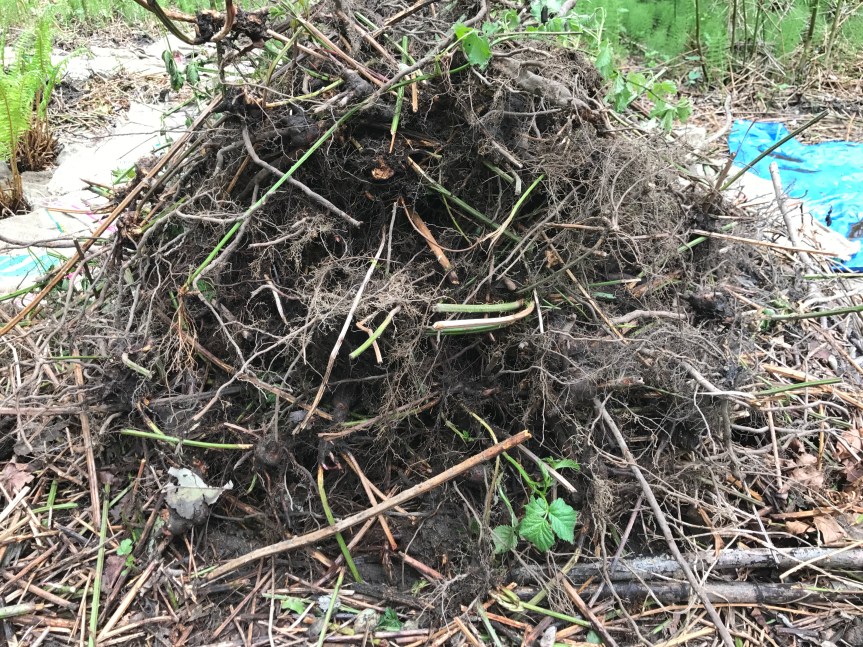
Towards the end of the event, part of Nicole’s team cleared more land. They dug up some huge blackberry root balls.
A few days later I weighed the biggest one. It weighed almost 10 pounds!
When the work party was over, we cleaned and put away the tools and celebrated all we had done. I think everyone had enjoyed their experience.
Later, I took another look at what we had accomplished. Once again, I was awed by how much the land had been transformed by a single work party.
Douglas Fir
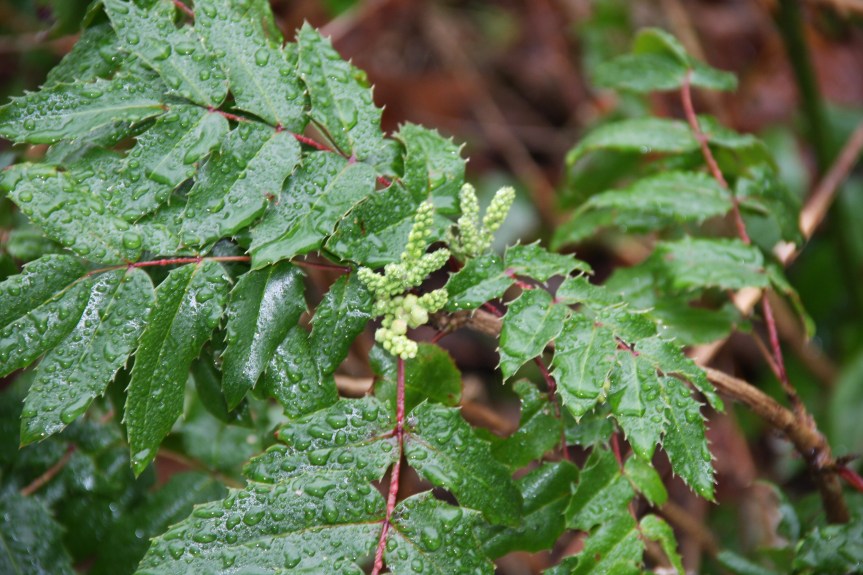
Oregon Grape
Red Columbine
Wild Ginger
Oregon Stonecrop
Sea Thrift
Newly planted field
Photos by Laurel Webb, Nicole Marcotte and Karuna Poole
Amma teaches us to “Be like a bird perched on a dry twig, ready to fly at a moment’s notice.” She also teaches us that “What we need will be provided” and to “Put in the effort and let go of the results.” Taking those attitudes can help us to stay in the moment which in turn can decrease the tendency to worry about the future. The Greenbelt restoration work parties we held during the last half of February provided me with many opportunities to practice each of those attitudes.
Students who take the University of Washington’s Introduction to Environmental Science course are required to do three hours of volunteer work. I had scheduled a work party for February 17 because it was the weekend before their assignment was due. That is always our biggest work party of the quarter.
I was concerned about that work party though, because the people who usually lead teams at our events were going to be at a retreat in Oregon that weekend. I decided to “think outside the box” and started inviting neighbors and people in the Amma community who weren’t going to the retreat. None of them had worked on this project before, but I knew they would do a good job. Pretty soon I had three volunteers. They all came to the site ahead of time for an orientation. We were ready!
I soon discovered more good news was in store. Someone who had planned to go to the retreat, decided not to go, and volunteered to help at the work party. She had lead teams many times so that was a real bonus. Then, the Forest Steward from Mt. Baker park wrote me and said he would help. Just before the work party, another neighbor volunteered to lead a team. I was excited. We had an abundance of staff. While all of this was coming together, 31 students registered for the work party. We were set. What a good example it had been of “What you need will be provided.”
Then “Be like a bird perched on a dry twig” took over. Days ahead of time, we heard that a big wind storm was coming on the same day as the work party. You can do forestry work in the rain, but you can’t do it in high winds; branches might break or trees might fall. On the 16th, it became obvious we couldn’t hold the work party. In fact, the Parks Department canceled work parties that day on a park by park basis. Ours was one that was canceled.
That left both me and the students in a dilemma. I needed to have the land prepared for a corporate group that was coming to plant trees, shrubs and ground covers on Monday, February 26. And the students needed their volunteer hours. I knew that most or all of the team leaders would be at work if I planned events during the week. I decided I would hold three small work parties on Wednesday, Thursday and Friday and be prepared to lead them by myself.
The “Be like a bird” lesson continued as the weather forecasters talked about the possibility of breezy weather and snow. Would these work parties have to be canceled too? The first indication that what I needed would be provided was when I found out that two of the people who had been scheduled to lead teams on the 17th had the week off from work and would help with one of the work parties!
Wednesday, February 21
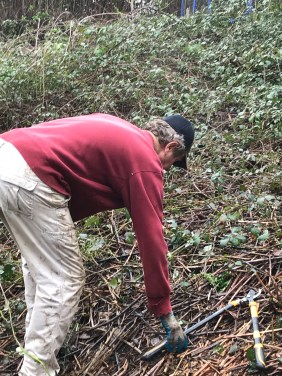
Wednesday arrived and all was well. In fact it was better than just “well.” A half hour before the work party began, Peter, the Forest Steward from Mt. Baker, emerged from the forest. Not only was he going to help with this work party, he was going to help with all three of them! What a surprise blessing he was. So we had two Forest Stewards and 7 students that day. We began to clear new areas of ivy and blackberries vines. We dug out some big blackberry roots!
(Click on the galleries to enlarge the photos.)
Thursday, February 22
Knowing that Peter would be helping made it possible for me to accept more students than I had originally planned. The work party grew to 23 students.
Maintaining the “Be like a bird” attitude was still important as the forecast was for snow and by Wednesday evening it was snowing, and sticking to the ground. Would I have to cancel the work party? I would decide in the morning.
Thursday’s work party had been scheduled to go from 2:30-5:30 to accommodate the students’ class schedule. The snow was very wet and was beginning to melt when I woke up that morning. Around 10 a.m. I decided to walk to the light rail and around the Greenbelt to see how much snow there was and whether we could work in it. I discovered the streets and sidewalks were clear and most of the Greenbelt was free of snow. What snow remained was melting. Even though the temperature was in the 30’s, it felt warmer than the day before because it was sunny.
My neighbor John also worked with us that day so we had three staff. We continued clearing the land that we had worked on the previous day.
After a snack break, we formed a bucket brigade and carried wood chips from the street into the site. The chips would be used as mulch during the February 26 planting work party.
While we were moving the wood chips, it started to snow lightly. When we finished, we cleaned and put away the tools and quickly headed back to our respective homes.
Friday, February 23
During the week’s third work party, we two Forest Stewards and three GreenFriends members served as staff. Twenty-one students participated. I experienced such a sense of abundance…. an abundance of staff and an abundance of students. Once again, what I had needed was provided.
About half of the students worked in the area we had been clearing during the previous work parties. We had cleared land that I hadn’t expected to clear until later this year! Peter, the Mt. Baker Forest Steward, worked with the students to create swale-like structures that will help prevent erosion. I appreciated learning new skills from him.
Another team worked in an area that has a big ivy mass. That team moved the big piles of ivy to the place on the site that has racks where ivy and blackberries can dry out rather than re-root.
A different group of students placed burlap around flags that were scattered through the site. Those flags marked the places we will be planting on the 26th.
After the break we formed another bucket brigade and finished moving the wood chips into the site.
After the remainder of the wood chips were onsite, we cleaned up and put away the tools, celebrated our accomplishments and went on our way.
What a week it had been. I was consistently challenged to stay in the moment, to let go, to trust what I need would be provided and to put in the effort and let go of the results. And I had certainly felt like a bird perched on a dry twig. We accomplished so much during these three work parties. Grace had flowed.
After every work party, I tell anyone who will listen that it was an amazing work party. And it always is. The transformation in the land that occurs during each three hour work party is mind-boggling, at least to my mind.
Four GreenFriends members, 3 neighbors and 21 students from the University of Washington’s Introduction to Environmental Science class participated in the February 3rd event. Towards the beginning, we divided into 4 teams. The GreenFriends members, who were serving as team leaders, wore orange vests so that they could be spotted easily.
Team 1
During our last work party, volunteers had focused on removing ivy from an evergreen tree and from the ground in an area on the northwest part of the site. At this work party, Team 1 continued that work, this time clearing ivy and blackberry root balls from an ever widening area. All of the debris was taken to an area we call The Rack Zone where it is put on racks that keep it from re-rooting. Having the vines and rootballs on the racks also enhances air flow and the debris will decompose faster than if it was left on the ground.
At the beginning of the work party the area looked like this:
The volunteers worked diligently and had a good time in the process. Even though I don’t have a “before” photo, know that the shed and stone wall shown in the last photo in this section was completely covered with ivy. Until recently, I didn’t even know there was a shed there.
(You can enlarge the photos in a photo gallery by clicking on any of the photos.)
At the end of the work party, the space looked like this. There is still work to do in this area but so much was accomplished during those three hours.
Team 2
The area where Team 2 worked is adjacent to Team 1’s section of the property. When English ivy grows unchecked and begins to flower, the leaves may change shape and become waxy. It may become a gigantic mass, developing thick stalks that may look more like a tree trunk than an ivy vine. One of the neighbors who has worked on this project from the beginning discovered such a mass in early January. Since then, he has been working to cut it down.
The first set of pictures below show what the area looked like at the beginning of the February 3rd work party. Notice the ivy mass in the background of the first photo. It is not nearly as big as it was originally but it is still huge. The second two photos show some of the piles we would be dealing with at this work party.
Here is a close up of different parts of that mass. It is SO dense.
The volunteers worked on the piles of debris, cutting the leaves and small branches of ivy away from the bigger branches. The leaves and small branches were moved to the rack zone to dry and the bigger branches either stayed in the area or were stacked near the rack zone.
The Rack Zone
By the end of this work party, the rack zone was almost completely full of ivy.
I wonder how long it will take for us to completely remove the mass. I suspect there will be many more work parties and many more piles before this task will be finished. But, at least, when the work party was over, the piles of debris that were there at the beginning were almost gone.
Team 3
On February 26, Silver Capital Management employees are coming to plant trees, shrubs and ground covers in this Greenbelt site. Team 3 helped prepare the ground for that planting work party.
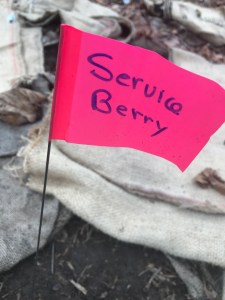
In the days prior to the February 3rd work party, pink flags were placed around the site, marking where each plant will go. Written on each flag was the type of plant that will be planted there.
We’ve found that planting proceeds smoother and faster if the areas where things will be planted are prepared ahead of time. Prior to the work party, I made two demonstration areas so that the volunteers could see what they would be doing. In one area, I used burlap that had been placed on the ground when we first cleared the land, and in the other I used new burlap.
Team 3 cleared weeds, if there were any, from around the flags and then placed burlap bags around them, leaving a place for the people who will be planting to dig a hole. Once the planting is finished the burlap will be adjusted, if necessary, and then covered with wood chips. Both the burlap and the wood chips will decompose and enrich the soil.
This team prepared spaces for about 70 plants. In the photos below, you can see the burlap that is now scattered throughout the site.
Team 4
The fourth team cleared an area that our volunteers had not tackled before. Seattle Parks Department staff had done an initial cutting of the blackberry vines in that area in March 2017 and then cut them back again during the summer. At the February 3rd work party, the volunteers dug out blackberry root balls and removed ivy.
This is how that land looked at the beginning of the work party. (I think this would be a particularly good gallery for you to click on!)
After instruction on how to clear the land, the team “rolled up their sleeves” and went to work.
The students dug up many blackberry root balls. These are photos of the biggest one they found!
The transformation that took place was remarkable. By the end, this section was clear of invasive plants and covered by burlap bags (the bags help prevent weed growth).
While the students were working, my neighbor John started removing blackberry vines in a nearby area, one where the blackberries are even denser. A team will work in that section during our next work party.
On February 26, these newly restored areas will become home to seven Douglas Fir trees as well as a variety of shrubs and ground covers.
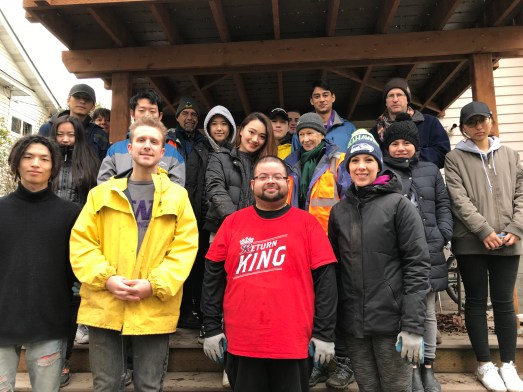
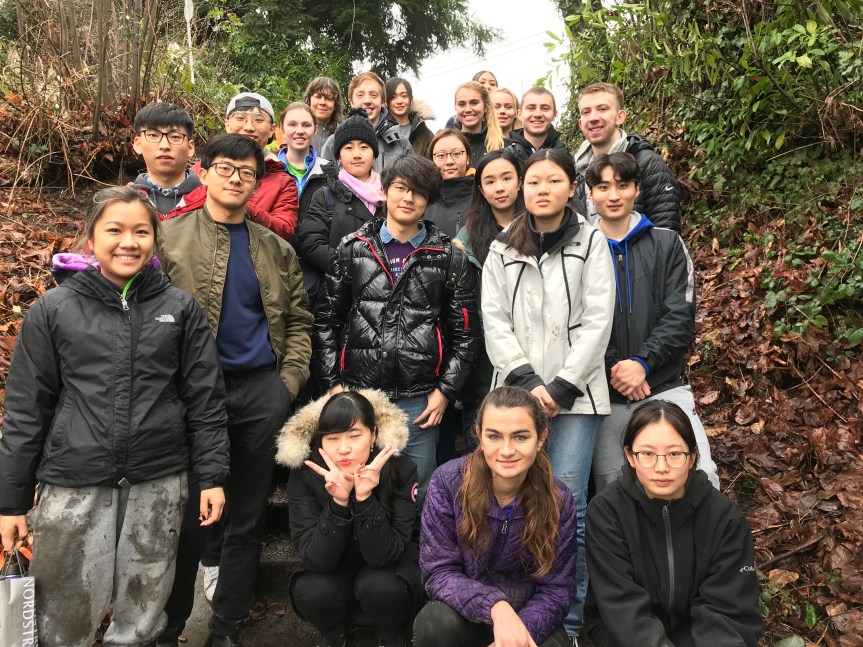
By 12:50 p.m., the tools we used had been cleaned and put away. We then gathered on the Hanford Stairs, which are on the north border of this site, to take a group photo and celebrate the completion of a very successful work party.
Wednesday, November 15 was a big day, one I’ve been eagerly awaiting. On that day, a corporate group from DocuSign came to our restoration site to plant the 330 shrubs and ground covers Seattle Parks Department had given us. November 15 was DocuSign’s Global Impact Day. I looked up the philosophy behind Global Impact and found this:
We believe character is defined through action. With DocuSign IMPACT, we are committed to putting this character into action by harnessing the power of DocuSign’s people, products, and profits to make a difference in the global communities in which our employees and customers live and work.
On that day, buses picked up the employees at their corporate headquarters and traveled to projects all over the city. I felt so grateful to have 42 of their volunteers helping us; and they were wonderful people to work with.
(Note: You might be wondering why we plant at this time of year. In the forest, planting starts after the fall rains begin. That way the plants have a chance to root before the summer comes. We’ve had almost no rain during the summer for a few years and there is no water source on this property. The plants have the best chance of survival if they have developed a healthy root system before the dry period.)
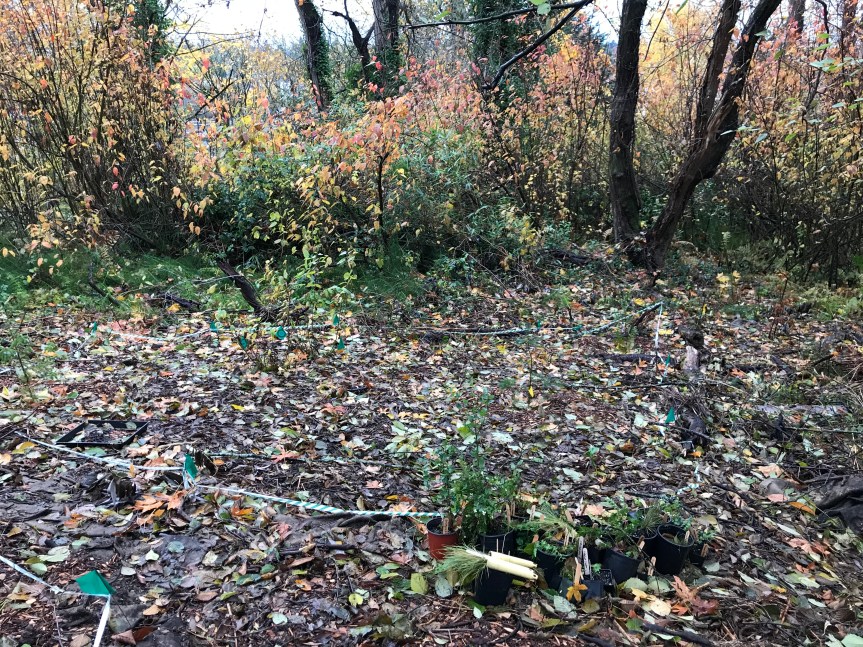
Prior to the work party, we prepared eight planting areas. Any remaining blackberry vines and rootballs, ivy and bindweed were removed and the areas were marked off with green and white, or yellow and black, tape. The University of Washington students who helped during our November 11 work party moved the potted shrubs and groundcovers to the areas where they would be planted.
The photo below is of the Dogwood Area, so named because it is near a large area of red twig dogwood and because a small patch of red twig dogwood came up within this planting area during the summer.
Location of the dogwood volunteers
Closeup of the dogwood
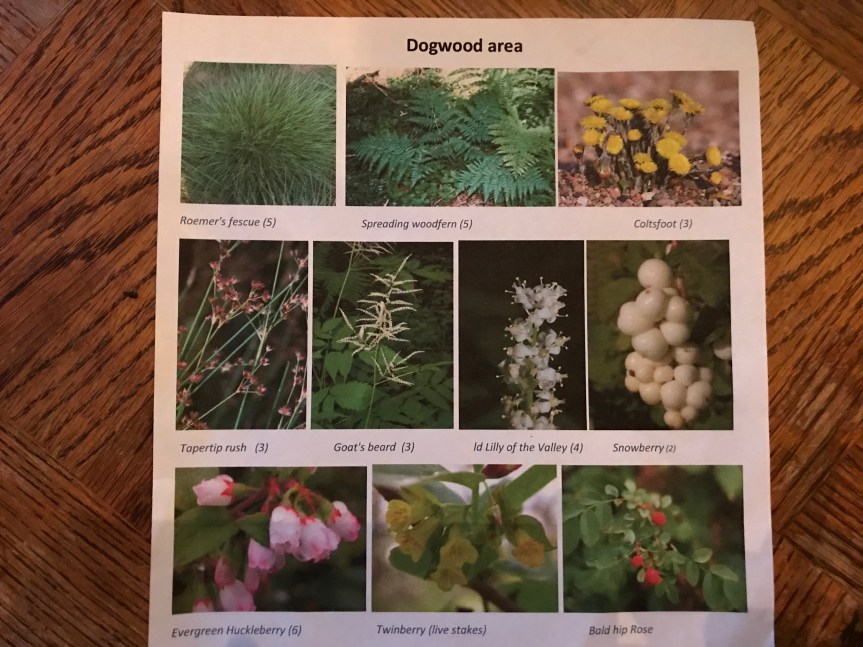
Another way we prepared for the work party was to create and distribute photo galleries of the plants that would go in each area. That way the workers could see the beauty they were helping to create.
I already mentioned that the DocuSign group was wonderful to work with. We had a dream staff too, consisting of Joanna Nelson de Flores, the director of Forterra’s Green Cities program, Nichole Marcotte, Forterra’s Stewardship Coordinator, Anavadya Oravec a Master Gardener and GreenFriends member and me! The staff arrived an hour and a half early so I had a chance to show them around the site. We spent part of our November 15th pre-work party time placing each plant on the spot where the DocuSign employees would plant it.
Joanna
Nichole and Karuna
Anavadya
When the participants arrived, I talked about the history of the project and gave information about safety relating to this particular site. Then the group was divided in half and walked to the part of the property where they would soon be planting. Joanna and Nichole each led a group. They talked about tool safety and then showed participants how to plant the shrubs and ground covers. I really appreciated having the opportunity to hear the experts teach! During the work party, all four of us supervised the work and helped as needed. (Click on the gallery to enlarge the photos.)
After each plant was planted, a blue and white tape was tied loosely on one of its branches, or on a stick that was placed next to it. Every year, Seattle Parks Department uses a different color of tape to tag the plants. So from here on out, whenever we see a blue and white tape in any of Seattle’s parks, we will know that the item was planted in 2017!
Once a shrub or groundcover was planted, four burlap bags were placed around it. When all of the planting in an area was complete and the burlap was down, the entire area was covered with wood chips. (The burlap and wood chips reduce weed growth, retain moisture, and prevent erosion. Both the burlap and the chips will decompose and enrich the soil.)
Below are photos of the completed planting areas. You can see the blue and white tape I mentioned throughout them.
And this is a photo of the empty pots!
I am so excited for Spring to arrive so I can see every bud, every flower, and every berry! I hope most (or better yet, all) of the plants survive the winter.
On Green Seattle Day, Green Seattle Partnership sponsors three hour work parties in parklands all over Seattle. This year Sarva and I agreed to help lead a team at Mountain View, a park that is a few miles south of our Greenbelt restoration site. Susan Zeman, a forest steward who often helps at our work parties, coordinated the Mountain View work party as well as one at View Point park which is located across the street from Mountain View. Susan had gathered enough forest stewards that Sarva and I were able to plant trees as well as being leads. Visala, Haley and Bob, who like Sarva and me are part of Amma’s GreenFriends group, also participated in this event.
This experience was particularly meaningful to me because ten years ago this park was completely covered with blackberries and ivy. Today it is a beautiful, healthy forest. It was inspiring for me to witness a living example what reforestation work can do. Someday our Greenbelt restoration site will look like this one.
Below are several photos from the Mountain View work party.
On the same Facebook page, I found a synopsis of the work that was done that day. What a testament it is to what can be accomplished when we come together in support of Mother Nature.
A few days later, I returned to Mountain View park. I loved walking through the leaves and gazing at all of the trees we had planted. I felt renewed and excited to continue the restoration work at our Cheasty Greenbelt site.
Since September of 2016, our local GreenFriends group has been working to restore a four-lot strip of Seattle’s Greenbelt to the healthy forest it was meant to be. In October of 2016, we linked our project to the Green Seattle Partnership, a collaborative group that includes the City of Seattle Parks Department, Forest Stewards, and many other nonprofit organizations, all of whom are dedicated to restoring Seattle’s 2,500 acres of forested parks.
This strip of Greenbelt has been covered by blackberry vines and ivy for 30-50 years. When the City of Seattle staff cut down the blackberry vines in March of 2017, they discovered the foundation of a house. We believe that house burned down in the 50’s. With blackberry vines that at times reached nine-feet in height growing over and around it, no one in the neighborhood even knew the foundation was there. We decided to focus on that area during the April 30 work party.
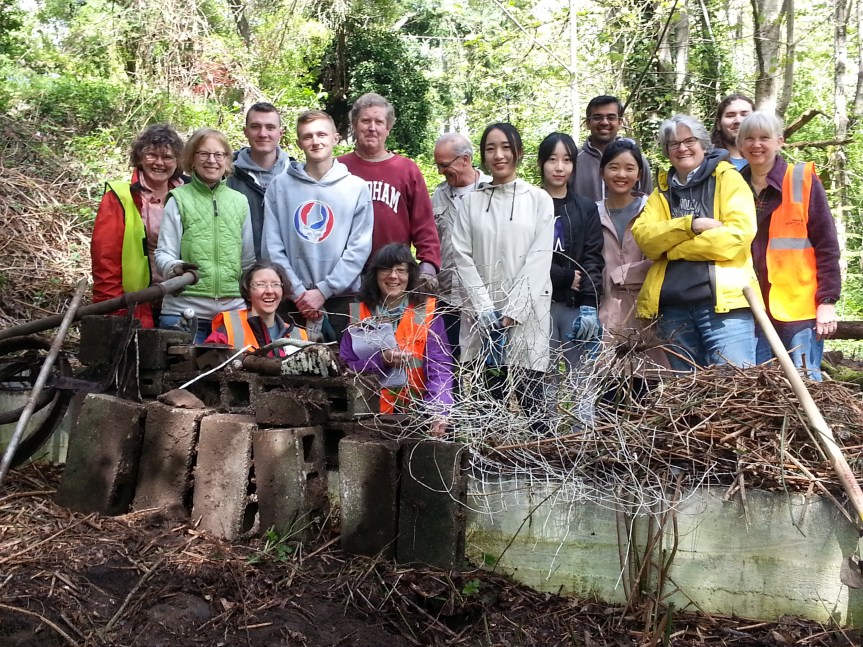
Our work party group standing behind some of the items we found in the dirt.
This particular work party was held in honor of Bridge 2 Beach Earth Day, an annual event focused on making “Mother Earth more beautiful and [Seattle] neighborhoods sparkle.” This year the Rainier Chamber of Commerce, the sponsor of the event, invited the Green Seattle Partnership to join in the effort.
Our work party began at 10 a.m. and lasted until 1 p.m. Seven GreenFriends, two Forest Stewards from the Green Seattle Partnership, a neighbor, and six students from a University of Washington Environmental Science class participated.
Our tools were provided by the Green Seattle Partnership
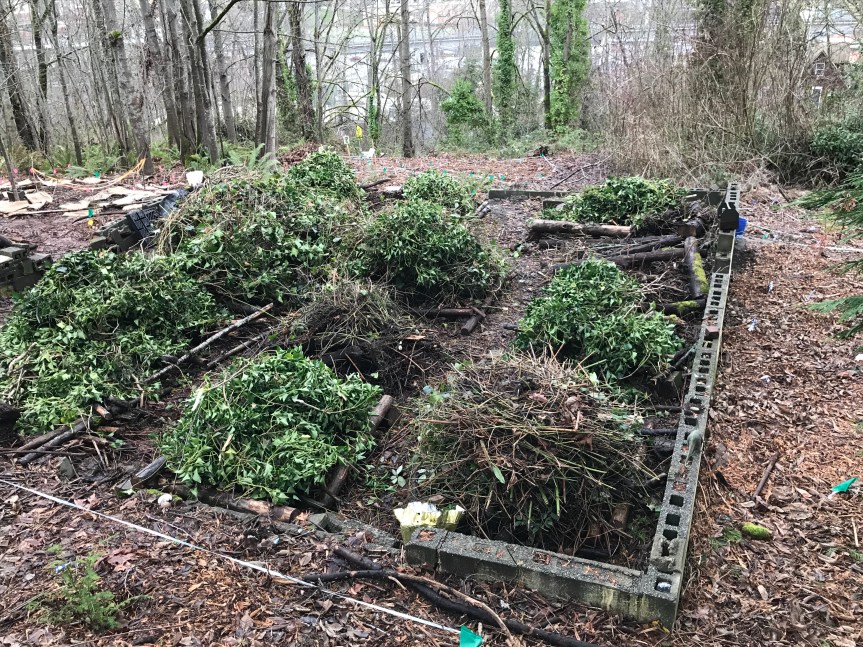
Our primary task for the day was to remove blackberry root balls and put them on racks made from fallen tree branches. That way, the roots cannot touch the ground and will dry out. The photo below shows one of the three root ball piles that we created that day. [Some of the root balls you see in the photo were touching the ground, so were moved to the top of the pile at a later time.]
In the process of clearing the root balls, we found many objects in the dirt. This was probably the first time these items had been exposed to the light of day since sometime in the 60’s
We even found a foot-long worm!
We have discovered many interesting things since we began the project. This may be my favorite one. I wonder how old it is.
Once the root balls are removed, we cover the cleared land with burlap bags to reduce weed growth. Then dried blackberry canes and other debris are placed on top of the burlap. In time, the bags and debris will turn into mulch which will hold in moisture and enrich the soil.
Below are some “before and after” photos from our three-hour work party.
It was such a fun, productive and rewarding day. We accomplished more than I ever thought possible. When I reported the students’ hours to their professor, he told me he was sure there would be plenty of interest if I wanted to schedule another work party. I decided to offer one on Saturday May 13. The professor sent a notice to the students at 7:30 p.m. and when I checked the next morning, the event was full! I look forward to whatever we experience and discover that day.
So much has happened since I woke up one morning in late August 2016 realizing that I wasn’t willing to watch another tree die in the Greenbelt lot behind my house. That lot was filled with blackberries which had been growing for decades. I gathered my trusty hedge shears and lopper and started chopping them down.
Soon, a friend started working with me. A month or two after that, three other friends, members of our GreenFriends group, joined me in clearing the land of invasive plants. We decided we would make restoring this lot a GreenFriends project.
In October, we linked our project to the Green Seattle Partnership, a collaborative group that includes the City of Seattle, Forest Stewards and many other non profit groups, all of whom are dedicated to restoring Seattle’s 2500 acres of forested parks. One of the city botanists came to see the work we had already done, answer our questions and give direction.
We were told that it was necessary for least one member of our group to take the Forest Steward training. That training would teach us what needed to be done on the lot and how to lead restoration work parties. Ananya and I decided to become Forest Stewards. The training wouldn’t be held in March and April of 2017 but we would be able to continue to remove the invasive plants in the meantime. We wouldn’t hold big work parties until we took the training.
Each restoration project has four phases: 1) Remove invasive plants, 2) Plant trees, shrubs and ground covers, 3) Plant establishment- watering, weeding, mulching and 4) Long term maintenance. Our project is in Phase 1. Once the invasive plants are gone, Seattle Parks Department will provide all of the trees, shrubs and ground covers for volunteers to plant.
We decided we would not only restore the one lot, we would restore the whole four lot strip of Greenbelt that it is a part of. The lot behind my house is Lot 3 and has been covered by invasive plants for around 30 years; Lot 2 and 4 have been covered for fifty or more years. There has been quite a bit of restoration work done in Lot 1 during the last three or four years. It needs maintenance work, but when we look at the many new trees, shrubs and ferns that run through it, we are able to visualize what the whole strip will become.
As we continued to remove the invasive plants, we found so much trash. In addition to the big garbage, there were tiny pieces of plastic everywhere. I found a bird’s nest that was full of plastic.
On Saturday, February 25, six children and their leader came from Redmond Satsang’s Bala Kendra program to pick up litter. This was their haul after an hour of work.
We have been cutting down invasive bamboo since the project began. Last month, Yashas and I cut off the leaves and branches from the stalks. Those stalks which were suitable for stakes were given away. [Note: When the project began, we were told we could give the bamboo to the zoo for the elephants to eat. That person, and the rest of us, had forgotten that the Seattle zoo no longer has elephants!]
We continued to remove the invasive hemlock plants, blackberries and ivy.
Yashas and I took a one day course to learn how to make live stakes. Live stakes are cuttings from shrubs that are used to make new shrubs. I brought 75 of them home (Twin Berry, 9 Bark and Indian Plum) and planted them in pots. In the fall, we will see how many of them rooted, and will plant the ones that did in the Greenbelt.
Volunteer groups are not allowed to use power tools, so when they are needed, city workers come to do the work. In March, eight workers from the Seattle Park Department cut down most of the invasive vines and bamboo on this four lot strip of Greenbelt. That will make it much easier for volunteers to dig out the blackberry root balls and ivy. It also opened up a view of the whole property that no one has seen for 50 years or more.
When they cut down the blackberries in the second lot, the workers found something that surprised all of us. There was a foundation of a house! I have lived here since 1973 and didn’t know there used to be a house there, and neither did my neighbors. Interesting objects were found in or near the “house.”
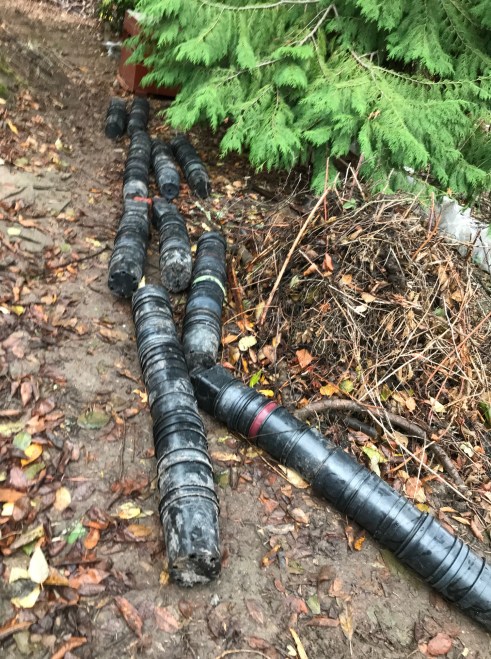
In the weeks after the city workers came, I spent a lot of time pulling out building racks we will put the blackberry vines and ivy on so they can dry out, digging out blackberry rootballs and covering the cleared land with burlap.
On March 4, Ananya and I took the first half of the Green Seattle Partnership Forest Steward training. We took the second part on April 1. We will attend ongoing training courses but are now qualified to lead bigger work parties.
On April 8, we held the first “official” work party. Nine volunteers met to build racks for the debris, rake debris, dig out ivy and blackberry root balls and find and mark ferns. We accomplished so much in our three hour work party. (You can click on any of the galleries in this post to see a bigger version of the photos.)
sign in
Every shoot leads to a rootball!
cleared area covered by burlap
blackberry root balls go on top of the debris racks
marking ferns
My update is now complete. This project has become my passion so you will definitely read more about it in the future!
Ivy is killing many of the trees in Seattle’s Greenbelt. On the four lots that our GreenFriends group has been working to restore, there is one tree that is so covered with ivy that you can’t see any other part of it.
One day in April, city workers came to cut down blackberry vines on the lots. They also dealt with the ivy on this tree.
That is done by cutting the ivy at shoulder height and at the bottom of the tree. This is called a survival ring. The ivy on the rest of the tree is left to die off since pulling it down would be near impossible and could be dangerous.
The ivy had formed a hard, dense cover around the tree. The workers were able to pull off a section of it. (Click on the galleries to see a bigger view of the photos.)
The “crust” was so dense and had many components.
I look forward to looking at this section of ivy under my microscope.
“The fool doth think he is wise, but the wise man knows himself to be a fool.” “Love all, trust a few, do wrong to none.” “Love looks not with the eyes, but with the mind, And therefore is winged Cupid painted blind.”-William Shakespeare
























 Living, Learning and Letting Go