Letting Go of Suffering- Week Twelve: Using Contracts to Heal

pen-661970_1920

A contract is usually an agreement between two or more people but you can also use contracts to make agreements with yourself. It is a structure that can be invaluable when you are serious about making changes in your life.

Here are some examples of this type of contract:

Example #1

Problem: I work 65 hours a week

Contract: I will work no more than 50 hours a week for the next month and will reduce my work time to 45 hours a week after that.


Example #2

Problem: I constantly criticize myself.

Contract: Every time I am self-critical, I will internally say the affirmation “I am worthy of respect. I will not harm myself by thought, word or deed.”


Example #3

Problem: I eat when I am not hungry.

Contract: For the next week, I will record every time I am tempted to eat when I’m not hungry. Next to the date and time, I will write what incident or thought triggered my desire to eat, as well as the emotion that followed the trigger.


Example #4

Problem: When someone asks me to do something, I automatically say yes, even when it is something I don’t want to do.

Contract: I will not say yes to requests without taking time to think about the request first.


In the next section, you will make a list of your self-sabotaging behaviors, such as those in the examples above. After you make your list, you will formulate a contract for each one. Don’t worry, I’m not going to ask you to commit to keeping a lot of contracts. The purpose of the first exercise is to help you learn how to write simple, clear contracts.

It is important that you word your contracts in a way that promotes you in being successful. For example, if you would like to exercise 5 days a week for 30 minutes, it would be best to start with a contract that says “I will exercise a minimum of 3 days a week for 20 minutes.” That way you won’t break the contract if you only do 3 or 4 sessions on a busy week. You can always do more than your contract requires.

Exercise #1

In the box below, list 4-8 behaviors you desire to change and write a contract for each one. If you have trouble identifying the changes you want to make, you might find it helpful to look through the Week 1 and Week 2 lessons of this course. If possible, complete Exercise #1 on the first day of this week so that you have the rest of the week to work on Exercise #2.

l51

Exercise #2

Pick two of the contracts from the list above, and commit to keeping them for the rest of the week. At the end of each day, jot down some notes about your experience.

52a

52b

At the end of the week, answer the questions below:

Was it easy for you to keep the two contracts?

If it wasn’t easy, then commit to continue keeping them. It takes time to change behavior patterns.

When you are ready to add one or two new contracts to the original two, write them in the box below.

52c

If you would like feedback about the contracts you write, feel free to put them in the comment section. I would be happy to answer questions or make suggestions.

Pen Photo Credit: Pixabay


See you next Monday for the thirteenth lesson.

To find the lessons in this series that have already been published click here.

Guest Post: Sitting with the Wolves by Wayne Carter

img_2852

July 2000: On my way to a Sundance in southern Alberta, I see a red building on my right. Something about the building grabs my attention so intensely that I U-turn on the highway. I must explore what is there. The place is a wolf haven, and I spend time petting wolves through a chain link fence.

July 2000: I am giving a new friend from Alberta a ride back to Seattle. I talk about the place and the wolves. Wolf Haven was closed when we got there.  I am disappointed.

April 2008: I am on spring break from college and meeting a friend in Jackson Hole, Wyoming for a week. One day it is snowing, and we decide to drive out to the country, to watch the snow, share our stories from the past year, and sit in silence staring at the mountains across the way. On our left, we both see a lone wolf, trotting across the snow covered field. As we continue to watch, the wolf stops and stares at us for what seems like 20 minutes. We sit in silence watching back..

April 2015: I am in Yellowstone National Park. Along with lots of snow from a fresh spring storm, I see wolves ‘being’ themselves in their environment. I watch, mouth open catching flies… Well if a fly could live in that temperature, I would have caught multiple. I am in awe of how natural the wolves seem.

June 2016:. I see a Facebook post from a friend and text her, saying  her radiance was showing in the picture and asking where the photo was taken. She responded with a location and shared a bit of the impact of her experience.

November 2016: I booked an hour at Colorado Wolf & Wildlife Center, the place my friend had named.

December 31, 2016: It was 5 degrees when I arrived in the mountains, snow and ice on the ground, a clear blue sky and the sun was just starting to make its way over the nearest of the eastern mountains. As I walked up, I did not see any wolves, but could hear them howling in the distance and then the echo of the howl on the hills around me. Somewhat surreal to my experience, my mind started thinking of safety, along with flashes of horror movies and bloody bodies laying in the woods while being torn to shreds by wild animals.

Luckily for me, the walk was a short distance and a nice person greeted me, taking me out of the next Stephen King thriller my mind was creating. Of course there was the paperwork; just in case I was attacked. There were ferrets and a rooster running around greeting people; the building was warm and full of wolf items.

I listened to the staff say to me: the wolves are not dogs, do not hug them, grab their face and kiss them, or rough-house with them; they will react as if you are their size and power and that could be dangerous.

img_2855

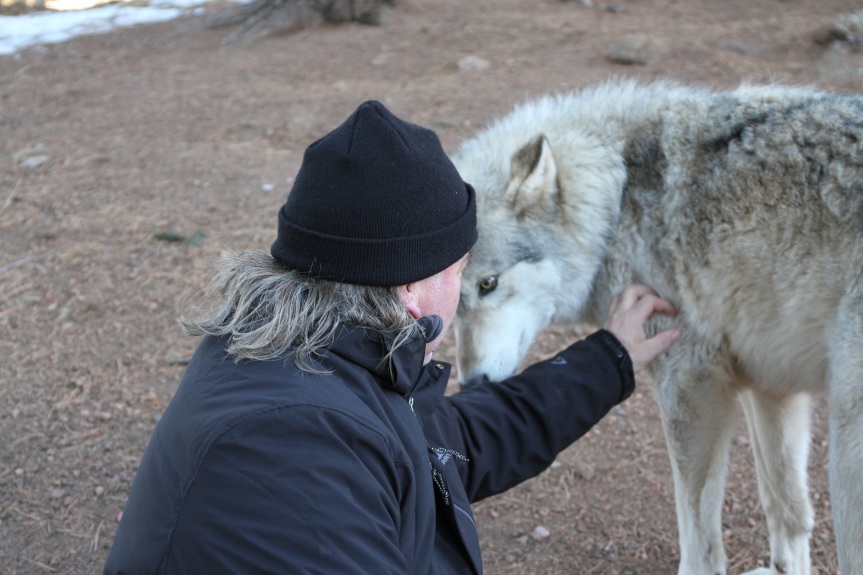
The first pack: Once I sat down on the ground, face level with the first pack, everything disappeared that did not need to be in my world at that moment. I was fully present to every breath, movement, posture, nudge, or growl from each wolf and each gesture had its meaning. I was not cold or concerned for my safety.

I have to be honest. One thing concerned me, and that was how they greet each other, and that greeting would also include me. The process is the equivalent of a human handshake; the wolves greet each other by sticking their tongues into each others mouths, and trying to touch the tonsils.

It took me three tries before I would let a partially wild animal get that close, i.e tongue in the mouth close. First try, the Alpha male comes over, sniffs my hand and arm, then goes for the tongue action. I keep my lips together and kiss him on the cheek like I would a friend.

The wolf walked off. Being the kind wolf that he is, and with some luck, he came back about 5 minutes later and tried it again. Still, I could only part my lips a tiny bit, and did not let his tongue in. I then notice the wolf seem to make a sigh and sit just far enough away from me that I could not physically connect with him. A few minutes went by, and the same wolf gave me another chance. No other wolves had come close to me.

Internally, I agreed to go for it. I told myself, how bad could it be… maybe just some small raw animal parts, a piece of stick or bone stuck to his tongue, and the possibility of having part of my face taken off by sharp and giant teeth.

Luckily for me, none of that happened. In fact, the wolf’s tongue was not slimy, not gross, no after taste, and he was very gentle so as not to bang teeth. I thought to myself, I have kissed a few women with worse tasting tongues. Somewhere in the faraway distance, I could hear one of the two staff giving instructions, although I somewhat failed to follow them and was guided by intuition.

(Click galleries to enlarge photos.)

When meeting the second pack, I was told not to get down to the level of the alpha male, as he is known for trying to top everyone.

Remember the rules I spoke about earlier, I broke them all. The first thing I did was grab the alpha wolf by the face and kiss him. Then, when he pushed against me, I gave him a big hug and kissed him again. I played with him like I would a regular dog. Sometime after the hug, I could hear the staff telling me, ‘apparently you guys know each other’ and not to worry about being topped.

We, the alpha male and I, rubbed, nudged, and pushed a bit back and forth. Later he allowed me to rub his belly and front legs. That is when I about pissed my pants. The alpha male started growling at me and showing his teeth. I yanked my hands away from him so fast. Even if it were a rattlesnake, I would not have been bitten.

The Wolf and Wildlife Center staff chuckled and informed me, the wolf was letting me know he liked what I was doing. Still shaken a bit, I informed them, that when someone growls and shows their teeth, I typically stop the behavior and move away. I was then encouraged to start rubbing him again in the same way, and he growled and snarled the entire time. Once I understood his communication style, I felt less nervous. Still, it took me a few minutes to relax. Wolves have big teeth and deep growls…. Just saying!

For my last 25 minutes, I had the option of seeing wolf puppies or another pack of adults. Of course I chose puppies. I mean come on, who doesn’t want to see puppies. When we arrived, I found out these were 80-90 pound sister and brother puppies who were eight months old!

The moment I sat down with them, I had two playful wolf puppies kissing me in their traditional way, then stealing my Seahawks hat; by the way, stealing my hat means means the wolves are Seahawks fans…(wink). They then stole my hair tie by gently pulling it out of my hair with their teeth. They tried to try to take anything that was loose on my clothing.

The staff started to get nervous that they might tear my coat, or ruin something. I wasn’t nervous, I was laughing and loving the playfulness of youth, the exploration of boundaries and their trust of me. Here are two kids wanting to play. I chose to wear what I wore, and be involved with them. How could I then get upset? I couldn’t.

Sadly it was time to leave, and my time with these wonderfully loving creatures would be over for now. Once I exited the area and returned to my truck, I started the motor, put the truck in gear and noticed something. I had no energy to leave, to drive, or to converse with others. My mind and body were silent. I had no want. There was no internal voice on either shoulder talking to me. My experience was “I am”.

Once I returned to the world of fast moving cars, Starbucks, and snowy Colorado mountain roads, I realized how similar my experience was to the many times I have received Amma’s darshan (hug).


cropped-senior-salon

Shared on Senior Salon and Lets Create a Fine Chain…

Letting Go of Suffering- Week Eleven: Stopping the Critical Self Talk

depression-1250870_1920

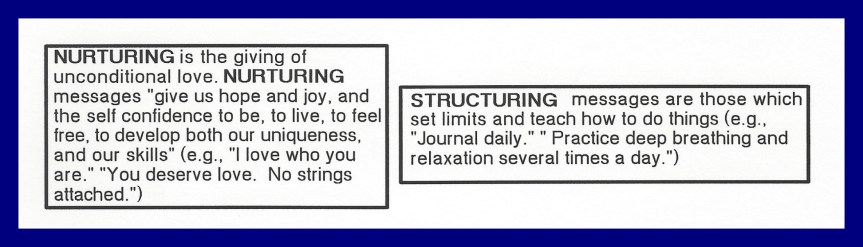
Suffering is created or enhanced by critical self-talk. An important step in ending suffering is to replace the negative critical messages with positive nurturing and/or structuring messages.

Source: Growing Up Again: Parenting Ourselves, Parenting Our Children.

Creating nurturing and structuring messages is a skill that takes practice. This lesson will focus on helping you to learn that skill by walking you through a multi-step process. At the end of the lesson you find a worksheet you can copy for future use.

EXAMPLE:

State the problem in one sentence:

I forgot to bring my children’s sack lunches when I drove them to the bus that would take them to summer camp.

What critical messages are you telling yourself?

1) Stupid! There were 300 children there and you were the ONLY parent who forgot her children’s lunches.
2) You are a terrible parent.
3) Why are you making such a big deal out of nothing? They won’t be allowed to go hungry.

Identify nurturing messages you can use to counteract the critical messages (messages that are gentle, caring, supportive, and unconditional).

1) You do care for your children and they know it.
2) You are a good parent even though you make mistakes.
3) It is highly unlikely that you were the only parent who forgot their child’s lunch.
4) It is important for your children to know that you make mistakes. When they see you make a mistake, they learn that it is okay for them to make mistakes.
5) You were feeling very sad because your friend Jean was leaving today and you won’t see her for a very long time. It is understandable that you didn’t remember everything.

Identify structuring messages you can use to counteract the critical messages (messages that set limits, show how and give options. 

1) Talk to the camp counselors. Tell them what happened and ask if they have arrangements for children who come without lunches.
2) Tell your children that you forgot the food and have them help brainstorm solutions.
3) Check and see if there is time for you to go to a convenience store and buy them some lunch. Continue reading “Letting Go of Suffering- Week Eleven: Stopping the Critical Self Talk”

Living and Learning in Amritapuri, India: Wrapping Up (Jan 2017)

12512718_10153228699456805_4784682354021587162_n

Every year, as my trip to Amritapuri is winding down I think of a statement I read decades ago in a book by Malidoma, an African shaman who lives most of the year in the U.S. In the book, Of Water and the Spirit, Malidoma commented that he goes to Africa every year to learn from his elders and detox from Western civilization.

I resonated with that statement when I first read it, and I still do. For me, being with Amma, especially in India, is like taking a vacuum cleaner to my whole system. While the living and learning experiences may be difficult at times, I always see my growth when I return to Seattle. I am softer, healthier, and more able to handle the challenges that life sends my way.

When I went to India the first time, I loved it. In fact, during my first three visits, I cried every time I thought about leaving. Then there was a period, that lasted for at least five years, when I had a love-hate relationship with India. The heat and the never ending physical and emotional challenges were difficult for me to cope with. I felt on overload most of the time. Even then, though, I had a deep internal sense that it was very important for me to take that annual trip. I often used the metaphor, to myself and others, that it was like going to a doctor knowing the treatment would be painful.

Thankfully, that period passed, and for a long time now I have eagerly anticipated my yearly trip. I know that every visit will be filled with learning and adventure and that the challenges that come to me will help me grow.

It is my experience that being with Amma, whether it is in India or the U.S., increases the frequency and intensity of the life lessons that come my way, along with the ability to work through them at a faster rate. When I’m in the middle of an emotional roller coaster, the growly declaration that “this is going to be the last time I’m going to do this” inevitably goes through my mind. At least now I know that the thought is just a thought, and it will pass. I fully believe that it is important for me to continue going to Amritapuri each year, and that those visits will cleanse my mind and body, and feed my soul.

As I was preparing to leave Amritapuri this year, it occurred to me that once I retire I can go to the ashram whenever I want to go, and stay as long as I want to stay.

I almost always travel to Amritapuri in November and December, the busiest time of the year; a time when my son and daughter’s lives are filled with creating the Christmas play on top of their regular seva responsibilities. While I love seeing the play and being involved in play preparation, I am also faced with the reality that I can’t spend as much time with my adult children as I want to. When I retire, will I go to India at a different time of the year? Am I willing to miss the play in order to spend more time with my kids? Will I go earlier and stay longer? Will I go twice a year even though that would mean facing jet lag twice? I know those questions will be answered as my life unfolds.

For the last few years, I have felt an increasing desire to do panchakarma, an Ayurvedic therapy that provides deep cleansing and detoxification. Panchakarma was one of those things that I used to say I would “Never” do, but since I discovered that my high blood pressure and high cholesterol would eliminate several of the procedures I’m resistant to doing, I have felt more inclined to consider it. I have no doubt that the treatments would be in my best interest and the people I know who have done it have loved it. Maybe I would too.

If I do panchakarma, I would want to do it in Amritapuri, but I’m still resistant. I know the protocol involves staying out of the sun, rain, and wind and that I would be expected to keep the fan off in my room and to avoid other places with fans. That’s a big deal, considering I’d be in India. I also would be expected to refrain from doing seva, napping, writing, or reading. There are many dietary restrictions as well. Am I willing to make those commitments for most or all of my trip?

My biggest resistance is to the activity restrictions. As an over-doer I am stumped by how I would fill my time if I avoided doing all of the items on that list. Am I willing to give up blogging, working in the gardens, taking Tai Chi, and the other things I love doing in Amritapuri? What WOULD I do? Would I spend those weeks staring at a wall?

No doubt, I would be confronting all the garbage that is inside my mind. I would also be confronting my reluctance to simply “BE.” Am I willing to do that?

So, as I wrap up this year’s trip to Amritapuri, my mind is filled with questions. It is also filled with gratitude for all I experienced on this trip, and excitement as I look forward to discovering where the next steps in my life will take me.


Photo Credit: Amritapuri Facebook Page

DEAR ME

Yesterday, I read a post at Neal’s Epiphany that I thought was incredibly powerful. I don’t know how Neal sees it, but using my psychotherapy frame, I see him as having written a beautiful letter to his inner child. Neal has graciously consented to me sharing his letter with all of you.

Neal's avatarNeal's Epiphany

Dear Me,

You and I go way back, to the beginning. We’re one hundred percent connected in a way no one will–or could ever–understand. We’ve been there, standing together. Sometimes crying in the shower, sometimes snorting through our nose, but it’s always been you and me. Always and forever…

Or so it was supposed to be, but some time ago I left you–

I left you floundering on your own, to rely on love and encouragement and strength from others–from strangers–when it was I who should have held you up. When it was I who should have hugged you and praised you and appreciated you for the wondrous person you are–for all the beauty and life you bring to this world.

I seldom tell you how much I love you. How much I admire you. How beautiful and caring and intelligent and strong you are. That you are my hero.

View original post 383 more words

Letting Go of Suffering- Week Ten: Failure

heart-157895_1280

You are lovable even when you fail.

Failing is a normal and necessary part of living.

You can learn from every failure.

heart-157895_1280

Another behavior that often leads to suffering is failure. Failure is “to disappoint expectations or trust; to fall short; to be or become absent or inadequate; to be unsuccessful.” (Webster’s Ninth New College Dictionary, Springfield: Merriam-Webster, Inc. 1988, p. 445)

The reality is that any time we choose to act, we take the risk of failure. In order to succeed, we must be willing to risk failing. There is much that can be gained from acting, even if the result is failure. As with mistakes, it is important to see that failure is a necessary part of living and that something can be learned from every failure. Continue reading “Letting Go of Suffering- Week Ten: Failure”

Jane Goodall: A New Kind of World

Photo Credit: Wikimedia
Photo Credit: Jeekc on Wikimedia

“I think one of the most important things for people to understand,” says Goodall, “is don’t feel helpless when you look at all the problems of the world.

Realize that if you think about the consequences of the small choices you make each day — what you buy, what you eat, where did it come from, how was it made, did it harm the environment, cruelty to animals, child slave labor — [you] make more ethical decisions.

It’s not just you. It’s more and more people around the world. In the end, it’s hundreds of millions of people making small choices, that are the right choices, that leads us to a new kind of world.”

Source

Letting Go of Suffering- Week Nine: Mistakes

heart-157895_1280

You are lovable even when you make mistakes.

Making mistakes is important for your growth.

You can learn from every mistake.

heart-157895_1280

Making a mistake is one of those life situations that often leads to suffering. A mistake is “a wrong action or statement proceeding from faulty judgment, inadequate knowledge or inattention.” (Merriam-Webster, Inc. 1988 p. 760.)

An important step in letting go of the suffering is to adopt the mind-set that mistakes are an important and necessary part of living, and that something can be learned from every mistake. In time, you may even come to see making a mistake as a positive event rather than a negative one.

35

This week, record every mistake you make. Write down the tiny mistakes as well as the big ones. Next to the mistake, write what you learned from making it and what you will do differently in the future. Add more paper if you need to.

36

37

38

heart-157895_1280

You are lovable even when you make mistakes.

Making mistakes is important for your growth.

You can learn from every mistake.

heart-157895_1280


See you next Monday for the tenth lesson.

To find the lessons in this series that have already been published click here.

Letting Go of Suffering- Week 8: Getting Off of the Drama Triangle

triangle-color

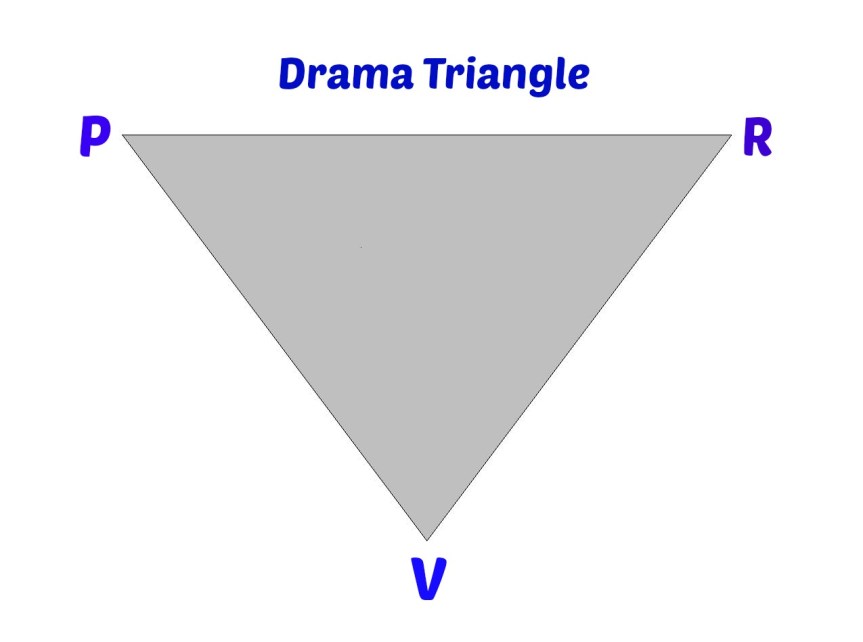
Suffering is often the result of having participated in a transactional “game” identified by Stephen Karpman as the Drama Triangle. The Drama Triangle contains three roles- 1) The Persecutor (P) who blames and criticizes, 2) The Rescuer (R) who thinks for others, helps when they have not been asked to help, does things they don’t want to do, and does things for others that they could do for themselves and 3) The Victim (V) who feels oppressed, blamed, unloved, hopeless and/or helpless. The Victim often is immersed in “Poor Me” energy.

Although it is possible to play the “game” totally within oneself, it is almost always played out between two people. Once the “game” begins, both players generally spend some time in all three roles.

EXAMPLE

Person A:  Gives unasked for advice (R)

Person B: Feels irritated and makes a belittling comment. (P)

Person A: Feels unappreciated and blamed. (V)

Person A: Angrily blames Person B for being unappreciative (P)

Person B:  Feels depressed because it seems like she can’t do anything right. (V)

Person B:  Over-adapts and does what Person A suggested even though she doesn’t want to. (R)

Drama Triangle Home

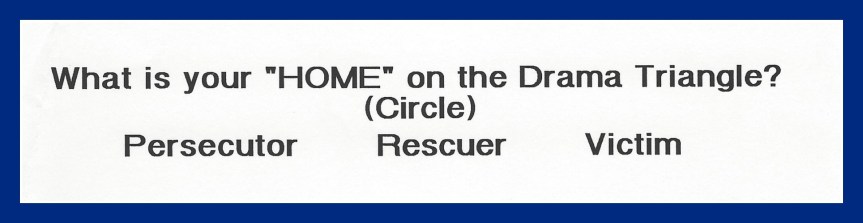
There is usually one part of the Triangle that is more familiar to us than the other parts. When we are involved in the “game,” what I call our “home” is the place where we usually spend the most time.

30a

Identify two times in the recent past when you have been on the Drama Triangle. Think of situations that occurred 1) at work with supervisors, employees or peers, 2) with friends, 3) with family, or 4) with any other individuals in your life. It could be a sales person, a barista, or anyone else who has crossed your path.

If you can’t think of anything that happened recently, then use two situations from the past. Describe how you and the other person moved through the Drama Triangle process. What caused the game to end? Was the problem that started the game ever solved? How?

30b

Getting Off of the Drama Triangle

At first, you might not recognize that you are on the Drama Triangle until you are fully involved in the “game”. Over time, you will begin to notice feelings, thoughts and body sensations that will alert you that you are on the Triangle. Eventually, you will recognize when other people invite you onto the Triangle and will be able to prevent the game from even starting.

The most important step in getting off the Drama Triangle is to decide that you are not willing to play the game. If one person refuses to engage in the process, the other person will soon give up.

When you decide you are not going to engage in the Drama Triangle process, picture yourself stepping off of the triangle. Here are some tips:

If you have been in PERSECUTOR:

a) See yourself stepping off of the Drama Triangle.

b) Take a time out so that you can cool down. Constructive problem solving is not likely to occur when you are in the heat of anger.

c) Do work to release your anger. (Examples: Write lists of the things you are mad about; write a poison pen letter letting out the rage, and then destroy the letter; twist a towel putting your anger into the towel; and/or tear up a phone book.)

d) When the amount of anger you have has decreased, engage with other person. Work with them in solving the problem. Set boundaries as needed.

If you have been in RESCUER:

a) See yourself stepping off of the Drama Triangle.

b) Take a time out if you need it.

c) Let the other person know that you love, support and care about them.

d) Acknowledge to yourself, and to them, that you have been rescuing and that in the future you will wait until they ask for what they need, or you will ask them if they want help from you.

e) Ask yourself if you have been rescuing others because there is a need of yours that needs to be met. If there is, then think of how you can meet that need. It may be YOU that needs to ask for help.

If you have been in VICTIM:

a) See yourself stepping off of the Drama Triangle.

b) Take a time out if you need it.

c) Write lists of what you are mad, sad and scared about.

d) Give yourself affirmations for your ability to think and solve problems.

e) Ask others to give you affirmations for your ability to think and solve problems.

f) List all of the solutions you can think of for solving the problem.

g) Start doing the items on your list. Continue until the problem is solved.

For the rest of this week record what happens when you realize you are on the Drama Triangle. Record small examples as well as big ones. Also record ways you avoided getting onto the Triangle in the first place. (Add more pages to this document if your list is long)

34

See you next Monday for the ninth lesson.

To find the lessons in this series that have already been published click here.

Lighten Up!

It has been said that laughter is the best medicine. I believe there is truth in that statement. It certainly helps us in lightening up, if we engage in activities that make us laugh.

There were two scenes in the recent Amritapuri play that made me laugh out loud. The songs that accompanied the scenes were also funny.

In one scene, a group of very young children dressed up as pigs.

During the finale,  one of the “piggies” got so excited that she started jumping very high. The crowd loved it.

15732177_10154166953868302_4761892420733602627_o

Here is the funny song that went with the scene.

The other scene that brought laughter was very different. It was the scene when Matthew, the prodigal son, reached the lowest part of his despair. He had lost all of his belongings and was working for a man in exchange for food.

While his life situation was in no way funny, the song that went with it, and the way the actor played the role, made it a very funny scene. As a psychotherapist, I know when we are feeling down, if we start talking about the situation in really grandiose, i.e. exaggerated “Poor me” terms, we may start laughing. To me this song and scene are a good example of that. While I can’t show you the video, I can share the “Poor, Poor Me” song in addition to the photos above.

I know that listening to these songs and looking at the pictures will help me lighten up when I am feeling mopey and victimy in the future. I hope they do the same for you.

To see all of the posts in this Amritapuri series, click here.