Living and Learning in Amritapuri, India: August 24-27, 2017

The Western Cafe Opens
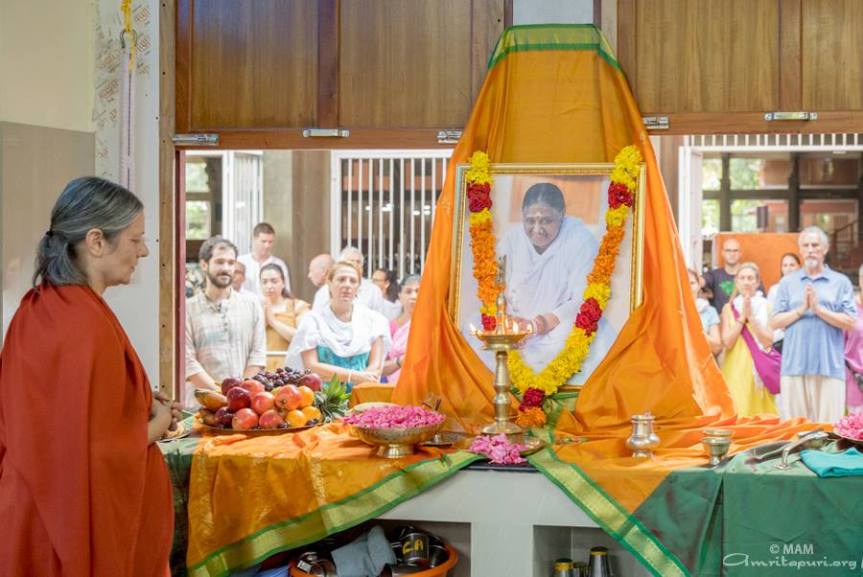
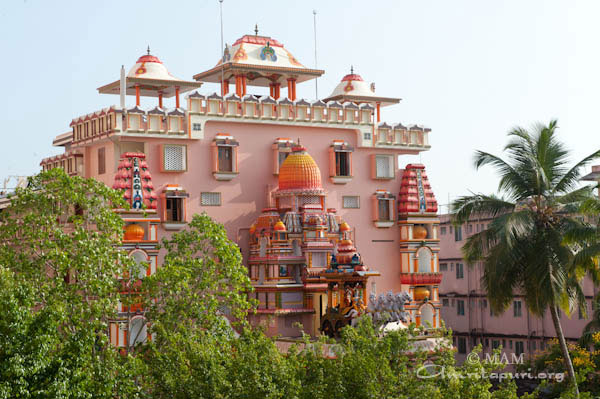
A puja was held at 7:30 a.m. on Thursday to bless the new cafe space prior to its opening. It was SOOOOO nice. Many people crowded into the café and others stood outside. A pujari performed many rituals, including chanting the 108 names of Amma, and a brahmachari led the group in singing four bhajans. I don’t remember the name of the first song but the others were Kali Durge; Amba Bhavani Sharade and Durge, Durge. Swamini Krishnamrita, who you can see in the photo above, did the Arati.

Afterwards, we went to the section of the new building where the canteen food is cooked. One of the stoves in that area was lit by the puja flame and we sang Om Namah Shivaya until a pot of milk boiled over. It took quite a while for that to happen so we sang for a long time. I enjoyed it so much.

Then, we returned to the café portion of the building and each devotee was given a small bowl of prasad that contained a chocolate chip cookie, a banana and keshari, an Indian sweet. The bowls were made from banana leaves.
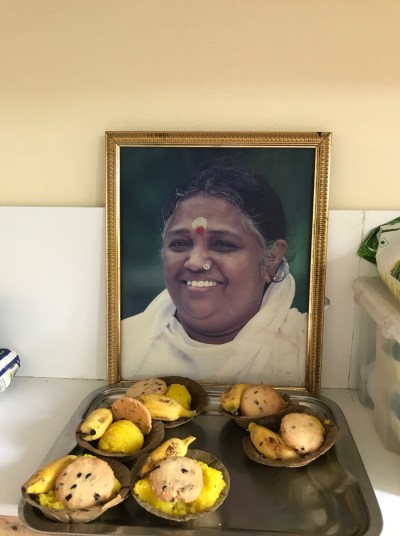
The prasad bowl reminded me of a pada puja that the café staff did for Amma many years ago. Normally, during a pada puja, Amma is offered a plate that holds a variety of Indian foods. The café staff had done the pada puja their way though and had brought Amma items from the cafe such as a veggie-burger, French fries, pasta and pizza! I wasn’t in India when it happened, but I still laugh when I think about it. Everyone, including Amma, had thoroughly enjoyed the unusual experience.

Ganesh’s Birthday Celebrations
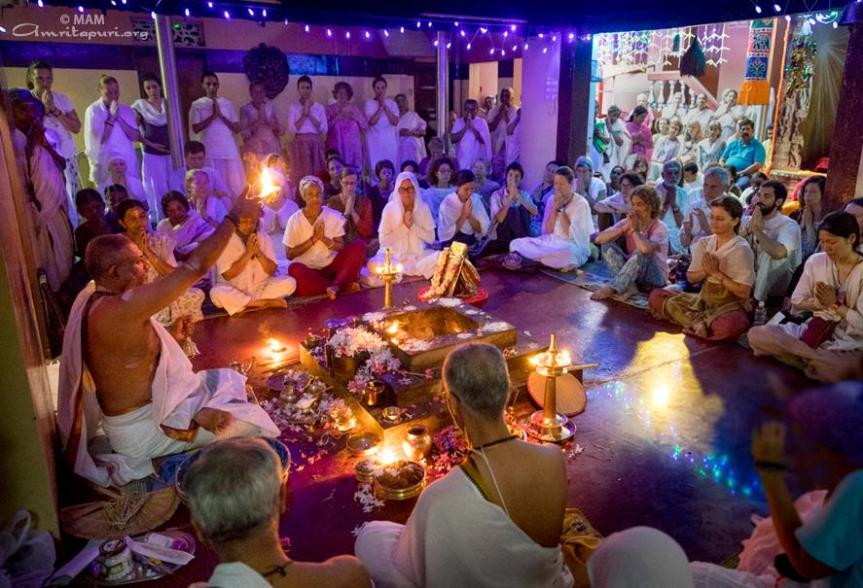
One of the reasons I came to India in August this year was so that I could participate in three festivals. The first one, Ganesh’s birthday is an eleven day celebration.

Ganesh is son of Shiva and Parvati and is known for having the head of an elephant. He is the god that is worshipped as:

  • remover of obstacles
  • patron of arts and sciences
  • deva of intellect and wisdom
  • god of beginnings

The celebration began with a puja at 5 a.m. on Friday, August 25. The pujari performed many rituals and the brahmacharis chanted numerous chants. It was beautiful although I have to admit I was too tired to enjoy it as much as I thought I would. Also, I had expected there would be a lot of singing but I was wrong, singing wasn’t part of this particular puja.

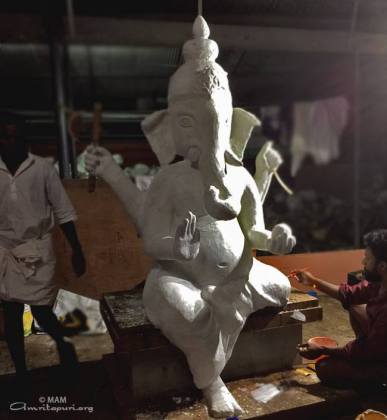
It was during this program that the Ganesh statue that had been made for this year’s celebration was installed. You might remember from a previous post that the statue had been created on the ashram grounds this year. At the time I wrote that post it looked like this:
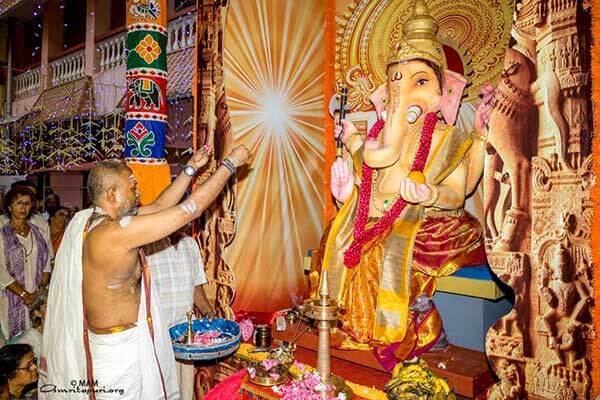
This is what it looked like on Friday morning when it was installed:
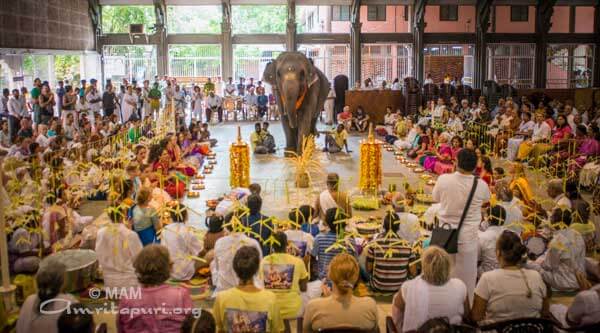
At 8 a.m. on that day, I went to the auditorium for another another Ganesh event. This turned out to be the one I had remembered from the past. It was also a puja but the ashram elephant, Lakshmi, came for this one. We sang lots of songs and Lakshmi danced to the music. Afterwards, she was offered many plates of food. She definitely enjoyed that!

People are gathering at the Kalari, the site where Ganesh was installed, between 9 and 10 every evening during the 11 day celebration. I attended the first two gatherings and will continue to do so. We sing rousing Ganesh bhajans for most of the time and then a beautiful Arati and closing prayers. After the program is over, each person is given a luscious and tasty treat.

On September 3, the last day of the celebration, the statue will be taken to the beach in a public procession, singing as we go. It will be immersed in the Arabian Sea where the clay will dissolve so Ganesh can go back to his home at Mt. Kailash where he lives with Shiva and Parvati.

Onam

The season of Onam also began on August 25. Onam  is a harvest festival and is considered to be the biggest and most important festival in Kerala. September 4 will be a full day of festivities at the ashram, but each morning until then a new pookkalam will be be made outside of Amma’s house. The pookkalams are constructed using flower petals of various colors. Here are photos of the ones that were made for the first three days of this Onam season.

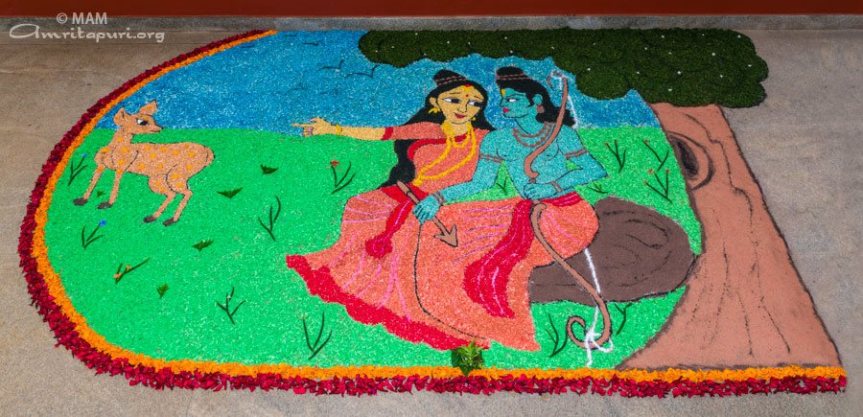
August 25
August 26
August 27

Photo Credits: All photos are from the Amritapuri Facebook Page

To view the previous posts in this series click here.

Will I Choose to be Independent or Interdependent?

Decades ago, I participated in an experiential exercise that the facilitator called The Relationship Dance. That exercise gave participants the opportunity to feel the difference between dependent relationships, independent relationships, and interdependent relationships.

First, we each picked a partner. During the Dependent section of the exercise, one person in each dyad leaned against their partner and they walked around the room in that state. One person had the experience of being completely dependent on their partner to hold them up, and the other person had the experience of being totally responsible for their partner’s well-being. In the Independent section, partners wandered through the room having essentially no contact with each other or with the people in the other dyads. Interdependence was demonstrated by having the pairs separate to do some individual activities and at other times walking shoulder to shoulder.

I’ve never forgotten that exercise. The experience of being Dependent was not familiar to me, and was not at all inviting. I was more familiar with having people be dependent on me. Being Interdependent was inviting but not familiar. When I experienced Independent, I felt lonely and it was all too familiar. Since this post isn’t about my relationship with a partner, I’m going to broaden the definition of interdependent so that it includes being in give-and-take, supportive relationships with many people.

I grew up as an army brat. It was very hard for me to make friends since we moved at least every three years. If I wasn’t leaving, then my friends were. Also, my mother once told me that I would make one friend at a time, and then was devastated when that person became friends with someone else. To compound the problem, in my opinion, our family had a very low level of connection with each other.

As a child I became very independent. Over the years, I have made significant changes in that part of my life and now have many friends who could potentially be a large support system. While I have moved a significant distance along the continuum that goes between independence and interdependence, I still have a way to travel before Interdependent becomes my primary way of being.

I have had an abundance of opportunity to watch my struggle in this area as I heal from breaking my wrist. My recovery was made harder than it would normally have been because I also had considerable pain from bruised ribs caused by a fall two weeks earlier. The rib problem made it painful for me to get up and lie down, and the fact that I needed to overuse my left side when I couldn’t use my right hand, prolonged that pain. (Be assured that I am looking at, and committed to changing,  the factors that caused me to get hurt twice in two weeks.)

I have long marveled at how people who live with physical limitations are able to overcome them. I decided to use this experience to see what I was able to do on my own. One of the accomplishments that I am most proud of occurred on the second day after I broke my wrist. On that day, I was able to pry open tight hooks on a bra and put on the bra using only my non-dominant hand. I soon discovered I could do my own laundry, get dressed in carefully selected clothes, cook using the food I had in the refrigerator and freezer, and crack an egg open. I also felt proud the day I changed the cloth waist ties on two pairs of Indian pants to elastic. With the cloth ties, I would have had to tie a bow, an impossible feat at that time.

While I was able to figure out how to do almost everything on my own, I did ask for help when it was impossible for me to do something that needed to be done. The best example of that was being unable to lock my deck door at night since I had to pull it towards me with one hand and turn the key with the other. I tried but I couldn’t do it. The temperature was in the 80’s and 90’s in Seattle that week and I couldn’t open any of the windows in my living and dining rooms with one hand. Leaving the deck door shut as well would have been unbearable.

I wouldn’t have felt safe leaving the door open at night so that was not an option. I asked one neighbor to lock the door each night before she left town. After she left, I knocked on different neighbors doors each night, asking them to lock the door for me. I rationalized that asking a number of people would cause them less of an inconvenience. Another example is that I asked a friend to bring my vacuum cleaner up the steep stairs from my basement since I knew it wouldn’t have been safe for me to carry it, but I didn’t ask for help vacuuming even though it was difficult for me to do with bruised ribs. And instead of asking for help to bring it back downstairs, I eventually took the vacuum cleaner outside and rolled it around the house and in the back door.

I did accept help from two friends who wanted to bring a meal and from another who offered to come cook some meals that would last for a few days. I also accepted help from a friend who offered to go grocery shopping for me and asked another to take me to the places I needed to go to get ready for my trip to India.

For the most part, however, I told the friends and neighbors who offered help that I was fine, but would let them know if I needed anything, and then for the most part didn’t ask.

While I did accomplish many things on my own, I was also abundantly aware how different my experience would have been if I had been living with someone or if I had taken full advantage of my support system. I was aware of the message in my head that said Don’t bother anyone,  an adult version of Children are to be seen and not heard. I also heard You should only bother someone if you really, really need it; You may need surgery for your arm or you might get sick sometime in the future, so don’t ask for help now, you might need it more later; and You choose to live alone and that decision has consequences, which was short for “You made your bed, now lie in it. As I write these messages down, I realize how immersed in old unhealthy ways of thinking I have been. I knew these messages were still alive in me to some degree, but the injury brought them out full force.

Just before I left for India, I attended a potluck in the Seattle area. I witnessed my reaction when the friend who drove me there offered to help me put food on my plate. I told her I could do it. I even resisted when she gave me reasons why I should let her help. Seeing such a blatant example of my resistance stuck with me. On my second day in India, a man offered to help me wash my dishes after a meal. I told him I could do it. He watched me struggle with that for a minute, and then took the dishes away from me and washed them. The incident made me aware once again of how I push help away. It also gave me the experience of how good it felt to get it. The next day another man asked if I wanted help washing my dishes. I said thank you and handed them to him. Since then, I have accepted help when it is offered and have been more willing to ask for it in the first place.

I dread the thought of ever being completely dependent on anyone. I hope that is not in my future, but I have no control over that. What I do have control over is whether I live my life alone now or instead create a life style that includes a mutually supportive community.

Even though this injury has highlighted my tendency to be overly independent, I know I have come a long way in this area. I also know I will have an abundance of opportunities, perhaps on a daily basis, to choose between an action that would support my tendency to be overly independent and one that would lead to an experience of interdependence.  It is my intention to increase the number of times I choose the road that leads to interdependence.


To view the previous posts in this series click here.
Living and Learning in Amritapuri, India: August 11-14 2017

Setting Up

I spent a good part of my first days at the ashram setting up my room. That included unpacking the suitcase I brought from Seattle and the items in the small trunks I keep here year round. I washed the clothes from the trunks in buckets. That task was made considerably harder since I couldn’t wring out the clothes with only one hand, my non-dominant hand at that. I knew I could choose to use a laundry service, but clothes dry so fast here that I prefer to do it myself. Luckily, I was in India not Seattle. I could press the items on the washing stone in my bathroom and get out a lot of the excess water. And in India, the clothes and towels would drip dry in a reasonable amount of time even though they were not rung out properly.

The morning of my first day I ordered a SIM card for my phone. I was surprised to discover I could buy a plan that included the SIM card and 1GB of data a day for 84 days for 450 rupees! Four hundred and fifty rupees is equivalent to $7.14. I sure wish we could get these prices in the U.S.

At the end of my last visit to Amritapuri, I loaned my internet stick to my daughter. She added data to it as  necessary during my absence so it stayed active during the year. As a result, I had immediate access to internet, rather than have to go through the application process. Sometimes it takes a week to get the SIM card and activate the internet stick. This time I didn’t have to wait at all for internet access and it took only about 36 hours  to get the SIM card. Once I had the SIM card, I discovered that using the Personal Hotspot on my iPhone gave me faster internet speed than the internet stick!

Changes

As always there are so many changes to see, even though I was here in January. I probably will have not seen them all by the time I leave. Construction has been endless since I first came here in 1990.

Since January, the Western café has been in a temporary structure while the new café is being constructed. They will be moving into the new café in a few weeks.

There are many changes related to security. I will mention a few of them. New structures are being built in the front of the ashram where visitors will register for the day. Residents, flat owners, and visitors staying more than 30 days will be given photo ID badges. Even the Swamis are wearing them! Visitors who are staying less than 30 days will use the receipt they are given when they check in as their form of ID. The auditorium is still open air in that it doesn’t have walls but now has white railings with some gold colored ornamentation around it.

Amma

Saturday, Sunday, Wednesday and Thursday are public darshan days at the ashram. It is on those days that people come for Amma’s blessing in the form of a motherly hug. She has hugged more than 37 million people worldwide. Darshan days last from 11:00 a.m. until around midnight. At most, Amma takes a ten minute break during that time.

On Saturday night, I eagerly awaited my hug. I was so tired that I was nodding off for hours as I waited for the international token numbers to start but it was of course well worth the wait. I had a fun and meaningful time with Amma.

Earlier that day I had been asked to help with the prasad queue. Amma hands each person that comes to her a packet of blessed ash and a piece of candy. Devotees who want to hand her the packets Amma will give out form a queue. Normally, I love to hand her prasad, but with a broken wrist, I couldn’t do it fast enough, and besides, I would have trouble standing when my time was up, so that seva (volunteer work) wasn’t possible for me. When someone asked me to be the person who makes sure the prasad giver line near Amma stays full by gesturing the people in the area of the auditorium where they wait for their turn, I eagerly said yes. I have felt drawn to that seva in the past but have never done it. It gave me time to be on the stage with Amma, and the experience of being useful. I loved doing it so will find out how to sign up for other shifts.

Monday and Friday evenings Amma comes to the beach to meditate with us and have a question and answer session. I forgot about it on Friday night but went to the question and answer part last night. I love being with Amma near the sights and sounds of the beach.

Festivals

I picked the dates I would come to the ashram based on the timing of the festivals. I really wanted to be here for Krishna’s birthday, Ganesh’s celebration and Onam, a family festival in Kerala. I knew there were multiple dates that Krishna’s birthday is celebrated in India so I googled Krishna Jayanthi, Kerala and found out it was August 14. As August 14 drew near, there were no signs of the big celebration. As I remembered it, the alternate date was after I would leave India, so I was bummed. Later that night, I was excited to learn that the celebration will occur on September 12, days before I leave. I look forward to sharing all three of those events with you.

Seva

When I am in India, I like to work in the gardens and to help Chaitanya in the café. I also work on the GreenFriends newsletter we publish in Seattle each month and write for this blog. Having the broken wrist has really put a dent in my ability to do some of those things. Chaitanya had hoped I could hand out the finished orders in the cafe but I would need to have the ability to move fast, to work with both hands, and to carry items having some weight. I can’t do any of those things so that job was out.

When people finish their meals, they wash and dry their dishes and then put them in a big bucket. The dishes are then dried a second time so no water remains on the plates. I discovered that I could slowly dry dishes for a short time, so have done some of that. Yesterday I tried buttering the bread that would be used for grilled cheese sandwiches and the buns that would be used for vege-burgers and omelet sandwiches. I was able to butter about a dozen buns but was slower than molasses. Those buns would probably be used in less than fifteen minutes. Buttering the bread didn’t work at all.

So far, I have been focusing on healing and getting over jet lag. I slept a lot yesterday so maybe I will be more awake today. I hope to go visit the garden that I worked in last year today. I can at least see it!

Greenbelt restoration work

Under normal circumstances, I would probably be thinking a lot about our Greenbelt restoration work back in Seattle. Part of me would want to be there working to turn that property back into a healthy forest. Since I wouldn’t be able to do that work even if I was there, I notice that it has been easier for me to be fully here.

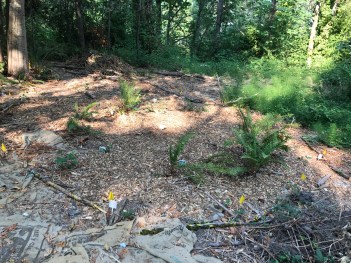
We will be receiving 400 trees, shrubs and ground covers to plant on that property in the fall so I hope that Ananya, the Forest Steward that is my partner in this project, and I will be able to do some long-distance planning while I am here. The photo above shows an area where a potential design for one segment has been laid out. The ferns in that area have grown after having been buried under blackberry vines for 30-50 years.

Weather

As I arrived in the ashram on Friday, it became very windy, and chilly. That seemed unusual to me. Later in the day someone else commented that they had never seen it so windy unless it was raining. It was chilly enough that in the evening I put on my jacket! The next two days were warmer. For me, yesterday qualified as HOT.

The forecast had called for rain every day, but there hasn’t been any rain since I’ve been here, at least not during my waking hours.


To view the previous posts in this series click here.


My 2017 Journey Begins

(Note: In my first post in this series, My Dream Becomes Reality, I shared a story of an event that spanned a period that started months before my trip and ended with what happened when I arrived at the ashram. In this post, I’m going to go back to the beginning of the journey itself. I encourage you to read the first post as preparation for this one if you haven’t already read it.)

My friend Ramana, who is also housesitting for me, took me to the airport early in the afternoon of August 11. This was the beginning of my 28th trip to Amma’s ashram in Amritapuri, India. The trip entails a fourteen-hour flight to Dubai, and after a two-hour layover, another four-hour flight to Trivandrum, India. Once there, I take a two to three-hour taxi ride to Amritapuri. The trip to India is grueling in any circumstance, but this time I would be doing it three weeks after having broken my wrist. Even the thought of going when I was essentially one-handed was overwhelming.

Normally I take two suitcases, mostly filled with supplies for other people, but this time I brought the bare minimum, one small suitcase plus my purse and  laptop. Once on board, I discovered that the flight attendants and even the passengers were more than willing to help me if I needed help. Before long, we were in the sky heading for India.

The last three years, Emirates has offered me the opportunity to purchase an upgrade to business class for the Seattle to Dubai segment of the journey. I had not done it in the past, but decided to take them up on their offer this time. It was still a tough journey but the upgrade made a huge difference in my experience.

Dubai

My friend Prarthana traveled to Amritapuri a week before I started my trip. I had not told her I was coming to India. It was fun to know that I would be surprising her when I showed up there. When I was on a two-hour layover in Dubai I received an email from her. In it she shared some of her travel experiences. When I answered the email, I didn’t mention that I was in sitting in the Dubai airport at the time I was reading it.

One of the things she shared was that the water in the toilets in the airport was heated. I found that strange, especially since I had just used one and it wasn’t heated, and I had never experienced heated toilet water there during previous layovers. Before I boarded, I used another restroom and it was abundantly obvious that the water in the toilet was very hot. Later, I learned that the heat that emanated from the toilet wasn’t because the water was heated, but rather because the weather in Dubai was so hot that the water coming through the pipes was hotter than water that would come from a hot water heater. I had noticed that the temperature in Dubai was 105 F first thing in the morning and it apparently can get to 120 F during the day. This was my first time traveling through Dubai in August.

Taxi to the ashram

It took me at least an hour to get my baggage after we landed in India. When I finally had my suitcase, I located the driver who would take me to the ashram. I am always amazed at the skill of the drivers, and their rock-solid steadiness. In India, the roads are usually filled with bicycles, motorcycles, buses, rickshaws, taxis, trucks, private cars and pedestrians. Drivers are constantly honking as they pass each other, swerving back into their own lane just before colliding with oncoming traffic. Speed limits are ignored whether it be on a highway or a village road.

I always remember my daughter’s first trip to India. She sat in the front seat and I was struck that she didn’t seem to have any reaction to this kind of driving. When I talked to her about it later, she said she had her eyes closed the whole time. She commented that it was like one big game of “Chicken.”

Two hours later, we reached Karunagappalli. We turned onto the small road that led to the beach road; the beach road goes all the way to the ashram. A few minutes later, the driver turned the car around. I didn’t understand whether the road was washed out due to the monsoons or if there was construction on the road ahead. I was glad he knew other ways to get to the ashram.

Soon, we were on the beach road. I was shocked to see how big the waves in the Arabian Sea were. I’ve been going to the ashram yearly since January 1990 and I had never seen the Sea so stormy. This was the first time I’d been to Amritapuri in August since 2003. Maybe I had forgotten what the waves were like during the rainy season.

Fifteen minutes later, we drove onto the ashram grounds. I was home.

To view the previous posts in this series click here.

With Amma in Chicago (June 2017)

Last year was the first time I attended Amma’s Chicago area programs. I had heard about the Center there for years and was excited to see it for myself. The site had once been a Seventh Day Adventist college. When I drove onto the property, I found myself on a tree-lined street of homes, homes that had once been faculty housing. I burst into tears. I have been to many of Amma’s ashrams and centers but this felt like being in a town, a town dedicated to Amma’s ideals of compassion and service.

Many of the original buildings had been remodeled and a new program hall had been built. The property was very large and a good deal of it was farm land. There was a large echinacea field as well as fields devoted to growing herbs and vegetables. I had such a good experience that year. Attending the Chicago programs is now a top priority for me.

This year, I arrived at MA Center-Chicago on June 20. I knew I was close when, in the distance, I saw the big blue water tower emblazoned with Amma’s logo. When I turned into the property and drove past those first houses, I felt as if I had come home.

Amma wouldn’t arrive at the program for another hour, so after saying hi to my son and daughter, Sreejit and Chaitanya, I headed to the fields. One of the first things I saw was a butterfly. That greeting became even more significant to me when it turned out to be the only butterfly I saw that day.

Prior to going to Chicago last year, I had seen a short aerial video of the Center’s echinacea field.

Seeing that field in person was a major goal for last year’s visit and I was eager to see it again this year. I walked and walked but couldn’t find it anywhere. I felt confused. It had been such a large field; they couldn’t have transplanted it, could they?

I did find the hoop house. There were so many more plants in it than last year.

I eventually gave up trying to find the echinacea field and returned to the program hall. When I asked someone about it later, I discovered the field was further away than I had thought. After attending Amma’s meditation, I headed outside again. Before long, I was able to find it. Last year I had been fascinated seeing the many stages of growth, from buds to full flower. The programs were held earlier in June this year and I only saw three open flowers in the whole field.  A lot of nettles and milkweed grew along with the echinacea. Those plants draw bees, butterflies and other insects to the field.

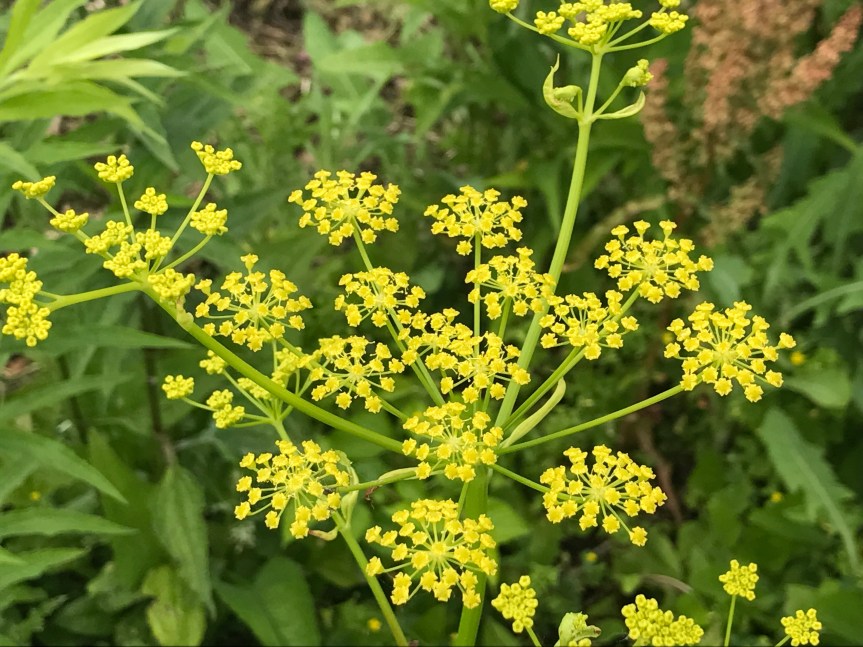
These beautiful flowers also were growing in the echinacea field. If you know what they are, please tell me!

From there, I strolled to a field of herbs.

And then walked to the vegetable field. I really liked the signs they had created to show what was growing in the row.

This fall, MA Center- Chicago is opening a GreenFriends Montessori School. It will focus on nature-based learning and peace education. As I gazed at this field I imagined the children helping to plant and care for the vegetables.

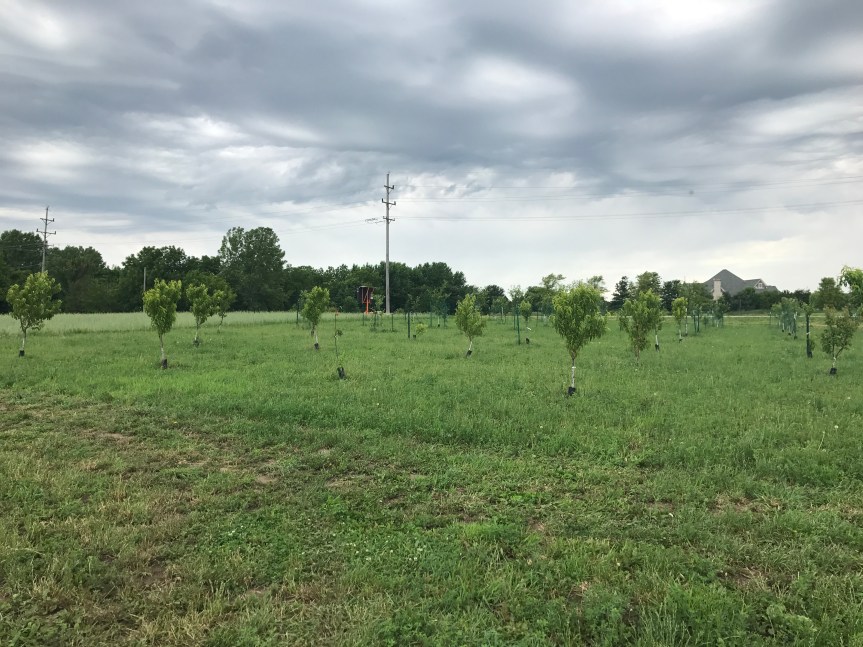
Beyond the vegetable field, there was an orchard. This photo shows only half of it. The trees had grown a lot since I had seen them last.

After visiting the fields, I began to walk back to the program hall. On my way, I saw a bird trying to pull a worm from the ground. (Or at least I think that was what it was doing!) Then another bird flew over my head a few times. I felt like it was “dive bombing” me. Moments later, I saw a bird house that was similar to the ones I have at home. It was only four or five feet off the ground. As I walked by it, a baby bird was looking out of the opening. I think there was another baby behind it. It must have been the mother or father bird that had been flying at me, concerned I was going to hurt the babies.

*****

As I sat in the program hall that day, ideas for designing a cluster of trees, shrubs and ground covers for our Greenbelt Restoration site in Seattle started coming into my mind. I thought about it throughout the day. My dreams during the night were incessant, and were all about the Greenbelt. The next morning, I located the children’s program room and drew my ideas on paper. I looked forward to returning to Seattle and doing the research necessary to determine whether or not my plan was viable.

*****

As I am writing this post, I am struck by how little time I spent near Amma in Chicago. I met Amma in summer of 1989. In the early years, I spent hour after hour sitting close, mesmerized. At some point, I started doing seva (volunteer work) throughout the year, and during the programs. That era lasted more than 20 years. Now I find that I still want to be with Amma, but I want it to be in a way that I can be immersed in nature at the same time. I’m reminded of the Bible verse that says  To every thing there is a season, and a time to every purpose under the heaven.” I am allowing my life to unfold. I feel close to Amma whether I am sitting next to her, being held in her arms, or walking in the fields taking in the glory of nature.

*****

Some of my favorite experiences in this year’s Chicago program occurred because Eknath was there. I don’t remember when I first saw Eknath at Amma’s programs but it must have been 10-15 years ago. I still think of him as a boy but he is probably his 30’s by now. Eknath is autistic. I was once told that when he first met Amma he couldn’t talk. That changed long ago. He often blurts out statements that make everyone, including Amma, laugh. One time he told Amma she should have a boyfriend. Another time, he went to her during darshan (darshan is the time she blesses people by giving hugs) and told her he wanted a peanut butter and jelly sandwich. Amma called someone from the Western Cafe and told them to make him a sandwich and bring it back to her.

Another memory I have of him occurred in the Amritapuri (India) auditorium. One day as I was walking to the auditorium, I heard a gut wrenching wail. Some instinctual part of me knew that it was Eknath and that someone had told him he had to leave India and return to the U.S. He cried with a profound level of despair that couldn’t help but affect those around him.

He is probably best known for going up to people and pulling up both sides of his mouth with his index fingers and telling them to smile. He emanates joy. He usually has earphones on, listening to Amma bhajans. Sometimes he sings along. When Amma and the swamis are singing, he gets so excited that he starts jumping and jumping and jumping. Occasionally, the swamis keep their songs going much longer than they would normally. His joy is infectious.

Eknath was doing all of those things during the second or third evening program in Chicago. Someone handed him a microphone and asked him to sing. He sang “What a Wonderful World.” (Lyrics) I doubt I was the only one in the room that was crying.

Here is a video of Louis Armstrong singing that song.

Eknath was then asked to sing another song. This time he chose “Santa Claus is Coming to Town” but he changed it to “Amma Claus is Coming to Town.” (Lyrics) Needless to say, hearing those lyrics applied to Amma was hilarious.

I am thankful that Eknath is in this world

*****

Every day with Amma is packed with experiences. In addition, this year I’ve had the chance to be with my son and daughter during the programs. That normally happens only when I’m in India. Life is good.

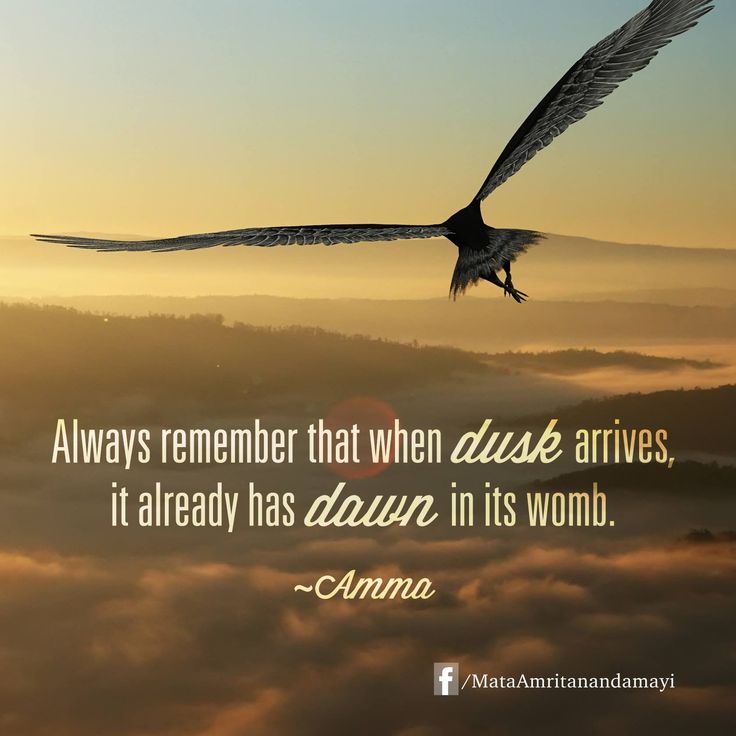
When Dusk Arrives

Amma’s Facebook Page

Amma is Coming!

Amma will be starting her 2017 Summer Tour in the Seattle area on Saturday, May 27. She will be holding programs at the Hyatt Regency Bellevue.

Amma is known as a humanitarian and a spiritual leader, teaching and modeling a message of love and service to the poor. She offers a motherly hug to those who come to meet her.

May 27, All Day Program:11 am
May 28 Morning: 10:00am Evening: 7:30pm,
May 29, Morning: 10:00am, Evening 7:00pm (Includes a ceremony for world peace)

(Lines for tokens for Amma’s embrace will start forming 90 minutes before each program. The number of tokens may be limited due to time constraints so it is best to come early if you want a hug.)

All programs are free. For more detailed information about each event click here.

After Amma leaves the Seattle area she will go to San Ramon, Los Angeles, Santa Fe, Dallas, Chicago, Atlanta, New York City, Boston, Washington DC and Toronto. To watch a movie about Amma’s darshan (hugs) and her innumerable humanitarian and charitable activities go to: embracingtheworld.org/news-etw-movie/


Recovering from Over-Doing

Two years ago, in a The Seeker’s Dungeon prompt, Sreejit asked us to fill in the blank in this sentence: “I am a Recovering _________.” There was no doubt in my mind what my behavior would be. If I was at a 12 Step meeting, I would say: “Hi! I am Karuna, and I am a recovering over-doer.”

As I thought about how I would present this topic, I decided to create a new mental health disorder. My fictitious disorder is called “Being versus Doing Disorder.”

The “Being vs Doing disorder” is on a continuum where the center, a balance between being and doing, is the healthy portion of the continuum. The more someone moves to either end of the continuum, the more likely it is they will have dysfunction in their lives.

When I think of the over-being end of the continuum I think of non-productivity, passivity, and lack of motivation. I don’t know as much about that part of the spectrum since I have almost no personal experience there. I have seen it at work in some of my psychotherapy clients and friends though.

Over-doing has many facets. It commonly begins in childhood when the only or main way to get positive attention from parents is to do impressive things. It also develops when parents criticize their children anytime they are relaxing or are doing things the parents consider nonproductive.

As a result, adults with an over-doing disorder may be seeking validation and praise for what they accomplish. An over-doer is also likely to be a rescuer. As such, they do things they aren’t asked to do and are likely to do things they don’t want to do. In addition, they do more than their share of the work that needs to be done and do things for other people that they could do for themselves. Those with this “disorder’ are likely to over-commit and seem incapable of being still.

Over-doing has been a major characteristic of my adult life. At one point, I was raising two children, working three jobs, doing my personal therapy and studying for a PhD. During my therapy, I realized I didn’t want a PhD, I was just seeking attention from the father, who had disowned me. I stopped my schooling but was still overdoing. Before long, I began to experience extreme exhaustion and was diagnosed with Chronic Fatigue Syndrome (CFS).

With CFS, I was in survival mode and it was impossible for me to do as much as I had been doing, although I still tried to. When it began dissipating after five years, I went back to over doing. There is no doubt that a part of me believed it was only acceptable for me to stop if I was sick. Eventually I developed high blood pressure and other physical problems.

I reached a point where I had to cut back on all of my commitments. Nowadays, I am putting my emphasis on doing the things I want to do, and am saying no to many requests. I still have trouble with “simply being” but I no longer am into major over-doing. I hope some day I will be much closer to the center of the being-doing continuum.

At one point, I realized a behavior that really fueled my over-doing disorder was the desire to be “in the know.” That put me in the place of being asked for information that I didn’t want to share, which then created stress, whether I shared it or not. As I continue to slow down, I am finding myself holder of less information. I am loving responding to requests with “I’m not in that loop anymore. You will have to ask someone else.”

I learned many skills during my over-doing years. When friends of mine were in a life and death crises, I stepped in to help immediately. There is a time and place for those skills, but it takes discrimination to use them correctly. In that instance, I have no doubt that my choices were appropriate.

I am very committed to my recovery from over-doing. While I may find myself immersed in the old behaviors from time to time, I don’t think I will ever be drawn so deep into them again. I see what I am doing much sooner and and change course when needed.

In evaluating myself on the scale found in Portia Nelson’s Autobiography in 5 Short Chapters, I find I am in generally in Chapter 4 or 5.

Chapter IV

I walk down the same street.

There is a deep hole in the sidewalk.

I walk around it.

Chapter V

I walk down another street.

Every time I walk around an invitation to over-do or avoid putting myself in the situation where I know I am going to be tempted, I consider my choice worthy of celebration! I am truly moving towards a life of balance.

Do you have a “Being vs Doing” disorder? Where do you fall on the continuum? How does it disrupt your life?

Photo Credit: Pixabay

This post was originally published on April 12, 2015

The Ideals To Which We Are Beholden

Sreejit from The Seekers Dungeon just wrote and published a new song. It is called The Ideals To Which We Are Beholden. The song is sobering and I believe it is a good reflection of the time in which we live. There is much in it that is worthy of contemplation.

Lyrics

When some are hailed as chosen it means others will be outcast – when greed defines our self-worth, we tighten poverty’s grasp – we’re all looking for happiness while pretending we’re not heartbroken – are you at peace with the ideals to which you are beholden?

The backs of others don’t make for a steady road – no one looks up to the boot against their throat – but our status is the one thing to which we have devotion– are you at peace with the ideals to which you are beholden?

We defend the words we know we have misspoken, we seek to teach before we truly have awoken, we soldier on though our beliefs are corroding – are you at peace with the ideals to which you are beholden?

We close the borders to keep our freedom safe, we close our hearts because rejection we cannot take – with love little more than a token notion,  are you at peace with the ideals to which you are beholden?

The innocent, who never had a chance because they were pawns in a power brokers dance, lay scattered, collateral is the word that’s softly spoken – are you at peace with the ideas to which you are beholden?

We defend the words we know we have misspoken, we seek to teach before we truly have awoken, we soldier on though our beliefs are corroding – are you at peace with the ideals to which you are beholden?

Oh mother, won’t you take your truth from me, and sing me back to sleep, just sing me back to sleep. I know the world is longing to be free, but sing me back to sleep, just sing me back to sleep. It takes so much good to destroy a little bit of evil so sing me back to sleep, just sing me back to sleep. But now you’ve destroyed my peace and I cannot sleep, so bring the fight to me, just bring the fight to me.

https://youtu.be/_DuQvm2O9fo

Letting Go of Suffering- Week Seventeen: Lighten Up!

The more we become immersed in suffering, the more difficult it may be to get out of it. Sometimes it may feel as if we are being pulled down into muck. In this course, you have learned many techniques for letting go of suffering. This last lesson will be about consciously working to “Lighten Up!”

One of the ways to lighten up is to do things that will make you laugh. Decades ago, I gave one of my psychotherapy clients a toy frog and encouraged her to carry it around with her when she was suffering. She was irritated with me at the time, but soon thereafter brought clown noses to group and distributed them. She wore hers whenever she realized she was suffering and found that it helped her to lighten her mood. I imagine seeing her also helped lighten the mood of a lot of other people!

Many years ago, I learned a technique from a therapist named Mary Goulding. She instructed us to push our tongues into our cheeks and then talk nonstop about all of the things we were suffering about. When we say those statements that way, they may lead to laughter instead of suffering.

Another way to lighten up is to talk about the problems that are bringing us down in a dramatic and highly exaggerated way. This past December, I was at Amma’s ashram in Amritapuri, India when the the Western residents performed their annual Christmas play. There was a point in that play when an actor portrayed his suffering in a way that resulted in the audience bursting into laughter. To me, the scene and the song that went with it, are a perfect example of this type of lightening up. Listen to the song and see if it might be a useful tool for you to use in the future!

You may also help yourself to lighten by going for a walk, immersing yourself in  nature, going to a movie, reading a book, watching a funny movie, or listening to music.  In the balloons below, write your favorite ways of lightening up.

Every day this week, spend some time practicing ways to lighten your mood. At the end of the day, journal about your experience.

Day 1

52c

Day 2

52c

Day 3

52c

Day 4

52c

Day 5

52c

Day 6

52c

Day 7

52c

As I mentioned in the beginning, this is the last lesson in the Letting Go of Suffering series. Thanks so much for participating in all or part of it. I hope you find the tools you have learned during the last seventeen weeks helpful in your life journey.

Sometime this week, I will be publishing a post that will provide links to all of the lessons, and will put a widget on the sidebar that will link to that list. I will also be publishing a poll asking some feedback questions.


To find all of the lessons in this series click here.

Photo Credits: Pixabay.