Greenbelt Restoration Project: February 3, 2018

After every work party, I tell anyone who will listen that it was an amazing work party. And it always is. The transformation in the land that occurs during each three hour work party is mind-boggling, at least to my mind.

Four GreenFriends members, 3 neighbors and 21 students from the University of Washington’s Introduction to Environmental Science class participated in the February 3rd event. Towards the beginning, we divided into 4 teams. The GreenFriends members, who were serving as team leaders, wore orange vests so that they could be spotted easily.

Team 1

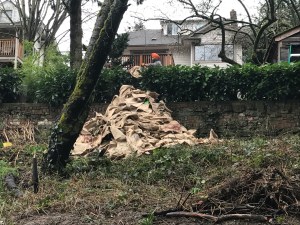
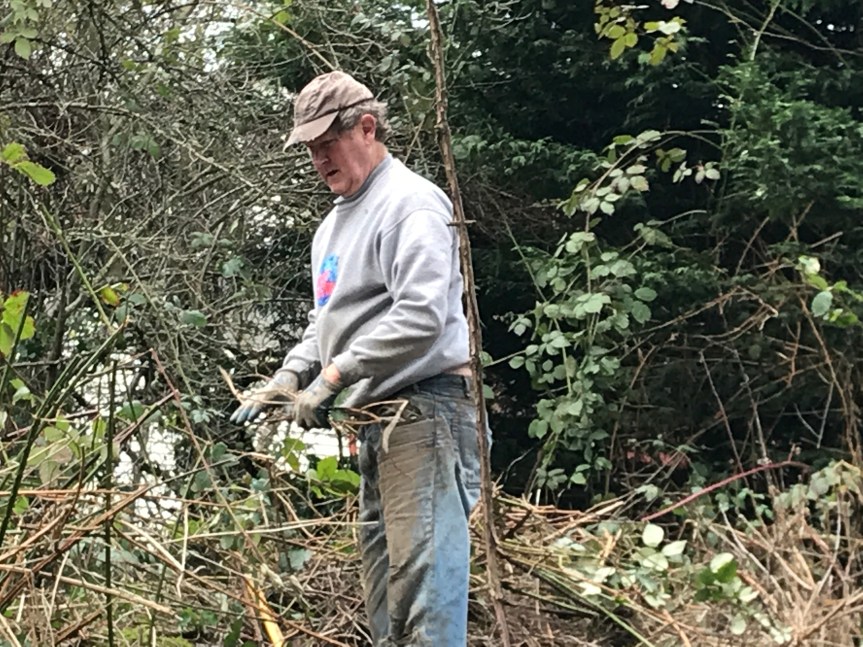
During our last work party, volunteers had focused on removing ivy from an evergreen tree and from the ground in an area on the northwest part of the site. At this work party, Team 1 continued that work, this time clearing ivy and blackberry root balls from an ever widening area. All of the debris was taken to an area we call The Rack Zone where it is put on racks that keep it from re-rooting. Having the vines and rootballs on the racks also enhances air flow and the debris will decompose faster than if it was left on the ground.

At the beginning of the work party the area looked like this:

The volunteers worked diligently and had a good time in the process. Even though I don’t have a “before” photo, know that the shed and stone wall shown in the last photo in this section was completely covered with ivy. Until recently, I didn’t even know there was a shed there.

(You can enlarge the photos in a photo gallery by clicking on any of the photos.)

At the end of the work party, the space looked like this. There is still work to do in this area but so  much was accomplished during those three hours.

Team 2

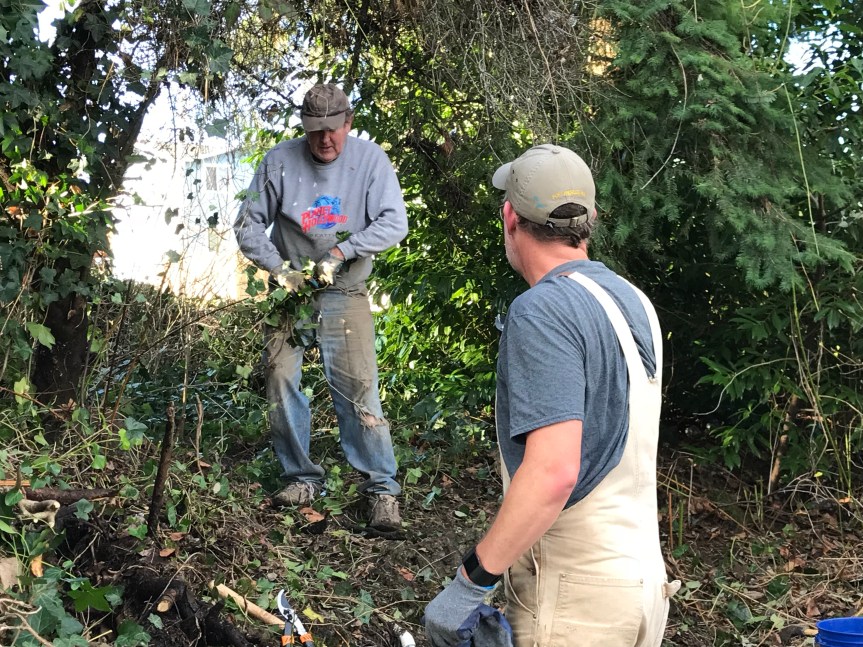
The area where Team 2 worked is adjacent to Team 1’s section of the property. When English ivy grows unchecked and begins to flower, the leaves may change shape and become waxy. It may become a gigantic mass, developing thick stalks that may look more like a tree trunk than an ivy vine. One of the neighbors who has worked on this project from the beginning discovered such a mass in early January. Since then, he has been working to cut it down.

The first set of pictures below show what the area looked like at the beginning of the February 3rd work party. Notice the ivy mass in the background of the first photo. It is not nearly as big as it was originally but it is still huge. The second two photos show some of the piles we would be dealing with at this work party.

Here is a close up of different parts of that mass. It is SO dense.

The volunteers worked on the piles of debris, cutting the leaves and small branches of ivy away from the bigger branches. The leaves and small branches were moved to the rack zone to dry and the bigger branches either stayed in the area or were stacked near the rack zone.

The Rack Zone

By the end of this work party, the rack zone was almost completely full of ivy.
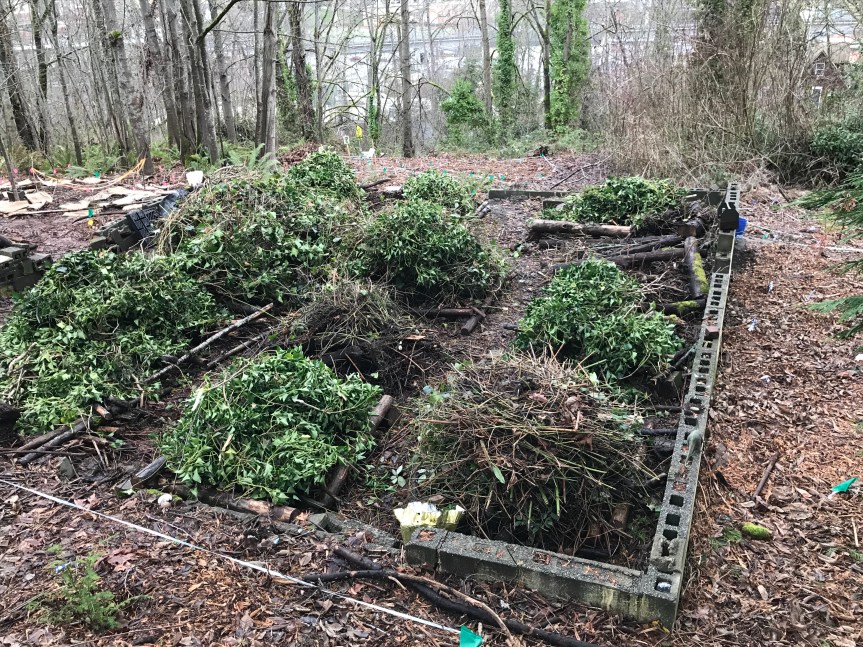

I wonder how long it will take for us to completely remove the mass. I suspect there will be many more work parties and many more piles before this task will be finished. But, at least, when the work party was over, the piles of debris that were there at the beginning were almost gone.

Team 3

On February 26, Silver Capital Management employees are coming to plant trees, shrubs and ground covers in this Greenbelt site. Team 3 helped prepare the ground for that planting work party.

In the days prior to the February 3rd work party, pink flags were placed around the site, marking where each plant will go. Written on each flag was the type of plant that will be planted there.
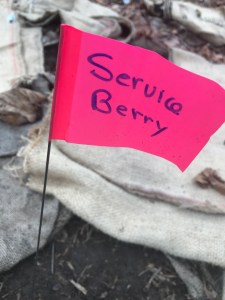
We’ve found that planting proceeds smoother and faster if the areas where things will be planted are prepared ahead of time.  Prior to the work party, I made two demonstration areas so that the volunteers could see what they would be doing. In one area, I used burlap that had been placed on the ground when we first cleared the land, and in the other I used new burlap.

Team 3 cleared weeds, if there were any, from around the flags and then placed burlap bags around them, leaving a place for the people who will be planting to dig a hole. Once the planting is finished the burlap will be adjusted, if necessary, and then covered with wood chips. Both the burlap and the wood chips will decompose and enrich the soil.

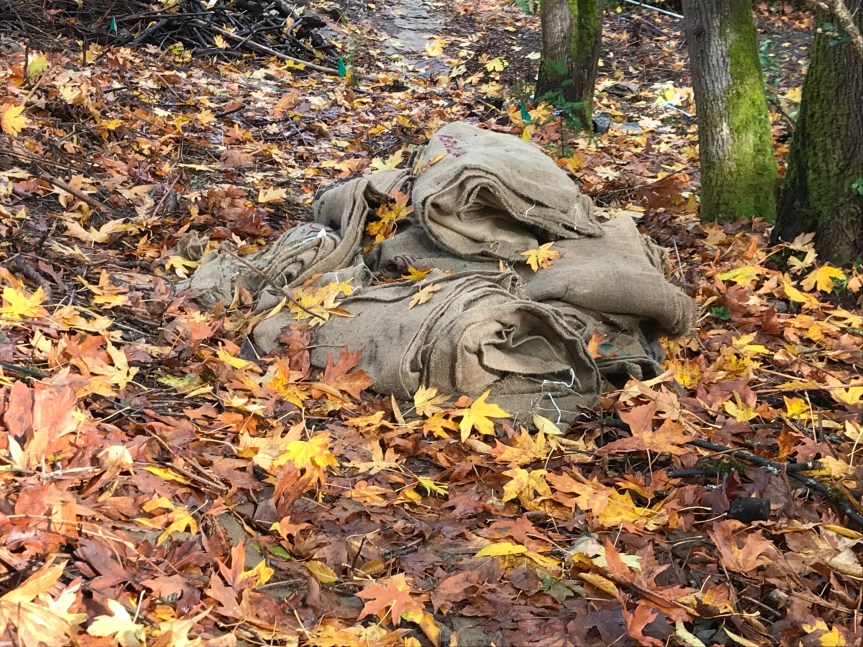
This team prepared spaces for about 70 plants. In the photos below, you can see the burlap that is now scattered throughout the site.

Team 4

The fourth team cleared an area that our volunteers had not tackled before. Seattle Parks Department staff had done an initial cutting of the blackberry vines in that area in March 2017 and then cut them back again during the summer. At the February 3rd work party, the volunteers dug out blackberry root balls and removed ivy.

This is how that land looked at the beginning of the work party. (I think this would be a particularly good gallery for you to click on!)

After instruction on how to clear the land, the team “rolled up their sleeves” and went to work.

The students dug up many blackberry root balls. These are photos of the biggest one they found!

The transformation that took place was remarkable. By the end, this section was clear of invasive plants and covered by burlap bags (the bags help prevent weed growth).

While the students were working, my neighbor John started removing blackberry vines in a nearby area, one where the blackberries are even denser. A team will work in that section during our next work party.
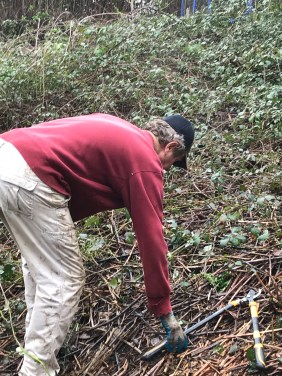
On February 26, these newly restored areas will become home to seven Douglas Fir trees as well as a variety of shrubs and ground covers.

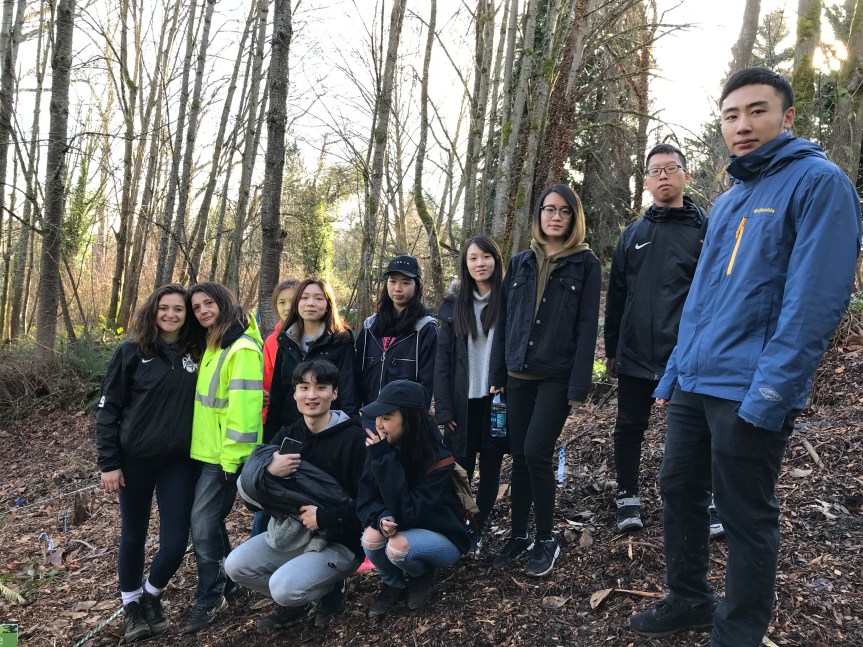
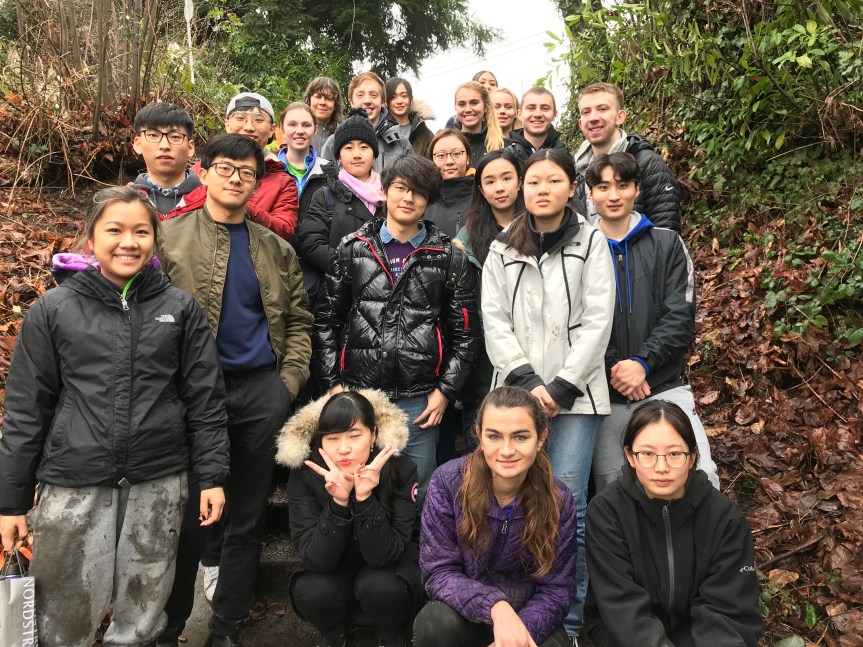
By 12:50 p.m., the tools we used had been cleaned and put away. We then gathered on the Hanford Stairs, which are on the north border of this site, to take a group photo and celebrate the completion of a very successful work party.
One Piece at a Time

Nature on its own is indeed beautiful and clean. The hills and rivers do not need us to clean them. In fact, it is nature’s water which cleans us; it is trees which purify air for us. Because we have littered, we have spoilt its pristine beauty.                                                                                                               

~Amma

 I once read that every piece of plastic that ever existed still exists. While that statement has been challenged (politifact.com), there is no disputing the fact that plastics decompose very slowly and some may never decompose.

We have certainly seen evidence of the long life of plastic in the GreenFriends Greenbelt Restoration Project that Seattle Satsang members are leading. The areas we are restoring have been covered by blackberry, ivy and bindweed vines for 30-60 years. With the aid of Green Seattle Partnership, the City of Seattle Parks Department, and volunteer groups such as students from the University of Washington’s Introduction to Environmental Science course, we are helping to return this stretch of Greenbelt to the beautiful forest it once was.

When the Seattle Parks Department staff initially cut down the blackberry vines for us, they discovered the foundation of a house that had burned down in the 1950’s. We found many plastic items in or near that foundation. It appears that a lot of plastic trash was also thrown into the Greenbelt by nearby residents and passersby.

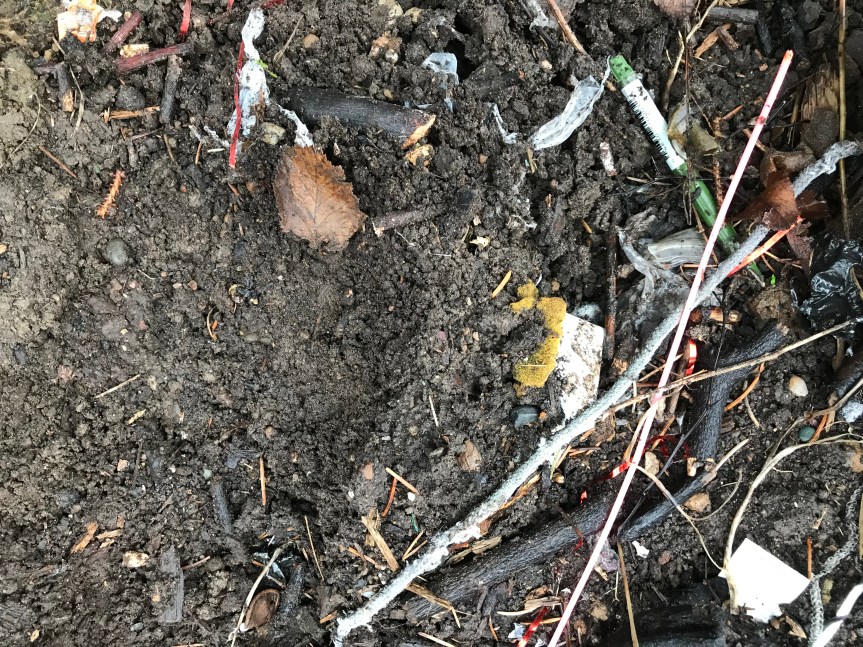
My house borders this Greenbelt property. When I cleaned out my bird houses last winter, I found a sizable bird nest. I was shocked by the amount of plastic a bird had used in constructing it (Photo 1). Photo 2 shows the pile of plastic I removed when I took the nest apart.

My experience with the bird nest opened my eyes to all the plastic that was in our Greenbelt site. After than, anytime I walked through the property, I saw that the ground was littered with flecks of plastic. I worried about the toxicity of the plastic and also remembered a photo that I once had seen of the contents of the stomach of dead albatross at Midway Island. (See Photo 3.) I felt an urgency for us to remove as much plastic from the site as possible, before the birds could start using it for nesting material.

512px-albatross_at_midway_atoll_refuge_8080507529
Photo 3 – Photo Credit:Wikimedia

We invited Seattle Satsang’s Bala Kendra group (our spiritual community’s children’s group) to come pick up litter. Photos 4 and 5 show the litter they picked up in one hour’s time. In addition to this diverse pile of garbage, they removed many small flecks of plastic from the ground.

Much of the trash our volunteers have removed from the site during the past year has been plastic. While the items might be dirty, as you can see in Photos 6-13, many of them look basically the same as they did decades ago.

Yesterday, I picked up the remains of a pile of burlap bags that we use to cover the ground after we clear it. Under the pile I saw this:

Photo 14

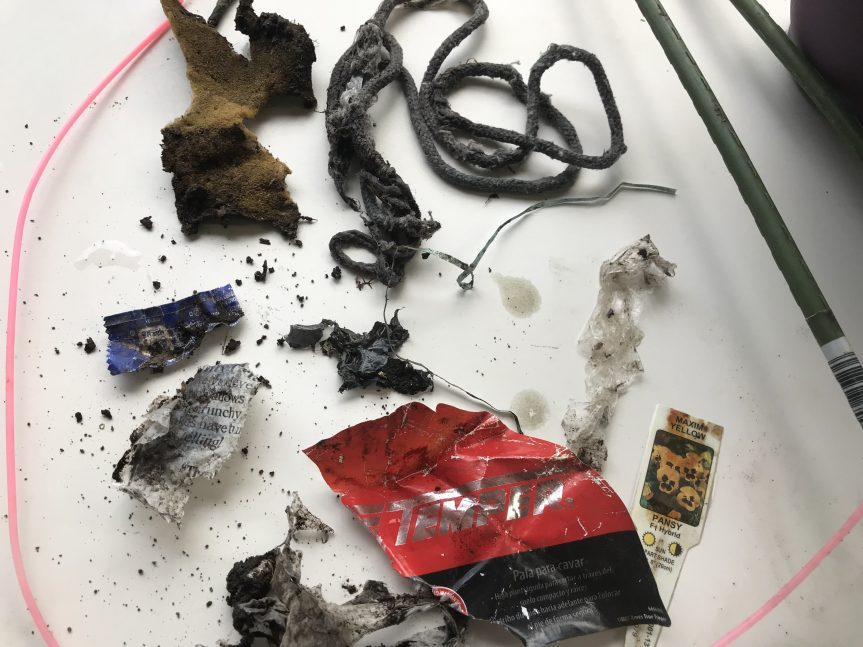
I went back later and pulled out some of that trash so that I could photograph it. Photo 15 shows those items. There was rope, candy wrappers, a garden stake, line string for a trimmer/edger, a plant sign, carpet pad and assorted other kinds of plastic.

Photo 15

Today I remembered another piece of plastic I had recently seen. I went back to that place and began to pull the plastic bag out of the ground. Photo 16 and Photo 17 show what I uncovered. Often, when I pull out plastic, what emerges is even bigger than this!

I wonder if we will ever come to the end of the plastic trash on this site! Maybe not, but every piece someone removes helps reduce the negative impact that humans have had on nature in this space and gives nature a chance to restore itself to its pristine beauty.

Greenbelt Restoration Work Party: January 21, 2018

I returned from India on the afternoon of Saturday January 13 excited to get back to my work in the Greenbelt. I had scheduled a work party for the first day that I thought I would be reasonably fit after such a long trip. That day was Sunday January 21.

Sixteen people participated in the work party: 2 GreenFriends members, 9 students from UW’s Introduction to Environmental Science course, 3 neighbors, a high school student and her mother.

The group was enthusiastic and accomplished so much. One team worked to remove ivy and blackberry rootballs from a section of the property we haven’t tackled before.

(You can enlarge the photos by clicking on the galleries.)

Another team worked in the “rack zone”. When the blackberry vines that had been growing on this property for 30-50 years were initially cut down, we discovered an old house foundation.  A volunteer suggested that we use the foundation to store all of the racks that hold the blackberry rootballs, ivy and bindweed that we dig out. [Note: We put the debris on racks so it stays off the ground. That way the plants won’t re-root, and by having air flow coming up from the bottom of the rack, the debris will decompose faster. Also keeping the racks in one area, rather than scattered throughout the site, gives us more planting space.]

When the debris decomposes, it becomes new soil. Our plan is to spread the partially decomposed materials throughout the foundation and build new racks on top of them. Eventually there will be a thick layer of dirt in the foundation and we will be able plant beautiful shrubs and ground covers in it.

During this work party, we started taking the racks apart for the first time.

As each one was disassembled, a new rack was built on top of the partially decomposed debris, and then the ivy and blackberry rootballs the other team had just removed from their work area were placed on top of the new racks. It will take several work parties to redo all of the racks but we got a good start. (Click on the photos below to see the full captions.)

My neighbor John, who has diligently worked on this project from the beginning, cleared an area of blackberry canes and rootballs.

For the last part of the work party, John and Jason worked in an area where ivy had killed two trees by wrapping itself around the tree trunks.

While they were doing that, the rest of us moved 1000 square feet of burlap bags from the street into the Greenbelt. I had no idea we would be able to move all of it in an hour, but we did!

Having the bags in the Greenbelt will give us easier access to the burlap when we are ready to spread it over newly cleared land. [Note: Spreading burlap bags over the cleared land helps prevent weed growth. Over time they will decompose and enrich the soil.]

In the past, we have dumped the burlap into mounds.

At a work party last fall, one group of students laid the burlap bags flat. Those bags were so much easier to spread than the wrinkled ones, so we decided to place all of burlap we were moving into flat piles!

Mother Nature really blessed this work party. The weather forecast app said the chance of rain at the beginning of the event was 90% and that the rain would continue throughout. The reality was that it sprinkled as I was setting up ahead of time and we had NO rain during the three hour work party. About an hour after the work party was over, it poured. Grace prevailed.

Even though I was still dealing with jet lag from my India trip, I was in bliss throughout this event. I love this work!

I give special thanks to everyone who helped by leading or being part of a team as well as to the neighbor who was willing to come early and help everyone sign in as they arrived.

Our next work party will be Saturday, February 3. If you live close enough to Seattle to participate and want to join us, you would be more than welcome! If you are interested in attending, leave a comment below.

We Had a Great Month Thanks to You

Last night, Sreejit posted the summary of his Rage Against the Machine event. He did it in a new way in that for each post he included a quote and one of the comments that a reader made. I think that is a valuable way to help new readers choose which posts to look at, so I’m passing his summary on to those of you who read my blog.

Greenbelt Restoration Work Party: November 11, 2017

On Saturday, November 11, we held another large restoration work party. Two GreenFriends members (Theresa and me), my new roommate (Jamie), and a Forest Steward that normally works on a different site (Susan) led work teams. My neighbor John who has attended almost every work party we’ve offered, and has worked endless hours on his own, did the amazing work he does every time. Blackberry root balls have no chance when they meet his pick ax.

After an initial orientation, twenty-nine awesome students from a University of Washington’s Introduction to Environmental Science class picked the teams they wanted to join and the work began. Our main task for the day was to get our eight designated planting areas ready for the DocuSign corporate group that is coming on November 15. That group will be planting more than 300 shrubs and ground covers. “Getting the areas ready” entailed digging out any remaining root balls and removing the burlap bags that had been laid down when the area was originally cleared. The burlap helps decrease weed growth and prevents erosion. In one area, the bags were covered by a heavy layer of branches and blackberry debris so that had to be removed before we could pick up the burlap.

Normally by now, the burlap bags would have decomposed but since there was almost no rain this summer, most of the bags were still whole. In places there were three layers of burlap, which would make it impossible to dig holes for the plants. With the burlap gone, it will be easy for the DocuSign group to plant the shrubs and ground covers. Once the plants are in the ground, they will replace the burlap and then cover it with wood chips.

While three of the teams did the work described above, the fourth carried 500 cubic feet of new burlap from the street to our restoration site and placed it in two stacks on the property. Once they finished that job, they started distributing the pots of shrubs and ground covers to the appropriate planting areas.

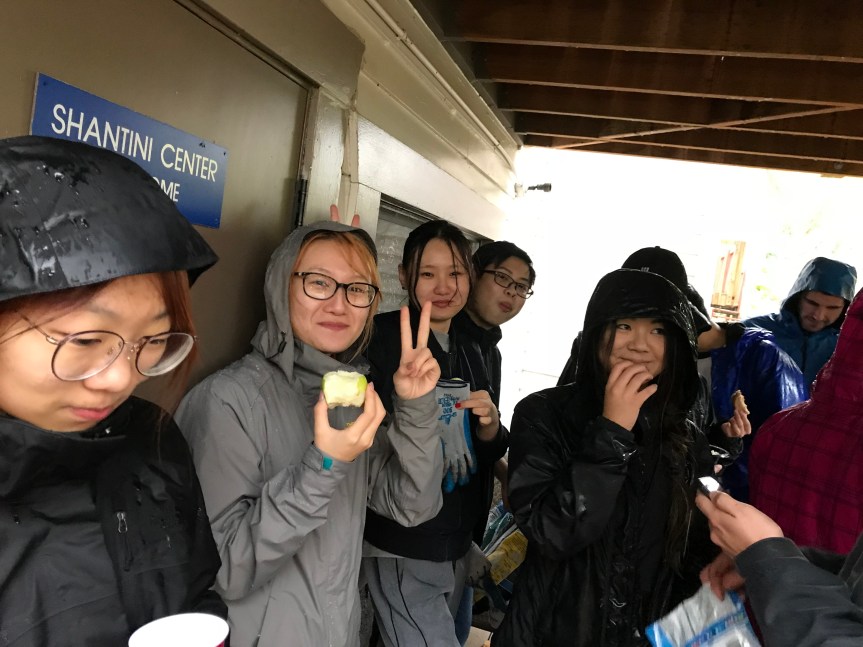
Normally the weather during our work parties turns out to be better than the forecast, but this day was an exception. It rained on and off throughout the work party, more on than off. Taking a 15-minute snack break in the pouring rain was not at all inviting. We decided to carry everything out of the Greenbelt and stand under the deck of my house.

It was during the break that I realized I hadn’t taken a single photo. Taking a group photo under the deck seemed like a good place to start! I think the photo at the top of this post and the one below reflect this work party well; everyone was both wet and happy.

I also took photos that showed the work we had already done that day. In the first gallery you can see what it looked like to start with an area that was covered with burlap covered by branches. (That particular photo was taken in August right after the area was cleared.) The second photo shows many of the branches that were removed on November 11th and the third is the pile of burlap that was picked up. I was astounded when I saw how neat this team’s pile was. It is going to make it so much easier to use than the chaotic stacks we usually create. I will  to do their way in the future. The fourth photo is what the land looks like now… i.e. ready for planting! (Click on any gallery to enlarge the photos.)

This is one of the piles of new burlap that students carried in from the street.

The students found some carpet and a fold out bed in one of the planting areas. Work party participants have attempted to dig these  items out in the past, but this team was able to do it!  When I tried to push/pull the bed, it didn’t move at all. I hope Seattle Parks Department will send a crew to remove them from the site. They regularly carry out trash piles for us, but these items are very heavy and are located at the top of a hill; one where there is no easy way to get the garbage down, especially without damaging newly planted trees.

After the break, some students continued distributing the plants to the areas where they will be planted. Before long most of the potted shrubs and ground covers were gone from the holding area.

Other work party participants resumed clearing the land of branches, blackberry vines and blackberry root balls.

Almost everyone spent the last 45 minutes of the work party participating in a bucket brigade, moving wood chips from the street, down the stairs and into piles on the site.

Afterwards, we celebrated all that we had accomplished, cleaned the tools, brushed the mud out of our shoes and went on our individual ways. What an incredible three-hour work party it had been.

Greenbelt Restoration Work Parties: July 16 and 23

I had scheduled four work parties for the month of July. I reported on the July 2nd and 9th events in earlier posts. When I broke my wrist on July 13th, it was obvious that I could not lead the last two, but other Green Seattle Partnership Forest Stewards stepped into that role. Ananya, a GreenFriends member and my fellow Forest Steward on this restoration project, led the first one. Ananya was not available on the 23rd so Susan, a Forest Steward who has been doing this work for more than a decade, led that one.

Even though I was not able to do the physical work, I was happy to discover that I could still contribute. I completed the pre-and-post work party administrative work, gave the initial orientation to the participants at the beginning of the events and helped with the snack breaks. As a result, I continued to feel like a part of the team.

July 16th

Five GreenFriends members, two students, and a neighbor participated in the work party on the 16th of July. They focused on picking up trash and dismantling the piles of debris that had been raked up during previous work parties. The debris was placed on burlap bags that had been spread earlier in July. They moved any blackberry root balls they found in the piles to the rack zone to dry. They also spread burlap bags over land that had been cleared in the past.

Trash

It is always interesting to see what kind of trash we find. At this work party, a student found a tube of lotion that had an expiration date of 1989. That student was born in 1997!

Sarva found this treasure:

Moving rootballs to the rack zone

Spreading debris on burlap (click on gallery to enlarge photos)

One of the highlights of this work party was that we turned in the certificate for the prize we had won at Rainier Chamber of Commerce’s Bridge2Beach Seattle clean up event in March. The certificate was for $50 of Full Tilt ice cream. Needless to say, we enjoyed that part of the work party.
July 23

The July work parties were scheduled in a way that would support the University of Washington Environmental Science students. Their volunteer hours and reports were due on July 27th so the July 23rd work party was in high demand. Twenty-one students and two of their friends, a neighbor and three GreenFriends members participated in this work party.

The participants were divided into various groups. One group carried burlap bags from an area near the street to our Greenbelt site. Other groups looked for and removed bindweed, i.e. morning glory vines; removed ivy; or dug out blackberry root balls. As various jobs were completed, participants continued the ongoing work of laying down burlap and covering it with debris.

Attendees of this work party had the opportunity to eat the rest of the Full Tilt ice cream!

It is amazing how much we accomplished during the month of July. Every work party was a confirmation of the saying, “Many hands make light work.”  And besides that, it was fun to work together.

These photos show some of the trash that was picked up during the four July work parties. I wonder if we will ever get to the end of it.

Everything we do takes us a step closer to planting trees, shrubs and groundcovers this fall. It also moves us towards restoring this land to the beautiful forest it was meant to be; one that will provide homes to birds, butterflies, bees and many other forms of wildlife.


Mystery in the Making

On Thursday, when I was showing a friend the restoration work we are doing in the Greenbelt, she asked me about the red she was seeing through the trees. It was deep into an uncleared and presently unreachable part of the project and I had never seen it before. We walked as close to it as we could get, but still couldn’t identify it. Our guess was that it is a rhododendron bush. If so, it is a first on that property.

The next day, I walked back to that area to see if I could get closer. I could still barely see the blossoms. In taking an enlarged view, this is what I saw.

I walked a different direction to see if I could get a better view. From that vantage point, I could spot a bit of red, but it was very tiny. See if you can see it.

So much of the property has already been cleared of blackberry and ivy vines and other invasive plants. I am enjoying the thought of making new discoveries when we begin working on the remaining areas of “uncharted territory”!

In Hindsight Was It A Mistake?

mistake-clipart-Mistakes

The directions for this week’s Dungeon Prompt were:

All of our mistakes have made us into the people that we are today, and so this is not meant to be an exercise in regret, but rather a fun look back with the thought, “that was maybe not such a great idea.”  Tell us about a past exploit of your younger, less wise self.

It only took seconds for me to know what I would be sharing!

I moved from Florida to Washington State in 1966 to go to a conservative Christian school named Seattle Pacific College. Months before I arrived, the administration had granted students the privilege of being able to go to movie theaters. The school still had rules against wearing pants on campus, except on Saturdays, and they didn’t allow students to play cards, dance, or drink alcohol.

I believe it was sometime early in 1968 when I decided to become a volunteer at the First Avenue Service Center.  That was a place where the homeless men and women from “skid row” could wash their clothes, bathe and have a place to hang out during the day.

I have no memory of how I found the Center but I loved being there. I talked with the people who frequented it and tried to bring some light into their days.  I played a lot of pinochle with them even though I knew my college would not approve; pinochle was a major past-time for those who gathered at the Center.  At some point, I wrote a letter to my mother saying something along the line of “Oh mom, I am meeting so many interesting people. I am getting to know ex-cons, drug addicts, drag queens, and prostitutes!”

I was very surprised when my mother wasn’t as excited about my adventure as I was. In fact, she told me she would be sending me a plane ticket home! I had no intention of leaving Seattle or the Center. While I don’t remember what happened next, since I never received the plane ticket, she must not have followed through on her threat. And I didn’t leave the Center.

My involvement with those people was not confined to my volunteer time.  I would hang out with some of them outside of the Center as well.  At one point, I started dating a young man who was a heroin addict. I was madly in love with him and did everything I could to spend time with him. To his credit, and my luck, he never asked me to get high with him. I had no interest in using any kind of drugs even though it was the 60’s. I just loved hanging out with him. I was so co-dependent though. If he wanted me to drive him somewhere I did it. I remember being so eager to see him that I drove back to Seattle non-stop after I had finished a summer job in New Mexico. The first thing he did upon my arrival was ask me to drive him to Portland … then … and I did it.

I didn’t know anything about co-dependency in those days, I just knew I was meeting fascinating people and my life was full of adventure. He eventually lost interest in me and took off.  Looking back, I believe that he never considered me to be his girlfriend.  I think I was mainly a chauffeur and he let me tag along at other times.

In hindsight, was it wise for a naive 19 or 20 year old to be volunteering at a place like that? Was it appropriate for me to be hanging out with “ex-cons, drug addicts, drag queens and prostitutes” outside of the Center?  Was my “dating” a heroin addict a mistake? I would answer “No” to all of those questions, although I have to admit as I am writing this blog post, I am wavering on those answers a bit.

Would I want my daughter to have the experiences I had?  I’d answer “Yes” in regards to some of them, but definitely not to all of them. I put myself into some very dangerous places and painful situations. Did I make mistakes?  Yes I did, but I learned from them.  And as Sreejit said in the prompt directions, everything that happened during that period of my life contributed to making me the person I am today.

I still remember a few of the people I met in those days. And the lessons I learned then allow me to do a much better job of keeping myself safe now. I also have a lot more compassion for my mother than I did at that time. I can certainly understand why she would react to my letter by telling me she would be sending me a plane ticket home!

Later in my life, I met my spiritual teacher, Amma.  When I asked her for a spiritual name she named me Karuna.  Karuna means compassion.  I think that my sense of compassion and my adventurous spirit really blossomed and came to fruition during the year or so I volunteered at the First Avenue Service Center.  I don’t have any regrets.

Photo Credit:  Clipart Panda

A Different Walk

In May, I wrote about a walk I took in my neighborhood.  These are some of the pictures I snapped that morning.