Greenbelt Restoration Work Party: June 22, 2018

The students from the University of Washington’s Introduction to Environmental Science class have become a major part of our GreenFriends Greenbelt Restoration project. They are required to have three hours of volunteer work and the course’s teaching assistants have been happy to send out the registration links for our work parties.

Their volunteer reports are usually due the sixth week of the quarter so there may be a long gap between the last work party of a quarter and the first one of the following quarter. I really miss working with the students during that time. I find it interesting that early in my work life (when I was 26 y.o.), I taught nursing students from the University of Washington, and here I am at the end of my work life (soon to be 70 y.o.) teaching UW students once again.

One of the reasons I enjoy working with them is that they may not have spent much time in nature and almost none have done this kind of work before. I love witnessing their growing enthusiasm as they work together to transform the land.

A student sent me an email after our last work party. He said:

Thank you for giving me a chance to actually get out of my college residence hall and gain first hand experience on working at eco-friendly environment. As an international student who is from Seoul, Korea, who has spent all of his life living in city regions, it was amazing to get some eco-friend work done at eco-friendly environment.

I think their participation in this project is as important to them as they are to me.

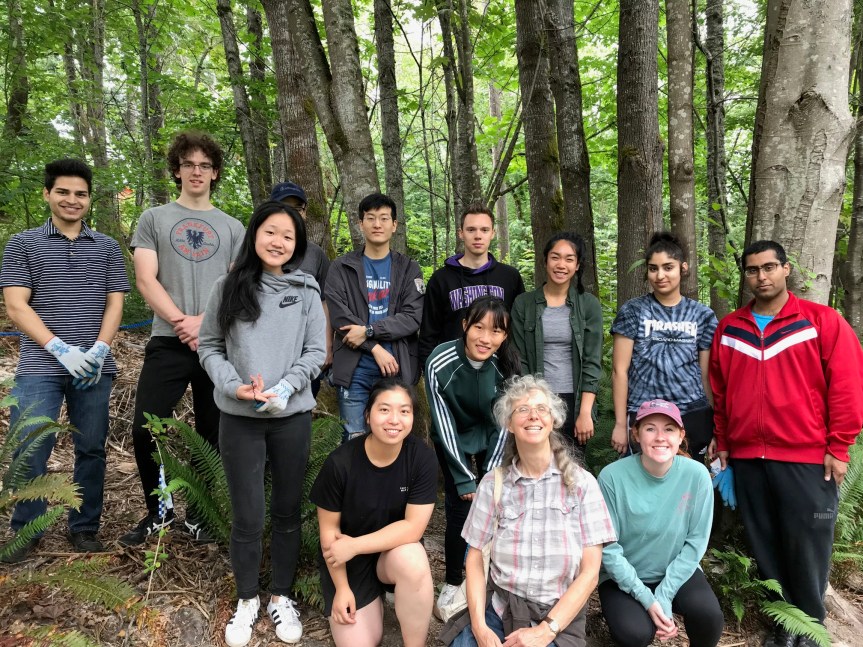
The June 22 work party was held during the first week of UW’s Summer Quarter. I had never offered one that early in the quarter before, so I didn’t know how many students would come. I was delighted when 10 college students, 2 high school students and an adult who has helped with forest restoration work parties in other Seattle parklands showed up.

This work party was devoted to removing the invasive vines and plants that have been emerging throughout our Greenbelt site. One of the invasive plants that abound at this time of year is bindweed (aka morning glory). Bindweed vines wind around healthy plants and essentially strangle them. I’ve been told that bindweed roots can go 32 feet into the ground, so it’s not a feasible goal to eliminate the plant completely. If we can dig out at least some of the root, though, it will weaken the vine and slow down its growth.

I took these photos of bindweed that covered a thimbleberry plant on our site last year. I’m happy to report that much less bindweed came up near that shrub this year.

If you click on any of the photo galleries you will see enlarged copies of the photos.

After listening to an initial orientation, the volunteers divided into three teams. Team One focused on removing bindweed from the northwest part of the property. It is painstaking work to remove the vine in a way that doesn’t destroy the leaves on the native plant that is being freed. This group worked diligently and carried many loads of bindweed to the area where we dry out the invasive plants, so they don’t re-root. [Note #1 The plant you see above the young man in the first photo below is knotweed. That is also an invasive plant but is one that Seattle Parks Department staff removes.]

The invasive plant that Team Two focused on removing is known as creeping buttercup. This team worked in a section of the property that hadn’t been cleared before. I had thought it might be pulled out easily, but that was not the case; the roots were firmly entrenched. The removal was also hampered by the fact that the ground is much harder in the summer; it can be difficult to even get a shovel into the dirt. I was excited to see the bare ground becoming visible as the work progressed.

Team Three focused on removing blackberry vines. For the most part, the blackberry plants were small, but there were a lot of them, especially on the paths.

After a break, all of the team members joined together in working on the western border of the Greenbelt site that is just north of ours. They continued the process of clearing an area that my neighbor John and I had started in early May. After the weeds were removed, work party participants spread burlap bags on the land and then poured wood chip mulch on top of the bags. The burlap and the mulch will reduce weed growth and keep the soil moist.

Once again, the effort of a small group of volunteers made such a tangible difference. And they accomplished all of this during a work party that lasted only three hours. Together we are restoring land that was covered by invasive blackberry, bindweed and ivy vines for more than 50 years. It is back on the road to once again becoming a healthy forest.

Nimo Patel: We Shall Overcome

Any of you who have read my blog for a while will know that I love Nimo Patel’s music. This morning, I was notified that he had just released a new music video.

With so much that is negative and demoralizing going on in my country, it can be difficult to maintain a sense of hope. Watching and listening to Nimo’s new video was what I needed in this moment. I’m crying … and feeling gratitude… from the depth of my heart.

To learn more about Nimo Patel click here.

To watch Nimo’s other music videos click here.

To download the Empty Hands Music album for free click here.

One Step at a Time

Snowberry fruit

In April, my neighbor John and I started doing some clearing of invasive plants, mainly ivy and blackberry vines, in the Greenbelt site that is to the north of ours. Members of Earth Corps had cleared parts of that site 10-15 years ago. They had also planted evergreen trees, native shrubs and ground covers. I know that Susan, who like me is a Green Seattle Partnership Forest Steward worked in that area with some elementary school students several years ago, but for the most part it has gone wild. I’ve been eager to delve into removing the invasive plants from that land for some time, but know that clearing and maintaining our main site needs to stay the priority for our work parties and for work John and/or I did on our own.

A few weeks ago, I decided to spend two hours on two different days working along 25th Avenue S north of the Hanford Stairs, which is on the west border of the Greenbelt site that has been calling me. Once the area along the street was cleared, I/we would clear the land along the Hanford Stairs and eventually work deeper in the forest. We could work on this project from time to time and still keep our main Greenbelt site our top priority.
The small area I decided to tackle that day was dense with snowberry and Indian plum shrubs, a maple tree and numerous evergreen trees. Blackberry vines ran through it all. The shrubs were so close together that it was impossible to walk through them. Experiencing the density of the native shrubs was a good reminder that almost everything we are planting in the other site will get big and I need to keep that in mind when making planting decisions.

I couldn’t figure out how to reach the blackberry roots so that I could dig out the root balls. The best I could do was reach into the foliage and cut back the stalks.

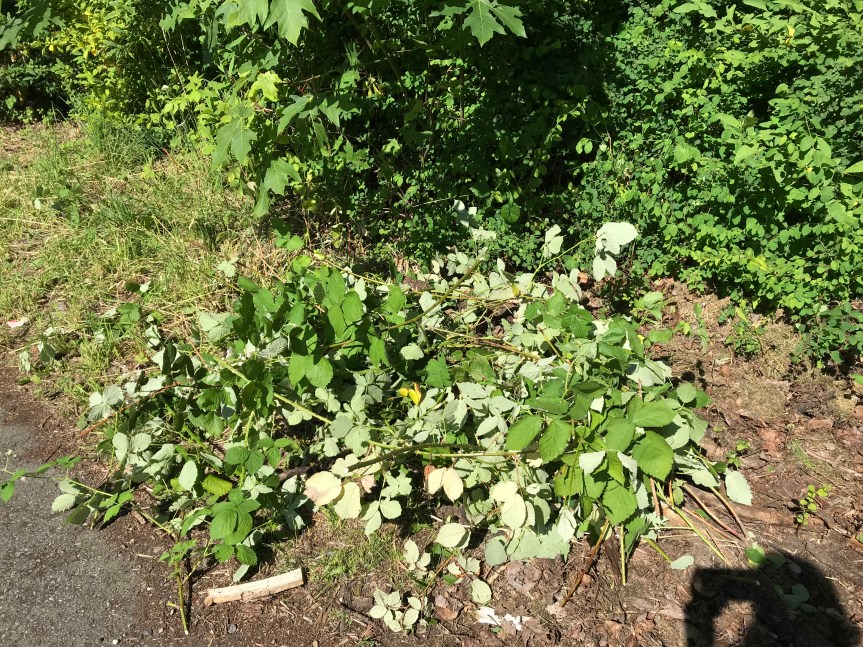
The first picture below shows what the shrubs along the street looked like when I began working that day.

The next one is of the first pile of blackberry stalks I removed.  By the time I took that photograph, I had already partially cleared the ground to the right of the cut stalks. You can get a sense what the ground looked like when I started by looking to the left of the pile.

At one point, I noticed that the snowberry plants had many tiny pink blossoms on them.

A moment later, I saw a small purple fruit deep in the foliage. I realized it was the fruit of an Indian plum shrub. I enjoyed seeing what the plants looked like when they were mature. I haven’t noticed either the pink blossoms of a snowberry plant or the purple fruit of an Indian plum shrub on our site yet.

As I was preparing to stop my work on the second day, I heard lots of buzzing. When I took the time to investigate the source of the sound, I saw honey bees, bumble bees and mason bees flitting from one pink snowberry blossom to another. I loved seeing that wildlife has returned to this site and look forward to the plants in our site getting big enough to attract the bees too.

Once I had cleared the land in front of the shrubs, and cut back as many of the blackberry stalks as I could reach, I laid burlap bags on the ground and scattered wood chip mulch over them. The burlap and mulch will help reduce weed growth and hold in moisture.

This is what the section looked like when I stopped working on the second day.

The before and after photos below show the increased space that resulted from removing the blackberry stalks. I hope to learn how to get to and dig out the roots balls. I also need to find out if there are other things I should be doing to decrease the density of the shrubs.

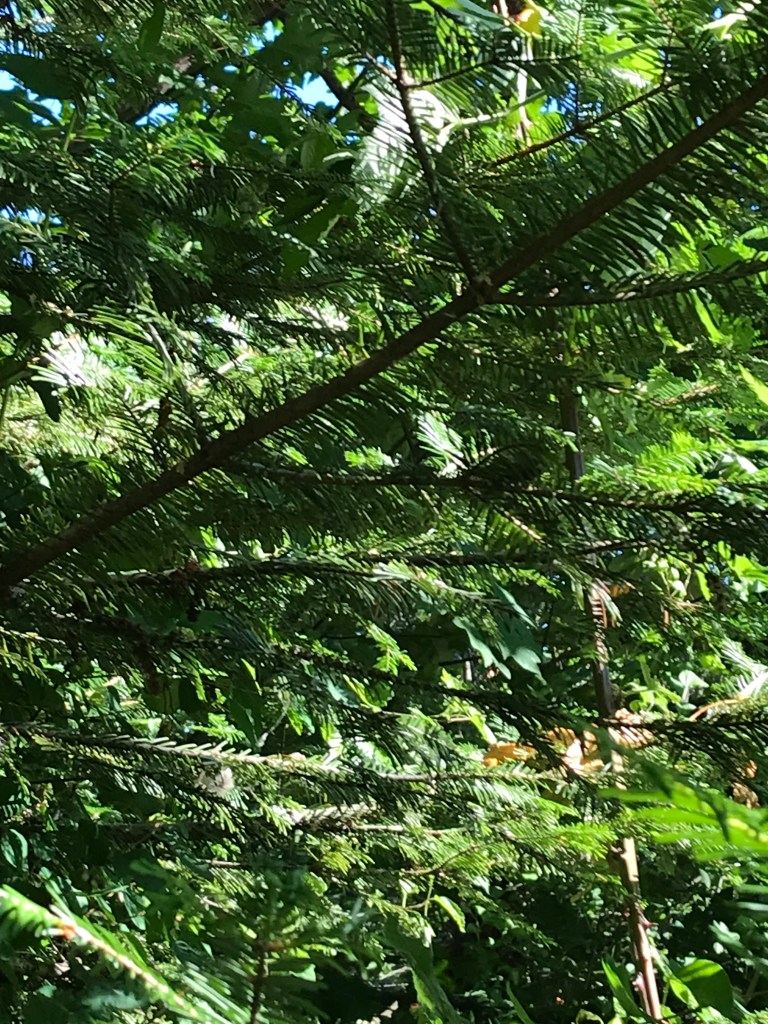
At one point, I saw an evergreen tree covered by blackberry vines deep in the mass of shrubs. I tried to get to it from all sides but never found a way into the thicket that surrounded it. I look forward to being able to free that tree from the blackberries. Hopefully that will be in the near future.

[I don’t think that particular tree can be seen in the following photo, but the photo may give you a sense of why I couldn’t get to it.]

As I was trying to find my way to the tree, I saw a shrub with beautiful white flowers. I thought it was stunning. I used my phone’s Plant Net app to see if I could find out what it type of plant it was. I was excited to discover it was an oceanspray shrub. In February we planted 10 oceanspray shrubs in our site. I loved having had a glimpse of what they will eventually look like.

The strip of land I worked on was only 15 to 20 feet long. So much more needs to be done even in this small section of the second Greenbelt site. Below are photos taken of an area adjacent to the one I described in this post. It is another 15 foot segment.

The strip along 25th Avenue S is 150-200 feet long. The whole site is 1.89 acres. I know it is important for me to focus on the moment rather than looking at the immensity of the whole. In other words, I will remember I need to move forward “One Step at a Time.”

His Singing Touched My Heart

A friend just sent me an America’s Got Talent video. It is with tears running down my face that I share it with you.

Sooryagayathri Sings Kurai Ondrum illai


Kuldeep M Pai has published a new music video of his student, Sooryagayathri, singing Kurai Ondrum illai. I find her music to be as inspiring now as it was when she was a young child. To my mind it is perfection.

I thank my friend Ramana for recommending that I check her out in August of 2016.

Some Day a Mighty Oak?

In February we planted 10 bare root Gary Oak trees in the Greenbelt. I think only three of them are going to live, but those three are doing well. This afternoon, I took two photos of one of them. The white areas on the leaves are cotton-like fibers from nearby cottonwood trees.

It is hard to imagine that this little tree may someday become a mighty oak. But it is also hard to imagine that only two months ago there was only one tiny bud on the top of this tree; and that bud didn’t appear to have any life in it.. I wonder how tall the tree will be by the end of the summer.

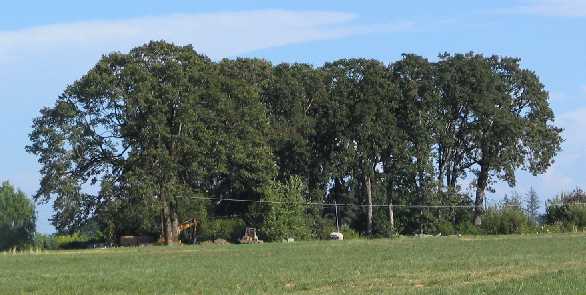
I was concerned that we planted the oaks too close together, but in writing this post I looked for a photo of a mature Garry Oak and found this! Maybe they were planted just where they were “supposed” to be planted, close to their friends.

Photo Credit: Wikimedia

The original uploader was Llywrch at English Wikipedia.
[CC BY-SA 2.0 (https://creativecommons.org/licenses/by-sa/2.0)%5D, via Wikimedia Commons

Mother Nature Blesses Us….. Twice

My neighbor John and I had plans to pull ivy, blackberries and other weeds in the Greenbelt for a couple hours today. Problem was, the weather forecast was for rain, and neither of us were interested in working in the rain.

We planned to start weeding at 11:30. When it began to rain at 11:00, I felt doubtful that we would be able to work. At 11:30, the rain stopped as abruptly as it had begun. The sun came out and we got busy. Before long it was so warm that I took off my coat. The weather change was remarkable.

After two hours, we decided we had done enough for that session. As soon as John left, I noticed that it was getting dark. It seemed like dusk, even though it was only 2:45 in the afternoon. By the time I finished picking up my tools and putting the weeds I had pulled on the racks to dry, it started to rain.

I felt as if Mother Nature had blessed us twice- when we were given sun and warmth while we worked and when the rain started as soon as we finished, showering the plants we love with much needed water.

Thank you Mother for taking care of all of your children, whether they be insects, animals, plants or people.

Update on Practice in Accepting Change and Letting Go

In my June 8 post, I shared my concern that the stairs near our Greenbelt site were being painted. I had come to the conclusion that it was a good opportunity for me to practice both accepting change and letting go.

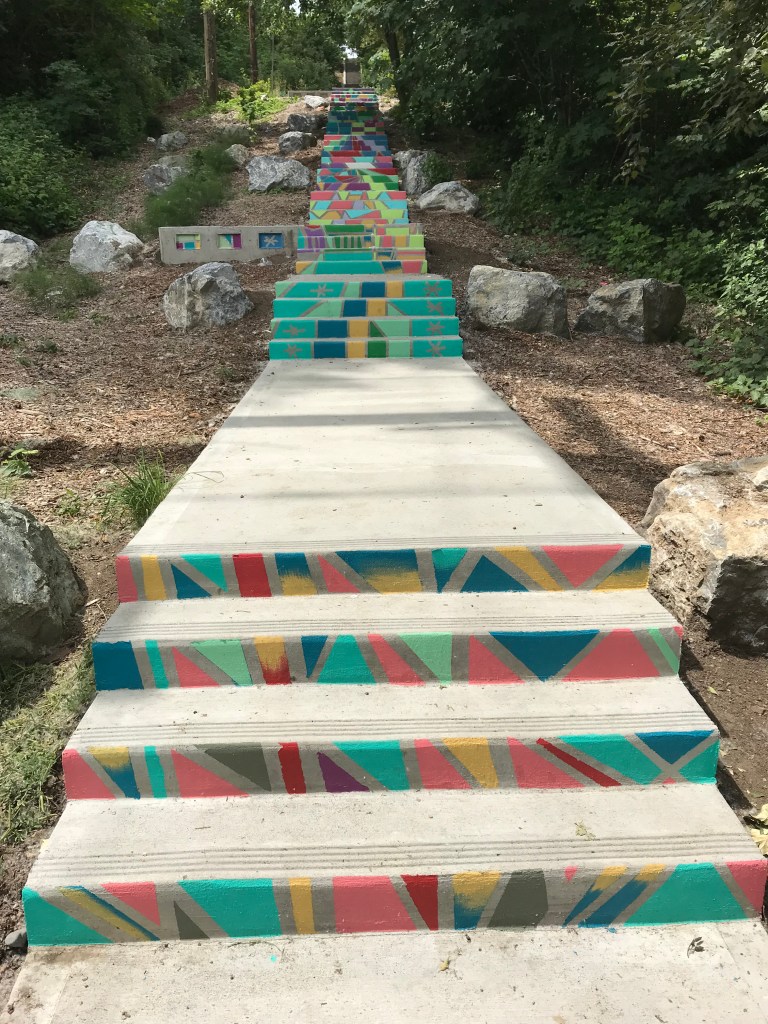
When the stairs below ours were finished, I thought the optical illusion was cool but another concern arose. Our stairs are much smaller and closer together than those. I wondered if the bright paint would be overwhelming. I decided to stick with my decision to consider it an opportunity to not worry; to let go and accept whatever change came my way.

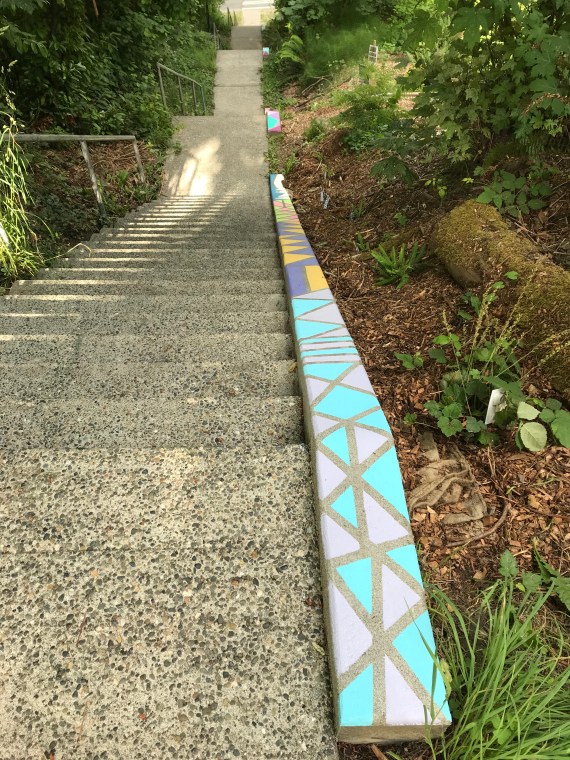
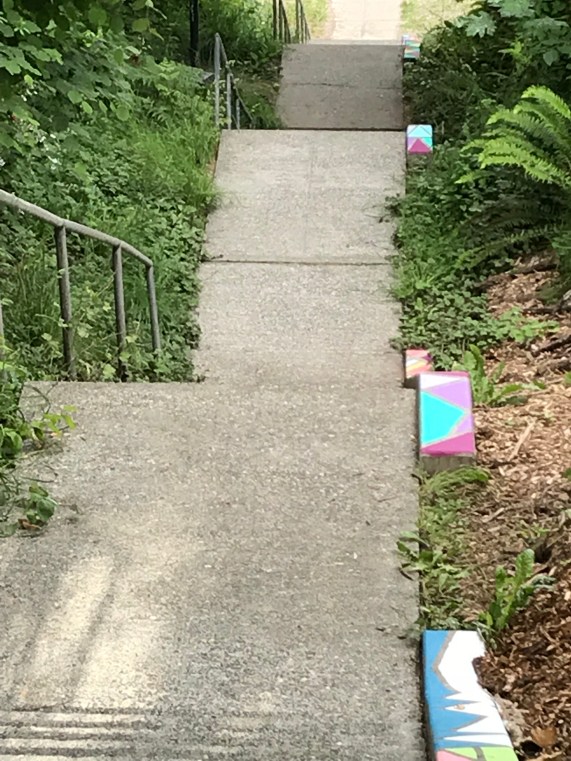
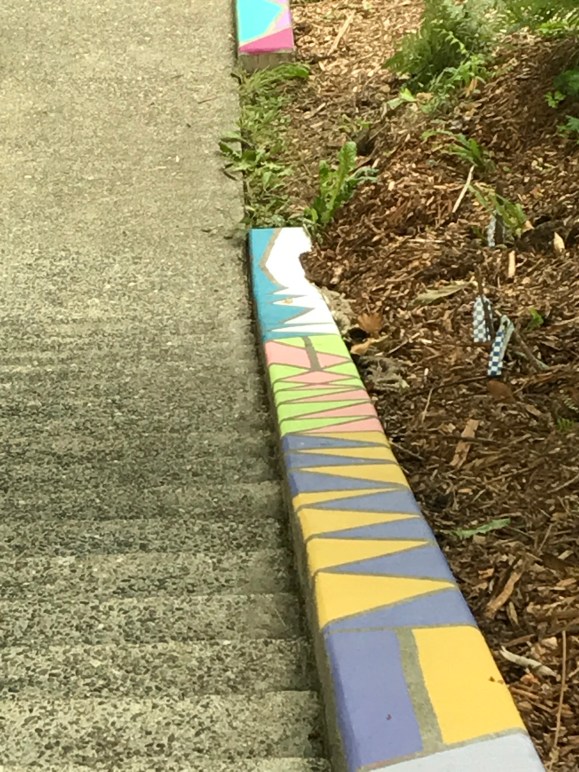
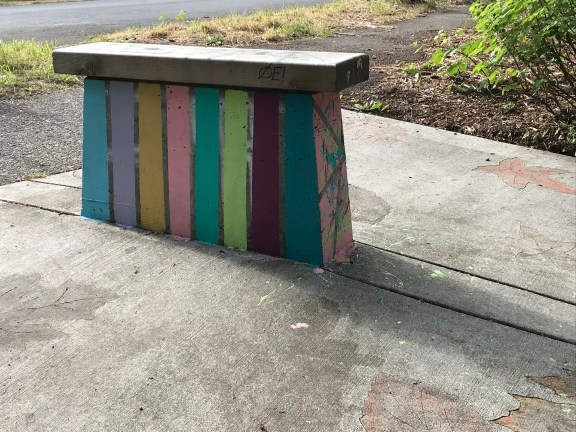
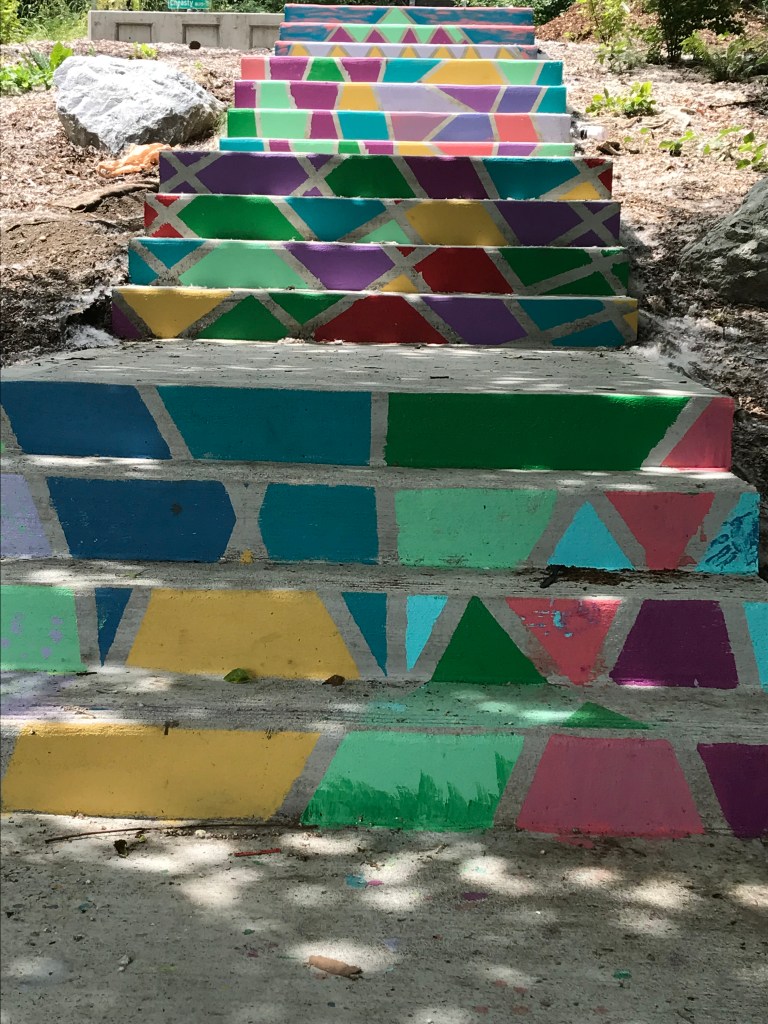
The stairs closest to our site were to be painted on Saturday. That afternoon, I decided to check it out. I was delighted with what I saw. The colors are beautiful. Instead of painting the sides of each step, like they did in the area below ours, the painters painted the cement border that goes between the various landings. They also painted the “bench” at the top of the stairs. (I put bench in quotes because it used to be the mount for a bulletin board.)

I’m so glad I decided to see this experience as a “lesson” rather than worrying or fretting about it. I couldn’t be happier with the results.

I Will Pass It On!

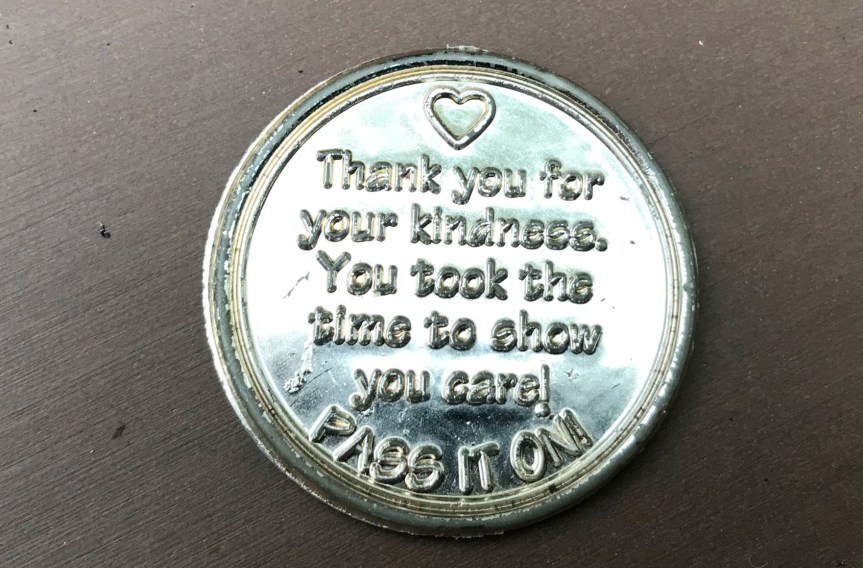
Friday morning, when I was pulling weeds in the Greenbelt, I noticed that there was a coin on the ground next to a sign I had placed under an Indian plum shrub during the spring of 2017.

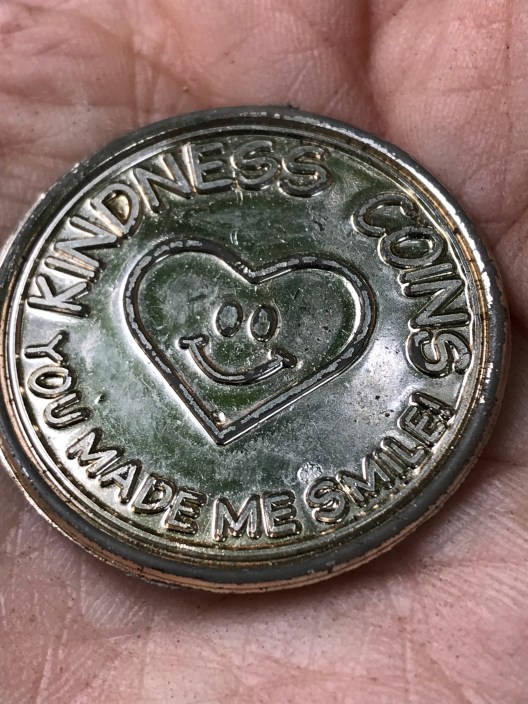
I was curious what it was, so I picked it up. These messages were on the two sides of the coin:

Over the year, a few people have told me that they appreciated the signs but I have no idea who put the coin there or when they did it. I felt very grateful for the expression of gratitude and will definitely pass the coin on!

Practice in Accepting Change and Letting Go

The last week in April, a friend sent me an email that said an artist, working with Seattle Department of Transportation’s Safe Routes to School project, was painting staircases around Seattle. The notice also said that the next steps to be painted were the Hanford Stairs, the stairs that border our Greenbelt restoration site.

When I saw the photo I was concerned. I couldn’t imagine something so bright going through the forest. I didn’t understand how painting the stairs would make walking to school safer, but thought that anything that accomplished that goal would be a good thing. I liked that she was inviting community members to help paint. In addition, I knew that this unexpected change would be an opportunity for me to practice letting go and suspending judgment.

I took some comfort in the fact that the notice included a photo of the stairs that were to be painted and they were the new set of stairs that are below ours. Maybe ours would stay the same.

Last Saturday was the day the lower stairs were to be painted. Yesterday afternoon, I decided to walk down and check them out. From the top of the stairs they looked like this…. no sign of paint.

But when I walked to the bottom of the stairs and looked up, this is what I saw.

The bright colors still seemed strange to me but I had to admit that there was beauty to it. I loved that the stairs looked clear one way and fancy when you looked at them from the other direction.

This morning, I noticed that there was a lot of sand on the plants on both sides of the stairs near us. It seemed so strange and I couldn’t imagine what could have caused it. When I pointed the sand out to somebody later in the day, she said that the stairs had been pressure washed. In that moment, I realized that our part of stairs must also be part of this project and that they will probably be painted tomorrow!

I still think it will take me time to get used to this change, but I’m glad that I decided that the lower stairs were okay and even kind of pretty. I have no doubt that children will enjoy them a lot and I hope that it does indeed keep them safe.