
“In essentially all individual moments, we’re safe and physically comfortable. We generally have to borrow worry from the future or the past to maintain unhappiness.”
Fritz Reitz
“In essentially all individual moments, we’re safe and physically comfortable. We generally have to borrow worry from the future or the past to maintain unhappiness.”
Fritz Reitz
After reading my Song Lyrics Sunday post for this week, a friend sent me an email telling me about Oscar Brown Jr.’s song The Tree and Me. It is beautiful, and I suggest you check it out too.
As I was listening to it, I remembered hearing Nimo Feat sing during the summer of 2015. I was so inspired by his music and even more inspired when I later read about his life and watched his videos. Here is a synopsis from his website:
From an Ivy League education to Wall street to fame and fortune as a MTV Rap star, at some point along Nimo’s journey he realized that we was walking a path of suffering and that the only path to light was through selfless service to others and his own internal purification. For the past 5 and half years Nimo has been serving and working with the underprivileged communities in the Gandhi Ashram in India.
Most recently Nimo has reconnected to his roots of music and is offering this gift of love, peace and oneness through his songs: an offering he calls “Empty Hands Music”.
Nimo chose the title ‘Empty Hands’, because of the profound wisdom we all can gain when we understand this deeper truth: that we arrive on this planet empty handed and we will all soon leave empty handed. So then, how and in what spirit do we want to spend the time in between?
The Empty Hands album can be downloaded for free here.
One of my favorite songs from that album is called Planting Seeds. Listening to it and watching the video still touches me so deeply. Moments ago, as I was finishing this post I watched it for the third time today. My tears are flowing.
PLANTING SEEDS
Written and performed by Nimesh “Nimo” Patel and Daniel Nahmod
Music Produced by Daniel Nahmod
Mixed by Brian Nicholls
Song inspired by original “Planting Seeds” song by Daniel Nahmod, 2006, from his ‘Water’ album
Lyrics
Intro:
I spent a long time runnin
I never knew then, what I know I know now,
That the fruits they always comin’
But you can’t go around just knockin’ them down
It takes a long time to showin’
We plant the seeds then, and we look at them now,
But the roots are always growin’
No matter if I’m there or never around…
Chorus:
Whatever grows will grow,
Whatever dies will die
Whatever works will work
Whatever flies will fly,
Whatever fails will fail|
What’s meant to soar will soar,
I am planting seeds nothing more
Verse 1:
Its like your whole life you’ve been training for this moment
And when the time comes you just disown it,
Meaning you just surrender don’t control it,
Not interested in the clay pots and moldin’
Or sitting next to the path, tryin’ to unfold it
Or waiting for the fruits to fall down toward ya’
You let it go and now your flowing feeling quite gorgeous
So you take steps away instead of towards it,
What a rush, feeling freedom with nothing to hold
We’ve been taught that what you touch will always turn to gold
But now we’re learning when we let it go, it overflows
With no credit to take cuz no credit is owned
A higher power working deeper when the seeds are sowed
And when the seeds are true, then they’re seeds of gold
But the real gold is joy, when life starts to flow
And when it does, you just smile, cuz now you know!
Bridge:
I spent a long time runnin
I never knew then, what I know I know now,
That the fruits they always comin’
But you can’t go around just knockin’ them down
It takes a long time to showin’
We plant the seeds then, and we look at them now,
But the roots are always growin’
No matter if I’m there or never around…
[Chorus x3]

I once heard a story about a monkey who decided to give up eating bananas. Even though the monkey was committed to his goal, when he saw a banana in a tree far away, he decided to sit closer to it. That way he could at least enjoy looking at it. Nothing wrong with that!
Soon, he decided to move even closer to the banana. And then closer. And then closer yet. Before long he was sitting right next to it. At that point, the monkey reached over and grabbed, peeled and ate the banana, telling himself that he would give up bananas “tomorrow.”
I often use that story when talking to my psychotherapy clients about breaking their addictive patterns. If you have the addictive substance, such as drugs, alcohol, a particular type of food, porn, etc., in close proximity to you, it is unlikely you will be able to keep your commitment to abstain.
That is the way I am about chocolate. Dark chocolate to be specific. A little dark chocolate can be healthy, but if I have some, I usually want more. If it is in the house, and it comes to my mind, it won’t be long before I go looking for it. Once it is in plain sight, forget about abstaining, I will do that “tomorrow.”
I don’t intend to ever give up dark chocolate completely, but when I am serious about stopping my over-indulgence, I know to not have it in the house and before I leave the house to recommit to myself not seek it out.
(Note: At the moment, I’m congratulating myself for choosing to use a photo of a monkey eating a banana for this post rather than a photo of a piece of dark chocolate. That way, every time I see this post in the future, I won’t be tempted to go buy some!)
Written for The Daily Prompt: Vice
Photo Credit: By Mouli kundu (Own work) [CC BY-SA 4.0 (http://creativecommons.org/licenses/by-sa/4.0)%5D, via Wikimedia Commons

The theme for this week’s Song Lyric Sunday is anger. The tune that came to my mind was Nancy Sinatra’s song These Boots Are Made for Walkin’. It was written by Lee Hazelwood and was released on February 22, 1966.
I enjoyed hearing a song from my past but watching the video was even more fun. The song came out when I was 17, six or seven months before I moved to Seattle… to go to college. It is highly unlikely I would have seen the video back then so I appreciate the opportunity to see it now.
You keep saying you got something for me
Something you call love but confess
You’ve been a’messin’ where you shouldn’t ‘ve been a’messin’
And now someone else is getting all your best
Well, these boots are made for walking, and that’s just what they’ll do
One of these days these boots are gonna walk all over you
You keep lyin’ when you oughta be truthin’
You keep losing when you oughta not bet
You keep samin’ when you oughta be a’changin’
What’s right is right but you ain’t been right yet
These boots are made for walking, and that’s just what they’ll do
One of these days these boots are gonna walk all over you
You keep playing where you shouldn’t be playing
And you keep thinking that you’ll never get burnt (HAH)
Well, I’ve just found me a brand new box of matches (YEAH)
And what he knows you ain’t had time to learn
These boots are made for walking, and that’s just what they’ll do
One of these days these boots are gonna walk all over you

For several years in the mid to late 1990’s and early 2000’s, I wrote articles about my experiences with Amma for “The New Times,” a free newspaper that was, at that time, available in Washington and Oregon. I have started sharing some of those articles on my blog. I am choosing the articles to post based on their topic, therefore they are not being shared chronologically. The article below was published in May of 1995.
As a psychotherapist and a consciously evolving human being, I have a strong interest in examining the emotional pain in my own and others’ lives. This year (1995), during my annual visit to the ashram of my spiritual teacher, Mata Amritanandamayi, also known as Amma, I had an experience that helped me put my own pain into perspective.
This year’s trip was different from my previous trips in that most of my two month visit was spent traveling with Amma as she conducted programs throughout India. (Amma’s public programs include lectures, devotional singing, and darshan, which means to be in the company of a great soul. Amma’s style of darshan is to hug each individual who comes to her.) My time in India was to end with a program in Pune, a city southeast of Mumbai.
Four days before I was to leave India, I found myself filled with grief. While I was excited to be returning to Caesar salads, Western toilets, hot showers, and American efficiency, I felt enormous grief about leaving my teacher, the devotional singing and the bliss of the divine energy that I access so easily when in Amma’s presence. I noticed that my sadness was mixed with a measure of rage which I knew was rooted in my childhood. I sat close to Amma and allowed the sadness and rage to wash away and the peace and stillness to come.
Two days later, during an evening program, I was watching Amma give darshan to the large crowd who had assembled. While I was watching, a man came to her carrying a large teenage boy who had no use of his arms or legs. His legs appeared to be no larger than the diameter of a fifty-cent coin. I thought he might also suffer from cerebral palsy. Moments later, another man carried in a boy who was in a similar condition. Then another pair presented themselves to Amma, and then another, and another.
Soon it became obvious that a bus load of severely handicapped teenagers had been brought to receive Amma’s touch. As the children kept coming, my body flooded with grief. Other images then started coming into my mind’s eye, images of the pain and suffering I had witnessed during the last few weeks.
Each of these scenes had moved me to tears. As the memories flickered through my mind’s eye, I imagined what it would be like to be trapped inside a body that I had no ability to operate; a body that even robbed me of my ability to communicate. I also imagined what it would be like to be born into extreme poverty, where I had little or no way to improve my situation. As I compared what I believed I would feel in those circumstances to the pain I was now feeling about leaving India, I was able to put my own pain into perspective.
I saw that the pain I was experiencing was temporary. Even though I hurt, I knew the grief would pass. Amma would be coming to the U.S. in a few months. In addition, I knew how to connect with divine energy whether I was in India or in Seattle, I just needed to be willing to make the effort.
I remembered that a portion of my pain was energy I was still holding onto from my childhood. I knew that as I continued to access and release this old rage, I would experience more and more peace and freedom from pain.
Next, I reminded myself that I had consciously chosen to put myself into a situation that would cause me pain. I know it is difficult for me to leave India. Going to India is a choice I make freely and willingly understanding that pain will be one of the many feelings I will experience on the journey.
I wondered briefly if I should feel ashamed of myself for feeling grief about my situation. I let that go, realizing that self-criticism was not the purpose of the lesson I was receiving. My grief and pain were real. My job was not to deny the pain or to judge it but rather to be active in releasing it.
As I pondered this newest thought, yet another came. I noted that as I progress in my own healing, I experience my heart opening more and more to those around me. It is as if my eyes are opening and I can more clearly see the needs of others from a place of deep compassion as opposed to guilt-ridden caretaking. I then thought of the others in my life who are equally committed to their personal growth. I recognized they are undergoing a similar progression.
As these insights flooded into my mind, I experienced a renewal of my commitment to continue this process. In my mind’s eye I could see the ripple effect that will occur as each one of us, completing our own healing, create a world where there is enough food, shelter and love for everyone. A world where no one is left alone in their pain.
We cannot eliminate pain from the earth; that is part of the human experience. We can, however, significantly change the way we relate to pain. I hope that my experiences will give you insights that help you to put your own pain into perspective.
“The New Times” articles that I’ve already shared:

“Worry is a thin stream of fear trickling through the mind. If encouraged, it cuts a channel into which all other thoughts are drained.”
Arthur Somers Roche
Think about how much time you have spent worrying during your life. Did all of your worrying help you in any way or in hindsight do you think that time could have been put to better use?
How would you be different if starting today you were able to live in the present instead of immersing yourself in regrets about the past or worrying about the future? What would your life be like if you no longer worried?
Close your eyes a moment and imagine yourself living a life free of worry. Notice how your muscles relax and your breath comes and goes easier. Are you breathing deeper? What other changes do you notice in your body and mind?
Would you like to let go of your tendency to worry? If your answer is “Yes,” considering using one or more of the techniques I list below whenever you find yourself worrying.
 Write a list of all of your worries. “I’m worried that _________.” Simply fill in the blank, over and over and over again, until you have listed all of the worries that you can think of. Write whatever comes to your mind whether or not it makes any sense. It is fine for you to write the same worry multiple times
Vince Horan, one of my co-therapists, frequently tells clients that “Fear needs information.” Take a good look at your list of worries and pick one. What information do you need to gather in order to relieve that fear? Go get it!
If you are ready to deal with more than one fear, then identify a second, third, fourth, etc. I suspect if you get the information you need, your fear will reduce, and so will your worrying
Play the “what if” game. For example, if you are afraid that you will lose your job, the “what if” might be “I won’t have enough money.” Next ask yourself “What if you don’t have enough money?” The answer might be “I won’t be able to feed my kids.” Then ask “What if you don’t have money to feed your kids?” The response might be, “I will go to a food bank.” Keep following the thread until you realize you will be able to deal with whatever happens.
FEAR is False Evidence Appearing Real. Look at your list of worries and identify the ways you have been fooled into thinking you are in danger. Next to the false evidence, write the truth.
Immerse yourself in the present. You may need to get so focused on the present that you think, “I am moving my spoon towards my bowl of cereal.” “I am picking up a spoonful of cereal.” “I am bringing the spoon towards my mouth.” “I am putting the spoonful of cereal into my mouth.” “I am chewing my cereal.” etc. If you focus on the present this minutely, you will become absorbed in the moment, your mind will quiet and your body will relax.
You can create a variation of Jean Illsley Clarke’s fuss box exercise. Stand in a box or on a pillow, or just draw a circle in the carpet with your finger and stand in the middle of it. Begin to list all of your worries out loud. Don’t stop and think, just let them pour out, even if they don’t make sense. It can be helpful to be dramatic and even to exaggerate them. At some point, you will feel done. If you’ve been dramatic and/or exaggerated, you may even find yourself laughing. When you feel finished, step away from your worry box and identify something you will do to deal with one of the problems you mentioned.
Many years ago, I learned a technique from a therapist named Mary Goulding. She instructed us to push our tongues into our cheeks and then talk nonstop about all of the things we criticize ourselves for. When we talk about our worries that way they, of course, sound really strange. It is another process that often ends up in laughter.
Create an affirmation and use it as a mantra, such as “I am a competent, capable adult.” The mantra is likely to be something you don’t fully believe but would like to believe.
Say the mantra 1,000 times a day for the next 21 days. Better yet, consider saying it 10,000 to 20,000 times a day! If you find yourself saying the affirmation and worrying at the same time, speed up the mantra. It doesn’t matter how fast you go.
Imagine the power of filling your mind with a positive belief rather than a fear-based one. If you say enough of them, you may find the affirmation flowing through your mind automatically. You may even wake up and find it streaming through your mind during the night.
Think of all of the challenges that have come into your life unexpectedly. Reflect on how well you dealt with those. We are usually able to deal with whatever unexpected situations occur in our lives. It is worrying about things that haven’t happened, and probably never will happen, that saps our energy and pulls us into depression, anxiety and overwhelm.
 Actively choose where you are going to put your attention. Decide if you are going to focus on worrying or focus on something else. If you choose to focus on something else, do it.
Listen to music that you find soothing. As you listen, practice breathing slowly and deeply. Focus on relaxing and letting go of tension.
Distract yourself by doing an activity that you really enjoy. Go for a walk, work in your garden, read a book, immerse yourself in a hobby, spend time with friends, etc
Call a friend and tell them you are worrying. Ask for reassurance or help in problem solving.
Create a 3-second contract, such as those used to break fantasy addictions in some 12-step recovery groups. Your contract might be “I won’t worry for more than 3 seconds.” You won’t break the contract when you find yourself immersed in worrying; you break it if you choose to continue worrying after you have become conscious you are doing it. Sometimes having the contract is enough. If it isn’t, consider creating a consequence you will do each time you break it.
When you are in a worry-free state of mind, write a letter to the part of you that worries. Give him/her reassurance and ideas for moving beyond the worry. Focus on messages that will give hope or help with problem solving. Then put the letter some place where you will be able to find it when you need it. Reading guidance from a stronger part of yourself may be more effective than advice coming from another person.
I’ve shared 15 actions you could take whenever you are worrying; there are certainly more. Add any others that you know, or discover, work for you. I suggest you keep a copy of this list handy so that you can use it whenever you are worrying.
At those times, work your way through the list, in any order you desire, until you find you have shifted out of the fear. The chances are good that you will be feeling better long before you do all of them.
I will end this post with two videos. You may even want to add them to your list of worry stopping techniques. They sure help shift my mood!
What helps YOU stop worrying?
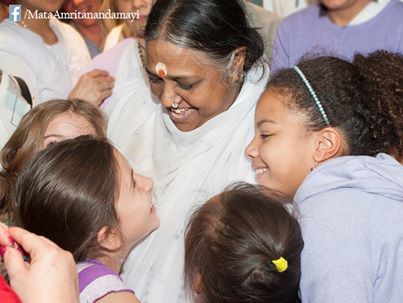
This past week I traveled to Toronto to attend the last of Amma’s 2016 North America programs. Every day with Amma is always filled with learning and experiences. There is no way I could detail everything that happened while I was there but I will share some of the events that were most important to me.
The Weight was Lifted
In the post I wrote from Amma’s Programs in Chicago (My Dream is Realized), I shared about the increasing emotional distress I have been feeling because, due to a variety of physical issues, I have been unable to participate in seva (volunteer work) at Amma’s programs for some time. For fifteen years I was the coordinator for Amma’s Pacific Northwest programs. I stopped doing that volunteer job about six years ago. While I still do various forms of seva in Seattle, I haven’t committed to any seva shifts during Amma’s programs for at least three years. I was beginning to feel useless.
Amma clearly was not upset that I wasn’t working, nor was anyone else. Regardless, I found myself becoming more and more critical of myself. I realized how much my distress was taking away my ability to really “be” at the program. All too often my mind was on what I wasn’t doing instead of being present. Prior to coming to Toronto, I decided I needed to ask Amma for help.
[Before I relate what happened when I talked to Amma, let me say that she gives very individualized responses. Two people may ask her the same question and get two completely different answers. It is important that people talk with Amma directly rather than assuming an answer given to someone else is the same answer she would give to them.]
On the first day of the Toronto program, I arrived early so that I could join the question line. (I will share more of that process in the next section.) As Amma answered the questions of the people in front of me, I eagerly anticipated my own experience. Finally, I reached the front of the line. As Amma listened to the translator while he shared my concern, her eyes gazed at me with love. Her response was immediate. With firmness, yet at the same time with great tenderness, she told me not to ever think like that. She said I have done so many years of seva and that I shouldn’t feel any guilt or any worry about not doing seva now. I felt seen, heard, loved and respected. It seemed like a heavy weight was removed from my mind and my heart instantaneously. Even though I heard Amma’s answer through the translator, I will be able to see the way she looked at me, feel her touch on my cheek and hear her words in my mind forever more.
Synchronicities
I imagine most of us have the experience of synchronous things happening from time to time. When around Amma, though, they seem to happen with much more frequency.
One of those events occurred on the day I asked Amma my question. I hadn’t asked her a question for a long time, but I knew the general practice was to meet on the left side of the stage before the program started and a question line monitor would come with a sign up sheet. If there were a lot of people waiting, then the organizer might do some prioritizing based on the severity of the issue.
I waited on the side of the stage for a long time and only one other person joined me. When the question line monitor arrived later, I was very surprised to discover that 8 of the 10 slots were already full. I assumed other people must have known who she was and stopped her as she walked through the crowd. I ended up with slot #10.
I was delighted that I was going to be able to ask my question, but a disgruntled part inside of me harrumphed from time to time, “I should have been FIRST not LAST.” I didn’t give the complaint much weight since I knew I could have lost out altogether and was ecstatic that my time would come.
As I was going through the line, a friend of mine who had recently suffered a major loss walked by. When she saw me, she asked if she could sit with me. Because I was last, and the line was moving forward leaving empty seats as each person’s question was answered, there was now an empty seat next to me. I put my arm around her shoulders as she cried. There was no doubt in my mind that the reason I was last person in the question line, instead of first, was so that I would be available to support her. The event also served as a reminder to me that I help in ways other than signing up for seva shifts.
Another synchronous event that occurred was one that was fun, but of no major significance. I was walking with Chaitanya and Akshay headed for a restaurant. I mentioned to them that I have become practically obsessed with eating sushi. Seconds after I made that statement, we turned a corner a block from the hotel where we were staying. On my left, there was a building with a big sign on it, “Grand Opening Coming Soon….. All You Can Eat Sushi.” I will look forward to going there when I go to the 2017 programs in Toronto!
Dance
There is always an entertainment program on the second night of Amma’s retreats. Devotees sing, dance or entertain in other ways. For many years, the Tour Staff has created a big dance to be performed during the last retreat of the tour. As has happened numerous times in the past, they invited me to join them. That left me in a dilemma. I REALLY, REALLY wanted to do it, but could my back take it? (I’ve had back problems since February.) My pain had reduced tremendously over the past month, but would I hurt myself if I danced a fairly high energy Indian dance? I knew that I could do it in a low impact way, but I still had doubts.
I decided to participate in the practices and take one day at a time. I could change my mind at any moment. After the first practice I was a bit sore, but the next day I felt better than I had in a long time. The same thing happened after the second practice. It looked like I was going to be able to participate in the dance!
During special events, like festivals, Amma frequently encourages the devotees to dance, and sometimes dances herself. The staff members that created the dance at the Toronto retreat decided that they wanted to surprise Amma by inviting the retreat participants to join in the staff dance. About three hundred staff and retreatants came to one or both practices. Right before the dance was to be performed, most of the chairs in the room were stacked on the sides of the room and everyone was invited to join in. People who knew the dance were scattered throughout the room and the dance was easy enough that people could participate whether or not they had been at a practice. As a result, at one o’clock in the morning, about 500 devotees danced for Amma. And at 2:30 a.m., just before the program ended for the night, Amma danced for us! It was a magical night, never to be forgotten.
These are only a few of the many experiences I had during the Toronto programs. I could write so much more, but hopefully I have said enough to give a sense of how profound the four-day program was for me. I have so many new memories to savor between now and when I go to India in November!
Photo Credit: Amma’s Facebook Page

This morning, a friend sent me this Zen Proverb. These behaviors are already values of mine but I know I will be working on all of them throughout my life. I think it is interesting that the one I do the least is the belly laugh.
Throughout the day, I reflected on how different our world would be if we all were able and willing to do these things.
1. Let go of comparing
2. Let go of competing
3. Let go of judgements
4. Let go of anger
5. Let go of regrets
6. Let go of worrying
7. Let go of blame
8. Let go of guilt
9. Let go of fear
10. Have a proper belly laugh at least once a day
Of all of the Challenge for Growth prompts I have participated in, I think that “I Unplug” has been the one that I needed the most. I have been aware for some time that it was important for me to make some big changes in regards to the amount of time I spend on the computer.
I have a Facebook page, but primarily have it so I can see my son’s photographs when he travels; I never use it to converse with or find friends or relatives. I don’t participate in Linked-In or Snapshot. I belong to Twitter but I never look at it. I occasionally look at Instagram. I do not play video games, and only shop online when I’m looking for something specific. I don’t surf the web.
Even though I don’t do those things, I still spend a high percentage of my time working on my laptop. I’ve been known to say “I live on my computer.” I read and write emails, write articles and organize a monthly GreenFriends newsletter, work on various projects for my spiritual community, and spend time reading and writing blog posts. I enjoy supporting new bloggers. Watching my blog stats feels like a game, but know I check them entirely too often. Since I’m on the computer so much, I’m continually distracted by email and blog notifications. Like Pavlov’s dog, I feel compelled to find out who just wrote me whenever I hear the notification sound.
When I returned from India in January, I took some steps to decrease my distractibility and my computer use; steps that would give me the time I needed to focus on other things. For example, I occasionally turned off the sound on the computer so that I didn’t hear the notifications. I also created what I am calling a circuit, which are a list of activities I want to do nearly every day; e.g., walk, house cleaning, office work, yard work, etc. At first there were only 5 items on my list, so I went through the activities sequentially, spending 15-20 minutes on each one. I did some of the items more than once a day. The circuit increased my productivity and kept me focused. After two weeks, I added more items to the list, so now I don’t do them in any particular order and am not concerned if I don’t do a few of them. In addition to the circuit, I make a “to do” list that includes items that need to be done during the week.
My next step in this change process is to “unplug” for some time each day!
I decided to turn the computer off at 9 a.m. each day and leave it off until noon. That is a time period that am normally working on it. During my unplugged time I will not answer or make unnecessary phone calls, with the exception of emergency calls and calls from potentiaI clients. Likewise, I will not use the phone for email, text, Instagram or to find something on the internet. I will also not turn on the television or the radio.
Below is a summary of my first four days of using this routine:
Day 1 Report: It’s amazing how much slower time seems to go and how much more I can get done when I’m not being distracted by emails and blog notifications. I am surprised to find that I am actually enjoying having the computer off. I feel better today than I have felt in a long time: more energy, and less body tension than when I sit most of the day. I was concerned that when I turned the computer back on I would be overwhelmed with the number of emails I found in my inbox. There were not nearly as many as I had expected, in part because I hadn’t been generating them. Much to my surprise, I discovered it was easier and faster to read and respond to the emails all at once, rather than answering them individually when they arrived.
Day 2 Report: My unplugged time is 9 a.m. to noon no matter where I am or what I am doing. I was at my Tai Chi class for the first half hour of today’s block; I was back home by 10:00. Around 11:30, I became very antsy. That last half hour seemed to last forever. I was eager to turn on the computer so I could finish my taxes, and I didn’t want to wait. I was far from patient, but I didn’t turn it on until the clock struck noon. During the afternoon, I finished my taxes and other computer work and completed most of the items on my circuit.
Day 3 Report: Not using the computer was easy today because I had an appointment and did errands during most of my unplugged time. I worked on almost everything on my “circuit” list today, plus finished many of my “to do” activities. Looking at the day as a whole, I see that I spent less time than normal on the computer. I was surprised to discover I felt reluctant to even turn it on. I haven’t felt any desire to turn on the television either. Not using the phone during the unplugged time has been easy from the beginning. I’m liking this new way of doing things.
Day 4 Report: I was feeling energetic this morning, so during my unplugged time I took a walk through some wooded areas and streets that make a big circle around my part of town. I’ve been unable to walk the full circle during the past two years because of low energy caused by some medical issues. Some very interesting, and synchronistic, things happened along the way, which I will be writing about in a separate post. During the last half of the journey, I also picked up litter, an activity dear to my heart. While the walk normally takes 45 minutes, when I returned home, I was shocked to discover that I had been gone from 9:45 to 11:30! After lunch, I worked on almost all of the items on my circuit and to do lists and I rarely looked at the blog stats. I’m definitely seeing the value of unplugging. I ultimately may turn off the computer for more than the 3 hours/day I have committed to for now.
I am going to end my daily reports here so that I can post my response to the prompt. But I’m not ending my 9:00 to noon unplugging periods; I am really appreciating that change. A few days ago, Nichole from Nik’s Place told me that she is looking at a situation in her life as an opportunity to reset, refocus and re-balance her life for the better.
That is true for me, too. I am working to “reset, refocus and re-balance my life for the better,” and reducing my time on the computer is an important part of that process.
Written for Challenges for Growth Prompt #7: I Unplug
In the early to mid-90’s, I created a personal mission statement based on a process I learned in Stephen Covey’s book First Things First. When I finished the mission statement, I hung it on a wall in my house. I glance at it from time to time, and when I do I always feel amazed. That document is as true today as it was on the day I wrote it. There is no doubt in my mind that these have been the guiding principles of my life and are evidence that I have walked this life with intention. Continue reading “Living with Purpose”
The Art and Craft of Blogging
A collection of discussions on the environmental issues
“The fool doth think he is wise, but the wise man knows himself to be a fool.” “Love all, trust a few, do wrong to none.” “Love looks not with the eyes, but with the mind, And therefore is winged Cupid painted blind.”-William Shakespeare
...moments of unexpected clarity
Home of Lukas Kondraciuk Photography
Wellness, Support and Mindset
Thoughts on Creativity & Deeper Things
A Blog by Novella Carpenter
Ramblings of an Irish ecologist and gardener
Teaching the art of composition for photography.
Blog from SathyaSaiMemories ~ stories of love in action and the benefits of giving
There are 11,507 stories in Haddonfield; this is one of them.
Perennial gardening and more from the Green Mountains of Vermont
Whatever it will be...
Welcome to my little slice of the blogosphere
 Living, Learning and Letting Go