Indian Praying Mantis

Someone walked up to me today and asked if I would like to photograph an insect. I, of course, was interested; even more so when I saw it.  It was about one inch long and had been sitting on the leaf for at least 30 minutes.

IMG_0697

When I first saw the insect, I thought it was looking straight ahead.  Later, when I examined the photo up close and noticed where the antenna were, I realized it was looking at me!

IMG_0701

A friend who saw the photo told me she thought it might be a praying mantis so I looked for one on the internet.  I didn’t find any with the same coloring but there isn’t much doubt that that is what it is.  I read that the young mantises stay still for a long time whereas the mature ones fly away. I think that this one had its front legs held close to its body and the back part was curled up. Maybe if the last segment came down, the wings would be more obvious.  Apparently mature mantises’ wings are very colorful in order to scare away predators.

Creobroter_gemmatus_03567
Mature Indian Praying Mantis; Photo Credit: Wikimedia


Weekly Photo Challenge: Now

1970: My Summer as a Migrant Farm Laborer #5 (Maryland and New Jersey)

The night we left South Carolina, we stopped in Virginia. We asked a man if he knew of any place where we could find shelter if it rained (we sleep on the ground in sleeping bags). He told us we could sleep on the front porch of his house. Then he changed his mind and said if it rained, we could sleep in the camper he had in front of his house. Still later he told us we could stay in the camper regardless of whether or not it rained. So we lived in luxury that night. I had left South Carolina filled with anger towards white people. His kindness began to restore my faith in people with white skin.

The next day we drove north of Richmond and stopped at a truck stop. Mimi and Lara were leaving us at that point so we all took showers and then Brenda and I helped them get ready to go. They found a ride to Boston with some truck drivers. Once in Boston they would find other means to get back to Seattle.

Mimi
Mimi leaving

Brenda and I then drove on to Easton, Maryland. We had no trouble finding a job or a place to stay. The farm labor office wanted to make sure that we realized all of the workers in the camp were black but offered no objection to our staying there.

The camp was not as nice as the one in South Carolina. It consisted of 54 houses that were each divided into three rooms. The only thing that separated the rooms were sheets of plasterboard; plasterboard that had big holes in it. A family lived in each room. Our room had two beds, a light that wouldn’t turn off and some shelves. That’s all.

ps_2015_11_24___13_08_22
Our home

There were showers in the camp, but no way to turn them on. Several houses down there was a water spigot.

We fixed up our room by buying some flannel to put on our beds and using plastic to cover the shelves and holes in the wall.

The first morning we picked cucumbers and earned $6. What cucumbers do to the hands is something else. They create a yellow-green-brown stain that doesn’t come off. I liked this picking better than any other we’d done. I was sure glad we were picking something other than fuzzy, itchy peaches.   If it got hot we’d be in trouble though because there was no shade in the cucumber fields.

I had sworn I would never work in a cannery again but that resolve didn’t last. Since picking vegetables wouldn’t provide enough income for us, we had to also work in a corn cannery. We worked one day separating good corn from bad, several days on a machine that stripped the husks off the cobs and several more putting the cobs into machines that took the kernels off. We worked 7 pm to 1 am.

The corn cannery paid once a week, on Friday. Since we didn’t know if there would be a lot of drinking in the camp on payday, we thought Friday night would be a good night to go to Baltimore. Once there, we went to an outdoor Peter, Paul and Mary concert!

The people in the camp were very nice. Many of the men offered to “keep us company” but no one was obnoxious about it and they took “No” for an answer. It seemed inconceivable to them that we could spend a summer, or even a night, without a man, but once our answer got around no one bothered us.

ps_2015_11_24___13_19_08
Our new friends

The corn cannery was really different than the peach cannery. Here we could work whenever we wanted to and they hired anyone who showed up for work. We were even allowed to take frequent breaks. The product they put out seem a lot better quality too. I had fun working at the cutter. I found I could put 110 ears in the machine per minute, but that was only when the machine didn’t get clogged. I was able to remove the clog myself, most of the time.

We worked in the fields for six days. Most of that time we picked tomatoes. I calculated our pay to be:

Regular tomatoes: 92 tomatoes= 1 basket= 18 cents

Pear tomatoes: 260 tomatoes= 1 basket= 20 cents

On our best day, we picked 65 baskets of tomatoes, together. Our combined total for that day was $12.35, or $6.18 each.

We wouldn’t have minded staying in that camp all summer. It was our most stable situation and the people were fun to be with.

We found that even in those poor conditions, we had everything necessary to be happy. It was amazing, considering that there were no showers, how clean the people were and how clean and well-dressed they kept their children. In this camp, the children went to school every day.

After two weeks we were ready to take off again. We received $140 cash for our work. That sure looked like a lot of money to us. Most of it was from the cannery work. $140/ 2 people= $70 each. Since that was for two weeks, we had each earned $35 a week for picking vegetables and working in the cannery combined.

After leaving Maryland, we drove to Ocean City, New Jersey and went to a coffee house called the Purple Dragon. A team from University Presbyterian Church in Seattle wase working there. They were all friends of Brenda’s. Were they ever surprised to see us! We stayed with them for two days.

We then drove to Middletown, New Jersey to be with lifelong friends of my family. I really enjoyed spending time with them. We talked a lot about my parents’ lives when they were young. It helped me to understand many things about them.

We had no luck finding for work in New Jersey. This had once all been farm country, but by 1970 it had all been developed. The few farms that were left were very small.

In the South we had encountered racial discrimination. In New Jersey, we faced gender discrimination. No one was willing to hire “girls.”

One day, we drove to New York City. We visited the Phoenix House (a drug rehabilitation program), Harlem, and the Downstate Medical Center midwifery program. We were pleased, and surprised, that we never got lost!

After leaving New York City, we headed for our next stop, Pennsylvania!


(The next post in this series will be published on Friday January 1.)

To read the previous posts in this series go to:

1970: My Summer as a Migrant Farm Laborer (Series Intro)
1970: My Summer as a Migrant Farm Laborer #1  (Seattle to Florida)
1970: My Summer as a Migrant Farm Laborer #2 (Atlanta International Pop Festival)
1970: My Summer as a Migrant Farm Laborer #3 (Working in Georgia)
1970: My Summer as a Migrant Farm Laborer #4 (Working in South Carolina)

Amritapuri Flowers


Living and Learning in Amritapuri (Dec 18-21, 2015)

12366450_10153278613243302_3737150413022117000_n
Photo Credit: Amma’s Facebook Page

Celebration

post-milestone-500-2xThis is the 500th post I’ve published since I started this blog in March 2014! I like that it is a “Living and Learning in Amritapuri” post that gets that distinction.

Painting

Paint doesn’t last a long time here, probably because we are so close to the Arabian Sea. I imagine the salt water breaks it down. This is one of the years that the front of the temple is being repainted. The work is so intricate and temple becomes even more beautiful when it is freshly painted. I don’t take photos on the ashram grounds unless they are nature oriented but you can see what I’m talking about in this picture.  I particularly wish you could see the horses clearly.  If you zoom in you will be able to see more.

asrham-07

Christmas Play

I’ve been meaning to tell you about something that happened during the second week I was here. On one of the first play rehearsals, I walked into the room where the practice was being held, only to find Jesus sitting by the door meditating. I was startled; the experience was so surreal. It, of course, only took seconds to realize that it was the woman playing Jesus in the play but it felt so real for that brief moment. None of the other actors wear their costumes during the rehearsals, but I soon discovered she always does. It not only helps her get into character, but, I think, it also helps everyone get into the spirit of the play.

[Note: Traditionally in India the actors are either all men or all women. That used to be true in the plays offered by the ashram Westerner’s too, but over the years there have been more and more men in our plays. Some women still play men’s roles though.]

Yesterday was the dress rehearsal for all of the women and children. There are seven very young children who were wearing sheep costumes. They were SOOOOOOO cute. I expect to have pictures to share with you after the play.

Only a few more days until Christmas Eve, the night the musical will be performed!

Tai Chi

I am so loving this process. I am able to reach a meditative place that I haven’t been able to reach since the mid 90’s. I look forward to finding a Tai Chi teacher when I get back to Seattle.

Often there is a man practicing Kung Fu near where we practice Tai Chi. It seems like they have similar origins since they share a lot of the same moves, but the Kung Fu seems so violent compared to the gentle movements of the Tai Chi. Both are beautiful in their own way.

The fishermen are usually out in the sea when we have the morning class. One day this week, the men had their boats pulled up on the beach and they were working on the nets. I noticed a lot of the boats and the supplies were stored on the beach the next day, so I took some pictures.

Bhakti

My next door neighbor helps care for the ashram dogs when they aren’t with Amma.  As a result, Bhakti, is frequently in or near her room. Bhakti is well loved at the ashram and is welcomed wherever she goes. Last year, I was amazed when I watched Bhakti wait for the elevator on the ground level, get on it when the door opened, and then get off when it arrived at our floor.  Somehow she knew her second home was there.

Photo Credit: amritapuri.org

Ants, Mosquitoes, Rain

If a moth dies during the night or if I drop some food on the ground, then a trail of ants usually comes. I discovered many years ago that it is generally possible for me to get the ants out of my room without killing them. If they are on a wall, I put some water in my hand and wetten the wall near the area where they seem to be going. When they get close to the water, they turn around and go back to wherever they came from. It even looks like they “talk” with their friends because the ants that are coming towards the wet area turn around and join the others when they see them going the other way.

There don’t seem to be many mosquitoes here this year. That has never happened before. I noticed it the other day but since mosquitoes usually don’t  bother me, I thought maybe I was wrong. Yesterday, a long term resident mentioned the lack of mosquitoes to me, so at least some other people have that belief too.

It has continued to rain almost every day; often very hard rain. Most years there is no rain when I am here in December so this is a marked change.  I assume the rain is the result of climate change; could the reduced number of mosquitoes be too?  I think mosquitoes are another “pest” for me to research so maybe you will see an “Interesting Facts about Mosquitoes” post someday!

Lessons, Lessons, Lessons

I wrote the above part of this post last night before I went to bed (it is 13 ½ hours later in India than the U.S. so it is Tuesday morning here now.) When I finished, I had the feeling/thought/sense/belief that I hadn’t had much to share this year and hoped that the pictures I’ve put up have made my posts valuable to others. Even as I had those thoughts, I knew that my perception was probably off because of the comments I have received from people after reading my posts.

This morning I woke up realizing that I actually have been bombarded by lessons, leelas, tests, and experiences. Yes I am feeling hot, tired, run down emotionally and physically, but that, in part, is a side effect of the purification and learning processes that I am undergoing.

So if I look at things from that perspective I have more to say!

    • My steady stream of “losing” things has slowed down considerably but not stopped. Everything that I had lost has “come back” except for the archana book. Many years ago when I was in a stream of losing things, I was so disturbed by it that I ended up deciding to see a psychologist. I wanted to rule out early onset Alzheimer’s and Multiple Personality Syndrome. Neither of those diagnoses seemed warranted but I wanted to hear that from a professional. The psychologist told me is that neither disease was present, but that my unconscious mind had found a fool proof way to get my attention. That was, and is, definitely the truth. I don’t think much else shakes me up as much as not being able to find things that should be easy to find.
    • There are a lot of people who have flats here and live alone.  To make sure no one is sick in their room without anyone knowing about it, we have to initial a paper first thing in the morning. Someone is assigned to check the room of anyone who has not signed in.  Going to each person’s room takes them considerable time and effort.  Generally, even though I have the best intentions, I forget to sign in three or four times during a trip.  One day last week, I was headed downstairs to sign the paper and was congratulating myself for not having missed a single day this time.  Imagine my surprise when I returned to my room later in the day and found a paper saying the person had come to check on me since I hadn’t initialed the paper.  I must have become distracted on my way downstairs.  A lesson in pride, not being present, and removal of ego I think.
    • The auditorium here has no closed sides and is huge. The west part of it is used for dining room seating for the Western Café and Western Canteen and the east part is used for dining room seating for the Indian food line. (Anyone can eat at any of these places, but the type of food served is different for each.) There has been an ongoing problem with Westerners taking the dishes from the café and canteen to their rooms to eat. That results in a constant loss of dishes. Even though the dishes may ultimately be brought back, during the time they are in private rooms they are unavailable for the cafe/canteen to use. One day this week, I came downstairs to discover that the whole dining area had been roped off and there is a closed line of tables against the ropes. The only entrance to the dining area is now on the west side of the hall. During the meal serving, someone is posted by the exit to stop people from leaving with the dishes. If they want to take their food to their rooms, there are bowls, plates and spoons available for purchase for 10-60 rupees (15 cents to $1). It used to be possible to walk through the auditorium and dining area as a short cut to many places in the ashram so I’m finding the change to be a big nuisance although I can see that the new system is working very well and is needed. I realize it is an opportunity to work on staying even minded and to surrender personal comfort for the higher good.
    • During the last two days, in my perception, my daughter and son were inundated with challenges. When that happens the mother bear in me comes out in force (“Mess with me but don’t mess with my kids”) and probably disrupts my piece of mind more than anything else. I know those lessons are important opportunities for them to learn as well as a chance for me to practice letting go and letting them have their own experiences, but it isn’t easy.

This list could go on and on but I’m going to stop. I think you can see why when people ask how my vacation was I say, or at least think, that it wasn’t a vacation. This is hard work. But I know the results are well worth going through the discomfort. I am learning and growing in a multitude of ways.

When I was looking for pictures for this post I saw the quote I put at the beginning. It seemed very relevant to what I had just written. Thank you Amma for helping me eliminate my ego so that the love inside of me can emerge.


To read the earlier posts in this series go to: https://livinglearningandlettinggo.wordpress.com/india/

Sunrise in Amritapuri, India

(Click anywhere on the gallery to enlarge the photos.)

Weekly Photo Challenge: Gathering

In India, you often take off your shoes before you enter a house, business or meeting room.  Yesterday, the cast gathered to practice the Amritapuri Christmas play that they will present to Amma and the ashram residents and visitors on Christmas Eve.  This is a photo of the footwear outside the hall where the practice took place.


Written for Weekly Photo Challenge: Gathering

Interesting Facts About Termites

Damage to a nest of Formosan subterranean termites brings hoards of workers and soldiers with dark, oval shaped heads scrambling to repair the hole. Termites shown about 4 times actual size. USDA photo by Scott Bauer.
Wikimedia photo by Scott Bauer

In a previous post, I mentioned that I wanted to learn more about termites.  They are as fascinating as I assumed they would be.  Here is some of the facts I discovered:

  • There are more than 3000 varieties of termites.
  • Termites work 24 hours a day 7 days a week.
  • If you calculated the weight of all of the termites in the world and the weight of all humans, the termites would weigh more.
  • Termites eat dead plant materials and cellulose in wood, leaves, soil, animal dung, etc. They are considered to be a pest when they are in our houses because of the damage they cause by eating the wood.
  • They are important to the environment because they are decomposers. They aerate and improve the quality of soil.
  • Termites have been around for 300 million years.
  • They descended from an ancestor that was similar to a cockroach.
  • New kings and queens have wings. The wings are needed in order for the pair to find and build their colony. Once the colony is established, the king and queen break off their wings and begin to reproduce.
  • Termite kings and queens stay together for life. The king helps the queen in raising their young .
  • The video below says that the queen may live for 15 years and during that time she will lay more than 164 million eggs. (One article I read said the queen may live 50 years.)
  • Termite workers and soldiers are sterile. The workers build and maintain the nest and take care of the king and queen. The soldiers defend the nest.
  • Both the workers and the soldiers are blind since they live in the dark and don’t need eyes.  (The king and queen need eyes to pick the location for their nest.)
  • The termites communicate with each other using pheromones, a chemical scent. They talk to each other in this way as well as leave trails to guide other workers. The soldiers communicate danger by banging their heads against the walls of the nest.
  • The size of a termite colony can vary from hundreds of termites to millions.
  • Cleanliness is important to termites.  They spend a lot of time grooming each other.

I found this interesting two minute YouTube video about a termite queen and her attendants.

You can read more about termites in these articles:

10 Fascinating Facts about Termites

Termite

Termites

Termites- Insects That Eat Wood

Termites, Order Isoptera


1970: My Summer as a Migrant Farm Laborer #4 (Working in South Carolina)

South carolina 3

After leaving Fort Valley, Georgia we drove to Greenville, South Carolina, but found no job there. We then drove about ten miles north and started asking people if they knew of any migrant camps. The first farmer we were directed to said his was an all-black camp and he wasn’t about to mix races; but, he gave us another name.

We followed his advice and went to the business he suggested. The owner was quite amused by us and willingly gave us a job. In fact, he let us work two hours that very afternoon.

The job issue was settled, but where would we stay? There were two crews; one black and one white. The white crew was comprised of single men. Mr. Robinson said we couldn’t stay with them, and we agreed with his decision. We had seen that the black camp had families, so we asked to stay there. He said we “wouldn’t last fifteen minutes in that camp.” I asked how that could be since there were so many children. The owner looked perplexed and told us that there were no children there. Then he thought for a moment and said, “Oh you mean the ‘n…..s’.” To him black children didn’t even qualify as “children.”  I was outraged but knew it wasn’t safe to express my feelings and thoughts.

His solution to the lodging issue was to give us a cattle truck to sleep in. One night of that and we swore we’d never do it again, and meant it. The next day, we picked peaches for the whole day and earned $3.75 each. We knew we would have to wait at the packing shed for about two hours to get paid, so we decided to walk to the black camp to check it out for ourselves.

When we entered the camp, we talked to some of the people who were gathered. They had a bus, so we asked if we could sleep in it. They introduced us to Leroy, the black crew boss. He said it would be fine for us to stay in their bus.  Later he told us they would be willing to set up beds in their kitchen for us.

With some hesitation, we decided to stay in the camp. The job paid so little, there didn’t seem any point to worrying about being fired when the owner found out we had disobeyed him. We had another reason for concern, however. We had been told before that the white people wouldn’t bother us for the things we did, but that they might take it out on the black workers. We talked to Leroy about our concern. He said our actions would not cause them any trouble, so we moved in.

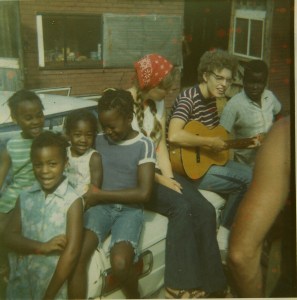
We made dinner and then everyone wanted Brenda to play the guitar so we could sing. We sat on the car with the kids and sang for hours.

Singing with kids


We went to bed about 10 pm and then the night began. The black crew’s kitchen was in the same building that the white crew lived in. What separated the two rooms was a partial wall with a bit of screening above that. The white men were drinking and pretty soon were quite drunk. There was a lot of daring and betting going on and it really scared us. “They want to see what a migrant camp is like? Let’s show them what a migrant camp is like.” We had a few visitors that night, but were able to get them to leave by talking fast and shaming them. Luckily for us, they were mostly talkers, and a few of them were on our side. By 2:00 am they had given up. We slept for a while and then picked fruit the next day, earning $4 apiece.

We stopped at 1 pm and then drove to the post office in Greenville. Our checks from Ft. Valley were there. We were able to cash them by finding a minister who was willing to co-sign for us.

To prevent a repeat of the previous night, we had arranged with Leroy’s wife to lock the kitchen door from the outside and keep the key. Since we had received our checks, we planned to leave the next day.

The whites treated the blacks worse here than any place we’d been. As I mentioned, there was a white crew and a black crew. They were not allowed to mix with each other in the fields. The black workers got paid even less than we did, even though they had much more experience. The white crew had access to toilets, the black crew and their families used outhouses. The white men kept the black men up all night forcing them to do whatever they wanted. Black women were taken and used at the whim of white men. It was really ugly.

[Note: As I typed this story from the scrapbook, I was really struck with the difference in the content of the sentences in the last paragraph and Leroy’s assurance that there would no problems coming their way due to us staying in the camp. If I’m remembering right, the black men in this camp kept their distance from us, i.e. they did not interact with us. I don’t think it would have been safe for them to even speak with us. My guess is that Leroy, as crew boss, had privileges that the other men didn’t have.]

We sang again that night. This time we sang a lot of spirituals and folk songs and the people from the camp sang with us. We were having a good time; a little girl was brushing my hair. Then at 11 pm we heard a voice, turned around, and found three policemen standing behind us. One said, “We have orders from Mr. Robinson to get you off of his land.” I couldn’t believe it. We talked with them for a while but got nowhere.

I was upset, mad, furious, angry and not too happy. We couldn’t understand why Mr. Robinson hadn’t said anything to us when he saw us during the day, or why he had waited until 11 o’clock at night to throw us out. The people were as upset as we were. Leroy was there with shaving lotion all over his face and a razor in his hand. We said a lot of sad goodbyes and then left. As we were driving away, we asked the police if we could go the packing shed and talk to the owner if he was still there. (The shed was only two minutes away.) They were okay with us doing that.

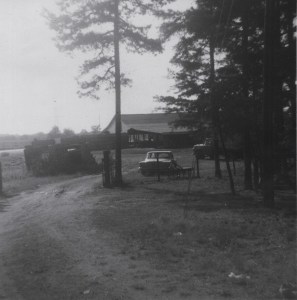
Packing Shed
Packing Shed

When we arrived at the shed, we discovered that four of the crew members, three black and one white, were already there. The two crews had signed on for the whole season, but they were telling the owner that if he kicked us out at that time at night, by morning his camp would be empty. We were so surprised!

We talked to Mr. Robinson also. It was clear he didn’t believe it was safe for us to stay in the camp and he wouldn’t allow us to do so. We told him we were responsible for whatever happened and we felt perfectly safe. Since his crews had threatened to leave, he was under considerable pressure and finally gave in; he would let us stay until morning.

The policemen drove away. It would have been interesting to hear their thoughts about what had transpired that night.

The four of us and the representatives from the two crews triumphantly returned to the camp. It was obvious the people enjoyed us as much as we enjoyed them. We sure appreciated that they had intervened on our behalf. We sang for a while longer and then went to bed.

We had no further problems that night. The white men were noisy again, but they didn’t say a word about us.  The next morning we departed the camp, and before long left South Carolina behind.


(The next post in this series will be published on Friday December 25.)

To read the previous posts go to:

1970: My Summer as a Migrant Farm Laborer (Series Intro)
1970: My Summer as a Migrant Farm Laborer #1  (Seattle to Florida)
1970: My Summer as a Migrant Farm Laborer #2 (Atlanta International Pop Festival)
1970: My Summer as a Migrant Farm Laborer #3 (Working in Georgia)

Living and Learning in Amritapuri (Dec 14-17, 2015)

green flowers
Elephant, Dragonflies, Eagle

Lakshmi, one of the ashram elephants, has been out three times since I’ve been here. She is led into the courtyard by her trainers/attendants and the devotees, especially children, feed her. I love watching her take a whole clump of small bananas with her trunk and eat them all at once. These are some pictures of Lakshmi and Amma from 2011.

This morning during my Tai Chi class big dragonflies flew overhead. When I did some more Tai Chi in the evening, the eagles were soaring above us.  Both scenes were so beautiful.

Play Preparation

Play preparation is happening everywhere. Practices, creation of the set design, costumes, backdrops, slides in Malayalam and English, lighting, sound, all occurring simultaneously. I generally go to one of the practices each day.  So far they have been learning and reviewing one scene at a time.  Starting on Sunday they will be putting it all together.  It is so exciting.  From my room I can hear many of the practices I don’t attend.  In fact, at times I can hear the music even better from my room.  The sound goes up I guess.

I am spending more time sewing costumes than last week although I only work on them 2-3 hours a day compared to Jani and Sumati’s night and day work.

There is one part of the play I am very eager to tell you about but will wait and until after it is performed on Christmas Eve.

Leelas abound

It is amazing how I can “lose” as many things in this one room as I do in my house. For several days this week I was not able to find my iPhone cord (and was very thankful I sensed I should bring two cords to India, and did), the Fitbit gadget (I don’t know what it is called) I put into my laptop’s USB port, and some tweezers. I looked for them for days and took everything in this room apart several times. When I couldn’t find a receipt I needed on Tuesday, it felt like the “last straw.” Within minutes of reaching that level of frustration, I found the phone charger and the Fitbit piece in places I had looked for them many times.  They were practically in plain sight.  I also remembered where I put the receipt. No tweezers though.

This scenario felt like something we call Leela (God’s play). No other way of seeing it made sense to me.

Soon after I wrote this section yesterday, I noticed that my meal card and my time card for Amma’s darshan (hug) had disappeared from my wallet. I felt sooooo frustrated and tired of this kind of leela.   There will be more to this story later in the post.

[Note: Tokens are distributed to get Amma’s hug. It is a way to create some organization in the darshan process; there is no charge for the token.  Yesterday the tokens for Westerners were given to people who had just arrived at the ashram, were leaving soon, or were new devotees.  The rest of us who hoped to have darshan later were given time cards which would probably be exchanged for darshan tokens sometime in the evening.]

Journey to town

Yesterday, I had to go to town for a variety of reasons. Prior to 2006 when we went to town we had to take a canoe. When the tsunami hit in 2004 Amma transported everyone in the village and ashram to the mainland by boat because there was no nearby bridge. Over the next two years, the ashram built a bridge so people could get off the peninsula in an emergency. Having the bridge has also made it possible for us to walk to town whenever we want to go there.

ashram-01

The view from the bridge is gorgeous. This is what I saw when I went to town yesterday.

On the way back, I stopped at a shop and bought some fruit and crackers. The picture of the cashew crackers on the front of the box made them look so good. After I purchased them, someone asked what the ingredients list said. I took a look. No cashews at all! I imagine one of the “flavorings” that are mentioned on the ingredient list is something that tastes like cashews!

IMG_0444

I remember hearing this year in the U.S. that one fast food company, I think it was McDonalds, was going to start using more real food. The example that was given was that they were going to use real black pepper! I was perplexed. Why would anyone use fake black pepper?  It didn’t seem like black pepper would be an expensive ingredient, certainly not as expensive as cashews.

T-shirt

I saw a t-shirt I liked the other day.  On the back it said:

                                                                                               Love & Serve

                                                                                               Give & Forgive

                                                                                                            ~Amma

More Leelas

While leelas mean “God’s Play,” they don’t tend to be fun.  I see them as challenges, tests, lessons, etc.  They can lead to an emotional roller coaster.  Sometimes when one happens over and over like what I described above, all you can do is shake your head and laugh, and continue riding the wave, roller coaster, or whatever metaphor you want to use.

I felt sad after I lost my time card.  I knew the crowds would be really big starting this coming weekend, and I thought that last night would be the only time I would have a chance to go for Amma’s hug until just before I leave the ashram in January.  For the next couple of hours I looked for the man who was in charge of the tokens for Westerners.  I didn’t think he would replace the lost time card, but it never hurts to ask.  I never saw him, and it was getting late.  Even though it was only about 8 pm I was so tired.

I decided to go talk to my daughter Chaitanya and see if she had any advice.  She has nothing to do with tokens in India but she is one of the people in charge of them on the foreign tours so I thought she might have an idea.  I really wanted to go for darshan that night.  As we were talking, Chaitanya glanced out of the cafe window and saw that the token person was standing right there!  She asked him if he was going to be able to hand out more tokens that night and he said only to people who had just arrived or were leaving.  I told him I had lost my time card.  He said “Oh, you had a time card?  Here, you can have the last of the ‘regular’ darshan tokens!”  I was happy and relieved.  I could have my hug, and the leela was over, maybe.

For the next hour or so I waited in the line and got my time with Amma.  So nice.  I felt content and headed for my room.  As I got near the elevator, I looked for the key to my room and discovered it was gone.  That was another one of those shaking my head times.  To me these experiences are practice in staying calm, going with the flow, being patient, being persistent, letting go, and/or learning to do whatever it takes.  I reviewed where the key could possibly be.  I had locked the room when I left it and put the key in my bag.  The only thing that made sense was that I must have dropped the key when I pulled my wallet out of the bag to buy some fruit to give Amma during my darshan.  I walked back to that table and found the people who staffed it in the last stages of putting everything away.  I asked the woman if she had found a key and she handed my key to me!  I was very thankful that the leela was short lived.

This morning, I discovered this set of leelas still aren’t done, which is no surprise.  I had not gone to the morning prayers the day before, so forced myself to get out of bed for them this morning.  When I was ready to leave my room for the temple, I discovered my chanting book was not in the place I leave it EVERY day when I return from the prayers. I quickly looked around the room and it was nowhere to be found.  Did I drop it when I came back from the prayers two days ago?  Or will it show up out of nowhere like the other items? Who knows.

The only chanting book I could find was a copy I have that is written in Devanagari script (Sanskrit).  By then I was so late for the prayers that there was no way I was going to find where they were in the book, particularly when I would be reading it in Sanskrit script.  I haven’t studied any Sanskrit since I’ve been here so thought maybe I was supposed to be working on that.  I stayed in my room and read the chant from that book, slowly, until the people in the temple were finished with the morning prayers.  Looks like it is going to be another day of challenge.  Oh…. and I found the lost tweezers within a minute of finding out I had lost the chanting book!

“I will accept each challenge as it comes and will learn and grow as a result.”

“I will accept each challenge as it comes and will learn and grow as a result.”

“I will accept each challenge as it comes and will learn and grow as a result.”

“I will accept each challenge as it comes and will learn and grow as a result.”

“I will accept each challenge as it comes and will learn and grow as a result.”

“I will accept each challenge as it comes and will learn and grow as a result.”

To see the earlier posts in this series go to: https://livinglearningandlettinggo.wordpress.com/india/