


Posted for Weekly Photo Challenge: Orange

Posted for Weekly Photo Challenge: Orange
Today was one of those days where I had “plans” but all of them changed.
It started with me waking up at 1:45 a.m. I had been dreaming about Sanskrit and about blogging, something that is happening with increasing frequency, but thankfully it is not usually that early. As I moved from a dream state into a more conscious state of mind, the idea of posting a Sanskrit declension matrix by making a Power Point slide show came to my mind. Then the idea of adding audio to it surfaced.
I have helped others with Power Point slide shows before but only by typing in the words. I had never done a real one and I certainly had never put audio to one. As I lay there sleepless, I started pondering how to do it. Around 3:00 a.m., since sleep didn’t seem to be coming, I got up.
I went back to bed for about an hour and a half at 5:00 a.m. and then spent most of the day working on this project. The slide show went together quickly and even the audio was reasonably easy to figure out. But then came getting correct pronunciation, correct timing and most time consuming of all, finding a way to put it into a format that the blog would accept. That last part took until 7:45 tonight! But with Grace and persistance, I finished it!
I’ve mentioned in earlier posts that every noun in Sanskrit may have 7 or 8 different cases. You can identify those cases by how the word ends.
Cases:
1st case is the subject
2nd case is the object
3rd case – “with” (with a fork)
4th case- “for” (for the beggar)
5th case- “from” (from the city)
6th case- possessive or “of” (boy’s; of the boy)
7th case- “in, at, on”
The slide show will present the declensions for the pronoun “aham” which means “I”. Singular, dual (2 people) and plural (i.e. three or more) forms will be presented for each of the seven cases. You will notice that some of the words are the same but have different meanings. In those instances, we have to read the word in a sentence to determine the meaning.
So with that for an introduction, here is my PowerPoint Slide Show with Audio of the declensions for the word “aham”! (In hindsight, it would have been helpful for me to put the case number and whether the word was singular, dual or plural on the slides, but even this way it gives you a good idea what the process is like!) I hope you enjoy it.
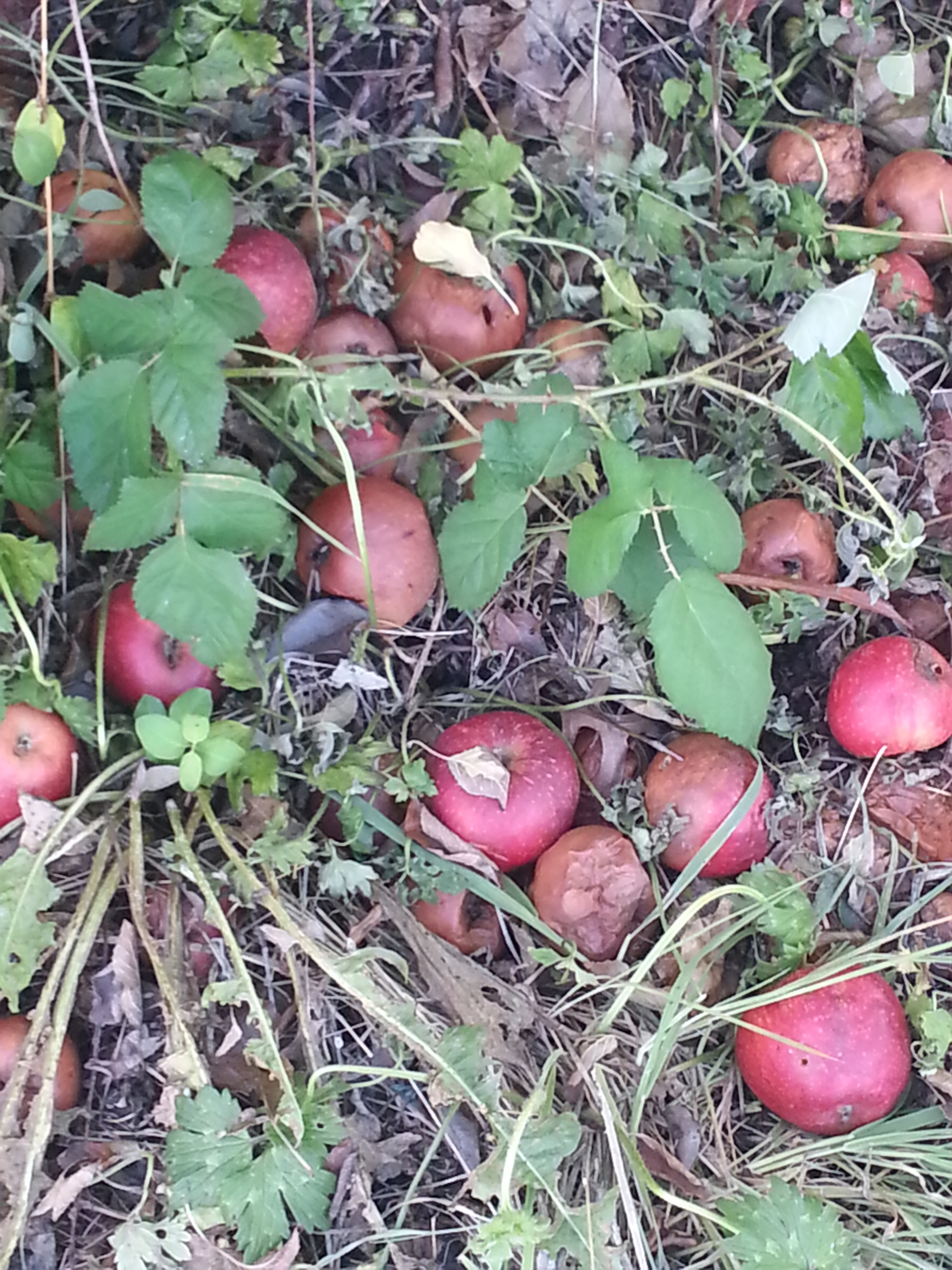
On a morning walk several weeks ago, I passed by a number of homes where the ground under fruit trees was covered with rotting fruit. Seeing the apples reminded me of a post I wrote in August. At that time, The Daily Post challenge had been to identify what we considered to be the 8th Cardinal Sin. I decided to add “Wasting Food” to the 7 Cardinal Sins from the Bible. (See The Eighth Cardinal Sin: Wasting Food)
In doing the research for that post, I learned that in 2012, the National Resources Defense Council (NRDC) of the United States concluded that the U.S. wastes 40 percent of its food. My response to the challenge reviewed many of the ways we waste food in this country. When I saw the rotten apples, I realized I should also consider letting the fruit and vegetables in our gardens rot as a form of wasting food. After all, if we don’t need the produce, we could give it to individuals and families in need or to organizations such as missions and/or food banks.
Earlier this summer, I had considered sending a note to neighbors reminding them that the food banks welcome garden fruit and vegetables but I never did it. I regret not having followed through on that impulse.
A few days go, I discovered in Seattle we have a group called City Fruit. Their website states:
City Fruit promotes the cultivation of urban fruit in order to nourish people, build community and protect the climate. We help tree owners grow healthy fruit, provide assistance in harvesting and preserving fruit, promote the sharing of extra fruit, and work to protect urban fruit trees.
Since 2008, City Fruit volunteers have harvested and donated more than 80,000 pounds of fruit (24,000 pounds were harvested in this year alone). This is definitely a group I could tell my neighbors about next year.
The spiritual group I belong to feeds the homeless in Seattle once or twice a month. That project is called “Mother’s Kitchen.” In August, one of our members decided to plant a garden dedicated to Mother’s Kitchen so that the people we serve would be eating more organic produce. She also asked us to donate vegetables from our gardens. I did not have a very good harvest this year so did not donate anything.
I pledge to those of you who are reading this, that next year I will inform neighbors of places that would welcome their unwanted fruit and vegetables and will do a better job of not wasting garden produce myself. I will continue to give extra produce to family members and friends, but will also share what I have grown with food banks and Mother’s Kitchen.
How do you, or will you, prevent vegetable and fruit wastage in your gardens?
Today is packed with “must do” events for me. I have little to no time to write, but when I saw The Daily Post challenge in my inbox, I knew I had to make the time. The prompt is:
Remember the seven cardinal sins? You’re given the serious task of adding a new one to the list — another trait or behavior you find particularly unacceptable, for whatever reason. What’s sin #8 for you? Why?
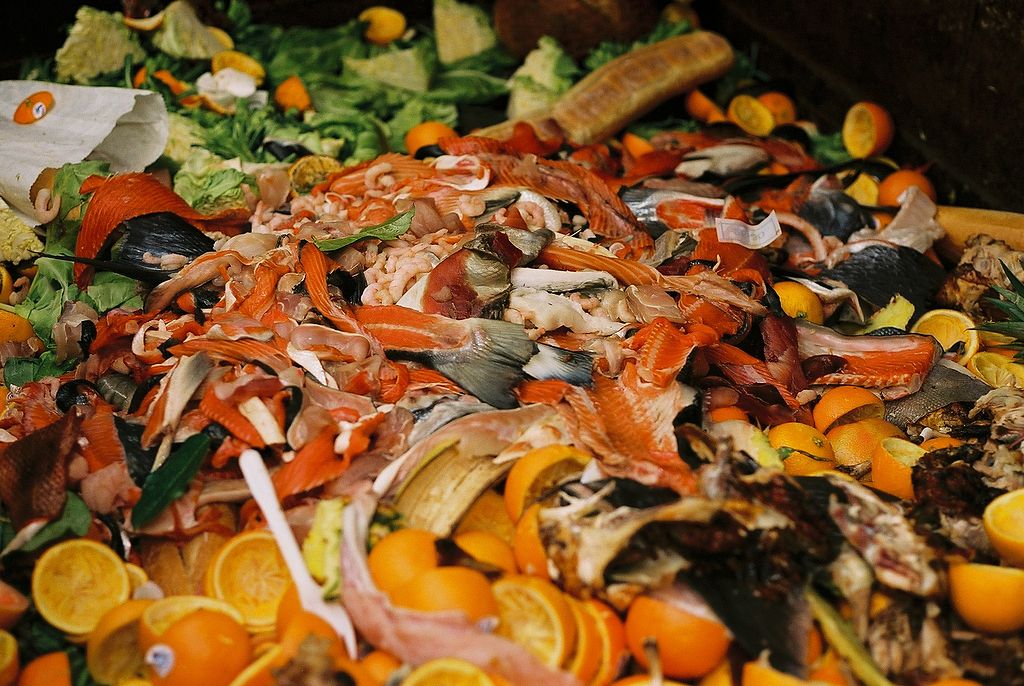
The seven cardinal sins listed in the Bible are: wrath, avarice, sloth, pride, lust, envy and gluttony. So what would I consider to be the eighth cardinal sin? I knew my answer immediately. For me, it is to waste food when so many people in the world go hungry.
In 2012 the National Resources Defense Council (NRDC) of the United States concluded that the U.S. wastes 40% of its food. That waste is valued at 165 billion US dollars.
(Please see the report for much more detailed information as well as the original sources for the statistics.)
Solving the problem
The NRDC report lays out solutions for all of the problems. For this post, I’m going to focus on some things that each of us can address personally.
The report comments that Americans discard 10 times as much food as the average South Asian. I imagine we waste more food than that most, or maybe all, other countries.
Many of us grew up with parents demanding that we eat our food because of the starving kids in China. As a result, many members of my generation tuned that message out and disregard the fact that there is some truth to that way of thinking. I believe it is important for us to become responsible citizens of the world.
That does not mean we should force ourselves or our children to eat when we/they aren’t hungry. It is also not about shaming people into cleaning their plates. Instead I think we should focus on how much we buy, how much we cook, and how much we put on our plates. Children will be more likely to finish their food if they are given a small portion. They can always ask for more if they want more. That is true for adults as well.
We can also compost leftover food. In Seattle we are able to compost all foods, even diary and meat products through the city system. That service is not available everywhere of course but most of us can compost our vegetables and other non-meat, non-dairy foods at home. By doing that we will create rich soil compost for our gardens.
I believe it is important for all of us to take personal responsibility for helping to solve this problem. What ways do you prevent food wastage in your home? Are there any new commitments you are willing to make to reduce your food wastage in the future?
*****

1. I learn from every mistake.
2. Change is a necessary and important part of living.
3. I honor my growth.
4. I treat myself and others with respect.
5. The old lessons were for then. It is time for me to move on. Continue reading “23 Affirmations for Letting Go”
The Art and Craft of Blogging
A collection of discussions on the environmental issues
“The fool doth think he is wise, but the wise man knows himself to be a fool.” “Love all, trust a few, do wrong to none.” “Love looks not with the eyes, but with the mind, And therefore is winged Cupid painted blind.”-William Shakespeare
...moments of unexpected clarity
Home of Lukas Kondraciuk Photography
Wellness, Support and Mindset
Thoughts on Creativity & Deeper Things
A Blog by Novella Carpenter
Ramblings of an Irish ecologist and gardener
Teaching the art of composition for photography.
Blog from SathyaSaiMemories ~ stories of love in action and the benefits of giving
There are 11,507 stories in Haddonfield; this is one of them.
Perennial gardening and more from the Green Mountains of Vermont
Whatever it will be...
Welcome to my little slice of the blogosphere
 Living, Learning and Letting Go