Greenbelt Restoration: Planting Time is A-Coming

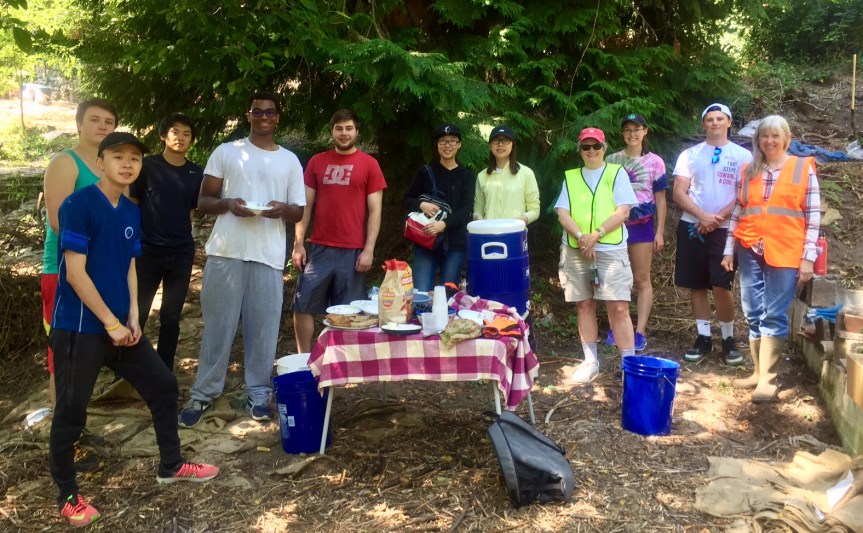
On October 22, our GreenFriends group planted 37 trees in our Greenbelt Restoration site (Tree Planting Day). That was a major development in this project, and another one is coming soon. On November 15, a corporate group from DocuSign will be planting more than 330 shrubs and ground covers for us. We’ve been busy preparing for that day.

Our fall plant order was submitted to the Seattle Parks Department in early May.  The plants would be delivered the end of October or early November. Prior to then we  needed to decide where to plant each of the plants. I identified eight planting sites and marked them with green and white or yellow and black tape. Then Ananya and I created a planting plan.

In June, I had taken a plant identification course. During the course, the instructor mentioned that when the plants were delivered, they would not be marked. I panicked. How would I be able to identify 360 plants when I only knew a few of them? To make matters worse, by that time we received them many would be in their winter state and might not even have leaves. I calmed myself down by reminding myself that we had been required to order everything in groups of 10 so I only had 26 different plants to identify. I didn’t know how I would do that either, but it definitely seemed more doable than 360. I also knew I could ask for help if I needed it.

As the date drew closer, I made a label for each plant, writing the name of the plant and how big it will get on each of the sticks.

It was possible that our plants wouldn’t be delivered until the second week in November. Since our planting day was scheduled for November 15, I was nervous about how I would do all that needed to be done to identify and mark the plants before that date. I was ecstatic when I looked out my window late in October and saw a Seattle Parks Department truck in front of my house. The plants had arrived!

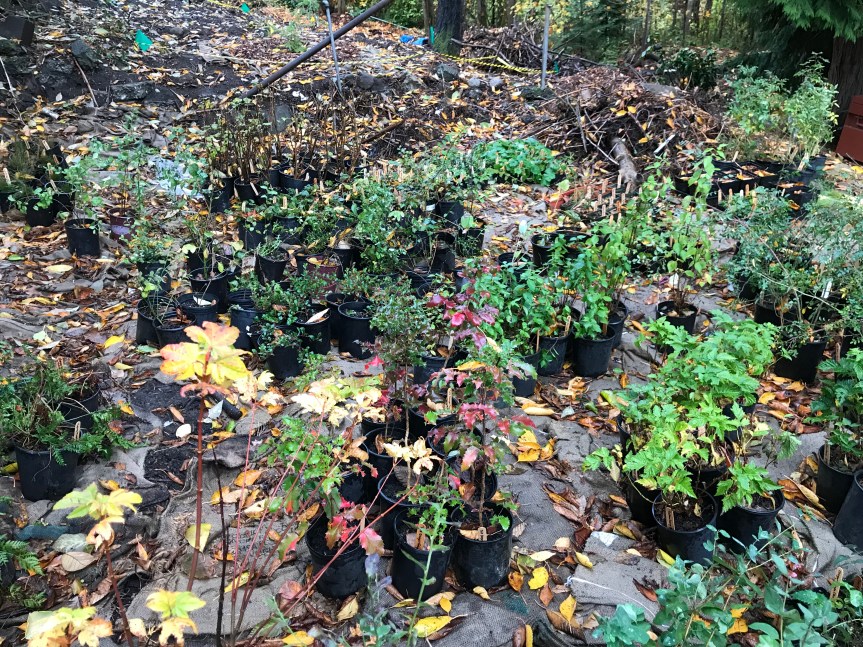
As I had been forewarned, the plants were unmarked. To further complicate things, they were carried into the Greenbelt by hand and/or in a wheelbarrow. Some remained in their groupings but many were placed on the ground randomly. When the delivery crew left, I started to sort them. I discovered that I was able to identify quite a few of the plants. When I knew what the plant was, I placed the appropriate stick in the pot.
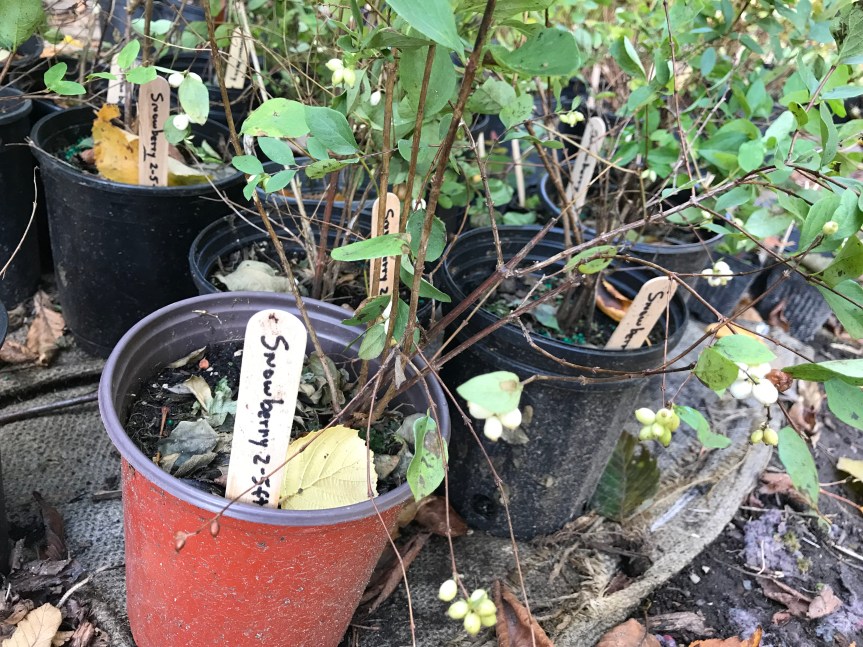
I doubted some of my identifications. Jayanand, a friend who lives on the Olympic Peninsula, came to mind.  I knew Jayanand had worked for 18 years as a botanist and ecologist for the National Park Service. I sent photos of the plants I was concerned about to him. He was able to correct some of my mistakes as well as identify some that I hadn’t been able to figure out. With his help, it wasn’t long before all of the plants were labeled.
Today (November 11)  we had a big work party to finish preparing the land for the November 15 planting. It was a wonderful work party, one that I will tell you about in my next post!
Greenbelt Restoration Work Party: October 1, 2017

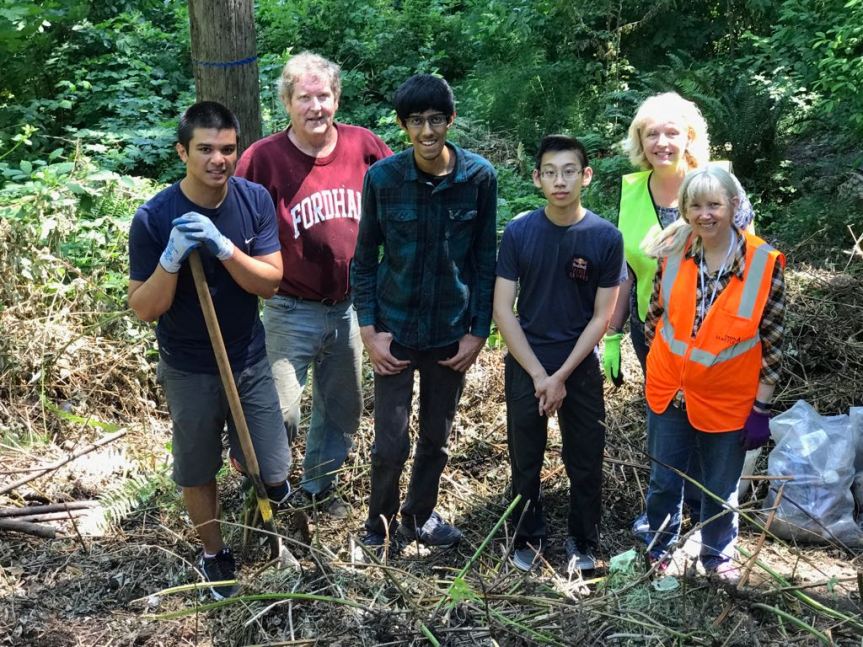
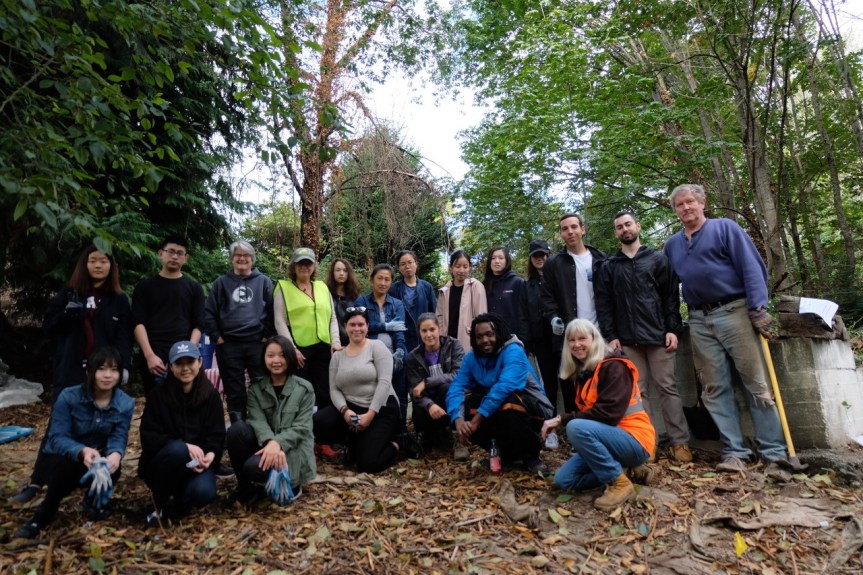
On October 1, we held our first forest restoration work party since the end of July. Participants included five members of our GreenFriends group, twelve students from the Introduction to Environmental Science class at the University of Washington, a neighbor, a high school student, a Green Seattle Partnership Forest Steward and two other Seattle residents.

In less than three hours, we …

removed blackberry, bindweed and ivy vines and dug out blackberry root balls from 2050 sq ft of property that had previously been cleared…

cleared 750 sq ft of land for the first time… Continue reading “Greenbelt Restoration Work Party: October 1, 2017”

Greenbelt Restoration Work Party: July 9

It seems like I think every work party we have is the best. That was true on this day too. Eight students from the University of Washington’s Introduction to Environmental Science class, one student from Garfield High School, one neighbor and three GreenFriends members came together to do restoration work in the Greenbelt.

We cut blackberry vines, dug out blackberry root balls and bindweed (morning glory vines)

(click on any of the galleries if you want to enlarge the photos)

…. picked up trash

…. freed ferns

…. carried wood chips from a pile near 25th Avenue S and S Hanford, down the Hanford stairs, into the Greenbelt and scattered them in an area that will be used for a 250 square foot cluster of trees, shrubs and ground covers when we start to plant in the fall. Having the wood chips there will facilitate decomposition of the burlap bags that are under it and help to build the soil by creating mulch.

…. and moved debris to the rack zone to dry.

Vandya, Ellen, John and I organized the work party and led work groups. Vandya and I also took photos. At one point, we snapped pictures of each other taking photos!

During the three hour work party we cleared a lot of land. The next step will be to spread burlap bags to prevent erosion and weed growth.

One group dug out the biggest root ball we’ve found!

Needless to say, our July 9 work party was a big success.

Greenbelt Restoration Project: July 2 Work Party

Seattle Parks Department cut down a new area of blackberries on our site mid-June. Since that time, my neighbor John has put in a tremendous amount of time raking up the debris and digging up the blackberry root balls. Last weekend, 9 volunteers picked up trash, laid  burlap on the areas that had been cleared (to minimize new weed growth), and dug out root balls. It is amazing how much can be accomplished in a short period of time when we all work together.

This work party was particularly exciting because three members of our newly formed AYUDH chapter participated. Some of their parents came too.

AYUDH is an international youth movement established by Amma. Members are 15-30 years of age.The acronym stands for Amrita Yuva Dharma Dhara which means “….the youth which perpetuates the wheel of dharma (righteousness).” The organization “seeks to empower the youth to integrate universal values into their daily lives. Starting with themselves, AYUDH helps establish a future of hope, peace and social engagement while maintaining an awareness of spiritual principles.”

This month we are holding work parties on July 2, 9, 16 and 23. There are already 13 people signed up for the 9th! I believe that six of them are students from the University of Washington’s Introduction to Environmental Science class.

Who Would Have Thought That I Would Be…..

The Seattle Parks Department gave our Greenbelt Restoration Project a job box that contains the tools we need to clear the land in our Greenbelt restoration site. That box is chained to one of the large cedar trees on the property.

Several weeks ago, I noticed that an animal was defecating near the base of that tree. Over the week, the pile grew. I wondered if a cat was using that spot for its personal litter box. I thought about cleaning it up but didn’t.

One day, another forest steward noticed the pile and commented. She thought it had been left by something bigger than a cat and wondered if it was droppings from a deer. Earlier in the week, someone had asked me if we had ever seen deer on the site. I said “No.” I loved the idea but wonder if deer could live in the inner city and stay safe.

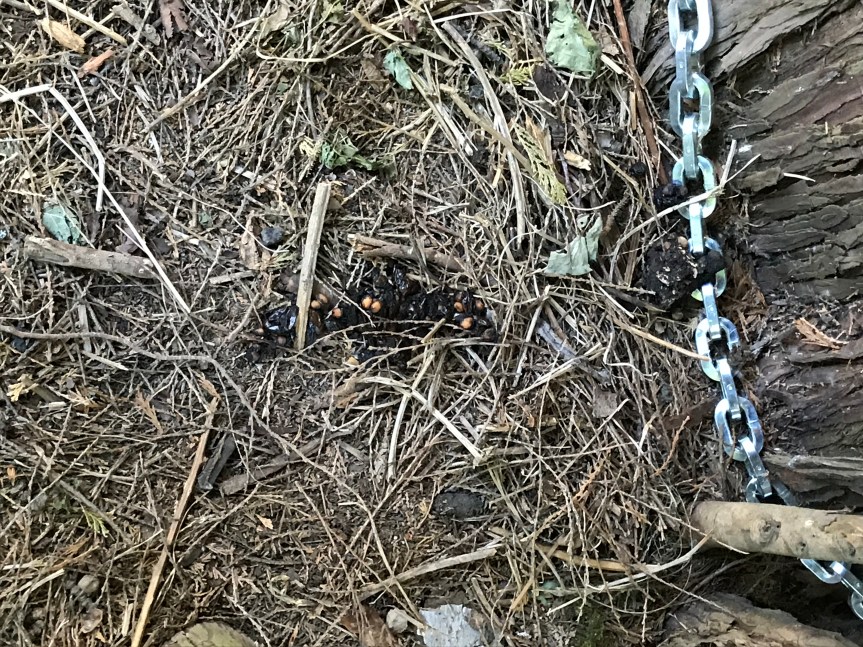
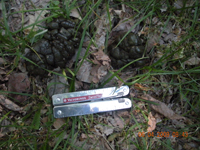
After this interaction, it occurred to me that not only was the poop pile unsightly, it was also disrespectful to the tree. I cleaned it up and buried the feces. The next morning, there were two more piles. One had an unusual consistency and I wondered if the animal had diarrhea. (The two photos below were taken a day later so the feces were no longer fresh.)

Aside from being irritated that my effort to clean the area hadn’t done any good, I was curious. I wanted to find out what animal was leaving these droppings. It was time to investigate.

I found a Scat ID section on the Internet Center for Wildlife Damage Management (ICWDM) website. ICWDM is “a non-profit, grant-funded site that provides research-based information on how to handle wildlife damage problems responsibly.” (The next series of photos were used with ICWDM’s permission.)

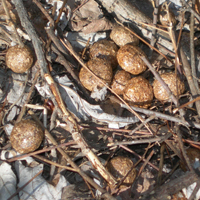
Black bear
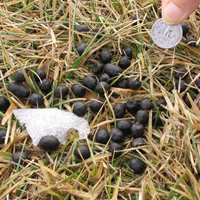
Rabbit droppings.
Deer (winter)
Deer
Raccoon

The description offered by the ICWDM said:

Raccoon (Procyon lotor): Droppings are 2 to 3 inches long and 1/2 inch wide. You often can identify what a raccoon recently has been eating. Corn kernels or fruit may be visible, for example. Droppings frequently are found in piles, called latrines, on roofs, in attics, in sandboxes, or open areas. Raccoons defecate in the same location.

Ah ha….. I hadn’t noticed anything peculiar about the first droppings but the last set were full of seeds/pits. Since there are big cherry trees on the property, and the cherry’s are ripe and falling, the animal had more than likely been eating cherries. My conclusion was that the pile was probably left by a raccoon, possibly a raccoon with diarrhea from eating too many cherries!

Realizing that the animal may have been a raccoon brought back memories; memories of standing on the land that is now Greenbelt, holding Sreejit as an infant, with a raccoon chasing our dog around and around me; memories of coming out to the tree-house that I had slept in April to October for five years only to find two big raccoons standing on their hind legs between me and it (that was the end of my sleeping in the tree house); memories of four raccoons, which are usually nocturnal, crossing my yard in broad daylight.

I haven’t seen a raccoon in this area for a decade. I like the idea of them, along with other wildlife, returning to the Greenbelt, but I hope that their activity is at night. And I’m glad that this land has mostly been cleared so it is likely they would choose a less visible site to sleep. Regardless, I am clearly being presented with the opportunity to work on my past fear.

Back to the story at hand…. scat, feces, poop, defecation, droppings…

Who would have thought that I would ever be investigating and blogging about “poop.” My life has taken an interesting turn… and I love it!

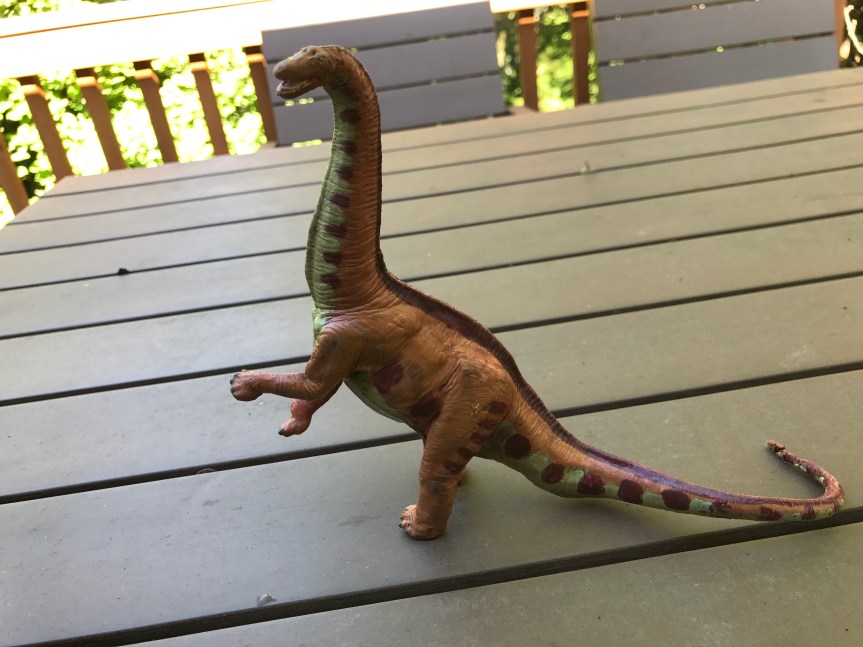
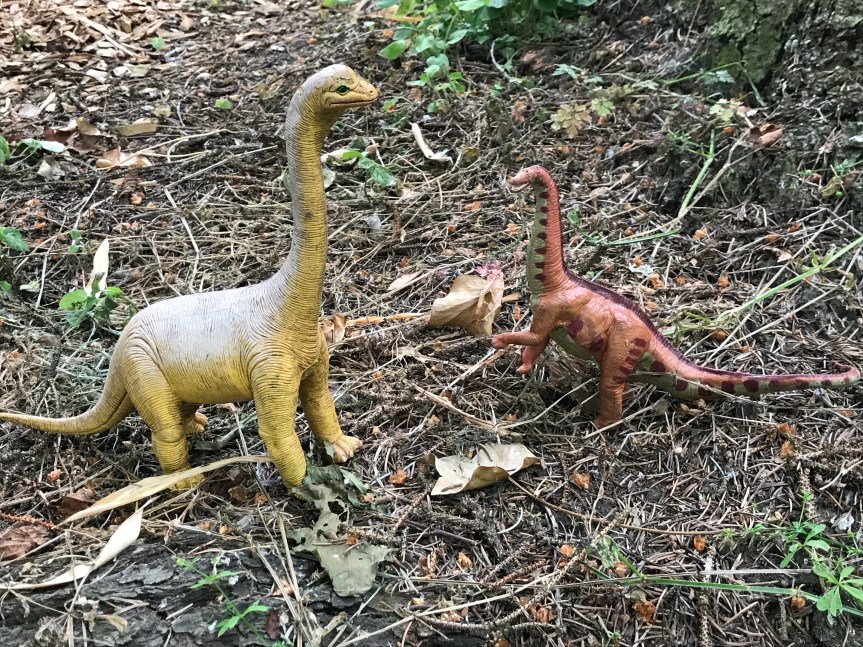
Found in the Greenbelt: Another Dinosaur!

Perhaps they are playing hide and seek, dashing from one place to the next!

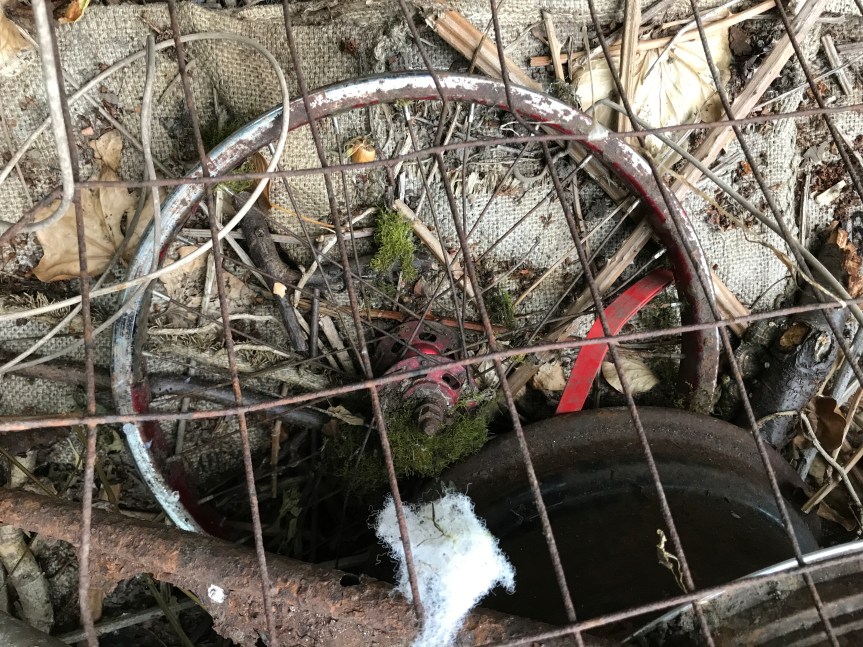
Daily Prompt: Wheel

We have found many wheels during our Greenbelt restoration work. I am glad I took photos of some of them.


Wheel

The Before in “Before and After”

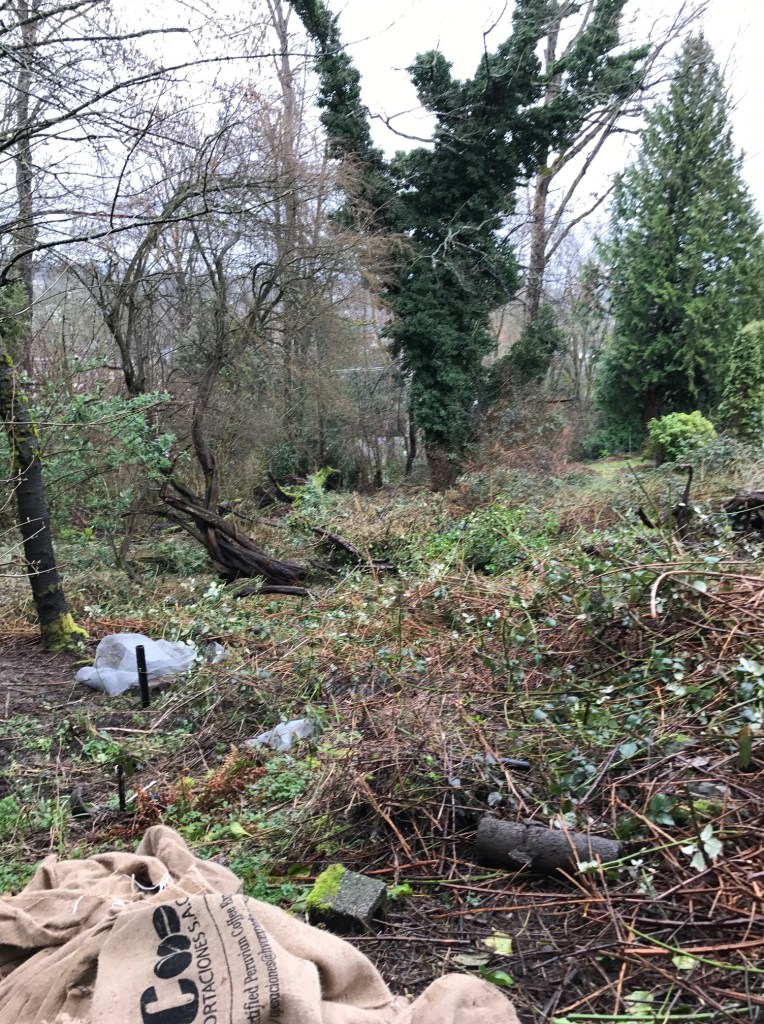
My neighbor Christine gave me these photographs a day or two ago. She took them in March after Seattle Parks Department staff cut down most of the blackberry vines on the Greenbelt lots we are restoring. I look forward to using it as a “Before” photo in November after we’ve cleared the land and planted new trees, shrubs and ground covers. And I also look forward to comparing them with the photos we will take every spring, summer, fall and winter from now on.

This one will also become a good “Before” shot.

Greenbelt Restoration Work Party: June 14

For three hours on June 14, eight volunteers worked diligently in our Greenbelt restoration site. A week before, Seattle Parks Department staff had cut down a large area of blackberry vines, leaving a lot of debris and uncovering an astonishing amount of trash.

We spent the first hour of the work party picking up trash. There is more garbage for us to pick up, but we got a good start on it.

When we began this project, there were two fields of invasive bamboo on this site. Seattle Parks Department cut the bamboo down last March. We placed the cut bamboo on drying racks so that they didn’t re-root. That bamboo is now dry.

On Wednesday, we stripped the branches from the dried bamboo canes. The canes were given away to gardeners and the branches are being used as part of our newest drying racks. (I will write a post about the drying racks soon.)

We also removed blackberry vines from plants and trees…

…. and rescued ferns and a fringe cup plant.

It was another productive and rewarding day in the Greenbelt!

Interesting Facts about Ferns

One part of our Greenbelt restoration site has so many ferns. I decided to read some articles about ferns and was fascinated by what I learned.

  • Ferns have been on earth for 360 million years.
  • The type of ferns we see now have been here for 45-50 million years.
  • Dinosaurs ate ferns, conifers, cycads and mosses.
  • Ferns were on earth 200 million years before flowers.
  • Ferns are helpful in preventing or eliminating pollution because they remove heavy metals from the air and the soil.
  • Today’s ferns are not edible because of toxicity. [Note: Maybe that is because of the heavy metal mentioned above.]
  • Some ferns have a life span of 100 years.
  • The height of ferns ranges from 2 inches to 30 feet.
  • Compressed ferns turned into fossil fuel and became the basis for oil, gas and oil.
  • Ferns reproduce from spores. They don’t have seeds or flowers.
  • There are at least 12,000 types of ferns on earth today. There may be up to 20,000 different species.
  • In North America there are 441 varieties of native ferns.
  • Ferns are vascular, circulating water and nutrients through their veins.
  • In the past, there were people who believed if they ate ferns they would become invisible. Still others believed ferns protected them against goblins and witches.

When I took this photo today, I imagined dinosaurs walking through this forest. Doing that reminded me of the Jurassic Park movies!

You can learn more about ferns from the articles below:

About Ferns

Fern

Fern Facts (Casa Flora)

Fern Facts (Soft Schools)

Five Fun Fern Facts

________

Daily Prompt: Taper