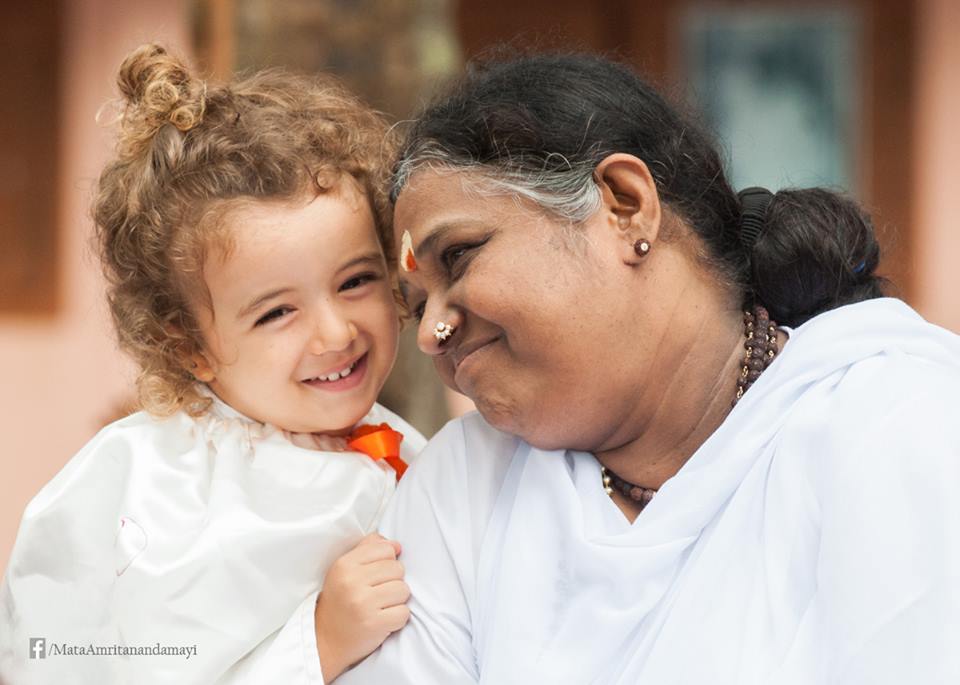
I would rather be…
letting go in Amma’s arms
awakening comes
Written for Dungeon Prompts: I’d Rather Be….

I would rather be…
letting go in Amma’s arms
awakening comes
Written for Dungeon Prompts: I’d Rather Be….

When I met Amma in 1989, I didn’t know anything about Eastern spirituality and I had never heard of Sanskrit. Months later, I attended a one or two day workshop focused on learning the sounds of the Sanskrit letters. I have no memory of where I heard about the workshop or why I went. I do remember one other Amma devotee there, so maybe he invited me to go, or perhaps a group of devotees attended. Many of the bhajans (devotional songs) Amma sings are in Sanskrit so it may be I wanted to learn to pronounce the words of the songs correctly.

The workshop leader, Vyaas Houston, taught us the sounds of the letters through music; i.e. we sang the alphabet! He told us that by the end of the workshop few, if any, of us would be able to sing the whole piece by ourselves, but as a group we would sing it well. He was right. I thought it was a powerful display of the power of group process.
My writing the first two paragraphs of this post brought back another memory of that time. In the first weeks after I met Amma, I bought a cassette tape at East-West Bookstore. It was called Jai Ma. When I played the tape the first time, I had an experience that astounded me. As I listened to one song, I burst into tears. During the next song, my body flooded with joy. Yet another tune filled me with peace. How could that be? After all, the songs were in Sanskrit and I had no idea what the words meant.
Later, when I told one of my co-therapists what had happened he responded, “Of course, in Sanskrit the feelings are imbedded in the sounds.” This therapist was very logical and science oriented, as opposed to being interested in spirituality, yet he said this in such a matter-of-fact way. I was intrigued, but not enough to start in-depth study of Sanskrit.

After the weekend workshop, I made flashcards to teach myself the meaning of some of the Sanskrit bhajans. I also wanted to learn Malayalam, Amma’s language, so even though the word on the flashcard above is Sanskrit, the letters are in Malayalam script. (The meaning of the word is on the other side of the card.) Over the years, I attempted to learn Malayalam several times but without a teacher it seemed impossible. I didn’t make any significant progress so eventually gave up the endeavor.
Amma has always worked to bring back India’s traditions, e.g. traditional dances, traditional music, traditional values. There was a period when Amma started encouraging the ashram residents to learn Sanskrit. I remember a time about five years ago when Amma asked some of the brahmacharinis (female monks) to stand up and speak to everyone present in Sanskrit. Amma looked so happy as she listened to them talk.
Watching Amma’s joy piqued my interest in Sanskrit again, but I knew learning on my own wouldn’t work well. In 2011 my desire began to grow. When I went to Amritapuri in November of 2011 for my annual visit to Amma’s main ashram in India, one of the first things I saw was a friend of mine, Meenamba, sitting by herself studying Sanskrit! I sat down beside her and told her I also wanted to learn. She offered to give me the books she used when she first started learning the language.
Soon thereafter, I received a group email from a devotee in Seattle named Madhavi. She was offering to teach our satsang (a group of Amma devotees) how to say and understand the Sri Lalitha Sahasranama Strotram, a spiritual text Amma asks us to chant daily. I had met Madhavi before but she was new to our satsang so I didn’t know anything about her.
Her email certainly caught my attention. I responded, commenting that learning to read the chant was not my goal; I wanted to learn spoken Sanskrit! I asked if she would be willing to correct my homework as I worked my way through the books I had been given.
Madhavi replied that she had been teaching spoken Sanskrit for seven years! She said I could learn the letters and their sounds in the class she had advertised, and that she was willing to expand the curriculum so that those of us who were interested in learning spoken Sanskrit could do so. I marveled at the synchronicity of all that was occurring. This was certainly a major turning point in my Sanskrit journey

Madhavi’s class started in February of 2012 and I have been studying Sanskrit with her ever since. That first summer I also took a Samskrita Bharati three-day intensive, and did that again in 2013 and 2014. While Madhavi’s classes focused on reading, writing, and grammar, Samsrkita Bharati’s classes focused exclusively on spoken Sanskrit. In fact, that group resists speaking any English during the summer camp and they also discourage students from taking written notes. Luckily, they were willing to relax the rules a little with me since I need some things clarified in English. But each year I attend the camp I can see my progress.
When I went India in November of 2012, I studied with Meenamba for a month. During Amma’s Seattle programs in the summer of 2013, members of Madhavi’s Sanskrit class went together to receive Amma’s blessing. In November 2013, I attended Meenamba’s Sanskrit class during my visit to Amritapuri and just before I returned to Seattle we also went as a group to be blessed by Amma. That time each of the students said a sentence in Sanskrit to her! Amma beamed.
In May of 2014, our Seattle Sanskrit class organized and performed a skit in Sanskrit for Amma. That autumn, I started attending a weekly Samskrita Bharati class as well as Madhavi’s class. All but two students in the new class were Indian. The Indian students learn so much faster than I can. That is largely due to the fact that their native languages contain a lot of Sanskrit words so vocabulary isn’t as much a problem for them as it is for me. I found that I had learned enough of the fundamentals of Sanskrit in Madhavi’s class though, so that even if I still couldn’t understand conversations in Sanskrit, I could usually understand what was being taught. I’ve had to learn to be patient with myself and be okay with what I can and cannot do. But I do see myself moving forward and that is what is most important.
Last winter, a brahmachari (male monk) was teaching a Sanskrit class when I came to Amritapuri so I attended his class. I appreciate how each of my instructors have used a different style of teaching. I have learned so much by experiencing the various styles.
As Amma’s 2015 summer tour approached, I decided I wanted to again speak to Amma in Sanskrit, but this time I wanted to say more than a solitary sentence! I had the opportunity to do that last Thursday when I attended her programs in Dallas. Speaking Sanskrit, I thanked Amma for the new satsang that recently formed in the Seattle area. I told her I was very happy there and that I was leading bhajans every week. I added that I loved studying Sanskrit and asked her to help me learn to speak it. Her smile got bigger with every sentence I uttered, which of course filled me with joy!
I believe this week has been yet another turning point on my Sanskrit journey. I think this will be the year that I will be able to build my vocabulary enough to finally be able to participate, at least to a limited degree, in Sanskrit conversations. I am excited and ready to do whatever it takes to make that happen!
Written for Dungeon Prompts: The Turning Point
Living and learning that is our task
Each encounter, removing the masks
There are no shortcuts, no easy way
To live life’s journey, day after day
Instruction manual? That would be nice
Not possible? Then here’s some advice
Gripping your plans with hands of steel
Gives pain, misery, endless ordeals
Open your hand, the path to reveal
As I wrote the acrostic, I remembered a poem that I have loved for decades. The author is unknown.
I asked God for strength that I might achieve.
I was made weak that I might learn humbly to obey.I asked for health that I might do greater things.
I was given infirmity that I might do better things.I asked for riches that I might be happy.
I was given poverty that I might be wise.I asked for power that I might have the praise of men.
I was given weakness that I might feel the need of God.I asked for all things that I might enjoy life.
I was given life that I might enjoy all things.I got nothing that I asked for, but everything I hoped for.
Almost despite myself, my unspoken prayers were answered.I am, among all men, most richly blessed.
Written for this week’s Dungeon Prompt.
Today, I saw a cartoon on Counseling TidBits that I loved. I asked Jane A Weiss, LCSW for permission to post it on my blog and she said “Yes.” Thank you Jane!
I hope you enjoy it as much as I did.

In this week’s Dungeon Prompt, Sreejit asks us to fill in the blank in this sentence: “I am a Recovering _________.” There was no doubt in my mind what the behavior would be for me. Using the Alcoholics Anonymous introduction, I will say: “Hi! I am Karuna, and I am a recovering over-doer.”
As I thought about how I would present this topic, I decided to create a new disorder. My fictitious disorder is called “Being versus Doing Disorder.”
The Being vs Doing disorder is on a continuum where the center, a balance between being and doing, is the healthy portion of the continuum. The more someone moves to either end of the continuum, the more likely it is they will have dysfunction in their lives.
When I think of the over-being end of the continuum I think of non-productivity, passivity, and lack of motivation. I don’t know as much about that part of the spectrum since I have almost no personal experience there. I have seen it at work in clients and friends though.
Over-doing has many facets. It commonly begins in childhood when the only or main way to get positive attention from parents is to do impressive things. It also develops when parents criticize their children anytime they are relaxing or are doing things the parents consider nonproductive.
As a result, adults with an over-doing disorder may be seeking validation and praise for what they accomplish. An over-doer is also likely to be a rescuer. As such, they do things they aren’t asked to do and are likely to do things they don’t want to do. In addition, they do more than their share of the work that needs to be done and do things for other people that they could do for themselves. Those with this “disorder’ are likely to over-commit and seem incapable of being still.
Over-doing has been a major characteristic of my adult life. At one point, I was raising two children, working three jobs, doing my personal therapy and in school studying for a PhD. During my therapy, I realized I didn’t want a PhD, I was just seeking attention from the father, who had disowned me. I stopped my schooling but was still overdoing. Before long, I began to experience extreme exhaustion and was diagnosed with Chronic Fatigue Syndrome (CFS).
With CFS, I was in survival mode and it was impossible for me to do as much as I had been doing, although I still tried to. When it began dissipating after five years, I went back to over doing. There is no doubt that a part of me believed it was only acceptable for me to stop if I was sick. Eventually I developed high blood pressure and other physical problems.
I reached a point where I had to cut back on all of my commitments. Nowadays, I am putting my emphasis on doing the things I want to do, and am saying no to many requests. I still have trouble with “simply being” but I no longer am into major over-doing. I hope some day I will be much closer to the center of the being-doing continuum.
I have realized a behavior that really fueled my over-doing disorder was the desire to be “in the know.” That puts me in the place of being asked for information that I don’t want to share, which then creates stress, whether I share it or not. As I continue to slow down, I am finding myself holder of less information. I am loving responding to requests with “I’m not in that loop anymore. You will have to ask someone else.”
I learned many skills during my over-doing years. Last week friends of mine were in a life and death crisis and I stepped in to help immediately. There is a time and place for those skills, but it takes discrimination to use them correctly. In that instance, I have no doubt that my choices were appropriate.
I am very committed to my recovery from over-doing. While I may find myself immersed in the old behaviors from time to time, I don’t think I will ever be drawn so deep into them again. I see what I am doing much sooner and and change course when needed.
In evaluating myself on the scale found in Portia Nelson’s Autobiography in 5 Short Chapters, I find I am in generally in Chapter 4 or 5.
Chapter IV
I walk down the same street.
There is a deep hole in the sidewalk.
I walk around it.
Chapter V
I walk down another street.
Every time I walk around an invitation to over-do or avoid putting myself in the situation where I know I am going to be tempted, I consider my choice worthy of celebration! I am truly movig towards a life of balance.
Do you have a “Being vs Doing” disorder? Where do you fall on the continuum? How does it disrupt your life? Do you consider yourself in recovery?
Wayne Carter, a longtime friend of mine, sent this letter to many of his friends last November. It was the first time he had written a public letter about his experience with traumatic brain injury. I thought it was a powerful glimpse of his life asked if I could share it on my blog. He responded this week:
Yes, YES! You can share this in your blog. It took me a while to deal with my own issues of being known. The fear, the what if’s, but I have gotten past enough of that now. Yes, you can use my name also. I continue to journal and will share some other times in my life related to TBI [Traumatic Brain Injury] when I feel it is the time to do so.
Here is Wayne’s letter:
“For those of you that do not know, on November 8, 2013, I was in a motor vehicle accident and I received a brain injury as a gift of that learning experience. One of the things I lost was the screen in my head that I used to recall things, yes, I lost my memory, kind of like the movie, the 50 first dates. I can watch the Seahawks game, and not know what the final score was, or what plays were made, and by whom.
I was released to drive in September, but if I start reading a billboard or looking around, I forget I am driving, so I cannot look around much when I am driving. I cannot remember what I gave or received as gifts from people for birthdays, or Christmas. I often have trouble recognizing people I know, such as my 5 year old nephew who wanted a hug from me at his birthday party and I did not know who he was.
I am quite a bit slower in life than I was before. I was running a construction company, a counseling and coaching business, and in a PhD. program to become a neuropsychologist. Today, I can read about 6 pages of a Chicken Soup for the Soul, or make a meal, remember to feed Hunter [my dog], or call one place a day to line up support, and then my brain is tired, the world becomes foggy, and I forget more and more and I need a nap. As an example, a few days ago, I was in my house, I came out of a room into the hall and could not figure out where I was, oops not really that scary anymore as it has happened multiple times since the accident, I know I will be ok, just stop moving.
I am starting to reach out to others again, wanting to hangout and the shame I carry is powerful. I sometimes wonder why me, what will life look like in the future, how will I pay my bills, where will I live, or what will I eat. Today, when I go to the store it is often overwhelming, there are too many people and options of soups, making up my mind is difficult, and comparing items is even worse.
I spent 9 months working with Harborview’s TBI clinic, and with other providers to get me to this place of being able to write this without thinking it was whining, to have notes and schedules in place to support me, and to pace my life in a way based on how my mind/body/spirit feels, rather than I can do all this, I am superman.
Yes, some days I feel very sad, a few days, very MAD, and some days I have pity parties galore. Then I put on my big boy pants and think of the things I am grateful for, think of what can I do right now, what do I need right now, often, that is just be, be amazed at the beauty of the world, the breathe of life, the love available inside of me, that I can share.
Here is my favorite TBI difficulty. I think I am hungry, so I either make lunch and eat it, or I put the food in the pot and forget to turn on the burner and wonder in hour or so, why am I so hungry, or I make lunch, then think, I am hungry, so I go make another lunch, and then I think, I am hungry, so I make a third lunch. Makes sense to me…. That has only happened a few times, but it is funny to me when I realize what I have done.”
Respectully,
Wayne D. Carter
Wayne, thank you for sharing your story with us. You have always been an inspiration and a role model and you continue to be. Karuna

Grandiosity and Importance
“As we grew, we began to feel responsible for how everything around us turned out– the happiness and suffering of our parents, our spouses, our friends, our colleagues and our children. One of the reasons we learned to judge ourselves so mercilessly is that we held ourselves to a much higher standard than the rest of humanity. Others were allowed to fail, to falter, to seek the help of others; we, on the other hand, were required to do it all perfectly, by ourselves, without a mistake, without the aid of anyone else.” Continue reading “Wayne Muller Quotes: Being Special in Importance and/or Woundedness”
When WordPress sent me an annual report for my blog on December 30, I decided I wasn’t going to post it. Since I’ve come home from India, though, I find I have enjoyed looking at other bloggers’ annual reports. So I changed my mind and decided to post mine too!
*****
The WordPress.com stats helper monkeys prepared a 2014 annual report for this blog.

Here’s an excerpt:
The concert hall at the Sydney Opera House holds 2,700 people. This blog was viewed about 14,000 times in 2014. If it were a concert at Sydney Opera House, it would take about 5 sold-out performances for that many people to see it.

New Year’s Eve
New Year’s Eve is always an evening of festivities. It was different than normal this year in that the day fell on a public darshan day. The crowds were big so even though she was moving fast, Amma didn’t finishing giving hugs until just before midnight. That meant the evening entertainment program started around midnight. There was a play that was mostly in Malayalam and some other entertainers as well. Then Amma gave a New Year’s talk and led several high energy songs.
I want to give particular emphasis to her New Year’s message. She talked about how to deal with all of the suffering we are witnessing in the world and also identified five things to keep in mind if we want to live meaningful lives. I have no doubt I will be reading this talk multiple times after I get home. To read the speech go to.
It was a tough evening for me because I was so tired, and my back problems make it hard for me to sit for long periods of time. I knew I couldn’t sit in a regular chair for so long, so I decided to sit on the side portion of the auditorium. Many of the brahmacharinis (female monks) were sitting on top of tables there. I sat behind them so I could get up as frequently as I needed to. I moved several times over the next hour trying to get a better view. Continue reading “Living and Learning in Amritapuri- Dec 27, 2014 to Jan 4, 2015”
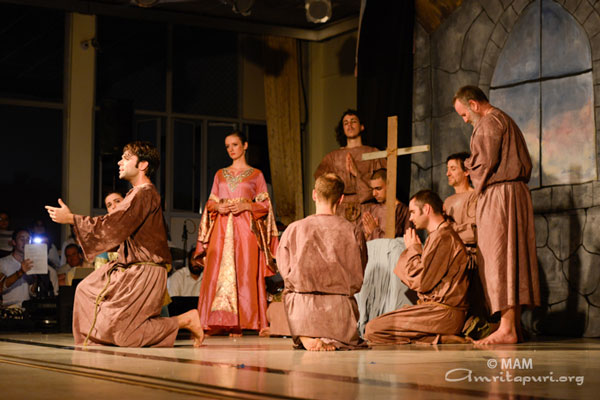
December 24
The play was as wonderful as I knew it would be. The audience was spellbound and tears flowed freely. Several days before, Amma told us that she would end darshan early so she could watch it with us. That was such a gift. It also meant that the play was on the main stage so everyone could see it well. Continue reading “Living and Learning in Amritapuri- Dec 24 -25, 2014”
The Art and Craft of Blogging
A collection of discussions on the environmental issues
“The fool doth think he is wise, but the wise man knows himself to be a fool.” “Love all, trust a few, do wrong to none.” “Love looks not with the eyes, but with the mind, And therefore is winged Cupid painted blind.”-William Shakespeare
...moments of unexpected clarity
Home of Lukas Kondraciuk Photography
Wellness, Support and Mindset
Thoughts on Creativity & Deeper Things
A Blog by Novella Carpenter
Ramblings of an Irish ecologist and gardener
Teaching the art of composition for photography.
Blog from SathyaSaiMemories ~ stories of love in action and the benefits of giving
There are 11,507 stories in Haddonfield; this is one of them.
Perennial gardening and more from the Green Mountains of Vermont
Whatever it will be...
Welcome to my little slice of the blogosphere

 Living, Learning and Letting Go