Dungeon Prompts: Moral Authority

Last Thursday, I received notice that Sreejit from The Seekers Dungeon was re-starting his Dungeon Prompt series. I was intrigued by the topic for the week, Moral Authority. I began to think about what moral authority meant to me.

The next day, I read that the Trump Administration had 1) stopped a study of the health effects of a mining practice in Appalachia, 2) disbanded the federal advisory committee on climate change, and 3) decided that the Environmental Protection Agency would work on building partnerships rather than focusing on regulations and enforcement. I felt despair when I read that information. It occurred to me that I was seeing examples of what moral authority is NOT, at least in my world view. 

I accept that President Trump has some authority over me because of the power of his position, but due to the things he says and does on nearly a daily basis, I do not believe that he has moral authority, or it least none that I will accept.

Since those were thoughts I had on the spot, I decided it was time for me to learn more about moral authority.

Wikipedia stated:

Moral authority is authority premised on principles, or fundamental truths, which are independent of written, or positive, laws. As such, moral authority necessitates the existence of and adherence to truth. Because truth does not change, the principles of moral authority are immutable or unchangeable, although as applied to individual circumstances the dictates of moral authority for action may vary due to the exigencies of human life. These principles, which can be of metaphysical and/or religious nature, are considered normative for behavior, whether they are or are not also embodied in written laws,[1] and even if the community is ignoring or violating them.[2] Therefore, the authoritativeness or force of moral authority is applied to the conscience of each individual, who is free to act according to or against its dictates.

Moral authority has thus also been defined as the “fundamental assumptions that guide our perceptions of the world”.[3]

Theodore Brown wrote:

Put the phrase “moral authority” into a Google search, and you will get back something over 670,000 hits.  Clearly the expression gets used a lot.  But what do people mean when they use it?  Many people seem to think that it means the right to weigh in on discussions involving what to do about some tough issue.  Other uses suggest that it is a measure of virtue; those who live exemplary lives have moral authority.  Or, that one can gain moral authority by having been put through a trial: the John McCain effect.  One simple definition is that moral authority is the capacity to convince others of how the world should be.  This distinguishes it from expert or epistemic authority, which could be defined as the capacity to convince others of how the world is.

When I found the diagram at the top of this post, it occurred to me that reflecting on those positive and negative behaviors might help me identify those people who I think have moral authority. From that exploration, I came up with a list of  behaviors that I think those who have moral authority have in common.  In my mind, people with moral authority:

  • love all beings in the world
  • love and are committed to nature
  • live lives of service
  • speak the truth
  • teach others to live in integrity
  • teach others healthy principles of living
  • teach others to love and respect one another
  • value unity over division
  • live lives that are true to their teachings, i.e. they walk their talk

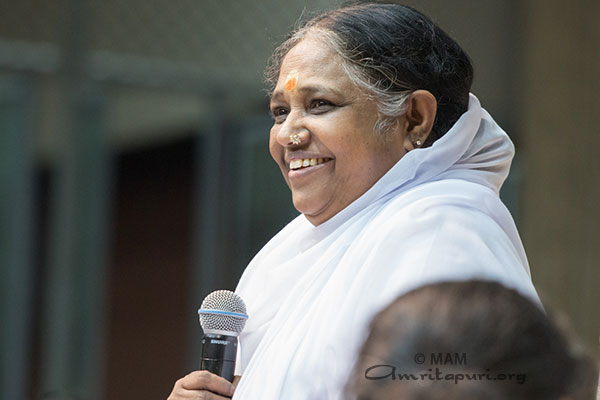
As I pondered who the people were that I think have moral authority, Jesus, Amma, Martin Luther King, and Pope Francis came instantly to my mind. Amma is clearly the person whose moral authority has impacted my life the most.

I believe blind faith may come in an instant, but mature faith develops from experience. I have been in Amma’s presence for 28 years- watching her, learning from her and seeing the impact she has had on my life and the lives of my friends, family, and other devotees. I have no doubt that she has made a massive difference in the lives of millions of people the world over.

Many years ago, I wrote a song, and had a friend translate it into Malayalam, that in a way reflects my decision to accept Amma’s moral authority. I titled the song, Only for This I Pray.

This is an audiotape and lyrics of that song.  Please pardon any pronunciation errors.

amma ende karangal ennum ninne sevikkatte
amma ende manass˘ mantrathāl nirayename
amma ende vākkukal ennum ninne pukazhthette
ende hridayam ānandam kond˘ nrittamādatte

ende sneham prakāshamāyi ennenum thilangatte
amma ende vishvāsam valarnnu kondirikkatte
ennenum ammayepole āyi varename
amma itinnu vendi mātram nyan prārthikkyunnu

Mother, may my hands be in service, my mind fill with mantra
May my voice forever sing your praise, my heart dance with joy
May my love shine ever brighter, my faith ever grow
Mother, may each day I become more like you, only for this I pray
Only for this I pray

That prayer is as true for me today as it was the day I wrote it.
 

Will I Choose to be Independent or Interdependent?

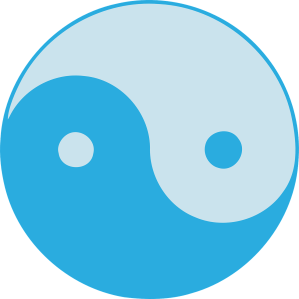
Decades ago, I participated in an experiential exercise that the facilitator called The Relationship Dance. That exercise gave participants the opportunity to feel the difference between dependent relationships, independent relationships, and interdependent relationships.

First, we each picked a partner. During the Dependent section of the exercise, one person in each dyad leaned against their partner and they walked around the room in that state. One person had the experience of being completely dependent on their partner to hold them up, and the other person had the experience of being totally responsible for their partner’s well-being. In the Independent section, partners wandered through the room having essentially no contact with each other or with the people in the other dyads. Interdependence was demonstrated by having the pairs separate to do some individual activities and at other times walking shoulder to shoulder.

I’ve never forgotten that exercise. The experience of being Dependent was not familiar to me, and was not at all inviting. I was more familiar with having people be dependent on me. Being Interdependent was inviting but not familiar. When I experienced Independent, I felt lonely and it was all too familiar. Since this post isn’t about my relationship with a partner, I’m going to broaden the definition of interdependent so that it includes being in give-and-take, supportive relationships with many people.

I grew up as an army brat. It was very hard for me to make friends since we moved at least every three years. If I wasn’t leaving, then my friends were. Also, my mother once told me that I would make one friend at a time, and then was devastated when that person became friends with someone else. To compound the problem, in my opinion, our family had a very low level of connection with each other.

As a child I became very independent. Over the years, I have made significant changes in that part of my life and now have many friends who could potentially be a large support system. While I have moved a significant distance along the continuum that goes between independence and interdependence, I still have a way to travel before Interdependent becomes my primary way of being.

I have had an abundance of opportunity to watch my struggle in this area as I heal from breaking my wrist. My recovery was made harder than it would normally have been because I also had considerable pain from bruised ribs caused by a fall two weeks earlier. The rib problem made it painful for me to get up and lie down, and the fact that I needed to overuse my left side when I couldn’t use my right hand, prolonged that pain. (Be assured that I am looking at, and committed to changing,  the factors that caused me to get hurt twice in two weeks.)

I have long marveled at how people who live with physical limitations are able to overcome them. I decided to use this experience to see what I was able to do on my own. One of the accomplishments that I am most proud of occurred on the second day after I broke my wrist. On that day, I was able to pry open tight hooks on a bra and put on the bra using only my non-dominant hand. I soon discovered I could do my own laundry, get dressed in carefully selected clothes, cook using the food I had in the refrigerator and freezer, and crack an egg open. I also felt proud the day I changed the cloth waist ties on two pairs of Indian pants to elastic. With the cloth ties, I would have had to tie a bow, an impossible feat at that time.

While I was able to figure out how to do almost everything on my own, I did ask for help when it was impossible for me to do something that needed to be done. The best example of that was being unable to lock my deck door at night since I had to pull it towards me with one hand and turn the key with the other. I tried but I couldn’t do it. The temperature was in the 80’s and 90’s in Seattle that week and I couldn’t open any of the windows in my living and dining rooms with one hand. Leaving the deck door shut as well would have been unbearable.

I wouldn’t have felt safe leaving the door open at night so that was not an option. I asked one neighbor to lock the door each night before she left town. After she left, I knocked on different neighbors doors each night, asking them to lock the door for me. I rationalized that asking a number of people would cause them less of an inconvenience. Another example is that I asked a friend to bring my vacuum cleaner up the steep stairs from my basement since I knew it wouldn’t have been safe for me to carry it, but I didn’t ask for help vacuuming even though it was difficult for me to do with bruised ribs. And instead of asking for help to bring it back downstairs, I eventually took the vacuum cleaner outside and rolled it around the house and in the back door.

I did accept help from two friends who wanted to bring a meal and from another who offered to come cook some meals that would last for a few days. I also accepted help from a friend who offered to go grocery shopping for me and asked another to take me to the places I needed to go to get ready for my trip to India.

For the most part, however, I told the friends and neighbors who offered help that I was fine, but would let them know if I needed anything, and then for the most part didn’t ask.

While I did accomplish many things on my own, I was also abundantly aware how different my experience would have been if I had been living with someone or if I had taken full advantage of my support system. I was aware of the message in my head that said Don’t bother anyone,  an adult version of Children are to be seen and not heard. I also heard You should only bother someone if you really, really need it; You may need surgery for your arm or you might get sick sometime in the future, so don’t ask for help now, you might need it more later; and You choose to live alone and that decision has consequences, which was short for “You made your bed, now lie in it. As I write these messages down, I realize how immersed in old unhealthy ways of thinking I have been. I knew these messages were still alive in me to some degree, but the injury brought them out full force.

Just before I left for India, I attended a potluck in the Seattle area. I witnessed my reaction when the friend who drove me there offered to help me put food on my plate. I told her I could do it. I even resisted when she gave me reasons why I should let her help. Seeing such a blatant example of my resistance stuck with me. On my second day in India, a man offered to help me wash my dishes after a meal. I told him I could do it. He watched me struggle with that for a minute, and then took the dishes away from me and washed them. The incident made me aware once again of how I push help away. It also gave me the experience of how good it felt to get it. The next day another man asked if I wanted help washing my dishes. I said thank you and handed them to him. Since then, I have accepted help when it is offered and have been more willing to ask for it in the first place.

I dread the thought of ever being completely dependent on anyone. I hope that is not in my future, but I have no control over that. What I do have control over is whether I live my life alone now or instead create a life style that includes a mutually supportive community.

Even though this injury has highlighted my tendency to be overly independent, I know I have come a long way in this area. I also know I will have an abundance of opportunities, perhaps on a daily basis, to choose between an action that would support my tendency to be overly independent and one that would lead to an experience of interdependence.  It is my intention to increase the number of times I choose the road that leads to interdependence.


To view the previous posts in this series click here.

The Value of Humility


Humility makes you receptive to all experiences without judging them. Thus, with humility you can go deeper and learn more.         ~Amma


Daily Prompt: Grit

Twelve days ago, I fell doing Greenbelt restoration work. I fell hard. The result: bruised ribs. When I first read today’s Daily Prompt: Grit, I took grit to mean the quality of doing whatever it takes to accomplish a goal, not letting any roadblock stand in the way. When I looked up the word in Wikipedia, I found this definition:

Grit in psychology is a positive, non-cognitive trait based on an individual’s passion for a particular long-term goal or end state, coupled with a powerful motivation to achieve their respective objective. This perseverance of effort promotes the overcoming of obstacles or challenges that lie within a gritty individual’s path to accomplishment, and serves as a driving force in achievement realization.

Since I fell, the amount of time I work in the Greenbelt has reduced dramatically, and what I do there has shifted. I may slowly place a few burlap bags over a cleared area; spend time laying out a design for a cluster of trees, shrubs and ground covers that will be planted the end of October; or I may wander around looking at the squirrels, birds and the occasional butterfly. Thankfully, I can still use my organizational abilities to lead work parties so the work is advancing; it just isn’t me holding the shovel.

Yesterday, I read that it takes bruised ribs 4-12 weeks to heal, and that the older you are, the longer it may take. I can tell that I am getting better. There is evidence of that daily. Healing just isn’t occurring on my preferred time table.

While I am frustrated by not being able to do what I want to do, when I want to do it, I know that I am being given lessons in patience and accepting what is. It doesn’t mean I have to stop advancing towards my goal, but it does mean that I can’t do the level of physical labor that I want to be doing. It is important for me to realize that developing patience and learning to accept what is are also lessons in my life’s curriculum and that those qualities are as important as grit in achieving my life goals.

I have grit, and I am learning behaviors that will support that grit.

A Treasure for Me

I laughed when I saw that today’s Daily Prompt is Chuckles. I also thought of the old saying “One man’s trash is another man’s treasure.” That is exactly how I feel about dandelions this time of year.

Two days ago, I saw this strip of dandelions near my home. It was at least 50 feet long and maybe more. Throughout the winter, I have been going to the grocery store to pick up lettuce that is going to be discarded. I feed it to the worms in my vermicomposting bins. The worms seem to be losing their enthusiasm for the lettuce, but they love the fresh dandelion greens.

The problem with the dandelions in this field is that it is part of light rail property and is completely fenced in. I have no way to access it, so I have to be satisfied with using the dandelions in my yard and the few that are on the street side of the fence.

Even though I know that it is important for me to focus on what I have, rather than what I don’t have, I have no doubt that I will still look longingly at the treasure that is beyond my grasp whenever I pass this field.

Youth Speaks: Why Are Muslims So…..

My daughter sent me a YouTube link this morning and I was profoundly moved by what I saw and heard. It felt so strange to want to clap, yet have sadness and tears be my primary reaction. This was recorded during the 8th Annual Brave New Voices International Youth Poetry Slam Festival in September of 2015.

After watching this video a Sanskrit chant came to mind, so I will end this post with that prayer.

Lokah Samastha Sukhino Bhavantu
May all beings in the world be happy.

Om Shanti, Shanti, Shanti
Peace, Peace, Peace

Song Lyric Sunday: How Could Anyone Ever Tell You

As soon as I finished my entry for this week’s Song Lyric Sunday, another song came to mind. That song, How Could Anyone Ever Tell You, was written and recorded by Libby Roderic in 1990.  I first heard it at a psychotherapy intensive and have used it in my psychotherapy practice from time to time since then.

The version in this post was recorded by Shaina Noll in 1992. It is part of Shaina’s CD, Songs for the Inner Child. She wrote this about that album.

The inspiration to record this collection of songs came to me one night as I was singing my children to sleep. As I sat rocking my youngest child, I realized that the singing my children found so calming and nourishing could extend beyond their rooms. I was doing inner child work at the time, personally and in my practice as a counselor. I suspected that the experience of being sung to could be deeply healing for many of the adults I knew. I felt instinctively that the songs my husband and I had been singing to our children could be a blessing to a wider audience.

As you listen to the song, imagine it is being sung to you.

Lyrics

How could anyone ever tell you
You were anything less than beautiful
How could anyone ever tell you
You were less than whole
How could anyone fail to notice
That your loving is a miracle
How deeply you’re connected to my Soul…

Letting Go of Suffering Course: Table of Contents

Even though the Letting Go of Suffering course is over, you will still be able to access the lessons any time you want to. Before long there will also be an icon on the right sidebar of my blog that will lead to this list.


Table of Contents

Introduction

Lesson 1 The Beginning

Lesson 2 The Beginning (continued)

Lesson 3 What Would Your World be Like If You Didn’t Suffer?

Lesson 4  Why Do I Suffer?

Lesson 5  Why Do I Suffer (continued)

Lesson 6  Using Affirmations To Heal

Lesson 7  Stopping Passive Behavior

Lesson 8  Getting Off the Drama Triangle

Lesson 9  Mistakes

Lesson 10  Failure

Lesson 11  Stopping The Critical Self Talk

Lesson 12  Using Contracts To Heal

Lesson 13  Holding Yourself Accountable

Lesson 14  Making It Bigger

Lesson 15  Changing Your Suffering Profile

Lesson 16  More Tools!

Lesson 17  Lighten Up!

Recovering from Over-Doing

Two years ago, in a The Seeker’s Dungeon prompt, Sreejit asked us to fill in the blank in this sentence: “I am a Recovering _________.” There was no doubt in my mind what my behavior would be. If I was at a 12 Step meeting, I would say: “Hi! I am Karuna, and I am a recovering over-doer.”

As I thought about how I would present this topic, I decided to create a new mental health disorder. My fictitious disorder is called “Being versus Doing Disorder.”

The “Being vs Doing disorder” is on a continuum where the center, a balance between being and doing, is the healthy portion of the continuum. The more someone moves to either end of the continuum, the more likely it is they will have dysfunction in their lives.

When I think of the over-being end of the continuum I think of non-productivity, passivity, and lack of motivation. I don’t know as much about that part of the spectrum since I have almost no personal experience there. I have seen it at work in some of my psychotherapy clients and friends though.

Over-doing has many facets. It commonly begins in childhood when the only or main way to get positive attention from parents is to do impressive things. It also develops when parents criticize their children anytime they are relaxing or are doing things the parents consider nonproductive.

As a result, adults with an over-doing disorder may be seeking validation and praise for what they accomplish. An over-doer is also likely to be a rescuer. As such, they do things they aren’t asked to do and are likely to do things they don’t want to do. In addition, they do more than their share of the work that needs to be done and do things for other people that they could do for themselves. Those with this “disorder’ are likely to over-commit and seem incapable of being still.

Over-doing has been a major characteristic of my adult life. At one point, I was raising two children, working three jobs, doing my personal therapy and studying for a PhD. During my therapy, I realized I didn’t want a PhD, I was just seeking attention from the father, who had disowned me. I stopped my schooling but was still overdoing. Before long, I began to experience extreme exhaustion and was diagnosed with Chronic Fatigue Syndrome (CFS).

With CFS, I was in survival mode and it was impossible for me to do as much as I had been doing, although I still tried to. When it began dissipating after five years, I went back to over doing. There is no doubt that a part of me believed it was only acceptable for me to stop if I was sick. Eventually I developed high blood pressure and other physical problems.

I reached a point where I had to cut back on all of my commitments. Nowadays, I am putting my emphasis on doing the things I want to do, and am saying no to many requests. I still have trouble with “simply being” but I no longer am into major over-doing. I hope some day I will be much closer to the center of the being-doing continuum.

At one point, I realized a behavior that really fueled my over-doing disorder was the desire to be “in the know.” That put me in the place of being asked for information that I didn’t want to share, which then created stress, whether I shared it or not. As I continue to slow down, I am finding myself holder of less information. I am loving responding to requests with “I’m not in that loop anymore. You will have to ask someone else.”

I learned many skills during my over-doing years. When friends of mine were in a life and death crises, I stepped in to help immediately. There is a time and place for those skills, but it takes discrimination to use them correctly. In that instance, I have no doubt that my choices were appropriate.

I am very committed to my recovery from over-doing. While I may find myself immersed in the old behaviors from time to time, I don’t think I will ever be drawn so deep into them again. I see what I am doing much sooner and and change course when needed.

In evaluating myself on the scale found in Portia Nelson’s Autobiography in 5 Short Chapters, I find I am in generally in Chapter 4 or 5.

Chapter IV

I walk down the same street.

There is a deep hole in the sidewalk.

I walk around it.

Chapter V

I walk down another street.

Every time I walk around an invitation to over-do or avoid putting myself in the situation where I know I am going to be tempted, I consider my choice worthy of celebration! I am truly moving towards a life of balance.

Do you have a “Being vs Doing” disorder? Where do you fall on the continuum? How does it disrupt your life?

Photo Credit: Pixabay

This post was originally published on April 12, 2015