Living and Learning in Amritapuri, India: Wrapping Up (Jan 2017)

12512718_10153228699456805_4784682354021587162_n

Every year, as my trip to Amritapuri is winding down I think of a statement I read decades ago in a book by Malidoma, an African shaman who lives most of the year in the U.S. In the book, Of Water and the Spirit, Malidoma commented that he goes to Africa every year to learn from his elders and detox from Western civilization.

I resonated with that statement when I first read it, and I still do. For me, being with Amma, especially in India, is like taking a vacuum cleaner to my whole system. While the living and learning experiences may be difficult at times, I always see my growth when I return to Seattle. I am softer, healthier, and more able to handle the challenges that life sends my way.

When I went to India the first time, I loved it. In fact, during my first three visits, I cried every time I thought about leaving. Then there was a period, that lasted for at least five years, when I had a love-hate relationship with India. The heat and the never ending physical and emotional challenges were difficult for me to cope with. I felt on overload most of the time. Even then, though, I had a deep internal sense that it was very important for me to take that annual trip. I often used the metaphor, to myself and others, that it was like going to a doctor knowing the treatment would be painful.

Thankfully, that period passed, and for a long time now I have eagerly anticipated my yearly trip. I know that every visit will be filled with learning and adventure and that the challenges that come to me will help me grow.

It is my experience that being with Amma, whether it is in India or the U.S., increases the frequency and intensity of the life lessons that come my way, along with the ability to work through them at a faster rate. When I’m in the middle of an emotional roller coaster, the growly declaration that “this is going to be the last time I’m going to do this” inevitably goes through my mind. At least now I know that the thought is just a thought, and it will pass. I fully believe that it is important for me to continue going to Amritapuri each year, and that those visits will cleanse my mind and body, and feed my soul.

As I was preparing to leave Amritapuri this year, it occurred to me that once I retire I can go to the ashram whenever I want to go, and stay as long as I want to stay.

I almost always travel to Amritapuri in November and December, the busiest time of the year; a time when my son and daughter’s lives are filled with creating the Christmas play on top of their regular seva responsibilities. While I love seeing the play and being involved in play preparation, I am also faced with the reality that I can’t spend as much time with my adult children as I want to. When I retire, will I go to India at a different time of the year? Am I willing to miss the play in order to spend more time with my kids? Will I go earlier and stay longer? Will I go twice a year even though that would mean facing jet lag twice? I know those questions will be answered as my life unfolds.

For the last few years, I have felt an increasing desire to do panchakarma, an Ayurvedic therapy that provides deep cleansing and detoxification. Panchakarma was one of those things that I used to say I would “Never” do, but since I discovered that my high blood pressure and high cholesterol would eliminate several of the procedures I’m resistant to doing, I have felt more inclined to consider it. I have no doubt that the treatments would be in my best interest and the people I know who have done it have loved it. Maybe I would too.

If I do panchakarma, I would want to do it in Amritapuri, but I’m still resistant. I know the protocol involves staying out of the sun, rain, and wind and that I would be expected to keep the fan off in my room and to avoid other places with fans. That’s a big deal, considering I’d be in India. I also would be expected to refrain from doing seva, napping, writing, or reading. There are many dietary restrictions as well. Am I willing to make those commitments for most or all of my trip?

My biggest resistance is to the activity restrictions. As an over-doer I am stumped by how I would fill my time if I avoided doing all of the items on that list. Am I willing to give up blogging, working in the gardens, taking Tai Chi, and the other things I love doing in Amritapuri? What WOULD I do? Would I spend those weeks staring at a wall?

No doubt, I would be confronting all the garbage that is inside my mind. I would also be confronting my reluctance to simply “BE.” Am I willing to do that?

So, as I wrap up this year’s trip to Amritapuri, my mind is filled with questions. It is also filled with gratitude for all I experienced on this trip, and excitement as I look forward to discovering where the next steps in my life will take me.


Photo Credit: Amritapuri Facebook Page

DEAR ME

Yesterday, I read a post at Neal’s Epiphany that I thought was incredibly powerful. I don’t know how Neal sees it, but using my psychotherapy frame, I see him as having written a beautiful letter to his inner child. Neal has graciously consented to me sharing his letter with all of you.

Neal's avatarNeal's Epiphany

Dear Me,

You and I go way back, to the beginning. We’re one hundred percent connected in a way no one will–or could ever–understand. We’ve been there, standing together. Sometimes crying in the shower, sometimes snorting through our nose, but it’s always been you and me. Always and forever…

Or so it was supposed to be, but some time ago I left you–

I left you floundering on your own, to rely on love and encouragement and strength from others–from strangers–when it was I who should have held you up. When it was I who should have hugged you and praised you and appreciated you for the wondrous person you are–for all the beauty and life you bring to this world.

I seldom tell you how much I love you. How much I admire you. How beautiful and caring and intelligent and strong you are. That you are my hero.

View original post 383 more words

Letting Go of Suffering- Week Ten: Failure

heart-157895_1280

You are lovable even when you fail.

Failing is a normal and necessary part of living.

You can learn from every failure.

heart-157895_1280

Another behavior that often leads to suffering is failure. Failure is “to disappoint expectations or trust; to fall short; to be or become absent or inadequate; to be unsuccessful.” (Webster’s Ninth New College Dictionary, Springfield: Merriam-Webster, Inc. 1988, p. 445)

The reality is that any time we choose to act, we take the risk of failure. In order to succeed, we must be willing to risk failing. There is much that can be gained from acting, even if the result is failure. As with mistakes, it is important to see that failure is a necessary part of living and that something can be learned from every failure. Continue reading “Letting Go of Suffering- Week Ten: Failure”

Jane Goodall: A New Kind of World

Photo Credit: Wikimedia
Photo Credit: Jeekc on Wikimedia

“I think one of the most important things for people to understand,” says Goodall, “is don’t feel helpless when you look at all the problems of the world.

Realize that if you think about the consequences of the small choices you make each day — what you buy, what you eat, where did it come from, how was it made, did it harm the environment, cruelty to animals, child slave labor — [you] make more ethical decisions.

It’s not just you. It’s more and more people around the world. In the end, it’s hundreds of millions of people making small choices, that are the right choices, that leads us to a new kind of world.”

Source

Letting Go of Suffering- Week Nine: Mistakes

heart-157895_1280

You are lovable even when you make mistakes.

Making mistakes is important for your growth.

You can learn from every mistake.

heart-157895_1280

Making a mistake is one of those life situations that often leads to suffering. A mistake is “a wrong action or statement proceeding from faulty judgment, inadequate knowledge or inattention.” (Merriam-Webster, Inc. 1988 p. 760.)

An important step in letting go of the suffering is to adopt the mind-set that mistakes are an important and necessary part of living, and that something can be learned from every mistake. In time, you may even come to see making a mistake as a positive event rather than a negative one.

35

This week, record every mistake you make. Write down the tiny mistakes as well as the big ones. Next to the mistake, write what you learned from making it and what you will do differently in the future. Add more paper if you need to.

36

37

38

heart-157895_1280

You are lovable even when you make mistakes.

Making mistakes is important for your growth.

You can learn from every mistake.

heart-157895_1280


See you next Monday for the tenth lesson.

To find the lessons in this series that have already been published click here.

Letting Go of Suffering- Week 8: Getting Off of the Drama Triangle

triangle-color

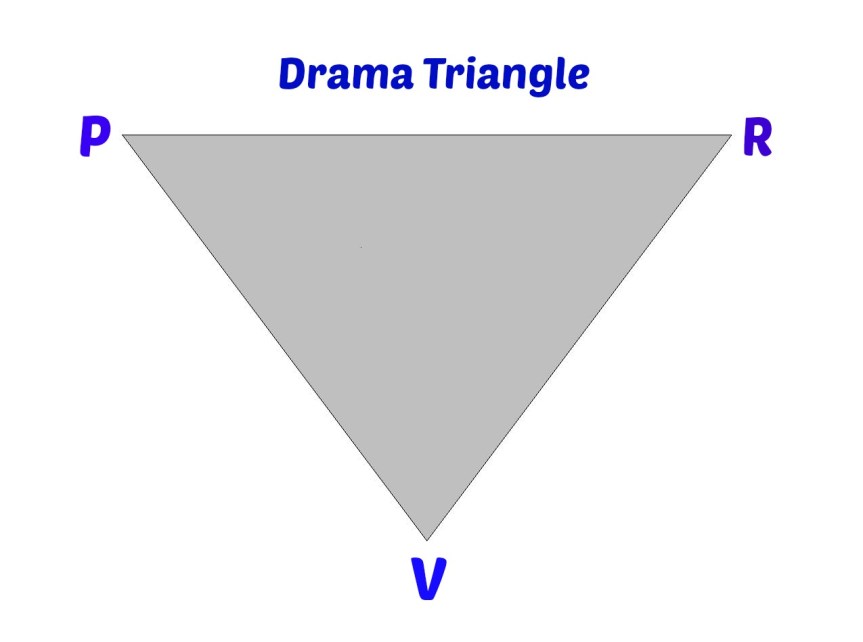
Suffering is often the result of having participated in a transactional “game” identified by Stephen Karpman as the Drama Triangle. The Drama Triangle contains three roles- 1) The Persecutor (P) who blames and criticizes, 2) The Rescuer (R) who thinks for others, helps when they have not been asked to help, does things they don’t want to do, and does things for others that they could do for themselves and 3) The Victim (V) who feels oppressed, blamed, unloved, hopeless and/or helpless. The Victim often is immersed in “Poor Me” energy.

Although it is possible to play the “game” totally within oneself, it is almost always played out between two people. Once the “game” begins, both players generally spend some time in all three roles.

EXAMPLE

Person A:  Gives unasked for advice (R)

Person B: Feels irritated and makes a belittling comment. (P)

Person A: Feels unappreciated and blamed. (V)

Person A: Angrily blames Person B for being unappreciative (P)

Person B:  Feels depressed because it seems like she can’t do anything right. (V)

Person B:  Over-adapts and does what Person A suggested even though she doesn’t want to. (R)

Drama Triangle Home

There is usually one part of the Triangle that is more familiar to us than the other parts. When we are involved in the “game,” what I call our “home” is the place where we usually spend the most time.

30a

Identify two times in the recent past when you have been on the Drama Triangle. Think of situations that occurred 1) at work with supervisors, employees or peers, 2) with friends, 3) with family, or 4) with any other individuals in your life. It could be a sales person, a barista, or anyone else who has crossed your path.

If you can’t think of anything that happened recently, then use two situations from the past. Describe how you and the other person moved through the Drama Triangle process. What caused the game to end? Was the problem that started the game ever solved? How?

30b

Getting Off of the Drama Triangle

At first, you might not recognize that you are on the Drama Triangle until you are fully involved in the “game”. Over time, you will begin to notice feelings, thoughts and body sensations that will alert you that you are on the Triangle. Eventually, you will recognize when other people invite you onto the Triangle and will be able to prevent the game from even starting.

The most important step in getting off the Drama Triangle is to decide that you are not willing to play the game. If one person refuses to engage in the process, the other person will soon give up.

When you decide you are not going to engage in the Drama Triangle process, picture yourself stepping off of the triangle. Here are some tips:

If you have been in PERSECUTOR:

a) See yourself stepping off of the Drama Triangle.

b) Take a time out so that you can cool down. Constructive problem solving is not likely to occur when you are in the heat of anger.

c) Do work to release your anger. (Examples: Write lists of the things you are mad about; write a poison pen letter letting out the rage, and then destroy the letter; twist a towel putting your anger into the towel; and/or tear up a phone book.)

d) When the amount of anger you have has decreased, engage with other person. Work with them in solving the problem. Set boundaries as needed.

If you have been in RESCUER:

a) See yourself stepping off of the Drama Triangle.

b) Take a time out if you need it.

c) Let the other person know that you love, support and care about them.

d) Acknowledge to yourself, and to them, that you have been rescuing and that in the future you will wait until they ask for what they need, or you will ask them if they want help from you.

e) Ask yourself if you have been rescuing others because there is a need of yours that needs to be met. If there is, then think of how you can meet that need. It may be YOU that needs to ask for help.

If you have been in VICTIM:

a) See yourself stepping off of the Drama Triangle.

b) Take a time out if you need it.

c) Write lists of what you are mad, sad and scared about.

d) Give yourself affirmations for your ability to think and solve problems.

e) Ask others to give you affirmations for your ability to think and solve problems.

f) List all of the solutions you can think of for solving the problem.

g) Start doing the items on your list. Continue until the problem is solved.

For the rest of this week record what happens when you realize you are on the Drama Triangle. Record small examples as well as big ones. Also record ways you avoided getting onto the Triangle in the first place. (Add more pages to this document if your list is long)

34

See you next Monday for the ninth lesson.

To find the lessons in this series that have already been published click here.

Letting Go of Suffering- Week 7: Stopping Passive Behavior

passivity

A major predecessor of suffering is passive behavior. Many years ago one of my mentors, Elaine Childs Gowell, taught me that we are being passive when we are aware that there is a problem and we:

a. Do nothing and hope the problem goes away.

b. Overadapt and do what other people want us to do.

c. Agitate by doing repetitive behaviors that aren’t directed towards solving the problem, e.g. tapping  fingers, swinging legs, playing with hair, mopping the floor at 2:00 a.m., etc. Addictive behaviors may be forms of agitation, e.g. over-working, over-eating, alcohol, drugs, and over-thinking.

d. Incapacitate through headaches, backaches, stomach aches, depression.

e. Escalate by behaviors such as throwing things, screaming and hitting.

EXAMPLE

Situation: Your 12 year old daughter received two D’s on her report card.

a. Do Nothing: Tell yourself she will do better the next time and just ignore the situation.

b. Overadapt: Decide not to talk to her teachers because your daughter doesn’t want you to.

c. Agitate: Grumble under your breath and clean the house late into the night.

d. Incapacitate: Develop a headache

e. Escalate: Scream at your daughter and then slap her when she sasses you.

Eliminating passivity from your life takes time and effort. First, you have to recognize when you are being passive, or are considering being passive, and then commit to doing something to solve the problem instead.

PRACTICE EXERCISE

This week, record each time you realized you were being passive, or had the opportunity to be passive. Then write down what you did to solve the problem.

When you choose to solve the problem instead of being passive, brag about it to yourself and to a friend. Receiving acknowledgement can be very helpful in changing self-sabotaging behaviors.

28

See you next Monday for the eighth lesson.

To find the lessons in this series that have already been published click here.

Letting Go of Suffering- Week 6: Using Affirmations to Heal

I often ask my psychotherapy clients what they would think and feel if they overheard a parent berating a child with the negative messages that they dump on themselves, e.g. “You are so stupid.” “Can’t you do anything right?” “You are selfish.”  “You are a disgrace.”

Clients often respond that they would feel angry and think that the child was being abused. I tell them when they speak that way to themselves, it is as if they were the parent who is abusing the child. In this case the child is their inner child. That awareness is often jolting enough to motivate clients to learn what they need to learn to stop the negative self talk.

Affirmations are positive statements which can be used to replace the negative messages you tell yourself. By using these positive statements, as one might use a mantra, i.e. saying them over and over, you can fill yourself with positive supportive energy instead of negative, discounting energy.

Below you will see two styles of affirmations. The affirmations in the first style are phrased so that you affirm the beliefs you want to have. These affirmations are stated as if they were already true. For example:

I belong

I am worthy

I am enough.

I am a competent, capable adult.

I am love.

I am lovable.

My needs are important.

I am learning and growing.

I deserve support.

The other option is to pick an affirmation that the healthy parent part of you says to your inner child. For example:

I love you.

Your needs are important to me.

I will teach you and guide you.

Pamela Levin and Jean Illsley Clarke created sets of developmentally based affirmations. Their affirmations use the parent to child style.

Pam Levin’s can be found her her book Cycles of Power. Some examples of her affirmations:

You have a right to be here.

You don’t have to hurry, you can take your time.

You don’t have to suffer to get your needs met.

Jean I. Clarke’s are in Growing Up Again. Here are a few of hers:

I’m glad you are you.

You can know what you need and ask for help.

You can learn when and how to disagree.

Creating Affirmations from Think Structures

You can use the Think Structures you wrote in Week Four and Week Five‘s Letting Go of Suffering assignments to create personalized affirmations. (The Think Structure and this affirmation structure are processes created by Pam Levin (Cycles of Power.)

I will show you how to create affirmations using this Think Structure:

  1. I am scared
  2. That if I ask for what I want
  3. I will be ridiculed or punished
  4. Instead of being heard and supported
  5. So I pout, isolate and don’t ask for what I want.

To form the affirmation, you will use the 2nd and 4th line of the Think Structure.

So my affirmation would be:

I do ask for what I want and I am heard and supported.

Create affirmations from some of the Think Structures you wrote during the last two weeks. If you have not seen or done those assignments, consider going back to those lessons and completing them.

24b

If you like, you can use your Think Structure affirmations when you do the affirmation exercise I will describe in the next section of this post.

Another way you can  use your Think Structure affirmations is to set up life situations that will facilitate your healing. Using the example above, I could let my friends know that I am focusing on asking for what I want and would like to practice doing that with them. I could also let them know that when I ask for what I want, I would like to be heard and supported. (Being heard and supported doesn’t mean they will give you whatever you ask for. A long time ago, I practiced this exercise with someone by asking him if he would pay for my Masters of Nursing degree. He was very honoring of my request but, of course, did not agree to fund my education!)

Using the Affirmation

Pick one of the affirmations from this lesson, or create one of your own. For the rest of the week say it at least 1000 times a day; 5,000-10,000 would be even better! It is fine for you to say it internally, going as fast as you want. (A short mantra can be repeated 1,000 times or more in 20 minutes.) You can count using a tally counter from an office supply store or an app such as iPhone’s Counter +.

Even though this lesson only lasts a week, it would be best if you continue to say the same affirmation for 21 days. If you say it in the higher range (i.e. 10,000 a day or more) you may find that it starts flowing through your mind automatically. You may even wake up during the night and realize you were saying it in your sleep. Imagine what it would feel like to be listening to positive thoughts throughout the night instead of your self-critical ones.

What if my mind is fighting the affirmation?

Sometimes a particular affirmation is so far from what you believe, you may find yourself very resistant to saying it. If that is the case, take a piece of paper and make two columns on it. On the left side write your affirmation and on the right side write the negative response that comes to your mind. Keep doing that until you have written the positive one 50 times. Here is an example:

Positive affirmation               Discount

My needs are important…      No they aren’t

My needs are important…      I should be needless and wantless

My needs are important…      It isn’t safe for me to have needs

My needs are important…      No they aren’t

My needs are important…      No they aren’t

My needs are important…      That statement is nonsense

etc.

Do this two column affirmation exercise for several days if you need to and then start saying the 1,000 repetitions of the positive affirmation each day. Or do the 50 written affirmations in the morning and then say the affirmation during the rest of the day. As you continue to write and/or say the affirmation, the negative messages will decrease and then stop.

Another thing you can do when you find negative thoughts coming into your mind when you say the affirmation is to speed up the rate you are saying the affirmation. Speed it up until you drown out the negative message.

Journaling

Take a few minutes each day this week to write about your experiences with the affirmation.

Day 1

25a

Day 2

25a

Day 3

25a

Day 4

25a

Day 5

25a

Day 6

25a

Day 7

25a

See you next Monday for the seventh lesson.

To find the lessons in this series that have already been published, click here.

Living and Learning in Amritapuri, India: December 23-25, 2016

hybiscus

Be Like a Bird Perched on a Dry Twig

I’ve mentioned before that Amma teaches us to be like a bird perched on a dry twig, ready to fly at any moment. That lesson has been front and center for the play cast during the last three years.

Five or six years ago, when the play was on a darshan day, Amma said to hold it on the auditorium floor since she would be using the main stage for darshan. The participants built a small stage for the performance.

In December of 2014, Christmas Eve was again on a darshan day. Since the cast believed the play would be on the auditorium floor again, they were very creative in how they built the stage. It had three levels so that three scenes could take place at once.

Amma is asked where she wants to hold the play 3-5 days before the event. In 2014, they were shocked when she said that she wanted them to perform it on the main stage. She would finish darshan early, and watch it with us. While everyone was delighted that Amma wanted to watch, they only had 72 hours to adjust all the backdrops and choreography to fit on the smaller stage.

In 2015, the play was once again on a darshan day. While they knew they couldn’t count on it, they planned for the play to be on the main stage since Amma had wanted it that way the previous year. Days before the performance, she told them they would need to use the auditorium floor since she would be giving darshan on the stage. Everyone flew into action, building a stage for the auditorium floor and adjusting everything that needed to be adjusted. That year they just took it in stride, seeing it as the opportunity for growth that it was meant to be.

The December 2016 play would normally have been on a non-darshan day but,  since it was a Leap Year, it ended up being on a Saturday, another darshan day. This time the play was planned so it would fit on either the stage or the auditorium floor. The leaders kept in mind that Amma could come up with an unexpected third alternative and that is exactly what she did. When asked where the play should be held, Amma informed them she would let them know on the day of the program.

While they were jolted by this response, they went on preparing the play, envisioning it in both places. The day before the event, thinking Amma, because of the size of the crowd, would most likely choose to hold the play on the auditorium floor, they installed the lighting and the backdrop. The gigantic backdrop was rolled and hoisted 30-40 feet above the auditorium floor.

On Christmas Eve morning, Amma was asked once again where she wanted the performance. She said she would decide later in the day. They still didn’t have a definitive answer at 6:00 p.m.

It soon became obvious that Amma wanted to see the play with us, so the backdrop and the lights were taken down around 7 p.m. I heard that it took 30 people to remove the huge structure of lights and carry it to the main stage. Both items were then reinstalled on the stage, while Amma was giving darshan.

Soon the cast were in their make up and  costumes. All the props were ready to be put on the stage. Nothing else could be done until Amma finished darshan and the stage was cleared.

Darshan was over at 10:30 p.m. It usually takes hours to do the play set-up but they accomplished it all in an hour; the play started at 11:30 p.m. and proceeded without a hitch. The music was wonderful, the acting was wonderful and the dancing was wonderful. Never has one of their plays gone so smoothly.

The cast had handled all of the challenges with such grace, knowing that everything they experienced had purpose. What a lesson it had been in flexibility, persistence, patience, non-attachment, equanimity, and being like the bird perched on a dry twig.

I will write more about the play in a future post, but for now I will share some pictures I found on Amma’s Facebook page today. They will give you an idea of the quality of the costumes and backdrops and even glimpses of the acting.

The story was about Jesus’ parable of the prodigal son, with the emphasis being on the loving father. The first photo is of the father, the second Jesus, the third of one of the piggies, the fourth is a village scene and the fifth is of the prodigal son in despair.

After the play, Amma sang some songs and led a meditation. The photo below was taking after we sang a very rousing bhajan. She often ends those kind of songs by saying “Mata Rani Ki Jai” (Victory to the Goddess/Divine Mother) over and over and we respond “Jai” (Victory) each time with arms up. That is what you are seeing in this photo.

If you look closely you can see Amma. (The picture also shows you what the auditorium looks like and gives you a sense of how many people were present.)

15675589_10154166954153302_5567896834987704938_o

Amma ended the evening by passing out Christmas cake to the thousands of people who were present. What a day it had been.

Prasad Giving

When I arrived at the head of the prasad giving line on Christmas Eve, Amma started hugging people faster. Our “shift” for handing Amma the candy and ash she gives to each person who comes to her for a hug lasts either two or three minutes. Usually the prasad giver only has the opportunity to hand her a few packets. Because she was going fast at that moment, I was able to give her many packets. I had a lot of fun.

I handed Amma prasad again on Christmas day. This time when I reached her, the person who was being hugged asked Amma a question. Amma had lots to say so I was able watch. I didn’t get an opportunity to hand her packets during my time, but I didn’t care. It was nice to be so close to her and after all, I had handed Amma so many packets the day before.

Karunalaye Devi

When I left the stage where Amma was sitting, one of the brahmacharis (male monks) started singing Karunalaye Devi, a song I mentioned in a previous post. Hearing it again felt like a gift.

When I returned to my room, I looked to see if the song was available on YouTube. I was surprised to discover that Amma has a YouTube channel that contains videos of many of her songs.

A version of Karunalaye Devi had recently been uploaded. The singing takes place in the Amritapuri auditorium, but there are also darshan scenes from  her Indian tours. The man in the photo below is Swami Amritasvarupananda, one of Amma’s senior swamis.

Christmas Surprise

The afternoon of Christmas Day, I participated in the play cast celebration. It is always so much fun, and, considering all the challenges, they had even more than normal to celebrate about. At the end of the party, we heard that Amma had said any ashram visitor who hadn’t had darshan during the previous week could come for darshan that night. Since the crowds are so large at this time of year, we hadn’t even considered going until January.

It made for another late night, but it was so worth it. What a wonderful Christmas season it has been.

To see all of the posts in this Amritapuri series, click here.

Finding Peace in the Middle of Chaos

img_1008

It is not uncommon for my mind to be chaotic even when I am in a peaceful setting. I long to get to the point where my mind is at peace regardless of how much chaos is around me. I have a long way to go to meet that goal.

I am getting plenty of opportunity to work on that issue in my Amritapuri Tai Chi class. Tai Chi, by its nature, is meditative. It slows down my mind and body more than anything else I have ever done.

I would guess that most Tai Chi classes are held in peaceful settings with soft music playing or silence in the background. The place where our class meets in Amritapuri is gorgeous. There are palm trees, views of the beach and the Arabian Sea, eagles flying overhead, etc. As I’ve mentioned before, though, there are also trucks, bicycles, buses and cars that occasionally go through the space where we meet.

With most of life’s lessons, it seems like once you have adjusted to one level, another dimension is added. This year has definitely demonstrated that process. During my first class, I was stung by a red ant. It is amazing how much a bite by a tiny ant can hurt. In fact, the bite was still stinging hours after the class finished.

Soon thereafter, a red ant hill showed up at the perimeter of the space we use for the class, so it has been important for me to stay conscious of that danger, and to make sure new students are made aware of it. (I have stepped on a red ant nest twice in the 27 years I’ve been coming to India, once in the daylight and once at night. It is an unforgettable experience; one I hope never to repeat.)

Starting with our second class, students taking a silent meditation retreat have done a walking meditation in front of us during part of our class. They don’t disturb us but I’m tempted to watch them instead of staying focused on my own work.

In last week’s post Be Like a Bird Perched on a Dry Twig, I talked about the third class when there were even more vehicles in the area than normal. Midway through the class, a truck pulled into “our” space and parked. The workers got out of the truck and started carrying their supplies to the nearby construction site. Since their work had priority, we had  to move to a smaller area, one that was bordered by 8 ashram cows lounging in the shade!

Tai Chi is so powerful that it was reasonably easy for me to find that place of peace and contentment even in these circumstances, although I certainly didn’t have single minded focus.

On my fourth class, another set of challenges were added to those that I have already described. (BTW, the cows have not returned to the beach, at least a that time of day, since the third class.) The fourth class was held on a weekend, the first weekend since Amma returned from her European and U.S. tour. The crowds coming for darshan (hugs) were very big that day. At one point, there were 14 vehicles parked on the beach.

Then something new happened. At first, one or two village men started removing carts of sand from the beach to somewhere in the village. Next, two women started a chain. One woman would carry a big pan of sand on her head and walk to a spot next to our class. She would then shift the pan to the head of a second woman who would carry it out to the main road. We often had to divert our path to stay out of their way.

Fifteen minutes before that class was over, a cement mixer started making its piercing noise in the construction area near to us. By that time, the whole situation had become funny.

During the fifth class, a third woman was added to the chain of sand carriers. On the sixth, there were all of the previous challenges, except the cows. In addition, a new layer of sand had been added to our area 0f the beach. The sand was beautiful and felt good on my feet, but it hadn’t been compacted yet, so there was no smooth or level ground to walk on. That made doing the Tai Chi moves much more difficult.

As you can see, doing Tai Chi on the beach in Amritapuri is definitely an opportunity for me to find peace in the midst of chaos. It is also an opportunity to see the humor in the situations that arise in life.

To look at previous posts in this Amritapuri series, click here.