On My Way to Amritapuri: November 24-26, 2016

Photo Credit: Wikimedia

Seattle to Dubai

I have been anticipating my 2016 trip to Amma’s ashram in Amritapuri, India for months. Every time I go there my life is filled with adventure, learning and renewal. Not only do I get to spend time with Amma, it is also the only period each year that Sreejit, Chaitanya and I are together. (My son, Sreejit, lived in Amma’s ashram in San Ramon, California from 1994 to 2009 and has lived in Amritapuri since then. Chaitanya moved to Amritapuri in 1998.)

On Thanksgiving morning at 5:30, a friend picked me up and took me to the airport. I checked in, got my boarding passes and went through the security line within 30 minutes. I appreciated the opportunity to begin this year’s journey in such a non-stressful way

Knowing I was going to be sitting in the plane for more than 15 hours, I decided to eat breakfast and then walk around the terminal until it was time to board. Within minutes, I saw a sign that made me do a double take. The words on the sign were: Pet Relief Area. I walked by it, but my curiosity got the better of me, so I turned around and walked back to the sign so I could see what a Pet Relief Area was. This is what I found:

I did not know that this type of service was available in airports; it seemed surreal. The first thought that went through my mind, as I shook my head in disbelief, was that this was one of those “Only in America” things. I also recalled a scene from a science fiction movie when a man traveled from the past to the future. He was shocked to see someone who was walking their dog stop to pick up the dog’s poop, put it in a bag and then take it with him. I don’t remember what year the time traveler came from, but if someone had told me back in the 60’s that in the future we would be picking up dog poop, I would have thought they were crazy. The other thought I had when I saw the Pet Relief Area sign was wondering if these relief areas had been available in the airport for some time and I had just been oblivious to them.

Later, when I looked for information about Pet Relief Area on the internet, I discovered that since 2009, the U.S. Department of Transportation has required airlines to make relief areas available for service animals. I also learned that in August 2016, a federal regulation was enacted that required any U.S. airport that served more than 10,000 passengers a year to provide a place for service animals to relieve themselves. Most airports also provide the service to law enforcement dogs, emotional support animals and airport therapy dogs. I found no evidence that these areas exist in other parts of the world.

My flight from Seattle to Dubai was rough for a variety of reasons. For the first hour or two, there was a lot of air turbulence. I don’t think I’ve ever been on a flight where the plane shook so much, except for the one I was on in the late 90’s where our plane had a decompression problem, probably due to a fire onboard. After the shaking started, that plane had descended 25,000 feet in about a minute’s time. Even though on this 2016 flight the shaking was due to air turbulence, it was still jolting enough to get me chanting my mantra!

The flight was also rough for me because my back pain had been re-stimulated by the process of getting ready for the trip. I walked as much as I could during the flight so that helped, but I was still uncomfortable. I looked forward to arriving in Dubai.

Dubai International Airport

There is a 13 ½ hour time difference between Seattle and India, and as I’ve aged, I have had increasing difficulty with jet lag. Sometimes it seems as if I spend most of my time in India adjusting to the time change. Just as I begin to feel normal, it is time to fly back to Seattle and once I’m there I have to start the whole adjustment process over again.

The last two years, I have stayed at the airport hotel in Dubai on my way home from India. It is expensive, but the chance to lie down and even sleep before the long leg of the trip has been well worth it. It even seemed to decrease the amount of jet lag I experienced after I returned to Seattle.

This year, I decided I would stay in the Dubai hotel for 15 hours on the way to India. I hoped by doing that, I would feel better when I arrived in India and as a result, jet lag would be less of a problem for me.

There is another reason I love to stay at that hotel. The Dubai airport has untold numbers of duty free shops. It is also full of jostling people and bright lights. When you walk out of the elevator that goes to the Dubai International Hotel, you enter a world of complete silence. I find the hotel’s atmosphere to be such a blessed relief from the hustle and bustle that occurs in the rest of the airport.

I practically fell into bed and then slept for five hours. When I got up, I went to the Emirates travel desk to pick up my food voucher. I knew from past experiences that Emirates wouldn’t pay for the hotel but they would pay for meals. This time, however, when I asked for the voucher, I was told that they no longer provided that service. I had never bought anything other than a scoop of ice cream in Dubai. After looking around, I decided I would order some sushi at a food court restaurant that was located next to McDonalds. I was quite surprised to discover, when I checked the exchange rate later, that I had spent $23 for sushi!

After my second nap, I was a bit groggy. I decided to go into the main part of the airport to find out my gate number. When I stepped onto a walking escalator, and started walking, it seemed as if I wasn’t going anywhere. I laughed, a few seconds later, when I realized the escalator was going the opposite direction. Therefore, when I walked on it, it seemed like I was standing still. Dubai must be like India, where the cars drive on the left side of the road. As I thought about it, I remembered noticing that foot traffic in the airport was on the left too. I’ve never made that mistake before, but, like I said, I was groggy.

Dubai to Trivandrum

My flight to India was scheduled to leave at 2:55 a.m. The boarding process went smoothly. Once I was on the airplane, though, I received an unpleasant surprise. My “J” seat turned out to be a middle seat. I need to get up, to walk or use the restroom, frequently, so it is very important to me to have an aisle seat. Since I purchased my plane tickets in March of this year, almost every seat on the plane was available. I had taken care to reserve my all-important aisle seat. When I picked up my boarding passes in Seattle, I double checked with the agent that I had aisle seats on both flights. She reassured me that I did. To say I was displeased with this turn-of-events would be an understatement. Reminding myself that the flight would only be four hours long helped a little.

I grumbled to myself for a while and then noticed the aisle seat in front of me was open. I asked the person in the middle seat if I could sit there. She said, the aisle seat was her seat; she had moved to the middle so she could sit next to her friend. She was unwilling to let me have the aisle seat. Sometime after resuming my inner grumbling, I looked behind me and saw an empty aisle seat. The door to the plane was shut by then but the flight was delayed, so I switched to that seat. I was jubilant. I was so glad that I had been proactive in seeking to make a change rather than getting stuck in feeling victimized.

When we had boarded the plane, I had noticed that the business section of the plane was bigger than any I have ever seen. I was even more surprised to see that there were only two passengers sitting in that area. Later, I discovered that the plane was at least a third empty. In my experience, the planes are always packed at this time of year. I don’t understand why there were so many empty seats, but I felt very graced. Not only did I get the aisle seat I wanted, but the seat next to me was empty for the entire flight.


To read the rest of the posts in this series click here.

Letting Go of Suffering: Week 2- The Beginning Continued

Exercise 1:

An important step in letting go of suffering is identifying the many ways we contribute to our suffering. I make myself suffer when I eat too much chocolate, when I agree to do things I don’t want to do, and when I over-think or over-do. What are the unhealthy behaviors  you do that bring suffering into your life?

chains

Exercise 2

In the psychotherapy model I use, therapists differentiate between core feelings and racket feelings. Child words, i.e. mad, sad, scared and glad, are used to designate the core feelings. Rackets are substitute emotions that are used to cover (hide) the core-level feelings.  Racket feelings are much more likely to lead to suffering than experiencing and addressing the core feelings.

In our families of origin, some emotions might have been more acceptable than others. In my family it was okay to feel scared but not mad, so I learned to cover my mad with scare. The pattern became so pervasive in my life that there was a period of time when I needed to assume that I was mad whenever I felt scared. When I examined my scare, I usually discovered there was no danger present and that I was actually mad. So in this example, scare was the racket and mad was the core. Other people may cover their scare with mad.

While core feelings can become rackets, there are also many other kinds of racket feelings. Some common examples are disappointment, confusion, sarcasm, and guilt. Using the chart below, identify the racket feelings that you use as substitute emotions. If you identify any that are not on the chart, add them. This week, whenever you experience a racket feeling, see if you can identify the core feeling that lies underneath it.

racket

Exercise 3

The more we can learn about our own suffering tendencies, the easier it will be to stay out of them. For example, if we tend to be miserable on holidays, then it is important to be proactive in making plans for those days, ones that will give us satisfaction and prevent suffering. In the chart below, identify factors that are part of your suffering profile. If you become aware of other factors during the week, or in the future, add them.

profile


See you next Monday for the third lesson.

To find the lessons in this series that have already been published click here.


Letting Go of Suffering: Week 1- The Beginning

You are probably reading this post because you have a desire to let go of your suffering. This course will consist of 17 lessons, each containing concepts or tools that can aid you in your endeavor. The content is based on a workbook I wrote in 1991. I will be posting a new lesson each Monday.

Suffering, as used in this course, is defined as “extended hurt.” It is “the persistence of painful feelings long after they were provoked.” (Judy Tatelbaum)  Letting go of suffering does not mean living a life void of challenges or pain; it means not getting stuck in the pain

People often think of suffering as being prolonged sadness. It can also be prolonged anger or fear. There is likely to be some degree of suffering present whenever we are holding on to the past or worrying about the future.

Suffering is also brought on by the unhealthy behaviors we do in the present, those behaviors that make us miserable.

Be gentle with yourself as you go through the course.  Let this be an opportunity for you to experience being successful without expecting yourself to be perfect.

During the first two weeks, you will be gathering information about yourself. You will also learn more about suffering and about letting go. As you complete the exercises, either print the post and write your answers directly on the exercise sheets, or just write your answers in a notebook.

Exercise 1

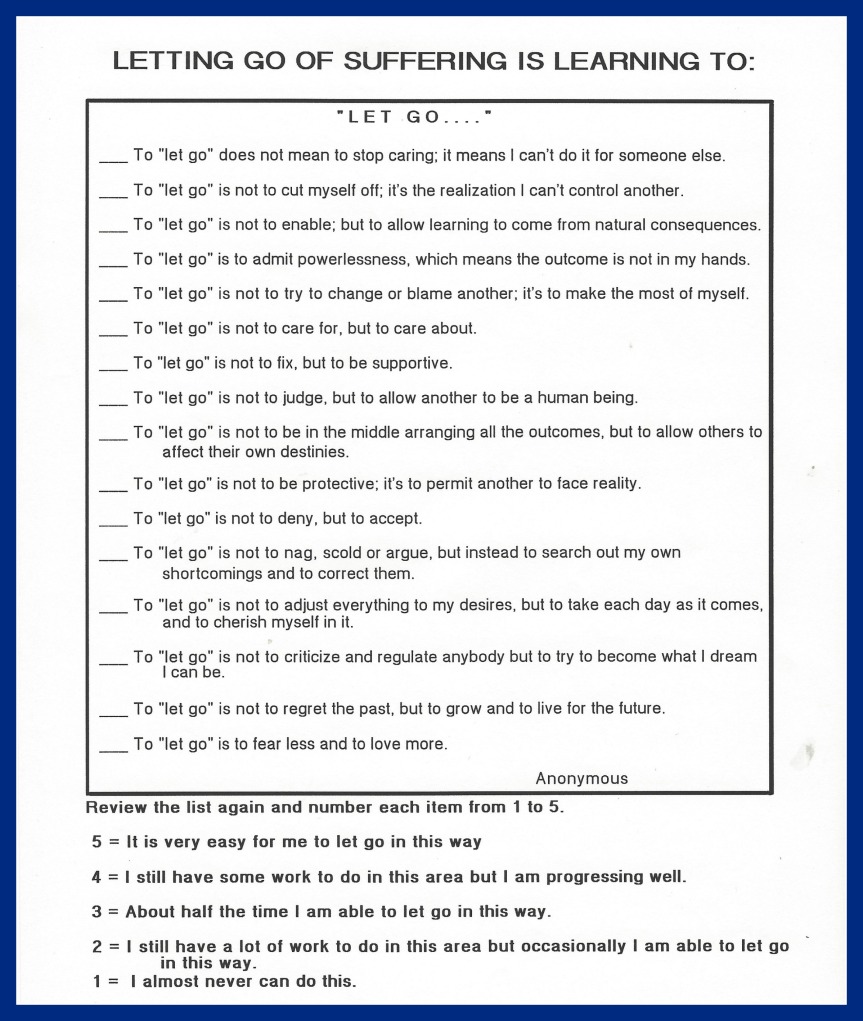
When you are suffering, it is often important to get help from others as you work to shift the energy. In the boxes below, or in your journal or notebook, write the names and phone numbers of people in your life who might be available when you need support.

support-2

Exercise 2

What scares you about letting go of your suffering? Write down any fears that come to your mind, whether they make sense to you or not.

fear2

Exercise 3

letgo2

For the rest of this week, reflect on your answers to these three exercises. Consider journaling about the thoughts, feelings and/or insights that surface as you do that.


See you next Monday for the second lesson.

To find the lessons in this series that have already been published click here.

Letting Go of Suffering- New Series Announcement

Are you tired of holding on to the past or worrying about the future?

Have you had your fill of feeling like a victim?

Are you committed to stopping your self-defeating behaviors?

Starting on Monday, November 21, I will be posting one chapter a week (for 17 weeks) from the Letting Go of Suffering workbook I wrote in 1991. If you answered “Yes” to any of the questions above, this upcoming “course” may be instrumental in helping you to make those changes.

This course is meant to increase your understanding of why you are the way you are and to teach you some new behaviors that can facilitate your movement from suffering to joy. Among the areas that will be addressed are:

  • Identifying Your Vision
  • Discovering Your Suffering Profile
  • Stopping Passive Behavior and Critical Self Talk
  • Using Affirmations and Contracts to Heal
  • Holding Yourself Accountable

I look forward to the possibility of sharing this journey with you.

Letting Go of Suffering Series:

Letting Go of Suffering- New Series Announcement

Letting Go of Suffering- Week 1: The Beginning

Letting Go of Suffering

IMG_8037

For several years in the mid to late 1990’s and early 2000’s, I wrote articles about my experiences with Amma for “The New Times,” a free newspaper that was, at that time, available in Washington and Oregon. I have started sharing some of those articles on my blog. I am choosing the articles to post based on their topic, therefore they are not being shared chronologically. The article below was published in August of 1995.

~

The experience of grief is inherent in living. As we live, events will happen that we don’t want to happen. We will undergo violations, endings, disappointments and betrayals. If we allow ourselves to fully feel the pain that comes with these events, we will most likely learn the important lessons that are there for us to learn and move on. If we suppress the painful feelings and mask them with self pity, guilt, blame, suspicion, sarcasm, indifference, and/or worry, we are likely to move into suffering.

One day last year (1994), during my annual visit with my spiritual teacher, Mata Amritanandamayi (Amma), whose ashram is located in Amritapuri, India, I had the opportunity to experience and move through two episodes of emotional pain. That year, I had come to the ashram bringing with me 60 handmade skirts and blouses. This clothing had been made by friends and myself for children living in the orphanage operated by Amma.

One day I told Amma that I was going to deliver the clothes to the orphanage. As you might imagine, I was totally shocked when she responded that since I had not brought 600 sets of clothes, enough for each child at the orphanage to have a set, none of the children could have them!

My mind immediately started operating on three tracks. The first track was filled with rage, fear and self pity. Among the internal messages were:

  • What do you mean I can’t take them? Don’t you know how hard we worked? 
  • You betrayed me! 
  • You made me betray my friends. 
  • You aren’t fair. 
  • You made me waste a whole year. 
  • Now everyone is gong to be mad at me and it’s YOUR fault. 

The second track both recognized the lessons I was receiving and attempted to de-escalate the parts of me that were angry and afraid. Those messages, which came in a clear matter of fact, non-critical tone included:

  • Of course she said that. She does not want to set up competition between the children. That is totally reasonable and consistent with what you know of her. 
  • If a gift is an offering that has no strings attached, then the clothes were not a gift. Look at your level of attachment. 
  • This was supposed to be seva (selfless service). Seva, by definition, means that there should be no expectation of the fruit of one’s actions. Examine the process that is happening. How can you learn to give freely? 
  • The work parties were very valuable for the people who participated. They experienced working in community. They experienced giving. They had fun. You have not hurt anyone. 
  • Your friends will have an opportunity to learn lessons such as those you are now learning. 

The third track in my mind was busy contemplating how to sell the clothes so the proceeds could be donated to the orphanage. In that way some of the intention behind the gift would be met. Within minutes I had formulated a tentative plan.

The second and third tracks obviously were supportive and needed no help from me. The first was a different story. I sat close to Amma and let the fury rage inside of me. I could have said something directly to her but there was no need. Ultimately, I believed her response to be correct. The energy I was now experiencing was primarily old betrayal energy of mine, rooted in my childhood. I first tried to move the energy through by imagining myself yelling at Amma. Then I imagined doing various anger release techniques I would do if I were in a therapy setting. These inner processes moved some of my negative energy, but not enough.

I decided to leave the temple and talk to some friends. I asked them if I could have a few minutes to vent, complain, suffer. They agreed and I allowed all that was inside of me to come pouring out. Afterwards, I discovered that the messages on the first track had lost their power. I returned to the temple to sit near Amma feeling successful and complete with the issue. (Brief episodes of anger and fear occurred occasionally over the next few weeks but I was able to easily release the negative energy.)

On the same day as all of this occurred, I experienced another powerful and important event as I was walking back from a local tea shop with a friend. As we passed one of the swamis (monks), he smiled at me. For no apparent reason my whole being exploded with an unnamed grief. The grief was so deep and so intense I could barely walk. I sat in a private place and let the feelings come. I knew it didn’t matter what the grief was about, I simply needed to feel and release it. After about fifteen minutes I felt done; exhausted yet lighter. (One of the ways to differentiate true grief from suffering is to notice what you feel like after you express the emotion. After expressing deep grief, even though you may be tired, you are also likely to feel relieved, lighter, and cleaned out. After immersing yourself in suffering you will probably feel even worse than you did before!)

I ended that day feeling very grateful. Grateful that I had accessed and let go of such core level grief. Grateful that I had experienced the difference between the pain of grief and the pain of suffering. Grateful that I had done my therapy and had the skills to move through the pain. Grateful that I had moved through so much of the pain in my therapy process that what was left was manageable. Grateful that when I am near Amma, I usually move through pain faster than in normal living. Grateful that the process of living has and will continue to bring up any residual pain so I can release it and thereby live my life more and more in the present moment.

As I said in the beginning, grief is inherent in living. We cannot totally avoid pain but we can learn to stop holding on to it. I hope my stories will be of value to you as a model for dealing with your own grief.

~

“The New Times” articles that I’ve already shared:

Support in Times of Trouble

A Multitude of Lessons

Exposing the “Know-It-All”

Many Paths, Same Destination

Putting Pain in Perspective

Feeding a Fledging

I saw this video at Amma’s Toronto programs last month.  It touched my heart so much then.  When I received a copy of it a few minutes ago, I knew I wanted to share it with all of you.

The video came with this introduction:

Recently, a baby bird that had fallen out of its nest was brought to Amma during darshan. After feeding the bird, Amma said that its pathetic condition and heartfelt cries reminded her of all the suffering being experienced throughout the world and how the only way to rid the world of such suffering is through the awakening of compassion: “Children, the tears of those suffering from extreme poverty and other misfortunes, as well as of those who have more than enough materially but are still crying out deep within, can only be dried by pure love and compassion. May that compassion awaken in everyone, everywhere.

Amma feeding a fledgling


Quote of the Week: Hafiz

Manic Screaming

We should make all spiritual talk
Simple today:

God is trying to sell you something,
But you don’t want to buy.

That is what your suffering is:
Your fantastic haggling,
Your manic screaming over the price!

*****

Khwāja Shams-ud-Dīn Muhammad Hāfez-e Shīrāzī (also known as Hafiz, was a fourteenth century Persian poet.

*****

Poem from I Heard God Laughing: Renderings of Hafiz by Daniel Ladinsky

*****

Living in Gratitude

I spent a lot of time during my childhood sitting in my room pouting.  Decades later, during my personal therapy journey, I was able to move beyond much of the negativity and pain of those early years.  It was in my therapy community that I first had a strong sense of belonging.  I felt content and happy.  One day, though, I heard a friend talking about feeling joy.  Happiness versus joy….. hummm.  That was something to contemplate.  I felt happy, but I certainly did not feel joy. Continue reading “Living in Gratitude”