The second is a September 12, 1962 speech by President John F. Kennedy. As you listen to it, consider how we can apply his words to solving the problems we are facing in the world today.
I felt some sadness as I listened to the song, because these last eight years have shown how much work we still have to do in regards to racial relations. At the same time, I know the words are as true now as they were when it was recorded.
In another post published today, Kathie also shared personal memories of what she was doing during the Civil Rights period and on the day that Martin Luther King was assassinated. Check out her post at In Honor of Dr. King. I think you will be glad you did.
Since Amma was on the North Kerala tour, my last days in the ashram for this year were relatively quiet. As soon as she left, I started cleaning up my room and storing my belongings. I also worked in the cafe, and had some special time with Chaitanya and Sreejit (my daughter and son). In addition, I reflected on my trip as a whole and pondered changes I would make once I returned to Seattle
Tai Chi
You might remember that my Tai teachers had returned to their respective countries. Dave departed just before Christmas and Stefanie left soon after New Year’s. Our class had decided to practice on its own, but a man we met just before our instructors left volunteered to teach us. He was a very kind and knowledgeable man, but his style was so different from what I was used to. Among other things, he taught us about 1) chakras, 2) giving gratitude to our organs for serving us year after year and 3) how each of the moves related to either bringing chi into our body or sending it out.
Like Dave and Stefanie, he often showed us how the movements we were doing related to the martial art form of Tai Chi. The information he shared was fascinating and valuable but we stood in one place while listening to him talk for an hour or more each day. My swollen feet didn’t do well with that. I tried sitting on the ground or on a step from time to time but that didn’t work for me either. He used quiet guided imagery a lot. I became agitated, wanting to be doing the beautiful Tai Chi moves. The rest of the class was thoroughly enjoying his class, though, so I began to think about dropping out.
I noticed my body was beginning to get stiff and was reverting to the way it had been before I had started the Tai Chi classes. One day, I decided to go to the beach early and practice the movements I had learned. I enjoyed doing that so much. That practice was followed by another day of standing still for over an hour, so I decided to drop the class.
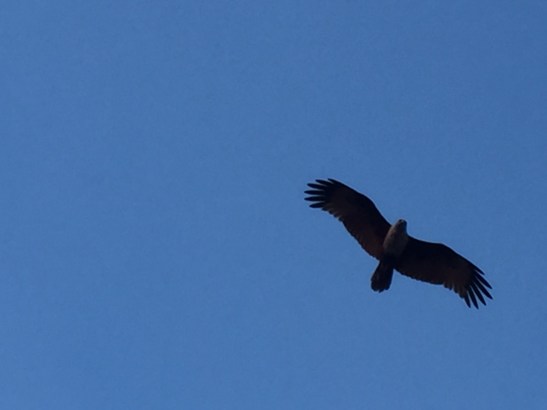
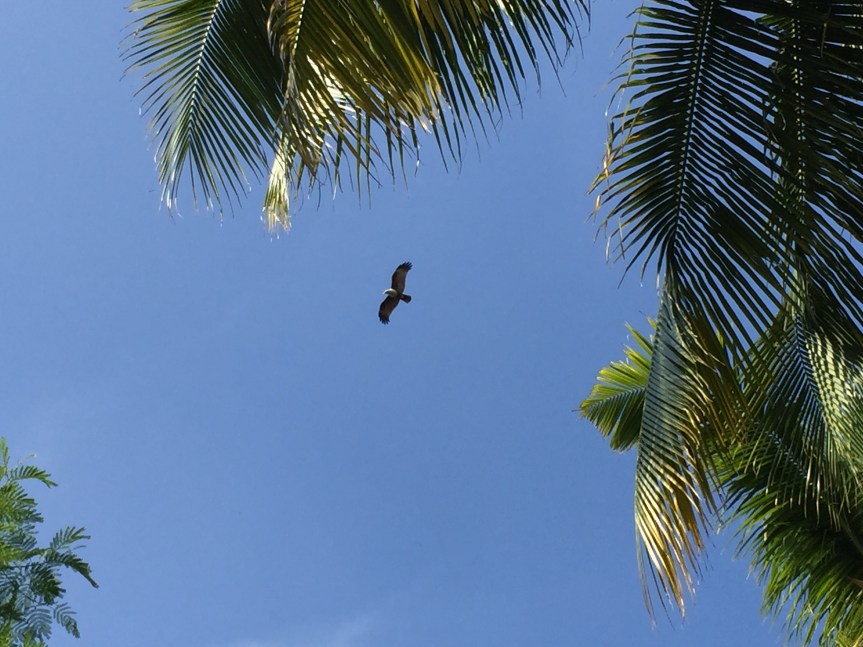
Each morning until I left the ashram, I took the elevator up to the 15th floor of the building I live in and then walked up to the roof. As I did Tai Chi on the rooftop, majestic eagles flew over me.
This slideshow requires JavaScript.
(I realize some of you may not be able to access the slide show so I will post one of the photos below.)
During the last two days of my stay in Amritapuri, I purposely left my camera in my room and experienced the eagles for myself. One day there were six of them flying over or near me! That truly felt like heaven.
As my time to leave the ashram approached, I started doing computer searches to look for teachers in Seattle. I plan to take my time in choosing a new instructor. Dave had suggested we look for teachers whose movements flow and who has noticeable chi themselves. I added another criteria to that list. I want a teacher who emphasizes practice over theory.
There is one Tai Chi story I have meant to tell you in past posts but kept forgetting to do so. I have shared many photos of the beautiful beach where we held the class. What was also true about that beach is that we were learning in an area which was used as a parking lot during Amma’s public darshan programs. On those days, there were as many as four large buses and numerous cars parked in “our” area. That space was also the thoroughfare for pick-up trucks and bicycles going to and from the food composting center. We definitely had plenty of practice in staying flexible and patient. The whole scene became funny at times.
Seahawks
Another subject I haven’t mentioned at all is my love for the Seahawks. I have had a life time distaste for football but all that changed in 2013 when I became an avid follower of our Seattle team. I love the sense of community supporting the team brings to Seattle, and our whole region for that matter. Last year I purposely woke up early when I was in India to “watch” some of the games. (I say “watch” but that really means I was watching the score.) This year I was content to just look at the scores when I woke up, but the team was still very much on my mind. I would be returning at the same time the playoff games started. In fact, the first play off game would take place when I staying in a hotel in Dubai, so I planned to “watch” it there. (Photo Credit: Ginny Gensler)
Trip summary
I decided to make a photo gallery that represents many of the highlights of my 2015/16 visit to Amritapuri:
Time with Amma
Time with Chaitanya
Time with Sreejit
Time with Akshay
India
Sunrises and sunsets
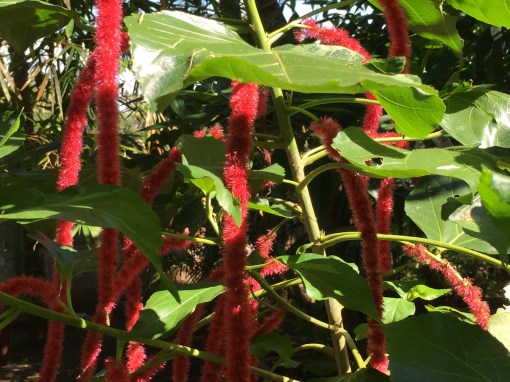
Beautiful flowers
Beautiful flowers
Writing my migrant farm labor series
Costumes with Sumati
Costumes with Jani
Sabbath dinner
12 foot high Goliath puppet
Saul’s army with David
John the Baptist
Jesus is home again!
(Hover the cursor over pictures to see the captions; Click the gallery to enlarge the pictures)
There are, of course, many other people with whom I had special times on this trip but have no picture of them to put in the gallery. I will keep the photo below separate from the gallery since I didn’t take it in Amritapuri. It portrays a pancake I made when I returned to Seattle; one that was inspired by the breakfasts my friend Lalita created each morning. I appreciate her positive modeling of healthy eating and all of the wonderful conversations we had during that meal. The pancake I made is topped with yogurt, pomegranate, bananas, chia seeds and hemp seeds. I will eventually look for ragi flour and try to replicate the cafe’s ragi pancakes!
January 17 Epilogue
I left India on January 10. On the way back to Seattle, I stayed 14 hours in the Dubai airport hotel and did indeed follow the first Seahawk playoff game while I was there! When I was still at the airport in India, I was thinking about the game and noticed that Skiddles were being sold there. I’ve never had a Skiddle in my life, but I knew one of our players often talks about them (I think they are one of his sponsors). I decided to buy a package of Skiddles as a symbol of support for my team. When I mentioned I had purchased them to Sreejit and Chaitanya they both told me how bad they were for my teeth! I thought it was funny to get that kind of feedback from my kids.
I arrived in Seattle on Monday morning and on Wednesday morning checked out my first Tai Chi class. I liked the class but I want to experience some other teachers before I make a decision about an ongoing classes. I have picked classes to attend on the 19th and 21st.
I spent this weekend attending a Sanskrit workshop. I love being with the Samskrita Bharati family but in the future I will remind myself not to participate in a workshop so soon after my return. (I’m still only sleeping 2 or 3 hours a night due to jet lag.) My friend Yashas took the workshop with me and he loved it. That really made the weekend extra special for me. Hopefully in time we will be able to speak Sanskrit together. (As an aside, the 2nd Seahawks playoff game was during the workshop. I know I was not the only person in the room who was surreptitiously glancing at their phone to check the score. We lost. Bummer.)
My visit to India was challenging but I learned so much and will be eternally grateful for the opportunities I have been given. Thank you for reading my posts and in so doing taking the journey along with me.
The first bhajan (devotional song) that Amma sang after giving her New Year’s Message was Khuśiyōm Kī Bahār, a beautiful, heartfelt song. Later I looked up the meaning and discovered that the translation is as moving as the tune.
Khuśiyōm Kī Bahār
May all beings be happy and without sorrows.
May all see only the good that is in everything.
May the spring of joy burst forth. May the world be filled with peace. O Lord, may we become selfless and free of desires and thus may we progress steadily towards You.
Let all people in the world be content. Let them see the divine spark in all others and let the light of love shine in their hearts. May all live in harmony.
Let us pray and hope together. We will chant constantly the divine mantra that is a prayer for the entire world to be happy.
Source: Bhajanamritam 5:98-99, Mata Amritanandamayi Center
In the mid 90’s, I read a book that really spoke to me. It was called “The Balkan Express: Fragments from the Other Side of the War”by Slavenka Drakulic. She is a respected journalist and commentator from Croatia. The publication contained a series of essays about the effect the Serbo-Croatian war had on her colleagues and fellow countrymen.
The portion of the book that I remember to this day is her essay “High Heeled Shoes.” In it she described her growing awareness that she had turned citizens of her country, even close friends, into “others.”
First, she saw that instead of seeing refugees as people who had escaped slaughter by the Serbians, she had started stereotyping them. “They are just sitting smoking, doing nothing. Waiting. Waiting for what? For us to feed them. They could work, there are plenty of jobs around, houses to be repaired or working the land.” She heard a woman on a train say “This city stinks of refugees” at a time when there were refugees sitting beside her.
As she continued to examine her own attitudes, she saw that she had reduced individuals to the category of “they” and from there to “second-class citizen” or “non-citizen.” She realized when we do this, they soon become “not-me” or “not-us.” We may feel some sense of responsibility for them, but it is the type of responsibility that we feel towards beggars. “The feeling of human solidarity turns into an issue of my personal ethics.” We help only if we want to.
As her reflection continued, she wondered :
Perhaps what I am also witnessing is a mechanism of self-defence as if there were a limit to how much brutality, pain or suffering one is able to take on board and feel responsible for. Over and above this, we are often confronted with more less abstract entities, numbers, groups, categories of people, facts– but not names, not faces. To deal with pain on such a scale is in a way much easier than to deal with individuals. With a person you know you have to do something, act, give food, shelter, money, take care. On the other hand, one person could certainly not be expected to take care of a whole mass of people. For them, there has to be someone else: the state, a church, the Red Cross, Caritas, an institution.
and
Out of opportunism and fear we are all becoming collaborators or accomplices in the perpetuation of war. For by closing our eyes, by continuing our shopping, by working our land, by pretending that nothing is happening, by thinking it is not our problem, we are betraying those “others” – and I don’t know if there is a way out of it. What we fail to realize is that by such divisions we deceive ourselves too, exposing ourselves to the same possibility of becoming the “others” in a different situation.
I still resonate with everything Slavenka Drakulic said in that essay. I know I put panhandlers in the “other” category. When I see someone whom I think might be about to ask me for money, a whole litany of judgments erupt within me. While I’ve worked on this issue, it is not gone. While I don’t believe I have the same negative judgments about the victims of war and the natural disasters that are occurring with increasing frequency in the world, I believe I am still seeing them as “others.”
I need to confront my judgments, help more, and remember to think of people as individuals who like me have needs and wants. I need to remind myself that we belong to the same human family. They are a part of me; we are one. No, I can’t fix all of the problems in the world, but I can do more than I am doing and it can be from a place of love, caring and inclusion rather than from some “better than thou” place within myself.
Observe how birth, suffering, illness and death touch each one of us who lives on the earth. This is the pain we all share, in which we all partake, the pain of being human that touches our common bodies, hearts and minds. You may say to yourself as each image arises. “I am your other self.”
Embrace each image with forgiveness, mercy and love, touching the pain your heart, touching all the beings who suffer with your heart. This is the inheritance of the family of creation. This is your family.
Feel the depth of connection to all beings as you allow the pain to be the doorway into community with your greater family. Feel the truth of that belonging. Gradually return to the awareness of your breath as it naturally flows in and out of your body; feel your body as a tiny cell in the larger body we all share.
Lokah Samastha Sukhino Bhavantu
May all beings in the world be happy.
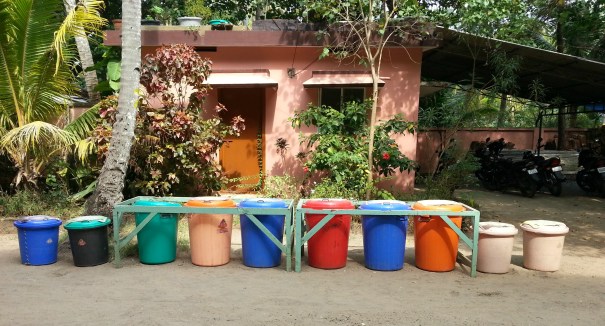
Amma has made recycling and composting a major priority for the ashram. Every resident and visitor sorts their trash into separate bins labeled for paper, soft plastic, hard plastic, yard waste, food waste, sharps, sanitary, cloth, dust and hair. Last year there were 16 recycling stations, such as the one in the photo above, scattered throughout the ashram grounds. Since so many more flats have been built since then, I imagine the number of recycling stations have increased as well.
The yard and food waste from these bins plus the leftover food from the various kitchens and dining areas are taken to the composting center and the rest of the items go to the recycling center. Think about how much waste 5000-15,000 residents and visitors might produce in a day and you will get a sense of the scope of these projects.
Once the bins arrive at the recycling center they are re-sorted by volunteers. Items that were placed in the wrong bin are removed and put in the appropriate bin. Once that process is completed, the items are sorted for a third time, in a much more detailed way. For example, items in the paper bin are divided into 10 different subcategories.
The recycled items are sold and help to fund Amma’s humanitarian projects.
The vermi-composting center is the small building on the left; the food and yard waste composting center is on the right.
The food and yard waste bins are taken to the composting center. The food is put on a metal table and volunteers take out any non-food items such as plastic bags, spoons, etc. Then large food items are cut. Next, items such as fresh cow dung from the ashram cows, egg shells, shredded yard waste as well as wood chips and sawdust from the carpentry shop are added to the food in order to increase the bacterial culture and nitrogen or to make the mix drier. Once the food waste has been processed, it is formed into piles. The piles are covered with more shredded wood and yard waste. As the food composts, the piles can become very hot. You can even see steam rising from them. Volunteers aerate the compost by turning it with pitchforks. (This year I saw signs asking for volunteers to turn the compost at 2 a.m.!) The piles stay at the composting center for two to three weeks and then go to a farm or to the vermi-composting center to finish the composting process.
The yard waste is being processed at the same time as the food waste. The yard waste consists of materials that are gathered when the ashram grounds are swept each morning, along with other garden waste. The waste is put into a container that has a metal grate on the bottom. The grate allows the sand, pebbles and dust to fall through. Next, rocks, seeds, plastic and other items that shouldn’t be part of the compost are removed. What is left is the usable yard waste. That yard waste is then put into a shredder. Once shredded, it may be added directly into the food waste as described above, or it may be spread on the surface of the compost piles.
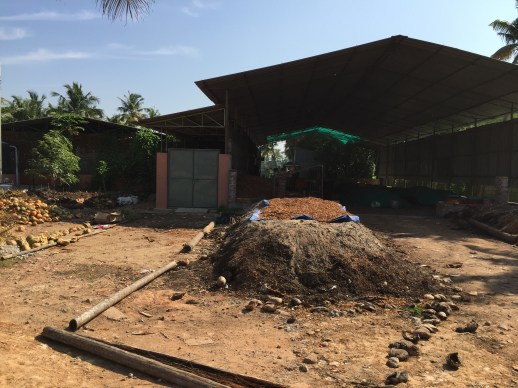
For years, the composting center has been located on the main ashram grounds. When I arrived at the ashram in November, I discovered it had moved. Now it is near Kuzhitura Farm, a 20 minute walk from the ashram. Pick-up trucks take the food and yard waste to the new center and the volunteers who work there generally ride bicycles. The new center is about three times the size of the original one.
Working with the food waste
Compost piles
~~~
The Red Worm Composting blog states that “Worm composting (also known as vermi-composting) involves the breakdown of organic wastes via the joint action of worms and microorganisms (although there are often other critters that lend a hand).” That process creates some of the highest quality fertilizer that exists. Red worms are the type of worms used for vermi-composting.
In the vermi-composting center, worm beds are formed from the food and yard waste compost. When the beds are ready, the worms are then added to the piles. Each day, a “slurpee” made from cow dung and water is poured on the top of the beds. The worms rise to the surface and feast. It takes about three months for the worms to turn the compost into fertilizer.
The ashram’s vermi-composting project moved to the Kuzhitura Farm location over a year ago. When I visited the new center last year, there were eight to ten worm beds. This year there were only the two shown below. I asked one of the people in the food composting center about the change and he told me they had discovered they were using way too much bedding material for the number of worms they had. Taking care of two big beds would certainly decrease the amount of time it took to maintain the beds!
There was another big change this year. In the past, when the fertilized compost was ready, volunteers separated the worms from the compost by hand. It took many volunteers and a lot of time to accomplish that process. (That was a job I loved to do!) The worms are now separated from the compost with a machine that is like a sifter. There was no staff present when I visited so I didn’t have the opportunity to talk to anyone about it, but I did take some pictures of the sifter.
The fertilized compost produced at Amritapuri has always been dark in color and very light weight. I’ve been jealous because it is so much nicer than what my vermi-composting system in Seattle produces. One of the people from the food composting center showed me some of the compost that is created using the new shifting process. It was even darker than it has been in the past…. and was so light-weight. I hope to learn more about these changes the next time I visit Amritapuri.
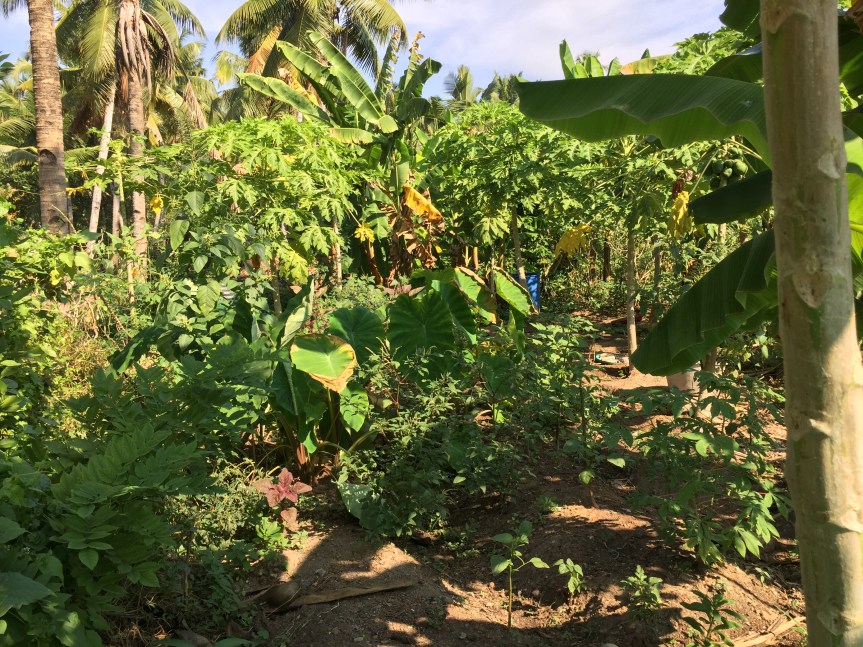
One of my goals for the last week of my trip was to visit the garden/farm south of the ashram as well as the one across the bridge near Amma’s Amrita School of Ayurveda. The land in both places is very dry, and water is scarce, so developing the gardens has been a process of trial and error over many years. This year the change was mind-boggling. In both places, I felt like I was walking into paradise. This post will be dedicated to the garden south of the ashram which is now called Kuzhitura Farm.
When I visited this farm last year, I had learned that they were focusing on using permaculture techniques. One of those techniques was the banana circle. I still remember how shocked I was when I researched bananas and banana circles later and learned that banana palms are not trees, they are actually considered a grass! (Banana Circles in Amritapuri).
When Premarupa and I arrived at the farm this year, I was struck by how different it looked. It is amazing how fast trees and plants grow in the tropics. While there are vegetables growing throughout the area, the big vegetable garden I remembered from the previous year wasn’t even in the same place. My guess is the trees and banana palms had grown so big that there was no longer enough sunlight in the original area. There is now a garden that is about triple the size of the previous one a distance away.
Here are pictures of the farm this year.
India
water retention pond
tulasi plant
India
(Click to enlarge pictures)
This property is also now home to Amritapuri’s food composting and vermi-composting (worm composting) centers. I will share more about those projects in the next post.
Since I wrote the “Needs vs Wants” prompt, I have been reflecting on my own relationship to that subject. Sitting here in my flat at Amma’s ashram in Amritapuri, India, it occurred to me that the reason I have been able to come here 26 times since January 1990 is because I have made that trip a major priority in my life. I value experience over material possessions so I have never been pulled into the world of consumerism and accumulation. There have only been two years when I was not able to save enough money to allow me to make that sojourn.
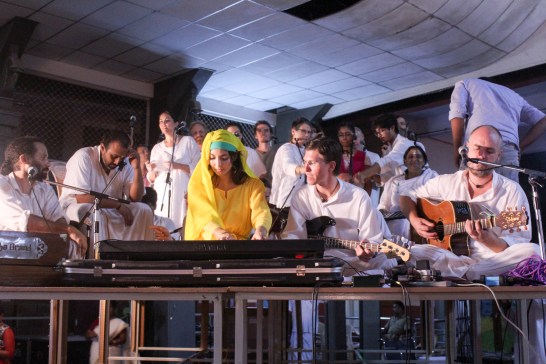
In an earlier post, I shared pictures of the actors and scenes from this year’s Amritapuri Christmas play, “Blessed Art Thou.” In this one, I will focus more on the musicians and vocalists. Their work was magnificent.
In many, if not most, of the plays in Amritapuri, the musicians and vocalists are off stage. The actors are actually lip syncing when they appear to be speaking. They do such a good job of lip syncing many who watch the play don’t realize that they aren’t speaking, unless they know that this practice is traditional in Indian dramas.
Vocalists
Sreejit coordinates the group of musicians and vocalists. He and his musician friends start writing tunes as soon as one year’s play is over; long before they know what the next year’s play will be about. They write many tunes during the year but only a small fraction of them become part of the production.
Here are some of my favorite songs from this year’s play. Two of the tunes are original and two aren’t.
Sabbath dinner
Part of this song is in Hebrew. It is traditionally sung in Jewish homes on the Sabbath. I think it is so beautiful.
***
Mary yearning for Jesus to return home
My favorite song in this play is “Each and Every Night.” Mary, mother of Jesus, is singing about how hard it is for her, as a mother, to wait for Jesus to come home again.
***
John the Baptist
The John the Baptist song was written and sung by Puneet Gabriel McCorrison. He is the person on the right side of the photo at the top of the post.
***
Satan tempting Jesus
This music and song is about the 40 days and 40 nights that Satan tempted Jesus. If you listen closely you will hear both the voice of Satan and the voice of Jesus. Sreejit is the voice of Satan! He is also in the photo at the top of the post, sitting on the left side. During the play, Sreejit played the harmonium and was the voice for both Goliath and Satan.
While there were many other songs in the performance, I believe these four will give you a good sense of how much the musicians and vocalists contributed to the play’s success!
New Year’s Eve
I was super busy on December 31. I left my room at 7:30 a.m. and didn’t make it back there, except for a few minutes, until 8:30 p.m. By then, I was so sleepy I couldn’t keep my eyes open. I knew the New Year’s Eve events would last until around 1:30 a.m., so decided to get some rest.
I slept from 8:30 to 10:30 p.m. When I woke up, I could tell that the entertainment portion of the evening program had already begun. I arrived at the auditorium in time to see a group led by Sashwat, an Amrita TV camera man. Two or three years ago he had surprised so many ashram residents by doing a rap performance on New Year’s Eve. This year, I sat on a table to the side of the hall and was able to see well. The singers and musicians were all sitting on the floor, as is typical in India. At one point a member of the group stood up and led several rap songs. He was the same man I mentioned in an earlier post, the one who practices Kung Fu moves on the beach! I was so surprised.
That group’s performance turned out to be the end of the entertainment program. Thursday was a darshan day and Amma continued to give hugs until just before midnight. She then led a meditation and a Lokah Samastha Sukhino Bhavantu (May all beings in the world be happy) chant. Next came her New Year’s message. Amma talked about a variety of topics. Among them were 1) welcoming the new year with joy and alertness, 2) compassion, 3) facing obstacles and 4) protecting nature’s harmony. You can read excerpts from her speech at: http://www.amritapuri.org/50825/16-newyear.aum.
Afterwards, Amma led several beautiful bhajans (devotional songs) and then did a Badaga dance. The crowd loved it all. The picture below was taken after one of the more rousing songs.
Following the bhajans, Amma served payasam (sweet pudding) to the thousands of people in the hall. She poured the pudding into cups and they were handed down from the stage on trays. Devotees then passed the cups of pudding to the people behind them until everyone had one. (Some of the brahmacharis also helped pour the payasam.)
After that, Amma left the hall and the devotees began to clean up. What a wonderful New Year’s Eve it had been.
New Year’s Day
Each year, about a week after the play, the cast get together to watch the newly created play video. It is always so much fun to watch it as a group. This year the viewing was on New Year’s Day and, as always, there was lots of laughter and applause.
That evening I went to the beach to meditate with Amma. On the way, I noticed one of the devotees who often represents the ashram was escorting a man and woman to the meditation. A young woman was walking nearby and when she saw the male visitor her jaw dropped in amazement. She came up to him and said she was a BIG fan of his. She turned around saying she couldn’t wait to tell her mother he was there.
I had no idea who he was but was definitely intrigued. Later I found out it was Russell Brand. I rarely see movies or watch other kinds of shows so I didn’t know anything about him. When I did an internet search, I discovered he is a British comedian, actor, and activist. I also learned he wrote an article about Amma last year so I looked that up as well. I was impressed with what he wrote. Many of his words were funny, but a lot of the things he wrote about Amma were profound. If you want to read his article you can find it at: https://web.facebook.com/RussellBrand/posts/10152650768708177
Time with Amma
In my last post, I had said I was going to make being with Amma a major priority for myself during the following week since she would be leaving on her North Kerala tour soon. While I did not always keep that commitment, I did make my decisions around use of time carefully. I think that was the life lesson, i.e. to make plans but be willing to let them go when it seems important to do so.
I received my last hug from Amma (for this trip) on December 30. I love it when Amma laughs while she hugs me. This time, it seemed like she held me for a long time while talking and laughing with the people who were nearby! What a great ending for that part of my trip
Celebration
One of the two elevators in our building has been out of service for a week or so. On New Year’s day there were so many people waiting for the elevator, I decided to walk up the stairs. There are fifteen flights of stairs to climb in order to get to my room on the fifth floor.
As I trudged up the stairs, I remembered I was carrying something for a friend living on the NINETH floor! I would have waited for the next elevator if I had remembered that, but I decided to just keep going. The celebration is that when I reached the eighth floor my pulse was 103 beats per minute (per Fitbit). On the nineth floor it was 105. A few months ago my pulse was 150 when I leisurely walked around a flat track at a park near Seattle. As far as I was concerned, for it to stay that low after climbing up 27 flights of stairs was worthy of a big celebration! I am so much healthier than I was when I arrived in India five weeks ago.
There is more I could say, but I will save it for another post. I hope that you all had a wonderful holiday season and wish you a very happy new year.
“The fool doth think he is wise, but the wise man knows himself to be a fool.” “Love all, trust a few, do wrong to none.” “Love looks not with the eyes, but with the mind, And therefore is winged Cupid painted blind.”-William Shakespeare


 Another subject I haven’t mentioned at all is my love for the Seahawks. I have had a life time distaste for football but all that changed in 2013 when I became an avid follower of our Seattle team. I love the sense of community supporting the team brings to Seattle, and our whole region for that matter. Last year I purposely woke up early when I was in India to “watch” some of the games. (I say “watch” but that really means I was watching the score.) This year I was content to just look at the scores when I woke up, but the team was still very much on my mind. I would be returning at the same time the playoff games started. In fact, the first play off game would take place when I staying in a hotel in Dubai, so I planned to “watch” it there. (Photo Credit: Ginny Gensler)












 Living, Learning and Letting Go