The Dungeon Prompt for this week asked us to identify a life pattern, one that we see repeating again and again. Since I already write regularly about the patterns in my life, I decided to answer this prompt in an unusual and fun way.
As I looked for a pattern to explore, I realized I have a nearly fifty-year-old pattern (something that happens in a regular and repeated way) of making items that are patterned (a repeated decorative design) and/or are made from patterns (a set of instructions to be followed in making a sewn or knitted item)! While I certainly don’t have pictures of everything I have made over the years, I do have a good sampling.
In the late 60’s and 70’s, I knit sweaters for myself and people important to me.
I also liked to sew. I made my blue wedding dress and the dashiki Al is wearing. I also made shirts and other clothing items for us.
I believe I crocheted the outfit Chaitanya wore when she came home from the hospital. I made the three sweaters below when Sreejit was a baby and have loaned them to friends with new babies many times. They still look as perfect as they did in 1975!
In the 70’s, I made several blankets. Two of them I still use.
In the 80’s, I made quilts for my daughter and my mother. When my mother passed, the white quilt was returned to me. It took me many years to finish Chaitanya quilt. By the time I completed it, she had moved to India where a quilt wasn’t needed. Both quilts are still used from time to time.
Sometime during the 90’s, I started making tiny Gods and Goddess dolls. They are sold during Amma’s tours as a way of making money for her humanitarian projects.
Saraswati
In the 2000’s, I worked with other Amma devotees to crochet blankets for homeless women who were moving into transitional housing.
Some years later, we worked together to crochet items out of recycled plastic.
Made from coffee and chip bags, strap and newspaper wrapper
Made from grocery bags
I can see that patterns are even a factor in the gardening I do now!
This has been a very interesting prompt for me to write. I am realizing how important projects such as these have been throughout my life.
It has been a very long time since I have immersed myself in any of these crafts. I hope to begin some of them again in the not too distant future!
When I met Amma in 1989, I didn’t know anything about Eastern spirituality and I had never heard of Sanskrit. Months later, I attended a one or two day workshop focused on learning the sounds of the Sanskrit letters. I have no memory of where I heard about the workshop or why I went. I do remember one other Amma devotee there, so maybe he invited me to go, or perhaps a group of devotees attended. Many of the bhajans (devotional songs) Amma sings are in Sanskrit so it may be I wanted to learn to pronounce the words of the songs correctly.
The workshop leader, Vyaas Houston, taught us the sounds of the letters through music; i.e. we sang the alphabet! He told us that by the end of the workshop few, if any, of us would be able to sing the whole piece by ourselves, but as a group we would sing it well. He was right. I thought it was a powerful display of the power of group process.
My writing the first two paragraphs of this post brought back another memory of that time. In the first weeks after I met Amma, I bought a cassette tape at East-West Bookstore. It was called Jai Ma. When I played the tape the first time, I had an experience that astounded me. As I listened to one song, I burst into tears. During the next song, my body flooded with joy. Yet another tune filled me with peace. How could that be? After all, the songs were in Sanskrit and I had no idea what the words meant.
Later, when I told one of my co-therapists what had happened he responded, “Of course, in Sanskrit the feelings are imbedded in the sounds.” This therapist was very logical and science oriented, as opposed to being interested in spirituality, yet he said this in such a matter-of-fact way. I was intrigued, but not enough to start in-depth study of Sanskrit.
After the weekend workshop, I made flashcards to teach myself the meaning of some of the Sanskrit bhajans. I also wanted to learn Malayalam, Amma’s language, so even though the word on the flashcard above is Sanskrit, the letters are in Malayalam script. (The meaning of the word is on the other side of the card.) Over the years, I attempted to learn Malayalam several times but without a teacher it seemed impossible. I didn’t make any significant progress so eventually gave up the endeavor.
Amma has always worked to bring back India’s traditions, e.g. traditional dances, traditional music, traditional values. There was a period when Amma started encouraging the ashram residents to learn Sanskrit. I remember a time about five years ago when Amma asked some of the brahmacharinis (female monks) to stand up and speak to everyone present in Sanskrit. Amma looked so happy as she listened to them talk.
Watching Amma’s joy piqued my interest in Sanskrit again, but I knew learning on my own wouldn’t work well. In 2011 my desire began to grow. When I went to Amritapuri in November of 2011 for my annual visit to Amma’s main ashram in India, one of the first things I saw was a friend of mine, Meenamba, sitting by herself studying Sanskrit! I sat down beside her and told her I also wanted to learn. She offered to give me the books she used when she first started learning the language.
Soon thereafter, I received a group email from a devotee in Seattle named Madhavi. She was offering to teach our satsang (a group of Amma devotees) how to say and understand the Sri Lalitha Sahasranama Strotram, a spiritual text Amma asks us to chant daily. I had met Madhavi before but she was new to our satsang so I didn’t know anything about her.
Her email certainly caught my attention. I responded, commenting that learning to read the chant was not my goal; I wanted to learn spoken Sanskrit! I asked if she would be willing to correct my homework as I worked my way through the books I had been given.
Madhavi replied that she had been teaching spoken Sanskrit for seven years! She said I could learn the letters and their sounds in the class she had advertised, and that she was willing to expand the curriculum so that those of us who were interested in learning spoken Sanskrit could do so. I marveled at the synchronicity of all that was occurring. This was certainly a major turning point in my Sanskrit journey
Madhavi’s class started in February of 2012 and I have been studying Sanskrit with her ever since. That first summer I also took a Samskrita Bharati three-day intensive, and did that again in 2013 and 2014. While Madhavi’s classes focused on reading, writing, and grammar, Samsrkita Bharati’s classes focused exclusively on spoken Sanskrit. In fact, that group resists speaking any English during the summer camp and they also discourage students from taking written notes. Luckily, they were willing to relax the rules a little with me since I need some things clarified in English. But each year I attend the camp I can see my progress.
When I went India in November of 2012, I studied with Meenamba for a month. During Amma’s Seattle programs in the summer of 2013, members of Madhavi’s Sanskrit class went together to receive Amma’s blessing. In November 2013, I attended Meenamba’s Sanskrit class during my visit to Amritapuri and just before I returned to Seattle we also went as a group to be blessed by Amma. That time each of the students said a sentence in Sanskrit to her! Amma beamed.
In May of 2014, our Seattle Sanskrit class organized and performed a skit in Sanskrit for Amma. That autumn, I started attending a weekly Samskrita Bharati class as well as Madhavi’s class. All but two students in the new class were Indian. The Indian students learn so much faster than I can. That is largely due to the fact that their native languages contain a lot of Sanskrit words so vocabulary isn’t as much a problem for them as it is for me. I found that I had learned enough of the fundamentals of Sanskrit in Madhavi’s class though, so that even if I still couldn’t understand conversations in Sanskrit, I could usually understand what was being taught. I’ve had to learn to be patient with myself and be okay with what I can and cannot do. But I do see myself moving forward and that is what is most important.
Last winter, a brahmachari (male monk) was teaching a Sanskrit class when I came to Amritapuri so I attended his class. I appreciate how each of my instructors have used a different style of teaching. I have learned so much by experiencing the various styles.
As Amma’s 2015 summer tour approached, I decided I wanted to again speak to Amma in Sanskrit, but this time I wanted to say more than a solitary sentence! I had the opportunity to do that last Thursday when I attended her programs in Dallas. Speaking Sanskrit, I thanked Amma for the new satsang that recently formed in the Seattle area. I told her I was very happy there and that I was leading bhajans every week. I added that I loved studying Sanskrit and asked her to help me learn to speak it. Her smile got bigger with every sentence I uttered, which of course filled me with joy!
I believe this week has been yet another turning point on my Sanskrit journey. I think this will be the year that I will be able to build my vocabulary enough to finally be able to participate, at least to a limited degree, in Sanskrit conversations. I am excited and ready to do whatever it takes to make that happen!
I found this video so inspiring that I cried. I hope you are moved by it too.
In 2008, when she was in third grade, Katie Stagliano planted a seed that grew into a 40 pound cabbage. She took it to a local soup kitchen where it was cooked, along with ham and rice, and served to 275 people. But the story only starts there. Watch the video to learn more.
For some time, I have been thinking about writing a post about a small lemon tree I purchased during the summer of 2013. My plan was to call the article “A Tale of Endurance.”
Then on Thursday, Sreejit posted his Dungeon Prompt for the week. He asked us to address:
How do you measure up to your eight-year-old-self’s plans for the future? We all had childhood dreams, or fantasies. How did you imagine the world as a kid? When you were eight years old, what did you plan on being when you grew up? What would that version of yourself think about who you are now?
Responding to this prompt posed a problem as I have almost no memories of my childhood. My mind went blank when I thought of my eight-year-old self. As I reflected on my childhood as a whole, it occurred to me that that my growing up years could also be seen as “A Tale of Endurance.” I wondered if I had that attitude about life by the time I was eight.
I decided to include both endurance tales in one post!
A Tale of Endurance #1
What did my eight-year-old dream of? I have no idea. My only clue is that I know my primary past-time during my childhood was reading. I do remember loving the Bobbsey Twin series. I think those were books an eight-year-old might read. I have no doubt that when I immersed myself in my books I was transported to other lands. It is likely that most of my childhood dreams came from the books I read.
Since I couldn’t answer the prompt by talking about my dreams, I decided to see if I could learn more about my eight-year-old self. I searched for some pictures and found two. I believe I was eight in the first one and nine in the second.
Me at 8?
On our way to Germany
I grew up as an army brat. I was born at Sandia Base in Albuquerque, New Mexico and lived there for the first years of my life. At some point during the Korean War my father went to Korea and my mother, brother and I moved to West Palm Beach, Florida, the city where my mother’s family lived.
I thought I had attended three different schools in the third grade but as I looked through old belongings yesterday, I discovered I had gone to two schools during the second grade and two in the third. When my father returned from Korea, we moved to Fayetteville, North Carolina; I would have been seven at that time. After two quarters of school in Fayetteville, we moved to Ft. Bragg, which is also in North Carolina. I finished the second grade there. I attended third grade at Ft. Brag for half a year and then moved to Pirmasens, Germany for the last half of third grade.
I can imagine the difficulty that switching schools so often would cause a child who was a strong introvert. In an army brat’s life, friendships were usually short; either we moved, or our friends did. I have no memory of any childhood friend, other than the cousins we visited on vacations.
I remember my mother saying that my pattern was to have one friend and then if they moved on to another best friend I would be devastated. I can imagine myself developing a “why bother” attitude when it came to friendship.
Yesterday, I also looked through all my elementary school report cards. I probably had read them sometime in the past, but it would have been decades ago. I paid particular attention to the report cards from the years I was eight and nine.
At that time, my teachers described me as earnest, pleasant, a hard worker, cooperative, and a good student who was creative, read well, learned quickly and had a wholesome attitude. In the second half of second grade and the first half of third grade, I received “Excellent” and “Good” for grades. When we moved to Germany and they used A, B, C, etc. as the grading system, I received A’s and B’s. The area where I consistently received the lowest marks and negative comments were in Writing. One teacher wrote “Carol (my name at that time) writes large enough but her letters are poorly formed.” Those comments continued throughout my elementary school years. I have no memory of my writing being an issue, although I’m not surprised considering how poorly I write now!
After writing positive comments on my report card, one teacher added- “I’m afraid she doesn’t receive much challenge.” I wonder what she meant?
Other comments that interested me were:
“She is slow to express herself.” That seemed reasonable for an introvert.
“Carol has improved some in writing but seems tense and not able to relax when writing and other times also. Have you noticed this?” My mother, who was also a teacher, responded “I have never noticed any tension in her writing at home but then she has an eraser at home (which she uses far too often) and I think her not having one at school may cause the tension. I’m not sure. She is a sensitive child and may be trying too hard to succeed in a subject she knows she’s having trouble with.”
I don’t know how soon my life began to feel like a tale of endurance. As I aged, I became more and more unhappy at home. At one point, I counted off the days until I could leave for college. I hated moving so often and wanted to create a life where I could stay put. Hmmmm. I wonder if that was a dream when I was eight. If so, it was one I created as I have lived in the same house in Seattle since 1973!
I have loved getting some insight into my eight-year-old self. Thank you Sreejit for offering this assignment and thereby prompting my exploration.
A Tale of Endurance #2
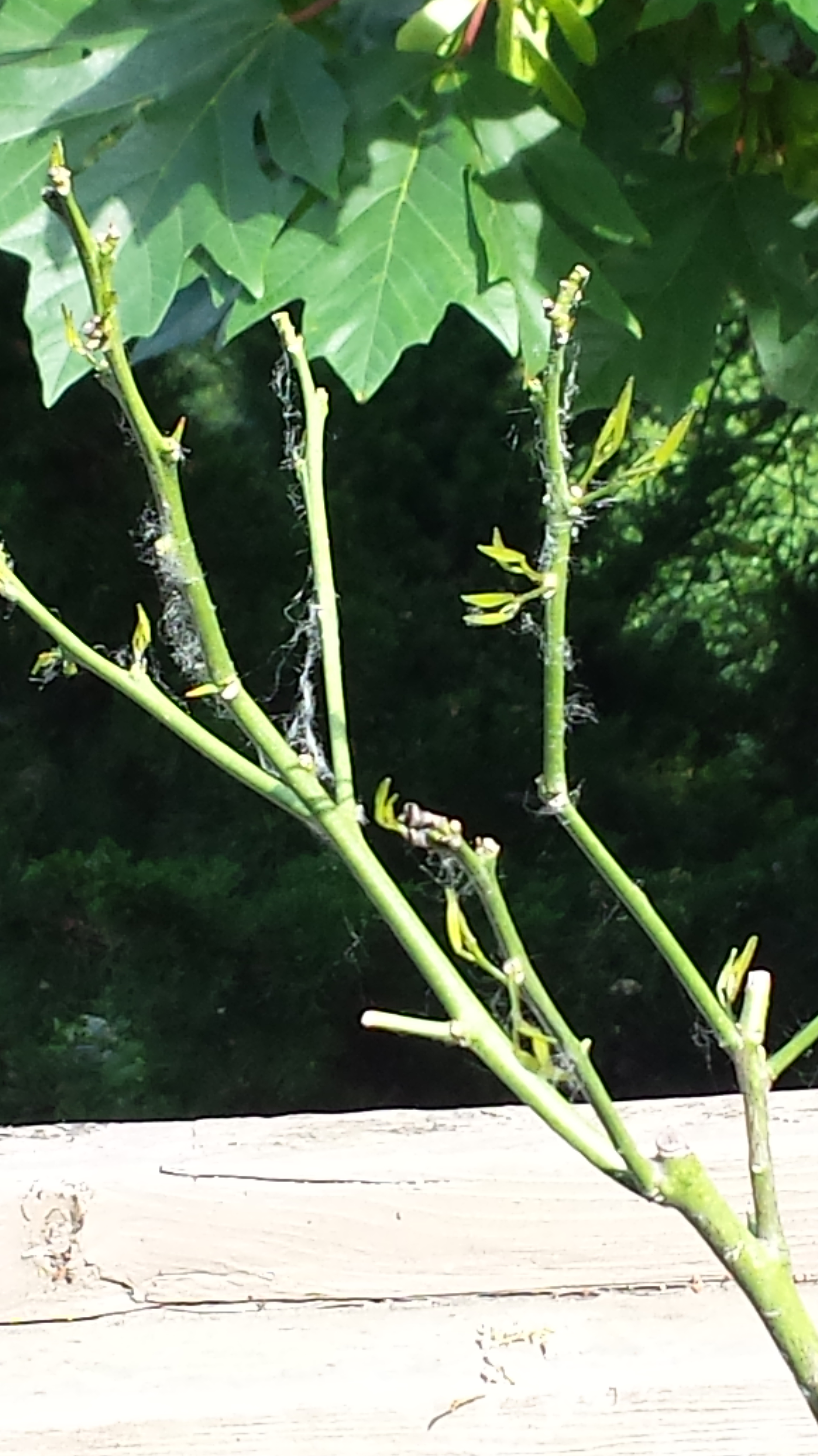
In the summer of 2013, I bought a small lemon tree. There were several lemons on it when I purchased the tree and I had visions of all of the lemons that were to come. The nursery staff told me to bring the tree into the house before the temperatures dropped, so as winter neared I put it indoors. One by one, the beautiful lemons turned black and fell off. Then most of the leaves fell off. Soon there was nothing left but the trunk (if you can call something that small a trunk) and a few leaves.
Spring came and nothing happened. The same few leaves stayed on, but there were no new ones and there were no buds. I took the plant to a nursery to see if it was possible to save it. They instructed me to use a particular kind of fertilizer. Months later there was still no new growth. It wasn’t until late August that a few flower buds formed. The plant was still alive but it seemed too late in the season for any fruit that formed to grow to maturity.
As it started to get cold, I once again brought the tree into the house. And again, the few small lemons that were on the tree turned black and fell off. This time the rest of the leaves fell off as well. I decided to leave the tree in the house even though it was just a stalk.
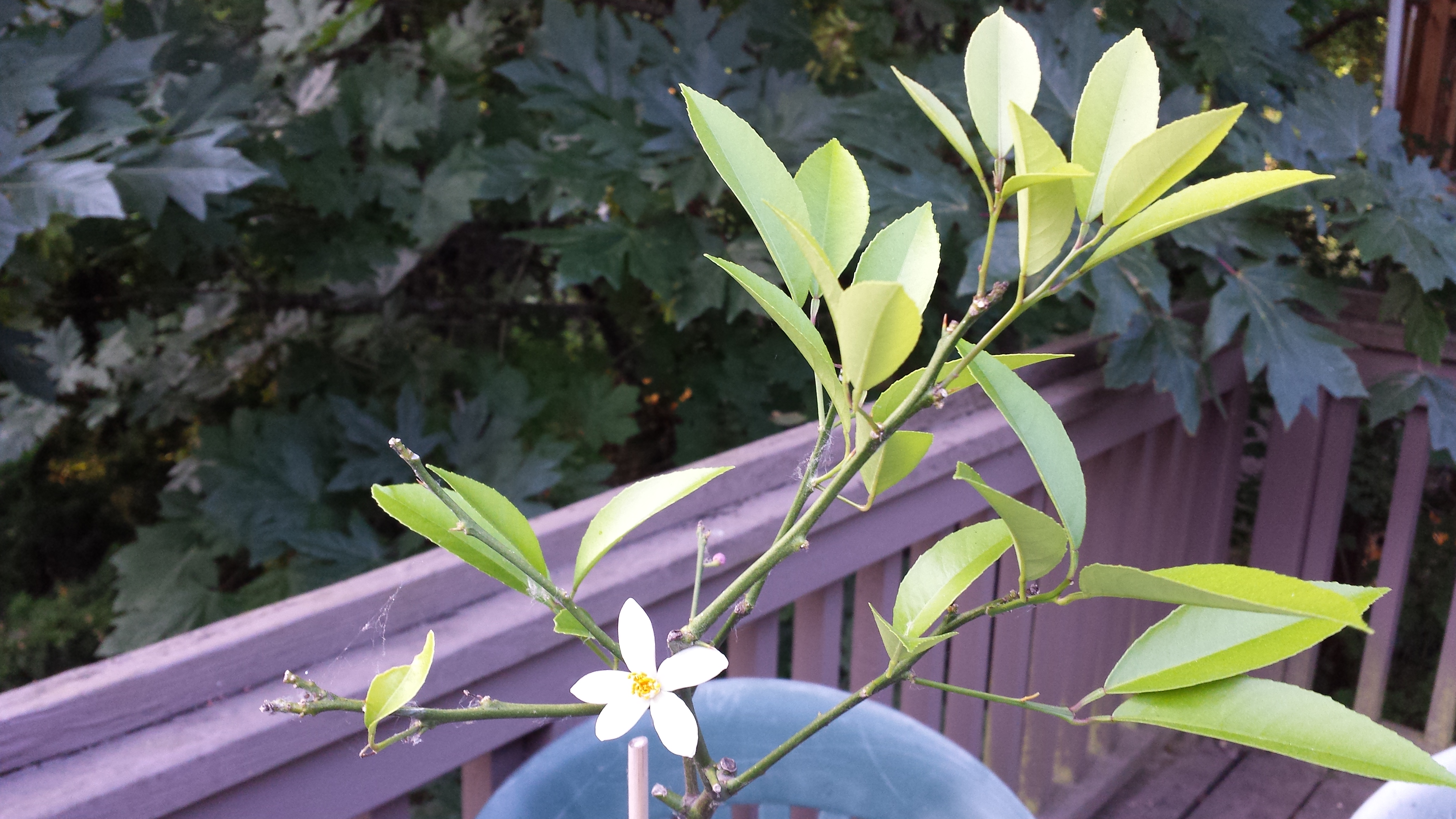
Sometime in late winter, I concluded that the situation was hopeless and put the tree outside on the balcony. I would compost it in the springtime. However, when springtime came and I picked up the container to take it to the compost heap, I noticed there were many tiny leave buds!
This tree seemed determined to live. Over the next weeks, the leaves grew, flower buds formed and then blossomed!
After a difficult childhood, my life blossomed and has been filled with friends, adventure and learning. It is interesting for me to see that many of the characteristics that my teachers pointed out on my eight-year-old report cards are characteristics that I am known for now. I think my eight-year-old would like the adult I have become.
It appears that this year the lemon tree is moving forward on its journey towards health. Perhaps in time it will even bear fruit that will become ripe!
I appreciate all the ways, past and present, that I am learning the value of endurance.
All of our mistakes have made us into the people that we are today, and so this is not meant to be an exercise in regret, but rather a fun look back with the thought, “that was maybe not such a great idea.” Tell us about a past exploit of your younger, less wise self.
It only took seconds for me to know what I would be sharing!
I moved from Florida to Washington State in 1966 to go to a conservative Christian school named Seattle Pacific College. Months before I arrived, the administration had granted students the privilege of being able to go to movie theaters. The school still had rules against wearing pants on campus, except on Saturdays, and they didn’t allow students to play cards, dance, or drink alcohol.
I believe it was sometime early in 1968 when I decided to become a volunteer at the First Avenue Service Center. That was a place where the homeless men and women from “skid row” could wash their clothes, bathe and have a place to hang out during the day.
I have no memory of how I found the Center but I loved being there. I talked with the people who frequented it and tried to bring some light into their days. I played a lot of pinochle with them even though I knew my college would not approve; pinochle was a major past-time for those who gathered at the Center. At some point, I wrote a letter to my mother saying something along the line of “Oh mom, I am meeting so many interesting people. I am getting to know ex-cons, drug addicts, drag queens, and prostitutes!”
I was very surprised when my mother wasn’t as excited about my adventure as I was. In fact, she told me she would be sending me a plane ticket home! I had no intention of leaving Seattle or the Center. While I don’t remember what happened next, since I never received the plane ticket, she must not have followed through on her threat. And I didn’t leave the Center.
My involvement with those people was not confined to my volunteer time. I would hang out with some of them outside of the Center as well. At one point, I started dating a young man who was a heroin addict. I was madly in love with him and did everything I could to spend time with him. To his credit, and my luck, he never asked me to get high with him. I had no interest in using any kind of drugs even though it was the 60’s. I just loved hanging out with him. I was so co-dependent though. If he wanted me to drive him somewhere I did it. I remember being so eager to see him that I drove back to Seattle non-stop after I had finished a summer job in New Mexico. The first thing he did upon my arrival was ask me to drive him to Portland … then … and I did it.
I didn’t know anything about co-dependency in those days, I just knew I was meeting fascinating people and my life was full of adventure. He eventually lost interest in me and took off. Looking back, I believe that he never considered me to be his girlfriend. I think I was mainly a chauffeur and he let me tag along at other times.
In hindsight, was it wise for a naive 19 or 20 year old to be volunteering at a place like that? Was it appropriate for me to be hanging out with “ex-cons, drug addicts, drag queens and prostitutes” outside of the Center? Was my “dating” a heroin addict a mistake? I would answer “No” to all of those questions, although I have to admit as I am writing this blog post, I am wavering on those answers a bit.
Would I want my daughter to have the experiences I had? I’d answer “Yes” in regards to some of them, but definitely not to all of them. I put myself into some very dangerous places and painful situations. Did I make mistakes? Yes I did, but I learned from them. And as Sreejit said in the prompt directions, everything that happened during that period of my life contributed to making me the person I am today.
I still remember a few of the people I met in those days. And the lessons I learned then allow me to do a much better job of keeping myself safe now. I also have a lot more compassion for my mother than I did at that time. I can certainly understand why she would react to my letter by telling me she would be sending me a plane ticket home!
Later in my life, I met my spiritual teacher, Amma. When I asked her for a spiritual name she named me Karuna. Karuna means compassion. I think that my sense of compassion and my adventurous spirit really blossomed and came to fruition during the year or so I volunteered at the First Avenue Service Center. I don’t have any regrets.
Some of you may remember that towards the end of last month, a swarm of tiny black ants formed on the sidewalk in front of my garden. I, of course, didn’t know how many there were but in my shock it looked like millions! I didn’t want to kill them but I also didn’t want that many ants, and potentially more, in my garden. I also didn’t want anyone to accidentally stand in them. After pondering the dilemma for a short time, I decided to wash them away with water from a hose. That solution worked and the ants never came back.
When I wrote about that event in Discrimination Opportunity, a blogging friend responded that he understood black ants to be harmless. In pondering his words, I realized that I had moved to action very quickly. I had been stung by red ants in the past after I unwittingly stood on or near their hills. Even one bite from a red ant can be very painful, and being bit by a large number of them is something I will never forget. Did that memory cause me to act too fast?
As I continued to reflect on my action, I realized that a child would be terrified if that many ants were crawling on them, even if they weren’t being stung. I concluded that my washing the ants away was a reasonable response, but I wasn’t sure that I was right.
Prior to that event, I had seen a few big black ants in my living room. After the incident with the tiny ants in the garden, more of those big ants showed up, both inside and outside of the house. Two ant events in a short period of time made me wonder what was going on.
When I become conscious of an animal, bird or other living being repetitively showing up in my life, I sometimes look to see what that creature symbolizes in Native American traditions. I googled “native american medicine ant” and found Dr. Loretta Standley’s website. She says this about ant medicine:
When Ant Medicine grabs your attention it is asking you to cooperate with your tribe (co-workers, family, projects, etc.,) in unity and patience. Ants are resolute and unwearied little creatures. Although they are tiny, they are indeed mighty. They have a strong skeleton on the “outside” of their body (exoskeleton) with specialized muscles that give them their strength. Ants can carry 30 times their weight, which would be equal to a 150 lb. person carrying a bulldozer on their back at 19,500 lbs.
The typical way to stop ant medicine is to literally stomp on it or fumigate it. If an ant is stomped on, it will emit pheromones that will draw more ants to the area. In short, ant medicine is unstoppable, tireless, patient and unified.
Ant’s message is about working non-stop toward your goals and forging ahead for the Good of the whole. Are you working on a project that benefits a larger audience? Have you been ignoring your tribe? Ant medicine cooperates with the tribe in harmony and wisdom toward a common goal, knowing that patience will be rewarded. Have you been cooperating with yourself on your own personal projects?
I was intrigued. Just the day before, I had met with two colleagues to clear up some long standing issues between us and was going to do the same with another friend the next day. I thought the “ant medicine” perspective was valuable and would ponder the questions Dr. Standley put forth. Now that I had this information would the ants go away?
Nope! If anything, the number of ants increased. I did more research and discovered the ants were carpenter ants. Everything I read indicated that I would probably have to call a professional pest control company to keep them from damaging my house. While there were still not that many ants, over the next few days their numbers continued to increase. Their favorite location seemed to be on my front porch.
I decided to take the time to observe them and see where they came from, where they were going and what they were doing. As I watched, I noticed that there were some small holes, or perhaps just indentations, in the caulking near the front door. The ants went to those holes over and over again. Even though the ants never went inside of them, it seemed like the holes were getting bigger. Maybe the ants were breaking down the caulking. They also went to a place next to the bottom corners of the door where some wires, probably old wires from broadband television hook ups, were located.
The following day there were even more ants on the porch. Anytime I left the door open even for a minute, the ants tried to get into the house. I decided I couldn’t continue doing this so called pest control. I made an appointment for them to do an assessment the following week.
I remembered hearing that spreading cinnamon powder could repel ants. It hadn’t worked very well in India when I tried it there, but I didn’t want to kill these ants unless it was absolutely necessary, so I spread some cinnamon in front of the door and in the areas where the wires were located. The number of ants decreased immediately but some still made their way through the cinnamon.
The next morning, I looked outside to see what was happening. There were three dead ants on the porch. Two were by themselves; the third was being pulled away by a live ant. The dead ant had a little different coloring than the rest of the ants. When I had looked up carpenter ants on the internet, I had noticed that the queen ant had different coloring than the workers so I wondered if the one being pulled away was a queen. I questioned whether a queen would be on the porch with a worker, but it seemed like a possible explanation as to why the black ant was trying to carry her away.
The live ant spent the whole day trying to drag the dead one from the porch. He seemed disoriented so I believed that he was probably also under the influence of the cinnamon.
I had thought the cinnamon would repel the ants, not kill them. My heart felt heavy as I watched his efforts. As I felt my feelings, I was struck by how much I have changed. I was raised in an era when we killed bugs, flies, spiders, and beetles, with swatters and insect spray, and here I was mourning the death of three ants and feeling compassion for the one who was taking such care to move the dead one.
I watched that process throughout the day, and noticed that no other ants ever came onto the porch. It has been almost two weeks since all of this happened and I have only seen two or three carpenter ants in or outside of my house during that time. They appear to be gone.
But my story doesn’t end there. There are two more related events!
During one of the psychotherapy groups I led the first week in June, an ant walked through the room. One of my clients immediately smashed it. As I thought about his action during the following week, I realized it was a good teaching opportunity. In the next group, I asked him if I could do a regression piece with him (a role play where he acted as if he was an eight year old and I was a healthy parent). He said yes so I talked to his eight year old about ants and what he thought should happen to them if they were in the house. We also talked about spiders. After we discussed his belief that they should be killed, I asked if he wanted to try something different. He was interested. I offered him the opportunity to be in charge of catching and releasing all bugs, spiders, and ants that might wander into the group room. He liked that idea and accepted the challenge. This past week an ant came into the room and he had his first experience of catching an ant and taking it outside!
The second incident occurred yesterday, the day I started writing this post. That morning, a friend phoned and said she wanted to talk to me about the morality of killing carpenter ants! Her situation was very different than mine in that there were a huge number of ants involved, but the timing amazed me. How interconnected we all are as we learn what we need to learn on our life journeys.
Am I done with the ant lesson? I don’t know; only time will tell. What I do know is that I have gained much from these occurrences. I see that I had an opportunity to:
Be thoughtful before taking an action that effects one of Mother Nature’s creatures.
Feel compassion for a creature as small as an ant.
Consider ways of thinking that are outside my normal experience, e.g. the Native American perspective.
Hear feedback and reflect on it.
Not criticize myself when I took action not knowing for sure what was right.
Learn from a previous experience, e.g. the ant swarm event prepared me for the carpenter ants
Share my experience with others, e.g. talking with my friend and to those who read this post.
Teach a new way to respect nature to a regressed 8 year old.
Be reminded that if I take my time, the answers will come.
See how all beings are interconnected.
Reflect on how much my attitudes towards live creatures have changed throughout my lifetime.
I feel very grateful for all I have experienced and learned as the result of this ant “lesson.”
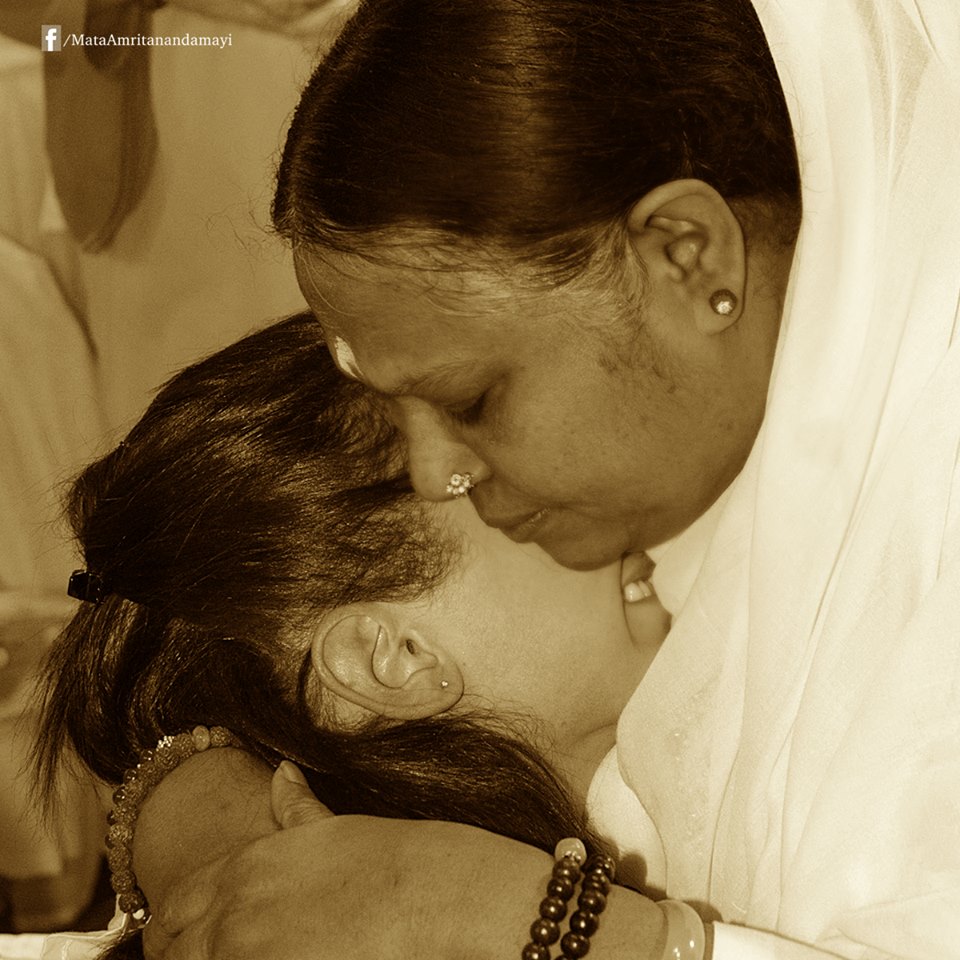
When I travel around the globe, people from war-stricken countries often come to see me. Women from these areas tell me, “We wake up in the morning to the sounds of gun-fire and screaming. Our children cling to us in fear and cry; we also hold onto them and cry. It’s been so many years since we awoke to the chirping of birds.”
Let us pray that the crackle of gunfire in such places is soon replaced by the sweet sounds of chirping birds, and that the young and old alike burst into laughter instead of tears.
–Amma
Amma is leading programs in North America until July 20. She is in San Ramon, California now and then will go to Los Angeles, Santa Fe, Dallas, Atlanta, Chicago, Washington D.C., Boston, New York City and Toronto. Schedule
“The fool doth think he is wise, but the wise man knows himself to be a fool.” “Love all, trust a few, do wrong to none.” “Love looks not with the eyes, but with the mind, And therefore is winged Cupid painted blind.”-William Shakespeare







 Living, Learning and Letting Go
_(2).jpg#/media/File:Shattuck_54238,_Camponotus,_Danum_Valley,_Sabah-web_(5042361317)_(2).jpg)