Greenbelt Restoration Work Party: September 30, 2018

I returned from India around noon on September 24th. I brought my luggage into the house and soon thereafter was checking out our Greenbelt site, eager to begin the forest restoration work again. I was pleased to see that most of the plants had survived the drought.

The University of Washington classes began on September 26th. This was to be the ninth quarter that students from their Introduction to Environmental Science course would help us. Most of our volunteers come from there, but we also get people from many other sources, such as neighbors and the Green Seattle Partnership Event Calendar. Most of our staff are part of GreenFriends, the environmental arm of Embracing the World.

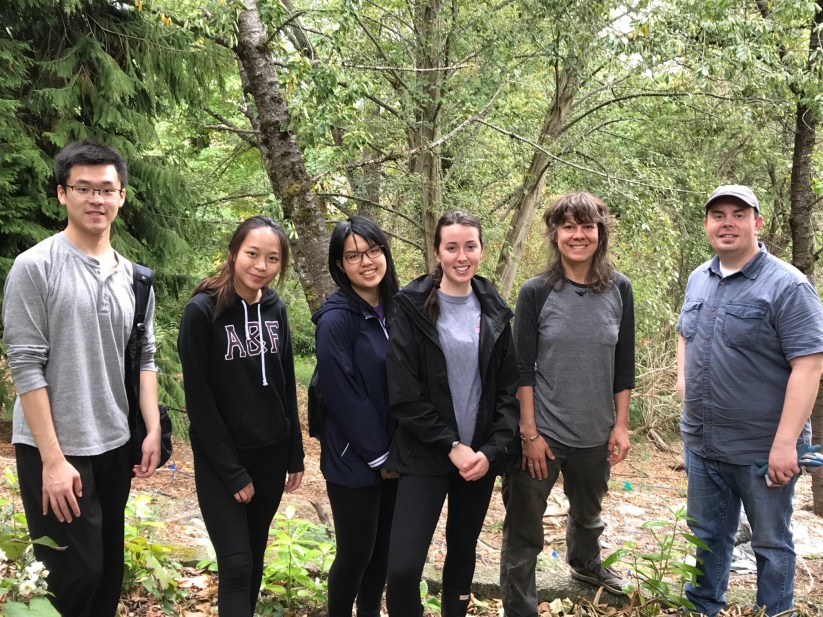
Our first fall quarter work party was held on Sunday, September 30.  Including the staff, we had eight volunteers. (There are only six people in the photo because I’m taking the picture and a neighbor didn’t arrive until the second half of the work party.)

I was so immersed in the work that I forgot to take photos throughout the work party. Luckily, I can show you some before and after pictures.

The Seattle Parks Department staff had delivered a pile of wood chips that looked similar to this one. Our main task for the day was to start the process of spreading wood chips along the paths in the Greenbelt. I knew from last year’s experience that during winter the paths get muddy and slippery and wanted to prevent that situation from reoccurring. After the work party orientation, we filled the buckets with wood chips.

(Click on any gallery to enlarge the photos.)

Then, we carried the filled buckets and spread the wood chips along the path, 3 inches thick and 3 feet wide. Some of the volunteers stayed at the wood pile to fill the empty buckets as they were returned. Together, we spread wood chips on 620 sq. ft. of land. I was amazed by how much a small group was able to accomplish in a little over an hour.

After a fifteen minute break, we divided into three teams. One team dug out invasive blackberries near the south-east part of the site. They also spread dried blackberry canes over burlap; this strip will become part of a path during an upcoming work party.

Before:

After:

The second team moved some stumps and thick branches from a future planting area, took wire and other trash to the trash pile, and then dug out blackberry vines and root balls from two areas that had been planted in March. The planting areas looked so nice after most of the blackberry shoots that had been coming up in them were removed.

The third group worked on a compost pile that was here long before our restoration project began. They dug out  weeds that were growing through it and pulled out any trash, branches or lumber that they found.

Before:

After:

I was so happy with the results of our work and feel very grateful to the volunteers who participated in this work party.

A Heartfelt Message from a Child

A friend sent me this video a few days ago. It is tough to watch but it has a VERY important message. I hope the time comes when the world has changed so much that this 6 year old’s words are no longer needed, other than for a history lesson.

I also found this follow up video:

It would be nice to see a follow up of the follow up.

Living and Learning in Amritapuri, India: September 15-24, 2018

This is the view from the bridge that goes between Amritapuri and Vallikavu.

I’ve been back in Seattle for 9 days, so it is high time that I finish the last post about most recent visit to Amritapuri, Living and Learning in Amritapuri, India: September 15 to 24, 2018. I have previously published three posts that focused on individual events that occurred during those dates.

Swachhata Hi Seva- September 15, 2018
The Intriguing Pond Heron
What Happened to the Amritapuri Swachhata Hi Seva Trash?

Sadness

Much of my last week in Amritapuri was spent packing, cleaning and doing the other things I needed to do to get ready to leave. I felt a sense of heaviness throughout the week. I had noticed that sensation towards the end of my last trip and have begun to realize that it is caused by an underlying sadness. Even though I felt ready to go back to Seattle, I felt sad to leave my family (Sreejit, Chaitanya and Akshay), Amma, and my Amritapuri friends.

Western Cafe and Western Canteen

People from so many western countries come to Amritapuri. I find it interesting to see how our food habits differ from each other. One of the things that has always seemed strange to me is that some people spread peanut butter and/or chocolate on their pancakes. They may also put peanut butter or chocolate in their ragi porridge. This year, a friend from Australia joked that peanut butter belongs ONLY on toast. I responded that peanut butter is good on bananas too, but she didn’t agree, restating that it only belongs on toast.

As I thought about it, it occurred to me that I like chocolate on everything else, so that I’d probably like it on a pancake too. And chocolate and peanut butter go together great. So, on one of my last days in Amritapuri, I tried chocolate on a pancake. I don’t think I’d do it again but it definitely was tasty. I just don’t need more reasons to eat chocolate.

People from some western countries only eat fried eggs that are cooked “sunny side up”. They don’t call them that though. I remember someone laughing at me years ago when I referred to their eggs in that way.

My favorite Western cafe items are cinnamon rolls, pesto omelets, lemon bars, chocolate bread, and pasta with cheese, soya, and tomato sauce. My favorite Western canteen items are all of the soups, mashed potatoes, Mexican rice and beans, and coconut beets. I’m sure there are some items I’m forgetting but those are the ones that come to my mind now.

Prasad Giving and Prasad Assistant

As I mentioned in an earlier post, during the last part of my visit, I started taking the opportunity to hand Amma the prasad she gives to each person who comes to her for a hug. (In this case, the prasad is a packet of ash and a piece of candy.) I loved doing this seva as much as I usually do.

Prasad-giving is also a good way to practice staying focused. I’ve learned from experience that if I don’t keep my eyes on Amma’s hand, I will miss the gesture she makes when she is ready to be handed the prasad.

There are often extra challenges to this seemingly easy job. One of the first times I handed the prasad to Amma on this trip,  a woman dressed in a white sari was whispering something into Amma’s ear. Part of her sari was draped in-between Amma’s hand and me; I couldn’t see a thing. I had to find a way to move  the sari so I could see at least part of Amma’s hand as well as get the prasad into Amma’s hand when it was time. It was a tricky situation but I did it.

At the beginning of my visit, I had said no to taking on a prasad assistant job. I declined the opportunity because I wanted to stay focused on my decision to attend more of Amma’s meditation, Q and A and bhajan programs and to sit in the front of the room rather than in the back or sides of the large auditorium. While it was possible for me to do all of these things, I didn’t want to overload myself with commitments; I was already working in the cafe every morning.

One of the prasad coordinators came to me about a week before I left Amritapuri and told me that she had lost one of her prasad assistants. She asked again if I would do it. This time I said yes. I served as a prasad assistant on September 16 and 21. That job required me to make sure that the prasad-giving line was always full of volunteers and that they were trained. I also was responsible for calling prasad-givers up to the stage in 2 minute intervals.

My shift was during a time of day when it is hard to find volunteers so it was an intense job. And as it turned out, I not only did my own hour long shift but also forty minutes of the person’s shift that did the job before me. Keeping the line filled was a challenge. Luckily, my supervisor helped find people too. The reason finding volunteers was difficult at that time of day was that many of the devotees were chanting the Sri Lalita Sahasranama and a variety of other chants during that time, and once that program was over, many of them went to lunch.

My Experiment

I have mentioned many times that an important focus for me during this trip was to sit in the front of the auditorium so I would be closer to Amma and could be more attentive than when I sat in the back or far sides of the hall. I also promised myself that would go to more of the programs. While I did not attend all of the meditations or Q&A sessions, I did go to more of them than I have in many years.

I was present for all of the bhajan programs. I routinely sat on the floor in the front section of the auditorium at that time. That was a major accomplishment for me. Being up front helped me stay focused. I loved singing so many of the older bhajans and looked forward to singing some of them at satsang once I returned to Seattle.

Darshan

I have also mentioned that this year devotees have been able to go for Amma’s darshan (hug) more often than “normal”. I’m so used to going only when I arrive and when I leave, or when I feel a strong need. Going frequently often feels wrong to me.

Generally, darshan tokens are given out in the morning. Sometimes, later in the day, Amma tells the token coordinators to hand out more tokens. On the evening of September 16 or 17, I was offered a darshan token and accepted it.  I started to question that decision as I was going through the darshan line.

As I neared the front of the line, Swami Amritaswarupananda started singing a slow version of Hare Rama, Hare Krishna. That is one of my favorite bhajans. When I was directly in front of Amma, and was next in line to be hugged, she started talking to someone. They talked for quite a while, so I was close to Amma much longer than I would normally be. My consciousness became so altered (i.e. I was going into a meditative state) that I wondered if I was going to be able to kneel down and stand up easily. Then I was in Amma’s arms. I no longer had any doubt that I had made the right decision when I chose to go for darshan.

I wonder how much stress I put on myself unnecessarily. Maybe I should just trust that if Amma asks the darshan token coordinators to hand out more tokens, I should just take one.

Geckos

There are often one or two small geckos in my flat. In December, the geckos that are living there are bigger than the ones that are present when I come to the ashram in August. Early on in this trip, I saw a little gecko in my room. A few days before I was to leave, I saw a really tiny one; it wasn’t much bigger than an inch. I enjoy having the geckos as roommates.


Returning to Seattle

As I age, I have had a harder time getting over jet lag. There is a 12 1/2 hour time difference between India and Seattle and switching day and night is not easy. Several years ago, I started spending a night in the Dubai airport hotel and that has helped. I added another “make it easier” step this time. My practice has been to take a taxi from Amritapuri to Trivandrum starting at 4:45 a.m. on the morning of my flight. That means that I need to get up around 3 a.m. This schedule has been stressful for me and I have had a hard time sleeping that last night.

I decided I would take a taxi to Kovalam, a town near Trivandrum, the night before I was to leave India. I left the ashram at 3 p.m. on the 22nd and arrived in Kovalam around 6. I was able to get a good night’s sleep in the Kovalam hotel before leaving for the airport at 6:30 the next morning. It really did make my leaving easier and I was rested when I boarded the plane. I plan to follow that schedule in the future.

Getting a good night’s sleep the night before I left India, and another one in Dubai helped a lot. The 14 1/2 hour flight between Dubai and Seattle still seemed endless and since I couldn’t sleep on the plane, I was exhausted when I got to Seattle. I hoped that my decisions would help the jet lag. And it did. For many years, it has taken 6 weeks to regain a normal sleep pattern. When I first return to Seattle, I don’t sleep for more than two hours at a time. As I am writing this (on October 3rd), I’m not back to “normal”, but I’ve slept five hours several times!

Greenbelt

I was out in my beloved Greenbelt within an hour of returning to Seattle. I discovered that all of the trees and most of the shrubs we had planted had survived the drought.

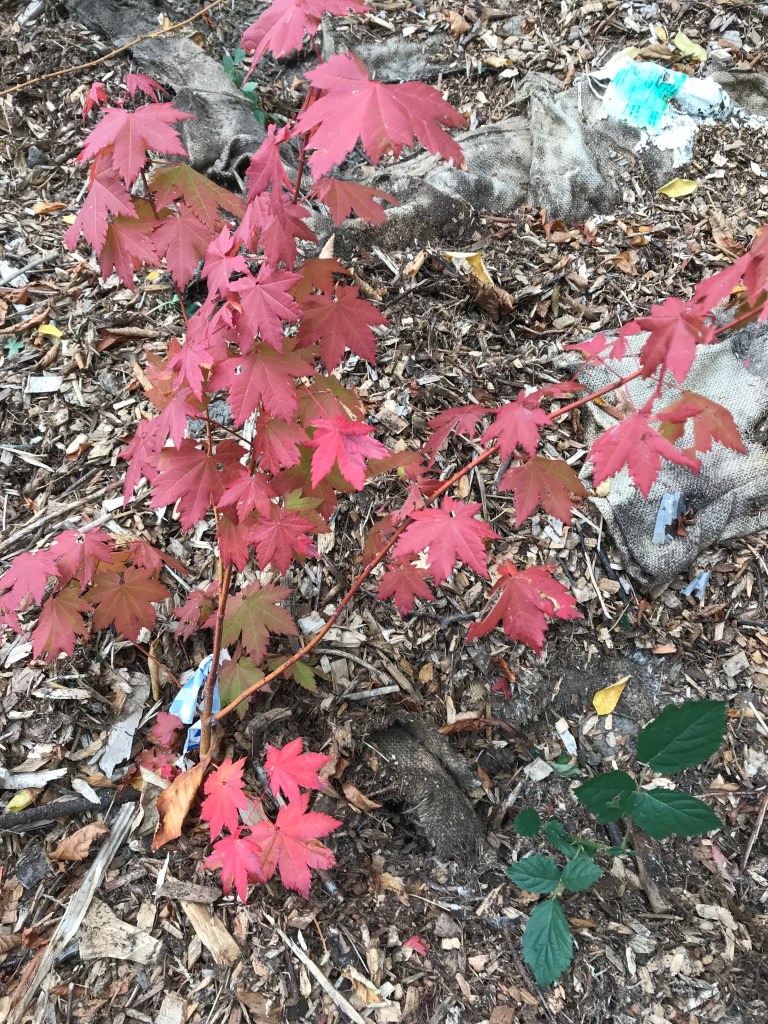
I noticed that some of the vine maple leaves were already turning red. We have planted MANY vine maples throughout the site. I am eager to see what the planting areas look like as all of them start to turn red. I imagine they will be even more beautiful as they grow. I wonder what they will look like at this time next year.

To read the previous posts in this series click here.

PNW GreenFriends Newsletter: October 2018

To download the latest PNW GreenFriends newsletter, click on the photo.

Enjoy!

Heavenly Creatures

Sreejit’s Friday reflections are getting more profound every week. This is my favorite of them all.

What Happened to the Amritapuri Swachhata Hi Seva Trash?

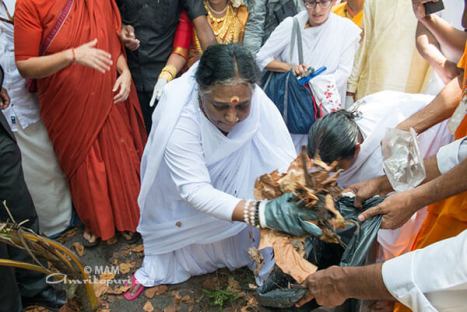
In a recent post, I talked about  Swachhata Hi Seva, a cleanliness campaign that was initiated by India’s Prime MInister Narendra Modi.  On September 15th,  Amma’s Amritapuri ashram residents and visitors, as well as students from Amrita University, participated in Swachhata Hi Seva by cleaning up six kilometers of land in communities near the ashram. More than 1600 people, including Amma herself, participated in the clean-up.

18swachata-16
Photo credit: Amritapuri.org

I had never thought about what would be done with the trash that was picked up that day. In the West, we would have either dropped it off at some waste management facility or city employees would have picked it up. A few days after Swachhata Hi Seva, I started seeing notices from the ashram’s recycling depot asking for volunteers to help sort the litter. It was then that I remembered there was no infrastructure in India to deal with garbage (or at least none that I know of) and that all of the trash that had been collected during the ashram work party would have been brought back to the ashram. I decided to help for a while.

There were many processing tables set up on the beach, with approximately eight volunteers at each station. One bag after another was brought to us and the contents were dumped onto the table. This photo shows what the garbage looked like, although the items in many of the bags were dirtier. Some of the bags contained the biggest ants I’ve ever seen.

We sorted the trash and put the items into new bags. There were bags for hard objects, soft plastic, metal, shoes,  plastic bottles, glass bottles and fabric. I was impressed by how fast we were able to sort each bag and be ready to move on to the next one.

When the bags of sorted items were full, they were moved to a separate area.

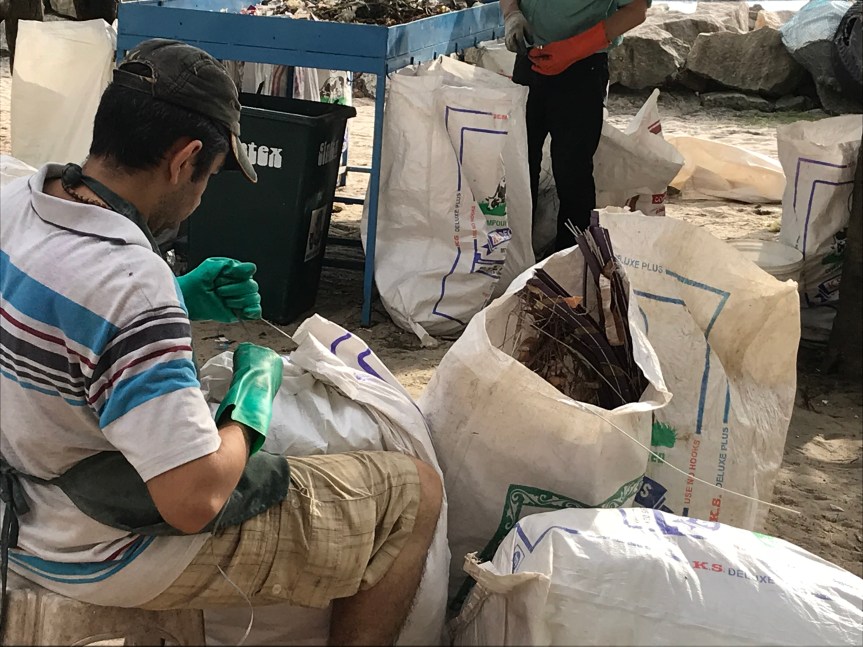
Next, someone sewed the bags shut.

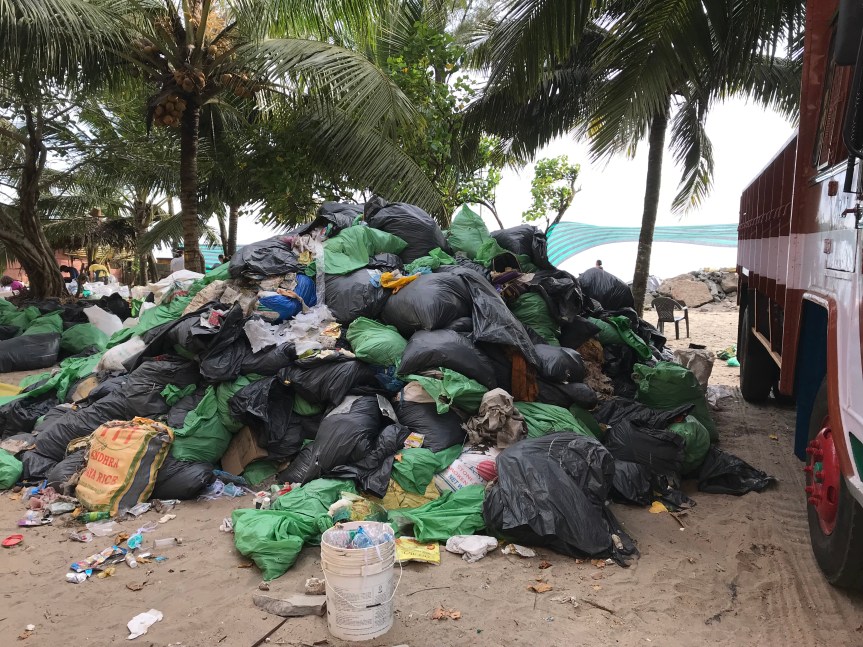
After the bags were sewn, they were moved to another pile.

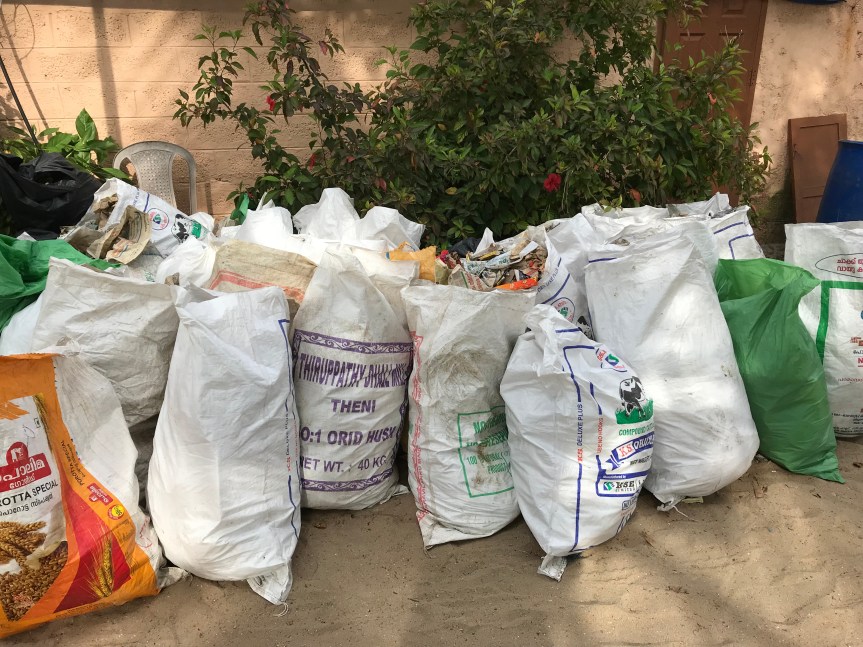
The sorting had already been going on for days. I don’t know how many bags of litter had been brought back to the ashram after the work party, but this photo shows how many bags still needed to be processed when I left the recycling depot that afternoon. The original pile must have been huge.

When I left the beach, I felt happy that I had participated in the work. A day or so later, I started to think about the situation again. What was going to happen with all of those bags? The ashram has had a recycling program for many years and I knew the recycling companies they sell to wouldn’t take dirty garbage.

Before I go on, let me say something about the ashram’s recycling program. There are recycling stations all over the ashram. Residents and visitors separate their garbage into many different bins- hard items, soft plastic, yard waste, fabric, metal, dirt and hair, sanitary items such as toilet paper, cardboard, paper, food waste, and soiled plastic.

The garbage bins are picked up daily and taken to the recycling depot. Volunteers do a second sorting there. They move any items that were put in the wrong bin and separate recyclables from non-recyclables. After the second sorting is done, the yard and food waste is taken to the composting facility and objects that need to be washed are washed.

Then, an even more detailed sorting process occurs. For example, there are at least 10 types of recyclable paper and many types of plastic and metal.

The day after I worked with the trash, I found myself sitting next to the person who is charge of the recycling depot. She confirmed that the more in depth sorting will need to be done and that the recycled items will have to be cleaned before they can be turned in. The thought of doing that work, in addition to all the regular ashram recycling, has got to be overwhelming; I imagine it will take all year. Maybe the next time I’m in Amritapuri, I will help them again.

Cee’s Flower of the Day Photography Challenge: September 25, 2018

I returned to Seattle yesterday, but I still have at least one more flower from the Amritapuri Gardens to share!

Flower of the Day

Swachhata Hi Seva- September 15, 2018

Towards the end of last week, we started to see signs posted around the ashram about an upcoming event planned by  Prime Minister Narendra Modi. The event, Swachhata HI Seva, would be held from September 15 through October 2. It was timed to be near Mahatma Gandhi’s 149th birthday and the 4th anniversary of Prime Minister Modi’s campaign to clean up India. To read Amma’s encouragement for everyone in India to participate in the clean up click here.


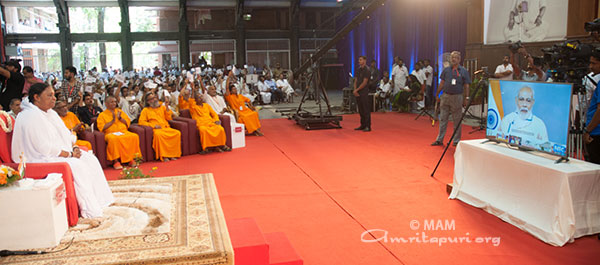
We soon learned that Swachhata Hi Seva would begin with a video conference where representatives from many different groups around India would report to Prime Minister Modi, and each other, about the clean up work they had done during the first four years of the campaign. They would also share their plans for Swachhata HI Seva.

Amma was to be one of the speakers. After the video conference, ashram residents and visitors, students from the local Amrita University and groups from Amma’s other institutions in the area would be cleaning up a six kilometer stretch of the coastal region near Amritapuri. Work parties would also be held at Amma’s schools, universities and institutions throughout India.

During the afternoon of the 14th, I glanced into the auditorium and saw lots activity. There were at least ten men setting up and testing cameras; I believed that they were from Amrita TV and surmised that this must be part of the video conference preparation. Later in the day, and throughout the night, chairs were set up in and around the auditorium, and the auditorium was decorated.

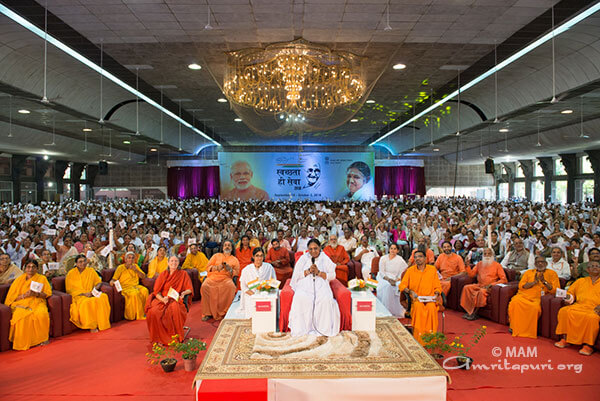
Seating began at 9:15 a.m. Amma arrived around 10:15.  Ashram residents and visitors as well as students from Amrita University and people from Amma’s other local institutions were present. I thought it was interesting to listen to the speakers; they represented so many groups dedicated to cleaning up India. Only a few of the presentations were in English but it didn’t matter to me. I enjoyed seeing and hearing the speakers’ passion for the campaign. The Prime Minister responded to each presentation.

Amma watched the video conference on a monitor that had been set up in front of her. The presentations were projected onto numerous larger screens so that everyone seated in the auditorium could watch… and hear…them.

Amma was the last speaker to present.

The first video below shows the Prime Minister introducing Amma. It also shows Amma giving her presentation. (The flags you see waving in the background on the photo above and in the video are Swachhata Hi Seva flags.) To read excerpts from Amma’s speech in English click here.

The second video is of Prime Minister Modi’s response to Amma’s report. There are English subtitles at the bottom of the screen throughout the video. The Prime Minister’s respect for Amma was palpable.

After the video conference was over, instructions to go to the beach to board buses were given over the loud speakers. There were so many people. Some of the female college students grabbed each others waists so that they wouldn’t get separated. I felt like joining them as a way to make it through the crowd, but I resisted the impulse. It has been a long time since I’ve been in the middle of a crowd that big.

I had originally thought about going to the beach and helping with the cleanup. I knew that I couldn’t do it for very long in that heat and the last time I did litter pick up without a litter grabber, I hurt my back and was out of commission for most of the  year. I thought I could help for 15 minutes though. When they started talking about buses, however, I assumed that going for a short time wasn’t going to be an option, so I headed for my flat.

Later, I learned that Amma had gone to the beach to help with the clean up before she started giving darshan that day. The couple that she was going to marry at the beginning of darshan helped too, in their wedding garments! I’m assuming that Amma was at the beach closest to the ashram, so that would have been an option for me too. Seeing the photos below reminded me of all the times Amma has joined in the ashram work. In the early days, I remember her carrying building construction materials, such as bricks and bags of gravel. She was, and is, SO strong.

More than 1600 people participated in that day’s 6 kilometer clean up!

(This has been the first of two posts about this event.)

The photos and videos came from Amritapuri.org.

The Intriguing Pond Heron

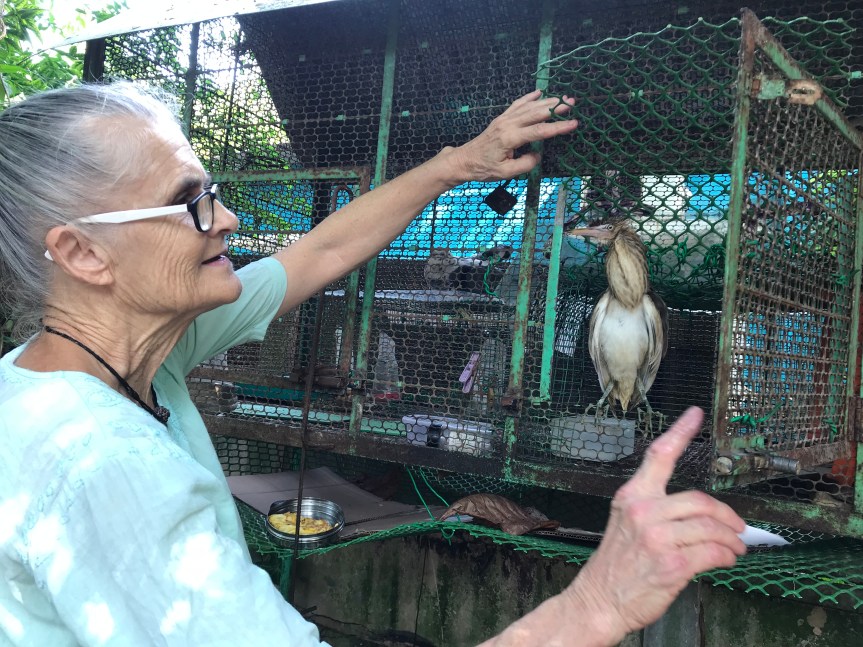
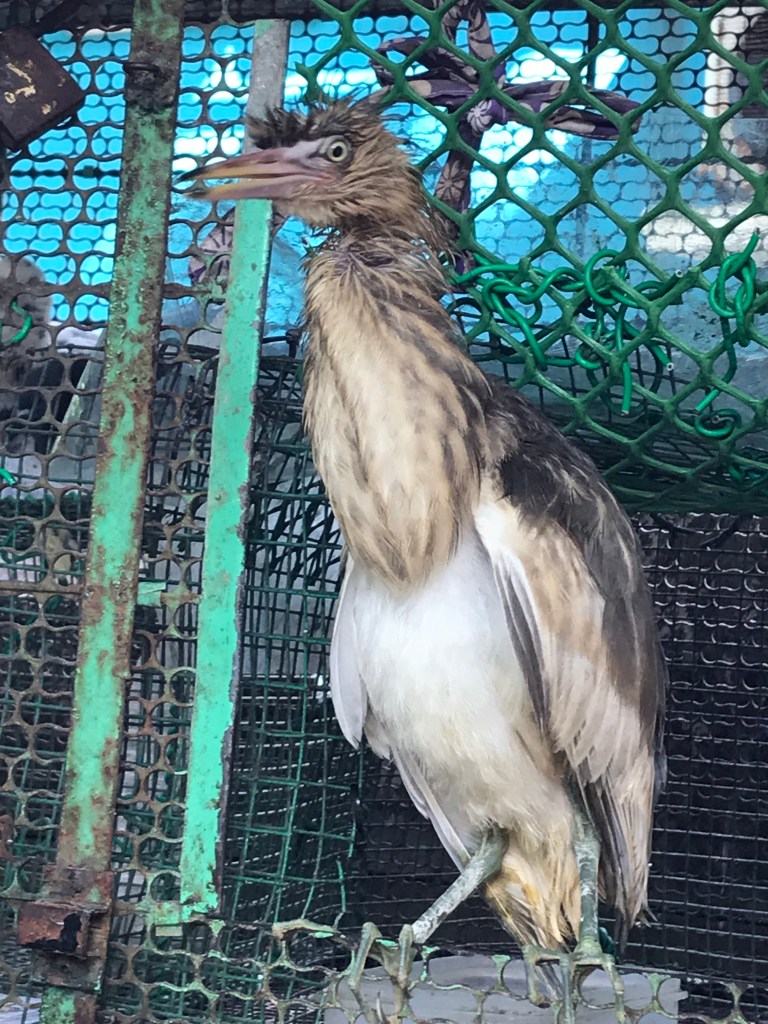
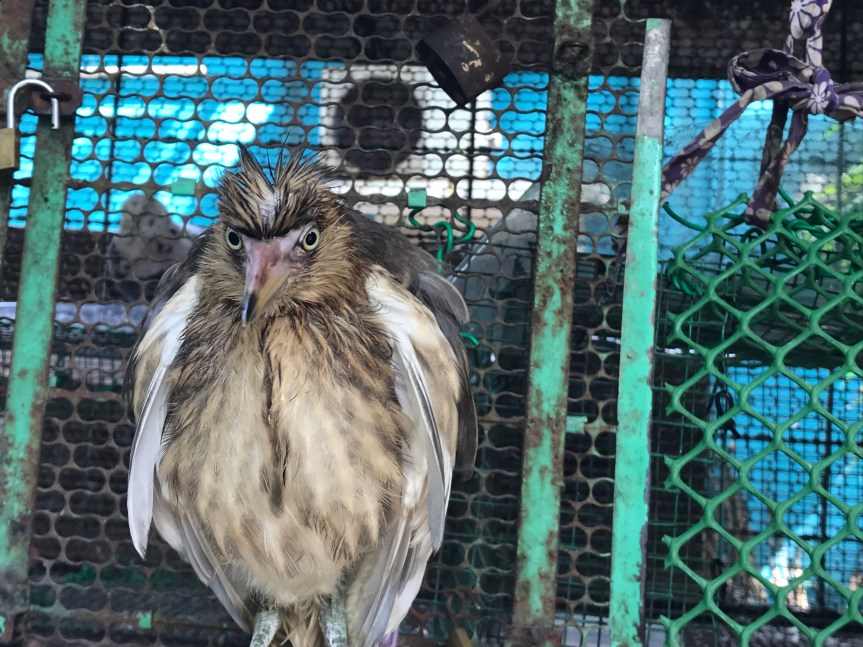
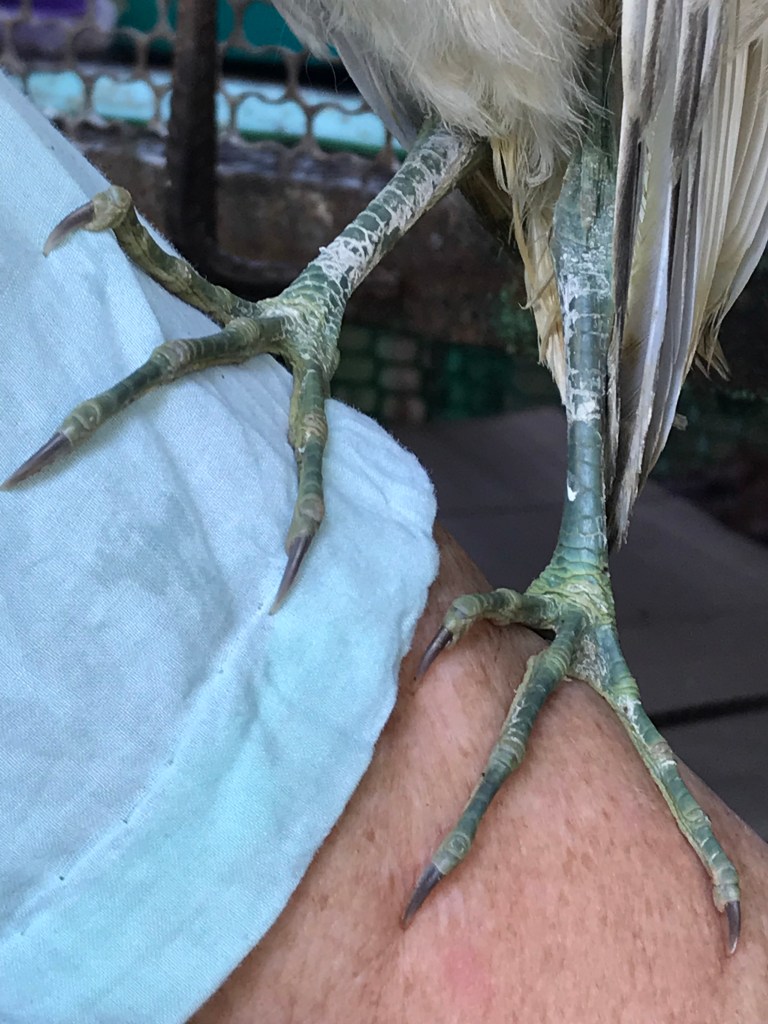
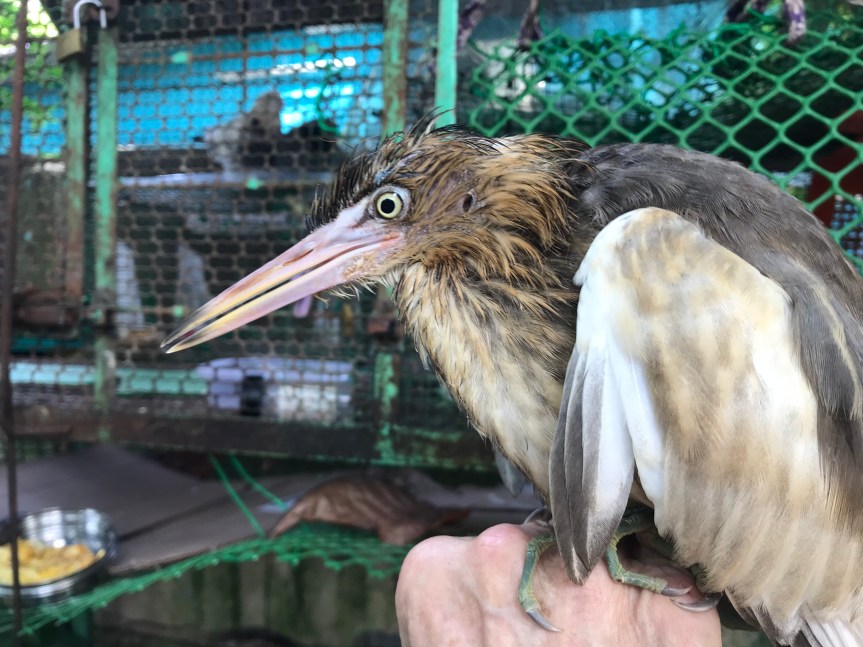
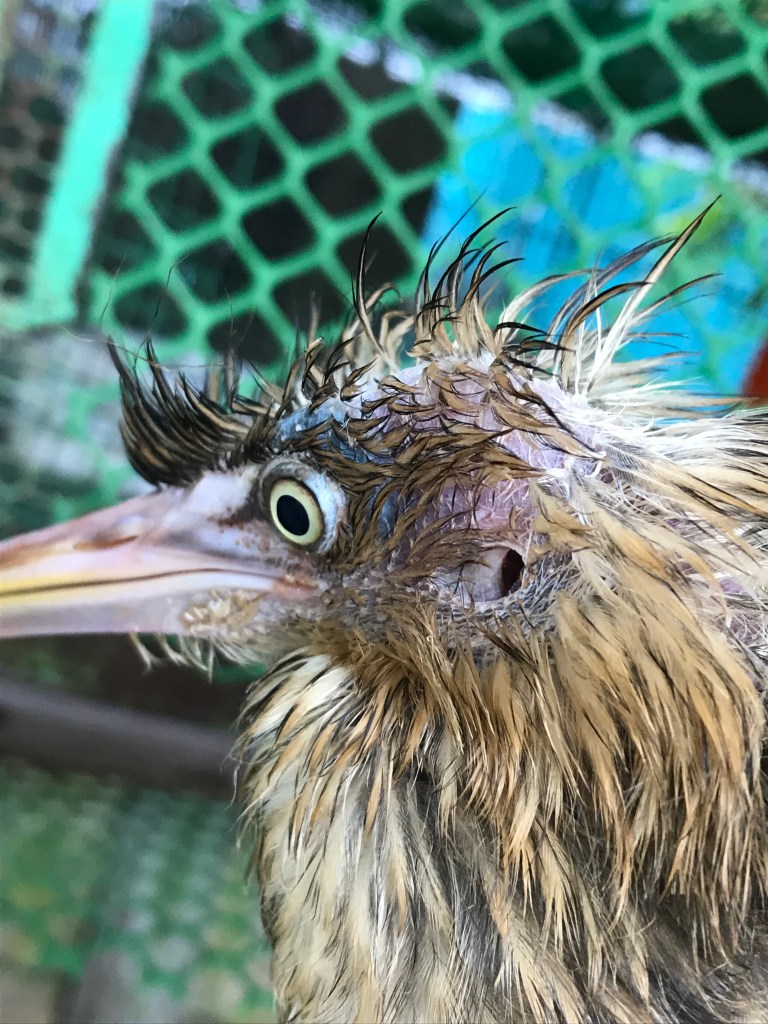
Two days ago, I visited a small garden that is near the Western cafe. When I walked into the garden, I saw a friend who lives at the ashram.  For years, devotees have brought her injured or abandoned birds that they have found. She nurses the birds back to health and then frees them. On that day, she was interacting with a pond heron. I was intrigued.

The “hole” towards the back of his head is his ear.

Living and Learning in Amritapuri, India: September 12-14, 2018

Choices

Nonattachment (or not)

I often say that the only joke I remember is Question: Do you know how to make God laugh? Answer: Tell him your plans for your life. Since we don’t even know what’s around the next corner, when we make plans, we have no way of knowing if we will be able to do them. I used to attend a church that added “If the Lord shall say the same” before any announcement. While there is nothing wrong with making life plans, I think it is important to remember that those events may or may not happen. Holding on tightly to plans can send pain and suffering our way.

I got a good reminder of that last week. I had planned the dates for my Amritapuri trip around the Ganesh Chathuri holiday. Last year, I had discovered that there were amazing bhajans held in the Kalari nine nights of that ten-day festival. The bhajans were led by a group of young men. Some played drums or other instruments. The singing got pretty raucous and I loved it. In fact, I think it would be accurate to say that I experienced unbridled joy. I have been waiting to have that experience again ever since last year’s Ganesh Chathuri.

There was a puja scheduled for the morning of September 13, the first day of the holiday. When I saw the area being set up on my way to my cafe shift, I realized I had forgotten what a big deal that puja was. It is held in the auditorium. The ashram elephant is brought in and there are rituals performed … and lots of singing.

When I went into the cafe, I mentioned it to Chaitanya. She hadn’t thought about the fact that I would want to attend the puja either. She offered to find someone to replace me, but it didn’t seem right to back out on her at the last minute, so I said I would stay. After all, I had the night bhajans to look forward to… and those were my priority.

As the sounds from the auditorium intensified, however, I longed to be there. I began to get agitated. Sreejit walked into the kitchen, so I asked him to relieve me for a few minutes so I could go see what was happening. Being at the puja, even for three or four minutes, was just what I needed. After all, I had the night bhajans to look forward to.

When my replacement came at 9:00 a.m., I was able to go to the auditorium for some of the last bhajan and for the Ganesh Aarati. I was also there when the prasad was handed out. It consisted of numerous types of treats in a small banana leaf bowl. I had already committed to myself that I would take that morning off next year if I’m here, but I felt satisfied with the small parts of the ceremony I had attended. After all, I had 9 evenings of wonderful Ganesh bhajans to look forward to.

On my way back to my room, I decided to go look at the Ganesh Chaturi schedule on the bulletin board. I was horrified when I saw what was written on the flyer. There had been a homa earlier in the morning and then the big puja …. and those were to be the only Ganesh Chathuri programs this year.

Amma had canceled the games and big processions associated with Onam and Krishna Jayanthi in recognition of the pain being experienced by the Kerala Flood victims. I hadn’t thought about that being extended to Ganesh Chathuri as well since there were no games or big processions associated with that festival.

I felt devastated. I started crying and I cried all day. It reminded me of a time years ago when I went to Amma crying to the core of me. At that time, a friend standing near Amma was alarmed. She thought one of my children must have died. The event that brought on my tears that year was not the death of one of my children, but rather was due to the fact that I didn’t have enough money to make my yearly trip to Amritapuri. Up to that point, I had come to India every year since 1990.

I believe what I access when I am in that state is my soul crying for God. And it may be have also brought up longing for experiences I have had in past lives. (For most of my years with Amma, I have cried whenever I saw Ayyappo pilgrims. They sing in that same style of music, raucous and tribal. I speculate that I took Ayyappo pilgrimages in some other lifetime. The yearning to do that again is still inside of me even though my conscious part doesn’t really want to go with them!).

Amma has said that crying for God is as powerful as meditation. I believe the longing I experienced when the bhajans were cancelled was good, but it sure was painful. I also believe that part of my pain was due to my holding on to plans instead of living from a place of nonattachment.

Later in the day, it occurred to me that having Amma’s darshan might help. Darshan was being held in the temple that day. I decided to look for the token table and found it in an unexpected place about 30 seconds later. Within the hour, I was in Amma’s arms. And, of course, being with her did help. Even though I remained teary for the rest of the day, they were not the kind of tears that were painful and wouldn’t stop.

Trust My Inner Wisdom (or not)

In the psychotherapy community I practiced in, we used an affirmation that said “Trust Your Inner Wisdom.” I usually added “except when you can’t.” Most of us have so many voices in our head. I believe it is important to make sure that we aren’t listening to a voice that supports our unhealthy belief systems and/or behaviors.

Decades ago, I heard a minister say that the first quiet voice we hear inside is usually the voice of God. The next messages that come into our mind may be a flood of discounting messages that tell us why that first message is wrong and why it won’t work. If we choose to listen to that second stream of messages, the original “voice” will fade away.

The misery I experienced when I found out there would not be Ganesh bhajans in the Kalari for the next nine days was a good example of my not listening to my inner voice. “Go check the schedule” had gone through my mind daily for about a week. I always responded. “I will …. later.” Later didn’t come until late morning on the day of the event.

As I already mentioned, I knew that Amma had cancelled the games and big processions during the two previous holidays because of the floods. While the night Ganesh bhajans weren’t games, they were raucous and high energy. Having them every night for nine days would certainly have fit into the “celebratory” category. While I was aware of this, I had not allowed myself to seriously consider that they might not happen, I believe that was also a discount to the wisdom of my inner voice.

The 20 Step recovery community extensively uses Portia Nelson’s Autobiography in 5 Short Chapters.

I

I walk down the street.
There is a deep hole in the sidewalk
I fall in.
I am lost...
I am hopeless.
It isn't my fault.
It takes forever to find a way out.

II

I walk down the same street.
There is a deep hole in the sidewalk.
I pretend I don't see it.
I fall in again.
I can't believe I'm in the same place.
But it isn't my fault.
It still takes a long time to get out.

III

I walk down the same street.
There is a deep hole in the sidewalk.
I see it is there.
I still fall in...it's a habit
My eyes are open; I know where I am;
It is my fault.
I get out immediately.

IV

I walk down the same street.
There is a deep hole in the sidewalk.
I walk around it.

V

I walk down another street.

I have found her autobiography to be a very powerful and helpful way of looking at life’s lessons. Years ago, I added another chapter to it… for my own use. In my adaptation, the new chapter came before any of the others. It said:

I receive a warning.
I ignore it.

My experience with the Ganesh holiday was a good example of this additional chapter. I had received warnings in the form of advice and intuitions and had ignored them all. And the result was I brought more pain to myself than if I had listened.

Exam Time

I worry too much about what other people think of me and I don’t like to be laughed at. I cringe whenever people tell stories about me that they think are funny and I don’t. I also get upset when I judge that I’ve made a fool of myself.

An incident that happened in the early 70’s stuck with me for decades. I went to a New Year’s Eve work party with Al (my husband). I worked nights at the time, and for some reason got dressed in the dark. At some point during the party, when we were talking to Al’s boss and his wife, someone noticed that I was wearing shoes that were two different colors. (At that time, I owned two pairs of shoes that were the same style, but different colors. When I had slipped them on in the dark, there was no way for me to tell that they didn’t belong together.)

I was mortified. Other people seemed to be fine about it, and said understanding things, but my inner critic flared. My feelings of humiliation were strong even decades later. I ended up doing some EMDR (therapy) on the issue in the mid 90’s. During it, I started to laugh. I had been divorced from Al for many years and here I was still worried about what the person who was his boss in the 70’s thought about me. My energy about the issue reduced tremendously after that, but it wasn’t 100% gone.

Last week I had a chance to see where I stood on those issues. One morning, I took my garbage to the recycling station. When I returned to my building, there was a group of women residents sitting near the elevator listening to the broadcast of a class that was being offered in the temple.  Before the elevator door shut, I saw one of the women smile and lean over to talk to the woman sitting next to her. They were both looking at me. At first, I took their smiles as a greeting but then I realized it didn’t feel that way. I looked down and was dismayed to discover that I was wearing two different kinds of thongs; and these weren’t even similar to each other. I couldn’t believe that I hadn’t noticed. Again, I had made a fool of myself and worried about being judged.

The difference between the event in the 70’s and the one that happened last week is that I had so much less energy about it. I still didn’t like that I made the mistake and I didn’t think it was funny, but I had much more of a “whatever” attitude about it.

Long ago, someone taught me the difference between shock and embarrassment. Shock is deadening. We may freeze and turn white as the blood drains from our face. On the other hand, when we are embarrassed about something, it can actually enliven us. We may turn bright red as blood rushes into our face. Some small part of us may even think it is funny.

I realize that the words I chose for these two experiences also show the difference between shock and embarrassment. For the one that occurred in the 70’s I used “mortified” and for the one that happened last week I used “dismayed”. I believe I went into shock during the first event and was embarrassed in the present one.

I’m not happy that I set myself up in this way and know that I still have energy about being laughed at, but I do appreciate seeing that my energy about the issue has lessened so significantly.

[Note: Soon after I wrote this section, I went to work at the cafe. Ziggy, a long term devotee who is also a clown, came up to me and asked permission to put a balloon earring on my ear. I laughed at the synchronicity and said yes. People did indeed laugh at me, and I thought it was fun!]

To read the previous posts in this series click here.