
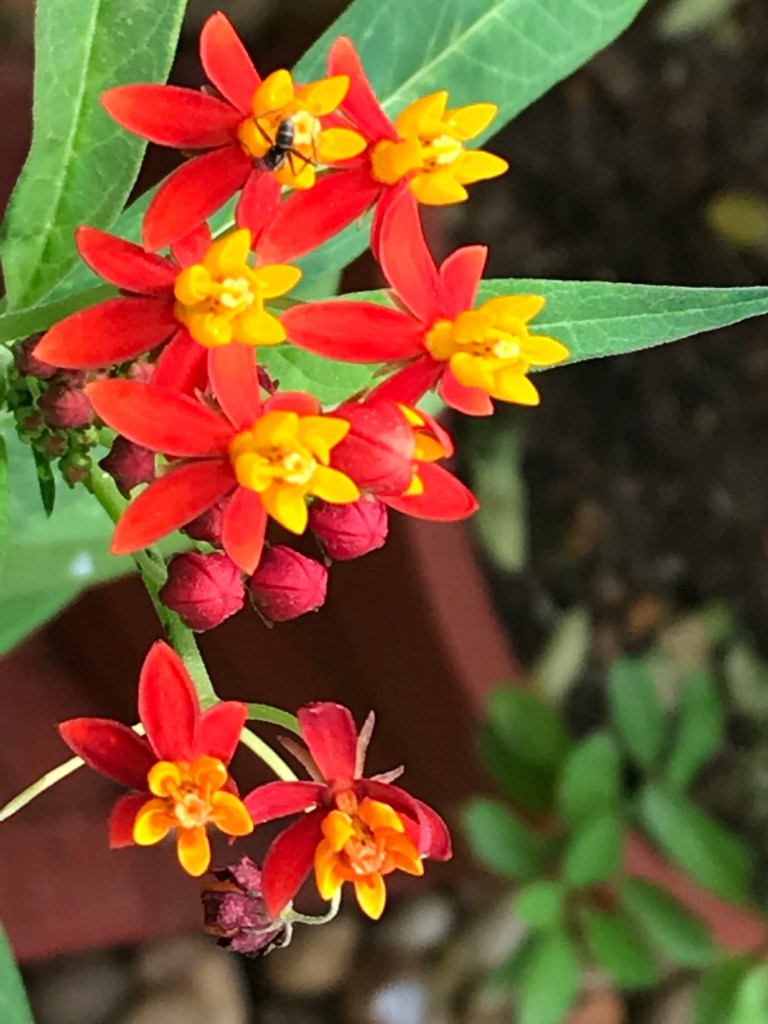
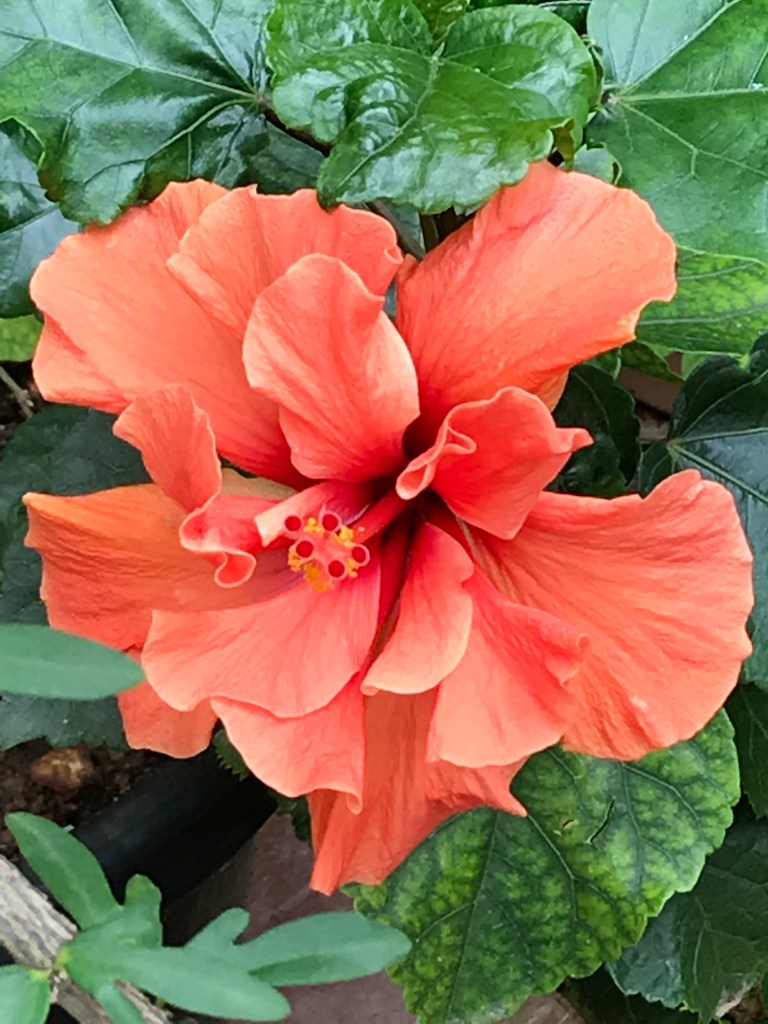
Cee’s Flower of the Day Photography Challenge: September 7, 2018
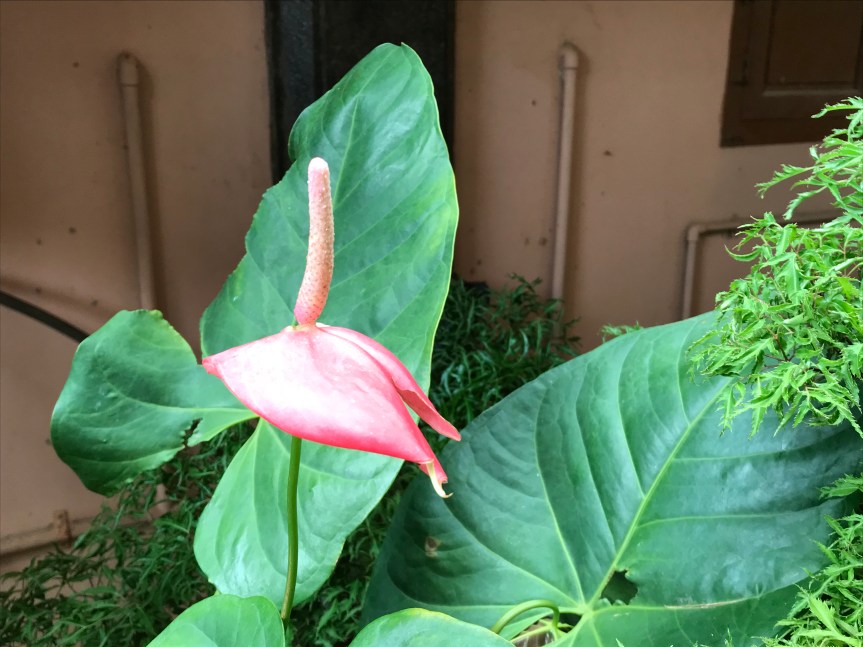
I love having an opportunity to share photos of flowers in Amritapuri. Thanks Cee!

September 7 Flower of the Day Challenge
Celebration

I created this blog in March 2014. My son (The Seeker’s Dungeon) had been urging me to start a blog for some time. My answer was always “maybe some day”. Then one day, almost out of the blue, I decided to do it. My main motivations were that I wanted to be able to post responses to his Dungeon Prompts Challenges and I wanted to surprise him. He definitely was surprised when he received my first submission. Neither of us had any idea how much the blog would become a part of my life. I love blogging.
Last night, I reached a major milestone. While I slept, the number of pages that have been viewed on my blog passed:
100,000
Never would I have dreamed I would reach that mark. Many thank to each of you who have taken the time to read my posts and to contribute to my life in this way.
Living and Learning in Amritapuri, India: August 29-September 1, 2018
Amrita University Graduation
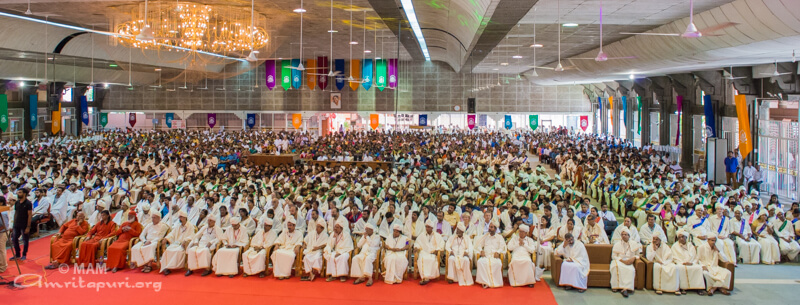
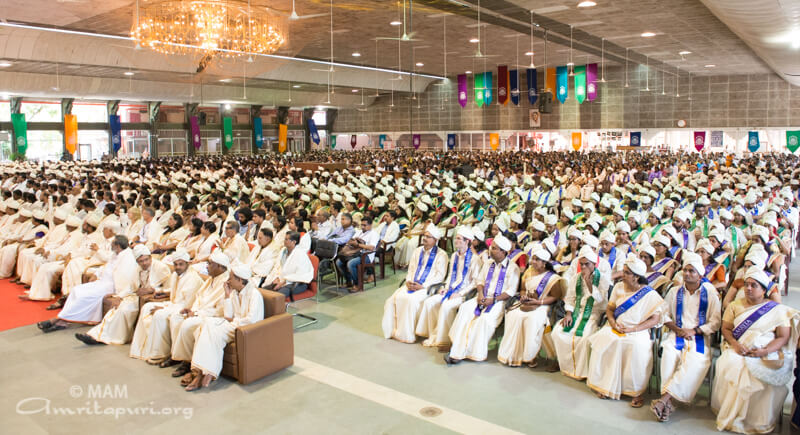
Friday, August 31, was graduation day for 1,325 undergraduate, post graduate and PhD students from the Amritapuri campus of Amrita University. The graduates came from the Schools of Arts & Sciences, Ayurveda, Biotechnology, Business, and Engineering.
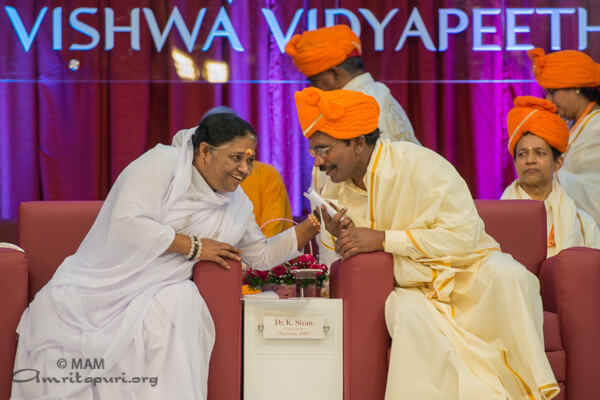
This year, the graduates and their families gathered in the Amritapuri auditorium and waited for Amma and the other dignitaries to arrive. The Chief Guests, were Dr. K Sivan, Chairman, Indian Space Research Organisation and Amma who is the Chancellor of the University.
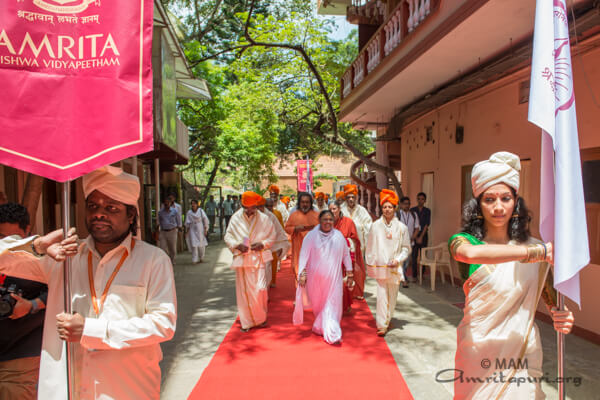

Student receiving his diploma

Student receiving her diploma
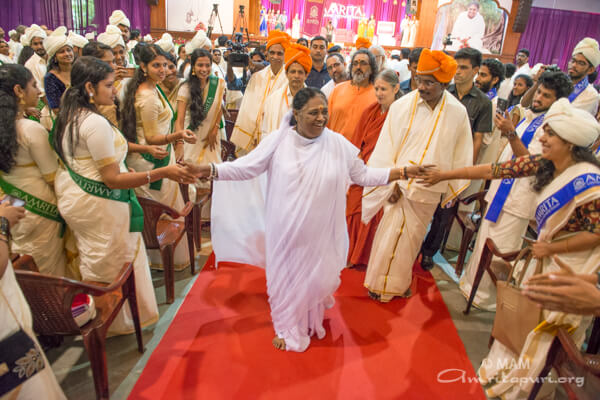
I was not able to attend the event, but I had been present when the decorating began the night before. The next day, I discovered that the front of the stage had been decorated with beautiful flowers and there were purple curtains that extended from one side of the auditorium to the other. They were so beautiful that they practically took my breath away. The pink lights that were placed behind the curtains made the scene even more striking. As you can see in some of the photos, many banners had been hung around the sides of the auditorium.
I was able to hear the last part of Amma’s speech. You can read some of Amma’s message to the graduating students if you click here.
So much love went into preparing and presenting this ceremony. I have no doubt that the graduates will remember this day for the rest of their lives.
The photos are from Amma’s Facebook Page and Amritapuri.org.
A New Experience

I have had a cyst on my left cheek for about six years. The doctors I have seen during that time have kept an eye on it but the only solution they offered me was to have it surgically removed. I had been told that the surgery would leave a sizable scar. I would have no problem with that if it was a necessary surgery, but since it was cosmetic, I decided to just let it be.
One day last week, a friend asked if I had considered talking to Dr. Sushila about the cyst. Dr. Sushila is the Ayurvedic doctor that runs Amritapuri’s panchakarma program. I’ve known her since my early days in Amritapuri. I thought it was a great idea, so I walked to her office and was able to schedule an appointment for that very day. During the visit, Dr. Sushila suggested I see a doctor who works at the Amrita University School of Ayurveda. The next morning, I took a rickshaw to the Ayurveda hospital/school/clinic.
Since it is a University clinic, there were students who observed the doctor closely. A few of them also assisted her. That first day, the doctor did an examination and then had one of the senior students make a poultice of herbs. I noticed it consisted of some black herbs and something that looked like a small citrus fruit. (I probably didn’t see everything that went into the poultice.) The student used a mortar and pestle to crush up the ingredients. After applying the mixture, she put a bandage over it. (The purpose of the poultice was to see if the cyst would soften overnight.)
That was the first of five daily visits to the clinic. The second morning, the doctor took of the bandage and then removed a scab that had formed on the outside of the cyst years ago. She then began the process of taking out the contents of the cyst. It was important that she also remove the outer sack because if any of the sack remained under my skin, the cyst would regrow. When the doctor finished her work, a different student applied a new bandage.
That day I had heard the doctor tell the students my cyst was a sebaceous cyst. When I looked it up later, I read that the contents of that type of cyst is a “cheese-like matter”. That description matched what I have observed in the past.
There had been some build-up of that matter overnight, so it was clear that not all of the cyst had been removed. The doctor supervised a senior student in removing more of the substance. She instructed me to return to the clinic for next two days. On the fourth and the fifth day there was no indication that the cyst was still producing the matter.
I was told I could remove the bandage at the end of that day. And, at that point, I could also finally wash my hair (I hadn’t been able to wash it because I was supposed to keep the bandages dry). When I took the last bandage off, I was very pleased to discover that there will be almost no scar.
Hopefully, I won’t need to return to the clinic, but if I do, so be it. The procedure caused no pain, so I do not dread the possibility of going back. Since I used to teach nursing students at the University of Washington, I had enjoyed being in the teaching environment.
I feel so grateful, and impressed, that the doctor was willing to give me this level of attention. I can’t imagine being told to come back five days in a row in the U.S. She had so much patience and was so gentle. And she asked repeatedly if I was experiencing pain. The cost was unbelievable. I paid 200 rupees ($3.00) to register at the clinic and 30 rupees (45 cents) for each of the dressings. That’s it!
Leelas Abound

Leela is a Sanskrit word that is often defined as “God’s play.” Even though the word “play” is used, that doesn’t mean all leelas are fun. They often take the form of lessons and challenges coming in rapid succession. Or they may be a whole series of events that leave you thinking “What in the world is going on?”
I always experience an increase in leelas when I visit Amritapuri. The leelas that stand out for me on this trip occurred the evening of August 31. You may remember that earlier on the trip, I made a commitment to myself to not sit in the back or far sides of the auditorium and instead to sit in the front of the hall. For several days, I took every opportunity to do that. While I loved being in the front, I also did too much; I can’t sit cross-legged for long periods of time so my legs hurt, and I was getting too tired.
On August 31, I decided I would stay in my room during the evening meditation and the question-and-answer period that followed it; I would just go to the bhajan (devotional singing) program that followed it. During the first program, I would catch up on computer work.
About the time that the meditation started, I received an email saying that someone may have attempted to get into my Comcast account and that I needed to reset the password. After multiple failed attempts at changing the password, I called the U.S. and got help from Comcast directly.
After the call I was able to change the password on both my phone and laptop, but still wasn’t able to get the emails to download. I ended up deleting the Comcast email account on both devices and then reinstalling it. After that I was able to get my emails on the phone, but still couldn’t get them to download onto the laptop. Soon thereafter, I discovered that all of the contacts on my laptop had disappeared. Needless to say, dealing with this took a lot of time and I didn’t get any computer work done during the meditation and Q&A. In fact, I’m still dealing with some of the problems that started that evening.
By then, it was time for me to go to the bhajan program, so I headed to the auditorium. Once there, I discovered Amma had started singing earlier than normal. As I walked into the hall, she was singing the last verse of Morya Re. I couldn’t believe it. I had heard that song for the first time during the 2017 Amritapuri Ganesh celebrations and fell in love with it. I have been with Amma for 29 years and I’ve never heard her sing the song before. I was happy that I got to hear some of it, but longed for the full experience.
I was still determined to sit in the front of the room but the hall was crowded due to the upcoming Krishna’s birthday celebrations. I decided to get to the front area by coming in from the side. Perhaps I could sit against the wall at the bottom of the stage. The front section of floor-sitting area is primarily occupied by the brahmacharinis (female monks) and long-term western residents. That would be an awesome place to sit for bhajans, although at this point I knew I would likely be sitting so close to the stage wall that I might not be able to see anything.
I did find a place to sit there and I was even able to get a glance of Amma from time to time. I was content. Moments later, an Indian brahmacharini asked if I could see Amma, and when I responded “a little” she motioned for me to come sit next to her. I was hesitant at first, because I didn’t want to block anyone’s vision, but she said it was fine. I moved up and felt very appreciative that she had helped me in this way. Then a Western resident, who was even closer to the front, motioned for me to come sit beside her, and I did. If Amma had been sitting on the floor instead on the high stage, I would have been about 20 feet away from her. Needless to say, I had a wonderful time singing bhajans from that area… and felt very taken care of besides.
My conclusions from these experiences:
Was I bad for skipping the meditation and Q&A : No
Was my choice to skip those programs a mistake: No, I made the choice based on self-care and it still feels right. However, choices may have consequences and these did.
Throughout this experience, I had the opportunity to practice behaviors such as persistence, flexibility, equanimity, and letting go. I was also reminded that what I need will be provided.
What I will do differently in the future because of this experience: I will come early to the bhajan program so if Amma starts the program before I expect her to, I will be ready.
To read the previous posts in this series click here.
Cee’s Photography: Flower of the Day- September 5, 2018
Cee’s Flower of the Day Challenge caught my eye. That is a good challenge for me to participate in while I am staying in Amritapuri!
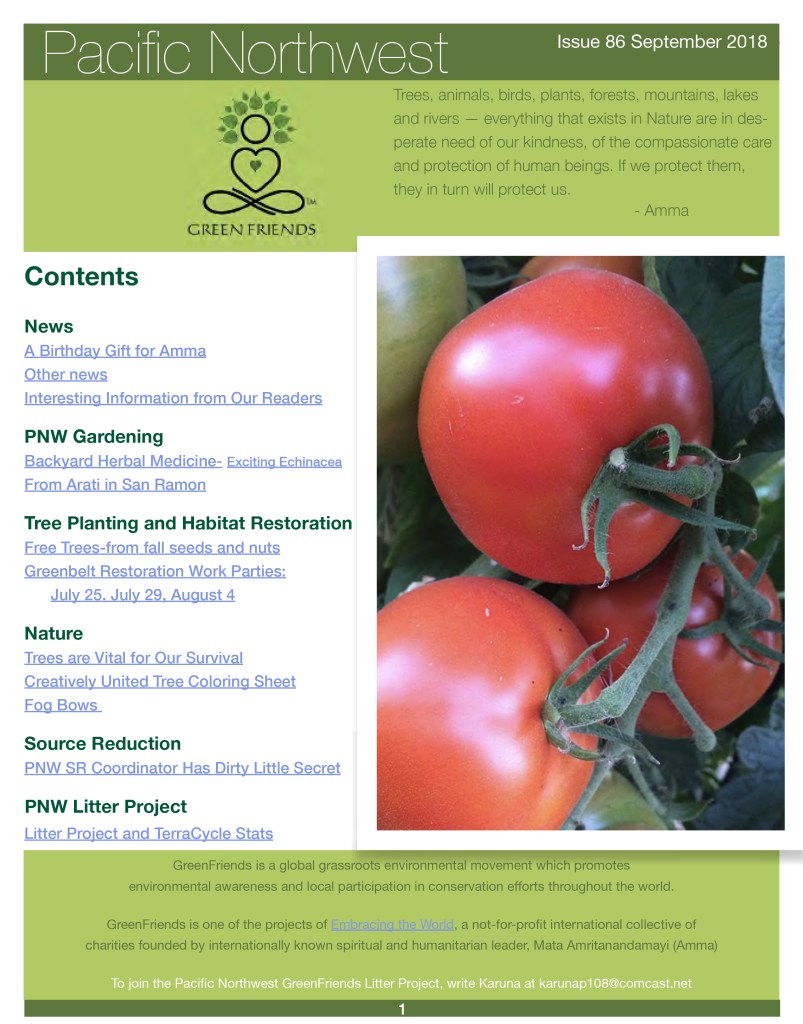
PNW GreenFriends Newsletter: September 2018
To download the latest PNW GreenFriends newsletter, click on the photo.
Enjoy!
So Many Memories
Every time I come to Amritapuri, I have so many memories of my first visit. I met Amma in June of 1989. Six weeks later, I was at her New Hampshire retreat and 6 months after that I was at her ashram in India. I don’t remember when the ashram started to be called Amritapuri, but I think it was many years later. At that time, we just referred to it as being near Oachira or Vallikavu.
In those days, the beach road was not paved and was full of potholes. The taxi drivers were not willing to drive on it so they would take us to Vallikavu. From there, we took a canoe to the ashram. This was our first view of the ashram:
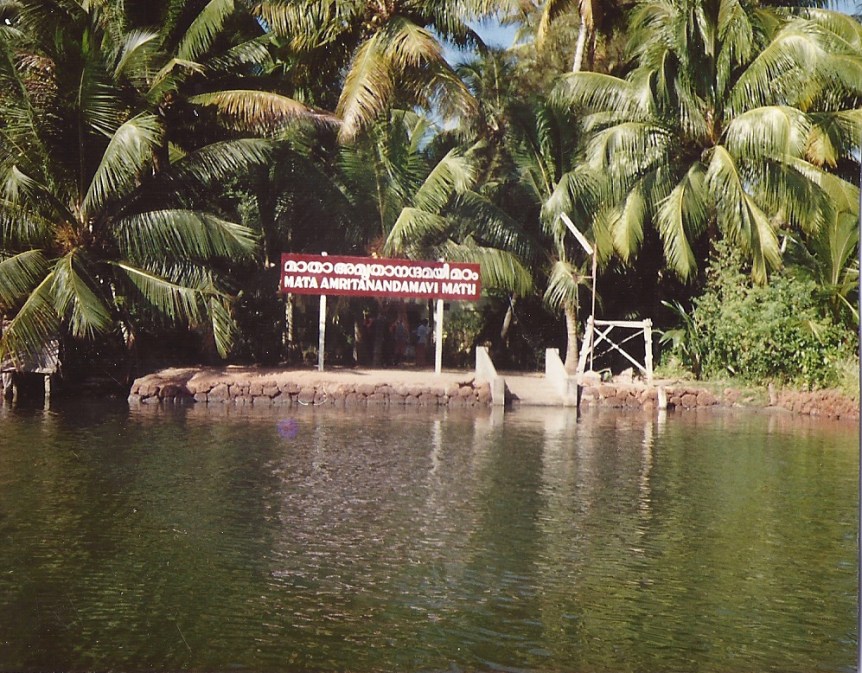
I arrived days after the temple was able to be used. The top floors had not been completed yet, and it would be years before the construction was done. I don’t have a photo of the temple from that time but the first photo below was taken within the last decade. The second two are from January 1990. You can click on the photo gallery to enlarge the pictures.


In those days, Amma would hold Devi Bhava programs three days a week. Those would be held in the temple. She gave darshan (hugs) in a small darshan hut.
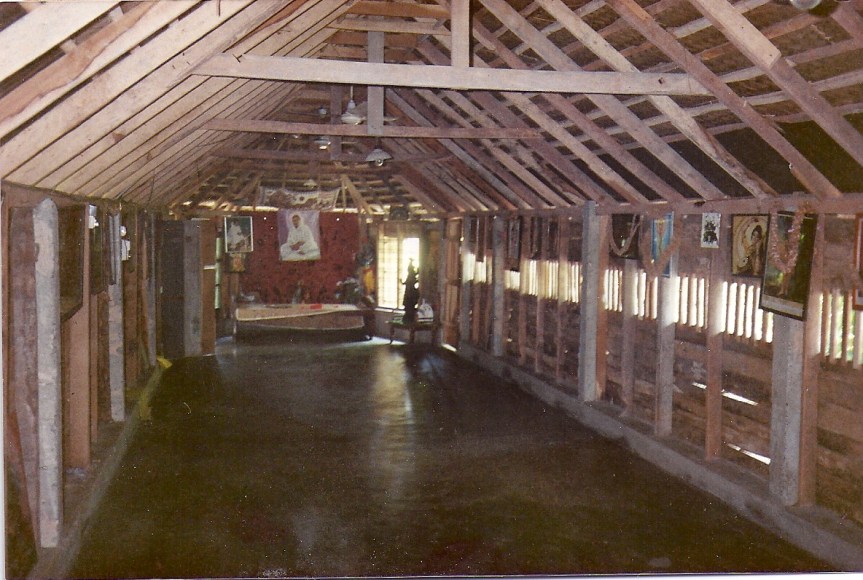
The evening bhajan program was held in the temple. My memory is that there were so few people that we only filled the front third of the temple. I remember wondering why Amma had built a temple that was so big.
A photo from later in the 90’s shows the answer to that question.
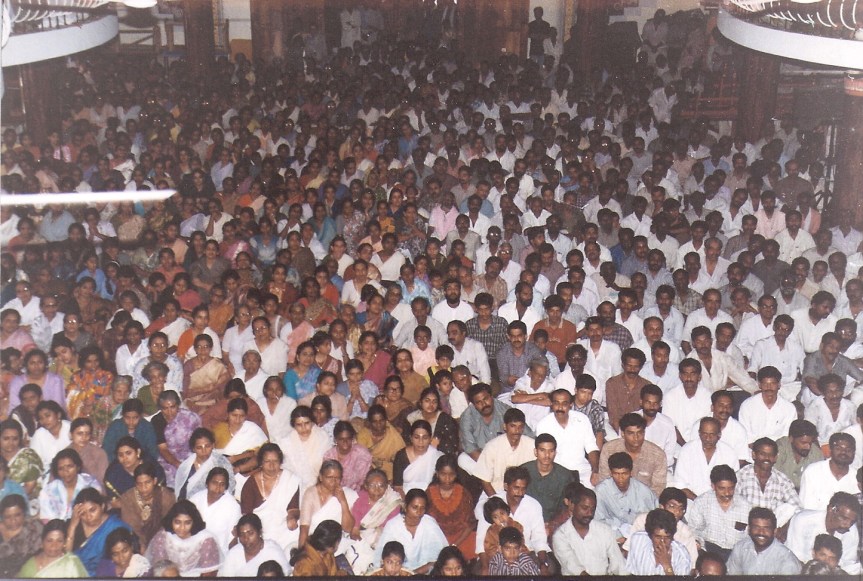
When I came to the ashram in 1990, we never knew if Amma would attend the evening bhajans. My memory is that she would participate at least two times a week, and that when she came the program would last longer.
That first year, Amma sat with us on the floor of the temple, all of us facing the Kali murti. She would lead the singing without a microphone. A year or two later Amma, as well as the swamis and other back up singers, moved to the side of the room. At that point, everyone was still sitting on the floor of the temple. I remember Amma scolding us for facing her instead of the front of the temple. Amma started using a microphone at that time.
I don’t remember what year Amma and the other singers started singing from elevated area at the front of the hall, near the Kali murti. I also don’t remember when the darshan programs moved to the temple.
During my first visit to the ashram, there were 30 western guests (now during the Christmas season there are close to 2000). The Western Canteen opened at that time. It offered only one meal a day, and that meal, as I remember it, consisted of a bowl of soup. (When I look at the photo below, it looks like the meal was bigger than that.) We were so grateful to have western food once a day.
Four days a week, the Canteen food was served on the fourth floor temple balcony. During the three Devi Bhavas, we gathered on the stairs going up to the sixth floor. Maybe those were the times we only had soup. There wouldn’t have been room on the stairs to serve much more than that.

Amma was 35 years old when I met her, and 36 years old when I visited the ashram for the first time. These are some photos of Amma from the early days.


I have been blessed to be able to consistently spend time with Amma in the United States and India during the last 29 years. I have so many memories of those experiences, and I am exceedingly grateful for that. Millions and millions of thanks to you Amma.
To read the previous posts in this series click here.
Living and Learning in Amritapuri, India: August 24-28, 2016
Kerala Flood Update
A few days ago, I saw a newspaper lying on a table. When I glanced at it, the article that caught my eye was announcing that the Chief Minister of Kerala (the chief executive of the state) requested that all Keralites living in or out of the state, donate a month’s salary to the relief effort. It was suggested that they donate three days a week of their salary at first and then pay the rest over a 10-month period.
What a difference it would make in the recovery effort if people did this. I wonder how many Keralites will be this generous or have enough income to be able to participate. I would guess that he will have more response than if the same request was made, after a tragedy, by any U.S. president or governor.
In researching this event today, I read this statement by the Chief Minister:
As you are aware, this is the worst calamity in the history of Kerala. This calamity has affected the entire stretch of Kerala and 12 out of 14 districts severely. The devastation and destruction are extremely severe and beyond a description. The loss of life, livelihood, homes, roads, bridges, agriculture, power lines and public infrastructure will have far-reaching impact on socioeconomic fronts. Though it was unprecedented, the government swung into action immediately and concentrated fully on rescue and relief. I need to underline the fact that all sections of the people held their hands together along with government agencies to conduct rescue and relief operations. The selfless efforts of the fisherfolks have to be specially underlined. Read more
I also learned that on August 26, the death toll was 302 with more bodies being discovered. There were 1435 relief camps still in operation and the population in those camps was 462,000.
I then looked for an update on Amma’s relief work. I found this statement on amritapuri.org.
As the flood waters recede, and as the spotlight wanes, Amma and MAM remain fully committed to helping the survivors with their recovery for as long as it takes. Next steps for the Math include focusing on disease prevention, ongoing treatment of injury and disease, and finding ways to re-house those who have lost everything. Read more
To read Amma’s Kerala flood rescue and relief day-to-day updates – click here


Onam 2018
This year, Onam occurred on Saturday, August 26. Onam is a family holiday in Kerala, one that celebrates the agricultural harvest. Amma decided that the ashram event would not be celebratory in nature because of the devastation caused by the floods. The tug of wars and cultural entertainment that would normally be part of the festivities were pulled from the program.
Huge crowds usually come to the ashram for Onam. I wondered how many people would be able to attend this year. Even though there weren’t as many people as normal, it was still big. The program began with Amma’s satsang (spiritual talk). She spoke in Malayalam, but the English translation was put up on screens. I find I am much more attentive when the translation is done this way. There were so many parts of Amma’s talk that spoke to me. I haven’t found the text of the full satsang anywhere, but you can read some of it here.
(The photo below shows only half of the auditorium.)

After the satsang, Amma sang three songs and then gave darshan (hugs) for a short period of time. When darshan was over, it was time for lunch. Amma handed a plate to every person in the auditorium.
The Onam lunch was quite a feast. There were so many types of food on each plat. A lot of tables had been set up and brahmachinis and other helpers walked around aiding devotees in finding a place to sit, handing out hot water to drink and a buttermilk sauce to put on the rice, and cleaning up the tables in-between diners. The meal really felt like a family event to me. I realized, once again, that I have a VERY large family.
(Click on any of the galleries to enlarge the pictures.)


After the lunch, Amma fed Lakshmi, the ashram elephant, her lunch. This is always one of my favorite parts of Onam. After Lakshmi finished eating, Amma had her pick up, with her trunk, any food that had dropped on the floor. It always amazes me to see how well Lakshmi can clean up her mess.
Once the floor was clean, a bucket of water was brought to her. Lakshmi drunk quite a bit of it and then pulled up more water into her trunk. Next, she sprayed the water all over the children who were standing or sitting close to her. There were screams of delight and laughter from all over the auditorium, especially from everyone who was sprayed. That process occurred over and over. I think they even brought Lakshmi a second bucket of water.
When the water in the buckets was gone, the lunch program was over. Lakshmi was taken away and the devotees dispersed.


Amma came back to the hall at 6:30 p.m. for the evening bhajan (devotional singing) program. The songs were beautiful, as always.
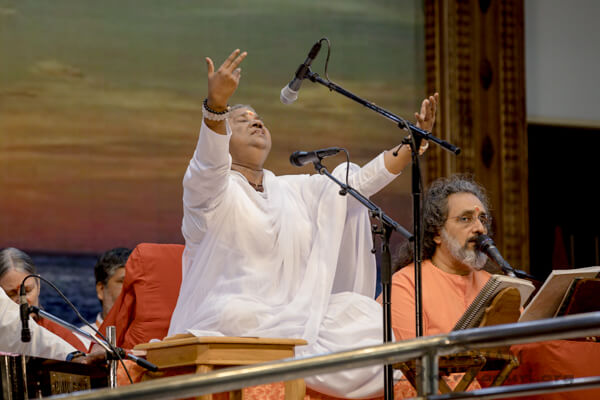
Since there would be no entertainment that night, I expected bhajans to be the end of the Onam program. That was not Amma’s plan, however. Instead of going back to her room when she finished singing, Amma announced that she would be continuing to give darshan.
Amma gives and gives and then gives some more. I don’t know when she stopped for the night, but I know I went to bed before she did.
Photo Credits: Onam Photos are from Amma’s Facebook Page and Amritapuri.org
Continuing to Explore
In my last post, I talked about making the decision to sit closer to the front of the room during programs instead sitting at the back or far sides of the hall. I have followed through on that commitment. Most often, I have been sitting on the floor in the section closest to Amma. I had forgotten what it is like to be surrounded by devotees who know the songs. The sound is so full and powerful.
I am still finding my limits though. I can sit cross-legged for an hour or even an hour-and-a-half. However, when I tried sitting in that way through Amma’s meditation and question and answer session, followed by the bhajan program, on Monday night, I found that my legs hurt a lot. Three-and-a-half hours was too much for me, even though there was a short break in the middle.
That night, Amma sang a lot of old bhajans, including one I hadn’t heard in many, many years. It was Shyam Radhe Shyam Radhe Shyam… Aarati Kunjavihari Ki Sri Giridhara Krishna Murari Ki. I was in heaven.
Salad Day
Sreejit cooks for the Western Canteen. One day last week was salad day. He made potato salad (potatoes, pickles) , 3 bean salad (pinto beans, chickpeas and green beans), and beet salad. Someone took a picture of him surrounded by the ingredients. I think it gives a good sense of the amount of food Sreejit prepares for lunch, six days a week, and for every dinner. Needless to say, I am very proud of him.

To read the previous posts in this series click here.
Living and Learning in Amritapuri, India: August 19-23, 2018

Western Cafe
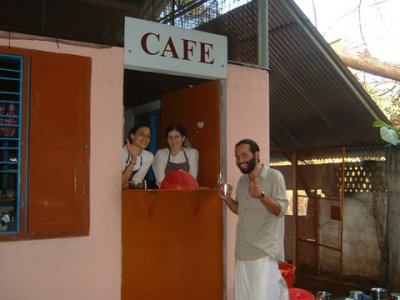
I started helping my daughter Chaitanya in the Western cafe on August 19, my second day at the ashram. The first four days, I buttered the bread that would be cooked on the grill. On Thursday, August 23, I started doing a 7:30 to 9:00 a.m. shift calling out cafe orders as they are ready. When I am given the plates from the kitchen, I check that what is on the plate matches the ticket. I then call out the ticket number and make sure each person gets the correct order. Some of the time, I work at a leisurely pace, but at other times the orders come out fast and furious and I have a whole crowd of people standing in front of me. The job certainly gives me practice in staying focused.
There are so many more people involved in ordering, cooking and serving the food than when I started working at the cafe in the late 90’s or early 2000’s. In the “old” days people would line up outside the cafe window to order and pay for their food. I would be sitting inside the cafe, taking orders and cashiering through the window. The photo above was probably taken in the early 2000’s. The window where I used to sit is the one on the left. Over the years, much of the process has moved outside with the people who take the orders, the cashiers, and much more being in front of the cafe. The whole building was remodeled and enlarged two years ago.
Crow

A funny thing happened on Monday or Tuesday. When I sat down to eat my breakfast, two crows flew over to me and perched on nearby chairs. Sometimes, one was on the chair directly in front of me and sometimes he was one chair over. The other crow was always on the back of the chair to the south of him. I’m used to crows perching on various ledges above me but don’t remember them being at eye level before. These crows rarely looked at me directly, but they were on constant alert, looking one way and then another.
At one point, a friend carried her breakfast plate to the table and set it down in the care of someone not far from me. She had covered her food with another plate. The person who was watching her food stepped away briefly. In an instant, the second crow flew to the plate, knocked the cover off and started pecking at her breakfast. I spontaneously stood up to shoo him away. Without hesitation, the crow that had been sitting in front of me grabbed part of my omelet and flew away with it.
From my perspective, the crows were working as a team and I had been a sucker in a conspiracy! I laughed.
Kerala Floods
(The photos below are of a 24 hr/day call-in rescue hotline operated by Amrita University’s faculty and students.)


It is estimated that one million people are being housed in flood relief camps. Four hundred and twenty people have died or are missing, Ten thousand kilometers of roads have been destroyed or damaged and 50,000 homes have been “wiped out”.
The flood cleanup has been hampered because when people return to their homes they are finding poisonous snakes (including pythons and cobras), centipedes and scorpions in their cupboards and personal belongings. Some have even found crocodiles in their houses.
The Cochin International Airport is the world’s first solar powered airport. The solar panels, along with the runway, taxi bay, shops as well as other areas of the airport were submerged during the flood. The damage is estimated to be more than three million US dollars. The airport was due to reopen on August 26 but the reopening has since been moved to the 29th.
Safe in Amma’s ashram, I feel separate from the nightmare in which many of the people of Kerala are living. It was good for me to research and write this summary. If you feel inspired to donate to the relief effort you can do that at: Amma.org (US) or Amritapuri.org (India). I’m sure there are many other ways to donate, but those are the two places I am aware of.
Onam
Saturday is Onam, Kerala’s biggest festival. It is a harvest festival and a family festival. I’ve heard that this holiday is similar to Christmas in the West, although it is a secular holiday. The government has canceled Onam celebrations this year because of all the flooding in the state. I know that some of Amma’s centers in the other parts of the world will host programs that will include praying for the Kerala people and Kerala relief fundraising dinners. There will be an Onam event of some kind in Amritapuri, but I don’t know the schedule or the content. I will be reporting on it in the next post.
Is a New Day Dawning for Me?
On Tuesdays, Amma serves lunch to the devotees and visitors who are living in the ashram. Amma blesses each plate and then the plates are passed to everyone by long lines of devotees. When it is time to form the lines, I eagerly join in. Once everyone has a plate of food, we eat together.
This past Tuesday, after finishing my lunch, I saw that Kumuda was sitting in one of the first rows of chairs in the middle section of the auditorium. The lunch was over, but Amma hadn’t started giving darshan yet; she was playing with some children.
When I walked over to Kumuda, an old but familiar energy washed over me. I realized being that close to the front of the room felt like being with Amma before the crowds got big. In those days, I spent many hours sitting and watching Amma; I was mesmerized by her. It has been a long time since I have had that experience. I don’t remember when it ended, but the shift probably started around the time I became the tour coordinator for Amma’s Pacific Northwest programs. I was tour coordinator for about 15 years, and it has been at least five years since I gave up that role.
In the last decade, I have developed the habit of sitting in the back or side of the program halls and just watching Amma on the screens. My relationship with Amma has not been affected by my moving to the back of the room, but my relationship to the music is a different story. For years, I have longed for my mind and body to react to Amma’s bhajans (devotional songs) the way it did in my early years with her. At that time, it was as if my body, mind and soul was fully immersed in the music. I remember feeling like the music was feeding my soul.
I resolved to test out sitting closer when I am in Amma’s presence and during any other program that I attend. Tuesday evening, I sat in the fourth row of auditorium chairs during the bhajan program. On Wednesday, I sat cross-legged on the temple floor watching Amma give darshan and later did the same sitting next to the brahmacharinis (female monks) when they sang. Tears ran down my cheeks as I experienced the music, just like they used to in the early days.
[Note: I’m making a big deal about sitting cross-legged because I didn’t know that I could still do that, especially for a whole program. I discovered that my back felt better sitting that way than it does when I sit in a chair. Also, there is a large section for floor sitting in front of the chairs, so if I sit there I will be closer to the front of the room.]
On Thursday, I sat cross-legged on the floor during morning archana and did that again when the women residents sang their series of Sanskrit chants soon after darshan started. That same evening, I sat cross-legged on the floor when Swami Pranavamrita sang during darshan. Once again, I experienced the bhajans in a way that I hadn’t experienced for years. My mind was (relatively) silent and I experienced a combination of joy and peace.
Is a new day dawning for me? It sure feels like it is.
To read the previous posts in this series click here.
Living and Learning in Amritapuri, India: August 15-18, 2018

I left Seattle for Amritapuri, India at 5:50 p.m. on the 15th of August. Fourteen hours later, I arrived at the Dubai airport. While I was there, I received notice that Amma had asked the Amritapuri ashram residents and visitors to chant the peace mantra 108 times at 10 p.m. That mantra and translation is:
Lokah Samastha Sukhino Bhavantu
May all beings in the world be happy
The chant ends with:
Shanti, Shanti, Shanti
Peace, Peace, Peace
Even though I didn’t know for sure why Amma had made that request, I assumed it was because of flooding that was occurring in the Kochi area. I decided I would also participate. I finished the chant minutes before boarding my plane to Trivandrum.
After the 14 hour flight between Seattle and Dubai, there is a 2 1/2 hour layover in Dubai, followed by a 4 hour flight to Trivandrum. Usually, I start the 2 1/2 hour taxi ride to Amritapuri as soon as I retrieve my baggage. This time, however, I was traveling with my friend Kumuda. When she comes to India, she spends a day in Kovalam so that she has a chance to rest before making the last leg of the journey. I decided I would also do that this time. Maybe resting at that juncture would reduce the amount of jet lag I experience.
We arrived at the hotel about 5 a.m. It is off-season now so the hotel was really quiet. In fact, we may have been their only guests! It was wonderful to lie down for a while and then walk to the beach for breakfast.
I hadn’t been to Kovalam since 1993 and at that time I had stayed in a different area. After we had breakfast, Kumuda showed me around. Two types of flowers caught my eye. They were so beautiful.


I also saw a vine on a trellis that was growing a fruit that looked like limes. I say “looked like” because the fruit was perfectly round and the skin was shiny. At first I wondered if it was an artificial plant. When I glanced at the leaves, though, it was obvious that the plant was real.


There was heavy rain from time to time on the day we were in Kovalam. When I checked the news that evening, I learned that 13 out of the 14 districts in Kerala had been put on red alert due to the rain. By morning, the last district was also on red alert. The worst flooding was in Kochi. [An article written on August 18 said the floods in Kerala were the worst in a hundred years. The article also said the flood had killed at least 324 people and 220,000 others had been displaced. Kochi airport was still completely submerged and was expected to be closed until August 26.]
The weather forecast predicted there would be thunderstorms the next day. I began to wonder if it would be safe to take the taxi ride from Kovalam to Amritapuri. When I checked the forecast the next morning, I discovered that it had changed. Now, it called for clouds or light rain during the time that we were planning the drive to the ashram. We left Kovalam at 5:30 a.m. and arrived at the ashram at 8:00.
I was grateful…. and relieved…. to be back at my spiritual home!

I checked in at the International Office and then took my luggage to my room. Shortly thereafter, I went to see Sreejit and Chaitanya, my son and daughter, who both live at the ashram. I love every reunion we have. It is always so good to be with them.
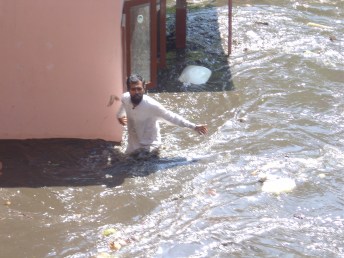
Being in a situation where flooding is possible, brings up memories for me of being in Amritapuri during the 2004 tsunami. After the tsunami hit, all the people from the nearby villages and the ashram were evacuated. Amma provided food and shelter for everyone at Amrita University and her nearby schools.
Many of the ashram residents and visitors and some of the villagers stayed at the Engineering College for five days. I remember witnessing the grief of the villagers who had lost family members. I also remember being thankful to have the clothes on my back and a mat to sleep on.
More than two hundred people had died in the village closest to the ashram that day and many more had died in other parts of India and beyond. Amma’ provided food, shelter, clothing, and medical care both locally and to Tamil Nadu and Sri Lanka. In the years that followed, she also provided job training and built many houses for tsunami victims. To read more about Amma’s 2004 tsunami relief programs click here.

Soon after I arrived at the ashram this year, I learned that Amma had sprung into action once again. Even though the first floor of her multi-specialty hospital (AIMS) in Ernakulum had flooded, it took in the patients from hospitals that had needed to be evacuated. Amma sent many of the ashram’s brahmacharis and brahmacharinis (male and female monks), as well as Western visitors who wanted to help, to AIMS to deal with the influx of patients and to do the manual labor needed to move everything from the flooded first floor of the hospital to higher floors. They also filled sandbags and dug structures to protect the hospital from future flooding. [ I haven’t seen those structures so I don’t know what they looked like.]
Amma has also started dozens of medical relief camps and provided water, food, clothes and bedding to people who needed it. Thirty out of 40 of her schools around the state have become relief shelters. She has also made a large donation to aid the government’s relief program. To learn more about the current relief efforts go to the Latest News section in Embracing the World.
After having breakfast, I went back to my flat and continued the process of moving in. At some point, I decided to go to the temple to watch Amma giving darshan to those who came to the ashram that day. [Amma’s form of darshan/blessing is to give hugs. She has embraced more than 37 million people world-wide.] When I visit India, I often wait for several days or even a week before I go to Amma for a hug. That day, darshan was being held in the temple and the crowd was much smaller than normal.
Usually, bus loads of people come to see Amma on darshan days. I realized that the devotees couldn’t get here because of the floods. And since the Cochin airport was closed, many of the international visitors weren’t able to be here either.
I decided I would go for darshan. Before long I was in Amma’s arms. Now I was truly …. and fully …. home.


Photo Credits: Amma’s Facebook Page
 Living, Learning and Letting Go