In my last Living and Learning in Amritapuri post, I mentioned that I knew I would have many experiences during my remaining days here. From my perspective, every moment I’m in Amritapuri is packed with challenges, lessons, opportunities and gifts.
I wrote that post on Saturday, January 7. The following day was the day I had been asked to be the first person to hand Amma prasad, the candy and ash that she gives people coming to her for a hug. I was excited to be given that opportunity.
Amma starts darshan at 11:15, but we must be prepared for anything that might occur, such as her arriving early. I was asked to come to the auditorium stage at 10:30. The person in charge of the prasad lines went over the process with me. I learned, to my surprise, that the person who hands Amma prasad first, moves to another prasad seva when they are finished.
The second seva involves handing prasad packets to the devotee who will be giving Amma the packets next. Receiving them ahead of time means the person is ready to give the prasad to Amma the minute they get to her.
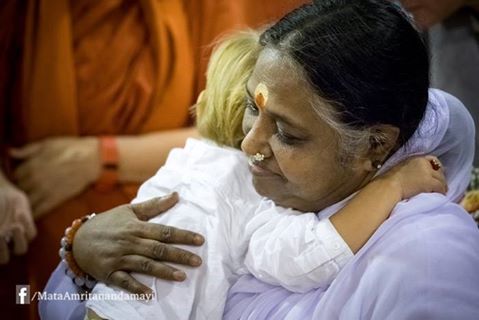
Handing Amma the packets was as wonderful for me as it always is, but the lesson came with the second part of the seva. There are many sevas on the stage but the last time I have done one of them, except for a few years when I helped people who needed to sit on a stool during their darshan (hug), was when I was on one of the 1995 Indian tours.
The prasad process has gotten so organized in the last 21 years. I suspect that many of the positions were created primarily to give people a chance to sit near Amma. I realized how much I have missed by not participating in those sevas. It is another example of how my “staying busy”pattern has not been to my benefit. There are two more darshan days before I leave Amritapuri. I’m going to try to sign up for one of the other stage sevas.
I had wondered if I would be able to sit on the floor for thirty minutes and when it turned out to be forty-five, I was even more concerned. By the time my shift was over, both of my feet were asleep. I had some problem getting up and I stumbled onto someone in the process. I need to figure out a more graceful way to exit the stage!
When I first stood up and turned to leave, I noticed that there were 20 or more Ayyappa pilgrims about to get darshan. I generally burst into tears whenever I see these men dressed in black. I considered their presence at that moment as a very personalized gift to me.
I have seen very few Ayyappa pilgrims, who are devotees of Lord Ayyappan, son of Shiva, this year, but the rest of that day and the next I saw them repeatedly. I suspect they were on their way home from their yearly pilgrimage.
Story #2 in Overcoming Myself will give you more information and some photos about the Ayyappa’s yearly pilgrimage to Sabarimala and Story #3 contains a song I wrote about my experiences with the Ayyappa pilgrims. I still haven’t sung that song for Amma. I wonder if I ever will.
To see all of the posts in this Amritapuri series, click here.
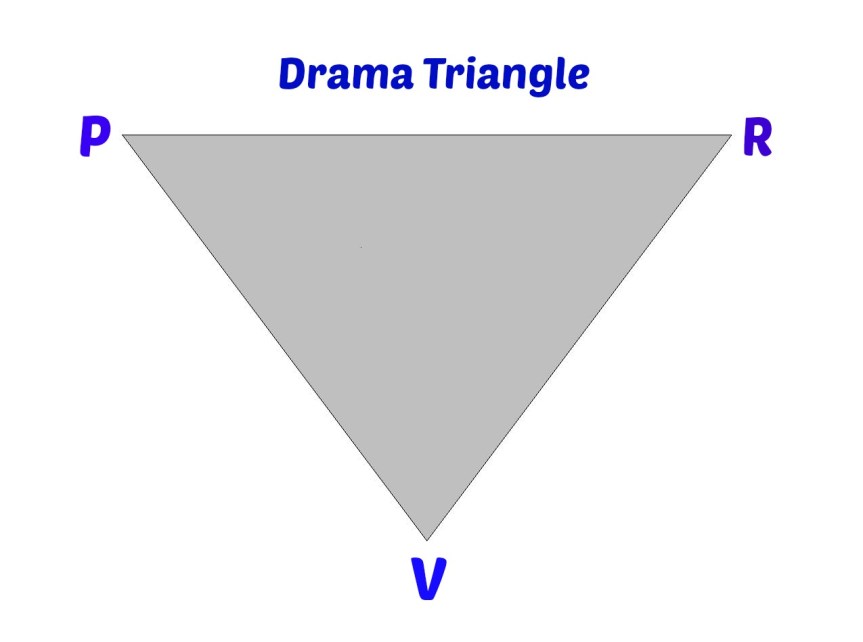
Suffering is often the result of having participated in a transactional “game” identified by Stephen Karpman as the Drama Triangle. The Drama Triangle contains three roles- 1) The Persecutor (P) who blames and criticizes, 2) The Rescuer (R) who thinks for others, helps when they have not been asked to help, does things they don’t want to do, and does things for others that they could do for themselves and 3) The Victim (V) who feels oppressed, blamed, unloved, hopeless and/or helpless. The Victim often is immersed in “Poor Me” energy.
Although it is possible to play the “game” totally within oneself, it is almost always played out between two people. Once the “game” begins, both players generally spend some time in all three roles.
EXAMPLE
Person A: Gives unasked for advice (R)
Person B: Feels irritated and makes a belittling comment. (P)
Person A: Feels unappreciated and blamed. (V)
Person A: Angrily blames Person B for being unappreciative (P)
Person B: Feels depressed because it seems like she can’t do anything right. (V)
Person B: Over-adapts and does what Person A suggested even though she doesn’t want to. (R)
Drama Triangle Home
There is usually one part of the Triangle that is more familiar to us than the other parts. When we are involved in the “game,” what I call our “home” is the place where we usually spend the most time.
Identify two times in the recent past when you have been on the Drama Triangle. Think of situations that occurred 1) at work with supervisors, employees or peers, 2) with friends, 3) with family, or 4) with any other individuals in your life. It could be a sales person, a barista, or anyone else who has crossed your path.
If you can’t think of anything that happened recently, then use two situations from the past. Describe how you and the other person moved through the Drama Triangle process. What caused the game to end? Was the problem that started the game ever solved? How?
Getting Off of the Drama Triangle
At first, you might not recognize that you are on the Drama Triangle until you are fully involved in the “game”. Over time, you will begin to notice feelings, thoughts and body sensations that will alert you that you are on the Triangle. Eventually, you will recognize when other people invite you onto the Triangle and will be able to prevent the game from even starting.
The most important step in getting off the Drama Triangle is to decide that you are not willing to play the game. If one person refuses to engage in the process, the other person will soon give up.
When you decide you are not going to engage in the Drama Triangle process, picture yourself stepping off of the triangle. Here are some tips:
If you have been in PERSECUTOR:
a) See yourself stepping off of the Drama Triangle.
b) Take a time out so that you can cool down. Constructive problem solving is not likely to occur when you are in the heat of anger.
c) Do work to release your anger. (Examples: Write lists of the things you are mad about; write a poison pen letter letting out the rage, and then destroy the letter; twist a towel putting your anger into the towel; and/or tear up a phone book.)
d) When the amount of anger you have has decreased, engage with other person. Work with them in solving the problem. Set boundaries as needed.
If you have been in RESCUER:
a) See yourself stepping off of the Drama Triangle.
b) Take a time out if you need it.
c) Let the other person know that you love, support and care about them.
d) Acknowledge to yourself, and to them, that you have been rescuing and that in the future you will wait until they ask for what they need, or you will ask them if they want help from you.
e) Ask yourself if you have been rescuing others because there is a need of yours that needs to be met. If there is, then think of how you can meet that need. It may be YOU that needs to ask for help.
If you have been in VICTIM:
a) See yourself stepping off of the Drama Triangle.
b) Take a time out if you need it.
c) Write lists of what you are mad, sad and scared about.
d) Give yourself affirmations for your ability to think and solve problems.
e) Ask others to give you affirmations for your ability to think and solve problems.
f) List all of the solutions you can think of for solving the problem.
g) Start doing the items on your list. Continue until the problem is solved.
For the rest of this week record what happens when you realize you are on the Drama Triangle. Record small examples as well as big ones. Also record ways you avoided getting onto the Triangle in the first place. (Add more pages to this document if your list is long)
See you next Monday for the ninth lesson.
To find the lessons in this series that have already been published click here.
When I saw that the Weekly Photo Challenge for this week was “Names”, I knew exactly what my contribution would be.
I laugh whenever I think of the name of this bakery in Vallikavu, India– and I thoroughly enjoy eating their ice cream sundaes. I, of course, had to buy one when I went to town to take this photo today. The sundae was called Chocolate Fantasy. Yummmm!
To see all of the posts in this Amritapuri series, click here.
I have felt graced many times lately. The ones I’m remembering in the moment are:
-I wear a Fitbit that serves both as a pedometer and as a watch. For some unknown reason, the Fitbit hasn’t synced for the last six weeks, so I’ve had to add 1 ½ hours every time I looked at the watch. That has been a nuisance. One day this week, I looked at my watch and the time was correct. It felt surreal.
-Last week I made an appointment for a massage. (Various forms of body work and classes are available here. The proceeds help fund Amma’s humanitarian projects.) When I arrived at the session, the massage therapist asked if I wanted a Swedish massage or Reflexology. I said “Both!” That wasn’t an option so I got the massage.
When I was in Tai Chi class on Thursday, I started feeling the nerve pain I get in my toes when my low back muscles are too tight. Towards the end of the class, a friend who was on a break from the Reflexology class she was teaching, walked up to me and asked if I wanted to have a Reflexology treatment in a half hour. She had an uneven number of people in her class, and needed to have someone receive a treatment when the students paired up and worked on each other. I, of course, was delighted to serve in that way!
-Amma held darshan in the temple again on Wednesday and Thursday of this week. That felt like such a gift. Being in the temple brings back so many memories for me plus it feels more intimate than being in the big auditorium.
-I’d been feeling down for awhile and hadn’t been able to shake it. On Wednesday, the crowd was small so I decided to go for darshan and ask Amma, internally, to help me lighten up. When I entered the darshan line, I learned that the man next to me was from the UK but had been living in a Buddhist monastery for many years. He was on his way back to the UK, where he plans to start an intentional living community focused on mindfulness and sustainability. He had never met Amma before. I loved talking to him while we proceeded through the darshan line. When I reached Amma, she held me for what seemed like a very long time. I feel so blessed to have her in my life.
-Someone asked me a few days ago if I would be willing to be the first person to hand Amma prasad this coming Sunday. They always like to have an experienced person do that job at the beginning. Needless to say, I didn’t have to think twice before I said yes to that!
– Amma comes to the beach for meditation and a question and answer period on Monday and Friday evenings. I didn’t go on Monday, but I heard afterwards that instead of being next to the Ayurvedic building, sandbags had been put on the beach and the meditation was held there. I felt sad that I had missed that experience so I made sure I went yesterday. It was wonderful to be there although I was sitting on the side and much lower than most of the people so I could see Amma but not much else. I had no idea what a big area our group covered until I saw this photo on Amma’s Facebook Page. I will go earlier on Monday!
-Tonight Swami Amritasvarupananda sang a song that used to take me into such a deep state of meditation. I haven’t had that experience for many, many years, but it happened again tonight. I am feeling so much gratitude.
Saraswati Garden and Eco Textile Work Center
I’ve continued to work an hour or two in the Saraswati Garden and Work Center most days. On Wednesday, we harvested the rest of the turmeric. Yesterday it was boiled and today another devotee and I sliced it. It will then be dried and ground into powder for use in dying fabric. After two hours of slicing, my hands were even yellower than when I did it for the first time. I know from experience that I will be yellow for days.
I’ve seen big lizards in the garden several times on this trip, but they always move so fast that a photo is out of the question. Two days ago, one scooted in front of me and then up the side of a wall. It then stayed in one place while I took out my camera. As soon as I snapped the shot, it sped off.
The garden has lots of caterpillars. I turned over a coconut shell yesterday and it was filled with caterpillars. I walked back to the house to get mye camera. There were still a lot of them in the shell when I returned. I associate caterpillars with destroying gardens and trees but I don’t see any evidence that these are hurting the plants in any way. I wonder what they are eating.
Wrapping up
A week from today I will be in Dubai waiting for my flight back to Seattle. I’m starting to sort through my belongings and pack. Before long I will be cleaning my room in preparation for the next person that stays here.
Even though I’m starting my ending process, I know my trip is not over yet. I have almost a week of experiences still ahead of me. On Monday, I’m going to Vrindavan Gardens, the oldest of the tulasi gardens. I’ve heard new things are happening there and I’m eager to find out what they are!
To see all of the posts in this Amritapuri series, click here.
It has been said that laughter is the best medicine. I believe there is truth in that statement. It certainly helps us in lightening up, if we engage in activities that make us laugh.
There were two scenes in the recent Amritapuri play that made me laugh out loud. The songs that accompanied the scenes were also funny.
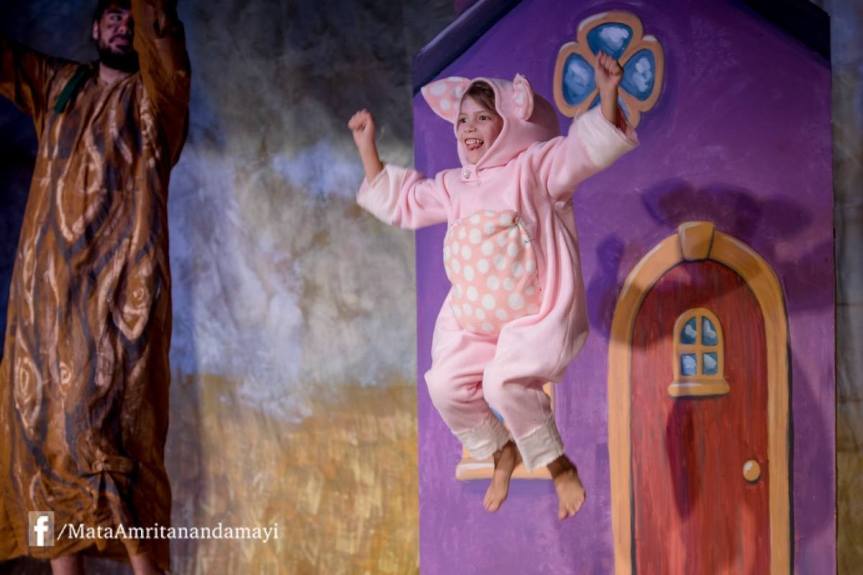
In one scene, a group of very young children dressed up as pigs.
During the finale, one of the “piggies” got so excited that she started jumping very high. The crowd loved it.
Here is the funny song that went with the scene.
The other scene that brought laughter was very different. It was the scene when Matthew, the prodigal son, reached the lowest part of his despair. He had lost all of his belongings and was working for a man in exchange for food.
While his life situation was in no way funny, the song that went with it, and the way the actor played the role, made it a very funny scene. As a psychotherapist, I know when we are feeling down, if we start talking about the situation in really grandiose, i.e. exaggerated “Poor me” terms, we may start laughing. To me this song and scene are a good example of that. While I can’t show you the video, I can share the “Poor, Poor Me” song in addition to the photos above.
I know that listening to these songs and looking at the pictures will help me lighten up when I am feeling mopey and victimy in the future. I hope they do the same for you.
To see all of the posts in this Amritapuri series, click here.
The Amritapuri Christmas play this year was based on Jesus’ parable of the prodigal son; with the main focus being on the love of the father. No names are used in the parable, so for the play the father was called Jonas, and his sons were Jeremiah and Matthew. Matthew was the son who left home.
Here are a selection of photos from the production. (If you click on the gallery the photos will be enlarged.)
Father with Matthew and Jeremiah as children
Father with Matthew and Jeremiah as children
Jesus
“The Collector”- he steals Matthews riches
City men dancing
Piggies
Piggies
Father celebrating Matthew’s return
Matthew singing about father’s love
Village celebrating Matthew’s return
Jeremiah angry that Matthew was being celebrated
Father talking to sons
Sons forgiving each other
Sons forgiving each other
Finale
Finale
There were so many beautiful songs. I’m going to share the audio from my two favorites. This first one, “I Search My Soul,” was written by my son Sreejit. In it, Jonas, Jeremiah and Matthew are singing simultaneously as they look within themselves.
Most of the songs in the play are original. There was one song though, that is commonly used by churches in plays about the prodigal son. Some of the words were changed to fit the script for this production, but it is basically the same as When God Ran written by Phillips, Craig and Dean. The song is so moving. I still cry every time I listen to it.
Matthew sings about his father’s love
I feel full of gratitude for everyone that worked together to create The Loving Father.
Thanks to Chaitanya who wrote the script and co-directed the play.
Thanks to Devapriya who choreographed the dances.
Thanks to Devika who co-directed the play with Chaitanya and played the role of Jesus.
Thanks to Jani who spends countless hours designing and sewing the costumes.
In most plays in India, the actors are not actually talking or singing. There is a group of musicians and singers who sit to the side of the stage who provide the instrumentation and the voices. So a special thanks to all of the musicians and singers who worked night and day to create and learn the dialogue and songs for this production.
And of course endless thanks to all the actors and dancers as well as those who sewed costumes, translated, created props, prepared power point slides, and set up and ran the lighting… and to anyone I forgot to mention.
To see all of the posts in this Amritapuri series, click here.
A major predecessor of suffering is passive behavior. Many years ago one of my mentors, Elaine Childs Gowell, taught me that we are being passive when we are aware that there is a problem and we:
a. Do nothing and hope the problem goes away.
b. Overadapt and do what other people want us to do.
c. Agitate by doing repetitive behaviors that aren’t directed towards solving the problem, e.g. tapping fingers, swinging legs, playing with hair, mopping the floor at 2:00 a.m., etc. Addictive behaviors may be forms of agitation, e.g. over-working, over-eating, alcohol, drugs, and over-thinking.
d. Incapacitate through headaches, backaches, stomach aches, depression.
e. Escalate by behaviors such as throwing things, screaming and hitting.
EXAMPLE
Situation: Your 12 year old daughter received two D’s on her report card.
a. Do Nothing: Tell yourself she will do better the next time and just ignore the situation.
b. Overadapt: Decide not to talk to her teachers because your daughter doesn’t want you to.
c. Agitate: Grumble under your breath and clean the house late into the night.
d. Incapacitate: Develop a headache
e. Escalate: Scream at your daughter and then slap her when she sasses you.
Eliminating passivity from your life takes time and effort. First, you have to recognize when you are being passive, or are considering being passive, and then commit to doing something to solve the problem instead.
PRACTICE EXERCISE
This week, record each time you realized you were being passive, or had the opportunity to be passive. Then write down what you did to solve the problem.
When you choose to solve the problem instead of being passive, brag about it to yourself and to a friend. Receiving acknowledgement can be very helpful in changing self-sabotaging behaviors.
See you next Monday for the eighth lesson.
To find the lessons in this series that have already been published click here.
On New Year’s Eve, I decided to go to bed just before midnight rather than stay up for the end of the Amritapuri, New Year’s celebrations. When I heard the next day about the things I had missed because of that decision, I felt a bit sad.
The entertainment continued for a while after I went to my room. When it was finished, a video of Amma’s Christmas message was shown. The translation of her talk was projected onto many different screens. I know it was shown in English, French, German, Russian, and Malayalam. There may have been other languages as well. If you would like to see a transcript of Amma’s talk, you can find it here.
By the time the entertainment program and the talk were done, Amma had finished giving darshan. (Darshan lasted until 1:00 a.m. That meant she had given hugs for 14 hours with only a ten-minute break.) Amma then led a meditation and sang three songs. I know two of them were favorites of mine; I haven’t heard what the third one was.
The name of the first song starts with Kushiyom. Amma introduced it a few days before the 2004 tsunami. The song ends with the Lokah Samastha peace chant. I couldn’t find a recording of the whole bhajan, but I did find one of Amma singing the Lokah Samastha part. The video was recorded days after the tsunami hit the village where the ashram is located. It was a time of so much destruction and grief.
The last song Amma sang is the bhajan I find to be the most celebratory of all of them, Mata Rani. This video is a favorite of mine.
Amma returned to her room at 2 a.m. Sweet pudding was distributed to the devotees afterwards. If I had stayed for the entire program, I wouldn’t have gone to bed before 2:30 or 3:00 a.m.
While I felt sad, particularly about having missed those two songs, I knew I had made the right choice. I had been so tired that night and was also feeling very chilled. I had gone to my room to get a long sleeve shirt earlier in the evening and, as weird as it may sound, I also wrapped myself in a double layer fleece blanket.
While it was a bit windy and the fans in the auditorium were blowing, I could tell the the temperature didn’t justify the level of cold that I was feeling. I had the same experience before I got sick last week and also one week here last year.
I fell asleep the moment I laid down and didn’t even hear the sound of the loud firecrackers from the village across the backwaters.
So yes, choices have consequences. In this case I felt sad about what I missed, but when I woke up on Sunday morning, I was awake and healthy, and able to enjoy New Years Day. I was very glad I had chosen to sleep.
So many lessons
Since I knew I would be missing time with Amma by going to bed early on New Year’s Eve, I made sure I had time with her during the day.
Several years ago, Amma created a plan that gave all of the Western visitors and residents the opportunity to sit on the stage with her for 30 minutes on each darshan day. (The Indian residents have a similar opportunity but I don’t know much about their structure.)
Soon after I arrived in Amritapuri on this visit, Amma changed the length of the sitting shift to 45 minutes. On New Years Eve, I made sitting on the stage a priority. I didn’t think I could sit cross-legged for 45 minutes and was prepared to leave early, but I ended up staying for the whole time!
Later in the day, I joined the prasad line. As I went through that process, it occurred to me I have mentioned in past posts that the prasad-giver hands Amma the candy and ash that she gives to each person who comes to her for a hug, but I haven’t said anything about what that experience is like, other than I love doing it.
It took two hours for me to make it to the front of the line. Once there, I began handing Amma the prasad. We give her a group of three packets at a time, each containing ash and a piece of candy. It is essential that we keep our eyes focused only on Amma’s hand at all times, because if we start watching her, we would be very likely to miss the cue that she is ready to receive more packets from us.
When Amma is ready for the packets, she opens her hand a certain way. Sometimes, she may want even more of them. In that case she opens her hand a little wider and we give her three more, i.e. six packets in total. Occasionally, Amma’s hand is an easy reach and sometimes it is further away.
The process is further complicated by the fact that Amma often moves her hands when she talks with people, so you may think it is time to hand her the packets when in fact she is just gesturing to make a point. She may also reach to a nearby plate to pick up extra candy, a banana, an extra ash packet or a variety of other things.
This time, there were a few other factors to take into account. Whenever Amma is on stage there are many people around her. The prasad-givers have some designated space but it is small. When I was next to Amma, there was a boy around 10 years old who came to her crying. She held and talked to him a bit and then asked him to sit behind her. He took half of the space of the person who times the prasad-givers’ two minute shifts. When the timer moved to make room for him, she had no choice but to take part of my limited space!
Then, a woman in a white sari stood over me talking with Amma. The end of her sari flapped in front of me. That meant I couldn’t even see Amma’s hand. So I was trying to hold the woman’s sari away from me, ducking low to get some kind of view of Amma’s hand, and attempting to get the packets into her hand in the correct way and at the correct time. (Sometimes I think Amma is setting all of this up to play with me!)
When my two minutes were up, the timer tapped me. It is always hard to exit quickly so the next person can get into place before Amma wants more prasad. Once I get out of that person’s way I have to navigate around a fan and a whole lot of people who are sitting on the stage, without stepping on someone. I left laughing at the leelas and celebrating that I had been able to stay focused throughout all of these challenges.
I believe everything happens for a reason and that we can learn from every experience. In the two hours I was in line, and in the two minutes I had handed Amma prasad, I could see that I had been given lessons in patience, focus, flexibility, letting go, equanimity and no doubt many other things. Amma teaches us through her every action.
To see all of the posts in this Amritapuri series, click here.
“The fool doth think he is wise, but the wise man knows himself to be a fool.” “Love all, trust a few, do wrong to none.” “Love looks not with the eyes, but with the mind, And therefore is winged Cupid painted blind.”-William Shakespeare


















 Living, Learning and Letting Go