I am oh so grateful for my daughter Chaitanya. She was born on September 14, 1977 so today is her 37th birthday! I feel so blessed to have her in my life.
Chaitanya has always lived life fully, whether it be playing with her friends, participating in drill team, running track or doing the many other activities she enjoyed during her childhood and teenage years.
Sreejit, Chaitanya, and dad
She and her brother Sreejit have a very special relationship. The pictures below give just a tiny glimpse into their life together!
Best of friends
Chaitanya went to India for the first time in 1993. She felt so at home in that country, especially at Amma’s ashram. Over the next few years, she visited the ashram several times. On her 21st birthday she decided to move to India on a permanent basis, choosing to dedicate her life to supporting Amma’s humanitarian work. For many years, she has overseen the work at the cafe and canteen that serves Western food to ashram residents and visitors.
Chaitanya and her husband Akshay met at the ashram and have been together since she turned 28. They have so much in common and are blessed to have each other.
Her dad and I, of course, also have many memories of special times with her.
Playing around
When she was a young adolescent, Chaitanya loved watching old Broadway musicals, especially if Gene Kelly was involved. Over the years, she created numerous short plays of her own. Since 2009, however, she has written and directed hour-long musicals every year. The plays are performed on Christmas eve in Amritapuri. I recently wrote a post about one of them.
Below you will find the mp3 and lyrics for two of my favorite play songs; the first is from God is Able and the second is from A Guiding Light.
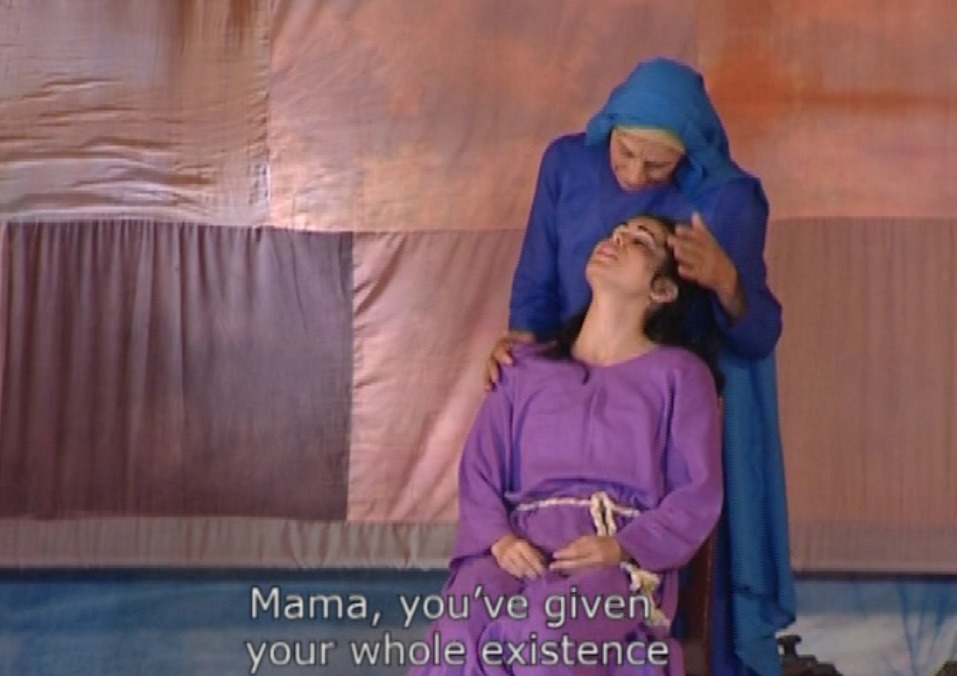
One segment of God is Able is about Rachel, the woman who was healed by touching the hem of Jesus’ garment. Rachel had been sick from childhood. The first words on the recording are from the mother, responding to Rachel’s concern that she (Rachel) is such a burden. Rachel then responds to her mother’s comments by singing this beautiful tune. I still cry when I hear it, especially if I’m also watching the play DVD.
Mama you’ve given your whole existence To serving this child plagued with illness You look exhausted, your face full of strain It’s I who should be easing all of your pain.
If I had strength in this body of mine I’d cook and I’d clean till the walls began to shine I’d put your feet up, tea in your hand Let you enjoy the life God has given
This may be a fantasy, an impractical dream I just long to return the love you’ve shown to me I’ve known there’s no cure a doctor can give Only a higher power can change what’s been destined.
I pray to you dear God, if it’s your will from above Give me the strength to overcome. There’s nothing I want more than to ease her weary soul To serve her is all I’m asking for.
*****
One part of A Guiding Light is about the three wise men who traveled to Judea to honor Jesus at the time of his birth. This song takes place at the beginning of that journey. (I recorded this song from the play DVD, using the voice recorder on my phone, so the sound certainly isn’t ideal, but it works!)
Wise men together:
High in the sky a star shines bright Through unfamiliar paths it will be my guiding light A journey I will make to a far off land That I may greet God in the form of man
Wise man 1:
I shall bring to him this gift of gold Treasure that never fades nor grows old Gold represents his earthly kingship In Righteousness he’ll rule, with love and virtue
Wise man 2: I shall bring to him sweet Frankincense These simple sticks hold great significance They symbolize his priestly role in life A burning offering of love and sacrifice
Wise man 3: I will take this bottle of embalming oil Though his body’s born, his soul is immortal He is beyond both Birth and Death Yet if he resides on earth life is surely blessed
Wise men together:
Yet if he resides on earth life is surely blessed
I am so proud of you Chaitanya. You have grown into a remarkable, adult woman whose strength, talent and wisdom I admire greatly. Happy Birthday!
Sreejit (my son), Chaitanya (my daughter) and Akshay (Chaitanya’s husband) came to the U.S. this summer to visit family, work and be part of Amma’s North American tour staff. Usually, they return to India immediately after the tour but this year their dad (my ex-husband) asked them to take him on a trip to Yellowstone and the Grand Tetons. It was a trip that Al, Sreejit and I had taken in 1976. Sreejit was still in a backpack at that time. This particular trip was an important part of Al’s “Bucket List” and he wanted all of us, including me, to participate.
Sreejit, Chaitanya and Akshay picked up their dad the day after they returned from Amma’s tour and they headed to Yellowstone. I joined them in the Tetons two days later.
The Grand Tetons were exquisite. Their beauty was muted by smoke from the fires in Washington, Oregon and California but they were still majestic. It was easy to imagine what they would look like in their full glory.
This slideshow requires JavaScript.
We had a wonderful trip and many experiences. Most important to me though was the time we spent together.!
Photo credit: Sreejit Poole
Al and Karuna
As we drove through Yellowstone on our way back to Seattle, we had two last surprises. After we passed this particular deer, we discovered there was another adult deer and three youngsters behind the trees. The young deer were playing; running away from their parents, through the forest and then back to their parents again, all at top speed! It was so much fun to watch them. And clearly being that close to the bison was amazing.
I’m so glad that Al brought us all together in this way. It is a memory that will last a lifetime for each of us.
One weekend during the mid 80’s, I was a client in a psychotherapy intensive. Early on in the intensive, one of the therapists asked us to divide up into three groups depending on whether we tended to take rebellious, over-adaptive (I.e. tendency to do what pleases others), or victim attitudes. I immediately joined the over-adaptive group.
The therapist, who was considerably shorter than me, walked close and looked up at me. “Who do you think you are kidding?” she said. I was surprised, because over-adaptive seemed like a reasonable choice to me. She then started rattling off a list of things I had done during my life. Hmmmm …. when I thought about it from that perspective, I realized she was right. I marched over to the “Rebellious” group.
I grew up in a military family where I spent a good part of my life in my room pouting. Another big chunk I spent with my nose in a book. When it was time to leave home to go to college, I picked Seattle Pacific College (SPC), a tiny conservative Christian school in Seattle, Washington. It turned out to be way more conservative than I was. Some rules were of no concern because I didn’t do the behavior anyway; no alcohol, no drugs, no smoking, for example. In addition there was to be no dancing or card playing on or off campus, and no pants were to be worn on campus except on Saturdays or when we were in our dorm. Permission to go to movie theaters had just recently been granted.
We had to live in the dorm at least a year. The first quarter our curfew was 8:00 p.m.; after that it was 10 p.m. I really enjoyed dorm life. I remember we played a lot of pranks on each other, like short sheeting our friends’ beds and putting shaving cream under doorknobs.
When the time came that I was allowed to live off campus, I did. I moved into an apartment with one of my former dorm mates. The incident I remember most clearly about that period was when I invited a boyfriend over to my apartment for Sunday lunch. Shortly thereafter, I received a call to come to the office of the Dean of Students. When I presented myself there, he confronted me for having had a man in my apartment. I remember he said, “My dear, we don’t even allow our engaged students do that!” I couldn’t believe it was against some unknown rule to invite someone over for Sunday lunch. My resentment towards the college took a big leap.
I became more and more disillusioned as we entered into the period of the civil rights and Vietnam War protests. I judged that students and faculty had their noses buried in their Bibles and had no interest in things that were truly important. At some point, I discovered the First Avenue Service Center, a place where homeless and poor people could gather during the day. The Center gave them the opportunity to be off of the streets, have friends to talk to, play cards, do their laundry and have meals. I became a volunteer in that center and it became a major part of my life. The homeless taught me to play double-deck Pinochle and I loved it. I spent hour after hour enjoying the company and the game even though I knew playing cards was against the school rules.
My fellow students couldn’t understand what I was doing. One told me, “I wouldn’t even take a bus on First Avenue. My mother obviously raised me different than yours.” I retorted either aloud or in my head, “I doubt it!”
I wasn’t content seeing the people only in the Center; I began to socialize with them outside of the Center as well. I loved being part of their lives. Except in one instance, I never felt in any danger.
I was so excited about the life I was living and the people I was meeting. I remember writing my mother and saying “Oh Mom, I’m having so much fun. I’m meeting and getting to know ex-cons, drug addicts, drag queens and other interesting people. It is wonderful!” Needless to say, my mother did not share my attitude. I was upset and shocked when I received a phone call or letter back from her saying that she was sending me a plane ticket home. I knew I wasn’t going to go home but I don’t remember how that scene played out. Whatever the process, the result was that I stayed at SPC.
I was definitely putting my mother through the wringer though. In later years she would say, “You were just fine until you went to college.” During this period of my college years she would get a notice that I was on the Dean’s list (i.e. honor roll) one quarter and on probation the next. Once she even received a letter saying there was a warrant out for my arrest. That even shocked me. It made no sense whatsoever. When I investigated, I discovered it was due to an unpaid traffic ticket, but the officials hadn’t bothered to put that information in the letter.
At some point I moved back in the dorm. That meant I had to deal, or as it turned out, not deal, with the college dorm curfew. If we weren’t in by the time the curfew came, we were locked out. With my new life style, I wasn’t always back in the dorm by 10:00 p.m.
As an aside, let me say that Al, the man I would eventually marry, arrived in Seattle in 1968 on the day that Bobby Kennedy was shot. I met him when he also became a volunteer at the Center. We never dated until I moved to Oakland after graduating from SPC, but he became my best friend during those years. There were numerous times when we sat at the waterfront all night talking because I couldn’t get back into my dorm. I really appreciate that he helped keep me protected during that period of my life.
Al
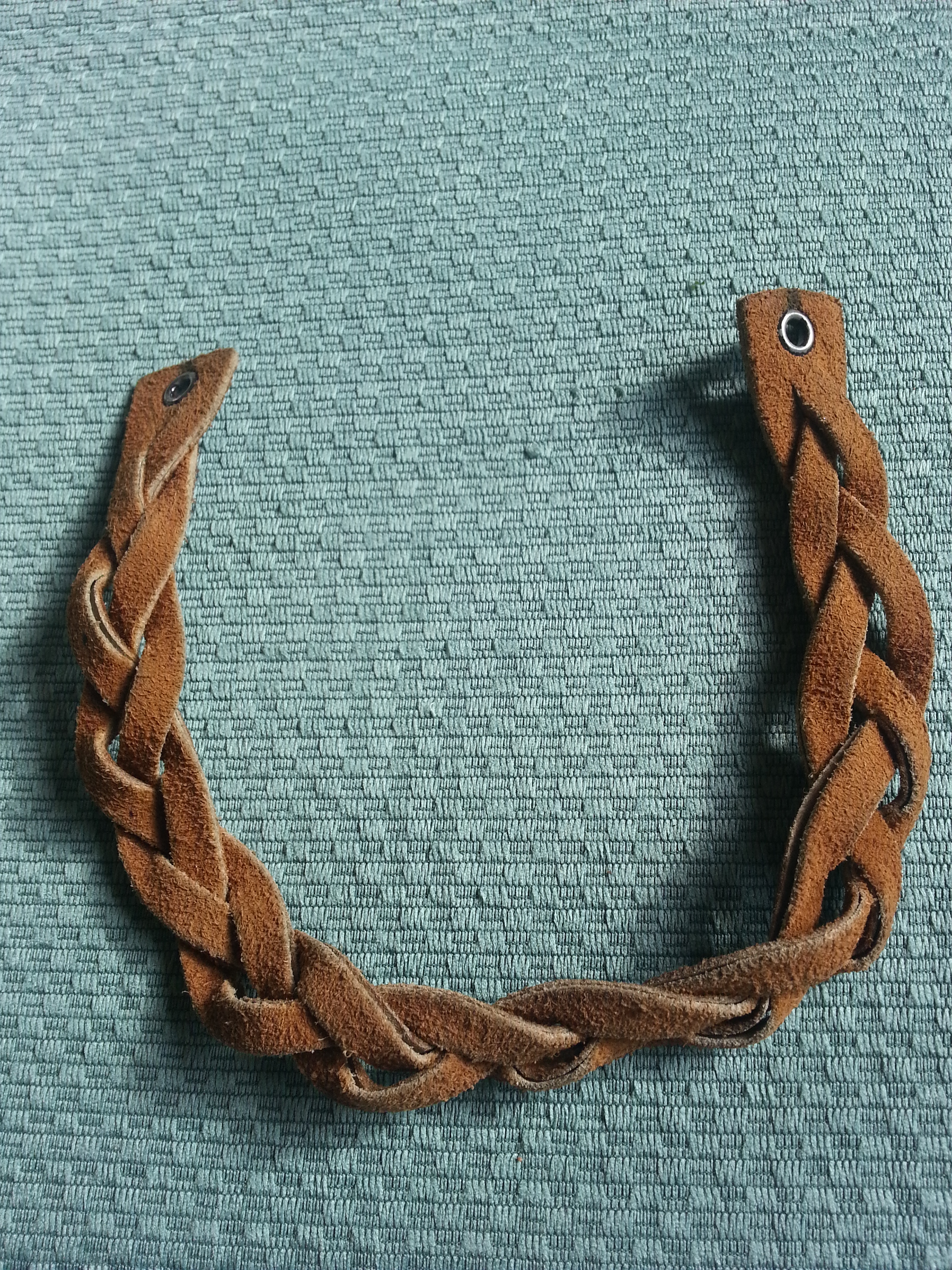
During those years, I started wearing a headband and moccasins, taking on the hippie image that I still identify with today. I consider that headband to be my most prized possession from my childhood and young adult years. When I called Al yesterday to ask for help in figuring out some of the timeline for this post, he commented that I didn’t wear the headband very long because a boyfriend I had at the time objected. He went on to say that I wore the moccasins for a very long time, in all kinds of weather. I remember wearing them walking the three miles from SPC to the Center in the snow! I recall the headband as being a very significant part of my life, however, so maybe I wore it before I met Al and/or after I later moved to California. I don’t remember. But I do know it was, and is, an important symbol from my time growing up.
This was a time period when a program called Urban Plunge was developed. The goal of Urban Plunge is to give students “a personal experience that will equip them to engage the homeless population with empathy and compassion.” The groups of students left the comfort on their homes and engaged with the homeless over a five-day period. They spent the night in church basements. I thought about taking the Plunge and then realized I didn’t need to. A good part of my life at that time was an “Urban Plunge.” [A few years after I moved to California, I learned that Seattle Pacific had started sending nursing students to train at the First Avenue Service Center. When I googled Urban Plunge as I was writing this post, I not only discovered that it still exists, but also found that the Seattle Chapter is sponsored by Seattle Pacific University! Oh how times have changed……]
While I can’t place them on a timeline, I know I had many other experiences during these years. I spent time in San Francisco, especially in the Haight-Ashbury district, land of the hippies. I loved it. I think it might have been there that I stayed a night or two in a Salvation Army Shelter. I was never part of the sex, drugs and rock and roll aspect of the hippy lifestyle, that was not me, but I was into having as many life experiences as possible. I particularly loved hanging out in Golden Gate Park with the drums playing and everyone dancing.
Seattle Pacific College could not offer the Psychiatric or Public Health portions of the nursing curriculum in those years, so the SPC students attended the University of Washington for two of the last three-quarters of their undergraduate program. I decided to move into a commune in the University District. I found I loved the community life style.
When it was time for me to take my last quarter at SPC however, my chosen residence became an issue. Returning students who were living off campus had to sign a form agreeing to not having men in their homes. (As I reflect back on it, I wonder if they added that statement to everyone’s contract after I had made the earlier “mistake” of serving lunch to my boyfriend in my apartment!) I was in a dilemma. If I told the truth school officials would be upset. But I wasn’t willing to lie. I told them I couldn’t sign that contract because I lived in a commune and of course men lived there. They gave me an immediate ultimatum; move out of the commune or leave school.
As much as it was tempting to make a political statement by leaving school, I was too close to finishing to take that self-destructive move so I moved out of the commune. I still stayed in rebellion though. When I left the commune, I moved into a small room in a house north of SPC. Living alone was also against the SPC rules but at that point I didn’t care.
Instead of living in a bustling community, I was now living alone, eating hamburgers at Dicks Drive-in and whatever I could take out of a can and cook on a hot plate in my room. Soon I would be able to leave the school and its rules behind.
When I graduated in 1970 with my Bachelor of Science in Nursing degree, there were no nursing jobs available in Seattle. Boeing was on strike and the wives of the Boeing men had to go back to work. Many were experienced nurses so they were hired for the available jobs. As a result, I moved to Oakland and started working at Highline County Hospital.
In Oakland, I continued having a myriad of experiences. I went to San Francisco frequently. I spent time listening to the drums in Golden Gate Park. I attended church services at Glide Methodist Memorial Church, a church that brought people from all the life styles together. (Their services were a major celebration of life.) I remember going to some Black Panther meetings in Oakland or Berkeley. This was a time of great turmoil and change in the United States. It was also the time when I started dating Al, so driving back and forth between Seattle and Oakland became regular events in both of our lives. My life was full, and happy.
I think I will end my narrative with a memory that is so important to me. I don’t know when it happened but I remember the impact on me when the father of a friend of mine said, “You are one of the true hippies.” While it is not a matter of good versus bad, right or wrong, I knew there were differences in those that called themselves hippies. I was not interested in drugs and partying. I believed he was acknowledging my willingness to immerse myself into experiences and into the lives of others, to be of service, to be an agent of change, and to being a bridge between communities. All of those have continued to be themes throughout my life. In fact, I consider them to be my purpose in being here in this world. I knew his comment was meant to be a complement and I took it that way.
I still have my headband, and have worn it from time to time in plays. I even wear moccasins every now and then!
Two years ago I went to my friend Marla’s 50th birthday party. We were asked to wear costumes. I, of course, chose to be a hippie. I decided to make a fancy headband for the occasion, but it was still a headband.
My friend Vince and me
I was, and in some ways still am, a hippie…. and I’m proud of it.
Written for Writing 101 Assignment #20 : Write a long post about something you Treasure
Soon after I returned from India in January, I received a series of emails from neighbors letting me know they had been robbed. In the 40 years I’ve lived here, I’ve had only one break-in. That was in the 70’s and was clearly the work of a child. l made that conclusion at the time because the thief had ignored the boombox and other things that were of value. The only item taken was a piggy bank. They then dropped the piggy bank as they fled down the back stairs. Loose change was scattered everywhere. Continue reading “FOUND!”→
The sixties were a tumultuous time to be growing up. As a twelve-year-old I was elated when John F. Kennedy was elected president. His vision for the country was so exciting to me. That excitement and optimism began to evaporate with the tumultuous and devastating events that came next. Continue reading “1961 and Beyond: Moving from Elation to Disillusion”→
Around 1980, I started attending a Unitarian Universalist church. Soon thereafter, I heard about an eight day family summer camp that was held at Seabeck Conference Center every year. It was sponsored by Eliot Institute, a regional Unitarian group. I was so excited and knew I wanted to go.
At that point my son was five and my daughter was two. I decided it would be too much for me to take a two year old to camp, so made plans for Sreejit and me to go. When we crossed the bridge into the conference center that first time, it was like entering another world. A world of unbelievable beauty, where one could relax, make new friends, get hugs, and simply breathe. I felt like I had found my “Home” in the universe. Continue reading “Seabeck: A Home in the Universe for Me”→
In looking back over the posts I’ve written since I started my blog, I found that the most popular one was my first, Living in Gratitude. As I pondered writing some kind of followup to that post, it occurred to me that today is the perfect day for me to share something my youngest brother wrote before he died of cancer at the age of 39. It is a piece that has meant so much to me.
The Truth I Live By
(William John Smith 1953-1992)
Everything makes sense. This can be paraphrased many different ways, although many attempts are less accurate. One of Voltaire’s characters stated, “All is for the best, in the best of all possible worlds.” This is unnecessarily optimistic. My phrasing doesn’t imply that everything that happens to us is good either in the short or the long term. Everyone experiences moments or long periods of unpleasantness. One can hope that over the long period of a lifetime these sad times may not add up to much overall, but most persons with a little thought can think of individuals whom “fate has treated unkindly,” i.e. who have received more than their share of agonies. I think this is one of the hardest things for you, C., that what has happened is just not fair. I’m not sure how long ago I came to believe (or realize) that fairness isn’t the issue. There is nothing fair about life, either in distribution of rewards or unhappiness. And what’s to say that it should be fair. If each of us had an opportunity to create a world, then maybe that’s an attribute that we would build in. But this world is not of our making, and all of the mental checklists that we might make comparing who’s gotten more breaks than we have, etc., will never change the fact that we have to make the best of what we’ve got, not despair over what we perceive as inequities. So life isn’t fair. How do we cope with that? One way might be to remind ourselves that no matter how bad things seem to be at any one time, a little time spent flipping around the TV channel or reading a news magazine will serve as a reminder that we should be embarrassed to be heard complaining about the vast majority of things that concern us. I don’t doubt for a second that I have lived a very privileged existence compared to 90% of the world’s people.
I’m not sure that that is the best way to approach a new tragedy, though (i.e., making ourselves feel better by thinking of others doing worse). I would appreciate a more optimistic approach. The best way to greet each unpleasant event is to grab it by the throat and make the best of it. C. and I have both had our share of suffering, almost all of it, I’m happy to say proceeding our first date. There is no doubt that led to a degree of maturity that made our time together (pre-diagnosis and post-diagnosis) much more meaningful than the lives of those growing up “with the silver spoons.”
Is cancer unfair? Is it fair that we should expect billions of cells in our body to reproduce over and over again, over an entire lifetime, and always get it right? Doesn’t it make more sense to recognize the initial miracle of our birth, the magnificence of our growth into feeling, loving, praising adults, the privilege of experiencing enough of life that we can despair over not having the time to spend longer doing the same? One of the things I am most grateful for is that many, many years ago I learned to be grateful for what I’ve been given. I didn’t, as occurs with many, only get shocked into this realization by a terminal tragedy. This type of appreciation often does begin in the midst of despair, and for that reason I am actually glad that I had enough hard times as a young man, to allow me to think hard about what things are and are not important. Accordingly, for the past 15 or 20 years, I’ve been able to ignore aspects of 20 th century American living that are of no consequence to me (parties, cars, frivolous chatter, clubs, etc.) and concentrate on things that touch me personally. I am forever grateful for what it was that dropped the blinders from my eyes so many years ago.
I am very sad that people seem to see so little of the world around them. I can’t walk outside without seeing the beauty of our created world, from the rainbow in a line of earthworm slime, to another visible ring on Jupiter. We have been given this magnificent world to study and enjoy in limitless detail at any level, microscopic to cosmic. Even though I have enough things to interest me another 10 lifetimes, I must take solace in knowing that, at least compared to others, I’ve had much more than my share even in half a life time..
I am blessed to have had a brother who could embody these attitudes. I hope those of you who read this find his words meaningful in your lives as well.
A year or two ago, my son, Sreejit, wrote a poem called A Couple of Brats. The first line stated: “A political statement until they had us,” referring to the births of his sister and himself, kids with a white mother and a black father. While I knew that line was true, at least to some degree, his poem still gave me plenty to reflect on. Recently, I have been thinking of the events that occurred throughout my life that led me to make that particular “political statement.”
The earliest memory I have of experiencing racism was when I visited Florida during my early grade school years. I grew up moving place to place in an Army family, but my mother’s home was in West Palm Beach, Florida. When we visited there one year, probably about 1955, we had occasion to get on a city bus. As a kid, it had been my experience that the best seats were at the back of the bus so, as always, I rushed to that prized area. Once seated, I looked towards the front of the bus and saw the look of horror on my mother’s face. She gestured me to come to the front of the bus, NOW! I couldn’t imagine what was wrong but obeyed her command. When I discovered the reason behind her demand, I was FURIOUS. How could they treat black people, known as coloreds or Negros in those days, in such a manner? I also remember during that time whenever we drove through the black part of town, it was referred to as N*****town. I was disgusted, but to the southern whites of that era, it was just the normal way to speak, they knew no other.
My parents retired to West Palm Beach just before my Junior year in high school. The following Summer, 1965, our church youth group took a trip from WPB to Seattle and back studying “Beliefs Men Live By.” The youth minister, who was pretty revolutionary, had arranged for two black teenagers to participate in the journey. During that period there was never any mixing of races, so that type of trip was a really big deal for both the white and black teenagers.
The minister had a difficult time finding a white family to host the black teenagers the night before we left West Palm Beach. The white families were afraid, knowing their neighbors would have strongly disapproved. Luckily, my Aunt Ruth and Uncle Ted stepped forward to provide the necessary shelter.
The next morning we began our adventure. I believe it was the first night, when we passed through Americus, Georgia, we glimpsed a Klu Klux Klan meeting through the trees. That was frightening for everyone. The van driver ordered the black teenagers to lie flat on the floor until we could get way out of town. I remember having a strong sense we were being followed.
One of the nights early in the trip, we stopped for the night at Tougaloo College, a black college in Mississippi. It was the first time any of us had experienced what it’s like to be in the minority in a racially divided group. During the evening we met with a group of the college students and had an interesting dialogue.
A year later, I moved to Seattle to study Nursing. After I graduated from college in 1970, three female friends and I decided to spend the summer working as migrant farm laborers. We would start in Florida, work up the east coast (Georgia, South Carolina, Maryland and Pennsylvania) and then head back to Washington State. We had a multitude of experiences that summer.
We had serious car trouble on the way to Florida, so it took us more than a week to get there. After having more car problems once we arrived in Florida, there was no money left to take our trip. We spent a week washing windows, cleaning houses and porches and selling flowers. Next, we found a job picking oranges in Belle Glade for a few days. At night, we stayed in a heavy canvas tent. In Florida heat, the temperature inside the tent was intolerable, so the tent went no further with us.
Each morning, we left the campsite at 5 a.m. and joined the bus taking the farm workers to the orchard. We were the only white people on the bus, but everyone was so nice to us. Once at the orchard, each woman was paired with a man. The men used a 20 foot ladder to pick the oranges high in the tree; the women picked the lower ones. During the days we worked in Belle Glade, the four of us earned between $17-31. We figured it took 30 oranges to earn 1 cent. We came back to my parents’ house in West Palm Beach, exhausted but feeling successful and ready for our big trip.
Our first stop was Byron, Georgia where we attended the Atlanta International Pop Festival, along with more than 200,000 other people! We had to park 3 miles away and hike in. There was no shade to speak of and it was 104 degrees. We ended up 30 feet from the stage! The artists I remember most were Jimi Hendrix, Chambers Brothers, Richie Havens and the Memphis cast for HAIR. I remember waking up to Richie Havens singing “Here Comes the Sun.”
After the festival, we drove 60 miles north. We stopped at a state campground and went to pay our fee. The ranger said we could not camp there unless we had an adult chaperone. I was flabbergasted as our ages ranged from 19 to 22! He said that would be true of any campground in the state. He added, “Lady, this is Georgia!” We got back into the car drove to a campground 20 miles away. They accepted us without question.
The next day, we started looking for work. The white farmers refused to let us work with black pickers. They suggested we ask for work at the farmers’ market in Atlanta. We did find a job there. It was tough work, made harder by the fact that the white farmers treated us like we were prostitutes; why else would white women be doing this kind of work?
We were advised that we could get farm labor work in Fort Valley, Georgia. One of the first things we did when we arrived in town was to go to a laundromat. A 13 year old white girl told us the hippies who went to the rock festival stripped naked in the car wash, in the grocery store, in the back of trucks. The things she said were outrageous. While we were there, a black man walked in and put his laundry in the washer. She was furious, grabbed her wet laundry from the machine she was using, saying N**** to him and rushed out. I had the feeling if we had talked to him our lives would have been in danger.
We were able to get some picking work in Ft. Valley, but it was not to pay our expenses so we decided to work in a peach cannery as well. The woman who hired us said she bet her husband $5 we wouldn’t last more than 2 days. We definitely intended to prove her wrong.
We were assigned the night shift. The workers on that shift were almost 100% black. The day shift was nearly 100% white, the exception being some hard labor jobs. To keep the job, we were required to work 7 days a week, 8-10 hours a day with one 10 minute break and no dinner. If we didn’t show up for work, we would be fired. If the machines didn’t work, which happened a lot, we didn’t get paid, but if we left we would be fired. After several weeks the night shift was laid off. By then we were very happy to leave.
Our boss, whom we liked a lot, gifted us with an empty peach can labeled Pride of Georgia. (It was many years before I ate another canned peach. The machine we had been running was overflowing with lye that hadn’t been completely rinsed off the peaches before they sealed the can.)
Next we went to South Carolina. We easily found a job, but finding a place to stay was a problem. The farm had an area for black workers to live and a separate area for the white workers. They wouldn’t let us stay in the black camp; saying we wouldn’t last 15 minutes there. I asked how that could be since the black camp was full of families. The farmer said there were no families in his camp. Then he thought a moment and said, oh you mean the N******. To him black children didn’t even qualify as “children”. Once again, I was outraged.
They gave us cattle truck to stay in, but staying there one night was more than enough. I decided to talk to the black crew boss, Leroy, and ask if we could sleep in their bus. He offered us that chance to stay in their kitchen. I asked if he would get in trouble with the farmer if we did that and he said no, there would be no trouble. We spent our first evening in the camp singing late into the night with the kids.
It turned out that the black workers’ kitchen was in the same building as the white men’s quarters. During the night they were drinking and we heard them saying “They want to see what a migrant camp is like; let’s show them what it is like.” Several times, white men came into the kitchen and it was only by our quick talking and shaming that were we able to get them away from us.
After talking with Leroy, our plan for the next night was to have his wife lock us in the kitchen so that the white men couldn’t get in again. However, around 11:00 p.m. when we were singing with the kids and a little girl was brushing my hair, someone spoke up behind me. We turned around to find three policemen standing behind us. They said the farmer wanted us off his land, NOW. We were shocked. The farmer hadn’t said a word to us about it during the day. We asked if we could go to the packing shed to talk to him ourselves and they said gave us their permission. When we arrived at the shed, we discovered that three black workers and one white worker had beat us there. They had told the farmer that if he kicked us out in the middle of the night, every worker he had would be gone by morning! Luckily, he relented and let us stay the night.
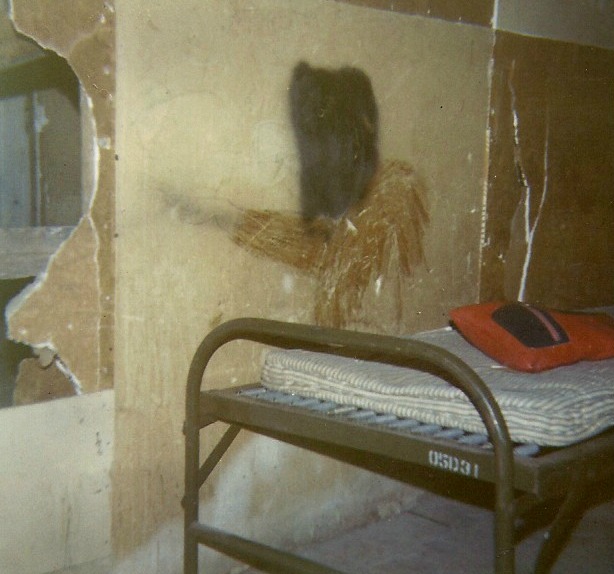
I will mention only one other experience from that summer; and that happened in Maryland. We had no trouble finding a job or a place to stay there. The labor office said we were welcome to stay in the farm workers’ camp as long as we realized everyone else would be black. That camp consisted of 54 buildings. Each building was divided into three rooms, and each room held a separate family. Our room had two beds, a light that wouldn’t turn off and a few shelves. There were huge holes in the plasterboard between our room and the room on the other side. There were showers in the camp, but they couldn’t be turned on. The only source of water was a spigot several houses down.
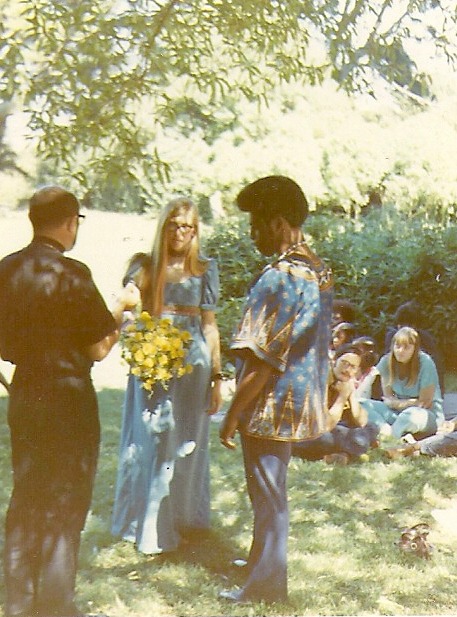
I came back to Seattle after that 1970 trip with lots of positive memories, but also angry about the racism I had witnessed. I decided that I was going to make a difference. In my young mind, the best way to stop this nonsense was to blend the races through interracial marriage. I started pursuing Al, who by that time had been my best friend for several years. A year later, we were married in Golden Gate Park in San Francisco. The morning of the day we were going to be married, we attended Glide Memorial Methodist Church. Roberta Flack sang during the church service, and Quincy Jones played the piano. While their appearance had nothing to do with our wedding, it made for a great memory! After our wedding service in the park, Jane Fonda came up to us and wished us well. What an awesome beginning to our new life!
While the mixing of races as a political stand against racism might have been a naïve way for me to look at solving racism, it always felt right to me. When I told my father of my plans, he vowed to never speak to me again, and he didn’t. Still my resolve never wavered. He told my mother that she could never see me again, but she wasn’t willing to stand for that and started visiting Seattle regularly.
So, was marrying Al a Political Statement? I’d have to say “yes”, at least in part. More than anything, it was a decision to walk my talk, to make my life a testimony to my beliefs.
As a result of the union between Al and me, two very beautiful, very talented, very loved and loving individuals were brought into this world. Three years after our marriage, Sreejit was born, and nearly three years after that came his sister, Chaitanya.
Did our marriage and having mixed raced children end racism? No it did not. But certainly, between then and now, mixed marriage has gone from unacceptable to much more widespread and “acceptable”. As individuals in each generation have more contact (of all kinds) with those of other races, we gain more understanding of each other. Every step forward makes a difference. I am happy to have participated in an active way in the journey.
I left home at 17 to go to college and had very little contact with my family after that. About a month ago, my brother Bob emailed me and told me he had my father’s slides. (My father died in 1999.) He asked if I would be interested in seeing them.
Bob ended up having them changed into digital format and sent them to me. I already had some pictures from when I was young, but not many, and they are all in black and white. These slides are all in color! Most of them I had never seen before, or at least not in the last 50+ years! It has been a real treat to have a surprise view of my past.
“The fool doth think he is wise, but the wise man knows himself to be a fool.” “Love all, trust a few, do wrong to none.” “Love looks not with the eyes, but with the mind, And therefore is winged Cupid painted blind.”-William Shakespeare



 so proud of you Chaitanya. You have grown into a remarkable, adult woman whose strength, talent and wisdom I admire greatly. Happy Birthday!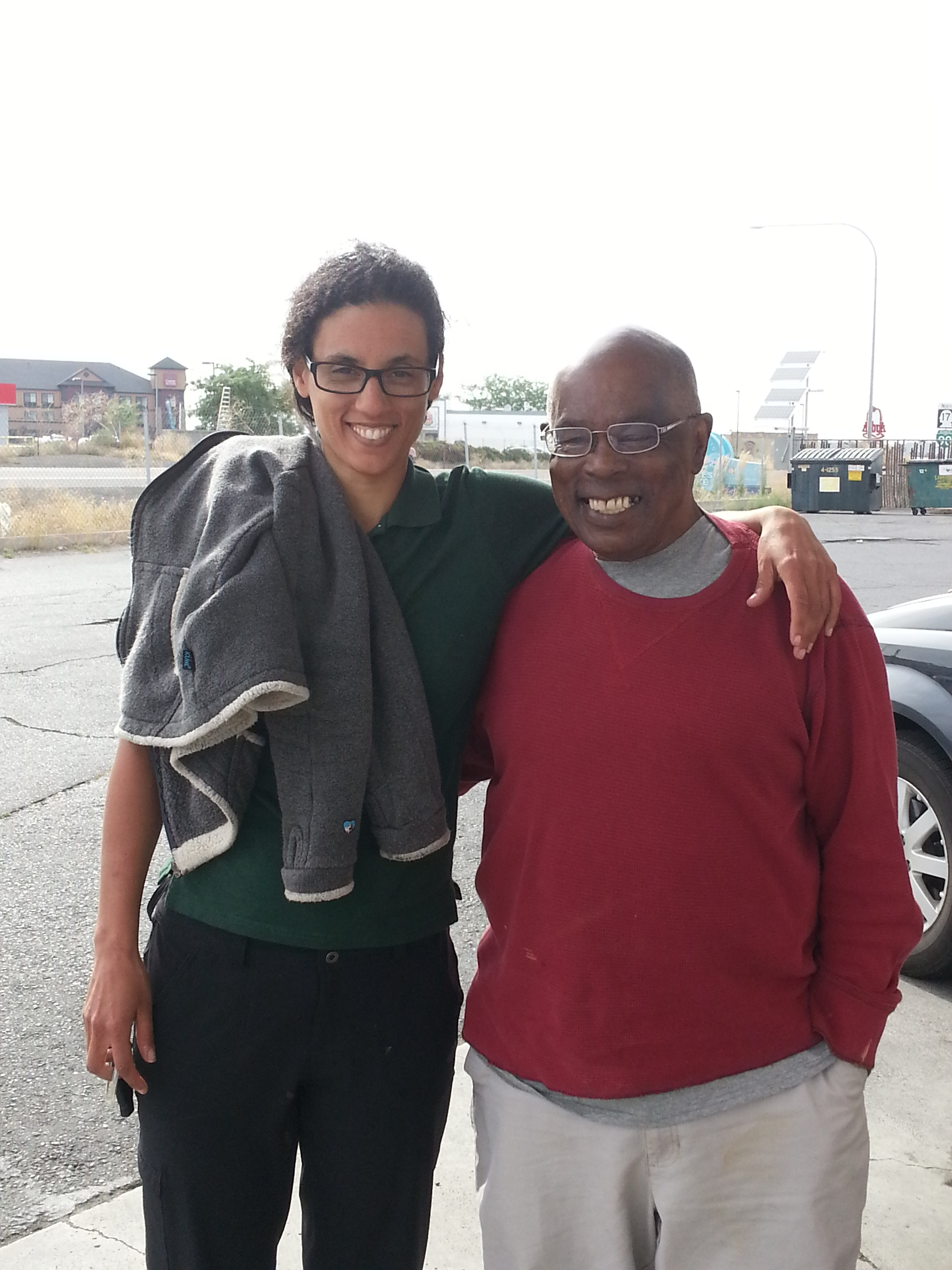







 Living, Learning and Letting Go