Letting Go of Suffering- Week Ten: Failure

heart-157895_1280

You are lovable even when you fail.

Failing is a normal and necessary part of living.

You can learn from every failure.

heart-157895_1280

Another behavior that often leads to suffering is failure. Failure is “to disappoint expectations or trust; to fall short; to be or become absent or inadequate; to be unsuccessful.” (Webster’s Ninth New College Dictionary, Springfield: Merriam-Webster, Inc. 1988, p. 445)

The reality is that any time we choose to act, we take the risk of failure. In order to succeed, we must be willing to risk failing. There is much that can be gained from acting, even if the result is failure. As with mistakes, it is important to see that failure is a necessary part of living and that something can be learned from every failure. Continue reading “Letting Go of Suffering- Week Ten: Failure”

Jane Goodall: A New Kind of World

Photo Credit: Wikimedia
Photo Credit: Jeekc on Wikimedia

“I think one of the most important things for people to understand,” says Goodall, “is don’t feel helpless when you look at all the problems of the world.

Realize that if you think about the consequences of the small choices you make each day — what you buy, what you eat, where did it come from, how was it made, did it harm the environment, cruelty to animals, child slave labor — [you] make more ethical decisions.

It’s not just you. It’s more and more people around the world. In the end, it’s hundreds of millions of people making small choices, that are the right choices, that leads us to a new kind of world.”

Source

Letting Go of Suffering- Week Nine: Mistakes

heart-157895_1280

You are lovable even when you make mistakes.

Making mistakes is important for your growth.

You can learn from every mistake.

heart-157895_1280

Making a mistake is one of those life situations that often leads to suffering. A mistake is “a wrong action or statement proceeding from faulty judgment, inadequate knowledge or inattention.” (Merriam-Webster, Inc. 1988 p. 760.)

An important step in letting go of the suffering is to adopt the mind-set that mistakes are an important and necessary part of living, and that something can be learned from every mistake. In time, you may even come to see making a mistake as a positive event rather than a negative one.

35

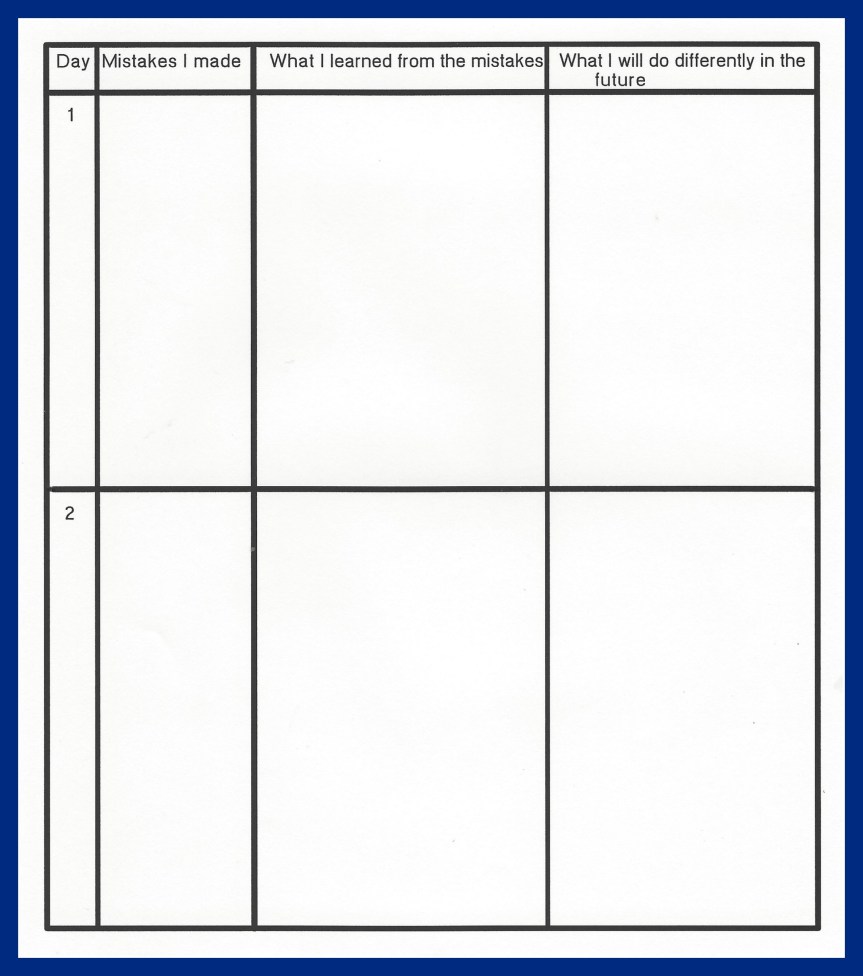
This week, record every mistake you make. Write down the tiny mistakes as well as the big ones. Next to the mistake, write what you learned from making it and what you will do differently in the future. Add more paper if you need to.

36

37

38

heart-157895_1280

You are lovable even when you make mistakes.

Making mistakes is important for your growth.

You can learn from every mistake.

heart-157895_1280


See you next Monday for the tenth lesson.

To find the lessons in this series that have already been published click here.

Letting Go of Suffering- Week 8: Getting Off of the Drama Triangle

triangle-color

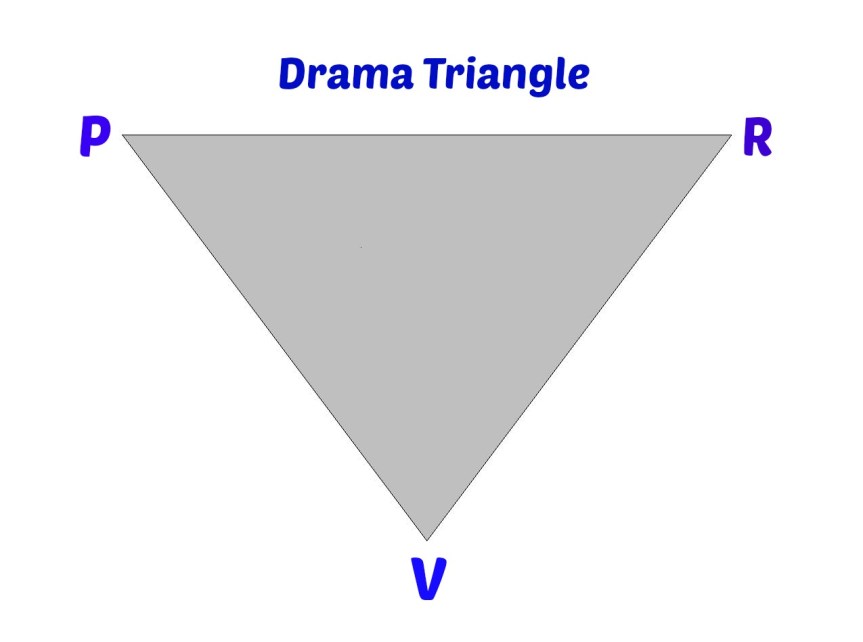
Suffering is often the result of having participated in a transactional “game” identified by Stephen Karpman as the Drama Triangle. The Drama Triangle contains three roles- 1) The Persecutor (P) who blames and criticizes, 2) The Rescuer (R) who thinks for others, helps when they have not been asked to help, does things they don’t want to do, and does things for others that they could do for themselves and 3) The Victim (V) who feels oppressed, blamed, unloved, hopeless and/or helpless. The Victim often is immersed in “Poor Me” energy.

Although it is possible to play the “game” totally within oneself, it is almost always played out between two people. Once the “game” begins, both players generally spend some time in all three roles.

EXAMPLE

Person A:  Gives unasked for advice (R)

Person B: Feels irritated and makes a belittling comment. (P)

Person A: Feels unappreciated and blamed. (V)

Person A: Angrily blames Person B for being unappreciative (P)

Person B:  Feels depressed because it seems like she can’t do anything right. (V)

Person B:  Over-adapts and does what Person A suggested even though she doesn’t want to. (R)

Drama Triangle Home

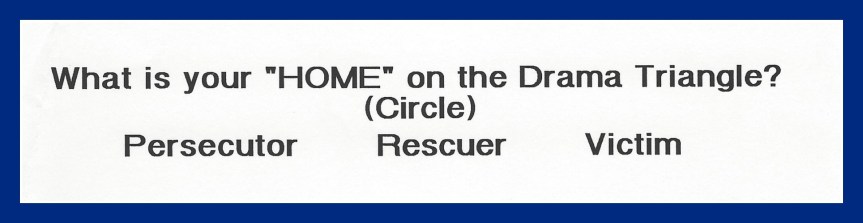
There is usually one part of the Triangle that is more familiar to us than the other parts. When we are involved in the “game,” what I call our “home” is the place where we usually spend the most time.

30a

Identify two times in the recent past when you have been on the Drama Triangle. Think of situations that occurred 1) at work with supervisors, employees or peers, 2) with friends, 3) with family, or 4) with any other individuals in your life. It could be a sales person, a barista, or anyone else who has crossed your path.

If you can’t think of anything that happened recently, then use two situations from the past. Describe how you and the other person moved through the Drama Triangle process. What caused the game to end? Was the problem that started the game ever solved? How?

30b

Getting Off of the Drama Triangle

At first, you might not recognize that you are on the Drama Triangle until you are fully involved in the “game”. Over time, you will begin to notice feelings, thoughts and body sensations that will alert you that you are on the Triangle. Eventually, you will recognize when other people invite you onto the Triangle and will be able to prevent the game from even starting.

The most important step in getting off the Drama Triangle is to decide that you are not willing to play the game. If one person refuses to engage in the process, the other person will soon give up.

When you decide you are not going to engage in the Drama Triangle process, picture yourself stepping off of the triangle. Here are some tips:

If you have been in PERSECUTOR:

a) See yourself stepping off of the Drama Triangle.

b) Take a time out so that you can cool down. Constructive problem solving is not likely to occur when you are in the heat of anger.

c) Do work to release your anger. (Examples: Write lists of the things you are mad about; write a poison pen letter letting out the rage, and then destroy the letter; twist a towel putting your anger into the towel; and/or tear up a phone book.)

d) When the amount of anger you have has decreased, engage with other person. Work with them in solving the problem. Set boundaries as needed.

If you have been in RESCUER:

a) See yourself stepping off of the Drama Triangle.

b) Take a time out if you need it.

c) Let the other person know that you love, support and care about them.

d) Acknowledge to yourself, and to them, that you have been rescuing and that in the future you will wait until they ask for what they need, or you will ask them if they want help from you.

e) Ask yourself if you have been rescuing others because there is a need of yours that needs to be met. If there is, then think of how you can meet that need. It may be YOU that needs to ask for help.

If you have been in VICTIM:

a) See yourself stepping off of the Drama Triangle.

b) Take a time out if you need it.

c) Write lists of what you are mad, sad and scared about.

d) Give yourself affirmations for your ability to think and solve problems.

e) Ask others to give you affirmations for your ability to think and solve problems.

f) List all of the solutions you can think of for solving the problem.

g) Start doing the items on your list. Continue until the problem is solved.

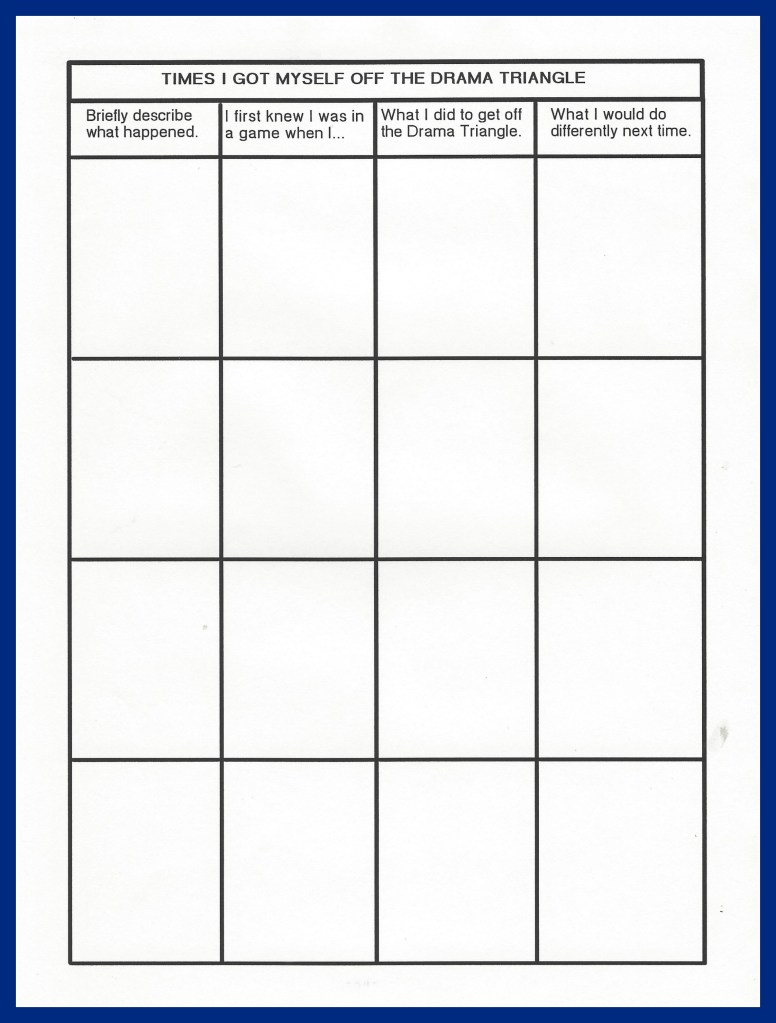
For the rest of this week record what happens when you realize you are on the Drama Triangle. Record small examples as well as big ones. Also record ways you avoided getting onto the Triangle in the first place. (Add more pages to this document if your list is long)

34

See you next Monday for the ninth lesson.

To find the lessons in this series that have already been published click here.

Lighten Up!

It has been said that laughter is the best medicine. I believe there is truth in that statement. It certainly helps us in lightening up, if we engage in activities that make us laugh.

There were two scenes in the recent Amritapuri play that made me laugh out loud. The songs that accompanied the scenes were also funny.

In one scene, a group of very young children dressed up as pigs.

During the finale,  one of the “piggies” got so excited that she started jumping very high. The crowd loved it.

15732177_10154166953868302_4761892420733602627_o

Here is the funny song that went with the scene.

The other scene that brought laughter was very different. It was the scene when Matthew, the prodigal son, reached the lowest part of his despair. He had lost all of his belongings and was working for a man in exchange for food.

While his life situation was in no way funny, the song that went with it, and the way the actor played the role, made it a very funny scene. As a psychotherapist, I know when we are feeling down, if we start talking about the situation in really grandiose, i.e. exaggerated “Poor me” terms, we may start laughing. To me this song and scene are a good example of that. While I can’t show you the video, I can share the “Poor, Poor Me” song in addition to the photos above.

I know that listening to these songs and looking at the pictures will help me lighten up when I am feeling mopey and victimy in the future. I hope they do the same for you.

To see all of the posts in this Amritapuri series, click here.

Letting Go of Suffering- Week 7: Stopping Passive Behavior

passivity

A major predecessor of suffering is passive behavior. Many years ago one of my mentors, Elaine Childs Gowell, taught me that we are being passive when we are aware that there is a problem and we:

a. Do nothing and hope the problem goes away.

b. Overadapt and do what other people want us to do.

c. Agitate by doing repetitive behaviors that aren’t directed towards solving the problem, e.g. tapping  fingers, swinging legs, playing with hair, mopping the floor at 2:00 a.m., etc. Addictive behaviors may be forms of agitation, e.g. over-working, over-eating, alcohol, drugs, and over-thinking.

d. Incapacitate through headaches, backaches, stomach aches, depression.

e. Escalate by behaviors such as throwing things, screaming and hitting.

EXAMPLE

Situation: Your 12 year old daughter received two D’s on her report card.

a. Do Nothing: Tell yourself she will do better the next time and just ignore the situation.

b. Overadapt: Decide not to talk to her teachers because your daughter doesn’t want you to.

c. Agitate: Grumble under your breath and clean the house late into the night.

d. Incapacitate: Develop a headache

e. Escalate: Scream at your daughter and then slap her when she sasses you.

Eliminating passivity from your life takes time and effort. First, you have to recognize when you are being passive, or are considering being passive, and then commit to doing something to solve the problem instead.

PRACTICE EXERCISE

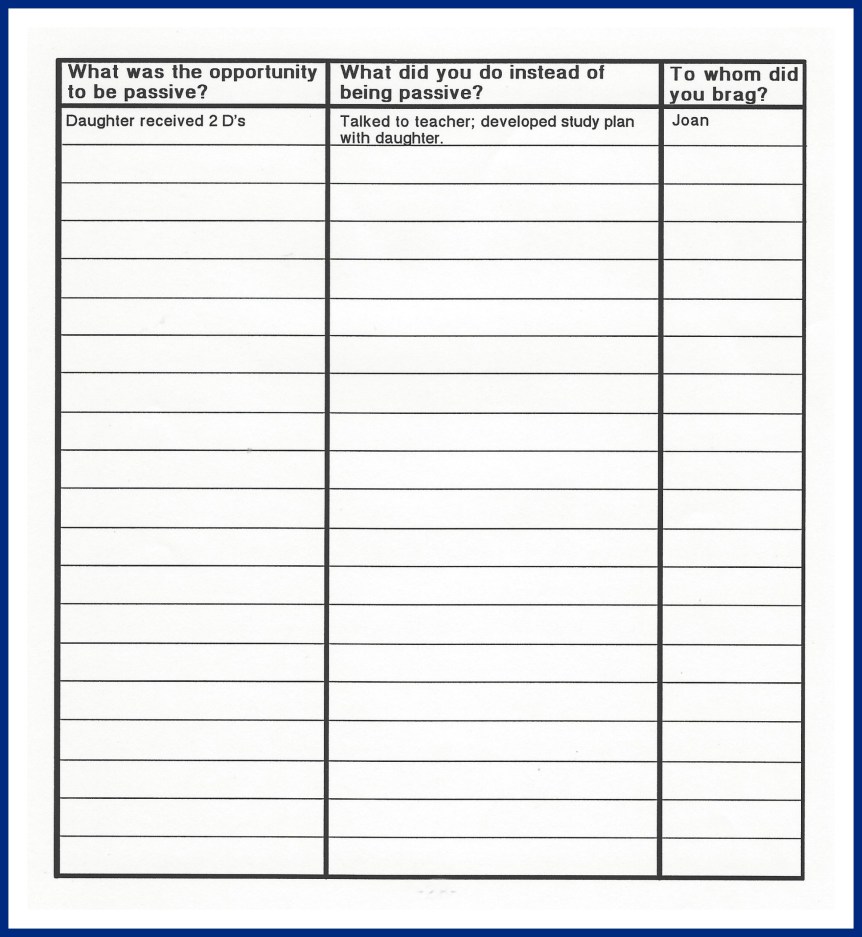
This week, record each time you realized you were being passive, or had the opportunity to be passive. Then write down what you did to solve the problem.

When you choose to solve the problem instead of being passive, brag about it to yourself and to a friend. Receiving acknowledgement can be very helpful in changing self-sabotaging behaviors.

28

See you next Monday for the eighth lesson.

To find the lessons in this series that have already been published click here.

Is My Path Taking a Turn?

img_5195

My favorite joke, and the only one I ever remember, is: Q: Do you know how to make God laugh? A: Tell him your plans for your life.

I think that is so true. There have been many turns in my life that I would have never predicted. If someone had told me those changes were coming, I would have said they were crazy. The most notable example is my relationship with Amma

At the time I met her, I had described myself as being somewhere between an agnostic and an atheist for 20 years. In those days, even hearing the word God made me feel sick to my stomach. I was a very logical, head based person and had no interest in spirituality or spiritually minded people.

In 1989, a new friend told me there was a woman saint coming to Seattle soon and invited me to attend her programs. My mind said NO but what came out of my mouth was OK.

My whole life changed the night I met Amma. Six weeks later, I was at her New Hampshire retreat and six months later I was in India. I have gone to India 26 times since that first visit. I have had other life plans change in unexpected ways since then, but none were as remarkable as that one.

On May 31 of 2017, I “plan” to retire. That is the time of year that Amma begins her annual North American tour so I have “planned” to attend some of those programs and then go to Amritapuri from mid-August until mid-January. I don’t remember when I developed this “plan”, but I think it has been firmly ingrained in my mind since I was in India this time last year.

One day in August of this year, though, I woke up thinking that I wasn’t going to watch another tree in the lot behind my house die. Al,  my former husband, and I had bought that property in 1973. I sold it in the mid-80’s and it changed hands again about ten years later. When Seattle formed the Cheasty Greenbelt, that owner sold it to the city.

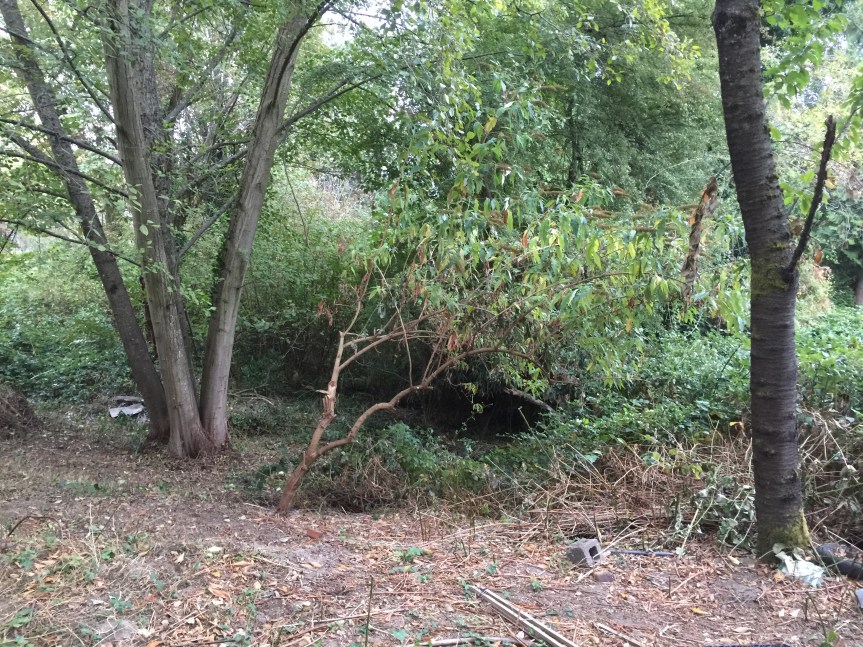
The property was originally beautiful but none of the subsequent owners did anything with it, so blackberries, ivy, morning glories and bamboo took over. Smothered by the invasive plants, many trees died.

After I had that early morning thought, I grabbed my shears and started to work. I enlisted my friend, Ramana, to help clear some of the land. While Ramana worked on the major clearing, I focused on freeing specific trees.

img_1112

I found so many beautiful and fascinating things on the land and know that there are many more buried under the remaining blackberries.

One day, it occurred to me that we could make this project a GreenFriends project. (GreenFriends is the environmental arm of Embracing the World, Amma’s network of humanitarian projects.) I called the people in our satsang who have coordinated our tree planting and habitat restoration work in the past. They were very interested in being involved. In October and November, they spent some time working on the lot with me.

We also talked with the Green Seattle Partnership about becoming one of their volunteer groups. In March, we will take the Green Seattle Partnership Forest Steward orientation. Once we do that, we will be able to host larger work parties.

Our project will be supervised by the Seattle Parks Department and the city will provide the saplings and other greenery that we will eventually plant there. The Park Department will do any work that requires power tools. If there is enough interest in the project, we may decide to clear all four lots that are in that strip of Greenbelt!

I feel a great deal of passion about this work and it has been on my mind since I’ve been in Amritapuri. Even before I left Seattle, it occurred to me that August and September would be prime time for working on that land and if I was in Amritapuri, I wouldn’t be available to organize the work.

I have an ever growing sense that I won’t be going to Amritapuri in August and that my path is taking a turn that gives working with nature more priority than spending extra time in India.

Starting last week, I found another thought creeping into my mind. I have kept close track of world events via CNN throughout this trip. I’m beginning to wonder if I will even make it to India next year. It seems like there is so much potential for war.

amma-and-me

My years with Amma have taught me a lot about staying in the moment and not holding on to  plans. They have also taught me that Amma will hold me close to her no matter what comes my way. I trust that my life will unfold as it is supposed to and acknowledge that I have no idea what that will look like. What I do expect is that I will be participating in at least part of the Lokah Samastha Sukhino Bhavantu chant for world peace that will be held in the Amritapuri temple from 6 a.m. to 6 p.m. on January 1.

Lokah Samastha Sukhino Bhavantu
May all beings in the world be happy.
Peace, Peace, Peace


Weekly Photo Challenge: Path

To see all of the posts in this Amritapuri series, click here.

Letting Go of Suffering- Week 6: Using Affirmations to Heal

I often ask my psychotherapy clients what they would think and feel if they overheard a parent berating a child with the negative messages that they dump on themselves, e.g. “You are so stupid.” “Can’t you do anything right?” “You are selfish.”  “You are a disgrace.”

Clients often respond that they would feel angry and think that the child was being abused. I tell them when they speak that way to themselves, it is as if they were the parent who is abusing the child. In this case the child is their inner child. That awareness is often jolting enough to motivate clients to learn what they need to learn to stop the negative self talk.

Affirmations are positive statements which can be used to replace the negative messages you tell yourself. By using these positive statements, as one might use a mantra, i.e. saying them over and over, you can fill yourself with positive supportive energy instead of negative, discounting energy.

Below you will see two styles of affirmations. The affirmations in the first style are phrased so that you affirm the beliefs you want to have. These affirmations are stated as if they were already true. For example:

I belong

I am worthy

I am enough.

I am a competent, capable adult.

I am love.

I am lovable.

My needs are important.

I am learning and growing.

I deserve support.

The other option is to pick an affirmation that the healthy parent part of you says to your inner child. For example:

I love you.

Your needs are important to me.

I will teach you and guide you.

Pamela Levin and Jean Illsley Clarke created sets of developmentally based affirmations. Their affirmations use the parent to child style.

Pam Levin’s can be found her her book Cycles of Power. Some examples of her affirmations:

You have a right to be here.

You don’t have to hurry, you can take your time.

You don’t have to suffer to get your needs met.

Jean I. Clarke’s are in Growing Up Again. Here are a few of hers:

I’m glad you are you.

You can know what you need and ask for help.

You can learn when and how to disagree.

Creating Affirmations from Think Structures

You can use the Think Structures you wrote in Week Four and Week Five‘s Letting Go of Suffering assignments to create personalized affirmations. (The Think Structure and this affirmation structure are processes created by Pam Levin (Cycles of Power.)

I will show you how to create affirmations using this Think Structure:

  1. I am scared
  2. That if I ask for what I want
  3. I will be ridiculed or punished
  4. Instead of being heard and supported
  5. So I pout, isolate and don’t ask for what I want.

To form the affirmation, you will use the 2nd and 4th line of the Think Structure.

So my affirmation would be:

I do ask for what I want and I am heard and supported.

Create affirmations from some of the Think Structures you wrote during the last two weeks. If you have not seen or done those assignments, consider going back to those lessons and completing them.

24b

If you like, you can use your Think Structure affirmations when you do the affirmation exercise I will describe in the next section of this post.

Another way you can  use your Think Structure affirmations is to set up life situations that will facilitate your healing. Using the example above, I could let my friends know that I am focusing on asking for what I want and would like to practice doing that with them. I could also let them know that when I ask for what I want, I would like to be heard and supported. (Being heard and supported doesn’t mean they will give you whatever you ask for. A long time ago, I practiced this exercise with someone by asking him if he would pay for my Masters of Nursing degree. He was very honoring of my request but, of course, did not agree to fund my education!)

Using the Affirmation

Pick one of the affirmations from this lesson, or create one of your own. For the rest of the week say it at least 1000 times a day; 5,000-10,000 would be even better! It is fine for you to say it internally, going as fast as you want. (A short mantra can be repeated 1,000 times or more in 20 minutes.) You can count using a tally counter from an office supply store or an app such as iPhone’s Counter +.

Even though this lesson only lasts a week, it would be best if you continue to say the same affirmation for 21 days. If you say it in the higher range (i.e. 10,000 a day or more) you may find that it starts flowing through your mind automatically. You may even wake up during the night and realize you were saying it in your sleep. Imagine what it would feel like to be listening to positive thoughts throughout the night instead of your self-critical ones.

What if my mind is fighting the affirmation?

Sometimes a particular affirmation is so far from what you believe, you may find yourself very resistant to saying it. If that is the case, take a piece of paper and make two columns on it. On the left side write your affirmation and on the right side write the negative response that comes to your mind. Keep doing that until you have written the positive one 50 times. Here is an example:

Positive affirmation               Discount

My needs are important…      No they aren’t

My needs are important…      I should be needless and wantless

My needs are important…      It isn’t safe for me to have needs

My needs are important…      No they aren’t

My needs are important…      No they aren’t

My needs are important…      That statement is nonsense

etc.

Do this two column affirmation exercise for several days if you need to and then start saying the 1,000 repetitions of the positive affirmation each day. Or do the 50 written affirmations in the morning and then say the affirmation during the rest of the day. As you continue to write and/or say the affirmation, the negative messages will decrease and then stop.

Another thing you can do when you find negative thoughts coming into your mind when you say the affirmation is to speed up the rate you are saying the affirmation. Speed it up until you drown out the negative message.

Journaling

Take a few minutes each day this week to write about your experiences with the affirmation.

Day 1

25a

Day 2

25a

Day 3

25a

Day 4

25a

Day 5

25a

Day 6

25a

Day 7

25a

See you next Monday for the seventh lesson.

To find the lessons in this series that have already been published, click here.

Letting Go of Suffering- Week 5: Why Do I Suffer? (continued)

Most likely, the reason you suffer as an adult is because suffering was an acceptable method of expressing your feelings, or more accurately, a method of “stuffing” your real feelings, in your family of origin. This week you will explore some of the childhood origins of your suffery behavior. Again, Levin’s Think Structure (Cycles of Power) will be used as the tool to help you organize your thinking.

(The Think Structure process is taught in the previous lesson.)

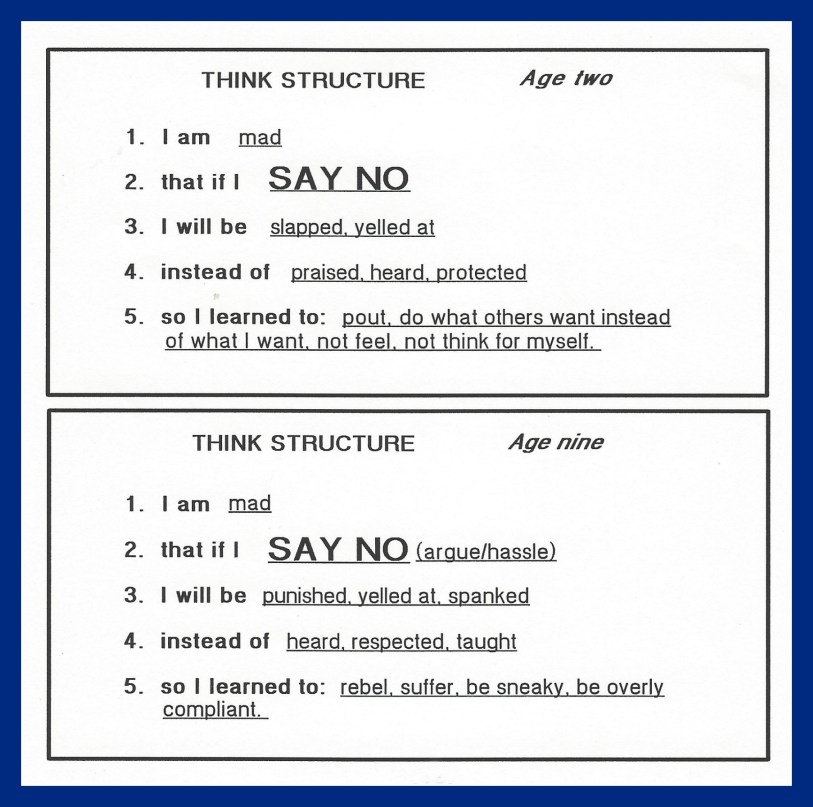
Example 1

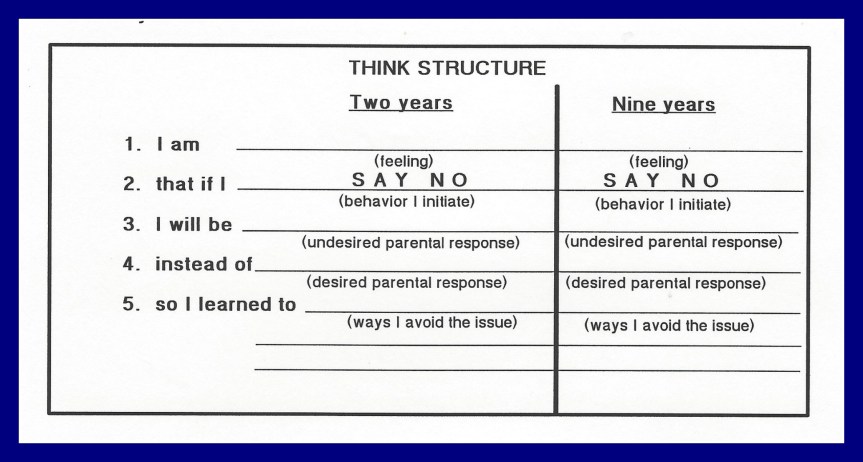
Situation: As an adult, I have trouble saying “NO”. I will think about what happened when I said “NO” as a two-year-old and nine-year-old child.

18

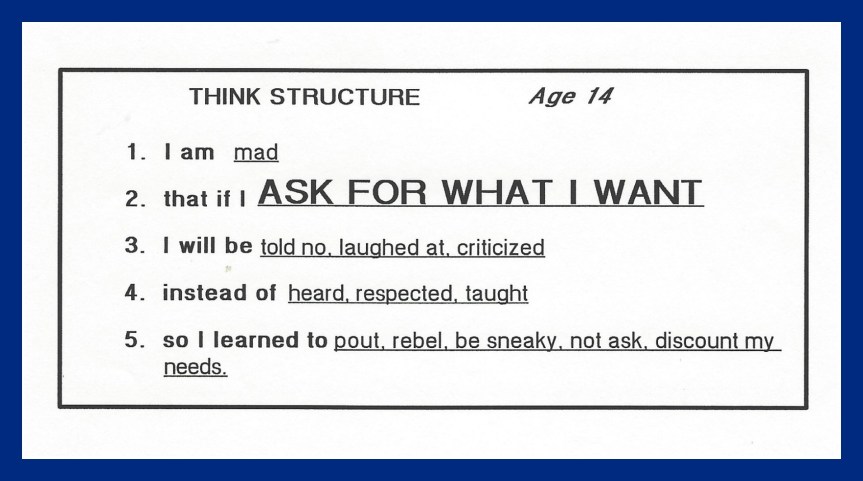
Example 2

Situation: As an adult, I have trouble asking for what I want. I will think about what happened when I asked for what I wanted as an infant and a 14 year-old child.

19a

19b

When you explore how your adult behaviors relate to your childhood, it would be helpful for you to look at one behavior over a variety of ages. In each of the examples below I ask you to look at an issue for two different ages. Fill in the blanks to come up with your own think structures.

Practice Exercise 1

20a

Practice Exercise 2

20b

During the rest of the week, complete Think Structures for some of the adult behaviors you worked on in Practice Exercise 3 in the previous lesson. Explore two childhood ages for each Think Structure. (Ages that tend to be particularly good to reflect on are infant, 2, 5, 9, 14 and 17.)

You may need to change the way you described the adult behavior in Practice Exercise 3 in the previous lesson, so that it becomes a childhood behavior. For example, if your adult behavior was “leave work early”, the child behavior might be “do what I want to do.”

21

See you next Monday for the sixth lesson.

To find the lessons in this series that have already been published click here.


I Trust You

A friend sent me the link to this video a few days ago, but I didn’t look at it until now. Tears are streaming down my face as I am writing this post. I hope it is as much a gift to you as it was to me.

The Following Morning Addendum:

img_1345

When I woke up this morning (I’m in India), I realized I wanted to share this post with my Song Lyric Sunday family. I think the video fits the intent behind this week’s prompt even though it doesn’t fit the structure.
I wasn’t able to find out the name of the background song in part because I can’t understand all of the words. But to me the message is not in the song, it is in the video. I am very disturbed by what is unfolding in our country right now and it was so good for me to watch this video before I went to sleep last night. It allowed me to see light amidst the darkness.