Sometimes when we are listening to another person, we may find our minds wandering to problems at work or home, or to future plans. At other times, rather than paying close attention to the person’s words, we may start thinking about how we are going to respond to them. Or we may reflect on advice we want to give them when they stop talking. If the person is angry, instead of listening to them, we may start planning our defense. These communication patterns often leave people feeling unheard, discounted and/or disrespected.
This week, for one, two, three days or longer, practice giving people your full attention when they are talking to you. Sometime during the week, write a post about some aspect of this topic or about experiences you have when you listen attentively. Feel free to use whatever form you desire: i.e., prose, story, poem, photograph, etc. (If you don’t have a blog, please share your thoughts and experiences in the comment section below.)
I look forward to seeing where this challenge takes you.
The article that you link to this prompt should be a new post written specifically for this challenge.
General Prompt Information:
New prompts will be posted at 5 a.m. (PST) every Wednesday.
Since it is easier to make behavioral changes if we focus on them one day at a time, each of the weekly challenges will start with “Today, I focus on…….” It will be up to you to decide how long you want to focus on a particular challenge— one, two, three days or even longer. At some point during the week, publish a post that relates in some way to the subject of the week.
Link your post back to this prompt post. If the pingback doesn’t work, then leave the link to your post in the comment section below. Be sure to include “Challenge for Growth Prompts” as one of your tags.
Throughout the week, I will publish the links for the posts that were created as the result of this prompt. I will also post the links from those who participated the previous week. That way they will be seen by anyone who comes to this page.
When we are in a bad mood, we may find ourselves focusing on someone else’s faults. When we focus on the negative, we are likely to see negativity all around us. From time to time, Amma reminds us that even a broken clock is right twice a day.
People often get triggered into negative thinking when they are with someone who reminds them of a person that hurt them in the past. In the psychotherapy model I use, we refer to that as “putting someone else’s face” on the present day person. That process is also referred to as projection.
Clients in therapy frequently project their parents’ faces on their therapists. I remember a time in the mid 90’s when a client was always angry with the male co-therapist in one of my therapy groups. He knew that the therapist reminded him of his father, but he was having a hard time “getting his dad’s face” off of the therapist.
This therapist had some unusual characteristics so I said to the client, “Did your dad ever wear an earring?” and “Did your dad sometimes wear red toenail polish?” The client started laughing. His father would NEVER have considered doing either of those things. Seeing the differences really helped him separate the therapist from his father.
This week, for one, two, three days or longer, focus on looking for the good in others. If you have trouble finding anything positive about a person, consider whose face you might have on them. If you decide it is a parent, or a boss, or someone else from your past, identify ways the current day person is different from the one in your past. Then “de-role” the present day person by saying to yourself, “You are not (insert the name or role of person from the past), you are (insert the name or role of the person in the present).” After you de-role the current day person, you may be better able to identify some of their good qualities.
Also consider making lists of the positive qualities of anyone you have negative thoughts about, whether they be from your past or present.
Sometime during the week, write a post about some aspect of this topic or about your experience when focusing on seeing the good in others. Feel free to use whatever form you desire: i.e., prose, story, poem, photograph, etc.
I look forward to seeing where this challenge takes you.
The article that you link to this prompt should be a new post written specifically for this challenge.
General Prompt Information:
Since it is easier to make behavioral changes if we focus on them one day at a time, each of the weekly challenges will start with “Today, I focus on…….” It will be up to you to decide how long you want to focus on a particular challenge— one, two, three days or even longer. At some point during the week, publish a post that relates in some way to the subject of the week.
Link your post back to this prompt post. If the pingback doesn’t work, then leave the link to your post in the comment section of this post. Be sure to include “Challenge for Growth Prompts” as one of your tags.
Throughout the week, I will publish the links for the posts that were created as the result of this prompt. I will also post the links from those who participated the previous week. That way they will be seen by anyone who comes to the this page.
If you don’t have a blog, please feel free to submit your contribution to the prompt in the comment section below.
This week’s contributors to Looking for the Good challenge:
My thanks goes to each of the bloggers listed above and to those of you who wrote your response to the challenge in the comments section of the challenge post.
To see the most recent Challenge for Growth Prompts Click Here
Welcome to the first “Challenge for Growth” Prompt! I look forward to posting a new challenge for you every Wednesday at 5 a.m. PST. I am also eager to see the posts you create in response.
General Prompt Information:
Since it is easier to make behavioral changes if we focus on them one day at a time, each of the weekly challenges will start with “Today, I focus on…….” It will be up to you to decide how long you want to focus on a particular challenge— one, two, three days or even longer. At some point during the week, publish a post that relates in some way to the subject of the week. Feel free to use whatever form you desire: i.e., prose, story, poem, photograph, etc.
Link your post back to this prompt post. If the pingback doesn’t work, then leave the link to your post in the comment section. Be sure to include “Challenge for Growth Prompts” as one of your tags.
Throughout the week, I will publish the links for the posts that were created as the result of this prompt. That way they will be seen by anyone who comes to the Challenge page.
If you don’t have a blog, please feel free to join the discussion in the comment section below.
This week’s challenge is:
“Today I focus on my needs rather than my wants.”
The nature of the mind is that as soon as one desire is met, it is off to the next one, often without taking any time to appreciate the desire that was just realized. An endless stream of wants leads to the experience of scarcity; we never feel full, we never think we have or are enough.
One way to create a sense of abundance in our lives is to decrease the number of our desires. We can do that by putting our primary focus on meeting our needs and then prioritizing our wants. The first step for many people is to learn to differentiate their needs from their wants. Some examples: We need water – We want a soda; We need food – We want a big restaurant meal; We need shelter – We want a new house.
This week practice identifying which of your desires are needs and which are wants. When looking at your list of wants, decide which are the most important to you. On the day or days you focus on this week’s challenge, give priority to meeting your needs. If you put energy into obtaining any of your wants, be sure they are ones you have determined to be of significant importance.
Sometime during the week, write a post about Needs vs Wants. It may be a general post regarding some aspect of the topic or it may be about an experience you had when focusing on your needs instead of your wants.
I look forward to seeing where this challenge takes you.
For years, I taught a workshop that included a guided imagery experience where participants, in their mind’s eye, emptied every room in their house and placed the contents of those rooms outside onto an ever-growing pile of belongings. I also had them visualize how big a nomad’s pile might be if he did the same thing.
Can you imagine creating that kind of a pile for yourself, i.e. removing every item from your living room, bedrooms, kitchen, bathrooms, dining room, basement, garage and every other room in your house and turning it into a mountain of belongings? How big would your pile be? Do the same process for a nomad. How does your pile compare to the nomad’s?
Next, I had the participants add all of the earth’s resources they believe they use in a year’s time to their piles, and asked them to “see” the nomad doing the same.
What would your pile look like if you added all the food you eat, the trash you discard, as well as all of the water, oil, natural gas, gasoline, wood and other resources you use in a year to your other belongings? See the nomad doing the same thing. How does your pile compare to the nomad’s?
Through that guided imagery, I hoped to give the workshop participants a sense of the “weight” belongings may add to their lives. I also wanted to give them a taste of the difference between wants and needs. Many attendees left that workshop with plans to organize a garage sale as soon as possible!
Does seeing your mountain of belongings give you a sense of being burdened or weighed down? How many of your belongings are wants and how many are needs? How many of your wants are very important to you?
I have lived in the same house in Seattle since 1973. You can imagine how much “stuff” I could have accumulated in 42 years. I have always valued experiences over material belongings though, so have used my financial resources to take trips to India rather than buying a lot of material possessions.
Even so, over the years my shelves, drawers, and closets filled. Around eight years ago, I decided I was going to give away anything I hadn’t used in the last five years, unless I planned to use the item in the near future. One of the articles I gave away at that point was a loom I had purchased in 1974. I hadn’t used the loom since my children were born. For decades, I told myself I would start using it once my son and daughter grew up and left home. They both moved out in the 90’s and I still hadn’t use the loom, so in 2007, I added it to my “to go” pile. I did a major purging of stuff that year.
Several years later, I felt compelled to go through my belongings again. This time I wanted to create an empty shelf every place in the house where shelves were located. I loved the sense of relaxation and peace I felt when I gazed at those open spaces. The shelves stayed empty until I decided to take in a roommate; at that time the empty shelves were needed for the roommate’s possessions.
Last year, I again felt pulled to reduce my belongings. The desire was so strong I wondered if something was about to happen. Was I going to be moving? Was I preparing for my impending death? (I have no terminal disease but fantasies can take any form!) I still don’t know the “why” but even as I write this post, my yearning to further decrease my possessions is stronger than ever.
Now I am giving away anything that I haven’t used in the last two years unless I have a strong desire to keep it. Once again, I have become a regular at the Goodwill drop off station!
I am loving the sense of lightening-up I am experiencing as I continue to let go of personal belongings I no longer need or want!
While there are days when I am tired or discouraged that I may think that I work in order to be able to buy the things I need to live, I know that isn’t really true. I have no doubt that I live to work. I have been a psychotherapist since 1987. My primary modality is group therapy based on a developmental model that includes the concept of “inner children.” I believe that one of the most important elements in healing is for clients to learn how to parent those vulnerable “children” inside of themselves.
Most people start therapy because they are depressed and/or anxious. They may have learned to cover their pain with addictive behaviors such over-working, over-thinking, eating disorders or substance abuse. They frequently have trouble in relationships and often feel alone and lonely. Past traumas may cause them to experience flashbacks. They often have poor self esteem and think they are unworthy and will never be good enough. They may be very critical of themselves and others.
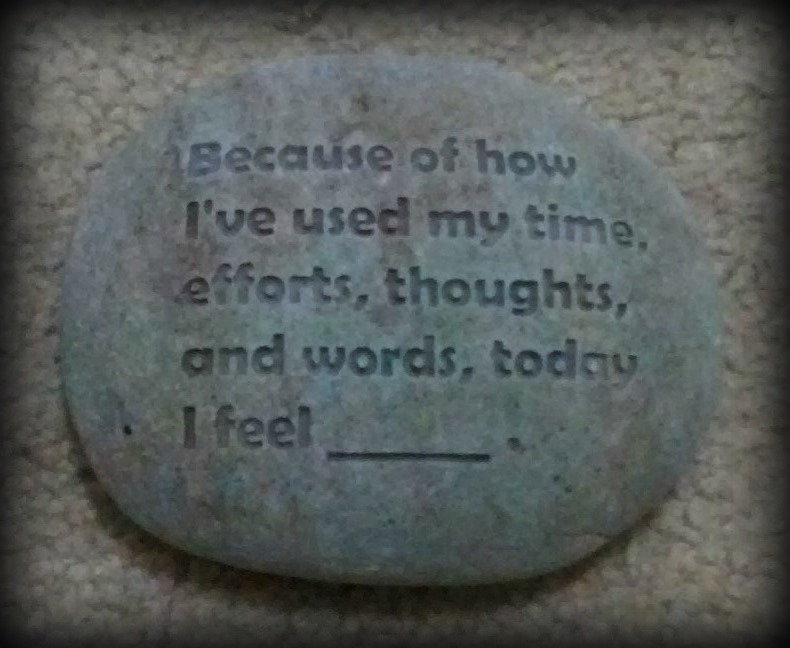
When a friend showed me a picture of this rock, I thought of a one of the self care contracts* that I use in my personal life and with my psychotherapy clients. That contract is “I am responsible and accountable for my thoughts, feelings, actions and attitudes.”
It is not uncommon to hear people in our society make comments such as, “You hurt my feelings.” and “You made me do that.” You…..you….you….you. When we get into the “you’s” we are more than likely not being responsible and accountable for our own feelings, thoughts, actions and attitudes. Using that way of speaking increases the chances we will immerse ourselves in victim thinking and as a result experience a sense of powerlessness.
I graduated with a Bachelor of Science in Nursing degree in 1970, followed by a Master of Nursing in 1974. After receiving my Master’s degree, I taught undergraduate nursing students at the University of Washington for five years. I enjoyed teaching, conducting research and writing for publication, all requirements of my Assistant Professor position. After teaching there for five years, I decided to take a job as a Maternal-Newborn Clinical Specialist at Swedish Hospital Medical Center in Seattle.
To progress along a tenure track at the University of Washington, I would have had to earn a PhD. At some point in the early 80’s, I decided to start working on the PhD. I don’t remember what my reasoning was at the time, but I imagine it was to keep my options open. Afterall, I might want to teach at the University again someday. I continued to work at Swedish Hospital part time as I started the PhD program coursework. I don’t remember what the degree was called in those days but I know that it focused on nursing research and that I chose a track that had a special emphasis in statistics.
At some point during those years, I also started my personal therapy. I loved that process. It helped me move through the pain of my early years and I was able to make good friends and connect in a way I hadn’t in the past. One day, I had an insight that hit me like a sledge hammer. Even though I was doing very well in my studies, I realized I didn’t want a PhD and I didn’t want nursing research to be my life’s work.
In that moment, I realized I was studying for the degree in hopes that my father would acknowledge my existence if I had a PhD. My education had always been important to him and some of my earliest memories were of me asking him to make up math problems I could work on.
While I don’t think we were ever close, our relationship became even more strained as I moved into my teen and young adult years. We had battles when I came home from college during summer vacations, usually over civil rights issues. During one of those altercations, he told me to get out of the house. My mother intervened so I didn’t actually move out. The last straw came in 1971 when I told him I was going to marry Al, an African-American man I had met in Seattle. Simply by my having made that statement, he declared that he would not speak to me again, and he didn’t. My father died in 1999 without ever having said a word to me or my children.
Realizing that my PhD study was so tied to a child-like yearning for my father’s approval ended my interest in the degree. I was loving my psychotherapy experience and in time it became my passion. I did what it took to get the credentialing to become a nurse psychotherapist (Clinical Nurse Specialist in Psychiatric and Mental Health Nursing) and I’ve been doing that work ever since.
I see the moment when I recognized the tie between my PhD program and the unfinished business from my past as one of those life changing moments, one that propelled me into work that I felt passionate about and believe I was born to do.
Many years ago, I was given a handout at a workshop that contained this prayer. I laughed when I read it then and I laugh when I think of it now. I can so relate.
I believe finding humor even in a dark or frustrating situation can help us lighten up.
As I mentioned in a previous post, I have a long history of overdoing. At one point in my life, I was holding three jobs at the same time. When I have become involved with organizations, I have often done more than is reasonable for one person to do. My overdoing has led to serious illnesses that have been breaking points, where slowing down became a necessity rather than a choice. I believe it was this pattern of overdoing that led to me to having Chronic Fatigue Syndrome for five or more years in the mid to late eighties, and to the high blood pressure I am dealing with today.
To some degree, the types of overdoing I am referring to were caused by a pattern of rescuing. In his Drama Triangle construct, Stephen Karpman describes the Rescuer in this way:
“The rescuer’s line is ‘Let me help you.’ A classic enabler, the Rescuer feels guilty if he/she doesn’t go to the rescue. Yet his/her rescuing has negative effects: It keeps the Victim dependent and gives the Victim permission to fail. The rewards derived from this rescue role are that the focus is taken off of the rescuer. When he/she focuses their energy on someone else, it enables them to ignore their own anxiety and issues. This rescue role is also very pivotal, because their actual primary interest is really an avoidance of their own problems disguised as concern for the victim’s needs.”
Jean Illsley Clarke once taught me five questions to ask myself when I think I might be rescuing.
Was I asked to do what I am doing?
Do I want to do it?
Am I doing more than my share?
Do others appreciate me for what I am doing? (Rescuers are often not appreciated.)
Am I doing something for someone that they can do for themselves?
Answering yes to one of those questions does not mean that I am rescuing, but if yes is the answer to many of them, the chances are that I am. So shifting my pattern of rescuing was an important part of my healing journey.
From a therapy perspective, focusing on self-care by stopping rescuing makes sense. Even though I valued being in service, it was still my job to keep myself healthy. When I began to look at self-care and selflessness from a spiritual perspective though, I started to have doubts. There are many who have forsaken their health, their comforts and sometimes even their lives, to live a life of service. They have shown us what is possible for one person to accomplish in a life time. They have been, or will be, a source of inspiration long after they are gone from this world.
To me, Amma, my spiritual teacher and mentor, is one of those people. Her form of blessing is through a hug. Amma has hugged more than 34,000,000 people in her lifetime. She needs almost no food or sleep. If she is not giving darshan (hugs) she is serving humanity in some other way, including her massive network of humanitarian projects known as Embracing the World. Her life is a model of selflessness.
When I thought about people present and the past who have inspired others through their selflessness, the following individuals came to mind. All have taught the importance of serving humanity.
John 13:34 “A new commandment I give to you, that you love one another, even as I have loved you, that you also love one another.
Acts 20:35 “It is more blessed to give than to receive.”
Matthew 25:35-40: ”For I was hungry and you gave me food, I was thirsty and you gave me drink, I was a stranger and you welcomed me, I was naked and you clothed me, I was sick and you visited me, I was in prison and you came to me.’ Then the righteous will answer him, saying, ‘Lord, when did we see you hungry and feed you, or thirsty and give you drink? And when did we see you a stranger and welcome you, or naked and clothe you? And when did we see you sick or in prison and visit you?’ And the King will answer them, ‘Truly, I say to you, as you did it to one of the least of these my brothers, you did it to me.’”
“Everybody can be great…because anybody can serve. You don’t have to have a college degree to serve. You don’t have to make your subject and verb agree to serve. You only need a heart full of grace. A soul generated by love.”
“Prayer in action is love, and love in action is service.”
As I pondered the importance of self-care versus selflessness, I could rationalize that I am not Amma, Jesus, Gandhi, Martin Luther King, St. Francis or Mother Theresa and therefore could not expect myself to serve at that level.
My thoughts on this topic took another turn, though, in the late 90’s when I read a book, A Promise is a Promise, by Wayne Dyer. It was an account of a teenager who in 1970 asked her mother to promise that she would never leave her. Soon thereafter the 17 year old slipped into a diabetic coma, one she never came out of. The mother kept her word and, with help, cared for her daughter until she herself died 25 years later. (A Promise is a Promise was written while the mother was still alive.) Then others cared for the daughter until she died on November 21, 2012, forty-two years after she became comatose.
Reading that book had a profound impact on me. I still remember Dr. Dyer saying that walking into their home felt like being in the holiest of temples.
When I first started reading A Promise is a Promise, I made the judgment that the mother was not taking care of herself appropriately. But as I continued to read, my attitude began to change. Her actions seemed like unconditional love, perhaps the highest form of spiritual practice. While I wasn’t aware of it at the time, I now see that her actions actually conformed to the guiding questions I had learned from Jean Clarke:
The mother had been asked and had agreed to what she was doing
She wanted to do it
Even though she devoted her life to caring for her daughter, she had help.
Her daughter would have undoubtedly appreciated her efforts
She was clearly doing something for her daughter that the girl could not do for herself
Reading about a “regular” person who was so selfless, presented me with another dilemma. When I lived a life of uncontrolled doing, even if when it was in the spirit of service, I became sick to the point I couldn’t function. How do I know when to focus on self-care and when to make service the priority?
I continue to ponder that question to this day. I believe for me it has to be about balance. I must practice good self-care by nourishing my body, mind and soul and at the same time make sure that I am not over-committing or over-stressing myself. I must also continue to watch out for my tendency to rescue. I can be in service to others and still do my best to keep myself healthy.
“The fool doth think he is wise, but the wise man knows himself to be a fool.” “Love all, trust a few, do wrong to none.” “Love looks not with the eyes, but with the mind, And therefore is winged Cupid painted blind.”-William Shakespeare






 Living, Learning and Letting Go