Finding Peace in the Middle of Chaos

img_1008

It is not uncommon for my mind to be chaotic even when I am in a peaceful setting. I long to get to the point where my mind is at peace regardless of how much chaos is around me. I have a long way to go to meet that goal.

I am getting plenty of opportunity to work on that issue in my Amritapuri Tai Chi class. Tai Chi, by its nature, is meditative. It slows down my mind and body more than anything else I have ever done.

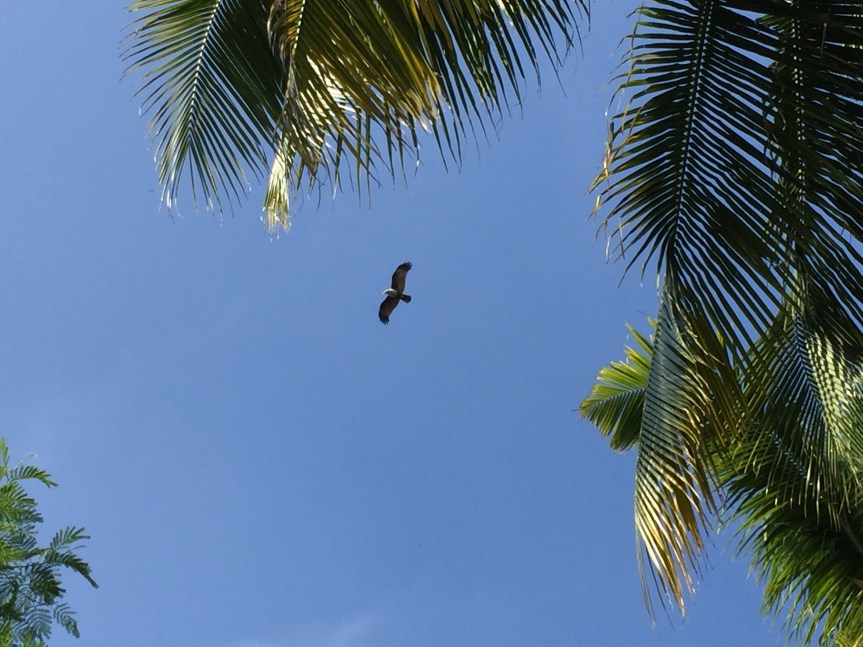
I would guess that most Tai Chi classes are held in peaceful settings with soft music playing or silence in the background. The place where our class meets in Amritapuri is gorgeous. There are palm trees, views of the beach and the Arabian Sea, eagles flying overhead, etc. As I’ve mentioned before, though, there are also trucks, bicycles, buses and cars that occasionally go through the space where we meet.

With most of life’s lessons, it seems like once you have adjusted to one level, another dimension is added. This year has definitely demonstrated that process. During my first class, I was stung by a red ant. It is amazing how much a bite by a tiny ant can hurt. In fact, the bite was still stinging hours after the class finished.

Soon thereafter, a red ant hill showed up at the perimeter of the space we use for the class, so it has been important for me to stay conscious of that danger, and to make sure new students are made aware of it. (I have stepped on a red ant nest twice in the 27 years I’ve been coming to India, once in the daylight and once at night. It is an unforgettable experience; one I hope never to repeat.)

Starting with our second class, students taking a silent meditation retreat have done a walking meditation in front of us during part of our class. They don’t disturb us but I’m tempted to watch them instead of staying focused on my own work.

In last week’s post Be Like a Bird Perched on a Dry Twig, I talked about the third class when there were even more vehicles in the area than normal. Midway through the class, a truck pulled into “our” space and parked. The workers got out of the truck and started carrying their supplies to the nearby construction site. Since their work had priority, we had  to move to a smaller area, one that was bordered by 8 ashram cows lounging in the shade!

Tai Chi is so powerful that it was reasonably easy for me to find that place of peace and contentment even in these circumstances, although I certainly didn’t have single minded focus.

On my fourth class, another set of challenges were added to those that I have already described. (BTW, the cows have not returned to the beach, at least a that time of day, since the third class.) The fourth class was held on a weekend, the first weekend since Amma returned from her European and U.S. tour. The crowds coming for darshan (hugs) were very big that day. At one point, there were 14 vehicles parked on the beach.

Then something new happened. At first, one or two village men started removing carts of sand from the beach to somewhere in the village. Next, two women started a chain. One woman would carry a big pan of sand on her head and walk to a spot next to our class. She would then shift the pan to the head of a second woman who would carry it out to the main road. We often had to divert our path to stay out of their way.

Fifteen minutes before that class was over, a cement mixer started making its piercing noise in the construction area near to us. By that time, the whole situation had become funny.

During the fifth class, a third woman was added to the chain of sand carriers. On the sixth, there were all of the previous challenges, except the cows. In addition, a new layer of sand had been added to our area 0f the beach. The sand was beautiful and felt good on my feet, but it hadn’t been compacted yet, so there was no smooth or level ground to walk on. That made doing the Tai Chi moves much more difficult.

As you can see, doing Tai Chi on the beach in Amritapuri is definitely an opportunity for me to find peace in the midst of chaos. It is also an opportunity to see the humor in the situations that arise in life.

To look at previous posts in this Amritapuri series, click here.


Letting Go of Suffering- Week 4: Why Do I Suffer?

The task for this week and the next will be to explore WHY you suffer, e.g. why you are suffering now as an adult and why you learned to suffer as a child. The primary tool you will use is Pam Levin’s “Think Structure” (Cycles of Power). This structure will help you 1) organize your thinking and 2) determine what motivates or drives the behaviors that lead you to suffering.

week-3-a

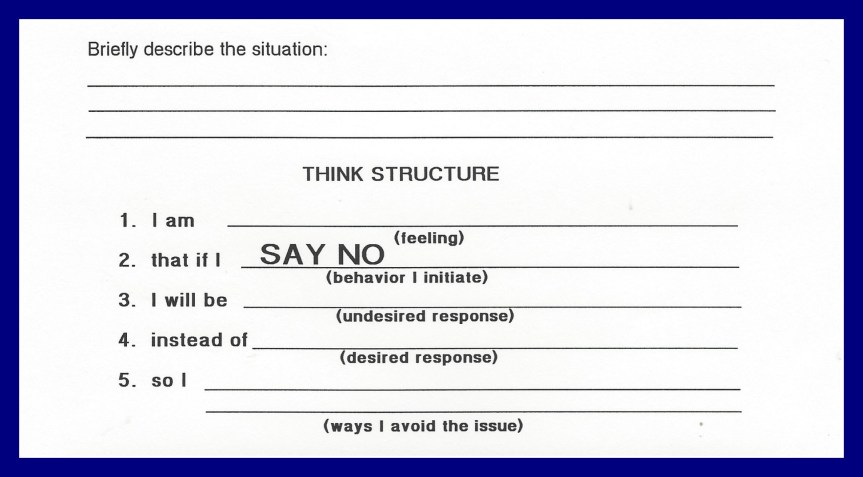
Example 1

Situation: I agreed to help a friend move to a new apartment and even though I didn’t want to do it. I feel mad that I am not spending my day doing what I want to do. This would not have happened if I had said “No” in the first place, but I was afraid to do that.

think-1

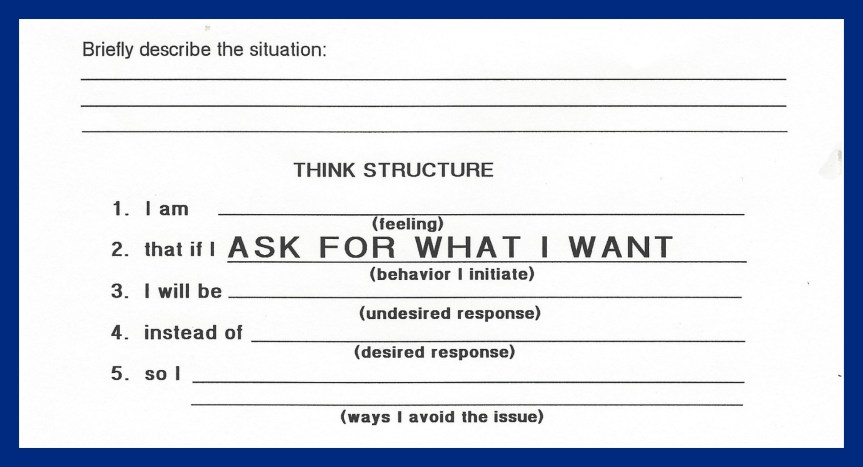
Example 2

Situation: I want to go to the movie but I am afraid that if I ask my friend to go, she will say “NO” to me, so I stay home alone.

think-2

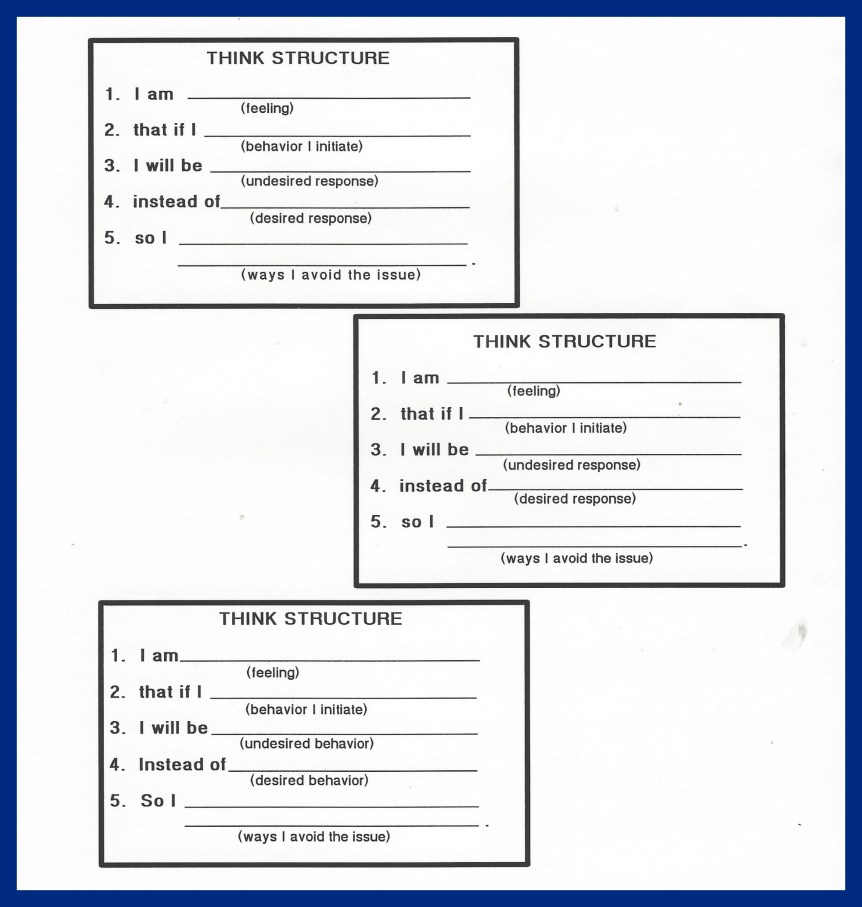
Your turn! Think of recent times when you had trouble 1) saying “NO” and 2) asking for what you want. Fill in the practice exercises below. If you can’t think of recent incidents, use experiences from the past.

Practice Exercise 1

think-3

Practice Exercise 2

think-4

During the rest of the week, be aware of times you are suffering. Use the Think Structure to help you sort out what is going on for you.  If you have no incidents of suffering during the week, complete the structures from incidents in the past. If you have trouble identifying when you are suffering, use some of the behaviors you identified in Exercise 1 of Lesson 2. Complete at least three more Think Structures this week.

Practice Exercise 3

think-5

Feel free to share or ask for feedback on Think Structures that you come up with!

See you next Monday for the fifth lesson.

To find the lessons in this series that have already been published click here.

Be Like a Bird Perched on a Dry Twig

european-bee-eater-852588__480

Amma tells us to be like a bird perched on a dry twig, ready to fly at a moment’s notice. That doesn’t mean that we should live from a fear based hyper-vigilance but rather we need to learn to live consciously, adapting to each change that comes our way.

Amma gives us a plenty of opportunities to learn that lesson, some directly, and some indirectly. I am going to share two recent experiences that were, in my mind, chances to practice that teaching.

Giving Prasad

In an earlier post, I mentioned that we are able to hand Amma the prasad that she gives each person who comes to her for a hug. For as long as I can remember, the type of prasad she has given in India has been a piece of hard candy wrapped in a packet of sacred ash. We have handed her those packets three at a time.

When I received the instructions for giving prasad on Wednesday, I was told we would be giving Amma chocolate Hershey’s kisses wrapped in an ash packet instead of the hard candy packets. Those would be given to her two at a time since the Hershey’s kisses are so much bigger than the hard candies.

When I joined the prasad line on Thursday, I was told that we would be alternating what we would give Amma. The first time we handed her prasad, we would give her three packets with the hard candy and ash. The next time, we would give her two packets with the Hershey’s kisses and ash.

When I reached Amma, however, I discovered that the devotees were handing her two packets, one with a Hershey’s kiss and ash, and one with the hard candy and ash. Amma had changed the instructions yet again!

I laughed at the leela. I laughed even more when I received my own hug that night and Amma handed me a flower petal and a Hershey’s kiss. That is the type of prasad we receive during the North American tour, but to my knowledge it has never been the custom in Amritapuri.

To me, this was a good example of being the bird perched on the dry twig. We had to be ready for the type of prasad to change at any moment and adjust accordingly.

Tai Chi

The second example occurred during my Tai Chi class. Soon after I arrived at the ashram this year, I visited the beach area we had used for the class last year. I found it full of construction debris. A few days later, it had been cleaned up so it seemed like we would be able to meet there after all.

Even in the best of times, the class is interrupted by an occasional truck, bicycle, or bus that wants to go through that area. Today was one of those days when so much came our way that it got funny. It was another darshan day, but this time the crowd was huge. When we arrived for the class, there were already two parked buses in the area. They bordered the space we were planning to use. Once the class started, two more buses drove onto the grounds and parked nearby.

About half way through the class, a truck with some construction supplies tried to go through our area to the building beyond. There was no room for them to do that, because of the parked buses, so the driver just parked in the space we were using and started carrying the supplies to the construction area. Clearly, we had no priority.

There are two other areas on the beach that could potentially work, but there seems to be a new routine at the ashram. When the ashram cows are walked in the morning, they are taken to the beach and tied to trees, where they “hang out” for hours.  Today there were eight cows in that area of the beach.

What could we do? We would have to hold our class a few feet from the cows.  So we did just that. And I loved it!

When we become like a bird perched on a dry twig, ready to fly at a moments notice, we are able to adapt what comes our way. Each challenge is an opportunity to practice detachment, surrender, equanimity, patience, persistence and flexibility.

To look at previous posts in this Amritapuri series, click here.

Making A Difference

img_4781

Many years ago, at the the end of the programs in each city on Amma‘s North American tour, there was an announcement that contained a story about a squirrel who contributed to the building of the Rama Setu bridge. The squirrel participated by rolling in the sand and then going to the end of the bridge and shaking the sand off, chanting the name of Lord Rama throughout the process.

Lord Rama rewarded the squirrel by picking him up and stroking his back. From then on, this type of squirrel had three stripes on its back, stripes that went from head to tail. The stripes are seen as Lord Rama’s fingers. At Amma’s programs, this story was used to teach that everything we do to contribute makes a difference.

I remember thinking that what was called a squirrel in the story must be what we call a chipmunk. Since then, I have learned that the squirrel is a palm squirrel and it the same size as a large chipmunk.

On one of the first days I was in the Saraswati garden, I heard a sound. I thought it was a bird at first, but when I followed the sound, I discovered it came from the squirrel in the picture at the top of this post. I didn’t know squirrels were so loud! Here are two more photos of that squirrel:

A few days ago, I saw another squirrel in the garden; or maybe it was the same one. I feel so privileged to have been able to watch squirrels like the one in the story I have heard so many times.

img_4833


To look at previous posts in this Amritapuri series, click here.

Amma Quote

16-newyear-2

The success of one’s life depends upon one’s ability to forget what is not relevant at the moment.  

Amma

Letting Go of Suffering: Week 3- What Would Your World Be Like If You Didn’t Suffer?

Walt Disney once said, “If you can dream it, you can do it.” Many years ago, Pam Levin taught me that the first step in manifesting your vision is to have one.

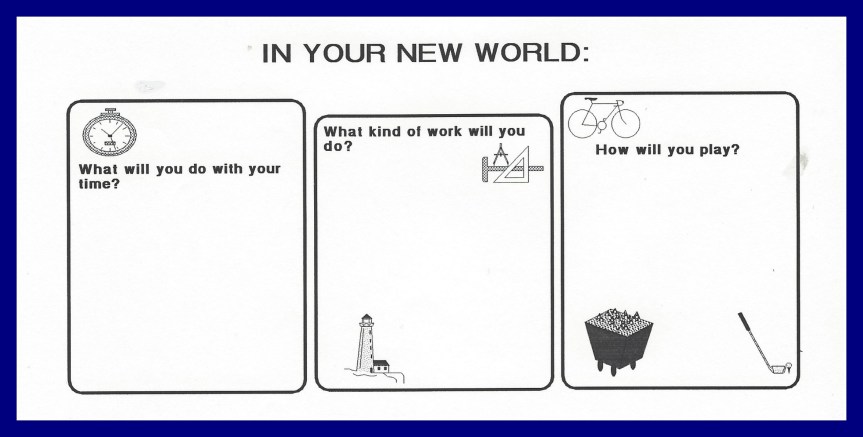
The exercises for this week are devoted to imagining what your life would be like if you didn’t ruminate about the past, worry about the future or do the unhealthy behaviors that you know make you miserable.

Exercise 1

Identifying Your Vision

Take a few deep breaths. Focus on “breathing in relaxation” and “breathing out tension.” Let your body settle into the chair you are sitting on, or the bed or floor on which you are lying. As you begin to relax, let yourself imagine what your life would be if you were no longer immersed in suffering.

Let the images come and your new world develop. When you are ready, bring yourself back into the present and then answer the questions in this exercise. If you need to, close your eyes and go back into your new world to get the answer to a question.

vision1

vision2

Exercise 2

To make your vision become a part of your life, spend 10-30 minutes a day for the next five days putting yourself into a meditative state (through breathing slowly and allowing yourself to relax) and then experiencing your new world. Feel what it feels like to live there. Experience whatever you experience. Let your new life develop in your mind’s eye. Jot down some notes in the spaces below.

vision3

As you identify other components you would like to have in your new world, add them to your vision. Periodically, throughout your life, refer to the two exercises in this lesson to see where you are in creating that vision. Each time, see if there are areas you want to add, or parts you want to let go of. Decide which part of your vision you want to work on next. Don’t feed suffering by expecting your life to change all at once. You will create you vision one day, or even one step, at a time.

See you next Monday for the fourth lesson.

To find the lessons in this series that have already been published click here.

Letting Go of Suffering: Week 2- The Beginning Continued

Exercise 1:

An important step in letting go of suffering is identifying the many ways we contribute to our suffering. I make myself suffer when I eat too much chocolate, when I agree to do things I don’t want to do, and when I over-think or over-do. What are the unhealthy behaviors  you do that bring suffering into your life?

chains

Exercise 2

In the psychotherapy model I use, therapists differentiate between core feelings and racket feelings. Child words, i.e. mad, sad, scared and glad, are used to designate the core feelings. Rackets are substitute emotions that are used to cover (hide) the core-level feelings.  Racket feelings are much more likely to lead to suffering than experiencing and addressing the core feelings.

In our families of origin, some emotions might have been more acceptable than others. In my family it was okay to feel scared but not mad, so I learned to cover my mad with scare. The pattern became so pervasive in my life that there was a period of time when I needed to assume that I was mad whenever I felt scared. When I examined my scare, I usually discovered there was no danger present and that I was actually mad. So in this example, scare was the racket and mad was the core. Other people may cover their scare with mad.

While core feelings can become rackets, there are also many other kinds of racket feelings. Some common examples are disappointment, confusion, sarcasm, and guilt. Using the chart below, identify the racket feelings that you use as substitute emotions. If you identify any that are not on the chart, add them. This week, whenever you experience a racket feeling, see if you can identify the core feeling that lies underneath it.

racket

Exercise 3

The more we can learn about our own suffering tendencies, the easier it will be to stay out of them. For example, if we tend to be miserable on holidays, then it is important to be proactive in making plans for those days, ones that will give us satisfaction and prevent suffering. In the chart below, identify factors that are part of your suffering profile. If you become aware of other factors during the week, or in the future, add them.

profile


See you next Monday for the third lesson.

To find the lessons in this series that have already been published click here.


Letting Go of Suffering: Week 1- The Beginning

You are probably reading this post because you have a desire to let go of your suffering. This course will consist of 17 lessons, each containing concepts or tools that can aid you in your endeavor. The content is based on a workbook I wrote in 1991. I will be posting a new lesson each Monday.

Suffering, as used in this course, is defined as “extended hurt.” It is “the persistence of painful feelings long after they were provoked.” (Judy Tatelbaum)  Letting go of suffering does not mean living a life void of challenges or pain; it means not getting stuck in the pain

People often think of suffering as being prolonged sadness. It can also be prolonged anger or fear. There is likely to be some degree of suffering present whenever we are holding on to the past or worrying about the future.

Suffering is also brought on by the unhealthy behaviors we do in the present, those behaviors that make us miserable.

Be gentle with yourself as you go through the course.  Let this be an opportunity for you to experience being successful without expecting yourself to be perfect.

During the first two weeks, you will be gathering information about yourself. You will also learn more about suffering and about letting go. As you complete the exercises, either print the post and write your answers directly on the exercise sheets, or just write your answers in a notebook.

Exercise 1

When you are suffering, it is often important to get help from others as you work to shift the energy. In the boxes below, or in your journal or notebook, write the names and phone numbers of people in your life who might be available when you need support.

support-2

Exercise 2

What scares you about letting go of your suffering? Write down any fears that come to your mind, whether they make sense to you or not.

fear2

Exercise 3

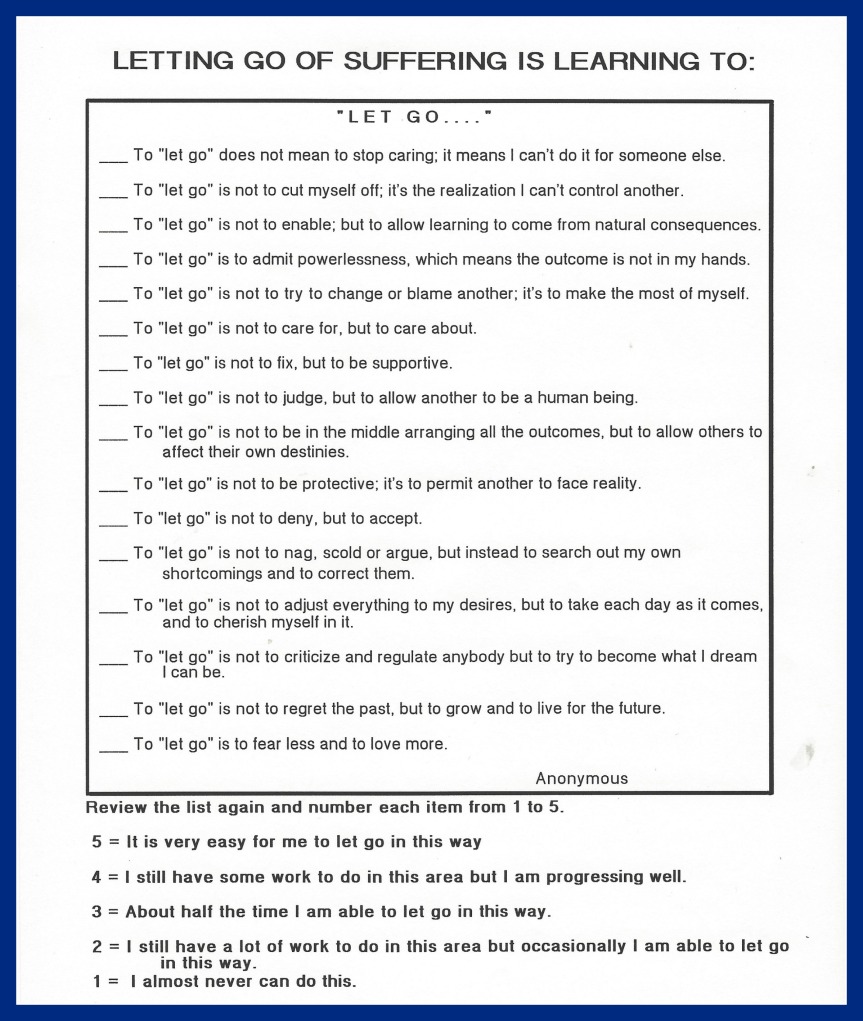
letgo2

For the rest of this week, reflect on your answers to these three exercises. Consider journaling about the thoughts, feelings and/or insights that surface as you do that.


See you next Monday for the second lesson.

To find the lessons in this series that have already been published click here.

Letting Go of Suffering- New Series Announcement

Are you tired of holding on to the past or worrying about the future?

Have you had your fill of feeling like a victim?

Are you committed to stopping your self-defeating behaviors?

Starting on Monday, November 21, I will be posting one chapter a week (for 17 weeks) from the Letting Go of Suffering workbook I wrote in 1991. If you answered “Yes” to any of the questions above, this upcoming “course” may be instrumental in helping you to make those changes.

This course is meant to increase your understanding of why you are the way you are and to teach you some new behaviors that can facilitate your movement from suffering to joy. Among the areas that will be addressed are:

  • Identifying Your Vision
  • Discovering Your Suffering Profile
  • Stopping Passive Behavior and Critical Self Talk
  • Using Affirmations and Contracts to Heal
  • Holding Yourself Accountable

I look forward to the possibility of sharing this journey with you.

Letting Go of Suffering Series:

Letting Go of Suffering- New Series Announcement

Letting Go of Suffering- Week 1: The Beginning

Borrowing Worry

upset-534103_1280


“In essentially all individual moments, we’re safe and physically comfortable. We generally have to borrow worry from the future or the past to maintain unhappiness.”

Fritz Reitz