This afternoon I heard Nimo from Empty Hands Music sing. I loved his songs and was intrigued by him so I checked him out at the first opportunity. This is what I found:
From an Ivy League education to Wall street to fame and fortune as a MTV Rap star, at some point along Nimo’s journey he realized that we was walking a path of suffering and that the only path to light was through selfless service to others and his own internal purification. For the past 5 and half years Nimo has been serving and working with the underprivileged communities in the Gandhi Ashram in India.
Most recently Nimo has reconnected to his roots of music and is offering this gift of love, peace and oneness through his songs: an offering he calls “Empty Hands Music”.
Nimo chose the title ‘Empty Hands’, because of the profound wisdom we all can gain when we understand this deeper truth: that we arrive on this planet empty handed and we will all soon leave empty handed. So then, how and in what spirit do we want to spend the time in between?
Next, I checked YouTube and found a video that has three different parts. In the first part he gives an overview of the Empty Hands Pilgrimage. The last minutes of that part includes some of his song Planting Seeds. In the second part he sings Grateful and the third is Being Kind. I was so moved by what I saw and heard that I sobbed. I hope the video touches your heart as well.
Nimo is offering his album of ten songs for free download. You can download them here.
For some time, I have been thinking about writing a post about a small lemon tree I purchased during the summer of 2013. My plan was to call the article “A Tale of Endurance.”
Then on Thursday, Sreejit posted his Dungeon Prompt for the week. He asked us to address:
How do you measure up to your eight-year-old-self’s plans for the future? We all had childhood dreams, or fantasies. How did you imagine the world as a kid? When you were eight years old, what did you plan on being when you grew up? What would that version of yourself think about who you are now?
Responding to this prompt posed a problem as I have almost no memories of my childhood. My mind went blank when I thought of my eight-year-old self. As I reflected on my childhood as a whole, it occurred to me that that my growing up years could also be seen as “A Tale of Endurance.” I wondered if I had that attitude about life by the time I was eight.
I decided to include both endurance tales in one post!
A Tale of Endurance #1
What did my eight-year-old dream of? I have no idea. My only clue is that I know my primary past-time during my childhood was reading. I do remember loving the Bobbsey Twin series. I think those were books an eight-year-old might read. I have no doubt that when I immersed myself in my books I was transported to other lands. It is likely that most of my childhood dreams came from the books I read.
Since I couldn’t answer the prompt by talking about my dreams, I decided to see if I could learn more about my eight-year-old self. I searched for some pictures and found two. I believe I was eight in the first one and nine in the second.
Me at 8?
On our way to Germany
I grew up as an army brat. I was born at Sandia Base in Albuquerque, New Mexico and lived there for the first years of my life. At some point during the Korean War my father went to Korea and my mother, brother and I moved to West Palm Beach, Florida, the city where my mother’s family lived.
I thought I had attended three different schools in the third grade but as I looked through old belongings yesterday, I discovered I had gone to two schools during the second grade and two in the third. When my father returned from Korea, we moved to Fayetteville, North Carolina; I would have been seven at that time. After two quarters of school in Fayetteville, we moved to Ft. Bragg, which is also in North Carolina. I finished the second grade there. I attended third grade at Ft. Brag for half a year and then moved to Pirmasens, Germany for the last half of third grade.
I can imagine the difficulty that switching schools so often would cause a child who was a strong introvert. In an army brat’s life, friendships were usually short; either we moved, or our friends did. I have no memory of any childhood friend, other than the cousins we visited on vacations.
I remember my mother saying that my pattern was to have one friend and then if they moved on to another best friend I would be devastated. I can imagine myself developing a “why bother” attitude when it came to friendship.
Yesterday, I also looked through all my elementary school report cards. I probably had read them sometime in the past, but it would have been decades ago. I paid particular attention to the report cards from the years I was eight and nine.
At that time, my teachers described me as earnest, pleasant, a hard worker, cooperative, and a good student who was creative, read well, learned quickly and had a wholesome attitude. In the second half of second grade and the first half of third grade, I received “Excellent” and “Good” for grades. When we moved to Germany and they used A, B, C, etc. as the grading system, I received A’s and B’s. The area where I consistently received the lowest marks and negative comments were in Writing. One teacher wrote “Carol (my name at that time) writes large enough but her letters are poorly formed.” Those comments continued throughout my elementary school years. I have no memory of my writing being an issue, although I’m not surprised considering how poorly I write now!
After writing positive comments on my report card, one teacher added- “I’m afraid she doesn’t receive much challenge.” I wonder what she meant?
Other comments that interested me were:
“She is slow to express herself.” That seemed reasonable for an introvert.
“Carol has improved some in writing but seems tense and not able to relax when writing and other times also. Have you noticed this?” My mother, who was also a teacher, responded “I have never noticed any tension in her writing at home but then she has an eraser at home (which she uses far too often) and I think her not having one at school may cause the tension. I’m not sure. She is a sensitive child and may be trying too hard to succeed in a subject she knows she’s having trouble with.”
I don’t know how soon my life began to feel like a tale of endurance. As I aged, I became more and more unhappy at home. At one point, I counted off the days until I could leave for college. I hated moving so often and wanted to create a life where I could stay put. Hmmmm. I wonder if that was a dream when I was eight. If so, it was one I created as I have lived in the same house in Seattle since 1973!
I have loved getting some insight into my eight-year-old self. Thank you Sreejit for offering this assignment and thereby prompting my exploration.
A Tale of Endurance #2
In the summer of 2013, I bought a small lemon tree. There were several lemons on it when I purchased the tree and I had visions of all of the lemons that were to come. The nursery staff told me to bring the tree into the house before the temperatures dropped, so as winter neared I put it indoors. One by one, the beautiful lemons turned black and fell off. Then most of the leaves fell off. Soon there was nothing left but the trunk (if you can call something that small a trunk) and a few leaves.
Spring came and nothing happened. The same few leaves stayed on, but there were no new ones and there were no buds. I took the plant to a nursery to see if it was possible to save it. They instructed me to use a particular kind of fertilizer. Months later there was still no new growth. It wasn’t until late August that a few flower buds formed. The plant was still alive but it seemed too late in the season for any fruit that formed to grow to maturity.
As it started to get cold, I once again brought the tree into the house. And again, the few small lemons that were on the tree turned black and fell off. This time the rest of the leaves fell off as well. I decided to leave the tree in the house even though it was just a stalk.
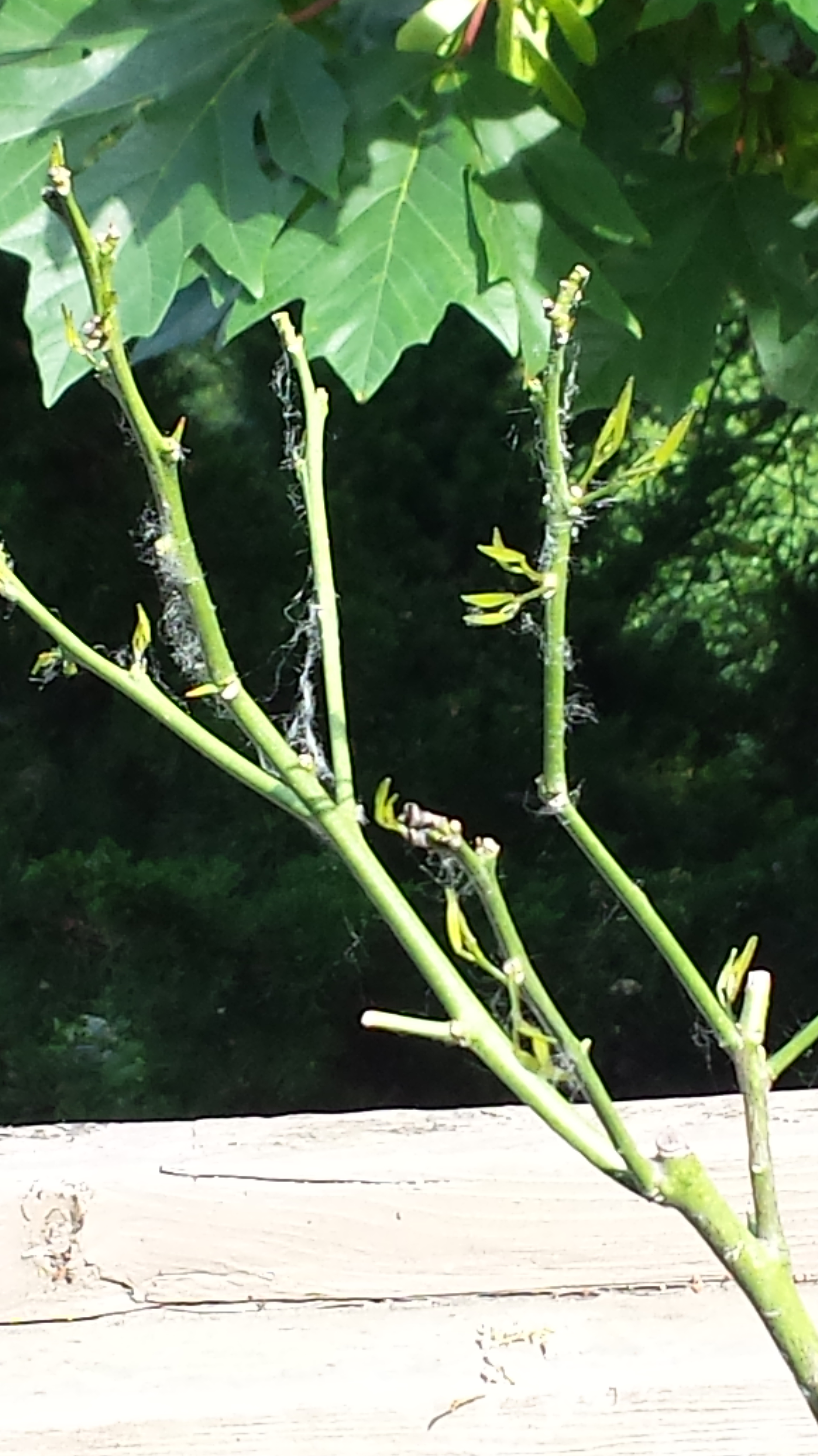
Sometime in late winter, I concluded that the situation was hopeless and put the tree outside on the balcony. I would compost it in the springtime. However, when springtime came and I picked up the container to take it to the compost heap, I noticed there were many tiny leave buds!
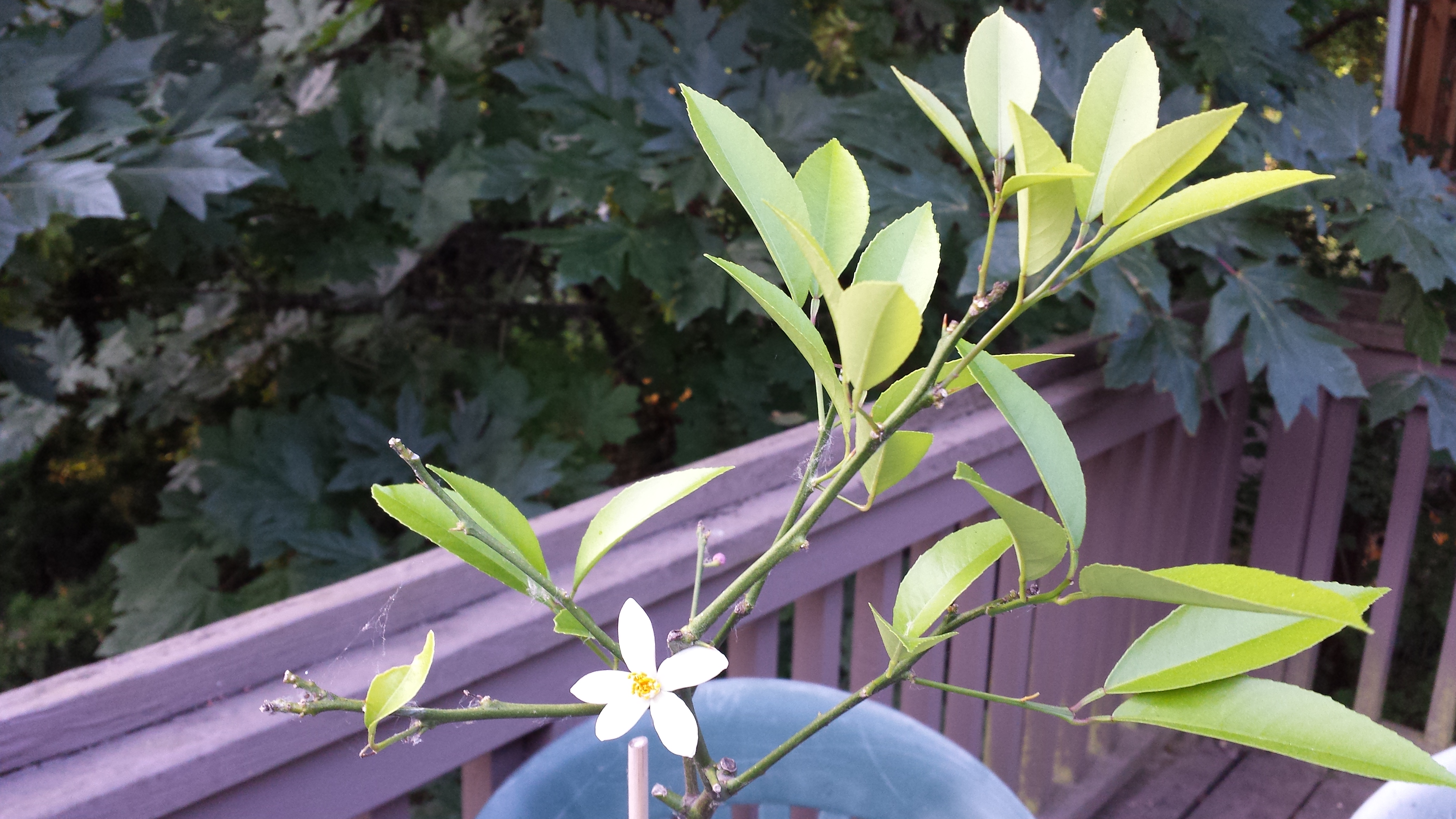
This tree seemed determined to live. Over the next weeks, the leaves grew, flower buds formed and then blossomed!
After a difficult childhood, my life blossomed and has been filled with friends, adventure and learning. It is interesting for me to see that many of the characteristics that my teachers pointed out on my eight-year-old report cards are characteristics that I am known for now. I think my eight-year-old would like the adult I have become.
It appears that this year the lemon tree is moving forward on its journey towards health. Perhaps in time it will even bear fruit that will become ripe!
I appreciate all the ways, past and present, that I am learning the value of endurance.
Some of you may remember that towards the end of last month, a swarm of tiny black ants formed on the sidewalk in front of my garden. I, of course, didn’t know how many there were but in my shock it looked like millions! I didn’t want to kill them but I also didn’t want that many ants, and potentially more, in my garden. I also didn’t want anyone to accidentally stand in them. After pondering the dilemma for a short time, I decided to wash them away with water from a hose. That solution worked and the ants never came back.
When I wrote about that event in Discrimination Opportunity, a blogging friend responded that he understood black ants to be harmless. In pondering his words, I realized that I had moved to action very quickly. I had been stung by red ants in the past after I unwittingly stood on or near their hills. Even one bite from a red ant can be very painful, and being bit by a large number of them is something I will never forget. Did that memory cause me to act too fast?
As I continued to reflect on my action, I realized that a child would be terrified if that many ants were crawling on them, even if they weren’t being stung. I concluded that my washing the ants away was a reasonable response, but I wasn’t sure that I was right.
Prior to that event, I had seen a few big black ants in my living room. After the incident with the tiny ants in the garden, more of those big ants showed up, both inside and outside of the house. Two ant events in a short period of time made me wonder what was going on.
When I become conscious of an animal, bird or other living being repetitively showing up in my life, I sometimes look to see what that creature symbolizes in Native American traditions. I googled “native american medicine ant” and found Dr. Loretta Standley’s website. She says this about ant medicine:
When Ant Medicine grabs your attention it is asking you to cooperate with your tribe (co-workers, family, projects, etc.,) in unity and patience. Ants are resolute and unwearied little creatures. Although they are tiny, they are indeed mighty. They have a strong skeleton on the “outside” of their body (exoskeleton) with specialized muscles that give them their strength. Ants can carry 30 times their weight, which would be equal to a 150 lb. person carrying a bulldozer on their back at 19,500 lbs.
The typical way to stop ant medicine is to literally stomp on it or fumigate it. If an ant is stomped on, it will emit pheromones that will draw more ants to the area. In short, ant medicine is unstoppable, tireless, patient and unified.
Ant’s message is about working non-stop toward your goals and forging ahead for the Good of the whole. Are you working on a project that benefits a larger audience? Have you been ignoring your tribe? Ant medicine cooperates with the tribe in harmony and wisdom toward a common goal, knowing that patience will be rewarded. Have you been cooperating with yourself on your own personal projects?
I was intrigued. Just the day before, I had met with two colleagues to clear up some long standing issues between us and was going to do the same with another friend the next day. I thought the “ant medicine” perspective was valuable and would ponder the questions Dr. Standley put forth. Now that I had this information would the ants go away?
Nope! If anything, the number of ants increased. I did more research and discovered the ants were carpenter ants. Everything I read indicated that I would probably have to call a professional pest control company to keep them from damaging my house. While there were still not that many ants, over the next few days their numbers continued to increase. Their favorite location seemed to be on my front porch.
I decided to take the time to observe them and see where they came from, where they were going and what they were doing. As I watched, I noticed that there were some small holes, or perhaps just indentations, in the caulking near the front door. The ants went to those holes over and over again. Even though the ants never went inside of them, it seemed like the holes were getting bigger. Maybe the ants were breaking down the caulking. They also went to a place next to the bottom corners of the door where some wires, probably old wires from broadband television hook ups, were located.
The following day there were even more ants on the porch. Anytime I left the door open even for a minute, the ants tried to get into the house. I decided I couldn’t continue doing this so called pest control. I made an appointment for them to do an assessment the following week.
I remembered hearing that spreading cinnamon powder could repel ants. It hadn’t worked very well in India when I tried it there, but I didn’t want to kill these ants unless it was absolutely necessary, so I spread some cinnamon in front of the door and in the areas where the wires were located. The number of ants decreased immediately but some still made their way through the cinnamon.
The next morning, I looked outside to see what was happening. There were three dead ants on the porch. Two were by themselves; the third was being pulled away by a live ant. The dead ant had a little different coloring than the rest of the ants. When I had looked up carpenter ants on the internet, I had noticed that the queen ant had different coloring than the workers so I wondered if the one being pulled away was a queen. I questioned whether a queen would be on the porch with a worker, but it seemed like a possible explanation as to why the black ant was trying to carry her away.
The live ant spent the whole day trying to drag the dead one from the porch. He seemed disoriented so I believed that he was probably also under the influence of the cinnamon.
I had thought the cinnamon would repel the ants, not kill them. My heart felt heavy as I watched his efforts. As I felt my feelings, I was struck by how much I have changed. I was raised in an era when we killed bugs, flies, spiders, and beetles, with swatters and insect spray, and here I was mourning the death of three ants and feeling compassion for the one who was taking such care to move the dead one.
I watched that process throughout the day, and noticed that no other ants ever came onto the porch. It has been almost two weeks since all of this happened and I have only seen two or three carpenter ants in or outside of my house during that time. They appear to be gone.
But my story doesn’t end there. There are two more related events!
During one of the psychotherapy groups I led the first week in June, an ant walked through the room. One of my clients immediately smashed it. As I thought about his action during the following week, I realized it was a good teaching opportunity. In the next group, I asked him if I could do a regression piece with him (a role play where he acted as if he was an eight year old and I was a healthy parent). He said yes so I talked to his eight year old about ants and what he thought should happen to them if they were in the house. We also talked about spiders. After we discussed his belief that they should be killed, I asked if he wanted to try something different. He was interested. I offered him the opportunity to be in charge of catching and releasing all bugs, spiders, and ants that might wander into the group room. He liked that idea and accepted the challenge. This past week an ant came into the room and he had his first experience of catching an ant and taking it outside!
The second incident occurred yesterday, the day I started writing this post. That morning, a friend phoned and said she wanted to talk to me about the morality of killing carpenter ants! Her situation was very different than mine in that there were a huge number of ants involved, but the timing amazed me. How interconnected we all are as we learn what we need to learn on our life journeys.
Am I done with the ant lesson? I don’t know; only time will tell. What I do know is that I have gained much from these occurrences. I see that I had an opportunity to:
Be thoughtful before taking an action that effects one of Mother Nature’s creatures.
Feel compassion for a creature as small as an ant.
Consider ways of thinking that are outside my normal experience, e.g. the Native American perspective.
Hear feedback and reflect on it.
Not criticize myself when I took action not knowing for sure what was right.
Learn from a previous experience, e.g. the ant swarm event prepared me for the carpenter ants
Share my experience with others, e.g. talking with my friend and to those who read this post.
Teach a new way to respect nature to a regressed 8 year old.
Be reminded that if I take my time, the answers will come.
See how all beings are interconnected.
Reflect on how much my attitudes towards live creatures have changed throughout my lifetime.
I feel very grateful for all I have experienced and learned as the result of this ant “lesson.”
On Thursday, I was asked what I would like to learn in the future. That was an interesting question. At first, what came to mind were skills I already have, but haven’t done for years, e.g. knitting, crocheting, and quilting. And I’m a beginning gardener so I definitely have much to learn in that arena! While those answers would have been true, they didn’t seem like the one I was looking for. Continue reading “I’d Still Like to Learn…”→
From birth to death and beyond Offering beauty and protection Rendering love unconditional Creator, sustainer, destroyer Energy that has no bounds Sharing all that she has to offer
Only “the times they are a-changin” Feeling our neglect, our abuse
Nature’s crying, can’t save us from ourselves Another earthquake, people dying Temperatures rising, ice caps melting Upon us come floods, superbugs, disease Realization is dawning, but is it too late Eager earnest effort is essential
I met Amma, a spiritual leader from Southwest India, in 1989 when she was leading programs in Seattle, Washington. A friend had invited me to go with her. I had no interest in attending, but when I was asked “Yes” came out of my mouth. As the music started that night, I burst into tears. Even though I had no previous experience with Indian music or Eastern spirituality, I had a strong sense of being “Home.” I cried for hours. Later in the night, I received my first hug from Amma, who is known as the Hugging Saint. Her hug felt good, but I was much more interested in the music!
I was intrigued enough by my experience to go to the programs the next day and to the last day of a retreat she was leading on Orcas Island. Afterwards, I was invited to be part of a group who was seeing Amma off at the Orcas Island airport. As she prepared to board the plane, I started crying as if my heart was going to break. I found my behavior extremely bizarre since I barely knew her and I saw no reason for my intense emotion. Six weeks later, I was at Amma’s programs in New Hampshire and six months after that I was with her in India.
Over the next few years, I continued to experience huge separation grief whenever I was leaving Amma, even if I was going to be seeing her again days later. My grief was particularly intense whenever I left Amma’s Indian ashram. At times, I wondered if I was going crazy. As I struggled to find some explanation, I remembered that Amma had said that those of us who are attracted to her have been with her in previous lives.
I knew Amma generally didn’t answer questions about past-life experiences, but I decided to present her with my theory at the next opportunity. When that time came, I told her I believed I had lived with her in an ashram before and that I grieved to return to that familiar “home.” I added that I thought my “job” in this lifetime was to be in service in the world and to learn to feel connected to her when I was not with her. It seemed to me that it was fine for me to come to the ashram every year, but that I should not live there.
When my comments were translated, Amma responded, “I recognize you.” I looked at the swami (monk) who was translating, puzzled. “She is telling you, you are right,” he said. My eyes filled with tears. She had said she knew me! I experienced the joy of being known and the relief of having my reasoning validated. I was not crazy. There was a logical, albeit unusual, explanation for my overwhelming grief.
My life had been focused on service before I met Amma, and it has continued to be. I have visited Amma’s Indian ashram almost every year since 1989. I feel connected to Amma when I am with her and when I am not. I also feel connected to the ashram when I am there and when I am not. I am so grateful for all I have learned and experienced in this lifetime.
During the last two months, I have been invited by two blogging sisters (SeasonedSistha2 and Tournesol Dans Un Jardin) to write ten four-word sentences about love. The form of the challenges were different, so I decided to do it my own way! Here are the sentences that came to my mind:
Love has many forms
Love through a smile
Love through a word
Love through a touch
Love through a look
Love heals painful wounds
Love leads to happiness
Love helps build communities
Love can transform evil
Love yourself, Love others
What four-word sentences about love would you like to add?
In this week’s Dungeon Prompt, Sreejit asks us to fill in the blank in this sentence: “I am a Recovering _________.” There was no doubt in my mind what the behavior would be for me. Using the Alcoholics Anonymous introduction, I will say: “Hi! I am Karuna, and I am a recovering over-doer.”
As I thought about how I would present this topic, I decided to create a new disorder. My fictitious disorder is called “Being versus Doing Disorder.”
The Being vs Doing disorder is on a continuum where the center, a balance between being and doing, is the healthy portion of the continuum. The more someone moves to either end of the continuum, the more likely it is they will have dysfunction in their lives.
When I think of the over-being end of the continuum I think of non-productivity, passivity, and lack of motivation. I don’t know as much about that part of the spectrum since I have almost no personal experience there. I have seen it at work in clients and friends though.
Over-doing has many facets. It commonly begins in childhood when the only or main way to get positive attention from parents is to do impressive things. It also develops when parents criticize their children anytime they are relaxing or are doing things the parents consider nonproductive.
As a result, adults with an over-doing disorder may be seeking validation and praise for what they accomplish. An over-doer is also likely to be a rescuer. As such, they do things they aren’t asked to do and are likely to do things they don’t want to do. In addition, they do more than their share of the work that needs to be done and do things for other people that they could do for themselves. Those with this “disorder’ are likely to over-commit and seem incapable of being still.
Over-doing has been a major characteristic of my adult life. At one point, I was raising two children, working three jobs, doing my personal therapy and in school studying for a PhD. During my therapy, I realized I didn’t want a PhD, I was just seeking attention from the father, who had disowned me. I stopped my schooling but was still overdoing. Before long, I began to experience extreme exhaustion and was diagnosed with Chronic Fatigue Syndrome (CFS).
With CFS, I was in survival mode and it was impossible for me to do as much as I had been doing, although I still tried to. When it began dissipating after five years, I went back to over doing. There is no doubt that a part of me believed it was only acceptable for me to stop if I was sick. Eventually I developed high blood pressure and other physical problems.
I reached a point where I had to cut back on all of my commitments. Nowadays, I am putting my emphasis on doing the things I want to do, and am saying no to many requests. I still have trouble with “simply being” but I no longer am into major over-doing. I hope some day I will be much closer to the center of the being-doing continuum.
I have realized a behavior that really fueled my over-doing disorder was the desire to be “in the know.” That puts me in the place of being asked for information that I don’t want to share, which then creates stress, whether I share it or not. As I continue to slow down, I am finding myself holder of less information. I am loving responding to requests with “I’m not in that loop anymore. You will have to ask someone else.”
I learned many skills during my over-doing years. Last week friends of mine were in a life and death crisis and I stepped in to help immediately. There is a time and place for those skills, but it takes discrimination to use them correctly. In that instance, I have no doubt that my choices were appropriate.
I am very committed to my recovery from over-doing. While I may find myself immersed in the old behaviors from time to time, I don’t think I will ever be drawn so deep into them again. I see what I am doing much sooner and and change course when needed.
In evaluating myself on the scale found in Portia Nelson’s Autobiography in 5 Short Chapters, I find I am in generally in Chapter 4 or 5.
Chapter IV
I walk down the same street.
There is a deep hole in the sidewalk.
I walk around it.
Chapter V
I walk down another street.
Every time I walk around an invitation to over-do or avoid putting myself in the situation where I know I am going to be tempted, I consider my choice worthy of celebration! I am truly movig towards a life of balance.
Do you have a “Being vs Doing” disorder? Where do you fall on the continuum? How does it disrupt your life? Do you consider yourself in recovery?
“The fool doth think he is wise, but the wise man knows himself to be a fool.” “Love all, trust a few, do wrong to none.” “Love looks not with the eyes, but with the mind, And therefore is winged Cupid painted blind.”-William Shakespeare









 Living, Learning and Letting Go
_(2).jpg#/media/File:Shattuck_54238,_Camponotus,_Danum_Valley,_Sabah-web_(5042361317)_(2).jpg)