The Seattle Parks Department gave our Greenbelt Restoration Project a job box that contains the tools we need to clear the land in our Greenbelt restoration site. That box is chained to one of the large cedar trees on the property.
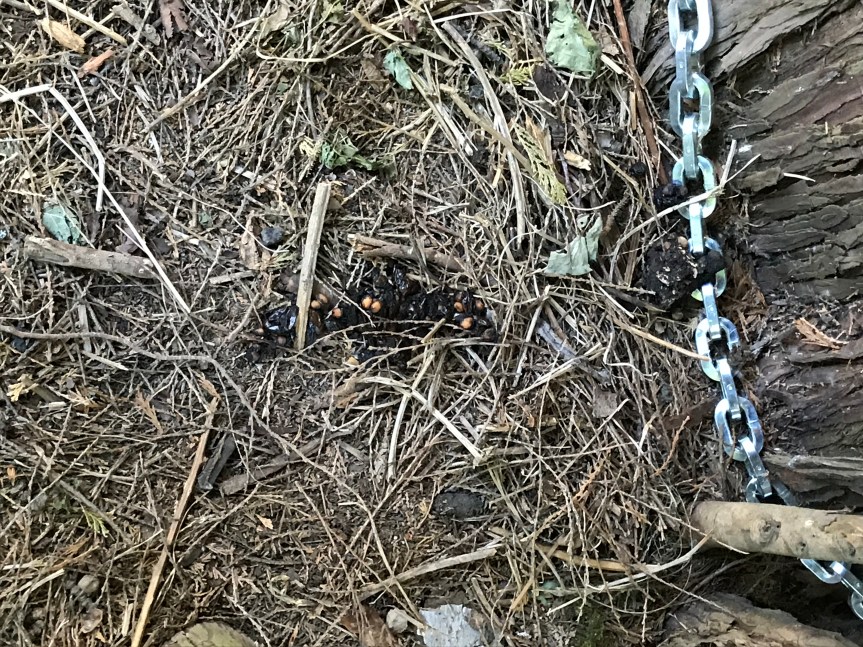
Several weeks ago, I noticed that an animal was defecating near the base of that tree. Over the week, the pile grew. I wondered if a cat was using that spot for its personal litter box. I thought about cleaning it up but didn’t.
One day, another forest steward noticed the pile and commented. She thought it had been left by something bigger than a cat and wondered if it was droppings from a deer. Earlier in the week, someone had asked me if we had ever seen deer on the site. I said “No.” I loved the idea but wonder if deer could live in the inner city and stay safe.
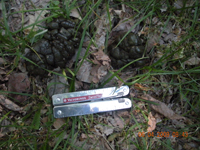
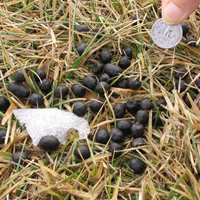
After this interaction, it occurred to me that not only was the poop pile unsightly, it was also disrespectful to the tree. I cleaned it up and buried the feces. The next morning, there were two more piles. One had an unusual consistency and I wondered if the animal had diarrhea. (The two photos below were taken a day later so the feces were no longer fresh.)
Aside from being irritated that my effort to clean the area hadn’t done any good, I was curious. I wanted to find out what animal was leaving these droppings. It was time to investigate.
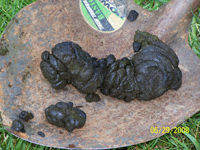
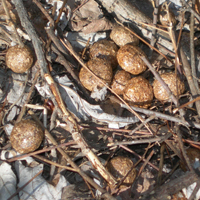
I found a Scat ID section on the Internet Center for Wildlife Damage Management (ICWDM) website. ICWDM is “a non-profit, grant-funded site that provides research-based information on how to handle wildlife damage problems responsibly.” (The next series of photos were used with ICWDM’s permission.)
Black bearRabbit droppings.Deer (winter)DeerRaccoon
The description offered by the ICWDM said:
Raccoon (Procyon lotor): Droppings are 2 to 3 inches long and 1/2 inch wide. You often can identify what a raccoon recently has been eating. Corn kernels or fruit may be visible, for example. Droppings frequently are found in piles, called latrines, on roofs, in attics, in sandboxes, or open areas. Raccoons defecate in the same location.
Ah ha….. I hadn’t noticed anything peculiar about the first droppings but the last set were full of seeds/pits. Since there are big cherry trees on the property, and the cherry’s are ripe and falling, the animal had more than likely been eating cherries. My conclusion was that the pile was probably left by a raccoon, possibly a raccoon with diarrhea from eating too many cherries!
Realizing that the animal may have been a raccoon brought back memories; memories of standing on the land that is now Greenbelt, holding Sreejit as an infant, with a raccoon chasing our dog around and around me; memories of coming out to the tree-house that I had slept in April to October for five years only to find two big raccoons standing on their hind legs between me and it (that was the end of my sleeping in the tree house); memories of four raccoons, which are usually nocturnal, crossing my yard in broad daylight.
I haven’t seen a raccoon in this area for a decade. I like the idea of them, along with other wildlife, returning to the Greenbelt, but I hope that their activity is at night. And I’m glad that this land has mostly been cleared so it is likely they would choose a less visible site to sleep. Regardless, I am clearly being presented with the opportunity to work on my past fear.
Back to the story at hand…. scat, feces, poop, defecation, droppings…
Who would have thought that I would ever be investigating and blogging about “poop.” My life has taken an interesting turn… and I love it!
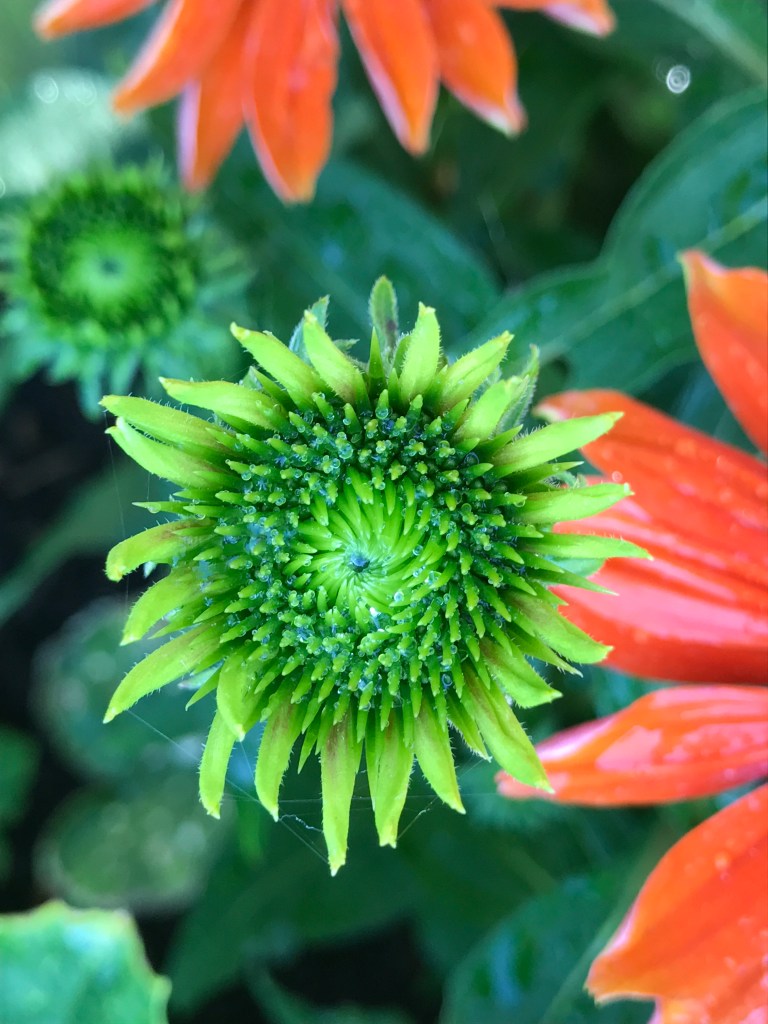
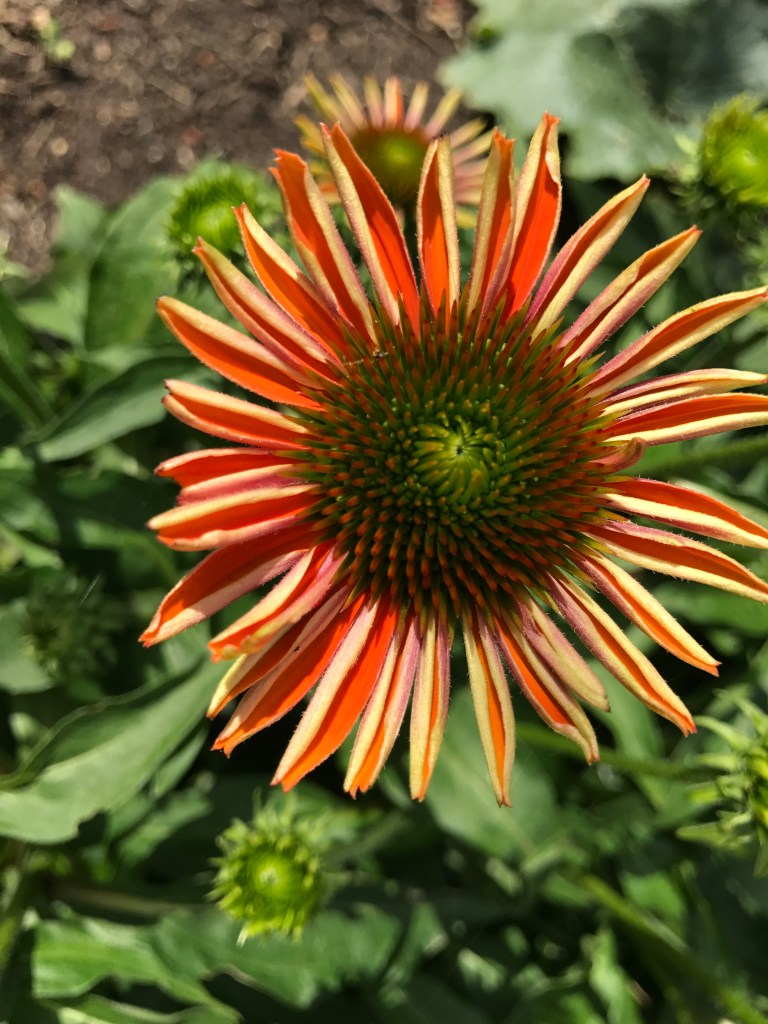
Last summer, I purchased my first echinacea plants. I’ve particularly enjoyed watching this one grow. It gets more sun than the other two and the difference is remarkable. One attribute that I find fascinating is that it has blossoms in so many stages of development at the same time. I am also enjoying the fact that the plant has at least four times the number of flowers-in-the-making than it did last year.
None of these flowers are fully developed yet. I look forward to showing you what it becomes. I also am anticipating looking at the flowers under the microscope. The shots I took last year were spectacular.
Last year was the first time I attended Amma’s Chicago area programs. I had heard about the Center there for years and was excited to see it for myself. The site had once been a Seventh Day Adventist college. When I drove onto the property, I found myself on a tree-lined street of homes, homes that had once been faculty housing. I burst into tears. I have been to many of Amma’s ashrams and centers but this felt like being in a town, a town dedicated to Amma’s ideals of compassion and service.
Many of the original buildings had been remodeled and a new program hall had been built. The property was very large and a good deal of it was farm land. There was a large echinacea field as well as fields devoted to growing herbs and vegetables. I had such a good experience that year. Attending the Chicago programs is now a top priority for me.
This year, I arrived at MA Center-Chicago on June 20. I knew I was close when, in the distance, I saw the big blue water tower emblazoned with Amma’s logo. When I turned into the property and drove past those first houses, I felt as if I had come home.
Amma wouldn’t arrive at the program for another hour, so after saying hi to my son and daughter, Sreejit and Chaitanya, I headed to the fields. One of the first things I saw was a butterfly. That greeting became even more significant to me when it turned out to be the only butterfly I saw that day.
Prior to going to Chicago last year, I had seen a short aerial video of the Center’s echinacea field.
Seeing that field in person was a major goal for last year’s visit and I was eager to see it again this year. I walked and walked but couldn’t find it anywhere. I felt confused. It had been such a large field; they couldn’t have transplanted it, could they?
I did find the hoop house. There were so many more plants in it than last year.
I eventually gave up trying to find the echinacea field and returned to the program hall. When I asked someone about it later, I discovered the field was further away than I had thought. After attending Amma’s meditation, I headed outside again. Before long, I was able to find it. Last year I had been fascinated seeing the many stages of growth, from buds to full flower. The programs were held earlier in June this year and I only saw three open flowers in the whole field. A lot of nettles and milkweed grew along with the echinacea. Those plants draw bees, butterflies and other insects to the field.
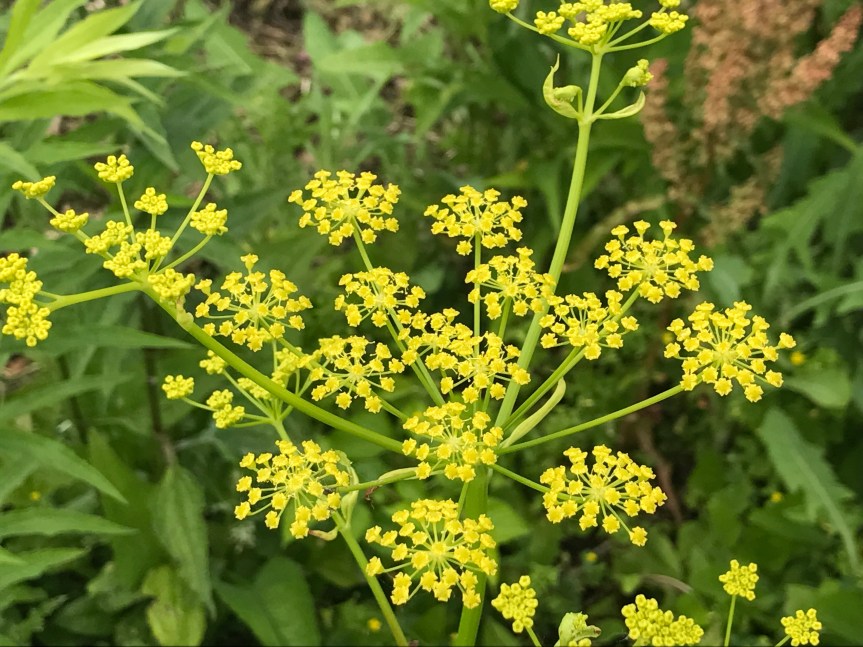
These beautiful flowers also were growing in the echinacea field. If you know what they are, please tell me!
From there, I strolled to a field of herbs.
And then walked to the vegetable field. I really liked the signs they had created to show what was growing in the row.
This fall, MA Center- Chicago is opening a GreenFriends Montessori School. It will focus on nature-based learning and peace education. As I gazed at this field I imagined the children helping to plant and care for the vegetables.
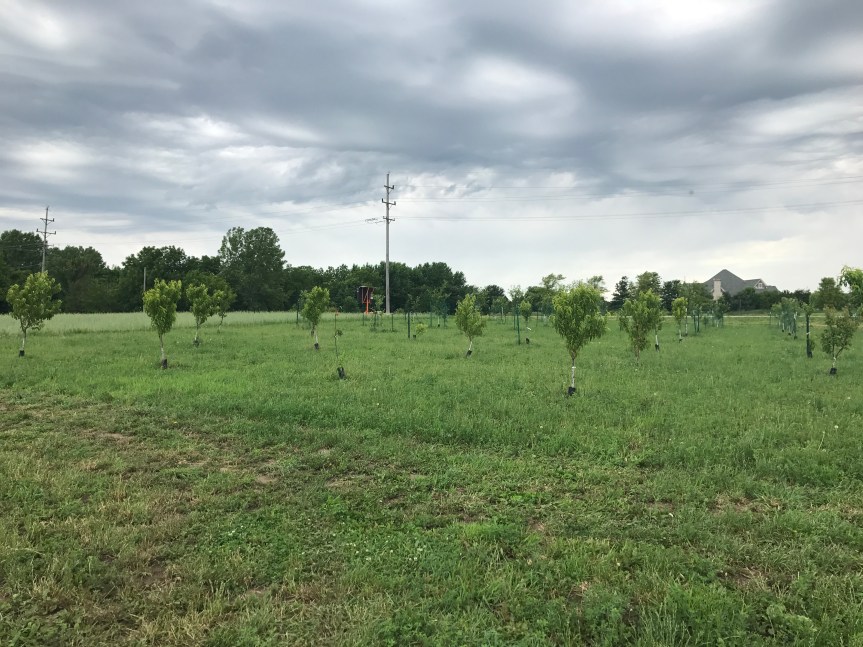
Beyond the vegetable field, there was an orchard. This photo shows only half of it. The trees had grown a lot since I had seen them last.
After visiting the fields, I began to walk back to the program hall. On my way, I saw a bird trying to pull a worm from the ground. (Or at least I think that was what it was doing!) Then another bird flew over my head a few times. I felt like it was “dive bombing” me. Moments later, I saw a bird house that was similar to the ones I have at home. It was only four or five feet off the ground. As I walked by it, a baby bird was looking out of the opening. I think there was another baby behind it. It must have been the mother or father bird that had been flying at me, concerned I was going to hurt the babies.
*****
As I sat in the program hall that day, ideas for designing a cluster of trees, shrubs and ground covers for our Greenbelt Restoration site in Seattle started coming into my mind. I thought about it throughout the day. My dreams during the night were incessant, and were all about the Greenbelt. The next morning, I located the children’s program room and drew my ideas on paper. I looked forward to returning to Seattle and doing the research necessary to determine whether or not my plan was viable.
*****
As I am writing this post, I am struck by how little time I spent near Amma in Chicago. I met Amma in summer of 1989. In the early years, I spent hour after hour sitting close, mesmerized. At some point, I started doing seva (volunteer work) throughout the year, and during the programs. That era lasted more than 20 years. Now I find that I still want to be with Amma, but I want it to be in a way that I can be immersed in nature at the same time. I’m reminded of the Bible verse that says “To every thing there is a season, and a time to every purpose under the heaven.” I am allowing my life to unfold. I feel close to Amma whether I am sitting next to her, being held in her arms, or walking in the fields taking in the glory of nature.
*****
Some of my favorite experiences in this year’s Chicago program occurred because Eknath was there. I don’t remember when I first saw Eknath at Amma’s programs but it must have been 10-15 years ago. I still think of him as a boy but he is probably his 30’s by now. Eknath is autistic. I was once told that when he first met Amma he couldn’t talk. That changed long ago. He often blurts out statements that make everyone, including Amma, laugh. One time he told Amma she should have a boyfriend. Another time, he went to her during darshan (darshan is the time she blesses people by giving hugs) and told her he wanted a peanut butter and jelly sandwich. Amma called someone from the Western Cafe and told them to make him a sandwich and bring it back to her.
Another memory I have of him occurred in the Amritapuri (India) auditorium. One day as I was walking to the auditorium, I heard a gut wrenching wail. Some instinctual part of me knew that it was Eknath and that someone had told him he had to leave India and return to the U.S. He cried with a profound level of despair that couldn’t help but affect those around him.
He is probably best known for going up to people and pulling up both sides of his mouth with his index fingers and telling them to smile. He emanates joy. He usually has earphones on, listening to Amma bhajans. Sometimes he sings along. When Amma and the swamis are singing, he gets so excited that he starts jumping and jumping and jumping. Occasionally, the swamis keep their songs going much longer than they would normally. His joy is infectious.
Eknath was doing all of those things during the second or third evening program in Chicago. Someone handed him a microphone and asked him to sing. He sang “What a Wonderful World.” (Lyrics) I doubt I was the only one in the room that was crying.
Here is a video of Louis Armstrong singing that song.
Eknath was then asked to sing another song. This time he chose “Santa Claus is Coming to Town” but he changed it to “Amma Claus is Coming to Town.” (Lyrics) Needless to say, hearing those lyrics applied to Amma was hilarious.
I am thankful that Eknath is in this world
*****
Every day with Amma is packed with experiences. In addition, this year I’ve had the chance to be with my son and daughter during the programs. That normally happens only when I’m in India. Life is good.
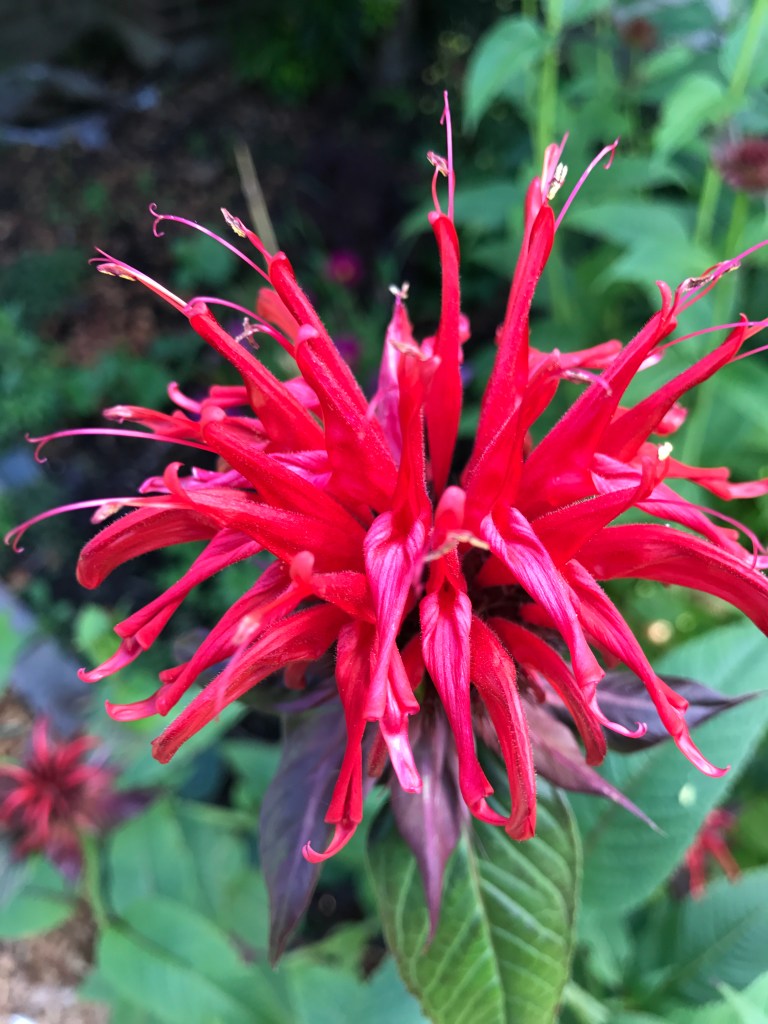
During the last week, the bee balm flowers in front of my house bloomed.
This morning, I stood looking out of my living room window and watched a hummingbird gathering nectar from the flowers.
The bird moved so fast.
At one point, it flew to the window where I was standing and for a few seconds looked at me! In that moment, the hummingbird seemed huge. Before I knew it, it was gone, leaving me with the memory of a special experience.
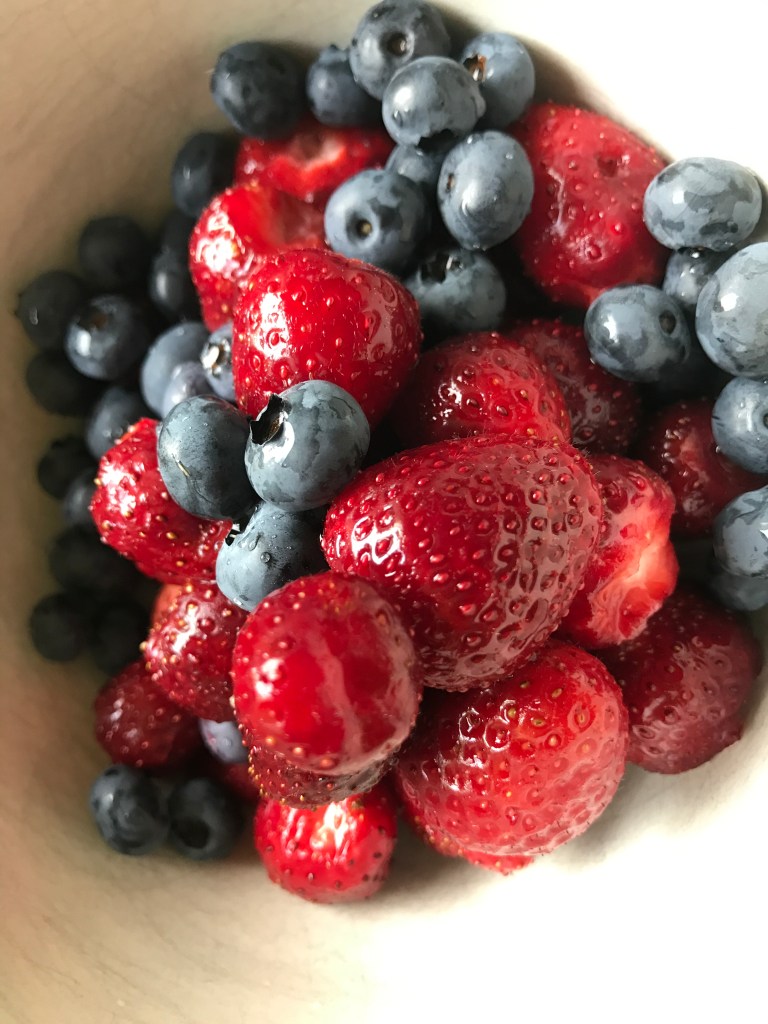
Last week, I went to Amma’s programs in Chicago and Atlanta. I had been enjoying eating the strawberries from my garden for about two weeks beforehand. When I returned home, I was surprised to see there were still strawberries available, and ripe blueberries as well. In fact, there were more blueberries than there has ever been on that little bush. Together they made a perfect snack.
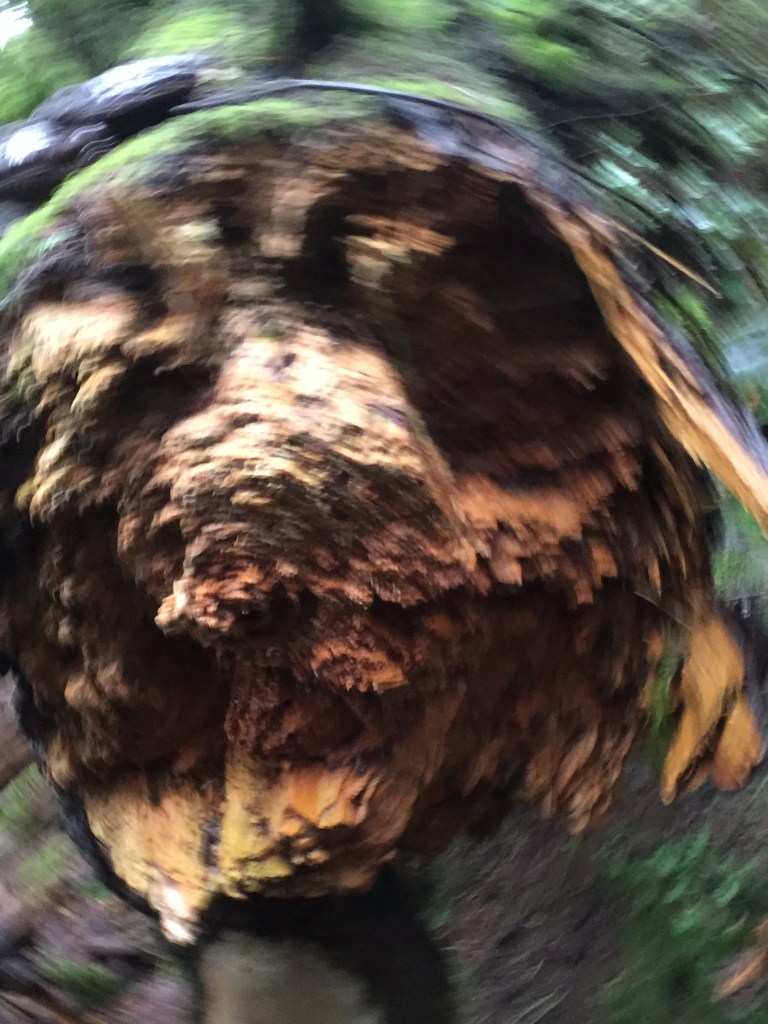
I took one of my favorite photos at Loon Lake in British Columbia in February of 2016. To me the lack of focus creates the illusion that the downed tree is spinning.
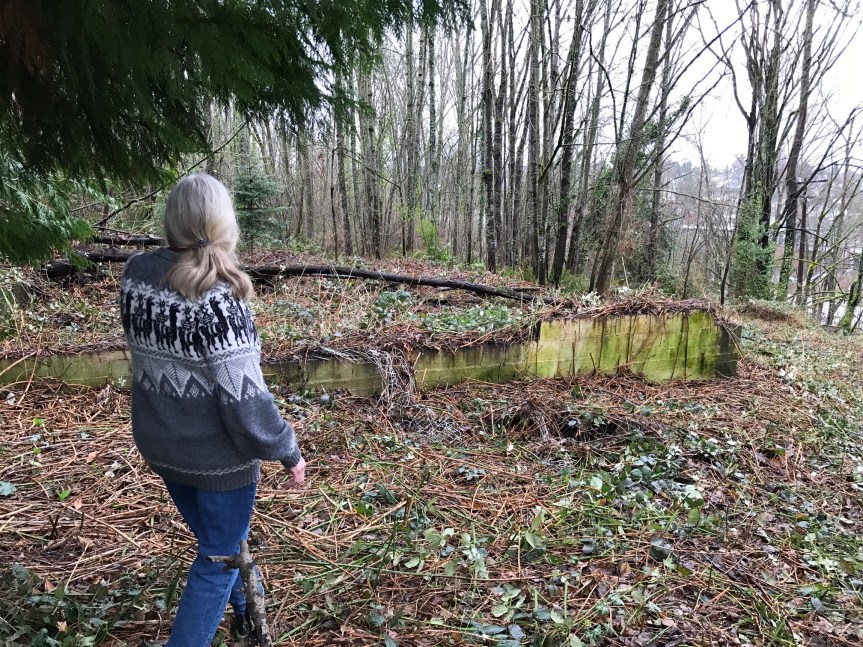
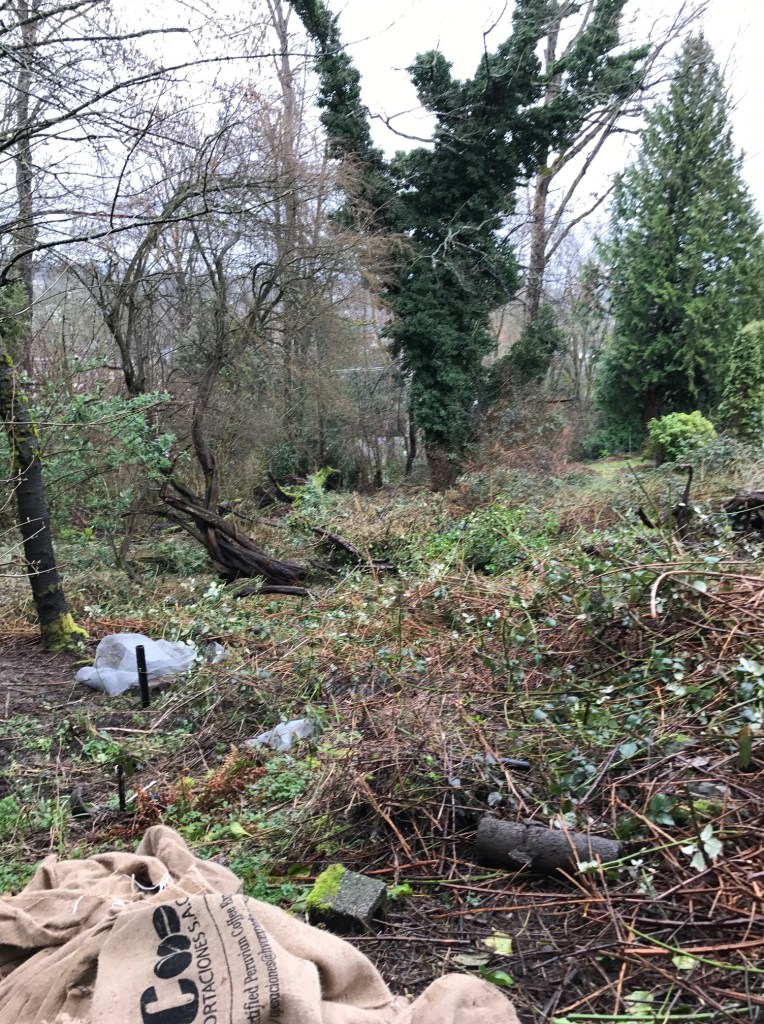
My neighbor Christine gave me these photographs a day or two ago. She took them in March after Seattle Parks Department staff cut down most of the blackberry vines on the Greenbelt lots we are restoring. I look forward to using it as a “Before” photo in November after we’ve cleared the land and planted new trees, shrubs and ground covers. And I also look forward to comparing them with the photos we will take every spring, summer, fall and winter from now on.
For three hours on June 14, eight volunteers worked diligently in our Greenbelt restoration site. A week before, Seattle Parks Department staff had cut down a large area of blackberry vines, leaving a lot of debris and uncovering an astonishing amount of trash.
We spent the first hour of the work party picking up trash. There is more garbage for us to pick up, but we got a good start on it.
When we began this project, there were two fields of invasive bamboo on this site. Seattle Parks Department cut the bamboo down last March. We placed the cut bamboo on drying racks so that they didn’t re-root. That bamboo is now dry.
On Wednesday, we stripped the branches from the dried bamboo canes. The canes were given away to gardeners and the branches are being used as part of our newest drying racks. (I will write a post about the drying racks soon.)
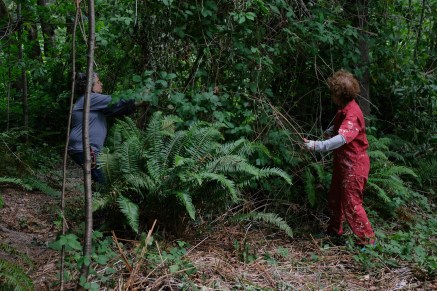
We also removed blackberry vines from plants and trees…
…. and rescued ferns and a fringe cup plant.
It was another productive and rewarding day in the Greenbelt!
“The fool doth think he is wise, but the wise man knows himself to be a fool.” “Love all, trust a few, do wrong to none.” “Love looks not with the eyes, but with the mind, And therefore is winged Cupid painted blind.”-William Shakespeare


















 Living, Learning and Letting Go