A Day of Challenges!

Today was one of those days where I had “plans” but all of them changed.

It started with me waking up at 1:45 a.m. I had been dreaming about Sanskrit and about blogging, something that is happening with increasing frequency, but thankfully it is not usually that early. As I moved from a dream state into a more conscious state of mind, the idea of posting a Sanskrit declension matrix by making a Power Point slide show came to my mind. Then the idea of adding audio to it surfaced.

I have helped others with Power Point slide shows before but only by typing in the words. I had never done a real one and I certainly had never put audio to one. As I lay there sleepless, I started pondering how to do it. Around 3:00 a.m., since sleep didn’t seem to be coming, I got up.

I went back to bed for about an hour and a half at 5:00 a.m. and then spent most of the day working on this project. The slide show went together quickly and even the audio was reasonably easy to figure out. But then came getting correct pronunciation, correct timing and most time consuming of all, finding a way to put it into a format that the blog would accept. That last part took until 7:45 tonight! But with Grace and persistance, I finished it!

I’ve mentioned in earlier posts that every noun in Sanskrit may have 7 or 8 different cases. You can identify those cases by how the word ends.

Cases:

1st case is the subject
2nd case is the object
3rd case – “with” (with a fork)
4th case- “for” (for the beggar)
5th case- “from” (from the city)
6th case- possessive or “of” (boy’s; of the boy)
7th case- “in, at, on”

The slide show will present the declensions for the pronoun “aham” which means “I”. Singular, dual (2 people) and plural (i.e. three or more) forms will be presented for each of the seven cases. You will notice that some of the words are the same but have different meanings. In those instances, we have to read the word in a sentence to determine the meaning.

So with that for an introduction, here is my PowerPoint Slide Show with Audio of the declensions for the word “aham”! (In hindsight, it would have been helpful for me to put the case number and whether the word was singular, dual or plural on the slides, but even this way it gives you a good idea what the process is like!) I hope you enjoy it.

Waking in the Night (Troiku)

I have been intrigued lately by a form of poetry that Tournesol from Traces of the Soul and Tournesol Dans Un Jardin has been writing.  (See Courting Moon.)  The style is a new form of Haiku called Troiku that was developed by Chevrefeuilles.

In this style, there is a three lined Haiku that is the base of the poem.  The author then creates a separate Haiku using each of the base lines.

Here is my first attempt at writing a Troiku!


*****

Waking in the night

dreaming about Sanskrit

It’s time to blog!


Waking in the night

Raindrops falling

Mind on overdrive


Dreaming about Sanskrit

Will I ever learn?

Yes!


It’s time to blog!

Ideas rolling in

Can sleep another day!


Sanskrit Fun!

We did a fun exercise in one of my Sanskrit classes this week. Before I show you the exercise, let me say that every noun in Sanskrit may have 7 or 8 different cases. You can identify those cases by how the word ends. The case endings also differ depending on whether the word is male, female or neuter.

Whether a word is considered male, female or neuter is very different than in English. For example, the word for house is neuter, the word for cup is male, and the word for bottle is feminine!

Cases:

1st case is the subject
2nd case is the object
3rd case – “with” (with a fork)
4th case- “for” (for the beggar)
5th case- “from” (from the city)
6th case- possessive or “of” (boy’s; of the boy)
7th case- “in, at, on”

So, with that introduction, here is the exercise we did!

Start with Subject and Verb

Karuna eats.
करुणा खादति
karunaa khaadati

Add 2nd case

Karuna ice cream eats.
करुणा पयोदिमं खादति
karunaa payodimam khaadati

Add 6th Case

Karuna chocolate ice cream eats.
करुणा चाकलेहस्य पयोहिमं खादति
karunaa caakalehasya payohimam khaadati

Add adjective

Karuna lots of chocolate ice cream eats.
करुणा चाकलेहस्य बहु-पयोहिमं खादति
karunaa caakalehasya bahu payohimam khaadati

Add 3rd case

Karuna, with a spoon, lots of chocolate ice cream eats.
करुणा चमसेन चाकलेहस्य बहु-पयोहिमं खादति
karunaa camasena caakalehasya bahu payohimam khaadati

Add 5th case

Karuna, with a spoon, from a cup, chocolate ice cream eats.
करुणा चमसेन चषकात् चाकलेहस्य बहु-पयोहिमं खादति
karunaa camasena cashaakat caakalehasya bahu-payohimam khaadati

Add 7th case

Karuna, with a spoon, from a cup, at home, chocolate ice cream eats.
करुणा चमसेन चषकात् गृहे चाकलेहस्य बहु-पयोहिमं खादति
karunnaa camasena cashakaat grihe caakalehasya bahu-payohimam khaadati

Add another 7th case

Karuna, with a spoon, from a cup, at home, in the evening, lots of chocolate ice cream eats.
करुणा चमसेन चषकात् गृहे सायङ्काले चाकलेहस्य बहु-पयोहिमं खादति
karunnaa camasena cashakaat grihe saayangkaale caakalehasya bahu-payohimam khaadati

Add a direction and also another 7th case

Karuna, with a spoon, from a cup, at home, in the evening, in front of the television, lots of chocolate ice cream eats.
करुणा चमसेन चषकात् गृहे सायङ्काले दरदर्शनस्य पुरतः चाकलेहस्य बहु-पयोहिमं खादति
karunnaa camasena cashakaat grihe saayangkaale dooradarshanasya purataha caakalehasya bahu-payohimam khaadati

Add another adjective

Karuna, with a spoon, from a cup, at home, in the evening, in front of the television, slowly, lots of chocolate ice cream eats.
करुणा चमसेन चषकात् गृहे सायङ्काले दूरदर्शनस्य पुरतः मन्दं-मन्दं चाकलेहस्य बहु-पयोहिमं खादति
karunnaa camasena cashakaat grihe saayangkaale dooradarshanasya purataha mandam mandam caakalehasya bahu-payohimam khaadati

Add another 3rd case

Karuna, with a spoon, from a cup, at home, in the evening, in front of the television, slowly, with happiness, lots of chocolate ice cream eats.
करुणा चमसेन चषकात् गृहे सायङ्काले दूरदर्शनस्य पुरतः मन्दं-मन्दं सन्तोषेण चाकलेहस्य बहु-पयोहिमं खादति
karunnaa camasena cashakaat grihe saayangkaale dooradarshanasya purataha mandam mandam santoshena caakalehasya bahu-payohimam khaadati

Add 4th case

Karuna, with a spoon, from a cup, at home, in the evening, in front of the television, slowly, with happiness, for fun, lots of chocolate ice cream eats.
करुणा चमसेन चषकात् गृहे सायङ्काले दूरदर्शनस्य पुरतः मन्दं-मन्दं सन्तोषेण परिहासाय चाकलेहस्य बहु-पयोदिमं खादति
karunnaa camasena cashakaat grihe saayangkaale dooradarshanasya purataha mandam mandam santoshena parihaasaya caakalehasya bahu-payohimam khaadati


मनसा सततं स्मरणीयम् – Let Us Always Remember

I received an email from one of my Sanskrit teachers today asking us to learn a new chant.  I listened to it and loved the tune.  I then found a YouTube version that had the Devanagari script, the transliteration and the translation.  The translation brought tears to my eyes.  I think the chant is so beautiful in every way.

Here is the translation and the video:

Let us always remember,
Let us repeatedly speak out:
Our duty is to do good to humanity.

Let us not focus on material pleasures
Nor lay in the lap of luxury;
Let us be awakened always that
Our duty is to do good to humanity.

Let us not enumerate our sorrows
Nor constantly reflect on our happiness
Let us step up to take action:
Our duty is to do good to humanity.

Let us sail over oceans of misery,
Let us scale mountains of difficulty.
While roaming through the jungle of adversity,
Our duty is to do good to humanity.

Be it a dense forest of extreme darkness
Or surrounded by kith and kin
When we travel these paths,
Our duty remains – to do good to humanity.

(Note: Kith and kin means friends and relatives.)

*****

Seattle-जनाः एकं कुतुम्बं अभवन्

Seahawks_Fans_are...the_12th_Man_(5341448344)
Photo Credit: Wikimedia


I returned to Seattle on Saturday, January 10 and yesterday, Sunday January 18, attended a Sanskrit class.  We are required to write sentences for each class.  I, of course, decided to focus on the Seahawks playoff game that would start an hour and a half after that class ended!

Continue reading “Seattle-जनाः एकं कुतुम्बं अभवन्”

संस्कृतम् (Sanskrit)

Sanskrit Practice

In my Seattle area Sanskrit class, part of our homework is to write 10 sentences in Sanskrit each week.  I enjoy putting them on my blog every now and then.  (I have my teacher correct my work before I post them!)  This week, I described some of my Tuesday, December 16 activities. Continue reading “संस्कृतम् (Sanskrit)”

Living and Learning in Amritapuri, India- Dec 4, 2014

Amma at the Vatican

What an amazing experience it was to be able to watch the of representatives of the world’s religions speaking and signing a Joint Declaration of Religious Leaders against Modern Slavery. (We were able to see a live stream from the Vatican program.) I felt so privileged to be able to witness that event.  I pray that their goal of ending modern day slavery by 2020 becomes a reality.  And hopefully it will also lead to healing friction between the various religions. Continue reading “Living and Learning in Amritapuri, India- Dec 4, 2014”

भारतं गमिष्यामि

One of the things I am passionate about is learning Sanskrit.  There is a meditative verse that is often sung at Sanskrit events. In this song, students pledge dedication to their Sanskrit studies.  I am going to begin this post by singing that verse.  Please forgive any  mispronunciation; some Sanskrit letters are still difficult for me to say correctly.

शुक्रवासरे अष्टाविंशत्-दिनांके  -November-मासे भारतं गमिष्यामि
On Friday November 28, I will go to India.

द्विवादने विमानपत्तनं चालिष्यामि
At 2:00 I will drive to the airport. Continue reading “भारतं गमिष्यामि”

Gratitude Sunday: धन्यवाद: मार्ल (Thank You Marla)

I have a lifetime pattern of having essentially no interest in sports.  Last year that changed in a big way. Starting with the third game, I began to feel drawn to watch the Seahawks play football.  From then on, I made a priority of watching every game. During the six weeks I was in India, I would follow the scoring on my Android.  If the game occurred while I was asleep, checking the final score was my first priority of the morning. Continue reading “Gratitude Sunday: धन्यवाद: मार्ल (Thank You Marla)”

Sanskrit Prayer to Mother Earth

Last May, my Sanskrit Class and our GreenFriends group put on a Sanskrit skit for Amma when she held a retreat in the Seattle area.


SKIT-For-Mac

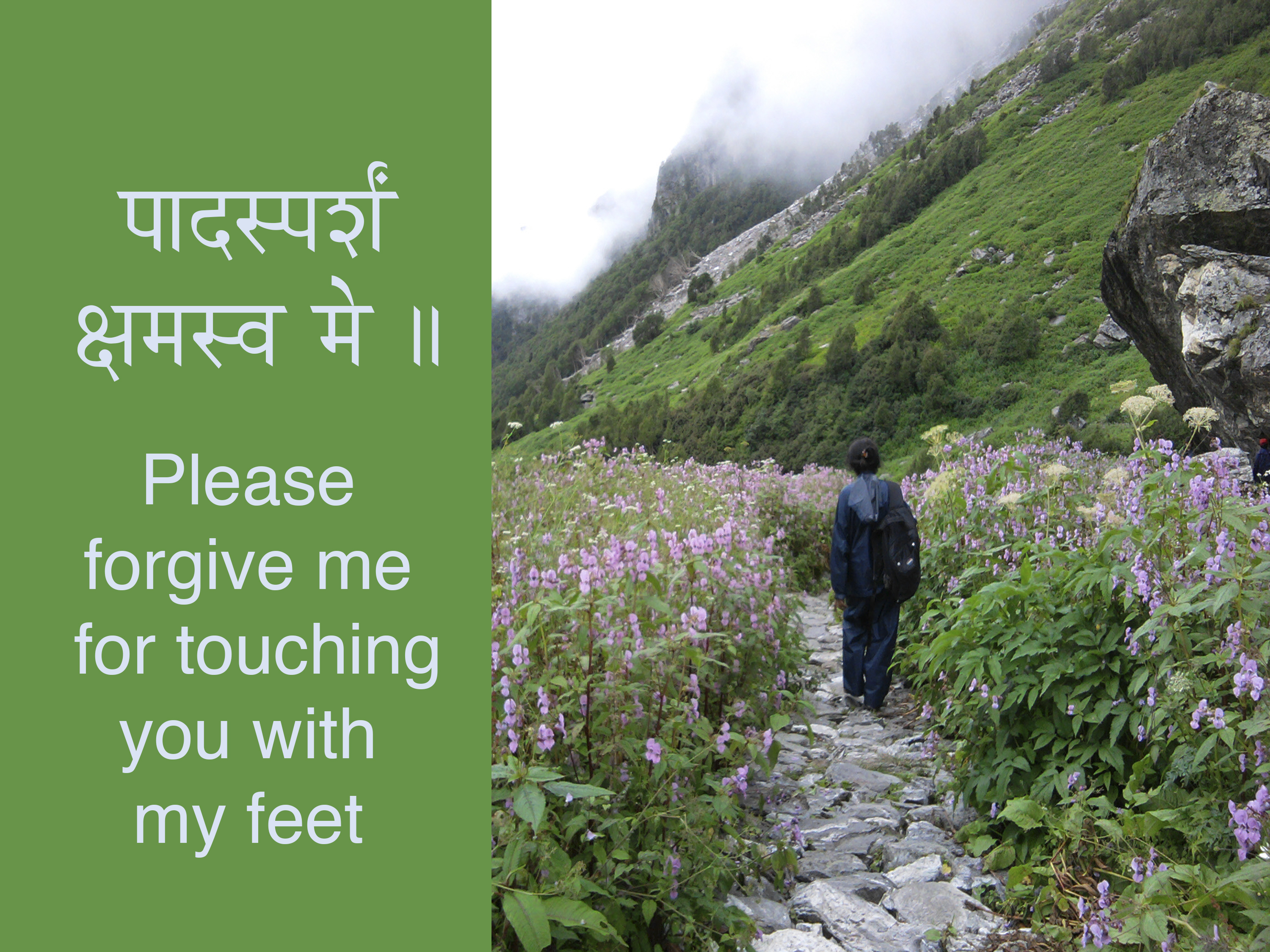
We started the performance with a prayer to Mother Earth.  I love the words of the chant and thought I would share the translation with you.  Many Indian children chant this prayer before they get out of bed each morning, i.e. before their feet touch the floor.

Slide2Slide3Slide4Slide5May we all learn to develop such respect for Mother Earth.