My Journey Towards Humility

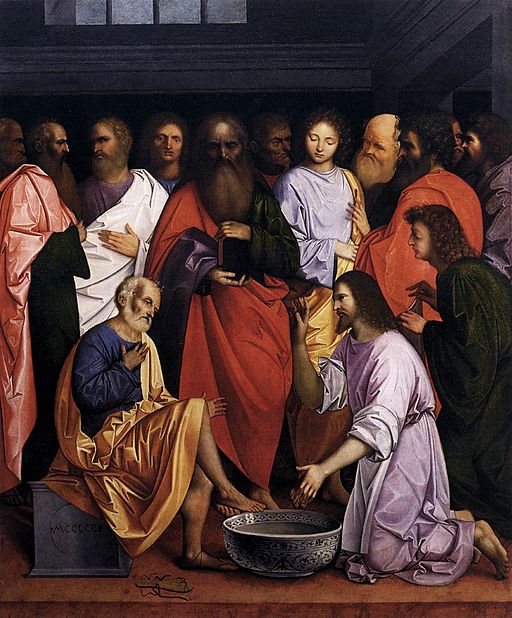
GA_da_Lodi_Lavatorio_1500_Gallerie_dell'Accademia_Venecia

“A true genius admits that he/she knows nothing.” Albert Einstein

“It is unwise to be too sure of one’s own wisdom. It is healthy to be reminded that the strongest might weaken and the wisest might err.” Mahatma Gandhi

“I will not ask thee for improved memory, only for a little more humility and less self-assurance when my own memory doesn’t agree with that of others. Teach me the glorious lesson that occasionally I may be wrong.”  An Anonymous Abbess 

“Acting with humility does not in any way deny our own self-worth. Rather it affirms the inherent worth of all persons. Some would consider humility to be a psychological malady that interferes with “success.” However, wealth, power or status gained at the expense of others brings only anxiety- never peace and love.” Commentary on Christian Bible Reference Site

Humility, among other things, is the absence of arrogance. One of the ways I am most likely to be arrogant is to hold on to a belief that I am right and others are wrong. I may verbalize my opinion and then stay silent, but internally I am very likely to be holding on to my rightness.

Two situations from the past come to mind when I think of ways I’ve worked on this issue: Continue reading “My Journey Towards Humility”

That “Now I Get It” Moment

20150712_193722

I graduated with a Bachelor of Science in Nursing degree in 1970, followed by a Master of Nursing in 1974. After receiving my Master’s degree, I taught undergraduate nursing students at the University of Washington for five years. I enjoyed teaching, conducting research and writing for publication, all requirements of my Assistant Professor position. After teaching there for five years, I decided to take a job as a Maternal-Newborn Clinical Specialist at Swedish Hospital Medical Center in Seattle.

To progress along a tenure track at the University of Washington, I would have had to earn a PhD. At some point in the early 80’s, I decided to start working on the PhD. I don’t remember what my reasoning was at the time, but I imagine it was to keep my options open.  Afterall, I might want to teach at the University again someday. I continued to work at Swedish Hospital part time as I started the PhD program coursework. I don’t remember what the degree was called in those days but I know that it focused on nursing research and that I chose a track that had a special emphasis in statistics.

At some point during those years, I also started my personal therapy. I loved that process. It helped me move through the pain of my early years and I was able to make good friends and connect in a way I hadn’t in the past. One day, I had an insight that hit me like a sledge hammer. Even though I was doing very well in my studies, I realized I didn’t want a PhD and I didn’t want nursing research to be my life’s work.

In that moment, I realized I was studying for the degree in hopes that my father would acknowledge my existence if I had a PhD. My education had always been important to him and some of my earliest memories were of me asking him to make up math problems I could work on.

While I don’t think we were ever close, our relationship became even more strained as I moved into my teen and young adult years.  We had battles when I came home from college during summer vacations, usually over civil rights issues. During one of those altercations, he told me to get out of the house.  My mother intervened so I didn’t actually move out. The last straw came in 1971 when I told him I was going to marry Al, an African-American man I had met in Seattle.  Simply by my having made that statement, he declared that he would not speak to me again, and he didn’t. My father died in 1999 without ever having said a word to me or my children.

Realizing that my PhD study was so tied to a child-like yearning for my father’s approval ended my interest in the degree. I was loving my psychotherapy experience and in time it became my passion. I did what it took to get the credentialing to become a nurse psychotherapist (Clinical Nurse Specialist in Psychiatric and Mental Health Nursing) and I’ve been doing that work ever since.

I see the moment when I recognized the tie between my PhD program and the unfinished business from my past as one of those life changing moments, one that propelled me into work that I felt passionate about and believe I was born to do.


Written for Dungeon Prompts: That Now I Get It Moment

Being the Hands of the Divine

The_Creation_Michelangelo

When I read the Dungeon Prompts: Our Magic Powers writing challenge for the week I was perplexed. The prompt was:

We are all gifted with certain magical powers. We may not have fully harnessed them, or we may rebel against the powers we’ve been given, but we know that they are there. The power may be so potent that we are scared to use it, or we may have come to terms and learned the intricacies of it. We may have used them for evil or for good, but when we think that we can go unnoticed, we have surely tested them out.

Magical powers go beyond a talent for something. It involves bending reality to your will. When your will comes in tune with the cosmic will you may notice your powers flow like a raging river. Whether you hide it or not, you know that it’s there. So this week, tell us about your magical powers.

To me, the magic in life is the work of the Divine, whether it be a seed turning into a beautiful flower or the wondrous nature of all life forms. All the synchronicities that occur in my life feel like a Divine play. I will never forget my last  trip to India when I was told I would be upgraded to Business Class if I was willing to sit in a seat where the video didn’t work.  Soon I discovered that the man sitting next to me, who was also gifted with an upgrade, was a Sanskrit student and teacher. In fact, he was teaching from the identical Sanskrit textbook that I was struggling with at the time. He had even gone to the same Sanskrit camp I had attended the previous summer! To me that whole scenario felt like magic, but I believe it was actually a gift from the Divine.

I see all of us as instruments of the Divine, tasked with being His/Her hands. When we do that work it may seem like magic to others, or even to ourselves. So in that spirit, what kind of magic is it that I do?

I thought back to my 65th birthday when a small group of friends celebrated that milestone with me. At one point in the evening, they talked about me. It was like being a witness to one’s own memorial service. I was amazed at what they said about me and the impact they believed I have had on their lives. I also thought about things other people have said about me in the past and to a post (When They Think of Me….) I wrote last year after having asked friends what objects they thought of when they thought of me. At that time, one person responded:

Well, my first thought of you is your abundant beautiful hair, but that’s not an object.  When I just stopped for a moment and visualized you, I immediately saw you with a tool in your hand.  The tool could be anything – a garden trowel, a spatula, a pen, a hammer, a paint brush, a computer, one of those long grips for picking up litter – but you very much (my impression anyway) –  interact with the world and use many kinds of tools.    So it would be Karuna, Jill-of-all-trades, with a tool.

I believe the following may be seen as my magic:

  • Sometimes my psychotherapy clients think that I must be able to see right through them, or read their minds.
  • The craft projects I do such as making tiny dolls, crocheting, knitting, quilting, etc.
  • Creating and inspiring others to join in new projects, such as the PNW Litter Project and the PNW GreenFriends Newsletter.
  • The amount of energy I have and what I accomplish with it.
  • My use of words in the books I have written and on my blog.

To me though, that isn’t magic. All of it happens when I am “in the flow” and willing to be used as an instrument, i.e. being the hands, of the Divine.  May I continue to live in this manner until the end of my days.

A Favorite Prayer

Many years ago, I was given a handout at a workshop that contained this prayer.  I laughed when I read it then and I laugh when I think of it now.  I can so relate.

I believe finding humor even in a dark or frustrating situation can help us lighten up.


Photo Credit: Wikimedia


Oh Lord,

Please help me make it through

this self imposed

and totally unnecessary challenge.

(Author Unknown)


Written for Dungeon Prompts: Using Our Words for Spreading Joy


Self-Care or Selflessness?

911px-Helping_hand_logo
Photo Credit: Wikimedia

As I mentioned in a previous post, I have a long history of overdoing. At one point in my life, I was holding three jobs at the same time. When I have become involved with organizations, I have often done more than is reasonable for one person to do. My overdoing has led to serious illnesses that have been breaking points, where slowing down became a necessity rather than a choice. I believe it was this pattern of overdoing that led to me to having Chronic Fatigue Syndrome for five or more years in the mid to late eighties, and to the high blood pressure I am dealing with today.

To some degree, the types of overdoing I am referring to were caused by a pattern of rescuing.  In his Drama Triangle construct, Stephen Karpman describes the Rescuer in this way:

“The rescuer’s line is ‘Let me help you.’ A classic enabler, the Rescuer feels guilty if he/she doesn’t go to the rescue. Yet his/her rescuing has negative effects: It keeps the Victim dependent and gives the Victim permission to fail. The rewards derived from this rescue role are that the focus is taken off of the rescuer. When he/she focuses their energy on someone else, it enables them to ignore their own anxiety and issues. This rescue role is also very pivotal, because their actual primary interest is really an avoidance of their own problems disguised as concern for the victim’s needs.”

Jean Illsley Clarke once taught me five questions to ask myself when I think I might be rescuing.

  • Was I asked to do what I am doing?
  • Do I want to do it?
  • Am I doing more than my share?
  • Do others appreciate me for what I am doing? (Rescuers are often not appreciated.)
  • Am I doing something for someone that they can do for themselves?

Answering yes to one of those questions does not mean that I am rescuing, but if yes is the answer to many of them, the chances are that I am. So shifting my pattern of rescuing was an important part of my healing journey.

From a therapy perspective, focusing on self-care by stopping rescuing makes sense.  Even though I valued being in service, it was still my job to keep myself healthy.  When I began to look at self-care and selflessness from a spiritual perspective though, I started to have doubts. There are many who have forsaken their health, their comforts and sometimes even their lives, to live a life of service.  They have shown us what is possible for one person to accomplish in a life time.  They have been, or will be, a source of inspiration long after they are gone from this world.

To me, Amma, my spiritual teacher and mentor, is one of those people. Her form of blessing is through a hug. Amma has hugged more than 34,000,000 people in her lifetime. She needs almost no food or sleep. If she is not giving darshan (hugs) she is serving humanity in some other way, including her massive network of humanitarian projects known as Embracing the World. Her life is a model of selflessness.

When I thought about people present and the past who have inspired others through their selflessness, the following individuals came to mind.  All have taught the importance of serving humanity.

Jesus:

John 13:34 “A new commandment I give to you, that you love one another, even as I have loved you, that you also love one another.

Acts 20:35 “It is more blessed to give than to receive.”

Matthew 25:35-40: ”For I was hungry and you gave me food, I was thirsty and you gave me drink, I was a stranger and you welcomed me,  I was naked and you clothed me, I was sick and you visited me, I was in prison and you came to me.’  Then the righteous will answer him, saying, ‘Lord, when did we see you hungry and feed you, or thirsty and give you drink? And when did we see you a stranger and welcome you, or naked and clothe you? And when did we see you sick or in prison and visit you?’ And the King will answer them, ‘Truly, I say to you, as you did it to one of the least of these my brothers, you did it to me.’”

Mahatma Gandhi :

“The best way to find yourself is to lose yourself in the service of others.” “You must be the change you wish to see in the world.”

Martin Luther King Jr.:

“Everybody can be great…because anybody can serve. You don’t have to have a college degree to serve. You don’t have to make your subject and verb agree to serve. You only need a heart full of grace. A soul generated by love.”

St: Francis of Assisi:

“O Divine Master, grant that I may not so much seek to be consoled as to console,
to be understood as to understand, to be loved, as to love.”

Mother Theresa:

Prayer in action is love, and love in action is service.” 

As I pondered the importance of self-care versus selflessness, I could rationalize that I am not Amma, Jesus, Gandhi, Martin Luther King, St. Francis or Mother Theresa and therefore could not expect myself to serve at that level.

My thoughts on this topic took another turn, though, in the late 90’s when I read a book, A Promise is a Promise, by Wayne Dyer. It was an account of a teenager who in 1970 asked her mother to promise that she would never leave her. Soon thereafter the 17 year old slipped into a diabetic coma, one she never came out of. The mother kept her word and, with help, cared for her daughter until she herself died 25 years later. (A Promise is a Promise was written while the mother was still alive.) Then others cared for the daughter until she died on November 21, 2012, forty-two years after she became comatose.

Reading that book had a profound impact on me. I still remember Dr. Dyer saying that walking into their home felt like being in the holiest of temples.

When I first started reading A Promise is a Promise, I made the judgment that the mother was not taking care of herself appropriately. But as I continued to read, my attitude began to change. Her actions seemed like unconditional love, perhaps the highest form of spiritual practice. While I wasn’t aware of it at the time, I now see that her actions actually conformed to the guiding questions I had learned from Jean Clarke:

  • The mother had been asked and had agreed to what she was doing
  • She wanted to do it
  • Even though she devoted her life to caring for her daughter, she had help.
  • Her daughter would have undoubtedly appreciated her efforts
  • She was clearly doing something for her daughter that the girl could not do for herself

Reading about a “regular” person who was so selfless, presented me with another dilemma. When I lived a life of uncontrolled doing, even if when it was in the spirit of service, I became sick to the point I couldn’t function.  How do I know when to focus on self-care and when to make service the priority?

I continue to ponder that question to this day. I believe for me it has to be about balance. I must practice good self-care by nourishing my body, mind and soul and at the same time make sure that I am not over-committing or over-stressing myself.  I must also continue to watch out for my tendency to rescue.  I can be in service to others and still do my best to keep myself healthy.

Written for Dungeon Prompts: Breaking Point

Eclectic Corner: Perspective (Quote)


Some people see the glass half full. Others see it half empty.
I see a glass that’s twice as big as it needs to be.”


Watch, Wait, and Wonder

800px-Shattuck_54238,_Camponotus,_Danum_Valley,_Sabah-web_(5042361317)_(2)

Photo Credit: Steve Shattuck

Some of you may remember that towards the end of last month, a swarm of tiny black ants formed on the sidewalk in front of my garden.  I, of course, didn’t know how many there were but in my shock it looked like millions! I didn’t want to kill them but I also didn’t want that many ants, and potentially more, in my garden. I also didn’t want anyone to accidentally stand in them. After pondering the dilemma for a short time, I decided to wash them away with water from a hose. That solution worked and the ants never came back.

When I wrote about that event in Discrimination Opportunity, a blogging friend responded that he understood black ants to be harmless.  In pondering his words, I realized that I had moved to action very quickly.  I had been stung by red ants in the past after I unwittingly stood on or near their hills. Even one bite from a red ant can be very painful, and being bit by a large number of them is something I will never forget. Did that memory cause me to act too fast?

As I continued to reflect on my action, I realized that a child would be terrified if that many ants were crawling on them, even if they weren’t being stung.  I concluded that my washing the ants away was a reasonable response, but I wasn’t sure that I was right.

Prior to that event, I had seen a few big black ants in my living room.  After the incident with the tiny ants in the garden, more of those big ants showed up, both inside and outside of the house.  Two ant events in a short period of time made me wonder what was going on.

When I become conscious of an animal, bird or other living being repetitively showing up in my life, I sometimes look to see what that creature symbolizes in Native American traditions.  I googled “native american medicine ant” and found Dr. Loretta Standley’s website.  She says this about ant medicine:

When Ant Medicine grabs your attention it is asking you to cooperate with your tribe (co-workers, family, projects, etc.,) in unity and patience. Ants are resolute and unwearied little creatures. Although they are tiny, they are indeed mighty. They have a strong skeleton on the “outside” of their body (exoskeleton) with specialized muscles that give them their strength. Ants can carry 30 times their weight, which would be equal to a 150 lb. person carrying a bulldozer on their back at 19,500 lbs.

The typical way to stop ant medicine is to literally stomp on it or fumigate it. If an ant is stomped on, it will emit pheromones that will draw more ants to the area. In short, ant medicine is unstoppable, tireless, patient and unified.

Ant’s message is about working non-stop toward your goals and forging ahead for the Good of the whole. Are you working on a project that benefits a larger audience? Have you been ignoring your tribe? Ant medicine cooperates with the tribe in harmony and wisdom toward a common goal, knowing that patience will be rewarded. Have you been cooperating with yourself on your own personal projects?

I was intrigued. Just the day before, I had met with two colleagues to clear up some long standing issues between us and was going to do the same with another friend the next day.  I thought the “ant medicine” perspective was valuable and would ponder the questions Dr. Standley put forth.  Now that I had this information would the ants go away?

Nope!  If anything, the number of ants increased.  I did more research and discovered the ants were carpenter ants.  Everything I read indicated that I would probably have to call a professional pest control company to keep them from damaging my house.  While there were still not that many ants, over the next few days their numbers continued to increase.  Their favorite location seemed to be on my front porch.

I decided to take the time to observe them and see where they came from, where they were going and what they were doing.  As I watched, I noticed that there were some small holes, or perhaps just indentations, in the caulking near the front door.  The ants went to those holes over and over again.  Even though the ants never went inside of them, it seemed like the holes were getting bigger.  Maybe the ants were breaking down the caulking.  They also went to a place next to the bottom corners of the door where some wires, probably old wires from broadband television hook ups, were located.

The following day there were even more ants on the porch.  Anytime I left the door open even for a minute, the ants tried to get into the house.  I decided I couldn’t continue doing this so called pest control.  I made an appointment for them to do an assessment the following week.

I remembered hearing that spreading cinnamon powder could repel ants.  It hadn’t worked very well in India when I tried it there, but I didn’t want to kill these ants unless it was absolutely necessary, so I spread some cinnamon in front of the door and in the areas where the wires were located.  The number of ants decreased immediately but some still made their way through the cinnamon.

The next morning, I looked outside to see what was happening.  There were three dead ants on the porch.  Two were by themselves; the third was being pulled away by a live ant.  The dead ant had a little different coloring than the rest of the ants. When I had looked up carpenter ants on the internet, I had noticed that the queen ant had different coloring than the workers so I wondered if the one being pulled away was a queen. I questioned whether a queen would be on the porch with a worker, but it seemed like a possible explanation as to why the black ant was trying to carry her away.

The live ant spent the whole day trying to drag the dead one from the porch.  He seemed disoriented so I believed that he was probably also under the influence of the cinnamon.

I had thought the cinnamon would repel the ants, not kill them.  My heart felt heavy as I watched his efforts.  As I felt my feelings, I was struck by how much I have changed.  I was raised in an era when we killed bugs, flies, spiders, and beetles, with swatters and insect spray, and here I was mourning the death of three ants and feeling compassion for the one who was taking such care to move the dead one.

I watched that process throughout the day, and noticed that no other ants ever came onto the porch.  It has been almost two weeks since all of this happened and I have only seen two or three carpenter ants in or outside of my house during that time. They appear to be gone.

But my story doesn’t end there.  There are two more related events!

During one of the psychotherapy groups I led the first week in June, an ant walked through the room. One of my clients immediately smashed it.  As I thought about his action during the following week, I realized it was a good teaching opportunity.  In the next group, I asked him if I could do a regression piece with him (a role play where he acted as if he was an eight year old and I was a healthy parent).  He said yes so I talked to his eight year old about ants and what he thought should happen to them if they were in the house. We also talked about spiders. After we discussed his belief that they should be killed, I asked if he wanted to try something different.  He was interested.  I offered him the opportunity to be in charge of catching and releasing all bugs, spiders, and ants that might wander into the group room.  He liked that idea and accepted the challenge.  This past week an ant came into the room and he had his first experience of catching an ant and taking it outside!

The second incident occurred yesterday, the day I started writing this post. That morning, a friend phoned and said she wanted to talk to me about the morality of killing carpenter ants!  Her situation was very different than mine in that there were a huge number of ants involved, but the timing amazed me. How interconnected we all are as we learn what we need to learn on our life journeys.

Am I done with the ant lesson?  I don’t know; only time will tell. What I do know is that I have gained much from these occurrences. I see that I had an opportunity to:

  • Be thoughtful before taking an action that effects one of Mother Nature’s creatures.
  • Feel compassion for a creature as small as an ant.
  • Consider ways of thinking that are outside my normal experience, e.g. the Native American perspective.
  • Hear feedback and reflect on it.
  • Not criticize myself when I took action not knowing for sure what was right.
  • Learn from a previous experience, e.g. the ant swarm event prepared me for the carpenter ants
  • Share my experience with others, e.g. talking with my friend and to those who read this post.
  • Teach a new way to respect nature to a regressed 8 year old.
  • Be reminded that if I take my time, the answers will come.
  • See how all beings are interconnected.
  • Reflect on how much my attitudes towards live creatures have changed throughout my lifetime.

I feel very grateful for all I have experienced and learned as the result of this ant “lesson.”
Reflection on Desire

sammamish trail
Photo Credit: Eric Ewing

As I have walked my psychological and spiritual life journeys, I have been taught much about desire. This week I have been reflecting on what I have learned.

From Amma I learned:

Peace of mind comes when the mind is free of desire. Amma uses the example of chocolate in teaching that concept. If I have been desiring chocolate, the moment the chocolate touches my tongue I may have the experience of bliss. If the bliss came from the chocolate then I could eat more and more chocolate and I would experience more and more bliss. Instead, if I continue eating chocolate, I will make myself sick. The bliss comes because my mind becomes silent the instant the chocolate touches my tongue. Moments later, another desire emerges and my mind gets caught up in wanting again.

My desires are most likely to be realized if I let go of them. If I hold on and try to force the issue they are less likely to materialize. It is also important for me to “Put in the effort and let go of the results.” If I have done the best I can in a given situation and let go of the results, I am more likely to have peace of mind. Staying attached to them is one way I make myself miserable.

From Church of God in Christ ministers I learned:

When the praises go up, the blessings come down!

God isn’t deaf. There is no need to ask for the same thing over and over. If I don’t receive that for which I ask, the answer may be “No.”

Worry is an insult to God.

Ask for what I want and then start praising and thanking God as if the desire has already manifested Continue reading “Reflection on Desire”

Chinese Proverb: Birds of Sorrow

Vasnetsov_Sirin_Alkonost
Photo Credit: Wikimedia


You cannot prevent the birds of sorrow from flying over your head,
but you can prevent them from building nests in your hair.


Attitude is the Key

20150512_152600
rebuilt wall

Last fall, I started working on a new project.  I live on the side of Beacon Hill in Seattle and my front yard slopes down, both south to north and west to east.  That means that rain water always flows towards the house.  I decided that it would be better to level off the land and in so doing create garden beds where I could plant flowers and vegetables.

To that, I brought home load after load of bricks, and with my level and shovel in hand, I began to build walls. The bricks are loose, but I staggered them in a way that they stayed standing.  When all of the walls are finished, I will have four large garden beds.

During the winter, I noticed some of the bricks were shifting and the walls had begun to sag.  I assumed it was because the dirt underneath was settling.  Also bricks have been bumped, children have moved them, people have even sat or stood on them! The structures still functioned well as garden beds but didn’t look as nice as they did originally.

Two weeks ago, I started to work on the project again.  I continued building new walls but also rebuilt some of the old ones.  (Since the bricks are loose I can do that as often as I need to.)  Before long, I discovered that settling land and human actions were not the only reason for the sagging walls.

800px-ScalopusAquaticus
Photo Credit: Wikimedia

Moles had been burrowing under the brick walls and the area was full of their tunnels!  That, of course, had caused the walls to become uneven.  I knew I wasn’t going to kill the moles, so what would I do? Continue reading “Attitude is the Key”