
In this week’s Dungeon Prompt, Sreejit asks us to fill in the blank in this sentence: “I am a Recovering _________.” There was no doubt in my mind what the behavior would be for me. Using the Alcoholics Anonymous introduction, I will say: “Hi! I am Karuna, and I am a recovering over-doer.”
As I thought about how I would present this topic, I decided to create a new disorder. My fictitious disorder is called “Being versus Doing Disorder.”
The Being vs Doing disorder is on a continuum where the center, a balance between being and doing, is the healthy portion of the continuum. The more someone moves to either end of the continuum, the more likely it is they will have dysfunction in their lives.
When I think of the over-being end of the continuum I think of non-productivity, passivity, and lack of motivation. I don’t know as much about that part of the spectrum since I have almost no personal experience there. I have seen it at work in clients and friends though.
Over-doing has many facets. It commonly begins in childhood when the only or main way to get positive attention from parents is to do impressive things. It also develops when parents criticize their children anytime they are relaxing or are doing things the parents consider nonproductive.
As a result, adults with an over-doing disorder may be seeking validation and praise for what they accomplish. An over-doer is also likely to be a rescuer. As such, they do things they aren’t asked to do and are likely to do things they don’t want to do. In addition, they do more than their share of the work that needs to be done and do things for other people that they could do for themselves. Those with this “disorder’ are likely to over-commit and seem incapable of being still.
Over-doing has been a major characteristic of my adult life. At one point, I was raising two children, working three jobs, doing my personal therapy and in school studying for a PhD. During my therapy, I realized I didn’t want a PhD, I was just seeking attention from the father, who had disowned me. I stopped my schooling but was still overdoing. Before long, I began to experience extreme exhaustion and was diagnosed with Chronic Fatigue Syndrome (CFS).
With CFS, I was in survival mode and it was impossible for me to do as much as I had been doing, although I still tried to. When it began dissipating after five years, I went back to over doing. There is no doubt that a part of me believed it was only acceptable for me to stop if I was sick. Eventually I developed high blood pressure and other physical problems.
I reached a point where I had to cut back on all of my commitments. Nowadays, I am putting my emphasis on doing the things I want to do, and am saying no to many requests. I still have trouble with “simply being” but I no longer am into major over-doing. I hope some day I will be much closer to the center of the being-doing continuum.
I have realized a behavior that really fueled my over-doing disorder was the desire to be “in the know.” That puts me in the place of being asked for information that I don’t want to share, which then creates stress, whether I share it or not. As I continue to slow down, I am finding myself holder of less information. I am loving responding to requests with “I’m not in that loop anymore. You will have to ask someone else.”
I learned many skills during my over-doing years. Last week friends of mine were in a life and death crisis and I stepped in to help immediately. There is a time and place for those skills, but it takes discrimination to use them correctly. In that instance, I have no doubt that my choices were appropriate.
I am very committed to my recovery from over-doing. While I may find myself immersed in the old behaviors from time to time, I don’t think I will ever be drawn so deep into them again. I see what I am doing much sooner and and change course when needed.
In evaluating myself on the scale found in Portia Nelson’s Autobiography in 5 Short Chapters, I find I am in generally in Chapter 4 or 5.
Chapter IV
I walk down the same street.
There is a deep hole in the sidewalk.
I walk around it.
Chapter V
I walk down another street.
Every time I walk around an invitation to over-do or avoid putting myself in the situation where I know I am going to be tempted, I consider my choice worthy of celebration! I am truly movig towards a life of balance.
Do you have a “Being vs Doing” disorder? Where do you fall on the continuum? How does it disrupt your life? Do you consider yourself in recovery?

Today I was sent a quote that was attributed to Buddha. It said: “Buddha was asked, ‘What have you gained from meditation?’ He replied, ‘Nothing! But let me tell you what I have lost. Anger, Anxiety, Depression, Insecurity, Fear of Old Age and Death.” I loved the quote but decided to check it out. While it can be found all over the internet, it was listed under fake Buddha quotes.
An earlier version of the quote is found in the 1973 publication of World Buddhism, Volume 22 by the World Fellowship of Buddhists. It was not directly attributed to Buddha.
It may be stating the case too strongly to say that in meditation one seeks to gain nothing. For there is an increase in happiness and peace of mind. But when asked, “What have you gained from meditation?” the answer would be: “It is not what I have gained that is important but rather what I have diminished, namely, greed, hatred, and delusion.”
I like thinking of meditation in this way.

Day 3’s assignment for Writing 201: Poetry is to write a poem about trust, using the form of an acrostic.
*****
Here is the result of my effort!
Blind faith does not the basis for true trust make,
Experience after experience is what it will take.
Seeing- hearing, being-doing,
Time, effort and discrimination are a must.
Intuition’s a factor, but inner silence may lead to “knowing” robust.
Let go of the need for perfection, that’s not the aim;
Live, learn, let go, and allow the other to do the same.
*****
The act of writing this poem was an experience in and of itself. I focused on letting go and letting the words emerge rather than trying to force them. When I came to close to finishing it, I was bothered by a couple of lines and wondered if they would be misunderstood. My eyes were then drawn to the line “Let go of the need for perfection, that’s not the aim.” I reminded myself this is my third poem. No one else will expect perfection from me, and I shouldn’t expect it from myself.
Over the next hour or so I tweaked a couple of words. Soon thereafter, I realized the entire poem could be seen as a message to me. I will learn to trust in my ability to write poetry as I continue to write poems!
*****
I was debating whether I would title this post “Lessons are for Learning” or “Look for the Good in Everything.” Both statements are true and they both fit the situation that I am about to describe. My thought was to use the first one that came to me, i.e. “Lessons are for Learning” but I decided instead to accept that “I Will Know When I Know.” I would decide on the title after I write the post!
As many of you know, I had been really looking forward to last Sunday’s divisional championship game between the Seahawks and the Packers. I was planning to watch it with my ex-husband Al. Due to jet lag, I only slept two hours Saturday night and attended a Sanskrit class Sunday morning. The game was at noon so I was going from the class to Al’s, with no time for a nap.
A variety of things had happened that day that triggered me and being so exhausted I was not at my best, to say the least. To top it off, on the way to Al’s apartment, I realized that he lived so close to the stadium that there was no way in the world I was going to be able to find a parking place. By then I was in a really bad mood, especially since it was raining and I did not have an umbrella or an appropriate coat in the car.
After dropping food off at Al’s apartment, I drove to a light rail station located about 4 miles from the International District where he lives. I parked the car and boarded the train. As I was walking back to the apartment, after having disembarked from the train, I noticed the strangest sound. It was loud and it sounded a bit like freeway traffic, but that wasn’t right either. What was it? Could the sound be the crowd cheering in the stadium? Unbelievably, it was!
By the time I made it back to the apartment, my bad mood had shifted and I was eager to watch the game with him. As the Seahawks made error after error, however, my excitement withered.
I knew that taking the light rail home was going to be a very overwhelming experience. Tens of thousands of fans descending on that station when I was so exhausted would be incredibly difficult. Al and I agreed that if the game ever got to the point where it couldn’t be salvaged, I would leave. When the Seahawk’s pass was intercepted with less than four minutes on the game clock, and a score of Packers 19 – Seahawks 7, l decided that time had come.
I left feeling fine about my decision. When a few minutes later I had the opportunity to give money to a panhandler, which is something that has been difficult for me in the past (Judgment or Compassion), I was even more confident that my choice had been correct.
Seconds later, there was loud cheering from the stadium followed by fireworks. What was going on? Al called me and Whats App texts started flying between my son Sreejit, who lives in India, and me. The Seahawks had scored a touchdown!
Soon I reached the light rail tunnel. In less than a minute’s time, the Seahawks recovered an onside kick and scored another touchdown, followed by a two point conversion, the combination of which put them ahead by a field goal. (I can’t believe I’m saying all of this, and even have a bit of a clue what I am talking about. Me, who until last year had NO interest in football!)
The tunnel was filled with fans who, like me, had left early. They were following the game on their phones and when the news that we were winning came through, the whole place erupted with cheers. I felt so much a part of this community experience.
With 14 seconds left, the Packers kicked a field goal that tied the game and sent it into overtime. The game was still going on when I reached my station. The elevator that took me from the tunnel to the surface street was full of people who had left the stadium early. One man said “I’m not here. If anyone asks, I’m still at the game. What happens in this elevator stays in this elevator.” Everyone laughed, and once again I had an experience of community.
I walked to my car and listened to the game as I drove home. Between the time I got out of my car and the time I turned on the television, the Seahawks had scored yet another touchdown and we had won. We were going to the Super Bowl for the second year in a row! And instead of facing tens of thousands of people in the light rail station, I was already in the quiet of my home. All was well.
Over the next few days there were times when I felt sad that I had missed all the excitement, but at the same time I knew I hadn’t; I had just experienced it in a different form. And I watched the game highlights that day, and in the days that followed, so that I could actually see what had happened.
I felt a nick of sadness again when I received pictures from friends who had been together when the big moments came.
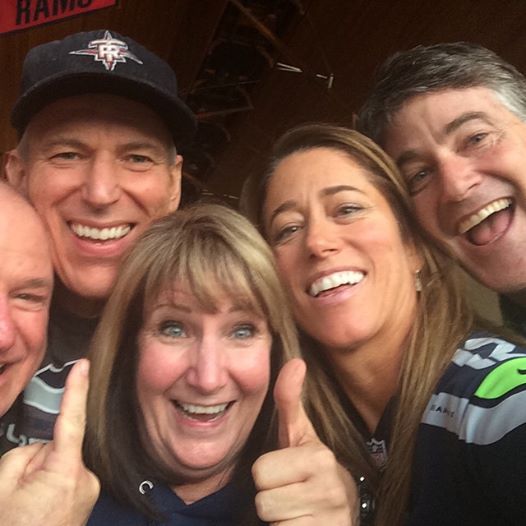
But while I hadn’t been with Al, Sreejit or friends in those moments, I was definitely not alone. I was with Al and Sreejit via media and had had Seahawks fans all around me. I had felt connected and a part of all the excitement. It was just in a different way than I had expected.
I feel thankful for all that I experienced. As I reviewed the day in writing this post, I saw that I had an opportunity to work on the following lessons:
So what will the name of this post be? I will go with “Lessons are for Learning.” And while I know it is important to never say never, I think it is safe to say I will never intentionally leave a Seahawks game less than four minutes before it is over, no matter how far behind they are!
A friend just sent me this five minute video. I hope you find it as inspiring as I did!
Each year, I spend six weeks in Amma’s ashram in South Kerala, India. Amma (Mata Amritanandamayi), who is sometimes referred to as The Hugging Saint since she has hugged 33 million people worldwide, is also known for her extensive networks of humanitarian projects called Embracing the World.
My last trip to Amritapuri was from November 30, 2014 to January 9, 2015. For the first time, I shared my experiences there through this blog. Afterwards, numerous people told me that the posts made them feel like they were taking the journey with me.
I decided to create this index of posts in case anyone else wants to accompany me vicariously on that journey. Enjoy!
When discussing the importance of brevity and simplicity of speech when one is trying to create inner silence, Muller provided information that I have recalled time and time again. He said:
Someone once noted that the Lord’s Prayer contained 56 words, the Twenty-third Psalm 118 words,and the entire Gettysburg address only 226 words– while the U.S. Department of Agriculture directive on pricing cabbage contained 15,629 words. One could easily conclude that we place a higher value on pricing cabbage than on liberty, prayer, or serenity.
From Legacy of the Heart: The Spiritual Advantages of a Painful Childhood by Wayne Muller, Simon and Schuster, 1992, page 104-105.
I suspect all of us prefer living from a sense of abundance rather than scarcity. Moving from scarcity to abundance, however, requires that we change our unhealthy beliefs and behaviors, many of which have probably become habits.
Over the years, some of my clients have found it helpful to make the abundance contracts that I describe in this post. Each contract is based on principles I have learned in my personal and/or professional journey. Continue reading “Creating Your World of Abundance”
The Art and Craft of Blogging
A collection of discussions on the environmental issues
“The fool doth think he is wise, but the wise man knows himself to be a fool.” “Love all, trust a few, do wrong to none.” “Love looks not with the eyes, but with the mind, And therefore is winged Cupid painted blind.”-William Shakespeare
...moments of unexpected clarity
Home of Lukas Kondraciuk Photography
Wellness, Support and Mindset
Thoughts on Creativity & Deeper Things
A Blog by Novella Carpenter
Ramblings of an Irish ecologist and gardener
Teaching the art of composition for photography.
Blog from SathyaSaiMemories ~ stories of love in action and the benefits of giving
There are 11,507 stories in Haddonfield; this is one of them.
Perennial gardening and more from the Green Mountains of Vermont
Whatever it will be...
Welcome to my little slice of the blogosphere
 Living, Learning and Letting Go