The Dungeon Prompt Sreejit gave us for this week was to “take some time and think about the one thing that you’ve learned which you would most like to pass on to future generations.” I gave myself several days to simply be with the instructions, knowing that the answer would “come” if I allowed myself to be quiet. And come it did! While I am far from having learned this lesson, I have come a long way down the path, and know I will go a lot further before I pass from this world. The lesson that is most important for me to learn and pass on is to quiet my over-active mind.
I have always been an introvert, and probably always will be. In addition, I lived in the era of “Children are to be seen and not heard.” In our home, the most common form of punishment was to be sent to our room. I spent a lot of time in my room. Did a lot of pouting there in fact.
I think my patterns of over-thinking have their roots in those early years. By the time I was in my thirties, I spent so much time immersed in my thoughts. When I was with a group of friends, or in a class, I analyzed everything I wanted to contribute to the conversation. By the time I had the perfect words figured out, the conversation would have moved past the point where speaking the words would have purpose. When I did manage to get them out, I would then spend an inordinate amount of time afterwards reviewing what I had said. Had I said what I wanted to say correctly? Had I made a fool out of myself?
That problem was probably at its height at the time I started my personal therapy process in the mid-eighties. I remember feeling like my mind was a computer that was about to explode. At one point, my therapist told me if I didn’t stop, I was going to end up in the hospital. He told me to pay complete attention to every moment. For example, when I was going to eat to say in my mind, “I am picking up my fork, I am putting the food on my fork, I am lifting the fork to my mouth, I am putting my fork down, I am chewing my food, I am swallowing my food, etc.” When I followed his instructions, my mind slowed down.
I met Amma in 1989. My mind was often very quiet when I sat near her, and I entered meditational realms that held so much deep peace and bliss. It was as if a door had opened for me and I could see what was possible. When I was away from her though, I would go back to many of my old thought patterns.
At that time in my life, I felt a strong desire to live in an ashram (monastery), even though I knew that it was not the appropriate time for me to do that. Whenever I thought about living in an ashram, I would feel so much grief that I couldn’t stop crying. Sometime in the early 90’s, I took this problem to Amma. Her immediate response was “Stop Thinking!” I now realize in those two simple words, she had given me a direction that could change my whole life.
Simple to say, but not simple to do. I have come a long way in that endeavor, but if I am in my “stuff,” over-thinking is still likely to be the cause of it. I make myself so miserable in that way.
I know that a silent mind is where intuition, insight, and inspiration reside. I also know that the road to a silent mind is by doing the spiritual practices I have been taught, such as japa (mantra repetition), chanting spiritual texts such as the Sri Lalita Sahasranama, singing bhajans (devotional singing), and mindfulness. Processes such as meditation and yoga also help.
So what is preventing me from doing those practices consistently, what is my resistance? I have no doubt that the resistance is fueled to my over-doing. As long as I fill my life with doing things that do not support my goal of having a quiet mind, I will not have it.
While I still am over-doing, I am much more likely to say no to things that I don’t want to do. I have a harder time saying no to activities that give me pleasure. However, some of those activities, such as studying Sanskrit and writing for my blog, are part of the path to a quiet mind. I am most successful in those undertakings when I do them in a way that is meditative.
Like most big changes, learning to quiet the mind takes time. I have the opportunity to make choices between doing and being many times each day. As I experience the benefits that come with a still mind, I am more likely to make choices that will promote it. I am progressing on the path, and that is what is important.
Today, I saw a cartoon on Counseling TidBits that I loved. I asked Jane A Weiss, LCSW for permission to post it on my blog and she said “Yes.” Thank you Jane!
Over the years I have learned many sayings and acronyms relating to fear. I have found them to be useful tools in my own life journey and have also used them with clients in my psychotherapy practice. Here are the ones that come to mind at the moment:
Feel the Fear and Do It Anyway.
Fear and excitement are two sides of the same coin.
We can see fear as:
False Evidence Appearing Real
Forget Everything And Run
or
Feeling Excited And Ready
Face Everything And Rise
Other important factors:
It is important to feel Fear when we are in danger. The emotion indicates that we need to take action. Fight or Flight might be necessary.
Most of our Fear however is Fear of the future. We often feel much more Fear of what might happen then we would feel if it did happen.
Fear may also mask another feeling. That usually happens because there were unacceptable and acceptable feelings in our families of origin. In my childhood home, feeling Fear was fine. Feeling anger was not. Therefore, I learned to feel Fear at times when I was actually angry. Once I saw this pattern, I realized it was important that I ask myself if I was angry anytime I felt Fear.
There is so much I could say on this topic but instead I am going to end with the video that Sreejit used at the beginning of the Dungeon Prompt that inspired this post. I find the video deeply moving. It also demonstrates many of the aspects of fear I have addressed.
During the last two months, I have been invited by two blogging sisters (SeasonedSistha2 and Tournesol Dans Un Jardin) to write ten four-word sentences about love. The form of the challenges were different, so I decided to do it my own way! Here are the sentences that came to my mind:
Love has many forms
Love through a smile
Love through a word
Love through a touch
Love through a look
Love heals painful wounds
Love leads to happiness
Love helps build communities
Love can transform evil
Love yourself, Love others
What four-word sentences about love would you like to add?
In this week’s Dungeon Prompt, Sreejit asks us to fill in the blank in this sentence: “I am a Recovering _________.” There was no doubt in my mind what the behavior would be for me. Using the Alcoholics Anonymous introduction, I will say: “Hi! I am Karuna, and I am a recovering over-doer.”
As I thought about how I would present this topic, I decided to create a new disorder. My fictitious disorder is called “Being versus Doing Disorder.”
The Being vs Doing disorder is on a continuum where the center, a balance between being and doing, is the healthy portion of the continuum. The more someone moves to either end of the continuum, the more likely it is they will have dysfunction in their lives.
When I think of the over-being end of the continuum I think of non-productivity, passivity, and lack of motivation. I don’t know as much about that part of the spectrum since I have almost no personal experience there. I have seen it at work in clients and friends though.
Over-doing has many facets. It commonly begins in childhood when the only or main way to get positive attention from parents is to do impressive things. It also develops when parents criticize their children anytime they are relaxing or are doing things the parents consider nonproductive.
As a result, adults with an over-doing disorder may be seeking validation and praise for what they accomplish. An over-doer is also likely to be a rescuer. As such, they do things they aren’t asked to do and are likely to do things they don’t want to do. In addition, they do more than their share of the work that needs to be done and do things for other people that they could do for themselves. Those with this “disorder’ are likely to over-commit and seem incapable of being still.
Over-doing has been a major characteristic of my adult life. At one point, I was raising two children, working three jobs, doing my personal therapy and in school studying for a PhD. During my therapy, I realized I didn’t want a PhD, I was just seeking attention from the father, who had disowned me. I stopped my schooling but was still overdoing. Before long, I began to experience extreme exhaustion and was diagnosed with Chronic Fatigue Syndrome (CFS).
With CFS, I was in survival mode and it was impossible for me to do as much as I had been doing, although I still tried to. When it began dissipating after five years, I went back to over doing. There is no doubt that a part of me believed it was only acceptable for me to stop if I was sick. Eventually I developed high blood pressure and other physical problems.
I reached a point where I had to cut back on all of my commitments. Nowadays, I am putting my emphasis on doing the things I want to do, and am saying no to many requests. I still have trouble with “simply being” but I no longer am into major over-doing. I hope some day I will be much closer to the center of the being-doing continuum.
I have realized a behavior that really fueled my over-doing disorder was the desire to be “in the know.” That puts me in the place of being asked for information that I don’t want to share, which then creates stress, whether I share it or not. As I continue to slow down, I am finding myself holder of less information. I am loving responding to requests with “I’m not in that loop anymore. You will have to ask someone else.”
I learned many skills during my over-doing years. Last week friends of mine were in a life and death crisis and I stepped in to help immediately. There is a time and place for those skills, but it takes discrimination to use them correctly. In that instance, I have no doubt that my choices were appropriate.
I am very committed to my recovery from over-doing. While I may find myself immersed in the old behaviors from time to time, I don’t think I will ever be drawn so deep into them again. I see what I am doing much sooner and and change course when needed.
In evaluating myself on the scale found in Portia Nelson’s Autobiography in 5 Short Chapters, I find I am in generally in Chapter 4 or 5.
Chapter IV
I walk down the same street.
There is a deep hole in the sidewalk.
I walk around it.
Chapter V
I walk down another street.
Every time I walk around an invitation to over-do or avoid putting myself in the situation where I know I am going to be tempted, I consider my choice worthy of celebration! I am truly movig towards a life of balance.
Do you have a “Being vs Doing” disorder? Where do you fall on the continuum? How does it disrupt your life? Do you consider yourself in recovery?
Today I was sent a quote that was attributed to Buddha. It said: “Buddha was asked, ‘What have you gained from meditation?’ He replied, ‘Nothing! But let me tell you what I have lost. Anger, Anxiety, Depression, Insecurity, Fear of Old Age and Death.” I loved the quote but decided to check it out. While it can be found all over the internet, it was listed under fake Buddha quotes.
An earlier version of the quote is found in the 1973 publication of World Buddhism, Volume 22 by the World Fellowship of Buddhists. It was not directly attributed to Buddha.
It may be stating the case too strongly to say that in meditation one seeks to gain nothing. For there is an increase in happiness and peace of mind. But when asked, “What have you gained from meditation?” the answer would be: “It is not what I have gained that is important but rather what I have diminished, namely, greed, hatred, and delusion.”
This morning, I walked while chanting the Sri Lalita Sahasranama. This is a sacred text that I ideally would be chanting daily. As I walked, I was pulled by the desire to be focusing on the beauty around me rather than reciting the chant. I have felt that pull many times before, but it was particularly strong today.
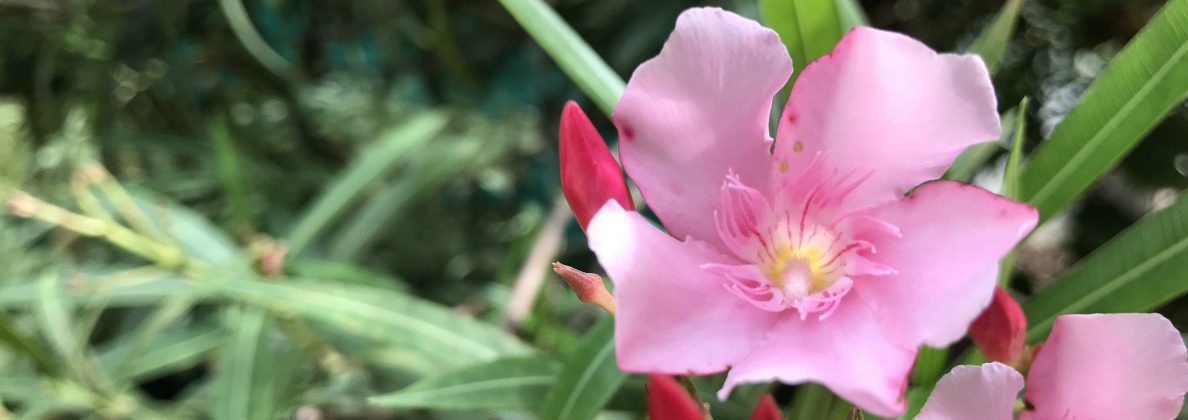
Then the question “Isn’t focusing on the beauty of Mother Nature a spiritual practice too?” came into my mind. Of course it is; about that I had no doubt. I realized what wanted to be doing was to immerse myself in nature, taking photographs to share on my blog and in the GreenFriends newsletter I organize monthly.
For the rest of my walk, I continued my chant, but if I felt called to stop and look at something and/or take a picture, I did. Sometimes I felt literally “called” in that it seemed like a song bird or crow was calling out to me.
I felt “rewarded” for being flexible in my definition of spiritual practice by capturing several beautiful photographs.
I suspect that tomorrow morning I will be going on a nature walk!
I was debating whether I would title this post “Lessons are for Learning” or “Look for the Good in Everything.” Both statements are true and they both fit the situation that I am about to describe. My thought was to use the first one that came to me, i.e. “Lessons are for Learning” but I decided instead to accept that “I Will Know When I Know.” I would decide on the title after I write the post!
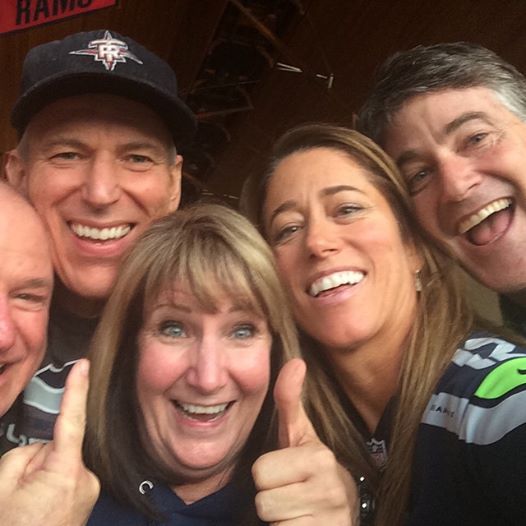
As many of you know, I had been really looking forward to last Sunday’s divisional championship game between the Seahawks and the Packers. I was planning to watch it with my ex-husband Al. Due to jet lag, I only slept two hours Saturday night and attended a Sanskrit class Sunday morning. The game was at noon so I was going from the class to Al’s, with no time for a nap.
A variety of things had happened that day that triggered me and being so exhausted I was not at my best, to say the least. To top it off, on the way to Al’s apartment, I realized that he lived so close to the stadium that there was no way in the world I was going to be able to find a parking place. By then I was in a really bad mood, especially since it was raining and I did not have an umbrella or an appropriate coat in the car.
After dropping food off at Al’s apartment, I drove to a light rail station located about 4 miles from the International District where he lives. I parked the car and boarded the train. As I was walking back to the apartment, after having disembarked from the train, I noticed the strangest sound. It was loud and it sounded a bit like freeway traffic, but that wasn’t right either. What was it? Could the sound be the crowd cheering in the stadium? Unbelievably, it was!
By the time I made it back to the apartment, my bad mood had shifted and I was eager to watch the game with him. As the Seahawks made error after error, however, my excitement withered.
I knew that taking the light rail home was going to be a very overwhelming experience. Tens of thousands of fans descending on that station when I was so exhausted would be incredibly difficult. Al and I agreed that if the game ever got to the point where it couldn’t be salvaged, I would leave. When the Seahawk’s pass was intercepted with less than four minutes on the game clock, and a score of Packers 19 – Seahawks 7, l decided that time had come.
I left feeling fine about my decision. When a few minutes later I had the opportunity to give money to a panhandler, which is something that has been difficult for me in the past (Judgment or Compassion), I was even more confident that my choice had been correct.
Seconds later, there was loud cheering from the stadium followed by fireworks. What was going on? Al called me and Whats App texts started flying between my son Sreejit, who lives in India, and me. The Seahawks had scored a touchdown!
Soon I reached the light rail tunnel. In less than a minute’s time, the Seahawks recovered an onside kick and scored another touchdown, followed by a two point conversion, the combination of which put them ahead by a field goal. (I can’t believe I’m saying all of this, and even have a bit of a clue what I am talking about. Me, who until last year had NO interest in football!)
The tunnel was filled with fans who, like me, had left early. They were following the game on their phones and when the news that we were winning came through, the whole place erupted with cheers. I felt so much a part of this community experience.
With 14 seconds left, the Packers kicked a field goal that tied the game and sent it into overtime. The game was still going on when I reached my station. The elevator that took me from the tunnel to the surface street was full of people who had left the stadium early. One man said “I’m not here. If anyone asks, I’m still at the game. What happens in this elevator stays in this elevator.” Everyone laughed, and once again I had an experience of community.
I walked to my car and listened to the game as I drove home. Between the time I got out of my car and the time I turned on the television, the Seahawks had scored yet another touchdown and we had won. We were going to the Super Bowl for the second year in a row! And instead of facing tens of thousands of people in the light rail station, I was already in the quiet of my home. All was well.
Over the next few days there were times when I felt sad that I had missed all the excitement, but at the same time I knew I hadn’t; I had just experienced it in a different form. And I watched the game highlights that day, and in the days that followed, so that I could actually see what had happened.
I felt a nick of sadness again when I received pictures from friends who had been together when the big moments came.
But while I hadn’t been with Al, Sreejit or friends in those moments, I was definitely not alone. I was with Al and Sreejit via media and had had Seahawks fans all around me. I had felt connected and a part of all the excitement. It was just in a different way than I had expected.
I feel thankful for all that I experienced. As I reviewed the day in writing this post, I saw that I had an opportunity to work on the following lessons:
Lessons are for Learning
Look for the good in all situations
Be here now
Be willing to let go of plans
Let go of expectations
Lighten Up
There are no accidents
Don’t overthink
Learn from my mistakes.
What I (or others) think are mistakes may not be
Community comes in many forms
I belong
Choices are not good or bad.
I can learn from any choice I make
I will know when I know
What is right for one person may not be right for everyone else
Be compassionate and kind with yourself and others.
Never say never
So what will the name of this post be? I will go with “Lessons are for Learning.” And while I know it is important to never say never, I think it is safe to say I will never intentionally leave a Seahawks game less than four minutes before it is over, no matter how far behind they are!
“The fool doth think he is wise, but the wise man knows himself to be a fool.” “Love all, trust a few, do wrong to none.” “Love looks not with the eyes, but with the mind, And therefore is winged Cupid painted blind.”-William Shakespeare








 Living, Learning and Letting Go